


PT Session Documentation begins with silence. The room hums, The clock ticks. You write, your pen chasing memory before it fades. Each line you record defends your care, your judgment, your license. But here’s the question. When CMS reads your note, will they see skill or guesswork?
You can treat a patient well and still fail on paper. That’s the cruel truth. A missing time log, a vague line, a copied paragraph, and your payment stalls. So how do you make your words work as hard as your hands? Let’s find out.
Understand The Purpose of PT Session Documentation?
You document because memory lies. Because it drifts, soft and unreliable, like breath on glass. Tomorrow, another therapist might take your place. They’ll read your words, hunting for the thread you left behind. If they can’t find it, the patient loses more than progress. They lose trust. And CMS does not take your word for it. They want proof. They want time stamps, codes, signatures. They want reason behind motion, skill behind care.
PT Session Documentation is more than a record. It’s a confession of intent. Every line carries your judgment, your craft, your claim to competence. It’s the map of what happened and why it mattered. It speaks for you when you’re gone from the room. It explains why the pain eased, why the balance held, why the patient walked a little straighter today. It’s your echo, steady and certain, long after the day ends.
The AMA calls it defensible documentation. They mean a shield of words. Every detail another layer of armor. Every number another strike held back. Without it, your notes are ghosts, paper without soul, effort without proof. You can treat with skill and still lose everything to silence. So write as if someone is watching. Because someone always is. An auditor. A reviewer. Another therapist. Maybe even the patient, reading what you wrote about their fight to move again. Your notes are your legacy. Sharp. Honest. Alive.
Capture Key Elements of Each Session
The patient walks in. You treat. You write. But what do you record? Each visit is a small battle, accuracy against time. The hum of the clinic fades into background noise. The clock ticks louder than breath. You know every word matters, every number must hold truth. A note is not a memory. It is evidence. And evidence demands detail.
Each note must show more than action; it must show intention. Every session should read like a map of what was done, why it was done, and how it changed the patient. The story of progress begins here, in small sentences that build trust and compliance at the same time. Here’s what belongs on every page:
- Date of service and total time. Time is the spine of the note. Record it exactly. The moment treatment starts, the clock begins its quiet test. CMS auditors read those minutes like law. Miss one, and the whole code can collapse. Clinics that prioritize Accurate time tracking in physical therapy protect themselves from billing disputes and ensure every CPT code reflects the real treatment time provided.
- Performed CPT codes such as 97110, 97140, or 97530. These numbers are not just billing tags. They are proof of your skill, each one linked to a specific intervention. They tell payers that your work had structure and purpose.
- Patient’s progress and response. This is where your voice matters. Describe what changed, what improved, what still limits them. Show that you were watching, adjusting, thinking. Accurate PT Documentation lives here, between observation and outcome.
- Therapist’s signature and credentials. The signature seals the note. It says, “I was here. I did this. I take responsibility.” Without it, even the best note turns meaningless.
Simple? Sure. But skip one, and the whole thing unravels. CMS Physical Therapy Documentation Requirements say timing must match billing. Get it wrong, and your 8-minute rule compliance disappears. You know the phrase, “If it’s not written, it didn’t happen.” That’s not advice. It’s survival. So set the timer. Note the minutes. Don’t trust your memory. It forgets faster than you think.
Document Functional Progress Instead of Just Activity
The muscles move. The clock runs. You write, “Therapeutic exercise, 30 minutes.” And nothing happens. That line sits flat, empty as air. It tells no story, offers no proof. It could belong to anyone, any day, any patient. But CMS does not care for effort. They care for evidence. They want to see progress etched into your words. They want outcomes they can measure, not just motion you can recall.
A note must breathe life into the work you did. It must show what changed, even in the smallest way. Was the balance steadier today? Did the gait smooth out, the reach grow longer, the pain fade sooner? Write that. That is the difference between movement and meaning. A sentence like “Patient performed hip abduction, improving range of motion from 30° to 45°” speaks louder than thirty lines of filler. It proves thought, observation, intent. It shows the therapy worked, not that it simply happened.
This is Accurate PT Documentation. Not ornate words, not long descriptions, but truth written with precision. Each number is a heartbeat. Each metric, a trace of progress. Your notes should move like your patient, slow, deliberate, stronger with every session. That is what Physical Therapy Progress Notes are meant to capture. Not minutes. Not motions. Transformation.
| Weak Example | Strong Example |
|---|---|
| “Therapeutic exercises performed for 30 minutes.” | “Patient performed hip abduction, improving range of motion from 30° to 45°.” |
`
That’s Accurate PT Documentation, not more words but better ones. Physical Therapy Progress Notes must show change, not repetition. Every movement is a data point. Every improvement is evidence. And evidence, not emotion, keeps your notes compliant.
How Do You Align Documentation with Medical Necessity?
Why this patient? Why this treatment? Those questions follow you into every room. You feel them even when the day runs long. CMS feels them too. They sit at the edge of every note, every claim, waiting for an answer. Medical Necessity Documentation PT is not paperwork. It is proof.
It says this patient needed you, not a machine, not a printout, not an exercise sheet from the internet. Only skill could draw that change, only knowledge could keep them safe while you pushed them forward.
Write about function. Always function. Motion means nothing if it leads nowhere. “Patient climbed stairs to reach second-floor bedroom safely” breathes life. It shows reason, risk, and reward. “Patient did step-ups” is a hollow note, a whisper no one hears. Your Plan of Care (POC) should echo every note you write. It must sound like you. Same goals, same measures, same rhythm of progress. When it breaks that rhythm, everything shakes.
APTA warns of that silence. When goals and outcomes fall out of step, auditors see it first. They see a fracture, a crack in your defense. They see care without clarity. So forge your words carefully. Link findings, goals, and outcomes like links in armor. Tight. Unyielding. Strong enough to take a blow. Each line protects the next. Each detail guards your name. Because one gap, one careless phrase, and the armor splits. Write like a craftsman. Write like it matters. Because it does.
Avoid Common PT Session Documentation Errors
This one’s a classic confusion point. Both codes deal with movement, but they describe different types of therapy. Many clinicians mix them up because they often appear side by side in a treatment plan. But the intent behind each code is different, and getting it wrong can mean denials or compliance issues.
Let’s compare.
| Code | Focus | Core Purpose | Example |
|---|---|---|---|
| 97110 | Exercise for strength or ROM | Improve muscle performance | Shoulder strengthening post-surgery |
| 97530 | Functional activity | Improve ability to perform real tasks | Lifting, reaching, or stepping tasks |
The clinic quiets. You sit, cursor blinking, time slipping away. The work was good today. You know it. The patient knows it. But one wrong line, one lazy word, can undo all of it. The worst mistakes aren’t loud. They creep.
A copy-paste that saves a minute. A timer left blank. A sentence written without thinking. You don’t notice them until the denial lands, cold and certain. That’s how claims die. Not from failure, but from fatigue. Each note carries your pattern, your habits, your care. CMS reads them like a pulse. When the rhythm falters, they see it. When errors repeat, they call it risk. When the risk grows, they call it noncompliance.
</tableEach mistake chips away at trust. One by one. The note becomes thin. The story breaks. You can feel it when you read it back, the hesitation, the hollow tone. That’s what CMS hears too. They call it pattern risk, but you know it by another name. Distraction. Exhaustion. Habit. So ask yourself now, before anyone else does.If this note stood before an auditor, would it hold? Would it sound like the truth you meant to tell, or like something you wrote to survive the day? Write like it matters. Because it does. Write like someone is listening. Because someone always is. And when the pen slows, when the fatigue sets in, remember, every note is your name in ink.How do you Leverage EHR Tools And Templates Wisely?Technology helps. Until it doesn’t. The screen glows, patient names lined like soldiers. Templates wait, neat, blank, perfect. Too perfect. You click. The boxes fill themselves. The note writes itself. And somewhere between the dropdowns and the auto-text, your voice disappears. Physical Therapy Daily Notes should sound like a living thing. They should move, breathe, remember. They should carry the small truths of the session: the flinch before motion, the sigh of relief after it, the shift from pain to progress. But templates flatten that. They trade life for speed.CMS reviewers can tell. They know the rhythm of copied notes. They’ve seen the same sentences echo from clinic to clinic. Each one identical, sterile, hollow. They read a note and know there was no thought behind it. Good EHR systems are tools, not ghosts pretending to speak for you. They can sharpen your process, never your intent. They help with:
- Dropdown CPT selections that keep PT Treatment Notes Compliance clean.
- Timers that protect Time-Based CPT Documentation accuracy.
- Built-in tracking that strengthens Physical Therapy Progress Notes.
Helpful, yes. But tools only work when the craftsman still holds them. You are the one who gives meaning to the data. The system only records it. A note built entirely by automation has no pulse. It doesn’t remember the sound of effort or the weight of progress. It only repeats. So use the tools, but don’t surrender to them. Let the software serve you, not shape you. Write what happened. What mattered. What changed. Let the note sound like you were there. Because you were.Conduct Routine Documentation AuditsAudits. The word alone tightens your chest. But what if they didn’t? What if you were ready? Do your own checks first. Physical Therapy Audit Preparation starts in-house. Review your notes weekly. Use a PT Documentation Checklist that tracks: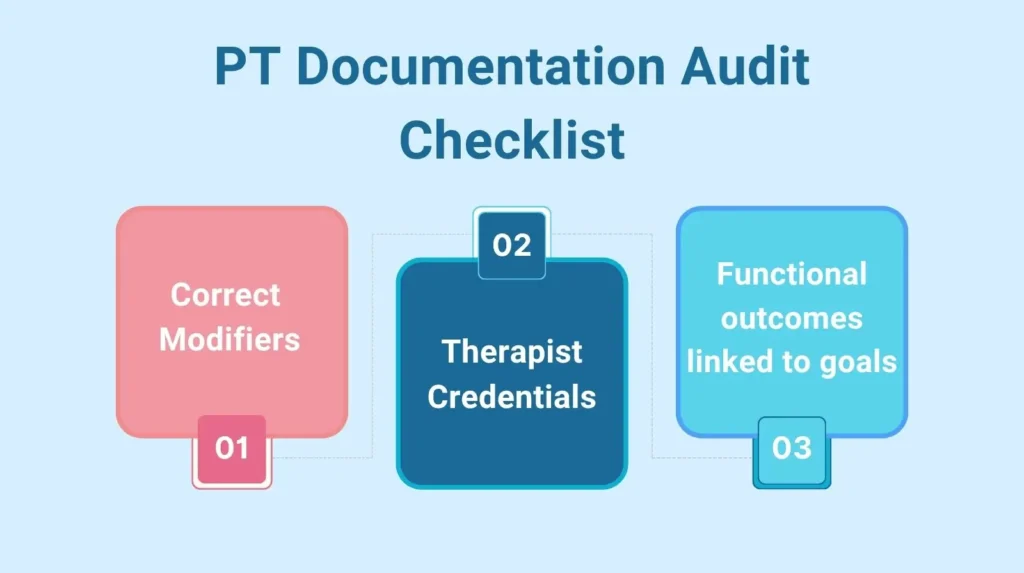 CMS data tells its own tale. Clinics that self-audit each quarter cut denials by nearly thirty percent. That isn’t luck. It’s discipline carved into habit. An audit isn’t an enemy. It’s a mirror.
Cold. Honest. Relentless. It reflects what you missed, what you forgot, what you thought no one would notice. Most look away. You shouldn’t. Look closer. The mirror isn’t here to shame you. It’s here to sharpen you. It shows the lines that falter, the codes that drift, the PT Session Documentation that starts to lose its shape. It catches the small cracks before they turn to fractures. The wrong time logged. The missing modifier. The goal that no longer matches the Plan of Care.This is what CMS sees when they read your notes, and now you see it too. That’s how you win. Self-auditing is not punishment. It’s protection. It’s the quiet armor you build for yourself, one correction at a time. Do it often. Do it before anyone asks. Not out of fear, but pride. You’re not chasing perfection. You’re claiming control. Every clean note, every corrected detail, another strike in your favor. So face the mirror. Hold its gaze. And when you walk away, make sure your work can stand without you.What is The Best Way to Educate and Train Staff Regularly?Rules shift. Guidelines bend. What worked yesterday might fail tomorrow. People forget. Habits fade. Mistakes return like ghosts that never left. There’s only one cure. Training. The clinic must breathe learning. Not once a year, not when audits loom, but always. Short sessions. Quick. Focused. One topic at a time. Maybe Physical Therapy Documentation Tips. Maybe the new CPT codes. Maybe the latest CMS change that rewrites everything again.Bring real notes. The good and the flawed. Lay them bare. Read them aloud. Find what rings true and what doesn’t. Fix them together until the habit takes root. That’s how accuracy stops being a task and becomes instinct. The APTA calls for yearly reviews. That’s the floor, not the ceiling. The wise go further. They build rhythm. They turn consistency into muscle memory. They make documentation a reflex, not a chore. Ask your team softly, “Would this note survive an audit?” If the silence stays too long, you already have your answer. So train again. Not for rules. For pride. For the craft that keeps your care alive.How Pro-MBS Supports PT Clinics?Paper. Always more paper. Notes waiting. Claims returning. Audits circling like hawks.
You finish one chart, another appears. You treat, you write, you fix, you chase. And still it feels like losing time to a system that never sleeps. Even good therapists drown in it. Every payer wants proof. Every code wants perfection. You heal with your hands, yet your worth is judged by what’s written. That’s the ache no one talks about. The quiet exhaustion that comes when care turns into compliance.Then there’s Pro-MBS. They walk into the noise and clear the clutter. They read what others miss. They catch the gaps before CMS does. Their team sharpens your PT Session Documentation until it speaks with confidence, until each note stands on its own. They train your staff to write with precision, to code with care. They turn your process into armor, cleaner notes, stronger compliance, faster payments. You focus on the work that matters most. They guard the words that protect it.
Get a Free PT Billing Audit
Frequently Asked QuestionsWhat are the 5 C’s of documentation?Clarity. Completeness. Conciseness. Correctness. Consistency. The five pillars of PT Session Documentation. Miss one and the note cracks. Miss two and the claim collapses. Every word must stand like stone. Exact. Deliberate. Unshakable. Pro-MBS trains you to write with all five. Every line proof. Every sentence armor.How to improve physical therapy documentation?Strip the noise. Keep the truth. Strong PT Session Documentation starts with attention to time, to progress, to proof. Do not write to remember. Write to defend. Each word must earn its place. Each number must hold meaning. Pro-MBS sharpens that discipline until precision becomes instinct.How to document therapy notes?Write what you saw. Not what you meant. Each PT Session Documentation must carry time, code, and change. No decoration. No guessing. Your note is a witness, not a diary. Pro-MBS teaches you to write like it will be read by auditors, by payers, by truth itself.What are the 7 criteria for high-quality clinical documentation?Accuracy. Legibility. Timeliness. Objectivity. Consistency. Completeness. Compliance. Seven blades of PT Session Documentation. Blunt one, and the rest dull fast. Auditors can feel weakness. They cut where the rhythm breaks. Pro-MBS forges your notes until every stroke lands clean.What are red flags in therapists?Copied notes. Missing minutes. Goals that never move. They look harmless until the audit begins. Weak PT Session Documentation always leaves tracks, patterns that repeat, words that lie. Pro-MBS hunts those cracks before CMS does. Silence becomes compliance. Repetition ends.What are some common mistakes in therapy notes?Copy-paste. Empty phrases. Time guessed, not logged. Each one kills trust faster than denial codes. PT Session Documentation fails when notes stop sounding human. Pro-MBS breaks that pattern. Every line rewritten. Every note rebuilt with purpose and proof.What are the 5 quality guidelines for documentation?Be accurate. Be measurable. Be defensible. Be relevant. Be whole. These are not tips. They are orders. PT Session Documentation that follows them survives every review. Pro-MBS turns them from checklist to reflex. Notes that hold. Notes that pay.How to document therapy session?Write like the room still breathes. Describe what changed, motion, strength, pain, purpose. Every PT Session Documentation must sound alive. No echoes. No copies. Pro-MBS teaches you to write with clarity so your words move like your work. Exact. Deliberate. Undeniable.
| Error | Why It’s Dangerous | Fix |
|---|---|---|
| Copy-paste notes | Looks cloned, lacks clinical reasoning | Write unique notes for each visit |
| Missing time logs | Breaks Time-Based CPT Documentation rules | Record exact minutes, not estimates |
| Inconsistent goals | Fails medical necessity checks | Align with POC every session |
| Unclear abbreviations | Confuses reviewers | Use approved medical terms only |