


CPT Code 99214 creates payment friction before denial risk ever appears. The claim clears edits, passes acceptance, and then stops moving.
Why does this keep happening when nothing looks wrong? Because payers do not treat this code as routine office billing.
They see it as moderate risk revenue that deserves a second look. That single view slows money without sending warnings. Billing teams feel it later, inside aging reports and cash gaps.
This breakdown explains payer behavior in plain billing terms. No coding lessons. No clinical talk. Just how and why payment stalls actually happen.
Quick Answer :
Why do payers slow payment on CPT Code 99214 so often? Because the code pays more and carries higher audit exposure. Payers expect stronger proof of decision-making depth. Many claims move into manual or semi-manual review queues. This happens even when claims are clean and accepted.
Why Is CPT Code 99214 Considered High Risk by Payers?
Why does CPT Code 99214 trigger more review than nearby levels? Because it sits at a financial tipping point for payers. It costs more than lower E and M codes. It also carries a long audit history.
From a payer view, several signals raise concern fast. Moderate decision-making is harder to prove at scale. RVU values jump compared to lower visit levels. Misuse patterns exist across many specialties. Past audits have reinforced caution over time.
Payers are not judging providers. They are controlling risk.
How Do Payers Flag CPT Code 99214 Claims?
How do payers decide which CPT Code 99214 claims slow down? They rarely focus on one encounter. They focus on patterns.
Utilization is compared across providers in the same specialty. Frequency is measured against peer averages. Sudden shifts from lower visit levels raise questions. Past claim behavior affects future routing.
No software name matters here. The logic stays simple. Outliers get attention.
Why Do Clean CPT Code 99214 Claims Go Unpaid?
What is the biggest billing myth around CPT Code 99214? That clean claims should pay fast. Acceptance only means the claim passed format checks. Adjudication comes later. Often much later.
Payers place claims into pending status quietly. No denial appears. No letter arrives. Time just passes. This is why teams ask the same question each month. Why was nothing denied, yet nothing paid?
What Documentation Slows CPT Code 99214 Payments?
What documentation patterns concern payers most? Not clinical care, but consistency.
Weak decision-making narratives slow review. Risk may feel implied instead of stated. Repeated use across many visits stands out. Templates that look too similar raise flags.
Payers review documentation at scale. Patterns matter more than paragraphs.
How Does CPT Code 99214 Increase AR Days?
How does CPT Code 99214 stretch AR without denials? Through delay, not rejection.
Medical review holds stop payment quietly. Soft edits extend processing time. Balances slide into older buckets. Thirty days become sixty. Sixty becomes ninety. AR teams often notice too late. Cash flow already feels the hit.
What Payer Reviews Are Triggered by CPT Code 99214?
What review cycles involve CPT Code 99214 most often? Many align with guidance styles from Centers for Medicare & Medicaid Services.
Review thresholds and pre-payment controls follow patterns outlined in CMS E/M risk guidance and utilization monitoring principles referenced by the American Medical Association.
- Pre-payment reviews delay release before money posts.
- Post-payment reviews increase future recoupment risk.
- Both models stretch financial certainty.
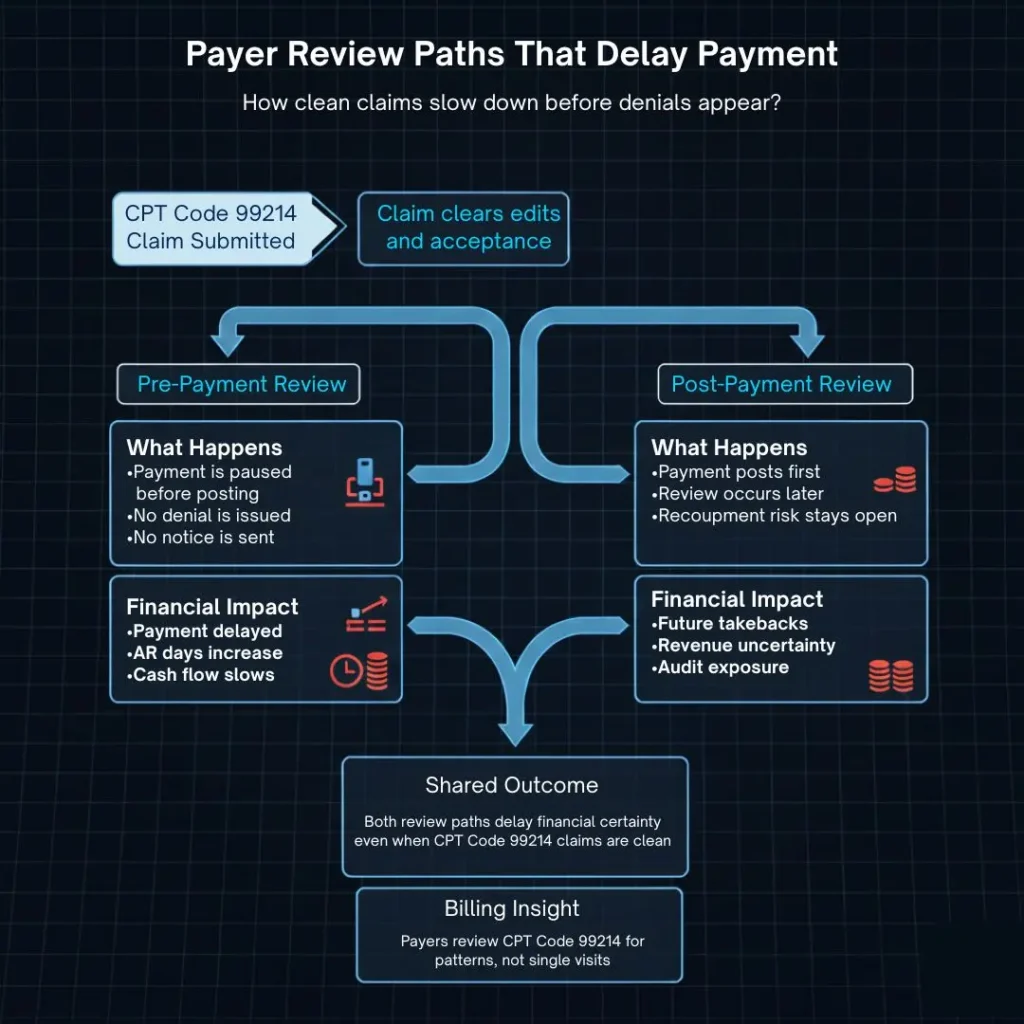
Timing depends on payer tolerance and history. Impact stays the same.
How Can Billing Teams Reduce CPT Code 99214 Delays?
What is the best way to reduce stalls without changing rules? Control patterns before payers do.
Billing teams that stabilize payment focus on:
- Provider-level frequency monitoring
- Consistent visit leveling and documentation alignment
- Adjusted AR follow-up timing based on review patterns
Small controls create real stability.
When Do CPT Code 99214 Delays Turn Into Denials?
How long can CPT Code 99214 claims sit before risk rises? Longer than most teams expect.
Extended holds may trigger record requests. Unanswered reviews increase denial odds. Post-payment audits raise recoupment exposure.
Guidance principles often mirror positions from American Medical Association. Early action protects both revenue and compliance.
How Can Pro-MBS Control CPT Code 99214 Payment Delays?
What happens when payer behavior becomes predictable?
AR stabilizes and forecasting improves. Cash flow stops swinging month to month. Pro-MBS helps organizations track CPT Code 99214 payer patterns early.
We align documentation and utilization signals with real review behavior. That reduces surprise holds and shortens AR cycles.
Our focus stays on control, consistency, and reduced AR shock. Schedule a CPT Code 99214 AR review with Pro-MBS.
Stabilize CPT Code 99214 Cash Flow
Frequently Asked Questions
Why do payers delay CPT Code 99214 payments even when claims are clean?
CPT Code 99214 pays more than nearby visit levels. That alone raises payer review risk. Clean claims still enter manual review queues. Payment stalls without warning. Pro-MBS helps reduce these silent holds early.
Is CPT Code 99214 considered high risk by payers?
Yes, CPT Code 99214 sits in a higher risk bucket. It has a long audit history across payers. Utilization patterns matter more than single visits. Outliers get slowed first. Pro-MBS tracks these patterns before AR ages.
Why do clean CPT Code 99214 claims go unpaid for weeks?
Accepted does not mean paid. CPT Code 99214 claims often sit in pending status. No denial appears. No request arrives. Pro-MBS flags these delays before cash flow slips.
What documentation issues slow CPT Code 99214 payments?
Payers look for consistency, not long notes. Weak decision-making signals slow CPT Code 99214 reviews. Repeated templates raise flags. Overuse patterns stand out fast. Pro-MBS aligns documentation signals to review behavior.
How does CPT Code 99214 increase AR days?
CPT Code 99214 stretches AR through delay, not denial. Medical review holds pause payment quietly. Thirty days become sixty. Sixty becomes ninety. Pro-MBS shortens AR cycles by acting early.
When do CPT Code 99214 delays turn into denials?
Long holds increase risk over time. Unanswered reviews raise denial odds. Post-payment audits add recoupment risk. Early action matters. Pro-MBS stops delays before denials begin.
How can Pro-MBS help with CPT Code 99214 payment delays?
Pro-MBS tracks CPT Code 99214 payer review patterns. We control utilization signals before AR ages. Denial management protects stalled revenue. Coding support improves consistency. Schedule a CPT Code 99214 review with Pro-MBS.