


Medical Coding decides how much a medical practice gets paid. When coding is wrong, money is lost fast. Many providers never see where the loss starts.
It hides inside charts, notes, and small coding choices. Wrong codes cause denied claims and slow payments. They also raise the risk of audits. That risk can grow without warning.
Coding is no longer simple work. It now controls payment and safety at the same time. When coding is strong, revenue stays steady. When coding fails, problems stack up fast.
Pro-MBS helps providers code the right way from the start. The goal is clear and simple. Get paid right and lower risk before claims go out.
Medical Coding is the process of converting patient care into standardized diagnosis and procedure codes used by insurance companies to determine reimbursement.
What Is Medical Coding and Why Does It Affect Revenue?
No code means no money. Doctors write notes after each visit. Coders turn those notes into number codes. Insurance companies read those codes to decide payment.
If a code is wrong, payment may stop. One small mistake can delay many claims. Over time, those delays add up to big losses. That is why coding matters every single day.
Medical Coding helps make sure codes match the care given. It checks that notes support each code used. This keeps claims moving and payments on time. Strong coding helps practices avoid stress and money loss.
What is Medical Coding?
Medical coding turns doctor notes into standard codes used by insurance plans to decide payment.
The American Medical Association (AMA) sets CPT coding rules used by providers across the country. These rules define how medical services must be coded for billing. The Centers for Medicare & Medicaid Services (CMS) sets Medicare coding and payment rules. These rules guide how claims are reviewed and paid by many insurance plans.
How Do Medical Coding Errors Create Audit Risk?
Coding errors happen when codes do not match the care written in the medical notes.
Coding mistakes do more than block payment. They can also bring audits. Errors often come from rushed work or unclear notes. Old rules also cause wrong code use. When payers see patterns, they ask questions. Those questions can turn into audits.
Audits may ask for money back. Some audits slow or stop future payments. This creates stress and loss for practices. Many teams miss these risks. They are busy and short on time.
Medical Coding helps catch errors before payers do. It reviews codes for patterns that raise red flags. This lowers the chance of audits and paybacks. Strong coding keeps practices safer every day.
Why do coding errors cause audits?
Audits happen when submitted medical codes do not align with documented clinical services or payer-specific billing rules.
How Do Medical Coding Services Support Billing?
Medical coding services help before billing starts. That early step matters the most. When codes are right first, billing works better later.
Coders read doctor notes line by line. They choose codes that match the care given. They also check that notes support each code used. This stops problems before claims are sent out.
Billing teams then send claims with fewer errors. They spend less time fixing mistakes. They spend more time tracking payments.
When coding is clean, billing runs smooth. Clean claims get paid faster. Good coding lowers denials. Lower denials mean faster cash flow and less stress.
Medical Coding helps billing teams work smarter and faster.
How Do Medical Coding Audits Stop Revenue Loss?
A Coding audit is a review of codes to confirm they are correct and supported by notes.
Finding problems early saves money. That is the main goal of audits. Audits help fix small issues before they grow. They protect payment and lower future risk. When audits are done right, practices stay safer and stronger.
Medical Coding uses audits to check work before payers do. This helps stop losses before they start.
What Coding Audits Check
Coding audits review codes against doctor notes. They check if the care listed matches the code used. Audits also look at payer rules for each service. They make sure required details are not missing. This step confirms claims are ready for payment.
Strong audits help prove care was real and needed.
What Audits Find
Audits find missing notes that weaken claims. They catch codes that are too high or too low. They also find repeat mistakes across many visits. These patterns often cause denials or audits later.
Finding these issues early protects revenue. It also builds better coding habits over time.
Why Early Audits Help
Early audits reduce paybacks from insurance plans. They lower the chance of payer reviews later. They help teams fix errors while claims are fresh. This saves time and stress for staff.
Medical Coding uses audits to keep payments steady. Strong audits help practices stay paid, safe, and confident every day.
In-House vs Outsourced Medical Coding: Which Is Better?
How a practice handles coding affects money, time, and stress. It also shapes how fast a practice can grow. When coding struggles, revenue suffers first. That pressure often falls on staff right away. Choosing the right coding model helps protect payments. It also helps teams stay focused and steady.
How a practice handles coding affects payment, risk, and staff workload. Some models offer speed but raise errors. Other models add checks but still miss problems. The right choice depends on accuracy needs and growth plans.
The comparison below shows how different Medical Coding models affect risk and accuracy.
| Option | What It Means | Risk |
|---|---|---|
| In house | Staff code alone | Higher errors |
| Mixed | Staff plus reviews | Medium risk |
| Outsourced | Full coding support | Lower risk |
Outsourced coding provides the lowest long-term risk by combining daily review, rule tracking, and dedicated expertise.
In-house coding often struggles as volume grows. Mixed models help, but still depend on busy staff. Outsourced Medical Coding offers the strongest control. It reduces errors, lowers audit risk, and supports steady growth.
In-house teams often handle many tasks at once. Coding becomes rushed when staff are short on time. Training can fall behind when rules change often. These gaps raise errors and denial risk.
Mixed models offer some support but still rely on busy staff. Reviews may happen too late to stop problems. Errors can still reach payers.
Outsourced coding brings full focus to coding work. Specialists review charts every day. They follow rule updates closely. This keeps accuracy steady as claim volume grows.
Strong coding support lowers stress and protects revenue. It also helps practices grow without adding risk.
Why Do Certified Coders Matter in Medical Coding?
Training protects revenue. Skill lowers mistakes. That is why certified coders matter so much. Certified billing and coding specialists study coding rules every year.
They stay updated when payers change what they want. They know how to read notes the right way. They spot small errors before claims go out. They fix gaps that cause denials later.
Over time, this lowers denial rates and payment delays. Strong Medical Coding relies on trained coders. Training builds trust with payers. Trust helps claims move faster.
Why Must Medical Coding and Billing Work Together?
Coding and billing are linked. One cannot work without the other. Coding decides what goes on the claim. Billing sends that claim and waits for payment.
If coding is wrong, billing must fix it later. That extra work takes time and costs money. It also slows cash flow for the practice. Staff spend hours fixing problems that could be avoided.
When coding and billing work as one, fewer errors happen. Claims go out clean the first time. Payments arrive faster and with fewer questions. This keeps income steady and stress lower.
Medical Coding helps connect coding and billing steps. Codes are checked before billing begins. Billing teams receive clean and ready claims. This reduces rework and staff burnout.
Pro-MBS aligns coding with billing every day. That teamwork keeps money moving on time.
How Does Pro-MBS Deliver Accurate Medical Coding?
Pro-MBS follows a clear and steady coding process. Accuracy always comes first. Every step is built to stop errors early. This helps protect payment and lower risk. Strong coding starts before a claim is ever sent.
Medical Coding Services from Pro-MBS focus on doing it right the first time. That saves time, money, and stress for providers.
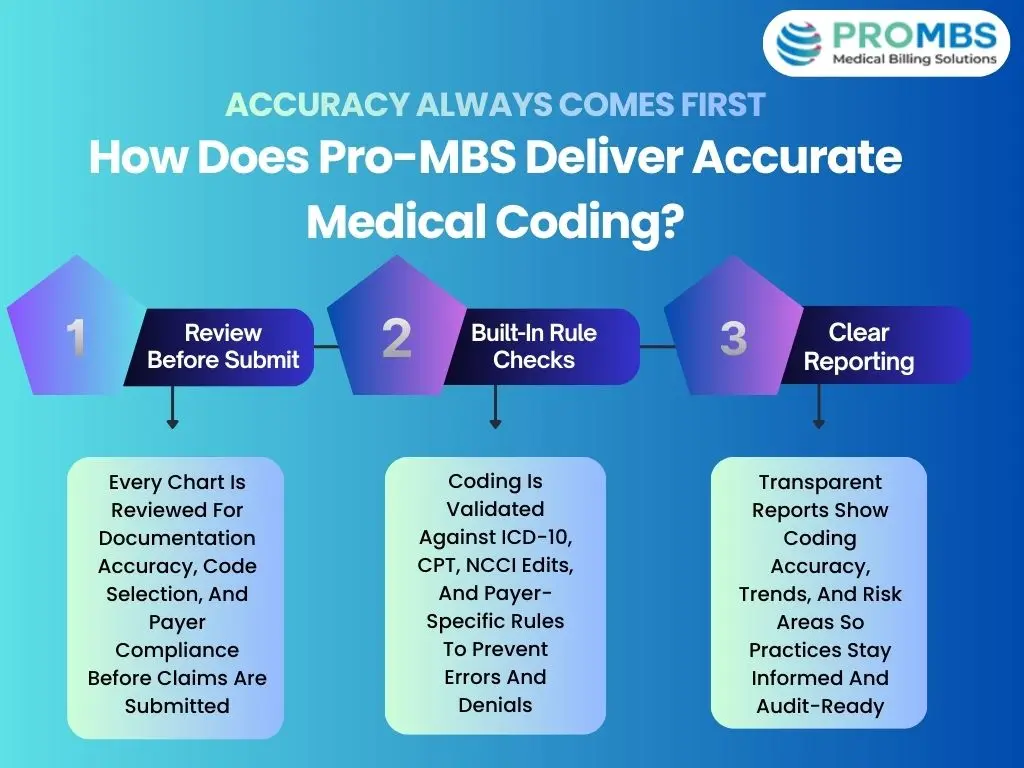
Review Before Submit
Charts are reviewed before claims leave the office. Coders read doctor notes with care. They check that each service is clearly written. Errors are fixed early, not after a denial happens. This helps stop delays and rework later.
Rule Checks
Codes are checked against payer rules. Each visit is matched to what the payer expects. This helps avoid missing or wrong codes. It also lowers the chance of payer questions. Rule checks help claims move through faster.
Clear Reporting
Results are tracked over time. Providers can see where issues start. Reports show trends, not just single errors. This helps teams improve and stay consistent. Clear reports build trust and control.
Strong coding keeps performance steady. It supports clean claims and on-time payments.
How Does Medical Coding Reduce Risk and Audits?
Risk control starts early. Fixing problems later costs more time and money. Small coding mistakes can turn into big issues if missed. That is why early review matters so much.
Pro-MBS looks for risk before claims are sent. Coding is checked with care. Notes are reviewed for missing or unclear details. This helps prove the care given was needed.
Patterns that raise payer questions are flagged early. These patterns often lead to audits if ignored. Denial trends are reviewed often. This shows where problems begin, not just where they end. Teams can then fix issues right away. Changes are made before payers step in. This lowers audit risk and payback requests.
Strong Medical Coding protects practices over time. It reduces fear, stress, and surprise reviews. It helps providers feel ready and in control every day.
Who Benefits Most From Medical Coding Services?
Every provider faces coding challenges. The size of the practice does not matter. Coding affects payment for everyone. When coding slips, revenue drops fast.
Solo providers benefit right away. They gain time to focus on patients. They spend less time on charts and claims. Stress drops when coding is handled correctly. Group practices see balance improve. Staff share work more evenly. Fewer errors mean fewer fixes later. This helps teams stay focused and calm.
Specialty clinics deal with harder rules. Coding services help match codes to care. This lowers denials and payer questions. Large groups need steady results across locations. Consistent coding keeps payments fair and even. Clear rules help every site perform the same way.
Medical Coding adjusts to each provider type. That flexibility protects revenue at every level.
When Should a Practice Outsource Medical Coding?
Warning signs appear early. Ignoring them costs money. Most practices feel the pain before they see the cause. High denial rates often point to coding problems. Claims may come back for small errors. Staff may fix the same issues again and again. This wastes time and slows payment.
Repeated payer changes signal rule gaps. Rules change often and are easy to miss. When teams fall behind, errors grow fast.
Slow payments despite full schedules show hidden issues. Care is given, but money does not arrive on time. This hurts cash flow and planning.
When these signs appear, help is needed. Outsourcing brings quick support and full focus. Specialists step in to review work right away. Problems are fixed before losses grow.
Strong Medical Coding steps in when systems fail. It restores order, protects revenue, and lowers stress.
When should a practice outsource Medical Coding?
Outsourcing is needed when errors, denials, or slow payments keep happening.
Why Do Providers Trust Pro-MBS for Medical Coding?
Trust comes from results, not promises. Providers trust Pro-MBS because the work speaks for itself. When coding is right, payments arrive on time. When issues appear, they are fixed early.
Pro-MBS focuses on protection first. Revenue safety always comes before speed. Experience across billing and coding helps spot risks early. Certified specialists handle coding with care and focus.
Clear reports show what is working and what is not. Providers can see trends and changes over time. There are no surprises or hidden issues. Providers always know where they stand.
The goal stays simple. Protect revenue and reduce risk through strong coding services.
Ready to Improve Medical Coding at Your Practice?
At Pro-MBS, we believe Medical Coding should help, not hurt. It should support care, not slow payment. When coding works, practices run smoother every day.
We deliver clear and accurate support. We check codes before claims go out. We review notes to make sure they fully support the care given. We fix errors early, not after a denial happens.
At Pro-MBS, we offer Billing and Coding Services, Revenue Cycle Management, and Denial Management. These services work together to protect revenue. Payments stay steady month after month. Risk stays low, and stress stays manageable.
We help teams spend less time fixing problems. They gain more time to care for patients. Work with Pro-MBS to strengthen your Medical Coding today.
Content reviewed by senior certified medical coders and billing specialists at Pro-MBS with experience across multi-specialty U.S. healthcare practices.
Frequently Asked Questions
What is medical coding in simple terms?
Medical coding means turning a doctor’s notes into standard codes that insurance companies understand. These codes tell insurers what care was given and how much to pay. If the codes are wrong or unclear, payment can be delayed or denied.
Why does medical coding affect how much a practice gets paid?
Medical coding affects payment because insurance companies base reimbursement on codes, not on written notes. Even if care was correct, the claim can be reduced or denied if the code does not match the visit. Accurate coding helps protect full payment.
How do coding errors lead to audits?
Committing errors while coding leads to audits when codes do not match the care written in the medical record. Insurance companies look for patterns of mistakes. If similar errors appear often, payers may review past claims and ask for money back.
How does medical coding help reduce claim denials?
Coding reduces denials by making sure each code matches the care provided and is supported by proper notes. When claims are coded correctly the first time, insurance companies process them faster and with fewer questions or rejections.
What is the difference between medical coding and medical billing?
Medical coding decides what goes on the claim, while medical billing sends the claim and follows up for payment. Coding comes first. If coding is wrong, billing teams must fix errors later. Strong coding makes billing faster and less stressful.
When should a practice outsource medical coding?
A practice should outsource coding when denials keep repeating, payments arrive late, or staff spend too much time fixing the same errors. Outsourcing helps bring focus, accuracy, and updated rules that busy internal teams may miss.
Why do providers choose Pro-MBS for medical coding services?
Providers choose Pro-MBS because coding is reviewed before claims are sent, errors are fixed early, and risks are identified ahead of audits. Clear reporting and experienced coders help practices stay paid, compliant, and confident month after month.