

Quick Reference: Hypomagnesemia ICD 10
The primary ICD-10-CM code for Hypomagnesemia (low blood magnesium levels) is: E83.42
Quick Breakdown
- Category: E83 (Disorders of mineral metabolism)
- Subcategory: E83.4 (Disorders of magnesium metabolism)
- Specific Code: E83.42 (Hypomagnesemia)
Key Considerations for Coding
When documenting or searching for this code, keep the following in mind:
- Underlying Cause: If the low magnesium is caused by a specific condition (like chronic alcoholism or malabsorption), you may need to code that primary condition first.
- Drug-Induced: If the condition is a side effect of a medication (such as long-term PPI use or diuretics), you should also use an additional T-code (T36-T50) to identify the drug, along with an encounter code (like T50.2X5A for adverse effect of diuretics).
- Related Conditions: If the patient also has low calcium or low potassium (common with magnesium deficiency), those require their own codes (E83.51 for hypocalcemia or E87.6 for hypokalemia).
Clinical Consistency
In a clinical setting, this code is typically applied when serum magnesium levels fall below the reference range—standardized in this guide as less than 1.7 mg/dL ($0.70text{ mmol/L}$), though specific thresholds can vary by laboratory and clinical presentation.
Introduction
In the intricate world of medical billing and clinical documentation, precision isn’t just a goal – it’s a requirement. Hypomagnesemia ICD 10, or low serum magnesium, is a frequent clinical finding that often goes underreported or incorrectly coded.
For healthcare providers and revenue cycle managers, understanding the specific ICD-10 nuances for magnesium deficiency is vital for patient care continuity and ensuring clean claim submissions.
What Is Hypomagnesemia ICD 10?
Hypomagnesemia is an electrolyte imbalance characterized by a serum magnesium level below the normal range (typically <1.46 mg/dL or 0.75 mmol/L). Magnesium plays a crucial role in over 300 enzyme systems, and its deficiency can have significant impacts on neuromuscular and cardiovascular health.
Symptoms and Causes
- Symptoms: Muscle cramps, tremors, seizures, cardiac arrhythmias (notably Torsade de Pointes), and hypocalcemia.
- Common Causes: Chronic alcoholism, malabsorption syndromes (like Celiac or Crohn’s disease), prolonged use of Proton Pump Inhibitors (PPIs), and diuretic therapy.
What Is the ICD-10 Code for Hypomagnesemia?
The correct ICD-10 code for hypomagnesemia is:
- E83.42 – Hypomagnesemia
While some coders mistakenly used nutritional deficiency codes (e.g., E63.8), the accurate code for diagnosed electrolyte imbalances is E83.42, located under the “Disorders of mineral metabolism” category.
Pro Tip:
Always verify whether hypomagnesemia is a primary diagnosis or secondary to another condition, such as chronic kidney disease, as this may require additional coding.
How Can We Enhance Clinical Specificity for Hypomagnesemia ICD 10?
In the evolving landscape of medical billing and coding, payers are now prioritizing management over just listing findings. Accurate documentation of the management strategies for hypomagnesemia not only improves patient care but also enhances coding accuracy, ultimately reducing claim denials.
Clarifying Lab Thresholds
In the Clinical Overview, the lab threshold for hypomagnesemia was mentioned as <1.46 mg/dL, while in the Practical Guide for Billers and Coders, it was noted as 1.8 mg/dL. To avoid confusion, it’s best to standardize this threshold across the article.
Most labs use 1.7 or 1.8 mg/dL as the lower limit for normal magnesium levels. Ensure that the documentation reflects the lab’s specific reference range, but for consistency, we recommend using 1.7 mg/dL as the threshold for hypomagnesemia.
Clarifying the Clinical Threshold for Hypomagnesemia ICD 10
In clinical practice, the standard threshold for hypomagnesemia is 1.7 mg/dL, which we’ve standardized for this guide. However, for even greater clinical specificity, it’s important to note that “Critical Values” for magnesium deficiency – those that typically require immediate reporting and often justify the use of IV magnesium therapy – are usually below 1.0 mg/dL.
This distinction is crucial for clinicians when determining the urgency of treatment and for billing purposes, as IV magnesium sulfate therapy may be reimbursed more effectively when documented as necessary for critical magnesium deficiencies.
Distinguishing E83.42 from E61.2
It’s important to distinguish between E83.42 and E61.2. While both codes refer to magnesium deficiency, E61.2 (Magnesium Deficiency) is used when the deficiency is due to nutritional causes without accompanying metabolic derangements.
On the other hand, E83.42 (Hypomagnesemia ICD 10) refers to the metabolic disorder of low magnesium levels that impact the neuromuscular and cardiovascular systems. Using the wrong code can trigger audit concerns, as payers are increasingly vigilant about these distinctions.
How Do 2026 Coding Trends Affect Hypomagnesemia ICD 10?
In 2026, the coding landscape places more emphasis on Medical Decision Making (MDM) and Social Determinants of Health (SDOH), both of which can directly affect coding accuracy and reimbursement.
2026 Update: Upstream Drivers and Nutrition Assessments
Starting January 1, 2026, the Center for Medicaid and Medicare Services (CMS) has transitioned the focus of HCPCS code G0136. Previously used for a general SDOH screening, it is now specifically designated for the Assessment of Physical Activity and Nutrition.
For patients with hypomagnesemia ICD 10 linked to poor diet (E61.2) or malabsorption, providers should perform and document a standardized nutrition assessment. This assessment not only supports the medical necessity of E83.42 – Hypomagnesemia but also enables billing of G0136, provided the assessment takes 5-15 minutes.
Medical Decision Making (MDM)
When documenting hypomagnesemia ICD 10, it’s no longer enough to simply list the diagnosis. For Evaluation and Management (E/M) codes, it’s essential to document the management decisions made during the patient encounter.
For instance, phrases like “Adjusted PPI dosage” or “Ordered IV Magnesium” provide clarity on the medical decision-making process and help determine the level of E/M services billed.
Social Determinants of Health (SDOH)
If hypomagnesemia ICD 10 is linked to food insecurity or lack of access to healthy nutrition, it’s important to include Z-codes (e.g., Z59.41 – Food Insecurity) to complete the clinical picture.
This reflects a growing CMS focus on addressing SDOH, ensuring a more holistic view of patient care. These codes are increasingly significant for care coordination and can influence reimbursement outcomes.
What’s New in the 2026 HCPCS Code for Hypomagnesemia ICD 10?
In 2026, the coding landscape places more emphasis on MDM and SDOH, both of which can directly affect coding accuracy and reimbursement.
The Big Change for 2026: HCPCS Code G0136
One of the most important updates for 2026 is the redefinition of HCPCS Code G0136, which was previously used for a general SDOH risk assessment. Starting in 2026, G0136 is now specifically designated for the “assessment of physical activity and nutrition.” This is directly relevant to hypomagnesemia, which is often linked to nutritional deficiencies.
Improvement for Nutritional Hypomagnesemia:
If hypomagnesemia is suspected to be nutritional in origin, healthcare providers can bill G0136 in addition to the E/M visit, provided they spend 5-15 minutes conducting a standardized nutrition assessment.
This billing option allows providers to address magnesium deficiency from a nutritional perspective, ensuring that both medical management and community health integration are captured and reimbursed appropriately.
What Are the Common Coding Mistakes for Hypomagnesemia ICD 10?
Inaccuracy leads to claim denials. Below are common pitfalls to avoid:
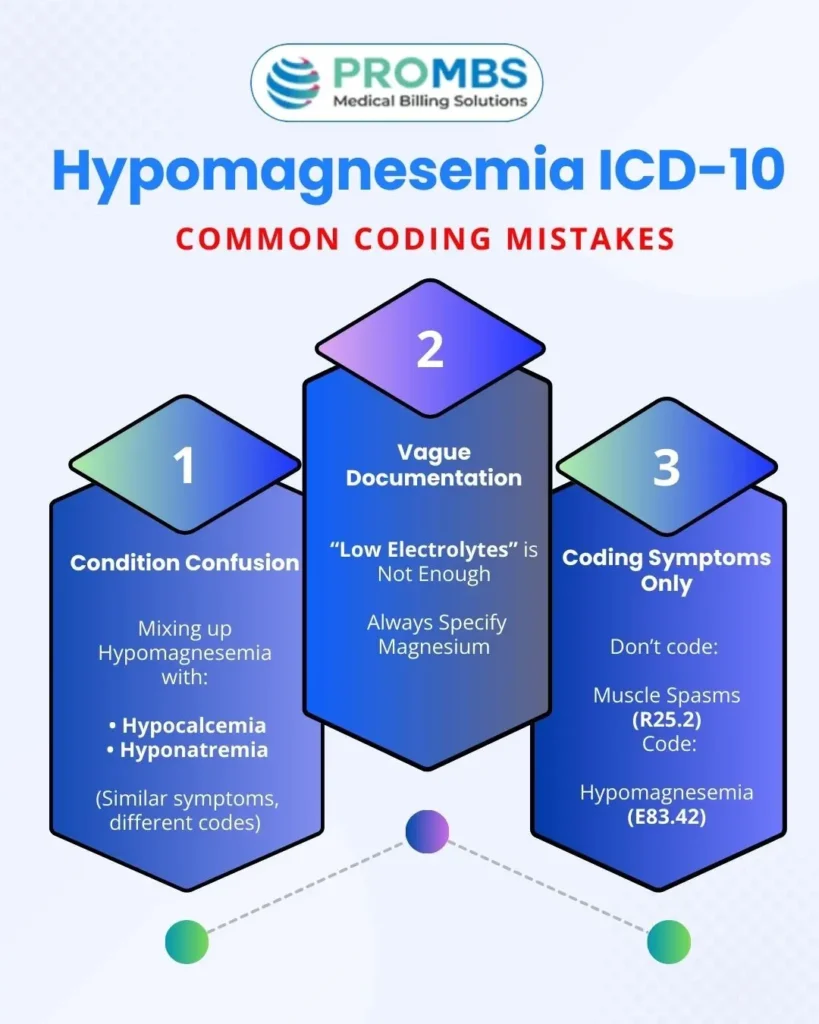
- Confusing with Other “Hypo” Conditions: Hypomagnesemia can be confused with hypocalcemia or hyponatremia due to overlapping symptoms.
- Vague Documentation: Simply writing “low electrolytes” without specifying magnesium can lead to inaccurate coding.
- Coding Symptoms Instead of Diagnosis: Avoid coding symptoms like “muscle spasms” (R25.2) instead of the underlying condition, hypomagnesemia (E83.42).
To avoid these errors, ensure the lab report (BMP/CMP with magnesium) matches the physician’s narrative before assigning the code.
Why Is Accurate Documentation Crucial for Hypomagnesemia ICD 10?
Accurate documentation serves as the “source of truth” for payers. If a patient is receiving IV magnesium sulfate, clinical notes must explicitly state “hypomagnesemia” to justify medical necessity.
Documentation Example:
- Weak: “Patient has low magnesium, started supplements.”
- Strong: “Patient presenting with muscle tremors and history of PPI use. Serum magnesium 1.1 mg/dL. Diagnosis: Acute hypomagnesemia. Plan: IV Magnesium Sulfate replacement.”
At-a-Glance Checklist:
Use this quick reference to ensure proper documentation and coding for hypomagnesemia:
Use this quick reference to ensure proper documentation and coding for hypomagnesemia:
- Is the serum Mg level documented?
Ensure that the patient’s serum magnesium level is clearly stated in the lab results.
- Did the provider link the lab to a diagnosis (not just “low Mg”)? Check that the provider has associated the magnesium deficiency with a clinical diagnosis (e.g., Acute hypomagnesemia) rather than a vague term like “low Mg.”
- Is there a treatment plan (oral vs. IV)? Verify that the treatment plan specifies the type of magnesium replacement (oral vs. IV), which is crucial for billing and medical decision-making.
Pro-Tip for Advanced Coders
When coding hypomagnesemia, be aware of the Excludes1 and Excludes2 notes in ICD-10. For instance, hypomagnesemia of the newborn (P74.3) is listed as an Excludes1 condition for E83.42, meaning both codes cannot be used together for the same patient. This is an important nuance that highlights the level of coding expertise required to ensure accuracy and avoid claim denials.
Billing, Reimbursement, and Compliance
The role of ICD-10 coding extends far beyond medical records; it is integral to the reimbursement process.
Impact on Revenue Cycle:
- Claim Acceptance: Payers use automated systems to cross-reference codes with treatments. If E83.42 is missing but magnesium therapy is billed, the claim will likely be flagged for “lack of medical necessity.”
- Compliance: Adhering to CMS guidelines is crucial. Coding must reflect the highest level of specificity.
The Impact of Correct vs. Incorrect Coding for Hypomagnesemia ICD 10;
| Component | Impact of Correct Coding | Impact of Error | 2026 Audit Risk |
|---|---|---|---|
| Reimbursement | Faster payment cycles | Denied claims / Appeals | High |
| MDM Leveling | Supports higher complexity | Downcoding of E/M level | Moderate |
| Patient Care | Accurate medical history | Missed drug-drug interactions | Low |
How Can Billers and Coders Ensure Correct Hypomagnesemia ICD 10 Coding?
To ensure seamless claim processing, follow these steps:
- Review Lab Results: Confirm serum magnesium levels are below 1.8 mg/dL (reference range varies by facility).
- Verify Physician Attestation: Ensure the physician has explicitly noted “hypomagnesemia” in their assessment and plan.
- Check for Related Conditions: If hypomagnesemia-induced hypocalcemia is present, code for both conditions, as they often occur together.
- Assign E83.42: Use this code as the definitive choice for the electrolyte imbalance.
What Are the Key Takeaways for Hypomagnesemia ICD 10 Coding?
Mastering Hypomagnesemia ICD 10 coding is a small but critical part of maintaining a healthy revenue cycle and providing high-quality patient care.
By moving away from generic nutritional codes and utilizing E83.42 – Hypomagnesemia with supporting documentation, healthcare facilities can significantly reduce claim denials and ensure compliance.
This approach not only improves coding accuracy but also promotes smoother reimbursement processes, ultimately leading to better patient outcomes and more efficient care delivery.
Properly documenting and coding Hypomagnesemia ICD 10 ensures that all clinical details are captured accurately, supporting both patient care and financial health.
If the doctor says “Cough due to Asthma,” you must code the Asthma first. The Cough ICD 10 becomes a secondary detail. This follows the ICD-10-CM guidelines for coding underlying causes.
Frequently Asked Questions
What is the ICD-10 code for hypomagnesemia?
The ICD-10 code for hypomagnesemia is E83.42. This code is used to document magnesium deficiency, which impacts neuromuscular and cardiovascular health.
How do I code hypomagnesemia ICD-10 correctly?
To code hypomagnesemia ICD 10 correctly, use E83.42 for diagnosed magnesium deficiency and ensure the condition is properly linked to symptoms or other underlying causes.
Can I use E83.42 for nutritional hypomagnesemia?
Yes, E83.42 – Hypomagnesemia applies to metabolic magnesium deficiency. If it’s nutritional, you may also need E61.2 for magnesium deficiency due to malnutrition.
What’s the difference between E83.42 and E61.2 in ICD-10?
E83.42 refers to metabolic hypomagnesemia, while E61.2 is for nutritional magnesium deficiency without metabolic derangements, making correct code selection essential for accurate billing.
Is hypomagnesemia ICD 10 code E83.42 linked to any other conditions?
Yes, ICD 10 for hypomagnesemia (E83.42) is often linked to other conditions, such as hypocalcemia, which should also be documented using the appropriate ICD 10 codes for proper reimbursement.