

Somewhere between 15% and 20% of all medical claims get denied on the first submission. Let that sink in. If your practice is submitting 500 claims a month and one in six bounces back, you are not running a billing operation. You are running a rework operation. And the brutal reality is that most practices have no idea how much revenue silently leaks out before a denial even shows up on a report.
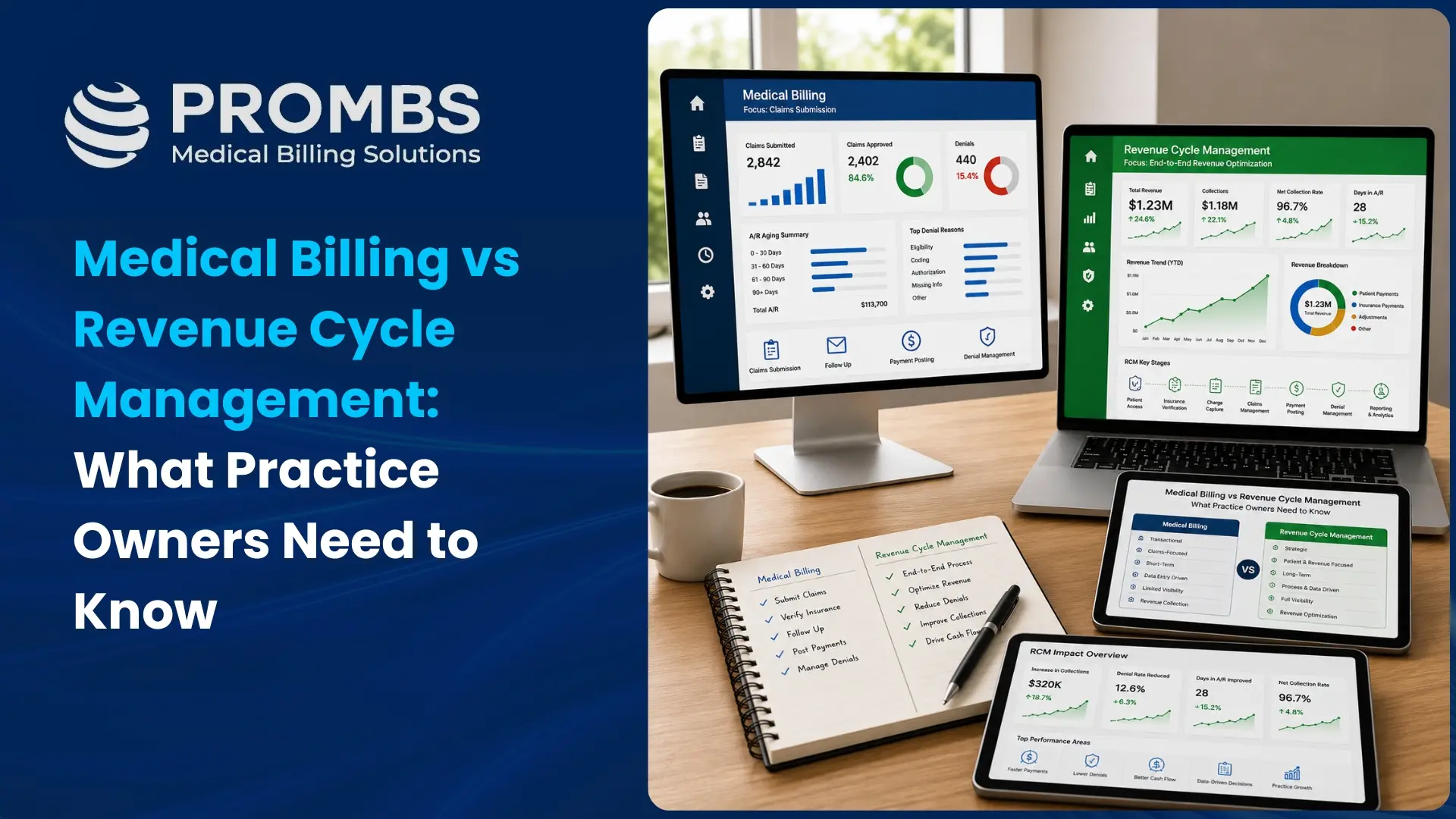
This confusion often comes from not fully understanding what medical billing actually covers versus what revenue cycle management is built to do. These two terms get used interchangeably all the time, and that mistake costs practices hundreds of thousands of dollars annually in preventable losses.
This article gives you a definitive, plain-language breakdown of medical billing vs revenue cycle management so you can make a clear-headed decision about what your practice actually needs. No jargon. No vague consulting-speak. Just the framework you need to evaluate your current setup, identify your gaps, and move forward with confidence.
What Is Medical Billing?
Medical billing is the process of translating clinical services into financial transactions and submitting them to payers for reimbursement. That is the textbook version. Here is what it looks like in practice.
It starts the moment a patient leaves the exam room. The provider documents the encounter, codes are assigned (usually CPT and ICD-10), and a claim is built and sent to the insurance carrier. If the claim is clean, the payer adjudicates it, sends an explanation of benefits, and issues payment. The biller then posts the payment, reconciles it against the expected amount, and sends any remaining balance to the patient.
That is the seven-step cycle working the way it is supposed to. In reality, the cycle looks more like this: claim goes out, payer kicks it back for a missing modifier or wrong place-of-service code, biller corrects and resubmits, payer partially pays, biller posts it, patient gets a confusing statement, and the balance ages out into the 90-day AR bucket.
Medical billing covers claim submission, payment posting, basic denial follow-up, and patient statement generation. A skilled biller working in a well-run practice can handle all of that effectively. What billing does not cover is where things get expensive. It does not address what happens before the patient arrives, meaning eligibility verification and prior authorization failures that make a claim uncollectable before anyone touches a keyboard. It does not include credentialing management, so if a provider’s contract lapses or a payer enrollment expires, claims start denying silently for weeks before anyone notices. It does not include analytics, so unless someone is pulling reports and analyzing trends, the same denial reason will keep repeating month after month.
Think of medical billing as the engine of your revenue process. It is essential, but an engine alone does not tell you the car is low on fuel, that a tire is going flat, or that you have been driving in the wrong direction for six months.
What Is Revenue Cycle Management? (And Why It’s Not Just a Fancy Term for Billing)
Revenue cycle management is the full ecosystem that governs how a healthcare organization generates, tracks, and collects its revenue from every patient encounter. The Healthcare Financial Management Association, better known as HFMA, defines RCM as the process that identifies, manages, and collects patient service revenue. But even that definition undersells how comprehensive it actually is.
RCM operates across three distinct phases, and billing is only one part of one phase.
The pre-visit phase is where revenue is either protected or left vulnerable. This is where credentialing and provider enrollment happen. If your providers are not properly enrolled with every payer they bill, or if re-credentialing lapses go unnoticed, claims will deny before they are ever sent. Eligibility verification is also pre-visit work. A thorough RCM operation verifies benefits before every appointment, confirms whether a service requires prior authorization, and flags patients whose coverage has changed since their last visit. None of that is billing. All of it determines whether billing will succeed.
The point-of-care phase covers charge capture and patient financial counseling. Charge capture is the process of making sure every billable service is actually coded and submitted. Studies consistently show that between 1% and 3% of charges are lost entirely due to documentation or capture failures. On a $2 million revenue practice, that is $20,000 to $60,000 quietly walking out the door. Patient financial counseling is the often-overlooked side of this phase. When patients understand their estimated responsibility upfront, practices collect more at the point of service and have fewer balances go to collections.
The post-visit phase is where billing lives, but it also includes denial management at a strategic level, not just reactive rework. Full RCM tracks denial patterns, identifies root causes, and implements upstream fixes so the same denials stop recurring. It includes accounts receivable management with aging analysis, payer contract management to ensure you are actually being paid at contracted rates, and comprehensive reporting that shows leadership how the entire revenue cycle is performing, not just whether claims went out on time.
The difference between billing and RCM is the difference between executing tasks and managing outcomes.
The 7 Biggest OON Billing Challenges in 2026
Understanding where billing ends and RCM begins is easiest when you look at how they compare across the areas that matter most to a practice.
Scope. Medical billing focuses on the claim lifecycle, from code assignment through payment posting. RCM encompasses the entire patient financial journey, from the moment an appointment is scheduled to the final dollar collected.
Timeline. Billing is reactive and transactional. It responds to encounters that have already happened. RCM is proactive and continuous. It influences outcomes before, during, and after the clinical encounter.
Goal. The goal of billing is to submit clean claims and collect payments. The goal of RCM is to maximize net revenue while minimizing the cost to collect it. These are related but meaningfully different targets.
Key Functions. Billing handles coding, claim submission, payment posting, and basic follow-up. RCM adds credentialing, eligibility verification, prior authorization management, charge capture optimization, denial analytics, payer contract oversight, patient payment programs, and executive-level financial reporting.
Technology Used. Billing typically relies on a practice management system and maybe a clearinghouse. Full RCM leverages those same tools plus business intelligence platforms, eligibility APIs, denial tracking systems, and increasingly, AI-driven claim scrubbing and predictive analytics.
Staff Requirements. A billing-only team needs coders, billers, and a follow-up specialist. An RCM team requires all of those plus credentialing coordinators, a denial management analyst, a patient financial counselor, and a revenue cycle manager who reports to leadership.
Reporting and Analytics. Billing reports tell you how many claims went out and how many came back. RCM reporting tells you your net collection rate, cost to collect, clean claim rate by provider and payer, denial trends over time, and how your performance compares to industry benchmarks. The Medical Group Management Association, MGMA, publishes benchmarking data that RCM-mature practices use as their performance baseline.
Compliance Coverage. Billing teams focus on coding accuracy and timely filing. RCM incorporates payer contract compliance, documentation audits, HIPAA and OIG risk management, and coding compliance programs.
Patient Financial Experience. Billing interactions typically happen after the fact, usually in the form of a confusing statement. RCM includes proactive patient communication, upfront cost estimates, payment plan options, and financial assistance screening, all of which directly impact both collections and patient satisfaction.
Cost Model. Billing is usually priced as a percentage of collections, typically between 4% and 7% depending on specialty and volume. RCM pricing varies by model, whether in-house or outsourced, and by scope. MGMA benchmarks suggest total billing and RCM costs for a well-run practice should land at approximately 5% of total collections when outsourced.
The 7 Costly Mistakes Practices Make When They Confuse Billing for RCM
1. Treating denial follow-up as a cleanup task rather than a prevention strategy
Most practices deal with denials after they happen, which means they are always in reactive mode. A true RCM approach tracks denial root causes, scores them by frequency and dollar impact, and fixes the upstream process, whether it is a documentation gap, an authorization miss, or a credentialing lapse. Reacting to denials is expensive. Preventing them is how you actually move the needle.
2. Skipping payer credentialing audits
Billing teams are usually not responsible for credentialing, and credentialing coordinators are not always integrated into the billing workflow. The result is that providers bill under outdated enrollment information, group NPI mismatches create silent denials, and newly added payers never get formally enrolled. One credentialing lapse can result in months of uncompensated claims.
3. No patient payment collection strategy at the point of service
If your front desk is not collecting copays and known balances before the patient leaves the building, you are adding those amounts to your AR and significantly reducing your likelihood of collecting them. Accounts receivable management research consistently shows that collection probability drops sharply after 90 days, and point-of-service collection eliminates that risk entirely.
4. Measuring success by claims submitted instead of revenue collected
Billing metrics like “we sent out 1,200 claims this month” tell you about activity, not outcomes. If your net collection rate is sitting at 88% when your specialty benchmark is 96%, activity metrics are masking a serious problem. This is one of the core reasons practices that rely on billing alone underperform financially without realizing it.
4. Measuring success by claims submitted instead of revenue collected
Billing metrics like “we sent out 1,200 claims this month” tell you about activity, not outcomes. If your net collection rate is sitting at 88% when your specialty benchmark is 96%, activity metrics are masking a serious problem. This is one of the core reasons practices that rely on billing alone underperform financially without realizing it.
5. Assuming prior authorization is someone else’s problem
Authorization denials are among the most common and most expensive denial types in healthcare. Yet in many practices, the clinical team handles auth requests inconsistently, there is no centralized tracking system, and billing only finds out about missing auths when the claim comes back denied weeks later. By that point, the patient may have already completed treatment, and the appeal window is shrinking.
6. Ignoring payer contract performance
Most billing operations submit claims and accept whatever payment arrives. A full RCM function includes contract management, meaning someone is regularly reconciling actual payments against contracted rates to ensure payers are not underpaying, applying incorrect fee schedules, or systematically undercutting reimbursements on specific procedure codes. Underpayment recovery is a significant revenue opportunity that billing alone almost never captures.
7. No clear framework for patient financial assistance or payment plans
As patient responsibility has grown with the rise of high-deductible health plans, practices without a formal financial counseling process are leaving substantial revenue on the table. Patients who cannot pay in full at once will not pay at all unless you offer a structured plan. Billing teams rarely own this function, and as a result, patient balances age out, get written off, or end up in collections, which damages both revenue and patient relationships.
Red Flags Your Practice Has Outgrown Medical Billing Alone
Your denial rate is above 8%. The 2026 industry benchmark for a well-managed practice is a first-pass denial rate below 5%. If yours is creeping above 8%, your billing operation is not preventing denials at a sufficient rate, and the root causes are almost certainly upstream of the claim itself.
Your days in accounts receivable exceeds 45. MGMA data consistently shows that high-performing practices maintain AR days below 40. If your AR days are running above 45, it means claims are sitting too long, follow-up is inadequate, or payers are taking longer to process claims than your team is tracking. Above 50 AR days is a serious warning sign.
Your staff is spending more than 20% of their time on rework. Correcting and resubmitting denied claims is not a productive use of your billing team’s capacity. If you track it, rework above 20% of total billing hours means your first-pass clean claim rate is too low and the root cause is a process or credentialing problem, not a billing problem.
You added providers, specialties, or payers in the last 12 months and did not overhaul your billing workflows. Every new provider needs enrollment. Every new specialty may have different authorization requirements. Every new payer has its own contract nuances. Practices that grow without reconfiguring their revenue infrastructure consistently see declining performance 6 to 12 months after the expansion.
Your net collection rate is below 95%. For most specialties, a net collection rate below 95% signals that money is being written off or aged out that should not be. Billing alone rarely tracks this metric. Full RCM treats it as the primary performance indicator.
You have no visibility into how your payer mix affects profitability. If you cannot easily see which payers are your best and worst performers, or which procedure codes are chronically underpaid, you are making scheduling, contracting, and staffing decisions blind. That is a structural RCM gap, not a billing gap.
Your patient collections are inconsistent or declining. If your front desk is uncomfortable discussing money, if you have no standard script for collecting copays, or if you have never screened patients for financial assistance eligibility, your patient revenue is underperforming. Professional medical billing and RCM services at prombs.com are specifically designed to address this complete picture.
You have experienced staff turnover in your billing department in the last 18 months. High turnover in billing is a sign that your revenue cycle infrastructure relies too heavily on individual knowledge rather than documented processes. Each time an experienced biller leaves, institutional knowledge about payer quirks, authorization requirements, and follow-up routines walks out the door with them. RCM-mature organizations build systems, not dependencies on individuals.
How AI and Automation Are Changing the RCM Game in 2025-2026
Artificial intelligence has moved from a buzzword in healthcare administration to a measurable performance driver in revenue cycle operations. This shift matters enormously for practices evaluating whether basic billing is sufficient or whether a full RCM infrastructure is worth the investment.
AI-driven claim scrubbing is perhaps the most immediately impactful application. Rather than waiting for a payer to reject a claim and return it for correction, AI scrubbing tools analyze claims before submission against payer-specific rule sets, historical denial patterns, and coding guidelines. Some platforms now flag claims with a denial probability score, allowing billing staff to prioritize high-risk claims for human review before they ever leave the practice. First-pass acceptance rates in practices using AI scrubbing are consistently running several percentage points above the national average.
Predictive denial analytics takes this further. Instead of reporting on denials that already happened, predictive systems identify patterns at the claim, provider, payer, and procedure code level and surface them as actionable intelligence. A practice using predictive analytics might learn that claims for a specific CPT code billed by one provider to one payer are denying at a 30% rate because of a documentation pattern in the notes, and they can fix that pattern before thousands of dollars in additional claims deny.
Automated eligibility verification has significantly reduced one of the most common sources of preventable denials. Prior to AI-enabled automation, eligibility checks were either done manually by the front desk or run in batches the night before appointments. Real-time eligibility APIs now check coverage at the moment of scheduling, at the time of the appointment reminder, and again at check-in, flagging coverage changes automatically and triggering staff action before the patient arrives.
AI in prior authorization is still developing but already showing impact. Several commercial platforms now integrate directly with payer systems to submit authorization requests automatically, track status in real time, and flag incomplete requests before they become claim-level denials. For specialties with high authorization volumes such as orthopedics, cardiology, and oncology, this automation can recover 10 to 15 hours of staff time per week.
For practices evaluating billing-only versus full RCM, the AI question matters for one core reason: these tools almost exclusively exist within full RCM platforms. Standalone billing software has not kept pace with enterprise RCM technology. A practice that relies on billing alone is likely not accessing any of these capabilities, which means it is operating at a structural performance disadvantage compared to competitors using modern RCM infrastructure.
Medical Billing vs RCM by Practice Type: What Actually Works
Solo practitioners and small practices (1 to 3 providers). The case for billing-only is strongest here, but only under specific conditions. If your payer mix is simple, your specialties have low authorization burdens, your denial rate is below 5%, and your AR days are below 40, a focused billing operation can serve you well. But even small practices benefit from at least the pre-visit RCM functions: eligibility verification, patient financial counseling, and basic denial analytics. The risk with billing-only at this scale is that one staff departure or one overlooked credentialing renewal can disrupt months of revenue.
Mid-size multi-specialty groups (4 to 15 providers). This is the danger zone for billing-only. Multi-specialty groups have heterogeneous payer requirements, varying authorization burdens by specialty, and enough claim volume that a 2% denial rate difference translates to significant annual revenue. At this scale, the administrative complexity almost always exceeds what a billing team alone can effectively manage. Full RCM, whether in-house with dedicated roles or outsourced to a professional partner, is the appropriate model.
Large groups and hospital-affiliated practices (15-plus providers). At this scale, revenue cycle performance is a strategic business function. Large groups require dedicated RCM infrastructure with analytics, contract management, compliance programs, and executive reporting. The cost of underperformance at this scale is measured in the millions, and billing-only operations are categorically insufficient. Hospital-affiliated practices often have RCM functions provided at the system level, but it is worth auditing whether those system-level functions are actually optimized for your practice’s specialty and payer mix or are simply standardized across all affiliates.
Telehealth and mental health practices. These practices have some of the most nuanced billing and credentialing challenges in all of healthcare. Telehealth billing requires ongoing fluency with state-specific coverage rules, place-of-service code accuracy, and parity law compliance. Mental health practices face unique credentialing hurdles, high rates of out-of-network billing, complex prior authorization requirements especially for ongoing treatment, and patient financial sensitivity that requires skilled counseling. These practice types arguably need the most comprehensive RCM support relative to their size, and billing-only approaches routinely underserve them.
In-House vs Outsourced RCM: How to Make the Right Call
The real cost of in-house billing is almost always higher than what practice owners calculate. Consider a single full-time biller: salary in 2025 typically runs between $42,000 and $58,000 annually depending on experience and region. Add employer payroll taxes, benefits, and paid time off and the true loaded cost is closer to $65,000 to $75,000. Layer in practice management software licensing, clearinghouse fees, coding reference subscriptions, and annual training, and you are realistically looking at $80,000 to $95,000 per year for one billing staff member, before you account for the cost of their downtime, errors, or eventual turnover.
Most practices that do a genuine accounting of their in-house billing costs find they are spending well above what outsourcing would cost for a broader, more capable service.
MGMA benchmarks suggest that total revenue cycle and billing costs for a well-run practice should approximate 5% of total collections. For a practice collecting $1.5 million annually, that is $75,000. For a practice collecting $3 million, that is $150,000. Outsourced RCM pricing typically ranges from 4% to 7% of collections depending on specialty, volume, and scope of services, and that fee covers the full RCM function, not just claim submission.
The framework for deciding is straightforward. If your practice collects over $1 million annually, has more than two providers, operates in a specialty with significant authorization or credentialing complexity, or has experienced declining collection rates, inconsistent AR performance, or billing staff turnover in the last two years, outsourced RCM almost certainly delivers better financial performance at comparable or lower cost than maintaining an in-house team.
📈
Free Revenue Assessment
Is your practice leaving money on the table?
If you recognized your practice in any of these patterns,
it may be time for a real conversation about your revenue cycle.
Key Performance Indicators: How Billing and RCM Teams Are Measured Differently
Billing performance is typically tracked with a narrow set of metrics. First-pass acceptance rate measures the percentage of claims approved on first submission, with anything below 95% indicating a clean-claim problem. Days in accounts receivable tells you how long it takes from service to payment. Denial rate measures the percentage of claims that come back rejected.
These are legitimate and important metrics. But they only tell half the story, and in some cases they can actively mislead. A billing team with a 97% first-pass rate and a 38-day AR might still be performing below potential if they are writing off underpaid claims, failing to collect at the point of service, or missing systematic payer underpayments.
RCM teams are measured by a broader set of indicators that capture the full financial picture. Net collection rate is the most important of these: it measures actual dollars collected as a percentage of net collectible revenue after contractual adjustments. A net collection rate below 95% for most specialties signals meaningful revenue leakage. Cost to collect measures total revenue cycle expense as a percentage of collections, which is how you determine whether your RCM infrastructure is financially efficient. Clean claim rate differs from first-pass acceptance rate in that it includes all technical, clinical, and administrative requirements for a claim to process correctly, not just initial payer acceptance.
Patient satisfaction scores tied to the financial experience are increasingly included in RCM performance frameworks, because patient collections now represent a growing share of practice revenue and a poor financial experience drives patients away regardless of clinical quality.
Measuring only billing metrics is like judging a restaurant by how fast orders get to the table without tracking whether customers enjoyed the food or came back. The efficiency data is real, but it is missing everything that determines long-term financial health.
Frequently Asked Questions
Is medical billing part of revenue cycle management?
Yes, medical billing is one component of revenue cycle management, but it represents only a portion of the full RCM process. Medical billing covers claim submission, payment posting, and basic denial follow-up. Revenue cycle management also includes pre-visit functions like eligibility verification and prior authorization, patient financial counseling, credentialing management, denial analytics, payer contract oversight, and comprehensive performance reporting. Billing is the transactional core of RCM, not the whole system.
What is the difference between a medical biller and an RCM specialist?
A medical biller is focused on the claim lifecycle: coding, submission, follow-up, and payment posting. An RCM specialist has a broader scope that includes understanding payer contract terms, denial root-cause analysis, credentialing workflow, patient financial engagement, and revenue analytics. RCM specialists typically work within a team that manages the entire patient financial journey, while a biller may operate independently or within a small billing department. The skills required and the business impact of each role are meaningfully different.
Can a small practice benefit from full RCM?
Absolutely. Even solo practitioners and two-to-three provider practices benefit from the pre-visit components of RCM, specifically eligibility verification, authorization management, and patient financial counseling, because these directly reduce denial rates and improve upfront collections. Many RCM vendors offer scaled service models appropriate for smaller practices. The question is not whether RCM adds value but whether the cost model fits the practice’s revenue. For most practices collecting above $750,000 annually, full RCM delivers measurable ROI.
What does revenue cycle management include that medical billing does not?
Revenue cycle management includes provider credentialing and enrollment, insurance eligibility verification, prior authorization management, charge capture optimization, patient financial counseling, denial root-cause analytics, payer contract performance monitoring, underpayment identification, and comprehensive financial reporting. Medical billing does not typically cover any of these functions. The result is that billing-only operations are working without the upstream protection and downstream analytics that RCM provides.
How much does revenue cycle management cost?
Outsourced RCM typically costs between 4% and 7% of a practice’s total collections, depending on specialty, claim volume, and scope of services. MGMA benchmarks suggest that total billing and RCM costs for a high-performing practice should be approximately 5% of collections. In-house RCM costs vary considerably based on staffing, technology, and overhead, and frequently exceed this benchmark when all expenses are fully accounted for. Many practices find that outsourced RCM delivers better performance at a comparable or lower cost than maintaining a full in-house team.
What is a good denial rate benchmark for a medical practice?
According to industry benchmarks, a well-managed medical practice should maintain a first-pass denial rate below 5%. Rates between 5% and 8% indicate opportunity for process improvement, particularly in eligibility verification and prior authorization workflows. Denial rates above 8% represent a significant revenue performance issue and usually signal structural problems upstream of the billing function. The American Academy of Family Physicians and MGMA both reference 5% as a reasonable target, with high-performing practices achieving rates below 3%.
Conclusion
Medical billing and revenue cycle management are not interchangeable, and treating them as if they are will cost your practice real money year after year. The core distinction comes down to this: billing is a task. RCM is a strategy.
If your practice is growing, adding providers, struggling with denials above 5%, or watching AR days creep past 40, billing alone is not built to solve those problems because those problems start before a claim is ever submitted. The upstream work, credentialing, authorization, eligibility, and charge integrity, determines whether your downstream billing can succeed.
The practices that consistently outperform their peers on revenue metrics are not necessarily the ones with the busiest billing teams. They are the ones that have invested in a revenue cycle infrastructure that is proactive, data-driven, and aligned with how payers actually adjudicate claims in 2026.
Three things to take away. First, assess your practice against the red flags in this article. If you recognize yourself in two or more of them, you have outgrown billing alone. Second, start measuring net collection rate and cost to collect in addition to your billing metrics. You cannot manage what you are not measuring. Third, get an honest accounting of what in-house billing is actually costing you before assuming it is the most economical option.
🚀
Ready to Improve Performance?
See what a fully managed revenue cycle can do for you
Whether you’re evaluating your current setup or considering
a full transition, get a clear-eyed assessment of where your revenue stands.