

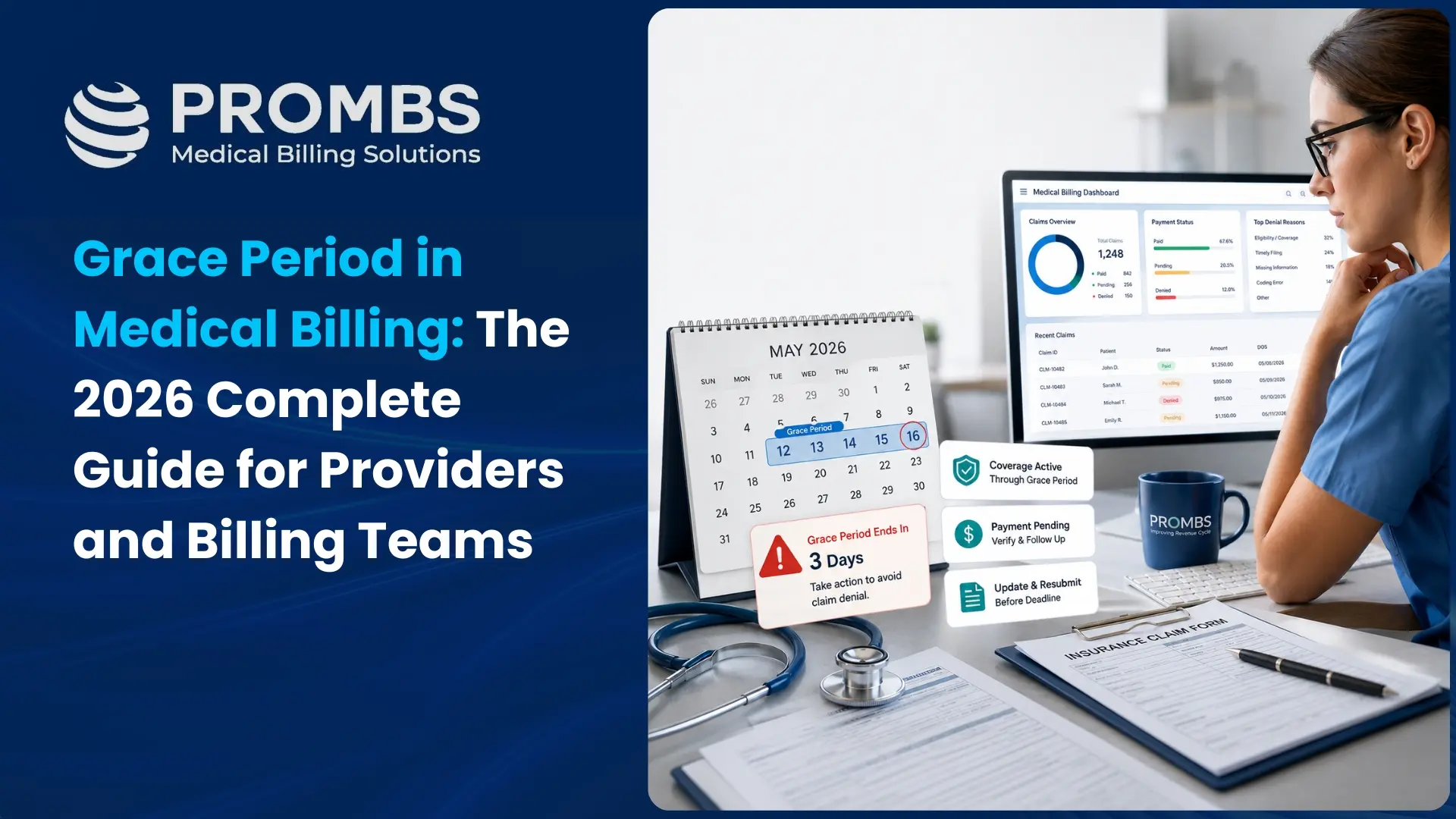
Here is a scenario that plays out in billing offices across the United States more often than most people realize. A patient visits her internist in late September. She recently changed jobs and, during the transition, missed a premium payment on her ACA Marketplace plan. The plan is technically active but sitting inside a 90-day grace period. The claim goes out. It comes back denied. Nobody on the billing team flagged the grace period status during eligibility verification. Now the provider is sitting on a $1,200 claim with a rapidly closing window to appeal, refile, or collect from the patient directly.
That single missed step can cascade into thousands of dollars of lost revenue, strained patient relationships, and hours of unnecessary rework. Understanding the grace period in medical billing, really understanding it, is one of the most practical things a billing team can do to protect a practice’s financial health.
This guide covers everything: what the grace period is and how it works, how it differs from timely filing limits (a distinction that trips up even seasoned billers), state-by-state variations, the 2026 ACA regulatory updates, what happens when claims are denied after a grace period ends, and a step-by-step billing team SOP you can put to use immediately.
Quick Answer: What Is a Grace Period in Medical Billing?
Grace Period: Set by ACA/state law/plan contract. Controls whether patient coverage is active. Provider cannot file an appeal based on timely filing. Timely Filing Limit: Set by each payer’s contract. Controls how long a provider has to submit a claim. Appeal possible with proof of timely submission.
What Exactly Is a Grace Period in Medical Billing?
The term grace period shows up in two distinct contexts in healthcare billing, and conflating the two is a common source of confusion. The first is the insurance premium grace period, which is what most billing professionals mean when they use the phrase. The second is the claims filing grace period, which some teams loosely refer to as a “timely filing grace period.” We will address both, but the insurance premium grace period carries the greater financial risk and deserves the deeper treatment.
An insurance premium grace period is the window of time that a health plan grants a policyholder to pay an overdue premium without losing coverage. During this window, the policy remains technically active. Providers can still see patients and submit claims. But depending on where the patient is within that grace period, the fate of those claims varies dramatically.
Under the Affordable Care Act, the rules governing grace periods for subsidized marketplace plans are codified at 45 CFR Section 156.270. The regulation creates a tiered structure that has enormous implications for medical billing.
The Three-Tier ACA Grace Period Structure
For enrollees receiving advance premium tax credits (APTCs) through the Health Insurance Marketplace, the grace period operates in three distinct phases:
Days 1-30: The insurer must pay all submitted claims as though coverage is fully active. There is no ambiguity here. The patient is covered, and the provider gets paid.
Days 31-60: The insurer may pend (hold without paying or denying) any claims received during this window. Providers receive remittances showing claims in a “pending” status. This is the most operationally dangerous phase, because money is neither arriving nor explicitly denied, and many billing teams do not flag these accounts for immediate follow-up.
Days 61-90: The insurer may continue pending claims. If the premium remains unpaid at day 90, coverage is terminated retroactively to the end of the first month of non-payment (day 30). All claims pended from days 31-90 are then denied. The provider must either bill the patient out-of-pocket or write off the balance.
For plans without APTCs, including employer-sponsored plans and off-Marketplace individual policies, the federal minimum grace period is 30 days. Many states mandate longer periods, and individual insurer contracts may extend it further. We will look at specific state rules later in this guide.
Grace Period vs. Timely Filing Limit: Clearing Up the Biggest Confusion in Medical Billing
Ask a roomful of medical billers what “grace period” means, and you will get at least two different answers. That is because the phrase gets used informally to mean two completely different things. Clearing up this distinction is genuinely important, because the downstream consequences of confusing the two can cost a practice tens of thousands of dollars annually.
The Insurance Premium Grace Period
This is the window the patient has to catch up on missed premiums. It is driven by the ACA, state insurance regulations, and individual plan contracts. The billing team does not control it. What the team can do is monitor for it during eligibility verification and respond strategically when a patient is inside their grace period.
The Timely Filing Limit
This is an entirely different concept. The timely filing limit is the deadline a provider has to submit a claim to an insurance company after the date of service. It is set by each payer individually, typically in the provider agreement. Medicare allows 12 months from the date of service for initial claims. Medicaid limits vary by state. Most private commercial insurers set limits at 90 to 180 days, though some use 12 months. Certain payers, including some Blue Cross plans, allow up to 24 months in specific circumstances.
Missing the timely filing limit is a billing team error. Missing the grace period is a patient coverage issue. Both result in denied claims, but the remediation paths are completely different. A timely filing denial can sometimes be appealed with proof of timely submission (a clearinghouse confirmation report, for example). A grace period denial, once the 90 days have passed and coverage is retroactively terminated, is much harder to reverse because the payer has a legitimate basis for the denial.
Key Distinction at a Glance
Grace Period: Set by ACA/state law/plan contract. Controls whether patient coverage is active. Provider cannot file an appeal based on timely filing. Timely Filing Limit: Set by each payer’s contract. Controls how long a provider has to submit a claim. Appeal possible with proof of timely submission.
There is a scenario where both come into play simultaneously, and it is worth walking through it explicitly. A patient is in day 45 of their ACA grace period. The provider submits a claim on day 50 of the grace period, which also happens to be day 120 after the date of service. If the insurer’s timely filing limit is 90 days, the claim faces denial on two grounds: pended for grace period AND late filing. The billing team now has two separate problems to address, each requiring a different remediation strategy.
Real-World Scenario: Following One Claim Through the Entire Grace Period Lifecycle
Let us trace a single claim from date of service through every possible outcome, with exact dollar amounts and dates. This is the kind of concrete walkthrough that billing teams can use during training.
The Setup
Maria, 34, is enrolled in a Silver-tier ACA Marketplace plan through CareFirst. She receives a $320/month APTC. She lost her waitressing job in early October and, scrambling to cover rent, skipped her November premium of $140 (her share after the subsidy).
On November 15, Maria visits her primary care physician, Dr. Patel, for a persistent cough and fever. The visit generates a claim for $285 (CPT 99213, office visit, established patient). November 15 is Day 16 of Maria’s grace period.
Phase 1: Claim Submission (Days 1-30)
Dr. Patel’s billing team submits the claim electronically on November 17. The clearinghouse confirms acceptance. Because Maria is in the first 30 days of her grace period, CareFirst is required to process and pay the claim. On December 3, an ERA arrives: CareFirst paid $218 after applying Maria’s $67 deductible. Maria owes $67 patient responsibility. The billing team posts the payment and sends Maria a statement. So far, everything functions normally.
Phase 2: The Pend Zone (Days 31-60)
Maria sees Dr. Patel again on December 2 (Day 33) for a follow-up. She also visits an in-network urgent care center on December 10 (Day 41) for a separate issue. Both visits generate claims submitted promptly. But Maria has still not paid her November premium.
When the billing team checks on the December 2 claim ($245 billed) in mid-December, the ERA shows a pend code: “Coverage Under Review – Premium Non-Payment.” The urgent care claim ($390 billed) shows the same status. Together, $635 in billed charges are sitting in limbo. No payment. No denial. No clear resolution date.
This is where many billing teams fall into a costly trap: they file the pending claims away and move on. The right move, as we will cover in the SOP section, is to immediately flag both accounts, contact Maria about her premium status, and begin preparing for the worst-case scenario.
Phase 3: Termination and Retroactive Denial (Day 90+)
Maria ultimately cannot pay the overdue premium. On January 30 (Day 91), CareFirst sends a termination notice. Coverage is retroactively terminated to November 30 (end of the first month of non-payment). Both pended claims, the December 2 visit and the December 10 urgent care visit, are denied. The ERA now shows: “Coverage Terminated – Member Not Eligible on Date of Service.”
Dr. Patel’s billing team now faces a real decision. The total denied amount is $635 billed. Maria is uninsured as of November 30. The team has three options:
- Bill Maria directly as a self-pay patient. At self-pay rates, the charges might be reduced to $400. Given Maria’s financial situation, this may result in a bad debt write-off.
- Apply for a state or federal hardship exception, if applicable, to continue treating Maria at a reduced rate.
- Refer the balance to a third-party collection agency, though this carries patient relationship and reputational risks.
None of these outcomes is as clean as a standard insurance payment. That is the true cost of a missed grace period flag: it is not just a denied claim. It is a downstream cascade that affects collections, patient satisfaction, and staff time.
Is Your Billing Team Monitoring Grace Period Flags in Real Time?
ProMBS specializes in revenue cycle management built for today’s complex payer environment. We catch the grace period issues your software misses.
Schedule a Free RCM Assessment ↗
State-by-State Variations: Grace Periods Are Not One-Size-Fits-All
Federal ACA rules set the floor for grace periods. State laws and individual state insurance regulations frequently go further. If your practice operates in multiple states or serves patients across state lines through telehealth, you need a working knowledge of how your specific states handle grace periods, both for premium non-payment and for timely filing. The table below covers five major states as a reference point, but every billing team should verify current rules with their state insurance commissioner’s website and each payer’s most recent contract.
| State | Timely Filing Limit | Key Notes |
|---|---|---|
| California | 90 days (private); 12 months (Medi-Cal) | State law extends Medi-Cal timely filing to 12 months post-DOS |
| Texas | 95 days (most private); 180 days (Medicaid) | Texas Medicaid allows 180 days from DOS for initial claims |
| New York | 90 days (private); 90 days (Medicaid) | NY Medicaid strictly enforces 90-day limit with few exceptions |
| Florida | 120 days (private avg.); 12 months (Medicaid) | Florida Medicaid: 12 months from DOS for initial submissions |
| Illinois | 90 days (private); 180 days (Medicaid) | Late filing penalty waived with valid documentation |
California is particularly worth calling out. The state’s Medi-Cal program extends timely filing to 12 months from the date of service, which is more generous than most private payers in the state. This creates an asymmetry: a California provider may have only 90 days to file with a private payer but a full year with Medi-Cal. Billing staff need to be trained on this distinction or claims will fall through the cracks.
New York presents the opposite challenge. Both private payers and Medicaid enforce a strict 90-day timely filing limit with limited exceptions. New York also has some of the most aggressive insurer enforcement of grace period denials, meaning there is less room for error at the submission stage.
Florida’s Medicaid program is one of the most provider-friendly in the country from a timely filing standpoint, with a 12-month window. But Florida also has a high rate of ACA Marketplace enrollment, which means a significant percentage of patients are subject to the 90-day APTC grace period rules. The combination creates a false sense of security: providers might assume they have plenty of time on all fronts and miss the shorter private payer deadlines.
2026 ACA Marketplace Updates That Affect Grace Period Billing
The regulatory environment around ACA Marketplace coverage has been evolving, and 2026 brought several updates that billing teams need to understand. The Centers for Medicare and Medicaid Services (CMS) finalized rules in early 2025 that took effect for plan year 2026, with direct implications for how grace periods interact with claims processing.
Enhanced APTC Eligibility and Its Billing Consequences
The American Rescue Plan Act enhanced subsidies that were extended through the Inflation Reduction Act continue to apply through 2026. This means a larger percentage of Marketplace enrollees are receiving APTCs than at any point since the ACA’s inception. More APTC recipients means more enrollees subject to the 90-day grace period structure rather than the 30-day floor. Billing teams that assumed a majority of their Marketplace patients were in the 30-day grace period bucket should revisit that assumption. The proportion with APTCs has grown significantly, and with it, the risk exposure from days 31-90.
Continuous Enrollment and Retroactive Coverage Issues
CMS also issued guidance in 2025 tightening rules around special enrollment periods (SEPs) and continuous enrollment. The practical effect is that some patients who previously had easier pathways to reinstate lapsed coverage may find reinstatement more difficult in 2026. For billing teams, this means that when a patient’s grace period expires and coverage is terminated, the likelihood of reinstatement with retroactive coverage restoring pended claims has decreased. The old strategy of waiting to see if a patient reinstates before writing off a claim is less viable.
Payer Notification Requirements
Under the 2026 rules, Marketplace insurers are required to notify both enrollees and, in certain circumstances, providers when a policyholder enters the grace period. The provider notification requirement is not universally implemented across all payers, and compliance has been inconsistent. However, best-practice billing teams are now checking payer portals weekly for grace period status flags rather than relying on passive notification.
You can review CMS’s official 2026 Notice of Benefit and Payment Parameters for the full regulatory text.
What Happens to Denied Claims After the Grace Period Ends: Recoupment and Recovery
When the 90-day window closes and a patient’s coverage is terminated retroactively, the billing team enters a critical phase that no competitor guide covers in adequate depth: the recoupment and recovery process. This is where the real financial pain is felt, and where a well-prepared billing team can recover revenue that a disorganized one will simply write off.
Insurer Recoupment: What It Means
In cases where the insurer paid a claim during days 1-30 of the grace period and the coverage is later terminated, the insurer technically has a right to recoup those payments. However, under current CMS rules, for claims paid during the first 30 days of the grace period, insurers cannot recoup those payments from providers. This is an important and often misunderstood protection. The financial loss for days 1-30 falls on the insurer, not the provider. The provider is not obligated to return payments received for services rendered during that first month.
Days 31-90 are different. Claims pended during this period were never paid, so there is nothing to recoup. But the provider is left holding the bag for services already rendered with no payment forthcoming from the insurer.
Patient Balance Billing After Grace Period Termination
When a grace period denial is finalized, the provider generally has the right to bill the patient directly as a self-pay patient. However, there are important nuances:
- ACA network agreements may limit what providers can collect from patients who were covered at the time of service. This is a gray area that varies by state and by individual insurer contract.
- Patients in financial hardship may qualify for charity care programs. Providers should have a clear charity care policy and train front desk and billing staff on eligibility screening.
- Writing off a balance as bad debt rather than pursuing a patient is sometimes the most practical decision, particularly when the collection costs exceed the balance owed.
The Appeal Pathway
Grace period denials are not always the end of the road. Providers can appeal denials, and in some cases, appeals are successful when:
- The provider can demonstrate they had no reasonable way to know the patient was in a grace period at the time of service (good-faith provider exception).
- The insurer failed to notify the provider per CMS requirements.
- The patient subsequently reinstated coverage and the insurer agrees to process pended claims retroactively.
The appeals process is insurer-specific. The American Medical Association (AMA) has published guidance on appealing grace period denials that is worth reviewing for any billing team that handles a significant volume of Marketplace claims.
You can access AMA’s resources on insurance appeals and claim disputes on their official website.
Billing Team SOP: A Step-by-Step Grace Period Management Protocol
The following standard operating procedure is designed for medical billing teams of any size. It can be adapted to your practice management software and payer mix. The goal is to catch grace period issues before they become denied claims, and to manage denials efficiently when they do occur.
| Timeline | Milestone | Action Required | Responsible Party |
|---|---|---|---|
| Day 0 | Service rendered | Log DOS in PM system immediately | Front Desk / Check-in Staff |
| Day 1-3 | Eligibility verification | Confirm active coverage and grace period status via payer portal | Billing Coordinator |
| Day 5-7 | Claim preparation | Code and scrub claim; validate ICD-10 and CPT accuracy | Medical Coder |
| Day 10-14 | Initial submission | Submit electronically; confirm clearinghouse acceptance | Billing Specialist |
| Day 20 | First follow-up | Check ERA/EOB status; flag pending or rejected claims | AR Specialist |
| Day 45 | Second follow-up | Re-submit corrected claims; escalate missing EOBs | AR Manager |
| Day 60 | Grace period review | Identify any claims at risk of passing 90-day limit | Billing Manager |
| Day 80 | Final action window | Force submission or file appeal before window closes | Senior Billing Staff |
| Day 90+ | Post-deadline audit | Document reason; initiate internal appeal or write-off if necessary | Billing Director |
Eligibility Verification Checklist (Per Patient, Per Visit)
Before any appointment, the billing team should confirm the following through the payer portal or eligibility verification service:
- Is the patient’s coverage active as of today’s date?
- Is the patient enrolled in an ACA Marketplace plan with APTCs?
- Does the eligibility response show any grace period or premium non-payment flags?
- What is the patient’s current deductible and out-of-pocket status?
- What is the payer’s timely filing limit for this plan?
- Has a previous claim for this patient been returned with a pend code related to premium non-payment?
When a Pend Code Appears: Immediate Response Protocol
The moment a claim returns with a grace period pend code, the following steps should be taken within 48 hours:
- Flag the patient account in your practice management system with a grace period alert.
- Contact the patient by phone and mail to explain the situation without alarming them. The goal is to encourage them to pay the outstanding premium and resolve the issue before day 90.
- Document all patient communication in the account notes with timestamps.
- Set a calendar reminder for day 85 to force a final decision: appeal, collect from patient, or prepare for write-off.
- Check the payer portal weekly for status updates on all pended claims.
Let ProMBS Handle Your Grace Period Risk Management
Our team monitors every claim in real time, flags grace period risks, and executes the SOP above on your behalf, so your revenue stays protected.
How Grace Periods Affect Different Provider Types Differently
Not all practices carry the same grace period risk. Understanding where your practice sits on the risk spectrum can help you allocate staff time and monitoring resources appropriately.
Primary Care and Preventive Services
High-volume primary care practices that serve a broad population are statistically more likely to have a meaningful percentage of Marketplace-enrolled patients with APTCs. This makes them among the highest-risk provider types for grace period exposure. The relative frequency of patient contact also creates more opportunities to catch the issue early, but only if the team is trained to look for it.
Specialists and Elective Services
Specialists, particularly those who perform elective or non-urgent procedures, have slightly more runway. Prior authorization processes often reveal eligibility issues before a procedure is scheduled, creating a natural checkpoint. However, specialists who see urgent referrals without pre-authorization steps are just as exposed as primary care providers.
Hospitals and Outpatient Facilities
Hospitals have the most sophisticated billing infrastructure and typically use enterprise-level eligibility verification tools that can flag grace period statuses in real time. Even so, emergency department billing is particularly vulnerable because services are rendered before eligibility can be thoroughly verified.
Protecting Your Practice: Proactive Strategies for Grace Period Risk Management
The most effective approach to grace period risk is prevention. Once a claim is pended or denied, you are already in recovery mode. The following strategies keep most grace period issues from reaching that stage.
Real-Time Eligibility Verification at Every Touchpoint
Run eligibility checks not just at scheduling but also at check-in, and again mid-month for patients with active treatment plans. Some payers update their grace period flags on a rolling basis, and a patient who was clear at scheduling may have moved into grace period status by the time they walk through your door.
Financial Counseling Integration
Train your front desk staff to recognize the early signs of insurance instability: patients who mention job changes, patients who ask about payment plans for premiums, patients who have recently switched plans. A brief, compassionate conversation at check-in can surface a grace period issue before it becomes a billing problem. Many patients do not know they are in a grace period; they received a notice but did not understand it.
Payer Communication Monitoring
Designate a staff member to monitor payer portals at least twice weekly for pend codes, status changes, and coverage termination notices. This is not the most exciting billing task, but it is one of the highest-value activities a billing team can perform in terms of revenue protection.
Grace Period Clause in Patient Financial Agreements
Include a clear provision in your patient financial agreement that explains the patient’s responsibility to maintain active coverage and to notify the practice if their insurance lapses. This document serves two purposes: it educates patients and it establishes a legal basis for billing the patient directly if a grace period denial occurs.
Frequently Asked Questions About Grace Period in Medical Billing
What is a grace period in medical billing?
A grace period in medical billing is the window of time that a health insurance policy grants a policyholder to pay an overdue premium before coverage is terminated. For ACA Marketplace plans with advance premium tax credits, this period is 90 days. For plans without APTCs, the federal minimum is 30 days, though state laws and individual payer contracts may set longer windows.
How long is the grace period for ACA Marketplace plans in 2026?
For ACA Marketplace enrollees receiving advance premium tax credits (APTCs), the grace period is 90 days. This has not changed under 2026 regulations. The structure remains tiered: insurers must pay claims for days 1-30, may pend claims for days 31-90, and may deny all pended claims if the premium is not paid by day 90.
What is the difference between a grace period and a timely filing limit?
A grace period is about patient coverage and premium payment. It controls whether the patient’s insurance is active on the date of service. A timely filing limit is about provider deadlines. It controls how long a provider has to submit a claim after the date of service. Both can result in denied claims, but they require completely different remediation strategies.
Can a provider bill a patient after a grace period denial?
Generally yes. When coverage is retroactively terminated and a claim is denied due to a grace period lapse, the provider typically has the right to bill the patient as a self-pay patient for services rendered during days 31-90. However, providers should review their specific network agreements and state laws, as some restrictions on patient billing may apply depending on the plan type and state.
Does the insurer have to notify the provider when a patient enters a grace period?
Under CMS guidance, Marketplace insurers are required to notify enrollees when they enter a grace period. Provider notification requirements are more limited and not uniformly implemented across all payers. Best practice is for billing teams to proactively check eligibility status and payer portals rather than relying on passive notification from insurers.
What happens to claims paid during the first 30 days if coverage is eventually terminated?
Under current CMS rules, insurers cannot recoup payments made to providers for claims submitted during the first 30 days of the ACA grace period, even if coverage is later terminated retroactively. The financial loss for those claims falls on the insurer. Only claims pended during days 31-90 are subject to denial without payment to the provider.
How do grace periods vary by state?
State laws frequently extend grace periods beyond the federal minimums. For example, California extends Medi-Cal timely filing to 12 months, while New York enforces a strict 90-day limit for both Medicaid and most private plans. Florida Medicaid allows 12 months from the date of service. Billing teams operating in multiple states should maintain a state-specific reference guide for both grace periods and timely filing limits.
What is the best way for a billing team to manage grace period risk?
The most effective approach combines real-time eligibility verification at every patient touchpoint, staff training on grace period pend codes, a documented SOP with clear ownership at each stage, and proactive patient communication when a premium non-payment flag appears. Designating a specific staff member to monitor payer portals twice weekly for grace period and coverage status changes is one of the highest-return activities a billing team can undertake.
The Bottom Line
Grace periods in medical billing are one of those topics that look simple on the surface but carry enormous financial complexity underneath. A basic definition, the one you will find on most competitor pages, does not give billing teams what they actually need: the granular knowledge to catch issues before they become denials, the regulatory context to understand how 2026 changes affect their patient population, and the operational procedures to manage pended and denied claims efficiently.
The 90-day ACA grace period structure, the distinction from timely filing limits, the state-by-state variation, the recoupment rules, the 2026 regulatory updates, and the practical SOP in this guide represent the full scope of what a modern billing team needs to master this issue. Revenue cycle management is, at its core, about closing the gap between services rendered and payments received. The grace period is one of the most underestimated sources of that gap.