

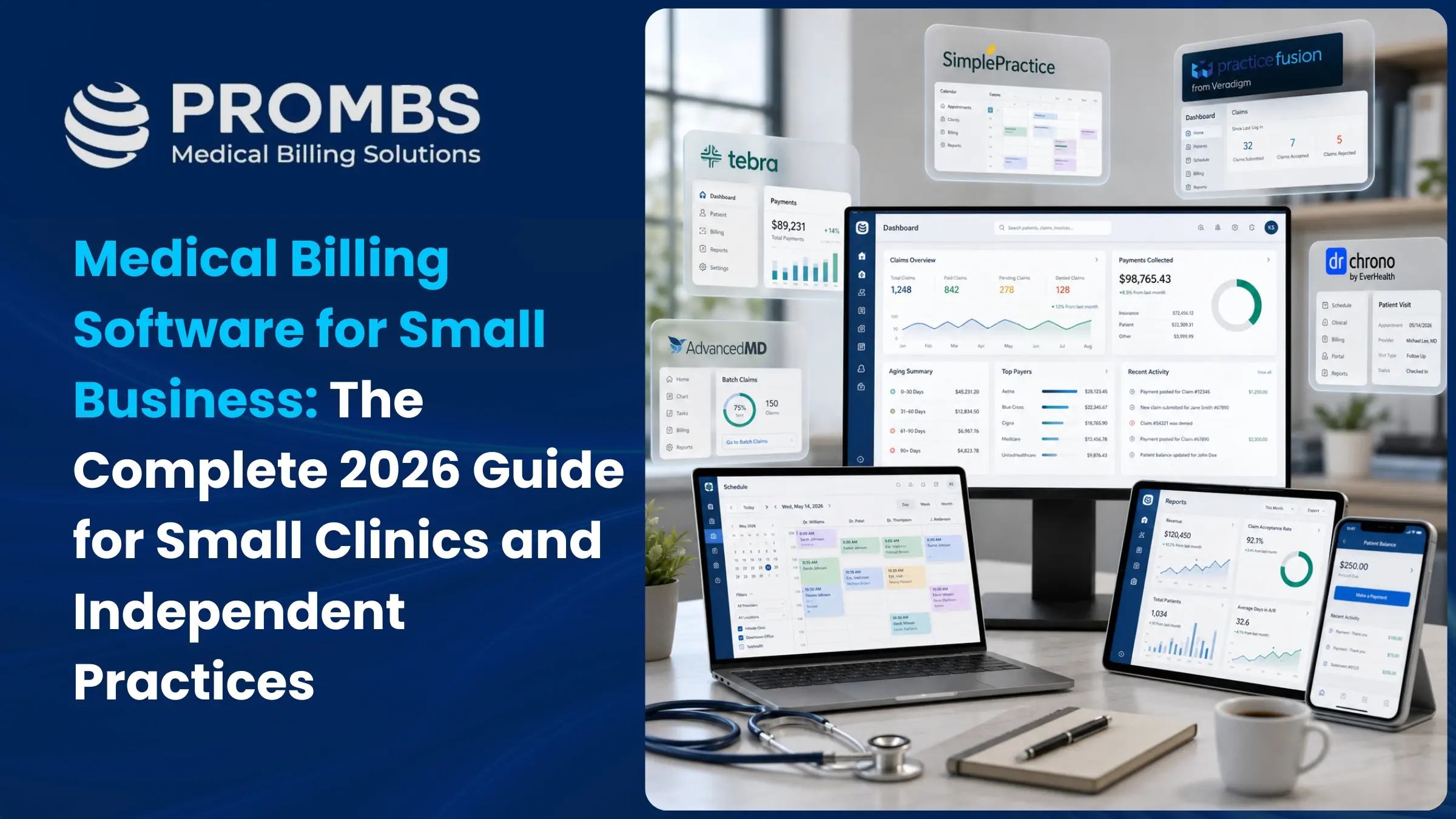
Running a small medical practice in the U.S. is rewarding work. But let’s be honest — the billing side of things can quietly drain your energy, your time, and your revenue without you even realizing it. A claim goes out with a coding error. The payer rejects it. Your front desk spends three hours reworking it. By the time you get paid, weeks have passed, and a portion of what you were owed may never come back at all.
This is the reality for thousands of solo practitioners, small clinic owners, and independent physicians across the country. And it is exactly why finding the right medical billing software for small business is not just a nice-to-have — it is genuinely one of the most important operational decisions your practice will make.
This guide breaks everything down for you: what to look for, which platforms are worth your money in 2026, what the hidden costs are, and how to calculate whether the investment will actually pay off. No fluff, no generic advice you have already read somewhere else.
What Is Medical Billing Software, and Why Does It Exist?
At its core, medical billing software is a digital system that manages the entire process of submitting healthcare claims to insurance payers and collecting payment from patients. It handles everything from translating a physician’s notes into billing codes (CPT, ICD-10, HCPCS) to tracking whether a claim was accepted, denied, or needs to be corrected and resubmitted.
Think of it as the financial nervous system of your practice. Without it, billing is a manual, error-prone, time-consuming process that depends entirely on whoever is doing the work that day. With it, much of that process becomes automated, standardized, and trackable.
For small practices specifically, this matters more than people realize. A large hospital system can absorb a 10% denial rate because of sheer volume. A solo practitioner or a three-physician group cannot afford that kind of leakage. Every denied claim, every late payment, every missed follow-up is money that does not make it back to you.
Why Small Businesses Cannot Just Use Generic Tools
Some practice owners try to get by with spreadsheets, QuickBooks, or whatever basic invoicing tool they already have. It is understandable — you are watching costs, and another software subscription feels like one more expense. But generic financial tools were not built for healthcare.
They do not understand CPT codes or modifier rules. They cannot scrub claims against payer-specific edits before submission. They have no built-in knowledge of Medicare fee schedules or Medicaid billing requirements. And most importantly, they are not HIPAA compliant billing software — which means using them for patient financial data puts your practice at serious legal risk.
Small practice billing has specific requirements that only purpose-built medical billing platforms can handle. You need a system that speaks the language of healthcare — CMS-1500 forms, electronic data interchange (EDI), remittance advice, and coordination of benefits. Generic tools simply do not do this.
Key Features to Look for in Medical Billing Software for Small Business
Not all platforms are created equal. Here is what actually matters when you are evaluating options for a small or independent practice.
Claim Scrubbing
This is the single most impactful feature for reducing your denial rate. Claim scrubbing is the automated process of checking a claim for errors before it ever gets submitted to a payer. A good scrubbing engine catches missing modifiers, incorrect diagnosis code combinations, invalid place-of-service codes, and dozens of other issues that would otherwise result in a denial.
The difference between software with strong scrubbing and software without it shows up directly in your clean claim rate. You want to see clean claim rates above 95%. Some of the better platforms in 2026 are pushing 98% through AI-assisted scrubbing that learns your payer mix and flags specialty-specific patterns.
Denial Management
Even with great scrubbing, denials happen. What separates good billing software from great billing software is what happens next. Look for a platform with a built-in denial management workflow — one that categorizes denials by reason code, assigns them to team members, tracks appeal deadlines, and provides analytics on your top denial reasons over time.
If you are seeing the same denial reason appear repeatedly, the software should be helping you identify that pattern and fix it upstream in your workflow.
EHR Integration
If your practice already uses an electronic health record system, you need your billing software to connect to it seamlessly. EHR integration means that the clinical documentation from a patient visit flows directly into the billing workflow without your staff having to re-enter data. Manual data re-entry is one of the leading causes of billing errors, so eliminating that step matters a lot.
Some platforms include a built-in EHR. Others integrate via APIs with popular systems like Epic, Athenahealth, eClinicalWorks, or Kareo. Ask every vendor specifically which EHR integrations they support and whether there are additional fees for those connections.
Revenue Cycle Management Tools
Good revenue cycle management (RCM) goes beyond just submitting claims. It encompasses the full financial journey of a patient encounter — from eligibility verification before the visit, through charge capture, claim submission, payment posting, and patient collections. Look for software that gives you visibility across that entire cycle, not just the submission piece.
Some platforms offer built-in eligibility checking so you know a patient’s insurance status and copay amounts before they even walk through the door. That alone can dramatically reduce the awkward billing conversations that happen after the fact.
Patient Portal and Patient-Facing Payment Tools
Patients today expect to pay online. They want to see their statements digitally, pay with a card from their phone, and set up payment plans without having to call your office. Billing software that includes a patient-facing portal reduces the burden on your staff and speeds up collections.
In 2026, practices that offer online payment options collect significantly faster than those relying on paper statements and phone calls. This is not a luxury feature anymore.
Cloud-Based Access and Mobile Functionality
Cloud-based billing software means you and your team can access the system from anywhere — whether that is a second location, a home office, or a provider checking things from their phone between patients. With more practices operating across multiple sites or with hybrid staff arrangements, cloud-based billing is effectively a requirement now, not an optional upgrade.
Mobile access is an extension of that. Some platforms have mobile apps that let providers approve charges, check claim status, or review collections dashboards on the go.
Payer Network and Clearinghouse Connections
Your billing software needs to connect to your payers electronically. Most platforms do this through a clearinghouse — a middleman that formats and routes your claims to hundreds of insurance companies. Ask vendors how many payers they are connected to, whether Medicare and Medicaid are included, and what the clearinghouse fees look like (sometimes these are bundled, sometimes they are an extra cost).
Top Medical Billing Software Options for Small Businesses in 2026
Here is a practical look at the platforms that make the most sense for small and independent practices. Pricing and features can change, so always confirm current rates directly with the vendor.
Kareo (Now Tebra)

Kareo merged with PatientPop to form Tebra, and it remains one of the most popular choices for independent practices. The platform is built specifically for small practices and includes billing, EHR, patient engagement, and practice management in one system. Pricing typically starts around $150 to $300 per provider per month, though the full suite can run higher. It is particularly strong for primary care, mental health, and specialty practices.
Pros:
Purpose-built for small practices, strong customer support, intuitive interface.
Cons:
Costs add up when you bundle all the modules, and some users report the EHR side is less robust than standalone EHR systems.
AdvancedMD

AdvancedMD is a solid mid-tier option that offers strong RCM tools and reporting. It is a better fit for practices that are a bit larger or that want deep analytics capability. Pricing is generally in the $400 to $700 per provider per month range depending on the configuration. They offer both a fully managed billing service and a self-service software model.
Pros:
Excellent reporting, good denial management workflow, solid payer integrations.
Cons:
Can be expensive for a true solo practice, and the learning curve is steeper than some competitors.
DrChrono

DrChrono is a strong choice for practices that want native iPad functionality and a modern interface. It includes EHR, billing, and scheduling in one platform and has a reputation for working well in ambulatory and mobile care settings. Pricing varies significantly by plan, so get a detailed quote based on your specific needs.
Pros:
Great mobile experience, Apple-native design, strong for multi-specialty groups.
Cons:
Customer support responsiveness has been a common complaint in reviews.
Practice Fusion

Practice Fusion is one of the most affordable options on the market and a popular starting point for solo practitioners. The base EHR is free (ad-supported), and they offer billing add-ons. If budget is your primary constraint, this is worth evaluating.
Pros: Low cost of entry, good for primary care, decent basic billing features.
Cons: The ad-supported model has raised concerns among some providers, and the billing capabilities are less robust than dedicated billing platforms.
TheraNest and SimplePractice (Mental Health and Behavioral Health)

For mental health practitioners, therapists, and behavioral health providers, general medical billing platforms often do not fit well. TheraNest and SimplePractice are purpose-built for this specialty. SimplePractice is especially popular among solo therapists and small group practices, with pricing starting around $29 to $99 per month. Both handle insurance billing, client invoicing, and scheduling in one place.
How to Choose the Right Medical Billing Software for Your Practice
The best billing software for a three-provider family medicine clinic in Texas is probably not the best choice for a solo chiropractor in Ohio or a group of physical therapists in New York. Here is how to think through the decision.
Start with your specialty. Some platforms are genuinely built for specific specialties and understand the unique billing rules, modifier requirements, and payer quirks that come with chiropractic care, mental health services, physical therapy, or OB/GYN. A general platform may technically support your specialty but without the built-in intelligence that catches specialty-specific billing errors automatically.
Think about your current EHR situation. If you have a system you love and do not want to switch, your billing software needs to integrate cleanly with it. If you are open to switching your EHR too, a fully integrated platform might give you a better overall experience than trying to connect two separate systems.
Consider your staff capacity. If you have a dedicated billing person or team, you can use a more complex platform with advanced features. If billing falls to your front desk staff in between other responsibilities, you need something intuitive enough that it does not require weeks of training to use properly.
And think honestly about your budget — not just the monthly subscription cost, but the total cost of ownership. More on that in the next section.
Hidden Costs That Billing Software Vendors Do Not Always Advertise
This is the part of the conversation that most blog posts skip over, and it is genuinely important. The monthly subscription price you see advertised is rarely the whole picture.
Implementation and setup fees are common. Some vendors charge anywhere from a few hundred to several thousand dollars to set up your account, configure your payer connections, and migrate your existing data. Ask about this upfront.
Data migration can be expensive and time-consuming. If you are switching from one platform to another, getting your patient records, claim history, and fee schedules moved over cleanly takes real work. Some vendors handle this for free, others charge for it, and some leave it entirely to you.
Training costs are often underestimated. Even if the software itself is intuitive, your team needs time to learn it. That time is not free — it takes staff away from other work, and some vendors charge for formal training sessions beyond the initial onboarding.
Clearinghouse fees can add up. Some platforms include clearinghouse access in their monthly fee. Others charge per claim or per batch transmission. If you are submitting hundreds of claims per month, this can become a meaningful line item.
Patient payment processing fees are another variable. Most platforms take a percentage of online payments processed through their patient portal — typically 2.5% to 3.5%. That is worth factoring into your cost calculation, especially if you have high patient payment volume.
AI and Automation Trends in Medical Billing for 2026
The billing software landscape is changing faster right now than it has in years, and small practices are starting to benefit from technologies that were previously only accessible to large health systems.
AI-powered claim scrubbing is the biggest shift happening right now. Where traditional scrubbing engines use rule-based logic (if modifier X, then check rule Y), newer AI-driven systems learn from your historical claim data and your specific payer mix. They get better over time at predicting which claims are likely to be denied and flagging them before submission. Several platforms have introduced this capability in the last 18 months with measurable improvements in clean claim rates.
Auto-coding assistance is another area gaining traction. Some platforms now use natural language processing to read clinical notes and suggest appropriate ICD-10 and CPT codes. This reduces the burden on providers or coders and catches under-coding situations that cost practices money. It is not a replacement for a trained coder, but it is a meaningful assist.
Automated patient communication is also becoming more sophisticated. Billing software is now handling appointment reminders, balance due notices, payment plan confirmations, and even insurance eligibility alerts through automated text and email workflows — reducing the time your staff spends on routine outreach.
For small practices, these AI features matter because they level the playing field. You do not need a large billing department to compete with bigger practices on claim accuracy and revenue recovery. The software does the heavy lifting.
Common Billing Mistakes Small Practices Make (And How Software Fixes Them)
After years of seeing small clinic billing operations up close, the same mistakes come up again and again. Good software addresses most of them directly.
Submitting without eligibility verification is one of the most expensive habits a practice can have. If a patient’s insurance has lapsed or their benefits do not cover a particular service, submitting a claim wastes everyone’s time and results in a patient balance that is much harder to collect after the fact. Billing software with automated eligibility checks solves this at the front end.
Incorrect or missing modifiers are a constant source of denials. The rules around modifier usage change regularly and vary by payer. AI-assisted scrubbing catches these errors before they leave your system.
Not following up on denied claims is essentially leaving money behind. Many small practices lack the workflow to systematically track and appeal every denial. A billing platform with structured denial management ensures nothing falls through the cracks.
Under-coding is quietly common, especially when physicians are doing their own coding. Billing software with coding suggestions based on documented services helps ensure you are capturing the full value of what you are providing — legally and ethically, based on what is actually in the note.
Late filing is another avoidable problem. Every payer has a timely filing window — miss it and the claim is automatically denied with no appeal option. Good billing software tracks filing deadlines and alerts your team when claims are approaching cutoff dates.
What to Ask Vendors Before You Sign Anything
Before you commit to a contract, there are specific questions worth asking every vendor you evaluate.
What is your average clean claim rate across your customer base? Any vendor worth considering should be able to answer this with a real number, not a vague positive response.
How are payer updates and coding changes handled? ICD-10 and CPT codes are updated annually. Ask who is responsible for keeping those updates current in your system and whether that is included in your subscription.
What does your implementation process look like, and what are the associated costs? Get this in writing.
What is your contract length and cancellation policy? Some platforms lock you into 12 or 24 month contracts. Understand what you are committing to before you sign.
Do you offer a free trial or demo with live data? Seeing the software work with your actual specialty, your payer mix, and your claim types is far more informative than a generic demo.
What kind of customer support is included? Is it 24/7, business hours only, or chat-based? What is the average response time for support tickets? Ask for references from practices your size in your specialty.
Does Billing Software Actually Pay for Itself? A Simple ROI Calculation
This is the question every small practice owner should be asking, and the math is usually more favorable than people expect.
Here is a simple way to think about it. If your practice bills $50,000 per month and your current denial rate is 12%, you are potentially leaving $6,000 per month uncollected or delayed (and some of those denials never get recovered). If good billing software reduces your denial rate to 5%, that is roughly $3,500 per month in recovered revenue.
Most small practice billing software costs between $150 and $500 per month per provider. Even at the higher end, the ROI calculation is not complicated. You are spending $500 to potentially recover thousands.
Add to that the staff time saved on manual claim follow-up, the reduction in paper and postage costs, the faster patient payment collection through online portals, and the decrease in compliance risk from using HIPAA compliant billing software — and the case for purpose-built medical billing software gets very strong very quickly.
For a practice that is currently doing billing manually or with a non-healthcare-specific tool, the payback period is often less than 60 to 90 days.
Start your search with a clear picture of your monthly claim volume, your current denial rate, and your top three specialty-specific billing pain points. Those three data points will help you ask better questions and evaluate demos more effectively. If you want help building a comparison checklist, reach out to your state medical association — many offer free practice management consulting for members.
Specialty-Specific Billing Considerations
Billing for a primary care practice and billing for a chiropractic office or a mental health provider are genuinely different exercises, and your software should reflect that.
Chiropractic billing involves specific modifiers, limitations on covered visit counts, and frequent medical necessity documentation requirements. Payers scrutinize chiropractic claims closely, so claim scrubbing rules specific to chiropractic coding patterns matter a great deal.
Mental health and behavioral health billing has its own complexity, including session-based coding, supervision billing rules, telehealth-specific modifiers that expanded significantly post-pandemic, and carve-out insurance plans that route mental health benefits separately from medical benefits. Platforms like SimplePractice and TheraNest were built for this world.
Physical therapy billing is heavily affected by therapy cap rules, functional limitation reporting, and KX modifier requirements under Medicare. A general billing platform that does not understand these nuances can create clean-looking claims that still get denied because of PT-specific requirements.
The takeaway here is that specialty fit matters as much as feature set. A platform with 95% of the features you want but no understanding of your specialty’s billing rules will frustrate you quickly.
Free vs. Paid Billing Software: What You Actually Get
There are genuinely free options in the medical billing software space, and for very small or just-starting practices, they can be a reasonable starting point. But it is worth understanding what free actually means in this context.
Practice Fusion offers a free EHR with ad-supported revenue. The billing add-ons are paid, but the entry point is low. For a solo primary care physician just getting started, it is a legitimate option.
Open-source billing platforms like OpenEMR exist and are used by some practices, particularly Federally Qualified Health Centers and community health programs. OpenEMR is free to use but requires technical expertise to implement and maintain. You will likely need IT support, which has its own cost.
The honest reality is that most free tools have meaningful limitations — in claim scrubbing capability, payer network coverage, denial management workflow, and customer support. For a practice that is actively billing insurance and collecting from patients, the productivity gains and revenue recovery that come from a paid platform typically outweigh the monthly cost within the first few months.
For practices in underserved areas or with tight budgets, it is worth asking vendors about nonprofit pricing, sliding scale models, or FQHC-specific programs. Some vendors offer significant discounts for community health settings.
Frequently Asked Questions About Medical Billing Software for Small Business
What is the best medical billing software for a solo physician?
For solo physicians in the U.S., the best options depend on specialty, but Tebra (formerly Kareo), DrChrono, and Practice Fusion consistently rank well for independent providers. Tebra is particularly strong for primary care and specialty practices, while SimplePractice is the top choice for mental health providers. The most important factors for a solo practice are ease of use, strong claim scrubbing, and good customer support — because you likely do not have a large billing team to manage complex workflows.
How much does medical billing software cost for small practices?
Medical billing software for small practices typically ranges from $150 to $500 per provider per month for a software-only model. Full-service RCM outsourcing, where the vendor handles billing on your behalf and takes a percentage of collections, usually runs between 4% and 8% of collected revenue. There are also additional costs to budget for, including implementation fees, clearinghouse fees, and payment processing fees for patient online payments.
Is cloud-based medical billing software HIPAA compliant?
Most reputable cloud-based billing platforms are HIPAA compliant, meaning they have implemented the required administrative, physical, and technical safeguards to protect patient health information. However, HIPAA compliance is a shared responsibility. The software vendor signs a Business Associate Agreement (BAA) with your practice, but your staff’s behavior, access controls, and internal policies also determine your overall compliance. Always verify that a vendor will provide a signed BAA before using their platform. The HIPAA Journal at hipaaguide.net is a useful resource for understanding your obligations as a covered entity.
Can medical billing software integrate with my existing EHR?
Yes, most modern billing platforms integrate with major EHR systems through APIs or direct data connections. Common integrations include Epic, eClinicalWorks, Athenahealth, Allscripts, and NextGen, among others. Some billing platforms also include a built-in EHR, which eliminates the integration question entirely. Before selecting a billing platform, confirm specifically which EHR integrations are supported, how the data flows between the two systems, and whether integration setup carries any additional cost.
What is claim scrubbing and why does it matter for small practices?
Claim scrubbing is the automated process of reviewing a medical claim for errors, missing information, and payer-specific rule violations before it is submitted. For small practices, it matters enormously because a denied claim means delayed or lost revenue, and small practices have far less capacity to absorb those losses than large health systems. Good claim scrubbing software catches issues like incorrect diagnosis code combinations, missing modifiers, invalid billing codes for a patient’s age or gender, and payer-specific documentation requirements — all before the claim goes out. Practices with strong claim scrubbing routinely achieve clean claim rates above 95%, compared to industry averages that can be significantly lower.
The Bottom Line on Medical Billing Software for Small Business
Small practice billing does not have to be a constant source of stress, revenue leakage, and administrative overload. The right medical billing software for small business handles the complexity so your team can focus on patients — and so you can actually get paid for the care you are providing.
The key is choosing a platform that fits your specialty, your team size, and your current workflow — not just the one with the most features or the lowest advertised price. Ask about hidden costs. Ask about claim scrubbing accuracy. Ask for references from practices like yours. Run a real demo with your actual billing scenarios.
And remember: the goal is not just to have software. The goal is to have a system that improves your clean claim rate, reduces your denial rate, speeds up your collections, and keeps your practice financially healthy so you can keep doing the work that matters.
Whether you are a solo physician in rural Montana, a two-provider mental health practice in Chicago, or a chiropractic clinic in suburban Florida, the right billing software is out there — and it will pay for itself faster than you think.