

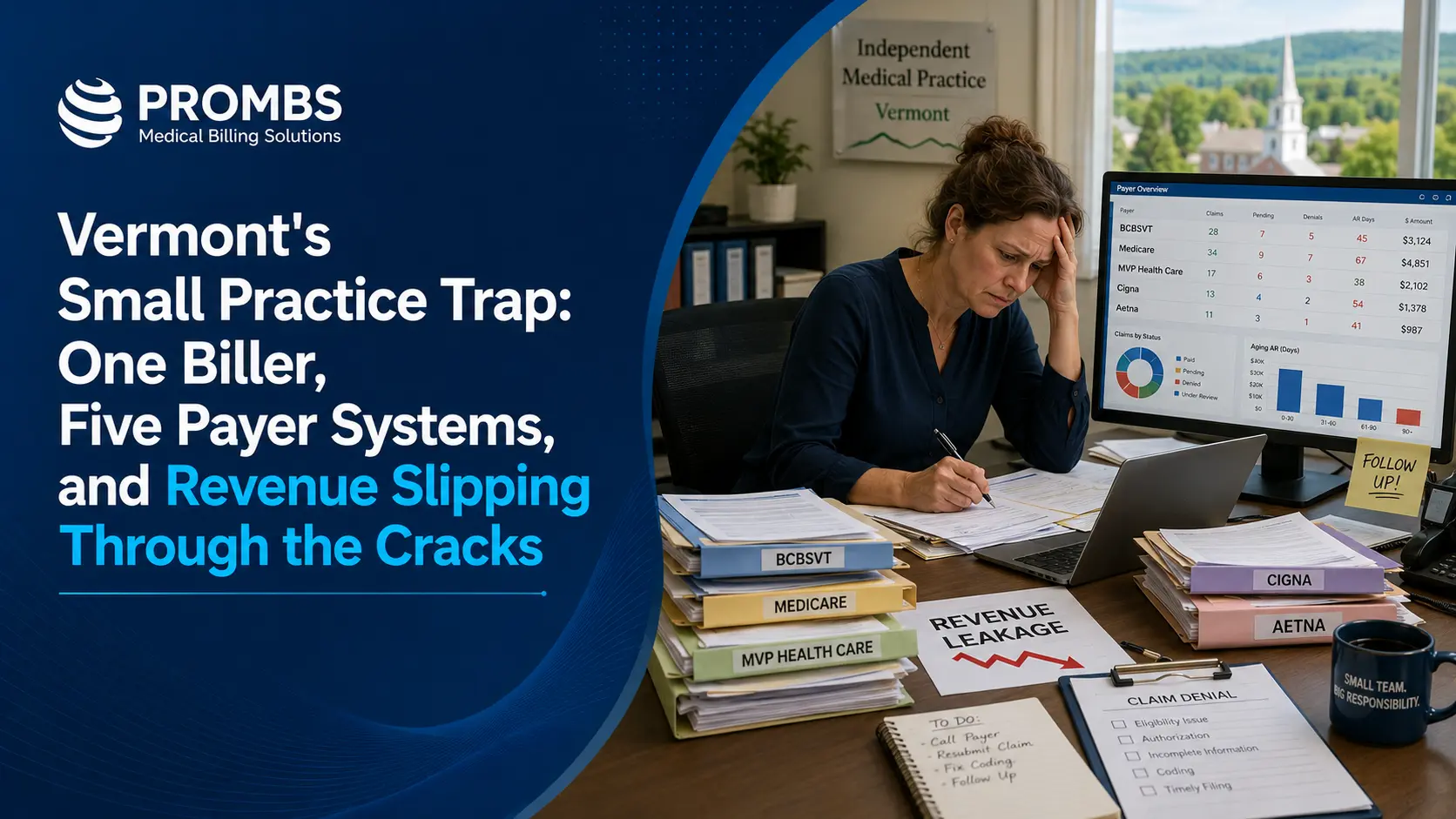
Here’s the trap that’s quietly draining Vermont’s small practices:
You have one, maybe two people handling billing. They’re good at their job. They know your patients by name.
But they’re also expected to keep up with Medicare, Green Mountain Care (Vermont Medicaid), commercial payers, OneCare Vermont’s All-Payer ACO Model, and whatever cross-border plan walked in from New Hampshire, New York, or Massachusetts this week.
That’s not a staffing problem. That’s five different billing systems running through one overworked person — and it’s costing you more than you realize.
Vermont is a state of small practices. Solo physicians, two-provider family medicine offices, rural behavioral health clinics — most of the state’s independent practices don’t have the scale to justify a full billing department. So billing becomes “one more thing” your office manager or a single biller handles alongside scheduling, intake, and everything else.
And Vermont’s healthcare landscape makes that especially hard:
- Vermont runs one of the only All-Payer ACO Models in the country through OneCare Vermont, which means many of your patients’ payments blend fee-for-service claims with value-based, per-capita components — two different billing logics running side by side.
- Vermont has one of the oldest and most rural populations in the Northeast, which means a high share of dual-eligible Medicare/Medicaid patients whose claims have to be coordinated across two programs correctly, every time.
- The Green Mountain Care Board regulates hospital and payer rates and reviews cost growth annually, so fee schedules and payer policies shift more often than a small office can track on top of daily patient care.
- Many Vermont practices sit near the New Hampshire, New York, and Massachusetts borders, pulling in patients covered by out-of-state commercial plans with their own prior authorization and billing rules.
- Telehealth billing has become a permanent fixture of rural Vermont care, and payer-by-payer telehealth reimbursement rules still don’t match each other.
Individually, none of these is unmanageable. Together, for a practice with one biller and no backup, they add up to claims sitting too long, denials that never get reworked, and revenue that just quietly disappears.
At Pro Medical Billing Solutions, we built our approach specifically for practices this size. This guide walks through why small Vermont practices lose more revenue than they think, what it’s actually costing you, and how the best medical billing company in Vermont closes that gap without requiring you to hire an in-house billing department you don’t have room for.
Why Small Vermont Practices Lose More Revenue Than Bigger Ones
Larger health systems can absorb billing complexity with dedicated staff for each payer type. Small Vermont practices can’t. Here’s where that gap actually shows up.
One Person, Every Payer Type
In a small practice, the same person who bills a straightforward commercial claim is also expected to correctly handle a dual-eligible Medicare/Medicaid claim, a OneCare Vermont attributed-patient encounter, and an out-of-state plan’s prior authorization — often on the same day.
Each of those has different rules. When one person is responsible for all of them, something gets deprioritized. Usually it’s the follow-up on denied or underpaid claims, because there’s no time left after getting new claims out the door.
The All-Payer Model Adds a Layer Most States Don't Have
Vermont’s All-Payer ACO Model through OneCare Vermont means a meaningful share of your Medicare and Medicaid patients may be attributed to value-based payment arrangements, while the rest of your patients are billed traditional fee-for-service.
That’s not a “set it and forget it” system. It requires tracking which patients are attributed where, reconciling incentive payments against your fee-for-service billing, and understanding how the two interact. Most small practices bill fee-for-service correctly and never fully reconcile the value-based side — leaving money on the table they don’t know is there.
Dual-Eligible Patients Are Billing Landmines
Vermont’s older, rural population means a high proportion of Medicare/Medicaid dual-eligible patients. Billing these correctly requires sequencing claims through both programs in the right order, with the right crossover handling. Get the order wrong, or miss a coordination-of-benefits step, and the claim either denies or underpays — and small offices often don’t have time to untangle why.
Out-of-State Plans Follow Out-of-State Rules
A practice in Brattleboro, White River Junction, or St. Albans may see a steady stream of patients covered by New Hampshire, Massachusetts, or New York commercial plans. Each of those plans has its own prior authorization thresholds, its own timely filing windows, and its own documentation requirements — none of which match Vermont’s in-state payers. A single biller juggling this alongside everything else will miss requirements simply because there are too many separate rulebooks to hold in one head.
Telehealth Billing Still Isn't Standardized
Telehealth became essential for rural Vermont access, and it’s stayed that way. But payers still don’t agree on modifiers, place-of-service codes, or reimbursement parity for virtual visits. A claim billed correctly for one payer’s telehealth rules can be denied outright by another for the same visit type.
Vermont's Small Practice Billing Landscape at a Glance
| Complexity Factor | What It Requires | Why Small Offices Struggle | Our Approach |
|---|---|---|---|
| All-Payer ACO Model (OneCare VT) | Tracking attribution and reconciling value-based vs. fee-for-service payments. | No dedicated staff to reconcile both payment models. | Dedicated ACO reconciliation tracking. |
| Dual-Eligible Medicare & Medicaid | Correct claim sequencing and coordination of benefits. | High claim volume with little room for billing errors. | Coordination-of-benefits specialists. |
| Green Mountain Care (VT Medicaid) | Continuous monitoring of fee schedules and policy updates. | A single biller can't keep up with every payer change. | Ongoing fee schedule and policy monitoring. |
| Out-of-State Commercial Plans | Managing different prior authorization and timely filing requirements. | Too many payer-specific rules for one billing professional. | Comprehensive multi-state payer rule library. |
| Telehealth Billing | Correct payer-specific modifiers and place-of-service codes. | Telehealth rules vary across insurance payers. | Payer-by-payer telehealth billing protocols. |
| Denial Follow-Up | Consistent and timely appeal and rework of denied claims. | After submitting new claims, there's little time left to recover denied revenue. | Dedicated AR and denial recovery team. |
Why It Matters: The best medical billing company in Vermont exists because billing complexity doesn't decrease with practice size. A two-provider practice often manages nearly the same payer requirements as a fifty-provider health system—but with only a fraction of the administrative staff.
💡 Pro Tip: If one biller is handling commercial insurance, Medicare, Medicaid, and OneCare Vermont attribution at the same time, denial follow-up is usually the first responsibility to fall behind. Unfortunately, that's also where some of the most recoverable revenue is often hiding.
What Happens When Small Practices Try to Manage This Alone
Every year, Medicare adjusts the dollar threshold above which a physical therapy claim needs a KX modifier attached to confirm that continued care is medically necessary. For 2026, that combined threshold for physical therapy and speech-language pathology services rose from $2,410 to $2,480.
This isn’t a hard cap on care. Patients can absolutely continue physical therapy past that dollar amount. What changes is the documentation burden. Once a patient crosses the threshold, your notes need to clearly justify why ongoing treatment is expected to keep improving or maintaining function — objective measures, updated goals, and a clear clinical rationale, not just a checkbox.
If your billing software or EMR still has the old $2,410 figure programmed into its alerts, that’s worth fixing this week. A missed KX modifier on a claim that should have one is one of the fastest ways to see an otherwise clean physical therapy claim get denied.
The "We're Too Small to Need Help" Assumption
Many small Vermont practices assume specialized billing support is only for larger systems. In reality, it’s small practices that feel every gap the most — there’s no second biller to catch what the first one misses, and no reserve capacity when someone is out sick or on leave.
The Denial Pile That Never Gets Worked
New claims always take priority over reworking old denials, because new claims are what keeps cash flow moving day to day. So denied and underpaid claims pile up in a folder, get triaged “later,” and eventually age past the timely filing window. That revenue doesn’t come back.
The Fee Schedule Nobody Has Time to Check
Green Mountain Care and commercial payer fee schedules change more than once a year. A single biller focused on getting claims out the door rarely has time to cross-check whether a payer quietly updated a rate. Underpayments on a schedule you haven’t rechecked can run for months before anyone notices.
The ACO Reconciliation That Never Happens
Attribution and value-based reconciliation under the All-Payer Model takes dedicated time most small offices simply don’t have. So the fee-for-service side gets billed, the value-based side gets ignored, and whatever incentive or shared-savings revenue exists goes unclaimed.
Know Your Vermont Revenue Gap
How Much Is Billing Complexity Costing Your Small Practice?
Small Vermont practices typically leave $8,000–$18,000 per month on the table through unworked denials, missed fee schedule updates, and unreconciled ACO attribution. Our free Vermont Revenue Audit shows you exactly where your revenue is slipping away—and how to recover it.
Analyze My Revenue Gap →✔ Takes only 2 minutes | ✔ Zero obligation | ✔ Results within 24 hours
The Real Financial Impact for a Small Vermont Practice
For a two-to-three provider Vermont practice, here’s what this complexity typically costs across a year.
Direct Costs:
- Billing staff time spent researching payer-specific rules: $2,500–$5,000/year
- Fee schedule tracking and updates: $500–$1,000/year
- Prior authorization delays and rework: $1,500–$3,000/year
- Total: $4,500–$9,000/year
Hidden Costs (The Real Killer):
- Unworked or aged-out denials: 4–7% of billed revenue
- Missed fee schedule updates: 2–4% annual revenue loss
- Unreconciled ACO/value-based payments: variable, often uncaptured entirely
- Staff time spent on billing instead of patient care: 8–12 hours/week
The Math:
For a small practice collecting $60,000/month across all payers:
- Unworked denials: $2,400–$4,200/month loss
- Fee schedule misses: $1,200–$2,400/month
- Unreconciled ACO revenue: $2,000–$5,000/month (often entirely unclaimed)
- Prior auth delays and rework: $1,000–$2,000/month
- Revenue actually lost: roughly $8,000–$18,000/month
That’s potentially $96,000–$216,000 a year for a practice with limited staff and even less room to absorb the loss.
Why Pro Medical Billing Solutions Is the Best Medical Billing Company in Vermont
We're Built for Practices Without a Billing Department
We don’t ask you to hire more staff. We become the billing department you don’t have room for — sized to a two-provider office just as effectively as a larger group.
We Reconcile Both Sides of the All-Payer Model
We track OneCare Vermont attribution alongside your fee-for-service billing, so value-based and shared-savings revenue doesn’t get left unclaimed simply because no one had time to look.
We Handle Dual-Eligible Sequencing Correctly, Every Time
Our team sequences Medicare/Medicaid crossover claims correctly the first time, so dual-eligible patients — a significant share of Vermont’s population — stop being a source of denials.
We Keep a Live Multi-State Payer Rule Library
Because Vermont practices routinely see New Hampshire, Massachusetts, and New York plans, we maintain current rules for each so your claims meet the right requirements the first time, not after a denial.
We Never Let Denials Age Out
Every denial gets worked on a schedule, not “whenever there’s time.” That’s the single biggest recovery lever for small practices, and it’s the first thing that slips when billing sits on one person’s plate.
We Track Fee Schedules Continuously
We update client fee schedules as soon as Green Mountain Care or commercial payers post changes — not once a year, and not after a pattern of underpayments shows up in your reports.
See the Difference
Small Vermont Practice
Solo Biller
Typical Clean Claim Rate
Pro Medical Billing Solutions
Dedicated Billing Team
Clean Claim Rate + Denial Recovery
Revenue Impact: For a small Vermont practice, closing the denial and reconciliation gap can recover $8,000–$18,000+ in monthly revenue that would otherwise remain uncollected.
Vermont Small Practices Closing the Gap
How Small Vermont Practices Stopped Losing Revenue to Billing Complexity
Green Mountain Family Medicine
📍 Montpelier, Vermont
"We had one biller covering everything—commercial, Medicare, Medicaid, and OneCare attribution. Pro Medical Billing Solutions found $11,000/month we were leaving on the table from unworked denials. Our collections increased by 16% without adding a single new patient."
— Dr. Rachel Holt
Practice OwnerNortheast Kingdom Behavioral Health
📍 St. Johnsbury, Vermont
"Dual-eligible billing was our biggest headache. Pro Medical Billing Solutions corrected our Medicare and Medicaid claim sequencing, reducing our denial rate by more than 50% within just two months."
— Dr. David Mercier
Clinical DirectorChamplain Valley Pediatrics
📍 Burlington, Vermont
"Between New York and New Hampshire patients, our prior authorization rules were constantly changing. Pro Medical Billing Solutions created payer-specific workflows for every state, and our claim rejection rate dropped to nearly zero."
— Dr. Lauren Tran
Practice OwnerFrequently Asked Questions
We're a two-provider practice — are we really too small to benefit from specialized billing help?
No. Small practices are often where the most revenue gets lost, because there’s no second person to catch what the first misses. Practice size doesn’t reduce payer complexity; it just reduces the staff available to manage it.
What is the All-Payer ACO Model, and why does it matter for billing?
Vermont’s All-Payer Model, run through OneCare Vermont, blends fee-for-service billing with value-based, per-capita payment components for attributed patients. Practices that only bill the fee-for-service side often leave value-based and shared-savings revenue unclaimed.
Why are dual-eligible Medicare/Medicaid patients harder to bill?
Claims for dual-eligible patients have to be sequenced correctly across both programs, with coordination-of-benefits handled properly. Vermont’s older, rural population means a higher share of patients fall into this category than in many other states.
We see a lot of out-of-state patients — does that actually change our billing?
Yes. Patients covered by New Hampshire, Massachusetts, or New York commercial plans bring their home state’s prior authorization thresholds, filing windows, and documentation rules with them, which don’t match Vermont’s in-state payers.
How do we know if we're losing money to unworked denials?
If your billing staff is prioritizing new claims over reworking denials — which is common when there’s only one or two people — some denials are likely aging past the timely filing window unnoticed. A billing audit is the fastest way to find out how much.
Do we need to hire more billing staff to fix this?
Not necessarily. Outsourcing to a team built for small practices typically costs less than a single additional hire and covers far more payer complexity than one person could manage alone.
Ready to Stop Losing Revenue to Complexity You Don't Have Staff For?
Every month your Vermont practice runs billing through one overworked person is a month of unworked denials, unreconciled ACO payments, and missed fee schedule updates adding up quietly in the background.
Pro Medical Billing Solutions was built for practices exactly this size. We become the billing capacity you don’t have room to hire.
Free Vermont Billing Audit
Your Small Practice Deserves More Than One Person Can Give It
Your Vermont practice could recover $8,000–$18,000 every month through billing optimization designed specifically for small practices. Request your FREE Vermont Billing Audit today and discover exactly where your revenue is being lost—and how to recover it.
Takes less than 5 minutes.
Our billing specialists will analyze your denial patterns, OneCare Vermont ACO reconciliation, and fee schedule accuracy—completely free, with no obligation.
