


An ophthalmology claim can look routine until it isn’t. A vision plan may cover the exam, while the medical payer handles the diagnostic test. Surgery brings global periods and modifier rules. Retina injections add drug units, NDC details, prior authorization, and reimbursement risk. One missed step can hold up a high-value claim for weeks.
That’s why choosing an ophthalmology billing company takes more than comparing fees, the billing team needs to understand how the visit was documented, why the test was ordered, and which payer should receive the claim. In practice, many denials begin before coding even starts, often with eligibility, authorization, or incomplete chart details.
The better ophthalmology billing companies don’t promise that every claim will sail through. No honest partner can. Most ophthalmology billing companies build checks around the places where revenue usually slips like medical versus vision coverage, diagnostic testing, surgery, injectable drugs, and payer specific edits.
The right ophthalmology billing company should make billing easier to see and manage, not turn it into another black box.
That difference matters when margins are already under pressure.
Best Ophthalmology Billing Companies at a Glance
Choosing a billing partner is confusing. This snapshot compares ophthalmology billing companies by positioning, not promises.
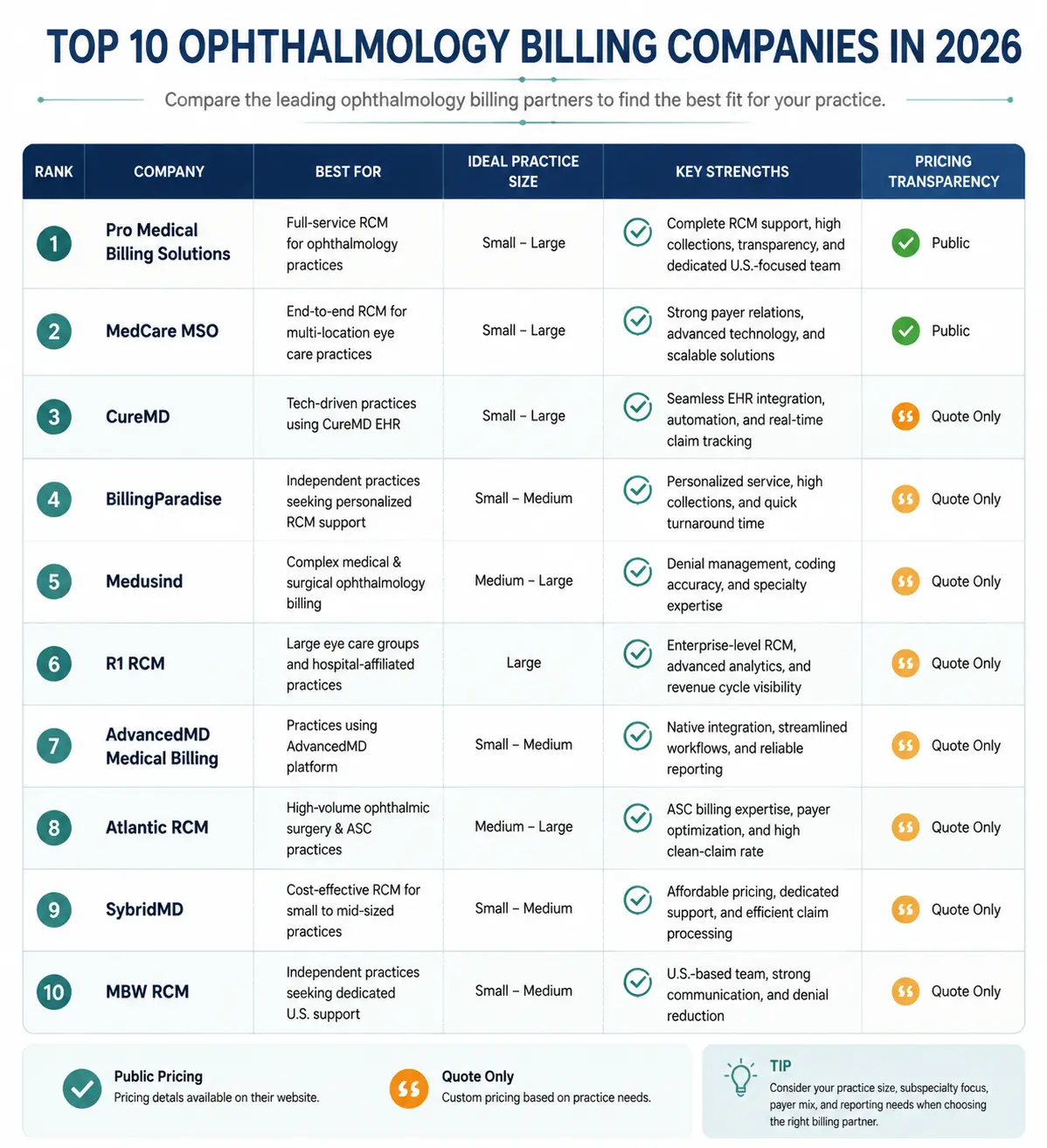
How We Ranked the Best Ophthalmology Billing Companies
Rankings can look convincing even when the method behind them is vague. We avoided that problem by reviewing every company through the same framework. Each provider was assessed for specialty knowledge, service depth, medical billing and coding audit, denial support, technology, reporting, scalability, pricing clarity, and market reputation.
We also looked at whether the company’s public claims were specific, current, and supported by verifiable information. No provider received extra credit for brand size alone. The goal was to compare ophthalmology billing companies on the factors that matter in day-to-day revenue cycle work, not on polished marketing language or unproven performance promises to practices.
Ranking Criteria and Weighted Scoring System
The scoring model gives the most weight to ophthalmology billing expertise at 25%. That matters because medical-versus-vision billing, diagnostic testing, injections, and surgical claims require specialty knowledge. Service scope accounts for 20%, covering front-end work, coding, claims, payment posting, denials, and AR follow-up.
Coding and denial management receive 15%, while RCM technology and reporting receive another 15%. We then assign 10% to scalability, since a vendor should support growth without service slipping. Pricing transparency also carries 10%, rewarding clear fees and fewer hidden add-ons. The final 5% reflects reputation, including credible reviews, years in business, and verifiable client experience. This weighting favors practical capability over popularity. A well-known company can still rank lower if its ophthalmology support, reporting access, or contract terms are difficult for a practice to verify independently.
Research, Verification and Editorial Disclosure
This ranking was reviewed in July 2026 using company websites, service pages, public pricing information, case studies, technology descriptions, and other materials available to prospective clients. Where a provider made a performance claim, we looked for supporting details such as a timeframe, calculation method, client example, or independent source, and claims that could not be confirmed were treated as marketing statements, not established results.
What Does an Ophthalmology Billing Company Do?
An ophthalmology billing company keeps the revenue cycle management moving when eye care claims get complicated, that means more than sending a bill. It means checking whether the visit belongs under medical or vision coverage, making sure the chart supports the service, and monitoring payer rules that can derail payment.
A retina injection is a good example. The claim may look complete, but one mismatch in drug units or authorization can hold up a large payment. The billing company follows that claim, posts the response correctly, and works the problem until the account is settled or clearly explained to staff.
From Eligibility Verification to Final Payment
Good ophthalmology billing services begin with a simple question: who is responsible for this visit? The answer may be a medical plan, a vision plan, or the patient. Eligibility and benefits verification help sort that out before anyone is left guessing.
Prior authorization comes next for services that require it. After the visit, the chart, codes, modifiers, and drug units need to match. Charges are entered, claims go out, and payer responses are posted against the account.
The messy part starts when payment is short, late, or missing. Someone has to read the denial, fix the cause, file the appeal, and keep an eye on aging AR. Patient balances need the same care. Clear statements and accurate amounts prevent confusion at the front desk later.
Specialized Ophthalmology Billing vs General Medical Billing
General billing teams can handle ordinary claims. Ophthalmology gets less ordinary very quickly. A cataract case may involve global-period rules. A retina visit may include imaging, an injection, a drug code, and an authorization that expires sooner than expected.
A specialized ophthalmology billing company is more likely to recognize those details before the claim stalls, that does not mean outsourcing is always the answer. An experienced in-house team may know the practice better than anyone. Software can catch edits, but it cannot chase every payer or explain a weak chart note.
Some practices split the work. Staff handle registration and charge capture, while an outside team manages claims, denials, and AR. The better model is the one the practice can oversee consistently without losing visibility.
Why Ophthalmology Billing Is Changing in 2026
Eye care billing isn’t standing still. Payers are changing edits, documentation expectations, and authorization steps, while practices are adding more imaging, surgery, and injectable-drug services. At the same time, automation is moving into daily billing work.
That can help, but it also creates new questions about oversight and accuracy. A capable ophthalmology billing company now has to do more than process claims. It must watch policy changes, understand increasingly layered procedures, and know when technology has missed the clinical detail that actually supports payment. And explain each change to staff.
Medicare Reimbursement and Coding Changes
Annual code changes rarely arrive with flashing warning lights. They show up later as a rejected test, an unexpected bundling edit, or a payment that doesn’t match the practice’s forecast. For that reason, ophthalmology reimbursement needs regular review across CPT, ICD-10-CM, NCCI edits, and the Medicare Physician Fee Schedule.
CMS updates payment policies each year and revises NCCI guidance and edits on a scheduled basis. A sound billing team checks effective dates, payer adoption, modifier rules, and local coverage requirements before changing workflows. It also avoids broad claims such as “reimbursement increased.” The effect can differ by code, setting, locality, payer, and provider participation. That makes blanket predictions especially risky.
AI, Automation and Electronic Prior Authorization
Automation is useful when it handles the repetitive work well. It can check eligibility, flag missing fields, scrub claims, sort denials, and move accounts into the right follow-up queue. AI in ophthalmology billing, however, shouldn’t be treated as a substitute for judgment. A system may spot a code conflict without understanding why two tests were medically necessary on the same day.
Electronic prior authorization is also expanding, with CMS pushing payers and health technology toward faster digital exchange. That may reduce manual work, but experienced staff still need to review documentation, payer responses, exceptions, and unusual drug or surgical cases before submission.
Medical, Vision, Surgical and Drug Billing Complexity
Ophthalmology rarely follows one billing lane. A routine refraction may involve vision benefits, while an exam tied to glaucoma or retinal disease may go to the medical payer. Diagnostic tests bring medical-necessity and frequency rules.
Surgery adds global periods, modifiers, co-management, and facility coordination. Injectable drugs create another layer: authorization, units, NDC details, wastage, and underpayment risk. That is why ophthalmology medical billing can’t rely on one standard workflow. The same patient may move through several coverage paths in one episode of care. The billing team has to recognize the difference early, because fixing the wrong payer later is slow and expensive. And can frustrate both staff and patients alike.
Top 10 Ophthalmology Billing Companies Ranked for 2026
A ranked list is only useful when readers can see how the choices were made. We reviewed these ophthalmology billing companies through the same lens. We use specialty depth, service coverage, coding support, denial work, technology, reporting, scalability, pricing clarity, and evidence that a practice can verify.
Each profile follows one structure, including best fit, practical strengths, and a fair limitation. That matters because a polished website can make every vendor sound identical. They aren’t. Some are built for independent practices, others for large groups or health systems.
The ranking below reflects fit and capability, not brand recognition alone or marketing volume.
01 Pro Medical Billing Solutions
Best Overall Ophthalmology Billing Company in the USA
★★★★★ Editorial Score: 4.8/5
Pro Medical Billing Solutions earns the top position for offering a broad revenue cycle model built around specialty billing rather than claim submission alone. Its ophthalmology services cover eligibility, authorizations, coding support, claim processing, payment posting, denial management, AR recovery, credentialing, and reporting.
The company also addresses a problem that general billing teams sometimes miss: the split between medical and vision coverage. That matters when the same patient receives an exam, diagnostic test, and procedure under different benefit rules.
Its hands-on account support may suit practices that want regular communication instead of a dashboard-only relationship. Still, this ranking is an editorial assessment, not an independent award.
| Review Lens | What We Found |
|---|---|
| Best Practice Fit | Ophthalmology practices seeking complete, specialty-focused revenue cycle support |
| Services Covered | Eligibility, coding oversight, claims, denial management, AR recovery, credentialing, and reporting |
| Ophthalmology Edge | Medical-versus-vision billing, cataract, retina, glaucoma, and diagnostic testing |
| Standout Value | Personalized account support with full-cycle revenue oversight |
| Reporting Experience | Clear financial reports, performance reviews, and account-level visibility |
| Practice Match | Solo ophthalmologists through large, multi-location groups |
| Pricing Visibility | Public starting rate of 2.49% of collections |
02 MedCare MSO
Best Ophthalmology Billing Company for Automation and Connected Workflows
★★★★★ Editorial Score: 4.7/5
MedCare MSO stands out for combining outsourced billing with ophthalmology-focused technology. Its public materials describe workflows for medical and vision split billing, prior authorization, claim processing, denials, payments, and reporting.
The software side is the real differentiator. MedCare promotes automation for prior authorization and claim review, which may help busy practices reduce manual follow-up. A retina or surgical group, for example, could use those tools to track high-value claims that shouldn’t disappear into a general work queue.
Technology isn’t the same as oversight, though. Practices should ask which decisions are automated, which require human review, and how exceptions are escalated. Integration costs and implementation responsibilities should also be confirmed before choosing this ophthalmology billing company.
| Review Lens | What We Found |
|---|---|
| Best Practice Fit | Practices looking for billing automation and connected ophthalmology workflows |
| Services Covered | Medical billing, coding, AR follow-up, denials, prior authorization, and reporting |
| Ophthalmology Edge | Medical-versus-vision claims, surgical billing, and authorization tracking |
| Standout Value | Billing services supported by ophthalmology-focused technology and automation |
| Reporting Experience | Dashboards, workflow tracking, payer visibility, and automated reporting tools |
| Practice Match | Independent clinics through growing, multi-provider ophthalmology groups |
| Pricing Visibility | Custom quote required |
03 CureMD
Best for Connected Ophthalmology EHR, Practice Management and Billing
★★★★½ Editorial Score: 4.6/5
CureMD is a practical choice for practices that want clinical and financial work handled within one environment. Its ophthalmology product combines specialty EHR functionality with practice management and revenue cycle services.
That connected setup can reduce double entry. A provider documents the visit, the billing team receives the clinical information, and staff can follow the claim without jumping between unrelated systems. For smaller and midsize practices, fewer moving parts can be a genuine relief.
ureMD is best understood as an integrated ophthalmology billing platform, not only an outsourced billing company. That makes it attractive for practices willing to use its technology. It may be less suitable for a group that already likes its EHR and doesn’t want the disruption of migration. Data conversion, customization, training, and exit access should be reviewed carefully.
| Review Lens | What We Found |
|---|---|
| Best Practice Fit | Practices wanting EHR, practice management, and billing in one connected environment |
| Services Covered | Eligibility, clinical documentation, claims, posting, denials, appeals, and reporting |
| Ophthalmology Edge | Specialty templates and connected clinical-to-billing workflows |
| Standout Value | One platform for clinical documentation and financial operations |
| Reporting Experience | Cloud dashboards, claim tracking, scheduling data, and revenue reports |
| Practice Match | Small and midsize ophthalmology practices |
| Pricing Visibility | Custom pricing based on software and billing requirements |
04 BillingParadise
Best for Ophthalmology Groups, Denials and Multi-EHR Support
★★★★½ Editorial Score: 4.5/5
BillingParadise focuses heavily on group-practice revenue cycle work. Its ophthalmology services include coding, claims, denial management, AR follow-up, appointment support, credentialing, reporting, and practice-management functions.
Its public materials also mention support across more than 20 EHR products. That can be useful when a growing group has several locations running different systems, a common headache after acquisitions or practice expansion.
Among ophthalmology billing companies, BillingParadise appears well suited to groups that need structured teams and measurable work queues. Several performance figures on its website are self-reported, however. Practices should request the calculation method behind clean-claim and acceptance-rate claims. They should also confirm whether staff are dedicated to the account or shared across several clients.
| Review Lens | What We Found |
|---|---|
| Best Practice Fit | Growing groups and multi-location ophthalmology practices |
| Services Covered | Coding, billing, AR management, denials, credentialing, scheduling, and reporting |
| Ophthalmology Edge | Group-practice workflows, diagnostic testing, and payer-specific claim requirements |
| Standout Value | Structured RCM teams with support for multiple EHR systems |
| Reporting Experience | KPI reporting, denial analysis, AR visibility, and location-level performance tracking |
| Practice Match | Independent groups through larger multi-provider organizations |
| Pricing Visibility | Custom quote required |
05 Medusind
Best Ophthalmology RCM Company for High-Volume and ASC Billing
★★★★½ Editorial Score: 4.5/5
Medusind’s ophthalmology offering is designed for scale. The company describes dedicated ophthalmology teams with experience in CPT coding, modifiers, and ambulatory surgery center billing.
That focus may suit practices where professional and facility billing overlap. Cataract surgery is a good example. The surgeon, office, and ASC may each have separate billing responsibilities, yet one missing detail can hold up the entire revenue picture.
Medusind also emphasizes analytics, workflow support, and account management. Those capabilities may help multi-location organizations identify recurring issues instead of reviewing claims one by one. As an ophthalmology RCM company, it appears strongest for established groups. Smaller practices should ask about minimum volume, team structure, service flexibility, and whether the account would receive enough direct attention.
| Review Lens | What We Found |
|---|---|
| Best Practice Fit | High-volume ophthalmology groups and practices connected with an ASC |
| Services Covered | Billing, coding, claims, denials, analytics, workflow support, and account management |
| Ophthalmology Edge | Surgical claims, modifiers, cataract billing, and ASC revenue workflows |
| Standout Value | Scalable billing operations for complex, multi-location organizations |
| Reporting Experience | Revenue analytics, operational dashboards, and workflow-level visibility |
| Practice Match | Large groups, surgical practices, ASCs, and multi-location organizations |
| Pricing Visibility | Custom quote required |
06 R1 RCM
Best for Hospital-Affiliated Groups and Enterprise Revenue Operations
★★★★½ Editorial Score: 4.4/5
R1 RCM operates at a larger scale than most providers on this list. Its physician revenue cycle services are built for hospital-owned groups, independent physician organizations, and health systems managing complex operations across multiple locations.
The company combines human revenue cycle teams with automation and AI-supported tools. Its platform addresses remits, denials, outstanding claims, patient access, and broader revenue operations.
This makes R1 a strong option for enterprise ophthalmology RCM, especially when an ophthalmology department sits inside a larger health system. It is not, however, an ophthalmology-only company. Small independent practices may find the model too broad or operationally heavy. Buyers should confirm ophthalmology staffing, implementation governance, reporting access, and how much control local practice leaders retain.
| Review Lens | What We Found |
|---|---|
| Best Practice Fit | Health systems, hospital-affiliated groups, and enterprise physician organizations |
| Services Covered | End-to-end physician RCM, patient access, claims, denials, payments, and revenue recovery |
| Ophthalmology Edge | Enterprise support for ophthalmology departments operating within larger systems |
| Standout Value | Large-scale revenue infrastructure combining technology, automation, and operational teams |
| Reporting Experience | Enterprise analytics, system-wide reporting, and revenue performance monitoring |
| Practice Match | Large physician groups, hospitals, and integrated health systems |
| Pricing Visibility | Custom enterprise proposal |
07 AdvancedMD Medical Billing
Best Ophthalmology Billing Provider for Pricing Accessibility
★★★★ Editorial Score: 4.3/5
AdvancedMD Medical Billing offers broad billing support with one advantage many competitors avoid: it publishes a starting percentage. Its services include eligibility checks, claim scrubbing, coding, submission, payment follow-up, AR recovery, and account management.
That pricing visibility can help a smaller practice begin its comparison. Still, the lowest percentage doesn’t always produce the lowest total cost. Credentialing, older AR, interfaces, patient calls, or coding audits may sit outside the standard fee.
AdvancedMD Medical Billing states that it supports more than 50 specialties. That breadth is useful, but it doesn’t automatically prove deep ophthalmology experience. Before selecting it as an ophthalmology billing provider, ask for ophthalmology references, coder credentials, sample denial reports, and written confirmation of how retina drugs and surgical claims are handled.
| Review Lens | What We Found |
|---|---|
| Best Practice Fit | Cost-conscious independent and growing ophthalmology practices |
| Services Covered | Eligibility, coding, claims, denial support, collections, and AR recovery |
| Ophthalmology Edge | Broad specialty billing support with access to standard RCM services |
| Standout Value | Publicly advertised starting pricing and flexible outsourced support |
| Reporting Experience | Cloud-based reports, account updates, and revenue performance visibility |
| Practice Match | Solo providers through larger physician groups |
| Pricing Visibility | Public starting rate of 2.99% |
08 Atlantic RCM
Best for Complete Revenue Cycle Outsourcing
★★★★ Editorial Score: 4.2/5
Atlantic RCM provides a traditional end-to-end outsourcing model. Its services include medical billing, coding, claims processing, payment posting, denial management, and AR follow-up.
This may suit an established practice that wants one outside team to own most of the billing process. Instead of splitting work among a clearinghouse, coding vendor, and AR company, the practice can place those functions under one relationship.
Atlantic lists ophthalmology and optometry among the specialties it serves, but its public materials contain less eye-care detail than several higher-ranked providers. For ophthalmology billing outsourcing, buyers should confirm who reviews surgical cases, diagnostic testing, global periods, and injectable-drug claims. Reporting frequency, team location, and escalation times should also be written into the agreement.
| Review Lens | What We Found |
|---|---|
| Best Practice Fit | Established practices seeking complete back-office RCM outsourcing |
| Services Covered | Coding, claim submission, payment posting, denial management, and AR recovery |
| Ophthalmology Edge | Broad physician billing support that includes ophthalmology and optometry |
| Standout Value | One vendor for most revenue cycle and billing functions |
| Reporting Experience | Standard RCM reports, AR monitoring, and account-level performance updates |
| Practice Match | Independent practices, physician groups, and hospital-based organizations |
| Pricing Visibility | Custom quote required |
09 SybridMD
Best for Billing, Credentialing and Administrative Support
★★★★ Editorial Score: 4.1/5
SybridMD combines medical billing with administrative services such as eligibility, coding, claim submission, payment collection, credentialing, and provider enrollment.
That wider service mix may appeal to smaller practices that need help beyond claims. A new ophthalmologist, for example, may need payer enrollment and billing setup at the same time. Keeping both tasks with one company can reduce handoffs.
SybridMD also states that it can integrate with different practice-management systems. Its public materials, however, explain general billing and credentialing more clearly than ophthalmology-specific workflows. Before using the company for outsourced ophthalmology billing, practices should ask who handles cataract, retina, glaucoma, and drug claims, where the assigned team is located, and how clinical questions are escalated.
| Review Lens | What We Found |
|---|---|
| Best Practice Fit | Practices needing billing, credentialing, and administrative support together |
| Services Covered | Eligibility, coding, claims, collections, AR management, and provider enrollment |
| Ophthalmology Edge | Multi-service support for practices outsourcing both revenue and administrative work |
| Standout Value | Billing and credentialing available through one vendor |
| Reporting Experience | Practice-management integration, claim tracking, and account reporting |
| Practice Match | New, small, and midsize ophthalmology practices |
| Pricing Visibility | Custom proposal |
10 MBW RCM
Best for Cataract, Retina and Glaucoma Billing Workflows
★★★★ Editorial Score: 4.1/5
MBW RCM publishes detailed material on ophthalmology billing, including cataract surgery, retina services, glaucoma care, diagnostic tests, global periods, payer rules, and modifiers.
The company also offers broader RCM functions covering eligibility, prior authorization, coding, charge entry, claim submission, posting, denial appeals, AR follow-up, underpayment recovery, and patient statements. This gives it a wider service base than a coding-only vendor.
Among ophthalmology billing companies, MBW shows a clear interest in surgical and procedure-heavy workflows. Still, many performance statements on its pages come from the company itself. Buyers should separate educational expertise from verified client results. Ask for comparable ophthalmology references, coder credentials, staffing information, reporting samples, and case-study calculations before relying on revenue or denial-reduction claims.
| Review Lens | What We Found |
|---|---|
| Best Practice Fit | Surgical ophthalmology groups and multi-location practices |
| Services Covered | Eligibility, coding, charge entry, claims, payment posting, denials, AR, and underpayment recovery |
| Ophthalmology Edge | Cataract, retina, glaucoma, diagnostic imaging, and procedure-heavy workflows |
| Standout Value | Detailed public focus on ophthalmology procedures and surgical billing challenges |
| Reporting Experience | Revenue analytics, denial reports, AR tracking, and operational performance reviews |
| Practice Match | Surgical groups, hospitals, ASCs, and multi-location eye-care organizations |
| Pricing Visibility | Custom quote required |
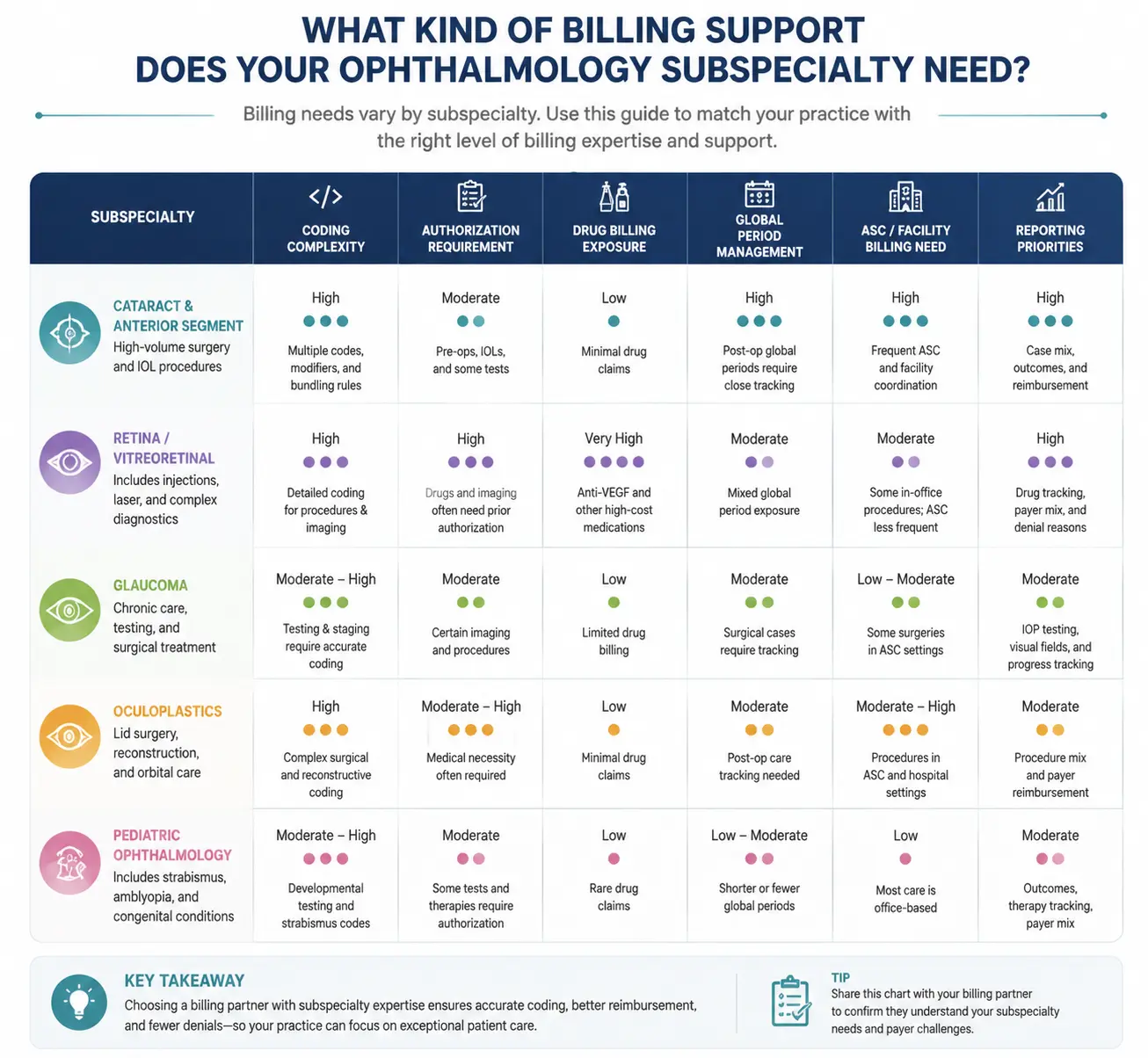
Which Ophthalmology Billing Company Fits Your Subspecialty?
Not every eye care practice needs the same kind of billing support. A cataract surgeon faces different risks than a retina group handling costly injectable drugs. Glaucoma clinics lean heavily on diagnostic testing, while oculoplastics may cross the line between cosmetic and medically necessary care.
The right ophthalmology billing company should match that clinical mix. Before choosing one, compare coding depth, authorization work, drug exposure, global-period knowledge, ASC coordination, and reporting detail. A vendor that looks strong on paper may still be the wrong fit for your subspecialty and workflow.
Cataract, Anterior Segment and ASC Billing
Cataract billing is rarely one clean claim. The surgeon’s professional fee, the facility claim, anesthesia, and lens-related charges may move on separate tracks. A capable cataract surgery billing company should understand laterality, global periods, postoperative care, and co-management between the surgeon and referring optometrist.
Lens procedures need careful documentation, especially when covered and noncovered services appear in the same episode. In practice, problems often start when office and ASC teams use different dates, modifiers, or assumptions. Strong coordination matters.
The billing partner should reconcile professional and facility records, flag mismatches early, and explain who owns follow-up when payment stalls across every claim, provider, and location.
Retina Injections, J-Codes and Drug Reimbursement
Retina billing carries real financial exposure because the drug may cost far more than the office visit. Good retina billing services should verify authorization, check the approved drug, and confirm units before the injection is given. The claim then needs accurate J-codes, NDC information, dosage, and wastage documentation.
Inventory records should also agree with what was billed. When those pieces drift apart, buy-and-bill claims can be underpaid or denied. A strong team compares acquisition records, administered units, remittance details, and payer allowables.
It should also catch partial payments, not just outright denials, because a quiet underpayment can be just as costly over several treatment cycles.
Glaucoma, Imaging and Diagnostic Testing
Diagnostic testing can look routine until a payer asks why it was done again. Ophthalmology diagnostic billing depends on medical necessity, timing, interpretation, and the relationship between the test and the patient’s condition.
Frequency limits may vary by payer or diagnosis. NCCI edits can also affect services billed on the same day, especially when procedures and imaging overlap. The chart should show more than a test result; it should explain why the test was needed and how the physician used it.
A careful billing team checks those details before submission, then watches for bundling edits, modifier misuse, repeat-test denials, and payer trends closely during follow-up.
Oculoplastics, Pediatric Ophthalmology and Medical-Vision Billing
Oculoplastics and pediatric eye care sit in billing gray areas more often than many practices expect. A drooping eyelid procedure may be functional for one patient and cosmetic for another. Bilateral services add another layer. Pediatric claims may need clearer documentation of symptoms, failed treatment, or developmental impact.
Specialty ophthalmology billing also has to route claims correctly when medical and vision plans overlap. A child may have a vision benefit for the exam but medical coverage for amblyopia treatment or diagnostic testing.
The billing team should review the reason for the visit first, and document the decision clearly internally.
How Ophthalmology Billing Companies Charge
The cheapest quote can end up being the expensive choice. Ophthalmology medical billing companies price their work in a few common ways: a share of collections, a monthly retainer, a fee per claim, or a software subscription. Some split the work with the practice and charge only for the pieces they handle.
What matters is the full cost after add-ons, staff time, missed follow-up, and transition work are counted. A lower rate means little if appeals, old AR, drug claims, or reporting sit outside the agreement over a full year period.
Percentage-of-Collections Pricing
Percentage pricing sounds straightforward: the company gets paid when the practice gets paid. The catch is how “collections” are defined. Ophthalmology billing company cost may be based on insurance payments alone, or it may include patient payments, old AR, drug reimbursement, and underpayments recovered later.
Ask to see that language in writing. A retina practice can pay far more than expected if high-cost drug payments are included in the same percentage as ordinary office claims over a full year overall.
Flat Monthly and Per-Claim Pricing
A flat monthly fee gives the practice a number it can plan around. Per-claim pricing rises and falls with volume. Both can work, especially when the workload is steady, and the fine print matters, though. Medical billing pricing may not include appeals, credentialing, old AR, or complex surgical and drug claims.
A quiet month may still cost the same under a retainer, while a busy month can make per-claim billing jump. Compare the likely annual total, not one attractive monthly figure.
Software-Only and Co-Managed RCM Models
With ophthalmology billing software, the practice buys the tools but keeps much of the work. Staff still review edits, answer payer questions, handle denials, and watch patient balances. Full outsourcing hands most of that responsibility to a vendor.
Co-managed RCM splits it. One practice may keep registration and charge entry, then send claims and AR follow-up outside. The hybrid model works only when ownership is clear. Otherwise, unpaid claims sit between two teams, each assuming the other is handling them.
Calculating the Total Cost and Expected ROI
A useful ophthalmology RCM ROI review starts with cash, not promises. Compare collections before and after the change, then add underpayments recovered and savings in payroll, overtime, or software. From that amount, subtract vendor fees, setup costs, interfaces, training, and temporary disruption during the switch.
Run the calculation for 12 months, then again for 24. Early costs can make the first year look weak. The second year often gives a clearer view of whether the arrangement is actually paying off.
How the Right Ophthalmology Billing Company Improves Revenue
“More revenue” is easy to promise. The useful question is where the improvement will show up. A capable ophthalmology billing company like Pro Medical Billing and AdvancedMD Medical Billing should shorten charge lag, cut repeat denials, recover old balances, and catch payments that came in contract. It should also make those changes visible in monthly reports.
In practice, the strongest gains often come from ordinary fixes: cleaner eligibility work, better documentation, and faster follow-up. None sounds dramatic. Together, they can steady cash flow and give staff fewer problems to untangle each week, without adding more office chaos.
Improve Eligibility and Prior Authorization Before the Visit
Strong eligibility and prior authorization work confirms active benefits, checks referral rules, and decides whether the visit belongs under medical or vision coverage. For injections, imaging, or surgery, the team should track approval numbers and expiration dates, not just note that authorization was requested.
It should also give staff a realistic patient estimate. That early clarity helps prevent cancelled procedures, avoidable denials, and awkward front-desk conversations when a patient expected the plan to cover more than it actually does before treatment begins.
Strengthen Documentation, Charge Capture and Modifier Accuracy
A code can be correct and the claim can still fail. The chart may not support laterality, a modifier may be missing, or a postoperative visit may conflict with the global period. Good ophthalmology coding accuracy comes from reviewing the full encounter, not simply reading a charge ticket. Specialty teams also look for tests and procedures that were documented but never billed.
These small misses are easy to overlook during a busy clinic. Repeated across several providers, though, they can quietly turn into lost revenue and hours of avoidable rework.
Protect Drug, Injection and Surgical Revenue
With retina drug billing, the team needs to match the drug purchased with the units given, the NDC submitted, and any wastage documented in the chart. Then it must compare the payment with the payer’s allowable amount. Surgical claims need similar attention around modifiers and global rules.
High-value accounts shouldn’t sit in an ordinary follow-up queue. They need faster escalation, because one missed underpayment may erase the margin from several correctly paid visits during every payment cycle.
Reduce Denials, Aging AR and Patient-Balance Leakage
Denials tell a story, but only when someone groups them properly. Effective ophthalmology denial management separates problems by payer, location, code, and cause, then assigns each one to a named owner. Appeals need dates, not sticky-note reminders.
Older AR should be sorted by value and collectability so staff don’t spend an hour chasing a balance worth less than the call. Patient statements matter too. If the amount is wrong or unclear, collection slows. Underpayments deserve their own review, since a “paid” claim can still leave money behind month after month.
Ophthalmology Revenue Cycle KPIs to Track
A revenue cycle can look healthy while money is quietly getting stuck. The bank balance may be steady, yet claims are aging, authorizations are expiring, or small underpayments are slipping through. That’s why ophthalmology RCM KPIs need to be reviewed together, not one at a time.
Start with clean-claim rate and first-pass acceptance. They show whether claims are leaving the practice in good shape. Denial rate explains what still breaks after submission. Days in AR and AR over 90 days reveal how long cash is sitting unpaid, while net collection rate shows how much of the collectible revenue actually came in.
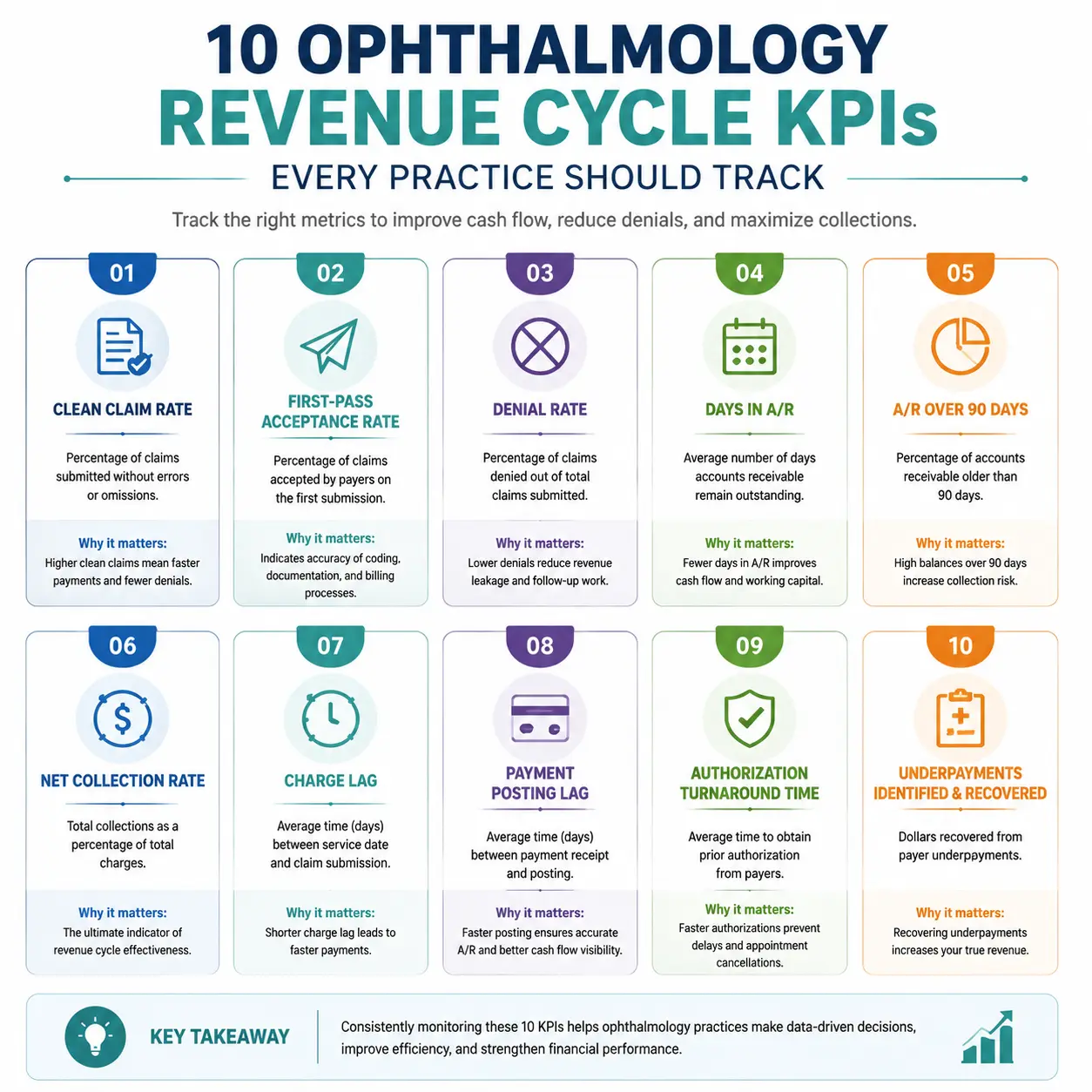
The timing measures matter too. Charge lag tracks how quickly visits become claims. Payment posting lag shows whether remittances are reaching patient accounts promptly. Appeal success tells you whether denial work is producing results, not just activity. Prior-authorization turnaround matters because delayed approvals can push back treatment or force staff into last-minute calls.
In practice, one metric rarely tells the full story. A practice may have a low denial rate but still carry too much old AR. Another may post payments quickly while missing underpayments. Review the numbers by payer, provider, location, and procedure type. That’s where patterns appear.
The goal isn’t to chase a perfect score. It’s to spot movement early, ask why it changed, and assign a clear owner before a small issue becomes a monthly revenue problem. A useful dashboard should also show the trend beside the current result, since a number without last month’s context can look reassuring when performance is actually slipping slowly again.
Red Flags When Choosing an Ophthalmology Billing Company
Some warning signs are obvious. Others look like harmless details until a difficult claim lands. When reviewing an ophthalmology billing company, pay attention to what the sales team avoids answering. Can they explain fees without circling back? Will they show a real report? Who takes over when a retina drug claim is denied on Friday afternoon?
One weak answer isn’t proof of poor service. The pattern is different. The safest choice is usually the vendor that is clear about limits, ownership, response times, and what happens when things go wrong.
Vague Pricing, Undefined KPIs and Unclear Service Scope
An ophthalmology billing contract should read like an operating plan, not a brochure. The fee needs a clear definition, including whether appeals, old AR, credentialing, interfaces, patient calls, and drug claims cost extra. KPIs should be defined in plain language.
“Clean claim rate” is useless if nobody explains the denominator. Response times matter too. A practice should know when routine questions, urgent denials, and payer escalations will be answered.
Ask for a sample report before signing. If the vendor cannot show how work, results, and exceptions are tracked, the practice may be buying activity without useful visibility or real accountability.
Weak Data Ownership, Security and Exit Terms
comfortable discussing security without hiding behind a generic policy statement. The practice needs a signed BAA, role-based access, named subcontractors, and a clear breach-notification process. Then ask who owns the claim history? Can reports be exported in a usable format? Will payer credentials remain under the practice’s control?
Exit language matters because relationships do end, even good ones. A clean contract explains how open denials, AR files, patient data, and system access will be transferred. Discovering those limits during termination is far too late for any practice to face alone.
No Ophthalmology References or Specialty-Trained Staff
Good ophthalmology billing specialists should be able to discuss a cataract global period, a bilateral test, or a retina drug underpayment without reaching for a script. Verify coding credentials, procedure experience, and references from practices with a similar payer mix and service line.
Ask how many accounts each team member carries and how often staff change. A strong coder can still miss follow-up when the workload is unrealistic.
Finally, map the escalation path. Who handles the first issue, who steps in next, and how quickly? “Our team will review it” isn’t a process. Names, roles, and timelines should be written.
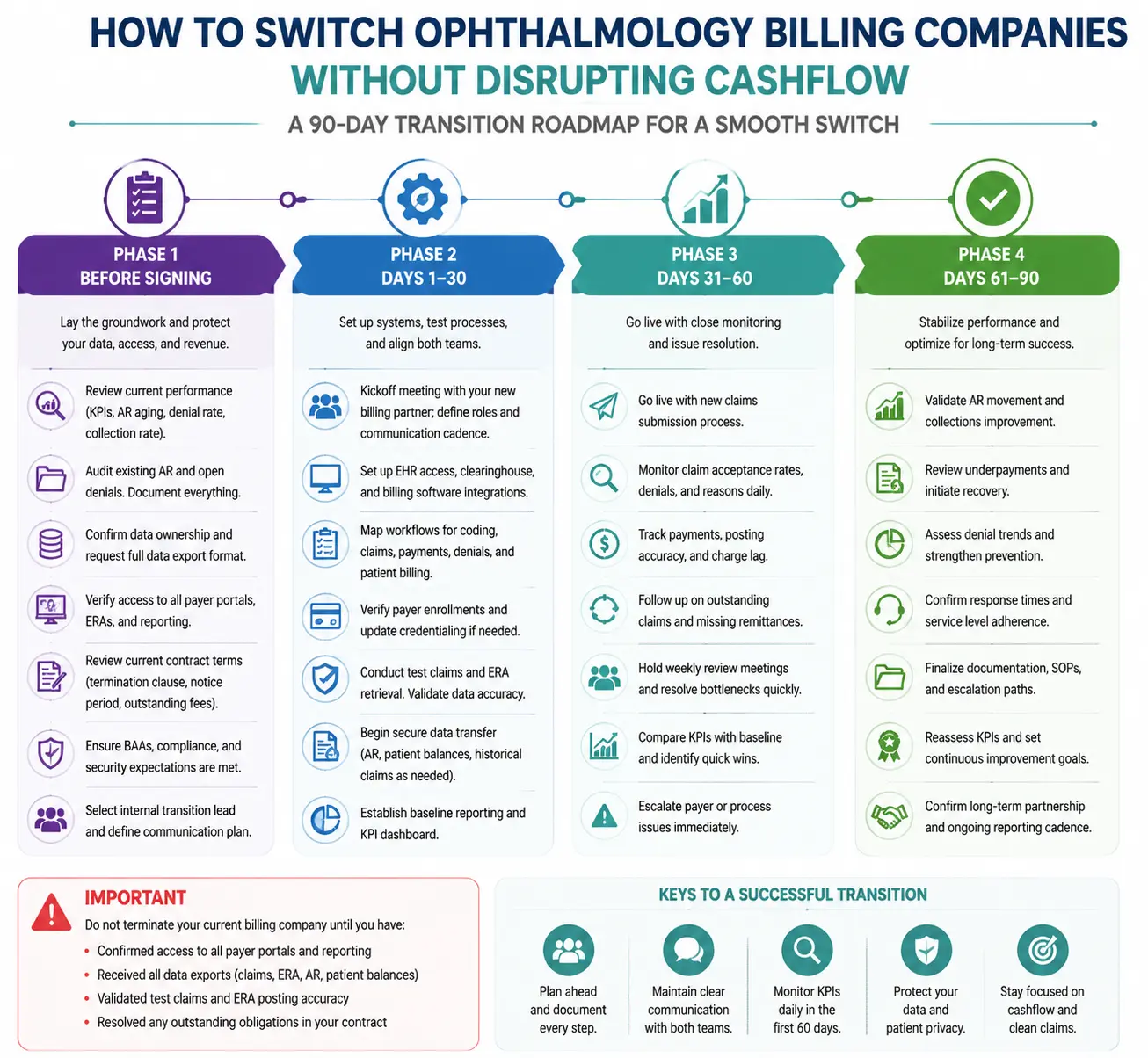
A 90-Day Plan for Switching Ophthalmology Billing Companies
Switching billing vendors is less like changing software and more like changing the engine while the car is moving. Claims still need to go out. Payments still need to post. Old AR cannot be abandoned, a careful move between ophthalmology billing companies should protect all three.
The first 90 days need clear ownership, parallel checks, and daily visibility into cash flow. If done well, the practice avoids a hard stop and if done poorly, it’s the other way around. It leads to small gaps in access, enrollment, or follow-up can quietly turn into weeks of delayed revenue during the handoff itself.
Before Signing: Audit, Data Access and Contract Review
Start with an ophthalmology billing audit before the new contract is signed. Capture the current denial rate, days in AR, charge lag, net collection rate, and AR over 90 days. Those numbers become the baseline later.
Then look at access, Confirm who controls payer portals, the clearinghouse, EHR permissions, ERA files, and reporting logins, also review fee schedules, active contracts, open appeals, unresolved denials, and any payer enrollment still in progress. Old AR deserves its own inventory by payer, age, and dollar value.
This part can feel tedious. It is. But missing one portal login or unsigned transition clause can create more trouble than the software setup itself. Put data ownership, termination support, export formats, and responsibility for open claims in writing before anyone gives notice. Leave no room for assumptions.
Days 1 to 30: Configuration, Testing and Parallel Monitoring
During the first month, the billing transition plan should be painfully clear. Map each step from registration to final payment. Decide who verifies benefits, who enters charges, who works denials, and who answers patient billing questions.
Next, test the plumbing. Confirm payer enrollment, submit clearinghouse test claims, validate ERA routing, and build claim edits for laterality, global periods, diagnostic testing, and drug billing. A few clean test claims are worth more than a polished kickoff deck.
For a short period, monitor the old and new workflows side by side. Watch daily charges, accepted claims, rejected claims, payments, and missing remits, and the staff should know exactly where to report an issue and how quickly it will be reviewed. The goal is not perfection in week one. It is catching small breaks before they become a cash problem.
Days 31 to 90: Performance Validation and Revenue Stabilization
From day 31 onward, ophthalmology RCM implementation should move from setup to proof. Compare the new numbers with the baseline. Are claims being accepted faster? Is charge lag improving? Are payments posting on time? Has denial volume changed by payer or procedure?
Look beyond headline metrics. Review old AR movement, underpayments found, appeal outcomes, and high-value surgical or drug claims still open. A lower denial rate means little if aging balances are climbing.
Vendor responsiveness matters here too. Track how long questions are not answered and whether the same issue keeps returning, and by day 90, the practice should know what is working, what needs correction, and who owns the next step, because a transition is only stable when the cash, reports, and day-to-day handoffs all make sense together without constant rescue work from practice staff each week.
12 Questions to Ask an Ophthalmology Billing Company Before Signing
A sales demo can make every vendor sound capable. The useful details usually appear when you ask how the work is handled on an ordinary Tuesday, not during a polished presentation. Use these questions when comparing an ophthalmology billing company.
- How many ophthalmology practices do you actively support today?
- Which subspecialties do your ophthalmology billing specialists work with most often?
- Who reviews cataract, retina, glaucoma, imaging, and injectable-drug claims?
- Can you describe a payer problem your team recently solved for a similar practice?
- Does your ophthalmology billing technology work with our current EHR and clearinghouse?
- Can we see claim status, denials, AR, and payments without requesting a report?
- Can our data and reports be exported in a usable format?
- What is included in the quoted ophthalmology billing company cost?
- Which services carry extra fees?
- Who works active claims, appeals, and old AR if the agreement ends?
- How are clean-claim rate, denial rate, and ophthalmology RCM performance calculated?
- Can we speak with two clients that resemble our practice?
A confident vendor won’t mind the follow-up questions or ask you to rely on assurances. “Our team handles everything” may sound reassuring, but it doesn’t tell you who owns the problem when payment stalls.
Choosing the Best Ophthalmology Billing Company for Your Practice
Choosing a billing partner starts with an honest look at the practice, not a vendor’s sales deck. A small glaucoma clinic may need tighter diagnostic billing controls. A retina group may care more about drug reimbursement and authorization tracking. Cataract practices often need strong ASC coordination and clean global-period handling.
The right ophthalmology billing company should fit your payer mix, procedure volume, staff capacity, EHR, reporting habits, and growth plans. Price matters, but so do contract flexibility, response time, and access to your own data. When comparing ophthalmology billing companies, ask which problems each one is built to solve and which services sit outside the fee.
See What Your Ophthalmology Revenue Cycle Is Missing
Sometimes the hardest part is knowing where revenue is slipping. A free audit from Pro Medical Billing Solutions can review denial patterns, aging AR, coding inconsistencies, underpayments, and authorization gaps. You’ll get a clearer picture of what needs attention first, what can wait, and whether outside support makes financial sense for your practice. That clarity can save months of trial, error, and preventable frustration.
Frequently Asked Questions About Ophthalmology Billing Companies
What does an ophthalmology billing company do?
An ophthalmology billing company handles the financial work tied to patient care, including coverage checks, coding review, claims, payments, denials, and older balances. Eye-care experience matters because a vision exam, OCT, cataract procedure, and retina injection may each follow different payer rules. Missing that distinction can delay payment before anyone notices.
How much do ophthalmology billing companies charge?
There isn’t one standard fee. Ophthalmology billing companies may charge a percentage of collections, a monthly amount, a price per claim, or a mix of those models. The important part is what the fee covers. Appeals, old AR, credentialing, patient calls, and drug claims may appear as separate charges in the agreement.
How long does it take to switch billing companies?
A straightforward billing transition may take several weeks. A messy one can take longer. The timeline depends on portal access, payer enrollment, clearinghouse testing, EHR setup, data exports, and the old vendor’s contract. Practices usually move faster when those details are settled before the current company receives notice.
Can one company manage medical, vision and ASC billing?
Yes, some can, but don’t assume it. Ophthalmology and optometry billing may involve different systems, staff, and payer rules. Ask who will handle each part and how professional claims will be coordinated with ASC billing. Those responsibilities should appear in the proposal and contract, not only in a sales conversation.
Which ophthalmology billing KPIs should practices monitor?
Useful ophthalmology RCM KPIs include net collection rate, denial rate, charge lag, first-pass acceptance, days in AR, balances over 90 days, underpayments, and authorization turnaround. Look at the details behind the averages. A healthy overall result can still hide trouble with one payer, location, procedure, or injectable drug.
When should an ophthalmology practice outsource billing?
Outsourced ophthalmology billing is worth considering when AR keeps growing, denials repeat, reports are unclear, or experienced staff are difficult to keep. It may also help when the practice adds surgery, retina injections, or another location. Outsourcing won’t repair a weak workflow by itself, though. The practice still needs clear oversight and accountability.