


Choosing a general surgery medical billing company is not the same as hiring a biller for a low-complexity office practice. One surgical claim can involve an operative report, multiple procedures, global-period rules, authorization conditions, payer edits, and separate professional and facility responsibilities. One weak handoff can delay a high-value claim. A repeated error can affect months of revenue.
Most practices searching for a general surgery billing company need more than claim submission. They need a partner that understands the surgical episode from scheduling through final payment, prevents avoidable denials, finds underpayments, and explains what is happening.
The best company is not necessarily the one with the largest team or highest clean-claim promise. It is the one that can prove its expertise in your procedures, payer mix, care settings, systems, and revenue problems. This guide shows how to identify that partner.
Why General Surgery Billing Requires Specialty Expertise
General surgery spans abdominal, breast, endocrine, colorectal, hernia, wound, soft-tissue, trauma, and minimally invasive care. Cases occur in offices, hospitals, outpatient departments, and ambulatory surgery centers. The billing rules can change with the procedure, diagnosis, payer, site of service, and role of each clinician. A generalist team may understand claims processing but still miss the details that make a surgical claim correct and defensible.
Operative reports drive accurate coding
Surgical coding cannot be reduced to a charge ticket. The operative report may need to support anatomy, laterality, approach, extent of work, additional procedures, medical necessity, and the roles of assistants or co-surgeons. Strong coders read the full report and send a clear provider query when the documentation is not specific enough.
Global surgery rules affect more than postoperative visits
The global surgical package may include routine preoperative, intraoperative, and postoperative services. The team must know what is included, what may be separately reportable, and what supports an exception. Modifiers 24, 25, 57, 58, 78, and 79 communicate different circumstances. A vendor should maintain patient-level global-period visibility rather than relying on memory.
For a broader explanation of how modifiers communicate special billing circumstances, review this guide to modifiers in medical billing.
Multiple procedures create both revenue and compliance risk
When more than one service occurs in an operative session, the team must account for bundling, multiple-procedure payment logic, add-on codes, distinct services, and payer edits. Over-bundling can leave valid reimbursement unclaimed. Improper unbundling can create denials or audit exposure. The goal is to report only the services supported by the record and applicable rules.
Professional and facility billing are different
The surgeon’s professional claim is not the same as the hospital or ASC facility claim. If a company handles “all surgical billing,” ask whether that means physician fees, ASC facility billing, or both. Also clarify who reconciles implants, supplies, anesthesia records, and facility charges. Practices connected to an ASC should evaluate ambulatory surgical center billing as a separate capability.
What Should a General Surgery Medical Billing Company Manage?
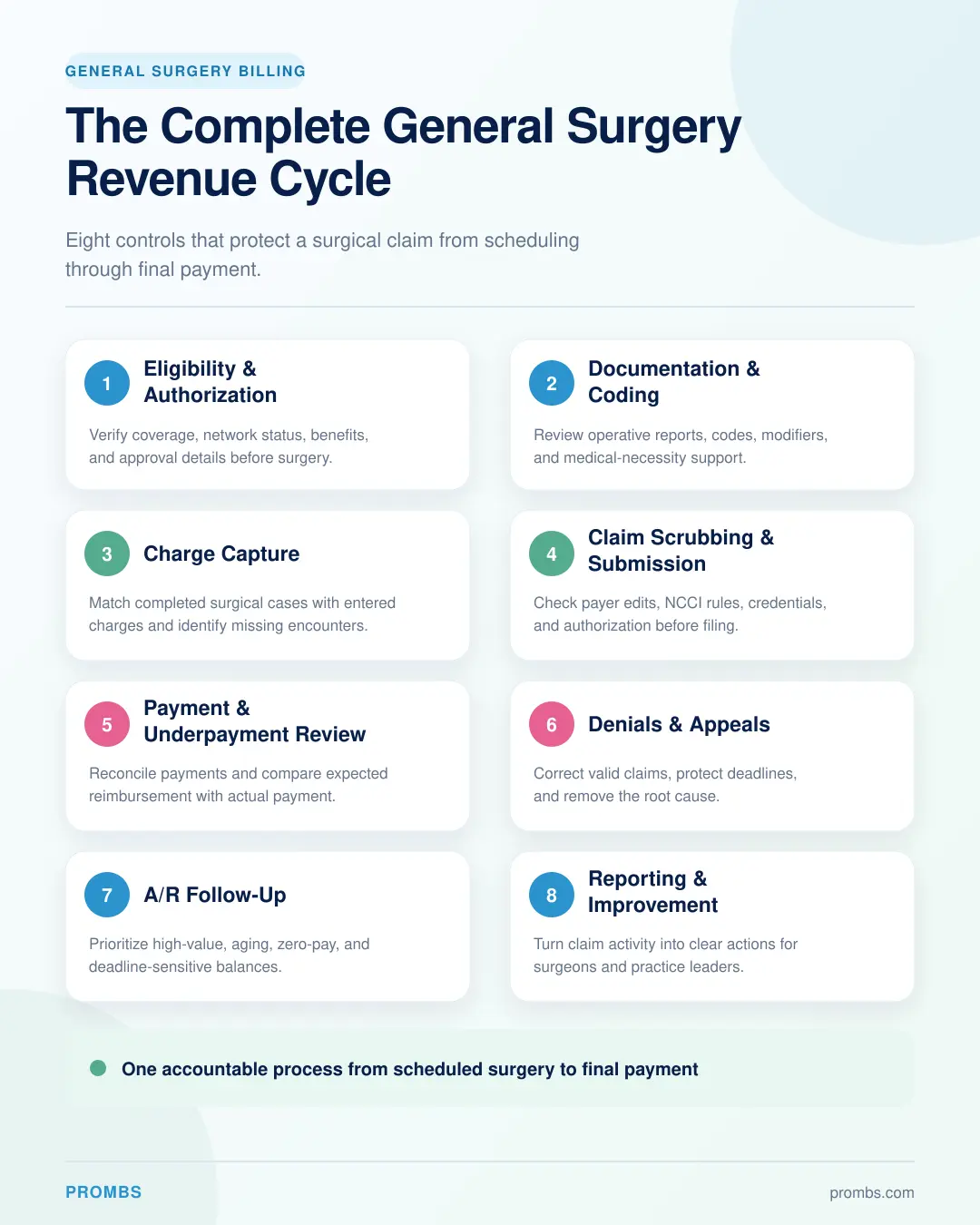
The best engagement covers the full path from pre-service checks to final account resolution. A long service list is not enough. Each function needs a clear owner, turnaround expectation, quality check, and reporting method.
| Revenue Cycle Function | What the Company Should Do | Proof to Request |
|---|---|---|
| Eligibility and Authorization | Confirm coverage, network status, patient responsibility, approval details, and payer requirements before service. | Verification record, authorization dashboard, and escalation workflow. |
| Documentation and Coding | Review operative reports and validate CPT, ICD-10-CM, HCPCS, modifiers, and code combinations. | Coder credentials, query examples, and audit results. |
| Charge Capture | Reconcile scheduled and completed cases against charges. | Missing-charge report and charge-lag metric. |
| Claim Submission | Apply payer, NCCI, demographic, credentialing, and authorization edits before submission. | Edit examples, rejection report, and submission lag. |
| Payment and Underpayments | Post and reconcile payments, then compare expected and actual reimbursement. | Adjustment controls and contract-variance report. |
| Denials and Appeals | Classify root causes, recover valid claims, and prevent recurrence. | Denial log by payer, procedure, owner, and outcome. |
| A/R Follow-Up | Prioritize accounts by value, age, payer, filing limit, and next action. | Work queues, account notes, and aging trends. |
| Reporting | Turn claim activity into decisions for practice leaders. | Dashboard, metric definitions, and meeting cadence. |
Pre-service work should protect the claim before surgery
The company should confirm whether the planned procedure needs authorization, whether the surgeon and facility are in network, whether the approval matches the scheduled service, and how changed operative plans will be handled.
Coding should include human review and quality assurance
Automation can surface missing fields, but it cannot replace informed review of complex operative documentation. Ask whether the coders regularly work with general surgery, how ambiguous reports are handled, and how audits lead to corrective education. Robotic assistance, for example, does not automatically create an extra professional service or higher payment.
Denial management should fix causes, not just claims
Resubmitting a claim may recover one payment, but it does not prevent repetition. Effective denial management connects each denial to its root cause and assigns preventive action. A modifier denial needs a different fix from a provider-enrollment or duplicate-claim denial.
A/R work should be prioritized intelligently
A surgical A/R team should prioritize high-value claims, approaching deadlines, older balances, zero-pay accounts, and patterns affecting multiple cases. Strong accounts receivable management shows how much is outstanding, why, and what happens next.
Payment posting should expose underpayments
A “paid” claim is not necessarily correct. Ask how the company compares expected and actual reimbursement. If it closes accounts without variance review, hidden leakage can remain in zero balances. A zero-balance A/R audit can reveal inappropriate adjustments and underpayments that aging reports miss.
Find the revenue leaks affecting your surgical claims
A focused review can identify documentation gaps, denial patterns, aging A/R, and payment variances before you commit to a new billing arrangement.
How to Compare General Surgery Billing Companies
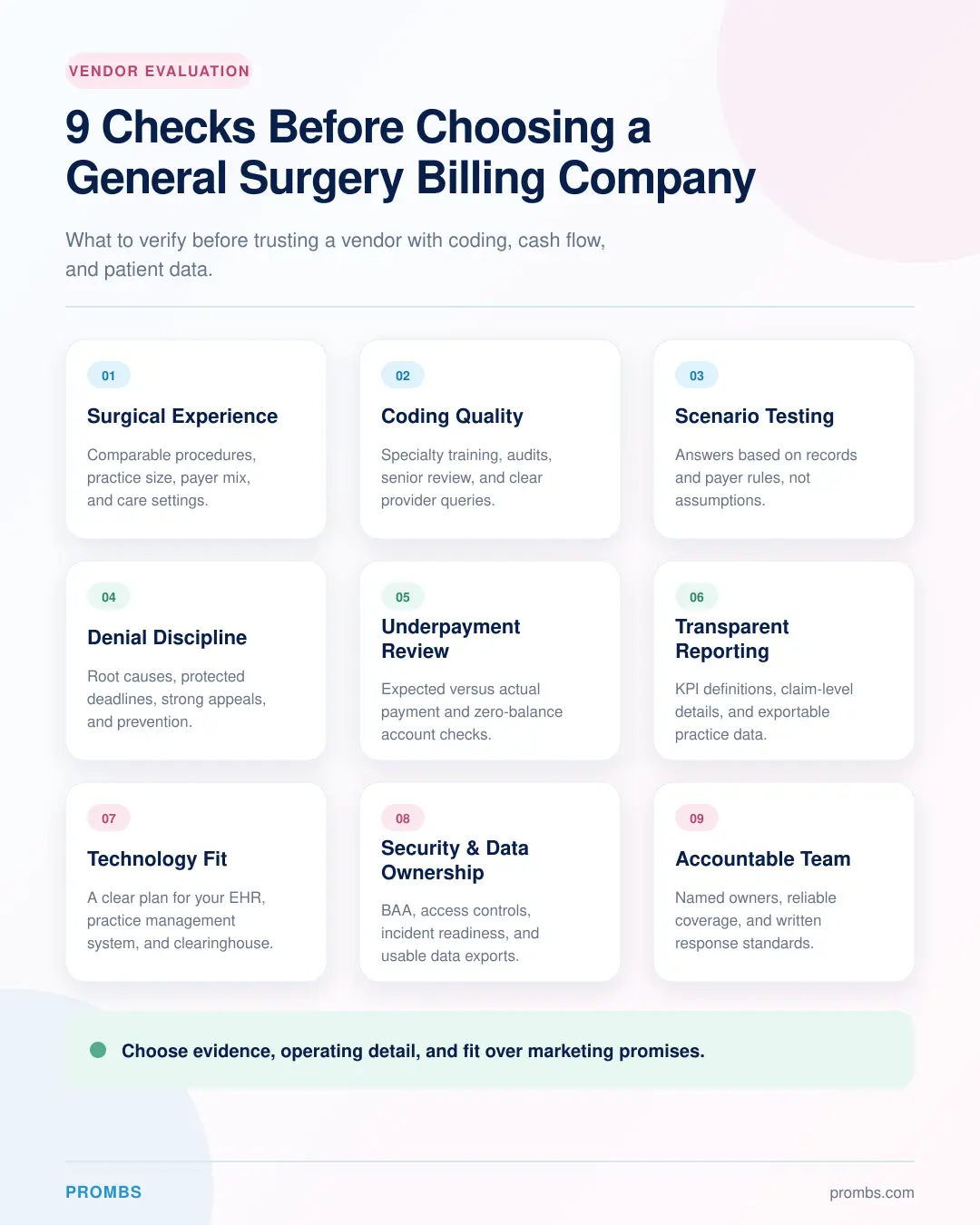
Most vendors promise accurate coding, fewer denials, and faster payment. The difference appears when you request evidence and examine the operating model.
1. Verify relevant surgical experience
Ask how much of the company’s work involves general surgery. Request examples matching your practice size, case mix, payer mix, and care settings. Office-based experience does not automatically prepare a vendor for trauma call, inpatient procedures, co-surgeons, and complex postoperative care.
2. Examine the coding quality program
Certification is useful, but it does not prove specialty competence alone. Look for:
- General surgery training and ongoing education
- Routine pre-bill and retrospective audits
- A defined accuracy calculation
- Senior review for high-risk or unusual cases
- Provider-query standards
- Documented corrective action when errors recur
- A process for code-set, NCCI, payer, and fee-schedule updates
Request a de-identified audit summary, not just one attractive percentage.
3. Test the company’s knowledge with real scenarios
Give each finalist two de-identified cases involving issues such as a return to the procedure room, different surgeon roles, or bundled services. A strong response identifies missing facts, checks the record and payer rules, and avoids assumptions. An instant code from a salesperson is not the goal.
4. Review denial prevention and appeal discipline
Ask for a denial report grouped by:
- Payer
- Procedure or service category
- Surgeon
- Facility or location
- Denial reason
- Root cause
- Dollar value
- Appeal status
- Preventive action
Ask who writes clinical appeals, tracks deadlines, and escalates high-value cases. An overturn rate without claim volume, value, age, and type is hard to interpret.
5. Confirm underpayment capabilities
The workflow should find recurring short payments by payer and procedure while distinguishing underpayments from correct reductions and adjustments.
6. Inspect reporting transparency
Request the actual dashboard before signing. Confirm claim-level access and data export. Reporting should show:
- Charge and submission lag
- Clearinghouse rejections
- First-pass acceptance
- Initial denial rate
- Denial dollars and root causes
- Days in A/R
- A/R over 90 days
- Net collection rate
- Expected versus actual reimbursement
- Authorization-related denials
- Provider-query volume and turnaround
Every metric needs a written definition. Two companies may calculate “clean claim rate” differently.
7. Understand the technology model
The company should explain how it will work with your EHR, practice management system, clearinghouse, payer portals, and documents. Confirm whether software must change, who pays interface fees, and what happens when an integration fails. Your practice should retain data ownership and usable exports during and after the relationship
8. Evaluate security and compliance
Ask for a signed business associate agreement and review:
- Role-based access
- Multi-factor authentication
- Encryption
- Workforce security training
- Subcontractor oversight
- Backup and recovery
- Incident response
- Breach-notification responsibilities
- Access termination when staff leave
- Independent security assessments
“HIPAA compliant” is not a complete security answer.
9. Identify the accountable team and its coverage
Identify who manages daily work, coding questions, payer escalations, reports, and executive issues. Also ask how the vendor covers absences, growth, and changing volume. Clear accountability, cross-training, and written response standards matter more than a large organizational chart.
Questions to Ask During a Vendor Demo
Use the same questions for each finalist.
- Which general surgery procedures do your coders handle, and how is their accuracy audited?
- What happens when documentation does not support the planned code or modifier?
- How do you track 0-day, 10-day, and 90-day global periods at the patient level?
- How do you manage assistant surgeon, co-surgeon, staged procedure, and return-to-OR claims?
- How do you keep payer edits and authorization requirements current?
- Which tasks are completed by your staff, which are automated, and which remain with our practice?
- How do you find missing charges by comparing completed cases with billed encounters?
- How do you identify underpayments after a claim has been paid?
- Can we see a de-identified denial report, A/R work queue, and monthly performance dashboard?
- What are your turnaround, escalation, data-export, and account-termination standards?
- What does the base fee include, and how will you handle existing A/R during launch?
If every answer returns to “proprietary technology” or a marketing percentage, you still do not know how the work will be done.
How Much Does a General Surgery Billing Company Cost?
Pricing commonly follows one of four structures:
- Percentage of collections: The fee rises or falls with collected revenue.
- Per-claim or per-encounter fee: The practice pays for each processed item.
- Fixed monthly fee: Cost is predictable but may include volume limits.
- Hybrid arrangement: A base fee is combined with volume, coding, or performance-related charges.
Do not compare the headline rate alone. Build an all-in cost using the same scope for every company. Ask whether the price includes coding, eligibility, prior authorization, credentialing, patient statements, clearinghouse charges, old A/R, denial appeals, underpayment review, reporting, interfaces, and implementation.
Also clarify how a percentage fee is calculated. Does it apply to insurance payments only, all patient collections, capitation, refunds, take-backs, old A/R, and money collected before the vendor worked the claim?
A low rate can become expensive if your staff must continue doing most front-end work, coding is billed separately, or denied claims are not pursued. A higher rate can also be poor value if the company cannot show measurable operational improvement.
The fair comparison is total cost against total responsibility, risk, and performance.
The KPIs That Should Decide Whether the Partnership Works
Set a baseline before launch, then review results by payer, procedure, surgeon, and location. Practice-wide averages can hide a high-value problem.
| KPI | What It Reveals | What to Investigate |
|---|---|---|
| Charge Lag | Time from service to charge entry. | Late operative notes, missing case feeds, or staff bottlenecks. |
| Claim Submission Lag | Time from completed charge to payer submission. | Coding queues, claim edits, or interface failures. |
| First-Pass Acceptance Rate | Whether claims pass initial submission checks. | Rejection reasons and recurring data errors. |
| Initial Denial Rate | How often adjudicated claims are first denied. | Payer, procedure, location, and root cause. |
| Net Collection Rate | How much collectible revenue is actually collected. | Underpayments, write-offs, and unresolved balances. |
| Days in A/R | Overall collection speed. | Payer delays, follow-up gaps, and claim complexity. |
| A/R Over 90 Days | Aging and timely-filing risk. | High-value cases, appeal deadlines, and stalled accounts. |
| Authorization Denial Rate | Front-end protection of scheduled procedures. | Approval accuracy, expiration, site, provider, and code mismatch. |
| Appeal Turnaround and Outcome | Speed and effectiveness of denial recovery. | Evidence quality, prioritization, and payer behaviour. |
| Expected-to-Actual Reimbursement | Contract performance. | Repeated short payments and incorrect adjustments. |
| Provider-Query Turnaround | Documentation workflow health. | Unclear queries, surgeon availability, and training needs. |
Use the same definitions every month. This guide to revenue cycle KPIs can help build a consistent dashboard.
Red Flags That Should Slow Down the Decision
Be cautious if a company:
- Guarantees payment, profit, or perfect compliance
- Promises a dramatic collection increase before reviewing your data
- Cannot explain whether it handles professional, facility, or both types of billing
- Uses outdated procedure examples or treats code rules as fixed forever
- Assumes robotic assistance automatically increases reimbursement
- Relies on automation without qualified operative-report review
- Quotes a clean-claim rate but will not define it
- Will not provide a sample dashboard or claim-level notes
- Has no clear process for underpayments and zero-balance review
- Avoids discussing security controls or a business associate agreement
- Cannot identify the people assigned to your account
- Restricts access to your data or makes exports difficult
- Hides exclusions, minimums, or termination obligations in the contract
- Offers references that do not resemble your practice
No responsible company can promise that every claim will be paid. Payers make coverage and payment decisions, documentation varies, and some services are not reimbursable. A trustworthy partner explains what it can control, what it cannot control, and how it will respond when a claim does not follow the expected path.
How to Switch Billing Companies Without Disrupting Cash Flow
A well-managed transition protects new claims and older balances. Treat it as an operational project, not a login handoff.
Phase 1: Establish the baseline and scope
Document collections, charges, denials, A/R aging, payer mix, procedures, systems, responsibilities, and unresolved issues. A medical billing audit can separate isolated errors from broader workflow problems. Put the new division of responsibility in writing.
Phase 2: Secure access and validate data
Set up approved access to systems, payer portals, payment sources, and documents. Test claims and remittances before launch. Validate provider enrollment, locations, billing data, and electronic payment settings. Resolve the credentialing and billing connection before it interrupts claims.
Phase 3: Separate old A/R from new production
Decide who owns pre-cutover claims and how both vendors will avoid duplicate work. Set access, note, reporting, and handoff standards. Review old surgical A/R before filing and appeal limits expire.
Phase 4: Launch with daily reconciliation
During early production, reconcile completed cases, charges, claims, clearinghouse responses, payments, and denials daily. Hold short reviews until the workflow stabilizes, with clear risks, owners, and deadlines.
Phase 5: Review performance against the baseline
Charge lag, rejections, and submission speed may improve before collections because payers need time to process claims. Use separate milestones for workflow stability, denial prevention, A/R reduction, and reporting accuracy.
In-House Billing or an Outsourced General Surgery Billing Company?
An experienced internal team can work well when the practice has stable staffing, strong surgical coders, clear management, reliable technology, and enough volume to support training and quality assurance.
Outsourcing may be the better fit when:
- Billing turnover disrupts cash flow
- Surgeons or managers spend too much time supervising claims
- Coding expertise is inconsistent
- Denials repeat without root-cause correction
- A/R is growing or underpayments are not reviewed
- The practice is adding surgeons, locations, or facilities
- Reporting does not explain where revenue is being lost
Some groups use a hybrid model. Internal staff manage scheduling, patient communication, and documentation follow-up while a specialty partner handles coding, claims, denials, A/R, and analytics. This comparison of outsourced billing services and internal teams can help clarify the tradeoffs.
A Practical 100-Point Vendor Scorecard
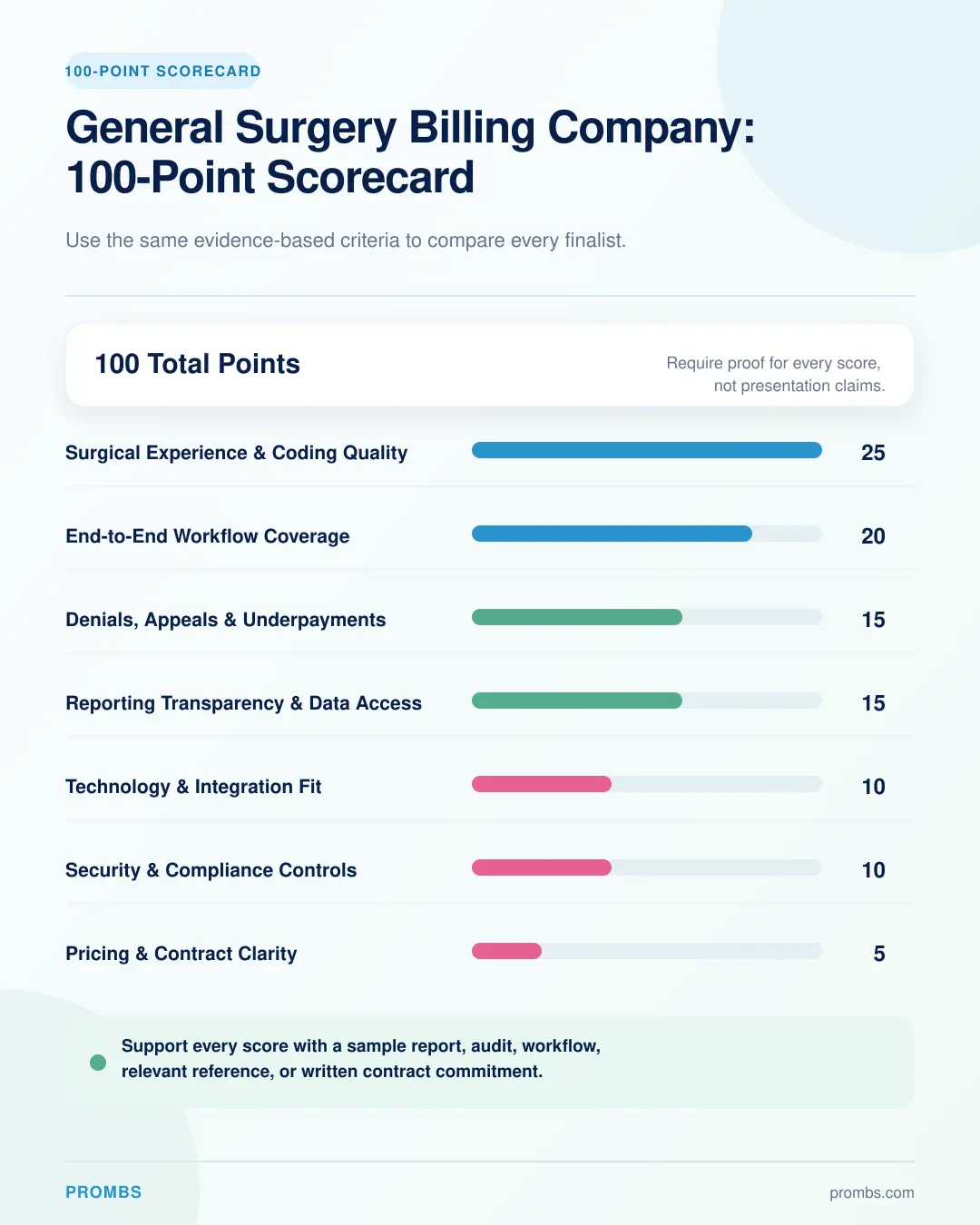
Score every finalist using the same evidence.
| Evaluation Area | Weight |
|---|---|
| General Surgery Experience and Coding Quality | 25 |
| End-to-End Workflow Coverage | 20 |
| Denial Prevention, Appeals, and Underpayment Recovery | 15 |
| Reporting Transparency and Data Access | 15 |
| Technology and Integration Fit | 10 |
| Security and Compliance Controls | 10 |
| Pricing and Contract Clarity | 5 |
| Total | 100 |
Require evidence for each score. A polished presentation should not earn the same points as a sample report, de-identified audit, relevant reference, written workflow, or contract commitment.
The scorecard does not make the decision for you. It prevents one appealing feature or low price from distracting the team from larger operational risks.
Choose a Company That Can Show Its Work
The right general surgery billing partner does more than transmit claims. It connects scheduling, authorization, documentation, coding, payer rules, payment posting, denials, and reporting into one accountable process.
Before signing, verify specialty experience, test the company with real scenarios, inspect sample reports, define every service, protect access to your data, and agree on measurable performance standards. If a vendor cannot explain how it prevents errors, finds underpayments, and manages a transition, a low price will not protect your revenue.
PROMBS provides specialized general surgery billing services for practices that need stronger coding support, denial control, A/R follow-up, and financial visibility without losing control of their existing workflow.
See what is holding back your general surgery revenue
Get a focused review of your claims, coding, denials, and aging A/R, then receive a practical plan based on the issues found.
Frequently Asked Questions
What does a general surgery medical billing company do?
It manages some or all of a surgical practice’s revenue cycle, including authorization, operative-report review, coding, claims, payments, denials, A/R, underpayments, and reporting.
Does a billing company need to replace our EHR or practice management system?
Not always. Many companies can use the current system or an approved integration. Require a technical assessment before agreeing to a platform change.
How quickly should we expect results after switching?
Charge lag, rejections, and documentation queues may change first. Collections and A/R need more time because claims are at different payer stages. Use phased milestones instead of a short-term revenue promise.
What is the most important question to ask a general surgery billing company?
Ask the company to show how it will manage your actual claim risks. Use de-identified examples, a sample dashboard, coding-audit evidence, and a written responsibility map.