


Plastic surgery billing is the process of turning cosmetic and reconstructive care into accurate charges, clean insurance claims, clear patient balances, and fully reconciled payments. What makes it unusual is that one practice may run two very different revenue systems at the same time.
A facelift paid in advance by the patient follows a self-pay path. Breast reconstruction after a mastectomy follows an insurance path built around benefits, medical necessity, authorization, coding, and payer policy. A nasal procedure may contain both functional and cosmetic work. If the practice treats all three cases the same way, money gets lost or compliance risk rises.
Strong billing begins before surgery is scheduled. The practice must classify the service, confirm who may be responsible, collect the right evidence, and keep cosmetic and covered charges separate from the start.
Why Plastic Surgery Billing Is Different
Most medical specialties primarily bill insurers. Many aesthetic practices primarily collect from patients. Plastic surgery often does both, sometimes during the same encounter.
That creates several pressure points:
- The same procedure can be cosmetic or reconstructive depending on why it is performed.
- Coverage may depend on functional symptoms, prior treatment, photographs, measurements, test results, or tissue weight.
- Procedures are often staged, performed together, or subject to global surgery rules.
- The surgeon, facility, anesthesia provider, and other entities may bill separately.
- High patient balances require clear estimates, deposits, refund rules, and reconciliation.
- Operative notes must support the code, modifier, site, size, and complexity.
The procedure name alone rarely answers the billing question. “Blepharoplasty,” for example, does not tell a payer whether the surgery was performed to improve appearance or relieve a documented visual obstruction. The reason for the service, the evidence in the record, and the patient’s specific plan determine the financial route.
The Two Revenue Tracks
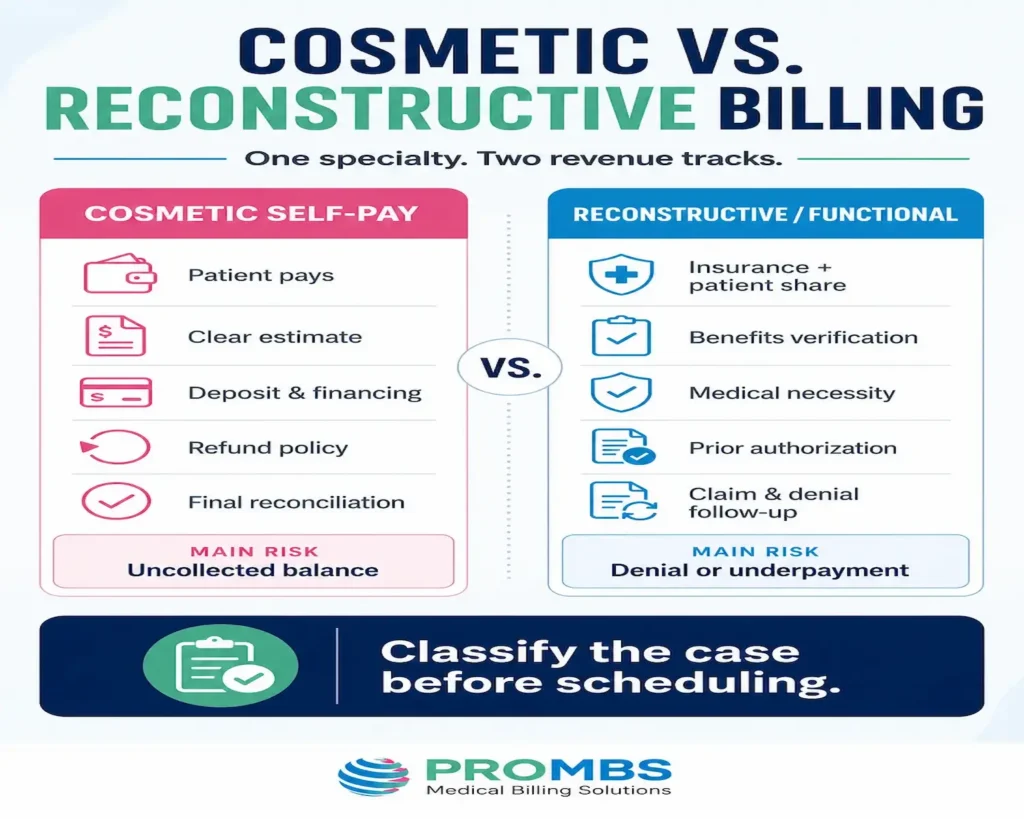
| Billing area | Cosmetic self-pay | Reconstructive or functional care |
| Primary payer | Patient or financing company | Health plan, then patient responsibility |
| Coverage focus | Clear price and financial consent | Benefits, exclusions, medical necessity, and payer policy |
| Pre-service work | Estimate, deposit, financing, cancellation terms | Eligibility, benefits, authorization, clinical evidence |
| Coding role | Internal charge integrity and accurate records | CPT, ICD-10-CM, HCPCS, modifiers, and claim edits |
| Main risk | Uncollected balance, refund dispute, or pricing error | Denial, underpayment, bundling, or audit exposure |
| Reconciliation | Package price against deposits and final services | Contracted allowance against ERA/EOB and patient share |
A mixed case needs a third layer: a defensible allocation between covered and elective work. Staff should not simply send the entire case to insurance and wait to see what happens. Nor should they collect the entire amount from the patient when a covered functional component may exist.
Find the Leak Before It Becomes Old A/R
A focused billing review can show whether revenue is being lost through weak authorization, incomplete operative notes, modifier errors, underpayments, or inconsistent patient collections.
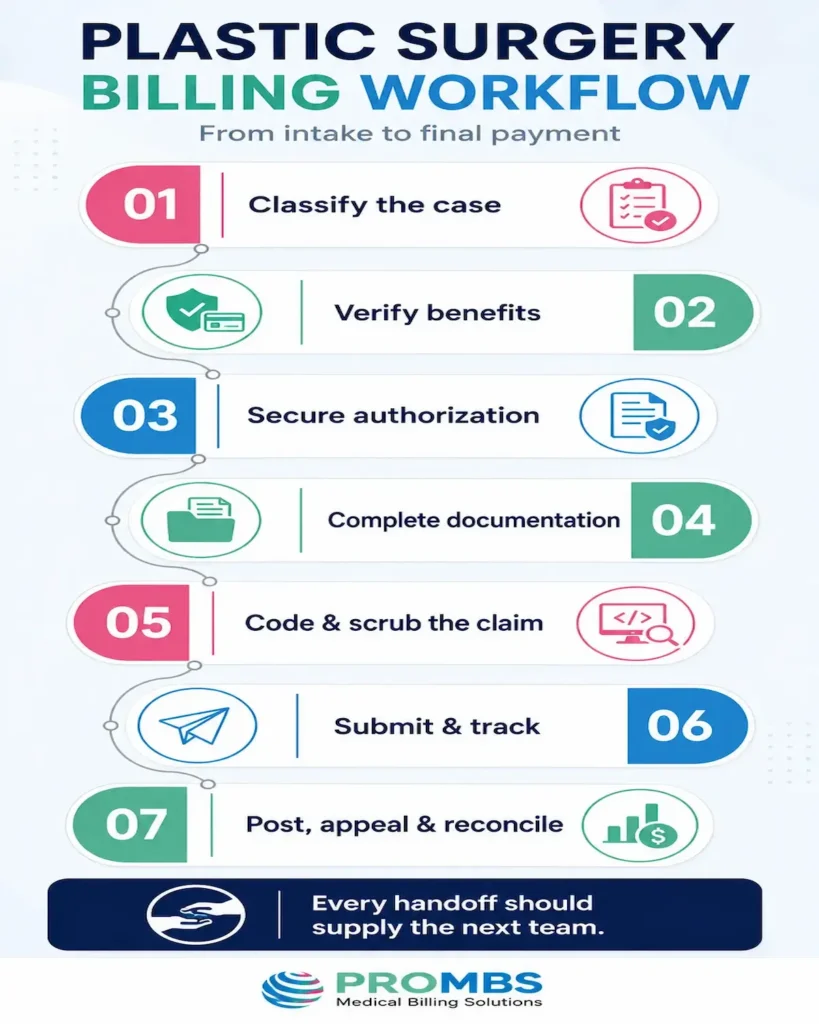
The End-to-End Plastic Surgery Billing Workflow
Good plastic surgery revenue cycle management follows the patient journey. Each step supplies the next team.
1. Classify the Case at Intake
The first question is not “Which code?” It is “Why is this service being performed, and who may be responsible?”
Build intake options for:
- Cosmetic only
- Reconstructive or functional
- Mixed cosmetic and functional
- Post-mastectomy, trauma, burn, congenital, wound, or Mohs reconstruction
- Workers’ compensation or liability care
The clinician establishes the indication. Intake simply routes the case.
2. Verify Benefits at the Procedure Level
An active card does not mean the surgery is covered. Verify the procedure, diagnosis, site, network, and benefit category.
Confirm:
- Plan status, effective dates, and coordination of benefits
- Network status for the surgeon and intended facility
- Cosmetic exclusions and reconstructive benefits
- Deductible, coinsurance, and out-of-pocket status
- Referral, authorization, and site-of-service requirements
- Required photographs, measurements, testing, or prior treatment records
- Separate rules for implants, biologic products, or assistant surgeons
Record the representative, reference number, date, and response. Verification is not a payment guarantee. ProMBS’ patient insurance verification guide offers a broader checklist.
3. Build the Authorization File Before Scheduling
Treat prior authorization as a clinical evidence project, not a form submission.
A strong file may include:
- The surgeon’s assessment and treatment plan
- Functional symptoms, duration, and effect on daily activities
- Relevant measurements, testing, and clinical photographs
- Conservative treatments and the response
- Prior operative, pathology, oncology, or trauma records
- Proposed codes, site of service, and a clear medical necessity letter
Match the approval to the final codes, units, dates, provider, and facility.
4. Make Documentation Code-Ready
Coders cannot infer missing facts. Notes often need precise measurements, anatomy, and a clear explanation of function.
The operative report should support, when relevant:
- Diagnosis, indication, site, and laterality
- Defect, wound, graft, flap, or repair measurements
- Repair depth, complexity, and technique
- Donor and recipient sites
- Tissue removed from each side
- Each surgeon’s work and any distinct operative fields
- Staged intent or unusual complexity
- Implant details, complications, and return-to-operating-room circumstances
A pre-close prompt can catch a missing measurement before it causes a coding query.
5. Code From the Record and Current Rules
Plastic surgery billing and coding requires the current CPT code set, ICD-10-CM guidance, payer policy, NCCI edits, global status, and the actual record.
Common code families may involve:
- Breast reduction, reconstruction, implants, expanders, and revisions
- Tissue transfer, skin grafts, and complex wound repair
- Scar, burn, trauma, and Mohs reconstruction
- Facial, nasal, eyelid, ear, hand, and craniofacial procedures
- E/M services and separately reportable products or supplies
Examples can train staff, but current codebooks, edits, plan documents, and local rules control the claim.
Medicare illustrates the core principle: cosmetic surgery is generally excluded, while therapeutic or reconstructive work may be covered when the record and policy establish medical necessity. See the CMS Billing and Coding: Plastic Surgery article.
6. Apply Modifiers With a Documented Reason
Modifiers clarify facts the base code cannot show. They cannot rescue an invalid code combination.
| Modifier | Common plastic surgery use | Documentation question |
|---|---|---|
| 22 | Work substantially greater than usual | What made the work unusual, and how much extra work or time was required? |
| 24 | Unrelated E/M service during a postoperative period | Why was the visit unrelated to the original surgery? |
| 25 | Significant, separately identifiable E/M on a procedure day | What evaluation went beyond the usual pre-procedure work? |
| 50 or RT/LT | Bilateral or side-specific service | What does the payer require, and does the note show both sides? |
| 51 | Multiple procedures in the same session | Does the payer append it, or should the practice report procedures without it? |
| 58 | Planned or staged related procedure during the global period | Was the later stage anticipated and documented? |
| 59 or X modifiers | Distinct service when an edit permits separate reporting | Were the sites, sessions, structures, or circumstances truly distinct? |
| 78 | Related return to the operating room during the global period | What complication or related condition required the return? |
| 79 | Unrelated procedure during the global period | Why is the later procedure unrelated? |
| 80 or 82 | Assistant surgeon service | Was assistance allowed, necessary, and documented? |
Instructions vary, especially for bilateral reporting and modifiers 51 and 59. Review each payer manual. For a foundation, see what a modifier means in medical billing.
7. Scrub and Submit the Correct Claim
The pre-submission edit should check:
- Patient, subscriber, provider, and place-of-service data
- Authorization number and match
- Diagnosis-to-procedure logic, laterality, and units
- NCCI and global period edits
- Assistant surgeon eligibility
- Required attachments
- Timely filing limits
Professional and facility claims must agree. Define who owns each bill and how plan changes reach every entity.
8. Post Payments at the Line Level
Compare actual payment with the expected amount. Total-only posting can hide:
- Incorrect procedure reductions or bundling
- Missing bilateral or implant payment
- Unexplained downcoding or contract underpayment
- Incorrect patient responsibility
- Secondary claim failures
Give every adjustment a reason and every credit an owner.
Documentation That Proves Medical Necessity
For reconstructive care, diagnosis codes do not create medical necessity by themselves. They describe a condition. The record must explain why the procedure is reasonable for that patient under the applicable policy.
A useful documentation stack has five layers:
- Condition: What abnormality, injury, disease, or post-surgical state exists?
- Functional effect: What impairment does it cause?
- Treatment history: What care was tried and with what result?
- Objective evidence: What do examinations, photographs, measurements, or tests show?
- Treatment logic: How will the procedure address the problem?
Reduction Mammaplasty
The file may need symptoms, conservative care, height and weight, photographs, and tissue removed. Criteria vary by payer, so one diagnosis or tissue-weight threshold does not guarantee coverage.
Functional Eyelid Surgery
Document the functional complaint, examination, photographs, and required visual field testing. A statement that the eyelids “feel heavy” may not satisfy the plan’s criteria by itself.
Functional Nasal Surgery
Separate breathing-related work from aesthetic refinement. In a mixed case, the record, estimate, consent, and charges should agree on which part is patient-paid.
Breast Reconstruction
Keep the mastectomy history, reconstruction plan, laterality, staged intent, and implant or flap details together. Federal protections may require plans covering mastectomy to cover specified reconstruction and related services. Review the U.S. Department of Labor’s WHCRA guidance, then verify the plan and authorization.
Mohs and Complex Wound Reconstruction
Document the post-excision defect, site, dimensions, repair, and distinct operative fields. Separate reporting must satisfy both code rules and the record.
The Most Common Plastic Surgery Billing Denials
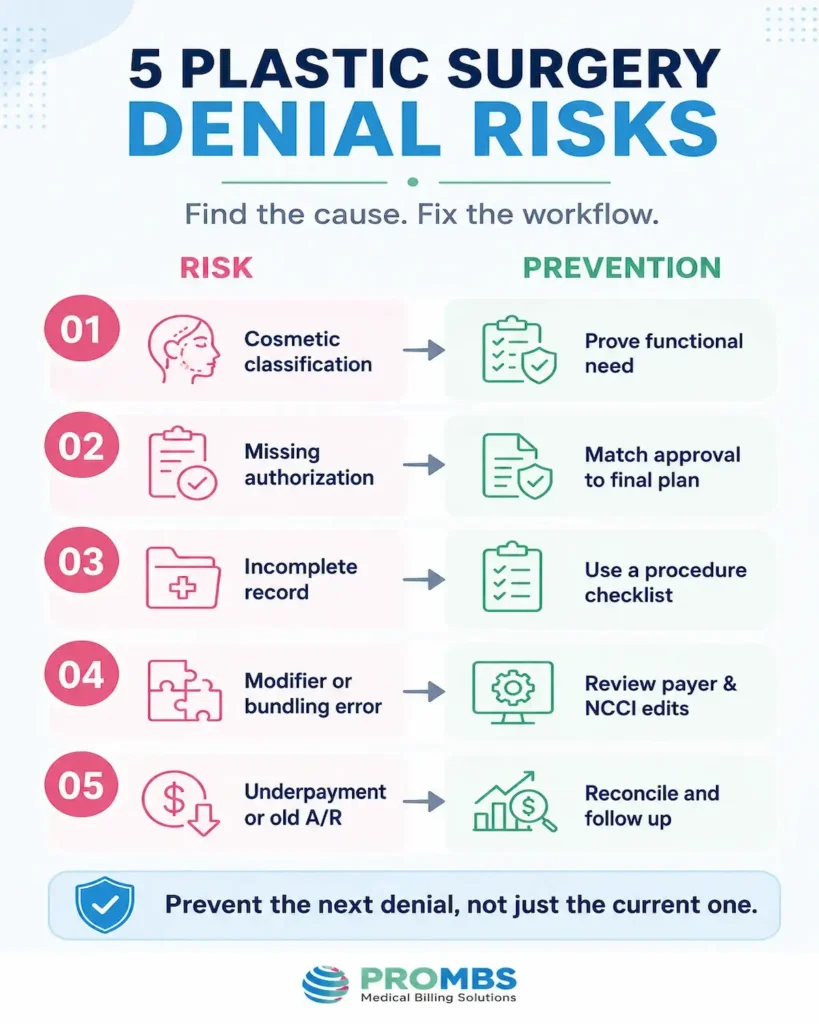
Denials are messages about a failed step. Treating every denial as a back-office problem misses the chance to prevent the next one.
| Denial pattern | Likely root cause | Prevention control |
| Service considered cosmetic or non-covered | Weak functional evidence, exclusion, or diagnosis mismatch | Confirm benefit and policy criteria before scheduling |
| Medical necessity not supported | Missing symptoms, treatment history, tests, measurements, or photographs | Use procedure-specific documentation checklists |
| Authorization missing or invalid | No request, wrong code, expired approval, or site/provider mismatch | Match final schedule to authorization before surgery |
| Claim lacks information | Missing attachment, operative note, authorization number, or provider detail | Use a specialty claim-release checklist |
| Procedure included in another service | NCCI edit, global package, or primary closure included | Review current edits and operative relationships |
| Modifier inconsistent with procedure | Blanket modifier use or payer-specific rule missed | Require a documented reason for every modifier |
| Duplicate claim | Corrected claim submitted as new or facility/professional confusion | Use correct resubmission indicators and claim ownership |
| Timely filing expired | Operative report delay, unresolved coding query, or poor work queues | Track unbilled cases from date of service |
| Underpayment | Contract rate, bilateral, multiple-procedure, or assistant logic applied incorrectly | Compare allowed amount with contract expectations |
When a denial arrives, record the payer, procedure, denial code, dollar value, root cause, responsible workflow, appeal deadline, and final outcome. That turns denial management into useful operational data. ProMBS’ guide on how to prevent claim denials explains how front-end and claim controls work together.
A Better Appeal Method
An appeal should answer the stated reason, not resend the same packet.
Build the appeal in this order:
- Confirm the reason and deadline.
- Pull the policy that applied on the date of service.
- Match the disputed criterion to specific record pages.
- Correct technical claim data separately.
- Track receipt, response date, and escalation level.
Not every denial should be appealed. If the service was excluded or the record does not support the billed work, repeated appeals waste time and may create risk. Correct the process instead.
Cosmetic Surgery Billing Needs Its Own Controls
Cosmetic surgery billing is often called simple because there is no insurer to chase. That is misleading. The collection happens earlier, but the practice still has to manage estimates, deposits, packages, financing, schedule changes, refunds, credits, and final reconciliation.
Build an Itemized Estimate
The patient should be able to see what the quoted amount includes, such as:
- Surgeon, facility, and anesthesia fees
- Implants or products
- Preoperative testing and supplies
- Postoperative visits
- Revision terms
- Optional add-ons
Avoid a single unexplained number when separate entities will bill the patient. If the patient is uninsured or elects not to use insurance, determine whether federal or state estimate requirements apply and provide the required notice within the proper timeframe.
Set Clear Collection Milestones
A practical schedule may include a consultation fee, booking deposit, and final balance deadline. The exact model should fit the practice, state law, merchant rules, financing terms, and patient experience.
The financial policy should explain:
- Deposit, rescheduling, and cancellation terms
- How plan changes or added procedures affect the price
- Refund timing
- Responsibility for complications or revisions
Reconcile the Final Case
After surgery, compare the estimate with the services and payments. Financing, cards, cash, credits, and refunds should reconcile to the patient and general ledgers.
For mixed cases, keep the cosmetic charge separate from the covered claim. Do not shift a denied insurance balance to the patient unless the payer contract, notice requirements, and signed financial agreement allow it.
Global Periods and Staged Reconstruction
The global surgery period is a frequent source of both missed revenue and incorrect billing.
For each procedure, the team should know:
- The applicable global indicator
- Which routine postoperative services are included
- Whether a later operation was planned, related, or unrelated
- Whether a return to the operating room occurred
- Whether an E/M service addressed a separate problem
- What the payer requires for modifiers and documentation
Staged breast reconstruction is a good example. The financial record should carry the original treatment plan forward so the next procedure is not treated as an isolated event. If the staged intent appears only in someone’s memory, the later claim is fragile.
Create a global-period flag in the practice management system and show the original procedure, date, surgeon, laterality, and planned next stage. This gives schedulers, coders, and billers the same context.
KPIs a Plastic Surgery Practice Should Review
One blended collection rate cannot explain a practice with both cash and insurance revenue. Segment the data.
| KPI | What it reveals |
| Cosmetic deposit collection rate | Whether the practice secures agreed funds before surgery |
| Unapplied deposit and credit balance | Whether patient money is being reconciled promptly |
| Authorization approval and turnaround | Whether covered cases are delayed or exposed before surgery |
| Charge lag | Whether operative notes and charges reach billing quickly |
| First-pass acceptance rate | Whether claims pass initial clearinghouse and payer edits |
| Initial denial rate by reason | Where workflow failures begin |
| Net collection rate for insurance | How much collectible insurance revenue is actually collected |
| Days in A/R and A/R over 90 days | How quickly claims move and where timely filing or appeal risk sits |
| Underpayment value | Whether payer contract terms are being enforced |
| Patient balance collection rate | Whether post-adjudication responsibility is collected |
| Refund turnaround | Whether patient credits are handled consistently |
| Revenue by cosmetic, reconstructive, and mixed case | Whether each service line is performing as expected |
Review trends by payer, surgeon, procedure group, location, and root cause. For a deeper explanation of aging and follow-up, see this guide to accounts receivable management.
In-House Billing or Outsourced Support?
A strong in-house team can perform well. Outsourcing helps when the practice lacks specialty depth, backup coverage, reporting, or denial capacity.
Ask these questions before deciding:
- Who reviews operative notes, coding edits, and authorizations?
- Can the team separate cosmetic deposits from insurance claims?
- How are global periods and staged cases tracked?
- Who follows underpayments and old A/R?
- What backup exists when the primary biller is absent?
- Can the practice see claim and adjustment detail?
- How are records exchanged securely and errors prevented?
When comparing a plastic surgery billing company, request a workflow demonstration using a mixed or staged case. Seeing each handoff reveals more than a generic clean-claim promise.
A 30-Day Plastic Surgery Billing Audit
Use one week for each step:
- Map one cosmetic, reconstructive, and mixed case from inquiry to payment.
- Test verifications, authorizations, estimates, deposits, and unapplied credits.
- Audit operative reports, modifiers, claim edits, and related facility claims.
- Review denials, high-value payments, and A/R over 90 days.
Assign an owner and deadline to each root cause. Remove one repeatable leak each month.
Common Mistakes to Avoid
- Classifying coverage by procedure name alone
- Checking eligibility without procedure-level benefits
- Treating authorization as a payment guarantee
- Using diagnosis codes without functional evidence
- Adding modifier 59 automatically
- Missing staged intent or mixed-case allocation
- Posting payments without checking expected allowance
- Ignoring credits, deposits, or timely filing risk
Turn Billing Data Into a Clear Action Plan
Pro Medical Billing Solutions can review your coding, authorizations, denials, aging claims, and payment workflows to identify where preventable revenue loss begins.
Build the Billing System Around the Case
The best plastic surgery medical billing process does not begin with a claim form. It begins with the clinical purpose of the case.
Once the practice knows whether the work is cosmetic, reconstructive, or mixed, the rest becomes easier to control. The right team verifies the correct benefit, gathers evidence before surgery, codes only what the record supports, separates patient-paid work, and follows every dollar through final reconciliation.
That discipline protects more than reimbursement. It gives patients clearer financial expectations, gives surgeons fewer last-minute billing questions, and gives practice leaders a reliable view of where revenue is earned, delayed, or lost.
Frequently Asked Questions
What is plastic surgery billing?
Plastic surgery billing manages charges and payments for cosmetic, reconstructive, and mixed procedures. It covers self-pay collections, verification, authorization, coding, claims, denials, patient balances, and A/R.
Does insurance cover plastic surgery?
Insurance generally excludes surgery performed only to improve appearance. It may cover functional or reconstructive care when the plan includes the benefit and the record meets its criteria. Verify coverage and authorization before surgery.
Which modifiers are common in plastic surgery claims?
Modifiers 22, 24, 25, 50, 51, 58, 59, 78, 79, RT, LT, X, or assistant surgeon modifiers may apply. The record, current code rules, payer instructions, and edits must support each one.
What should a plastic surgery billing company handle?
A qualified partner should be able to manage or coordinate benefits, authorization, specialty coding, claim edits, global periods, denials, appeals, underpayments, patient responsibility, reporting, and A/R. If the practice also wants support for cosmetic payments, confirm exactly how estimates, deposits, financing, refunds, and mixed cases will be handled.