


Healthcare organizations do more than provide patient care. Behind every successful medical practice is a complex financial process that ensures services are properly documented, billed, and reimbursed.
This process is known as revenue cycle management (RCM).
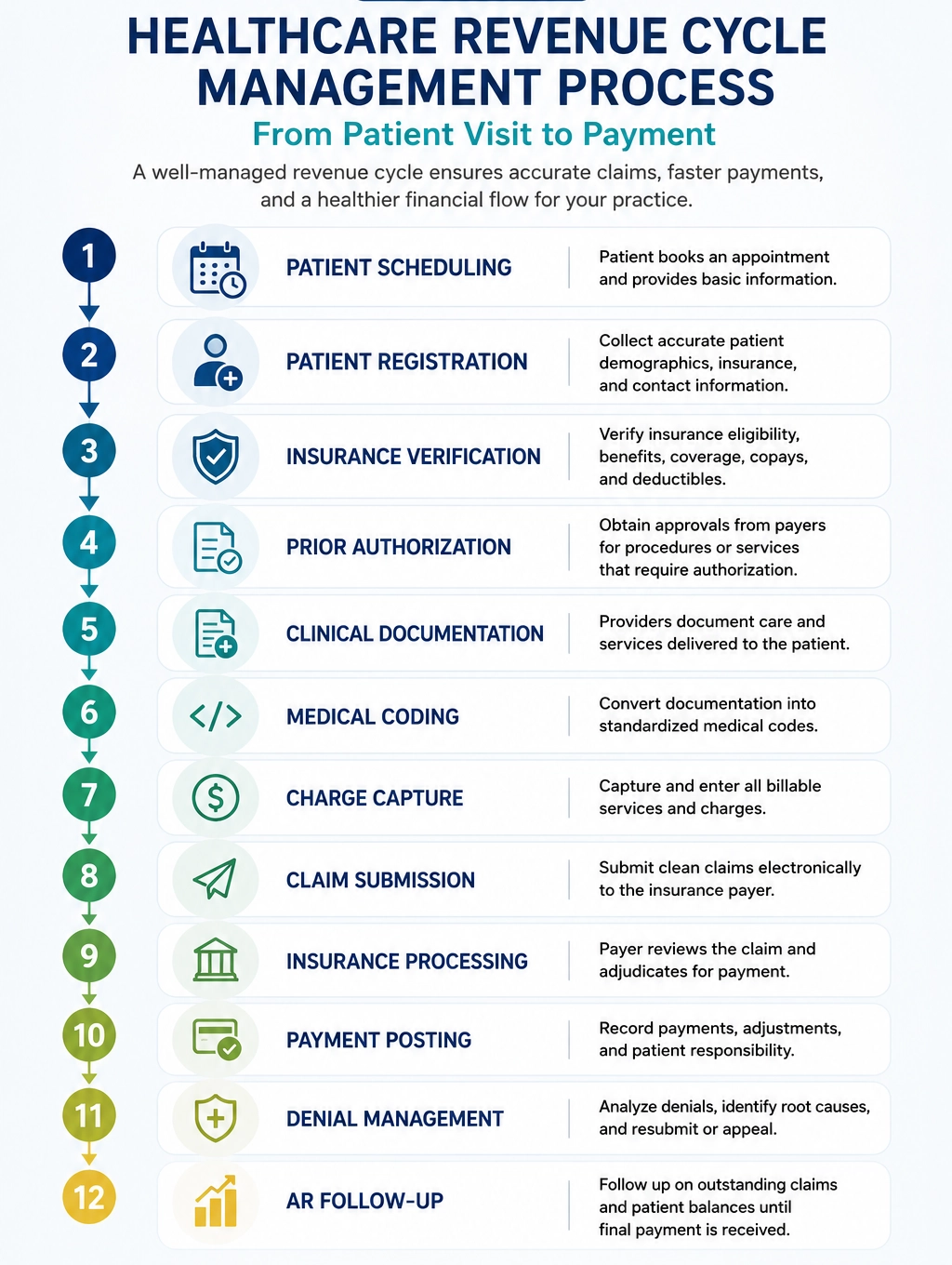
Revenue cycle management connects every financial step of healthcare delivery, starting from the moment a patient schedules an appointment and continuing until the practice receives final payment.
A strong RCM process helps healthcare organizations:
- Improve cash flow
- Reduce claim denials
- Receive payments faster
- Improve billing accuracy
- Identify revenue opportunities
- Create better financial visibility
On the other hand, weak revenue cycle processes can create problems such as:
- Delayed reimbursements
- Increasing accounts receivable
- Claim denials
- Coding errors
- Administrative overload
- Lost revenue opportunities
Many practices focus only on submitting claims, but effective RCM goes beyond billing.
It involves managing the entire financial journey of a patient encounter, including:
- Scheduling
- Registration
- Insurance verification
- Prior authorization
- Documentation
- Coding
- Claim submission
- Payment posting
- Denial management
- Accounts receivable follow-up
This guide explains what revenue cycle management is, how the healthcare RCM process works, why it matters, and how practices can improve financial performance.
What Is Revenue Cycle Management (RCM)?
Revenue cycle management is the process healthcare organizations use to manage the financial lifecycle of patient care.
It begins before a patient receives treatment and continues until the healthcare provider receives complete payment.
In simple terms:
Revenue Cycle Management turns healthcare services into revenue.
The RCM process connects clinical operations with financial operations by ensuring that:
- Patient information is accurate
- Insurance coverage is verified
- Services are properly documented
- Procedures are correctly coded
- Claims are submitted accurately
- Payments are collected efficiently
A successful RCM system requires coordination between:
- Front-office staff
- Healthcare providers
- Medical coders
- Billing specialists
- Insurance companies
- Patients
When these areas work together, practices can maintain a healthier revenue cycle.
Revenue Cycle Management vs Medical Billing: What Is the Difference?
Many people use medical billing and revenue cycle management interchangeably, but they are not the same.
Medical billing is one part of the overall revenue cycle.
Medical Billing
Medical billing focuses on activities related to receiving payment after healthcare services are provided.
It includes:
- Preparing claims
- Submitting claims
- Following up with payers
- Posting payments
- Managing denied claims
Revenue Cycle Management
Revenue cycle management covers the complete financial process before, during, and after patient care.
It includes:
- Patient scheduling
- Registration
- Insurance verification
- Authorization management
- Documentation review
- Coding
- Billing
- Payment collection
- Reporting and analysis
A simple way to understand it:
Medical billing helps collect payment.
Revenue cycle management improves the entire system that creates and collects revenue.
Why Revenue Cycle Management Matters for Healthcare Practices
Healthcare practices operate in an environment where reimbursement depends on accuracy, timing, and efficient workflows.
Even small problems within the revenue cycle can create financial challenges.
For example:
A patient receives treatment, but the insurance information was not verified correctly.
The result:
- The claim may be denied
- The patient may receive an unexpected bill
- Staff must spend additional time fixing the issue
- Payment may be delayed
A strong RCM process helps prevent these problems before they impact revenue.
1. Improves Cash Flow
Cash flow is essential for healthcare practices.
Revenue cycle management helps practices receive payments more consistently by improving:
- Claim accuracy
- Payment tracking
- Denial resolution
- Accounts receivable management
A well-managed revenue cycle reduces unnecessary delays between providing care and receiving payment.
2. Reduces Claim Denials
Claim denials are one of the biggest financial challenges healthcare organizations face.
Denials often happen because of:
- Incorrect coding
- Missing documentation
- Insurance eligibility issues
- Authorization problems
- Medical necessity concerns
Effective RCM identifies where these problems occur and creates processes to prevent repeated errors.
3. Improves Financial Visibility
Many practices know how much money they collect but do not always understand:
- Where revenue is being delayed
- Which payers create problems
- Why claims are denied
- How accounts receivable is performing
Revenue cycle management provides reporting and analytics that help practice leaders make better financial decisions.
4. Reduces Administrative Burden
Healthcare teams already manage many responsibilities:
- Patient care
- Documentation
- Scheduling
- Compliance requirements
- Patient communication
Managing billing problems internally can add significant pressure.
An effective RCM process reduces administrative workload by creating organized workflows and clear responsibilities.
The Complete Revenue Cycle Management Process
The healthcare revenue cycle includes multiple steps that work together.
Each stage affects whether a practice receives accurate and timely reimbursement.
Step 1: Patient Scheduling and Registration
The revenue cycle begins before the patient arrives for care.
During scheduling and registration, practices collect important information, including:
- Patient demographics
- Contact information
- Insurance details
- Reason for visit
- Responsible party information
Accurate registration creates the foundation for the entire billing process.
Errors at this stage can lead to:
- Claim rejections
- Incorrect patient balances
- Payment delays
Common registration issues include:
- Incorrect insurance information
- Missing patient details
- Duplicate records
- Incorrect subscriber information
A strong RCM workflow emphasizes accuracy from the beginning.
Step 2: Insurance Verification and Eligibility
Before healthcare services are provided, insurance eligibility should be verified.
Insurance verification confirms:
- Active coverage
- Benefits
- Deductible information
- Copayment requirements
- Covered services
- Authorization requirements
This step helps practices understand whether services are likely to be reimbursed.
Without proper verification, practices may experience:
- Avoidable claim denials
- Patient billing disputes
- Delayed payments
Early verification helps prevent revenue problems before they happen.
Step 3: Prior Authorization Management
Many healthcare services require approval from insurance companies before treatment.
Prior authorization helps confirm that a payer agrees to cover a specific service.
Authorization requirements may apply to:
- Procedures
- Imaging services
- Specialty treatments
- Certain medications
- Advanced therapies
Common authorization challenges include:
- Missing approvals
- Incorrect authorization details
- Expired authorizations
- Delayed payer responses
A strong RCM process tracks authorization requirements and ensures approvals are completed before services are provided.
Step 4: Clinical Documentation Review
Documentation connects patient care with reimbursement.
Healthcare providers must maintain accurate records that support:
- Services provided
- Diagnoses
- Medical necessity
- Treatment plans
- Procedures performed
Documentation errors can result in:
- Coding problems
- Claim delays
- Denials
- Compliance concerns
A strong revenue cycle includes documentation review to ensure medical records support the services billed.
Revenue Cycle Management Overview
| RCM Stage | Purpose |
|---|---|
| Patient Scheduling & Registration | Collects accurate patient and insurance information before care is provided. |
| Insurance Verification | Confirms coverage, benefits, and payer requirements. |
| Prior Authorization | Ensures required approvals are obtained before services. |
| Documentation Review | Confirms medical records support services provided. |
| Medical Coding | Converts healthcare services into standardized billing codes. |
| Claim Submission | Sends accurate claims to insurance companies for processing. |
| Payment Collection | Ensures reimbursement is received and properly recorded. |
Step 5: Medical Coding
After documentation is reviewed, the next step in the revenue cycle management process is medical coding.
Medical coding converts healthcare services, procedures, and diagnoses into standardized codes used by insurance companies for reimbursement.
Accurate coding is essential because it communicates:
- What service was provided
- Why the service was medically necessary
- How the payer should process the claim
Medical coding typically involves:
CPT Coding
Current Procedural Terminology (CPT) codes describe the services and procedures performed.
Examples include:
- Office visits
- Diagnostic procedures
- Surgical services
- Therapy services
- Preventive care
Choosing the correct CPT code requires understanding both the documentation and the service performed.
ICD-10 Diagnosis Coding
ICD-10 codes describe the patient’s condition or reason for treatment.
They help establish medical necessity by explaining:
- Symptoms
- Diagnoses
- Chronic conditions
- Injuries
- Medical concerns being treated
A mismatch between diagnosis codes and services provided can result in:
- Claim denials
- Payment delays
- Additional payer reviews
HCPCS Coding
Healthcare Common Procedure Coding System (HCPCS) codes are used for certain healthcare services and supplies that are not fully represented by CPT codes.
These may include:
- Medical equipment
- Certain medications
- Specialized healthcare services
Why Accurate Coding Matters in RCM
Coding errors are one of the most common causes of revenue cycle problems.
Incorrect coding can lead to:
- Claim rejection
- Underpayment
- Denials
- Compliance concerns
A strong revenue cycle management process includes regular coding reviews to ensure claims accurately represent the care provided.
Step 6: Charge Capture and Charge Entry
After coding is completed, the next step is capturing and recording all billable services.
Charge capture ensures that healthcare organizations receive credit for every service provided.
During this stage, billing teams verify:
- Procedures performed
- Diagnosis codes
- Service dates
- Provider information
- Associated charges
A missed charge can directly impact practice revenue.
For example:
A provider completes a service, but the charge is not properly entered into the billing system.
The result:
- The service may never be billed
- Revenue is lost
- Financial reports become inaccurate
A strong charge capture process helps prevent missed revenue opportunities.
Step 7: Claim Submission
After charges are entered and reviewed, claims are submitted to insurance companies.
A medical claim contains important details, including:
- Patient information
- Provider information
- Diagnosis codes
- Procedure codes
- Charges
- Insurance details
Claims are usually submitted electronically through a clearinghouse that checks and transfers claim information to payers.
Before submission, effective RCM workflows review claims for:
- Coding accuracy
- Missing information
- Invalid data
- Payer requirements
This process helps improve clean claim rates.
What Is a Clean Claim?
A clean claim is a claim submitted correctly the first time without errors or missing information.
Clean claims typically include:
- Accurate patient details
- Correct insurance information
- Proper coding
- Complete documentation
- Correct provider information
A higher clean claim rate helps practices:
- Receive payments faster
- Reduce administrative work
- Improve cash flow
Poor claim quality often leads to:
- Rejections
- Delayed payments
- Increased workload
Step 8: Insurance Claim Adjudication
After a claim is submitted, the insurance company reviews and processes it.
This process is known as claim adjudication.
During adjudication, payers evaluate:
- Patient eligibility
- Coverage details
- Medical necessity
- Coding accuracy
- Contract requirements
- Claim information
The payer may:
Approve the Claim
The insurance company processes payment based on:
- Patient benefits
- Provider agreements
- Contract terms
Reject the Claim
Rejected claims usually contain errors that must be corrected before resubmission.
Common rejection reasons:
- Incorrect patient information
- Invalid codes
- Missing claim details
- Incorrect insurance information
Deny the Claim
A denied claim has been processed but the payer decides not to pay.
Common denial reasons:
- Authorization issues
- Coding mistakes
- Documentation problems
- Coverage limitations
- Medical necessity concerns
Understanding why claims fail is an important part of effective RCM.
Step 9: Payment Posting
After claims are processed, payments are recorded through payment posting.
This stage involves recording:
- Insurance payments
- Patient payments
- Adjustments
- Contractual obligations
- Remaining balances
Accurate payment posting helps practices understand their true financial position.
It allows organizations to track:
- Total collections
- Outstanding balances
- Payment trends
- Insurance performance
Incorrect payment posting can create inaccurate reports and make revenue analysis difficult.
Step 10: Denial Management
Denial management is one of the most important components of healthcare revenue cycle management.
Every healthcare practice experiences denied claims. The key difference is how effectively those denials are analyzed and prevented.
A strong denial management process includes:
- Reviewing denial reasons
- Identifying patterns
- Correcting claim issues
- Appealing appropriate claims
- Improving workflows
The goal is not only recovering lost revenue.
The goal is preventing future denials.
Common RCM Denials and Prevention Strategies
| Denial Reason | Why It Happens | Prevention Strategy |
|---|---|---|
| Eligibility Denials | Insurance information is incorrect or coverage is inactive. | Verify patient eligibility before services are provided. |
| Coding Errors | Codes do not accurately represent the services documented. | Perform coding audits and documentation reviews. |
| Authorization Issues | Required approval was not obtained before treatment. | Track payer authorization requirements. |
| Medical Necessity Denials | Documentation does not support the service provided. | Improve documentation quality and coding accuracy. |
| Timely Filing Issues | Claims are submitted after payer deadlines. | Monitor claim submission timelines. |
Step 11: Accounts Receivable Management
Accounts receivable (AR) management focuses on collecting payments that remain outstanding.
A healthy AR process helps practices identify:
- Unpaid claims
- Delayed payments
- Aging balances
- Insurance follow-up opportunities
AR is commonly monitored through aging categories:
- 0–30 days
- 31–60 days
- 61–90 days
- 90+ days
The longer a claim remains unpaid, the more difficult it can become to collect.
Effective AR management includes:
- Reviewing aging reports
- Following up with payers
- Resolving unpaid claims
- Tracking collection performance
Key Revenue Cycle Management Metrics Healthcare Practices Should Track
Successful RCM requires more than collecting payments.
Practices need measurable data to understand financial performance.
Important RCM metrics include:
Days in Accounts Receivable (AR)
Measures how long it takes for a practice to collect payment after providing services.
Lower AR days generally indicate a more efficient collection process.
Clean Claim Rate
Measures the percentage of claims accepted without corrections or rework.
A higher clean claim rate usually means:
- Better coding accuracy
- Improved documentation
- More efficient workflows
Denial Rate
Shows the percentage of claims denied by payers.
Tracking denial rates helps identify:
- Coding problems
- Authorization issues
- Documentation gaps
Net Collection Rate
Measures how effectively a practice collects the revenue it is entitled to receive.
It helps evaluate overall billing performance.
First Pass Resolution Rate
Measures how many claims are successfully processed without additional work.
Improving this metric reduces administrative burden.
RCM Performance Dashboard Example
| RCM Metric | What It Measures |
|---|---|
| Days in AR | How quickly a practice collects outstanding payments. |
| Clean Claim Rate | Percentage of claims accepted without corrections. |
| Denial Rate | Percentage of claims rejected or denied by payers. |
| Collection Rate | How effectively earned revenue is collected. |
| First Pass Resolution | Claims successfully processed without additional follow-up. |
Common Revenue Cycle Management Challenges
Even well-managed practices face RCM challenges.
Some of the most common include:
Increasing Claim Denials
Frequent denials can reduce revenue and increase administrative work.
Solution:
- Analyze denial patterns
- Improve coding accuracy
- Strengthen documentation
Insurance Verification Problems
Incorrect insurance information can create avoidable claim issues.
Solution:
- Verify coverage before appointments
- Confirm patient responsibility
- Maintain accurate records
Coding and Documentation Errors
Coding mistakes can affect reimbursement.
Solution:
- Conduct regular audits
- Train staff
- Improve documentation workflows
Growing Accounts Receivable
Aging claims can impact cash flow.
Solution:
- Monitor AR reports
- Prioritize unpaid claims
- Improve follow-up processes
How Healthcare Practices Can Improve Revenue Cycle Management
Improving revenue cycle management does not always require increasing patient volume.
Many practices can improve financial performance by identifying weaknesses within their existing workflows.
A strong RCM strategy focuses on improving accuracy, reducing delays, and creating better visibility into the financial health of the organization.
1. Improve Front-End Revenue Cycle Processes
Many revenue problems begin before a claim is ever created.
Front-end processes include:
- Patient scheduling
- Registration
- Insurance verification
- Authorization management
Improving these areas helps prevent problems before they reach the billing stage.
Practices should focus on:
- Collecting accurate patient information
- Verifying insurance before appointments
- Confirming authorization requirements
- Communicating patient responsibility clearly
A strong front-end process creates cleaner claims later.
2. Strengthen Documentation and Coding Accuracy
Documentation and coding are the foundation of successful reimbursement.
Healthcare practices should ensure:
- Provider notes support services billed
- Diagnosis codes match patient conditions
- Procedure codes accurately represent services
- Required modifiers are applied correctly
Regular coding audits can help identify:
- Documentation gaps
- Coding inconsistencies
- Training opportunities
Improved coding accuracy reduces denials and improves reimbursement consistency.
3. Create a Proactive Denial Management Strategy
Many practices treat denials as a billing problem.
However, denials are often symptoms of larger workflow issues.
A proactive denial management approach includes:
- Tracking denial trends
- Identifying root causes
- Reviewing payer patterns
- Improving internal processes
For example:
If a practice notices repeated authorization denials from one payer, the solution is not only appealing claims.
The practice should review:
- Authorization workflows
- Staff training
- Payer requirements
This prevents similar issues from occurring again.
4. Monitor Revenue Cycle Performance Regularly
Healthcare organizations need accurate data to understand how their revenue cycle is performing.
Regular reviews should include:
- Claim performance
- Collection trends
- Denial rates
- AR aging
- Payer performance
Without reporting, practices may not know where revenue is being delayed or lost.
5. Use Technology and Automation
Technology plays an increasingly important role in modern revenue cycle management.
Healthcare organizations use technology to improve:
- Eligibility verification
- Claim tracking
- Reporting
- Payment processing
- Workflow automation
Automation can reduce manual tasks and help staff focus on more complex revenue cycle activities.
However, technology works best when combined with accurate processes and experienced professionals.
Medical Billing vs Revenue Cycle Management
Although medical billing and revenue cycle management are closely connected, they serve different purposes.
| Area | Medical Billing | Revenue Cycle Management |
|---|---|---|
| Primary Focus | Processing claims and collecting payments. | Managing the complete financial lifecycle of healthcare services. |
| Main Activities | Coding, claim submission, payment posting, and follow-up. | Scheduling, registration, eligibility, billing, collections, reporting, and analytics. |
| Timing | Mainly focuses after services are provided. | Begins before the patient visit and continues after payment collection. |
| Goal | Receive reimbursement for healthcare services. | Optimize the entire revenue generation process. |
| Scope | One component of healthcare finance. | A complete approach to managing healthcare revenue. |
In-House vs Outsourced Revenue Cycle Management
Many healthcare practices evaluate whether they should manage RCM internally or partner with an experienced revenue cycle company.
Both approaches have advantages, but the right choice depends on the practice’s resources, goals, and operational complexity.
| Area | In-House RCM | Outsourced RCM |
|---|---|---|
| Staff Management | Practice manages hiring, training, and employee retention. | Provides access to experienced revenue cycle professionals. |
| Industry Expertise | Depends on internal staff knowledge and training. | Access to specialists familiar with healthcare billing challenges. |
| Denial Management | May be limited by available staff time and resources. | Uses dedicated processes to identify and prevent denials. |
| Technology | Practice manages billing systems and reporting tools. | Often includes established workflows and reporting capabilities. |
| Scalability | Growth may require additional employees and resources. | Can adapt as practice volume and needs change. |
| Financial Visibility | Depends on internal reporting capabilities. | Provides structured reporting and performance insights. |
How Pro Medical Billing Solutions Supports Healthcare Practices
Effective revenue cycle management requires more than processing claims.
Healthcare practices need structured workflows, accurate coding, proactive denial prevention, and clear financial reporting.
Pro Medical Billing Solutions helps healthcare organizations improve their revenue cycle through:
- Insurance verification
- Medical coding support
- Claims management
- Payment posting
- Denial management
- Accounts receivable follow-up
- Revenue cycle reporting
- Credentialing support
Our approach focuses on identifying revenue cycle gaps and improving the processes that impact reimbursement.
From the initial patient encounter to final payment collection, PROMBS helps practices create a more efficient and predictable financial workflow.
Healthcare organizations looking to improve their billing operations can explore our Revenue Cycle Management Services and learn how structured RCM solutions can support long-term growth.