

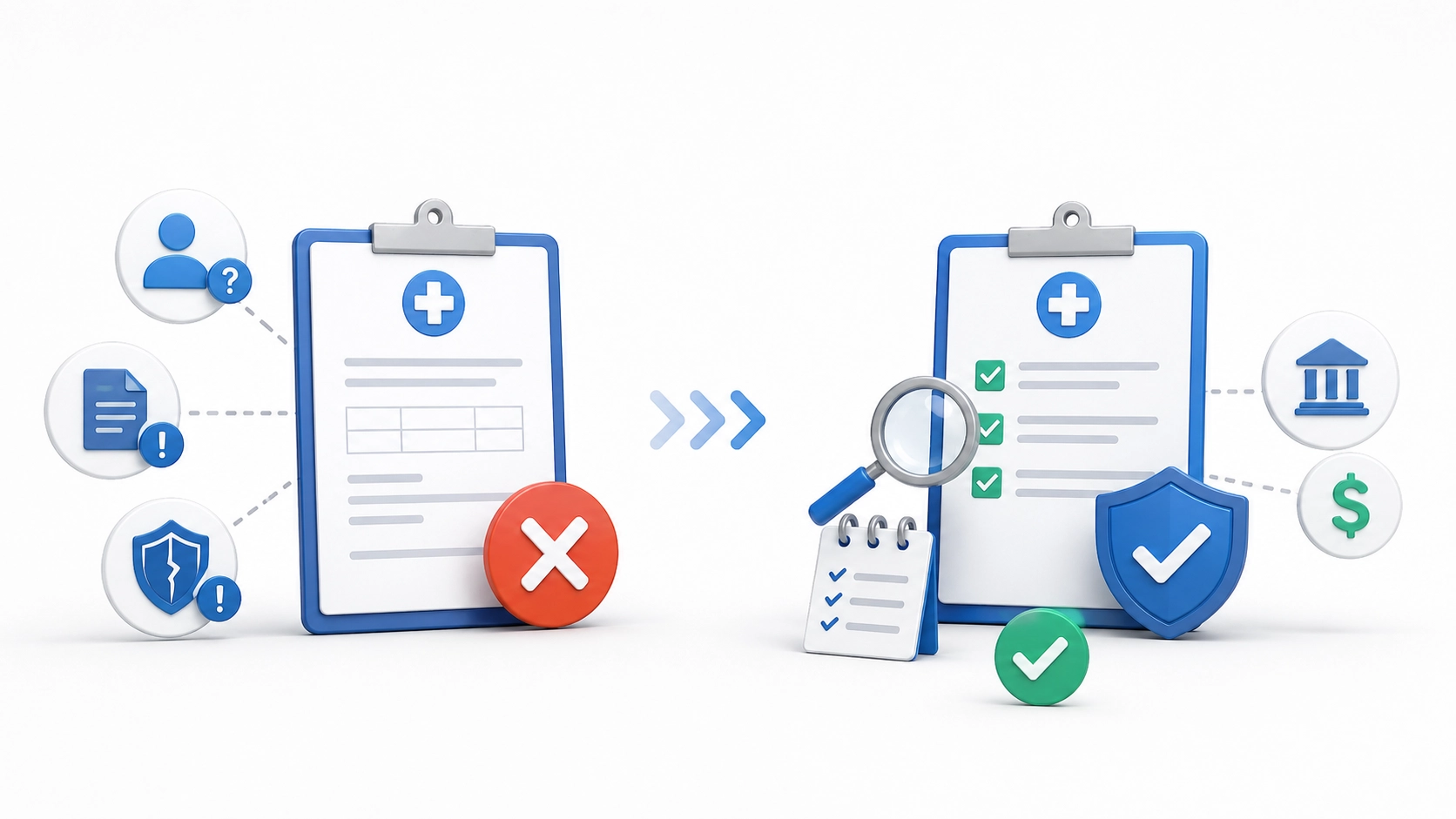
A healthcare practice can provide excellent patient care, submit thousands of claims, and still struggle with inconsistent revenue because some claims never turn into payments.
The reason?
Medical claim denials.
A denied claim represents more than a delayed payment. It often points to a problem somewhere within the healthcare revenue cycle.
The issue may not start when the claim reaches the insurance company.
It may begin earlier:
- Patient information was entered incorrectly
- Insurance eligibility was not verified
- Prior authorization was missed
- Documentation did not support the service
- Coding did not accurately represent the encounter
By the time a claim is denied, the original problem may have started days or even weeks earlier.
This is why successful denial management is not just about appealing rejected claims. It is about understanding why claims fail and improving the processes that create those failures.
Effective denial prevention helps healthcare practices:
- Improve cash flow
- Reduce administrative workload
- Accelerate reimbursement
- Improve revenue cycle performance
- Create more predictable collections
This guide explains what medical claim denials are, why they happen, where they originate, and how healthcare practices can prevent them.
What Are Medical Claim Denials?
A medical claim denial occurs when an insurance company reviews a submitted claim and refuses to pay for the healthcare services provided.
When a claim is denied, the provider does not receive expected reimbursement until the issue is resolved.
A denial may happen because:
- The claim contains incorrect information
- The service does not meet payer requirements
- Required documentation is missing
- The procedure was not authorized
- The coding does not match the documentation
- The payer determines the service was not medically necessary
For healthcare organizations, denied claims create additional work because teams must:
- Investigate the denial reason
- Correct errors
- Submit additional documentation
- File appeals when appropriate
- Follow up with insurance companies
A single denied claim may seem small, but thousands of denied claims can significantly impact practice revenue.
Medical Claim Denials vs Claim Rejections: What Is the Difference?
One common misunderstanding in healthcare billing is treating claim denials and claim rejections as the same thing.
They are different.
Understanding the difference helps practices respond correctly.
Claim Rejections
A rejected claim usually means the claim was not accepted for processing because it contained an error.
The payer or clearinghouse identifies the issue before the claim is fully processed.
Common rejection reasons include:
- Incorrect patient information
- Missing required fields
- Invalid insurance information
- Incorrect payer details
- Formatting errors
Rejected claims can often be corrected and resubmitted quickly.
Claim Denials
A denied claim is different.
The claim was accepted and reviewed by the payer, but payment was refused.
Common denial reasons include:
- Lack of medical necessity
- Incorrect coding
- Missing authorization
- Coverage limitations
- Documentation problems
- Timely filing issues
Denied claims often require deeper investigation and may require appeals.
Why Medical Claim Denials Are a Major Problem for Healthcare Practices
Claim denials affect much more than reimbursement.
They impact:
- Practice cash flow
- Administrative workload
- Patient experience
- Staff productivity
- Revenue forecasting
A practice with frequent denials may experience:
Delayed Revenue Collection
When claims are denied, payment is delayed.
Instead of receiving reimbursement after normal processing, staff must spend additional time resolving issues.
Increased Administrative Work
Denied claims require:
- Investigation
- Documentation review
- Payer communication
- Appeals
- Follow-up
This creates additional workload for billing teams.
Growing Accounts Receivable
Unresolved denials often contribute to increasing AR balances.
The longer a claim remains unpaid, the harder it can become to collect.
Reduced Financial Visibility
High denial rates make it difficult for practices to accurately predict revenue.
Without understanding denial patterns, practices may not know:
- Which payers create problems
- Which services are frequently denied
- Where workflow improvements are needed
Where Do Medical Claim Denials Actually Begin?
One of the biggest mistakes practices make is assuming denials are only a billing department problem.
In reality, many denials begin before a claim is ever submitted.
The revenue cycle works like a chain.
If one part fails, the final claim can be affected.
1. Patient Registration Problems
The first opportunity for errors occurs during patient registration.
Incorrect information such as:
- Wrong date of birth
- Incorrect insurance details
- Missing demographic information
- Incorrect subscriber information
can result in claim problems later.
A claim cannot be processed correctly if the foundational information is inaccurate.
2. Insurance Verification Issues
Insurance verification is one of the most important denial prevention steps.
Problems occur when practices fail to confirm:
- Active insurance coverage
- Patient benefits
- Deductible requirements
- Coverage limitations
- Authorization requirements
For example:
A patient may have insurance coverage, but a specific service may require prior approval.
Without verification, the claim may be denied after treatment has already been provided.
3. Documentation Problems
Medical documentation supports every claim submitted.
If documentation does not clearly explain:
- The service provided
- The diagnosis
- Medical necessity
- Treatment details
the payer may question reimbursement.
Documentation issues are especially common when:
- Services are complex
- Multiple conditions are addressed
- Procedures require additional justification
4. Coding Errors
Coding translates healthcare services into information insurance companies use for reimbursement.
Coding-related denial issues may involve:
- Incorrect CPT codes
- Incorrect ICD-10 codes
- Missing modifiers
- Code mismatch with documentation
A claim may be denied even when the service was medically necessary if the coding does not accurately represent the encounter.
5. Authorization Failures
Many services require approval before they are performed.
Authorization-related problems happen when:
- Approval was never obtained
- Authorization information was incorrect
- The approved service does not match the billed service
These issues can create preventable denials.
Medical Claim Denial Prevention Overview
| Revenue Cycle Stage | Common Problem | Prevention Approach |
|---|---|---|
| Patient Registration | Incorrect patient or insurance information. | Verify demographics and insurance details before services. |
| Eligibility Verification | Coverage issues discovered after treatment. | Confirm benefits and payer requirements early. |
| Documentation | Medical records do not support services billed. | Improve documentation review processes. |
| Coding | Codes do not match services provided. | Perform coding reviews and audits. |
| Authorization | Required approval is missing. | Track payer authorization requirements. |
Common Medical Claim Denial Reasons and How Practices Can Prevent Them
Not all claim denials happen for the same reason.
Some occur because of simple administrative mistakes, while others happen because of deeper workflow problems within the revenue cycle.
The most effective denial prevention strategies focus on identifying the root cause behind denials instead of only fixing individual claims.
A practice that understands why claims fail can create processes that prevent similar issues in the future.
1. Insurance Eligibility and Coverage Denials
Insurance eligibility issues are among the most common causes of preventable claim denials.
These denials often happen because:
- Patient insurance information is outdated
- Coverage is inactive
- The wrong payer is billed
- Benefits were not verified
- Patient responsibility was misunderstood
For example:
A patient schedules an appointment and provides insurance information. The practice confirms the insurance exists but does not verify whether the specific service is covered.
After treatment, the claim is denied because the service was not covered under the patient’s plan.
The issue did not begin with billing.
It began during eligibility verification.
How to Prevent Eligibility Denials:
Practices should:
- Verify insurance before every visit
- Confirm active coverage
- Check benefits and limitations
- Identify authorization requirements
- Maintain updated patient records
A strong front-end verification process prevents many avoidable denials.
2. Medical Coding Errors
Coding errors are one of the most significant causes of medical claim denials.
Healthcare services must be accurately translated into standardized codes that communicate:
- What service was performed
- Why it was performed
- How it should be reimbursed
Common coding-related denial reasons include:
- Incorrect CPT codes
- Incorrect ICD-10 codes
- Missing modifiers
- Incorrect code combinations
- Documentation not supporting the selected code
For example:
A provider performs a complex evaluation, but the documentation does not support the level of service billed.
The payer may reduce payment or deny the claim.
How to Prevent Coding Denials:
Practices should focus on:
- Regular coding audits
- Documentation review
- Coding education
- Accurate modifier usage
- Specialty-specific coding knowledge
Accurate coding connects clinical documentation with appropriate reimbursement.
3. Missing Prior Authorization
Prior authorization denials occur when insurance companies require approval before a service is provided.
These denials commonly affect:
- Imaging services
- Procedures
- Specialty treatments
- Certain medications
- Advanced therapies
Common authorization problems include:
- Authorization was never obtained
- Approval expired
- Wrong service was authorized
- Authorization information was incomplete
For example:
A patient receives an advanced imaging procedure, but the payer required prior approval. Since approval was not obtained, the claim is denied.
How to Prevent Authorization Denials:
Practices should:
- Identify authorization requirements before treatment
- Track approval status
- Confirm authorization details
- Maintain authorization records
Authorization management is a key part of preventing unnecessary revenue loss.
4. Medical Necessity Denials
Medical necessity denials occur when an insurance company determines that documentation does not sufficiently support why a service was provided.
These denials often involve questions about:
- The reason for treatment
- Patient condition
- Documentation quality
- Diagnosis support
Common causes include:
- Missing clinical information
- Weak documentation
- Diagnosis codes not supporting the service
- Lack of supporting records
How to Prevent Medical Necessity Denials:
Healthcare practices should:
- Improve provider documentation
- Ensure diagnosis codes match services
- Review documentation before submission
- Maintain complete medical records
Strong documentation protects both reimbursement and compliance.
5. Duplicate Claim Denials
Duplicate claims occur when the same service is submitted more than once.
This may happen because of:
- System errors
- Accidental resubmission
- Incorrect claim tracking
- Communication issues between teams
Although duplicate claims may seem like a simple mistake, they create unnecessary delays.
How to Prevent Duplicate Claim Denials:
Practices should:
- Monitor claim status before resubmitting
- Maintain accurate billing records
- Use claim tracking systems
- Review rejected claims carefully
6. Timely Filing Denials
Insurance companies have specific deadlines for submitting claims.
If a claim is submitted after the payer’s deadline, it may be denied.
Common causes include:
- Delayed claim submission
- Missing follow-up
- Internal workflow problems
- Unresolved billing errors
How to Prevent Timely Filing Denials:
Practices should:
- Monitor claim submission timelines
- Review aging reports regularly
- Create escalation processes
- Address rejected claims quickly
Timely follow-up is essential for protecting earned revenue.
7. Incorrect Patient Information
Small registration errors can create major billing problems.
Examples include:
- Incorrect spelling of patient name
- Wrong date of birth
- Incorrect insurance member ID
- Missing demographic information
These errors may prevent claims from being processed correctly.
How to Prevent Registration-Related Denials:
Practices should:
- Verify information during scheduling
- Confirm details at each visit
- Update patient records regularly
Accurate data entry creates a stronger foundation for the entire revenue cycle.
Common Medical Claim Denials and Prevention Strategies
| Denial Type | Common Cause | Prevention Strategy |
|---|---|---|
| Eligibility Denial | Incorrect insurance information or inactive coverage. | Verify benefits and coverage before services. |
| Coding Denial | Incorrect CPT, ICD-10, or modifier usage. | Perform coding reviews and documentation audits. |
| Authorization Denial | Required approval was missing. | Track payer requirements before treatment. |
| Medical Necessity Denial | Documentation does not support the service. | Improve clinical documentation quality. |
| Duplicate Claim Denial | Same claim submitted multiple times. | Monitor claim status before resubmission. |
| Timely Filing Denial | Claim submitted after payer deadline. | Maintain consistent claim monitoring. |
Hard Denials vs Soft Denials: Understanding the Difference
Not every denial has the same outcome.
Understanding denial types helps practices prioritize their recovery efforts.
Soft Denials
Soft denials are generally recoverable issues that can often be corrected.
Examples include:
- Missing information
- Coding mistakes
- Documentation issues
- Incorrect claim details
These denials can often be resolved through:
- Claim corrections
- Additional documentation
- Resubmission
- Appeals
Hard Denials
Hard denials are more difficult because they usually involve situations where payment cannot easily be recovered.
Examples include:
- Services excluded from coverage
- Non-covered procedures
- Incorrect patient responsibility decisions
- Certain contractual limitations
The best strategy for hard denials is prevention.
Why Understanding Denial Types Matters
A practice should not treat every denial the same way.
Effective denial management requires:
- Prioritizing recoverable claims
- Identifying repeat problems
- Improving workflows
- Reducing future denials
A high-performing revenue cycle focuses on prevention, not only recovery.
Key Medical Claim Denial Metrics Practices Should Track
Managing denials successfully requires measurement.
Without tracking performance, practices cannot identify whether denial problems are improving or getting worse.
Important denial management metrics include:
1. Denial Rate
Denial rate measures the percentage of claims denied by payers.
A rising denial rate may indicate problems with:
- Coding
- Documentation
- Eligibility
- Authorization processes
2. Top Denial Reasons
Tracking the most common denial categories helps identify where improvements are needed.
Examples:
- Authorization issues
- Coding errors
- Eligibility problems
- Documentation gaps
3. Appeal Success Rate
This measures how many appealed claims are successfully recovered.
A low appeal success rate may indicate:
- Weak documentation
- Incorrect appeals process
- Lack of supporting information
4. First-Pass Resolution Rate
This measures how many claims are processed successfully without additional work.
Improving first-pass resolution reduces:
- Administrative workload
- Claim delays
- Rework
5. Days in Accounts Receivable
AR days show how quickly a practice collects revenue.
Increasing AR days may indicate:
- Slow payer response
- Poor follow-up
- Growing unpaid claims
Denial Management Performance Dashboard
| Metric | What It Shows |
|---|---|
| Denial Rate | The percentage of claims denied by insurance companies. |
| Top Denial Reasons | The most common problems affecting reimbursement. |
| Appeal Success Rate | How effectively denied claims are recovered. |
| First-Pass Resolution Rate | How many claims are processed successfully the first time. |
| Days in AR | How quickly outstanding revenue is collected. |
Building a Proactive Medical Claim Denial Prevention Strategy
The best denial strategy is not reacting faster.
It is creating processes that prevent denials from happening.
A proactive approach includes:
Better Front-End Processes
Prevent problems before claims exist by improving:
- Patient registration
- Insurance verification
- Authorization tracking
Stronger Documentation Practices
Ensure providers document:
- Services performed
- Medical necessity
- Patient condition
- Treatment details
Regular Coding Reviews
Coding audits help identify:
- Common errors
- Training opportunities
- Documentation gaps
Denial Trend Analysis
Do not only fix individual claims.
Analyze patterns:
- Which payers deny most?
- Which services are affected?
- Which reasons repeat?
This helps solve the underlying problem.
How Healthcare Practices Can Reduce Medical Claim Denials
Reducing medical claim denials requires more than improving the billing department.
Denials are usually the result of problems occurring across multiple stages of the revenue cycle.
A successful prevention strategy focuses on improving the entire process — from patient registration to final payment collection.
Here are the key areas practices should focus on.
1. Strengthen Patient Registration and Eligibility Verification
Many claim problems begin before the patient receives care.
Incorrect information collected during registration can create avoidable issues later.
Practices should verify:
- Patient demographics
- Insurance information
- Member IDs
- Coverage status
- Benefits
- Patient responsibility
A strong eligibility verification process helps identify potential problems before services are provided.
For example:
If a patient’s insurance plan does not cover a specific service, identifying that information before treatment can prevent an avoidable denial and improve patient communication.
2. Improve Clinical Documentation
Documentation is the foundation of every successful claim.
Medical records should clearly support:
- The service performed
- The patient’s condition
- Medical necessity
- Treatment decisions
- Provider involvement
Weak documentation can create problems even when the service was appropriate.
Practices should establish documentation standards and regularly review records to ensure they support billed services.
3. Perform Regular Coding Audits
Coding accuracy directly impacts reimbursement.
Regular coding reviews help practices identify:
- Frequently denied codes
- Documentation gaps
- Modifier issues
- Incorrect code selection
Coding audits should focus on:
- Accuracy
- Compliance
- Consistency
- Education opportunities
The goal is not only finding mistakes.
The goal is improving the process that creates those mistakes.
4. Track Authorization Requirements
Prior authorization continues to be a major source of claim denials.
Practices should create clear workflows for:
- Identifying services requiring authorization
- Submitting authorization requests
- Tracking approval status
- Confirming authorization details before treatment
A missing authorization can result in a denied claim even when the service was medically necessary.
5. Analyze Denial Trends Instead of Individual Claims
Many practices review denied claims one by one but fail to analyze larger patterns.
A stronger approach asks:
- Which denial reasons occur most often?
- Which insurance companies create the most problems?
- Which services are frequently denied?
- Are denials increasing or decreasing?
Trend analysis helps practices solve recurring problems instead of repeatedly fixing the same errors.
6. Improve Communication Between Teams
Denial prevention requires collaboration between:
- Front desk teams
- Providers
- Coders
- Billing specialists
- Practice administrators
For example:
A billing team may notice frequent coding denials, but the solution may require better provider documentation.
Improving communication creates a stronger revenue cycle.
When Should Practices Consider Outsourcing Denial Management?
Not every practice needs external denial management support.
However, certain situations indicate that additional expertise may be beneficial.
A practice may benefit from outsourcing when it experiences:
Increasing Denial Rates
If denied claims continue increasing, there may be deeper workflow problems.
Common causes include:
- Coding issues
- Authorization failures
- Documentation gaps
- Eligibility problems
A denial management partner can analyze patterns and recommend improvements.
Growing Accounts Receivable
Increasing AR balances often indicate unresolved revenue cycle issues.
Outsourced support can help practices:
- Prioritize unpaid claims
- Follow up with payers
- Recover delayed revenue
- Improve collection workflows
Limited Internal Resources
Many practices have small administrative teams handling:
- Scheduling
- Patient communication
- Billing
- Insurance follow-up
Managing complex denials requires time and expertise.
Outsourcing provides access to specialists without increasing internal workload.
Lack of Denial Reporting
Without proper reporting, practices may not understand:
- Why claims are failing
- Which payers create problems
- Which services generate denials
A structured denial management process provides better visibility.
In-House vs Outsourced Denial Management
| Area | In-House Denial Management | Outsourced Denial Management |
|---|---|---|
| Expertise | Depends on internal staff experience and available training. | Provides access to specialists focused on denial prevention and recovery. |
| Time Management | Staff must balance denials with other administrative responsibilities. | Dedicated teams focus specifically on resolving claim issues. |
| Denial Analysis | May focus mainly on individual denied claims. | Analyzes patterns and identifies root causes. |
| Reporting | Depends on internal reporting capabilities. | Provides structured denial reports and performance insights. |
| Scalability | Requires additional staff as denial volume increases. | Can adjust support based on practice needs. |
How Pro Medical Billing Solutions Helps Reduce Medical Claim Denials
Preventing claim denials requires more than fixing rejected claims after they happen.
Pro Medical Billing Solutions helps healthcare practices improve denial performance by focusing on the processes that create billing problems.
Our approach includes:
- Insurance verification support
- Documentation review
- Medical coding assistance
- Claim accuracy checks
- Denial analysis
- Appeal support
- Accounts receivable follow-up
- Revenue cycle reporting
By identifying recurring denial patterns, practices can improve workflows and reduce preventable revenue loss.
Healthcare organizations looking for dedicated support can explore our Denial Management Services and learn how a structured denial prevention strategy can improve revenue cycle performance.