

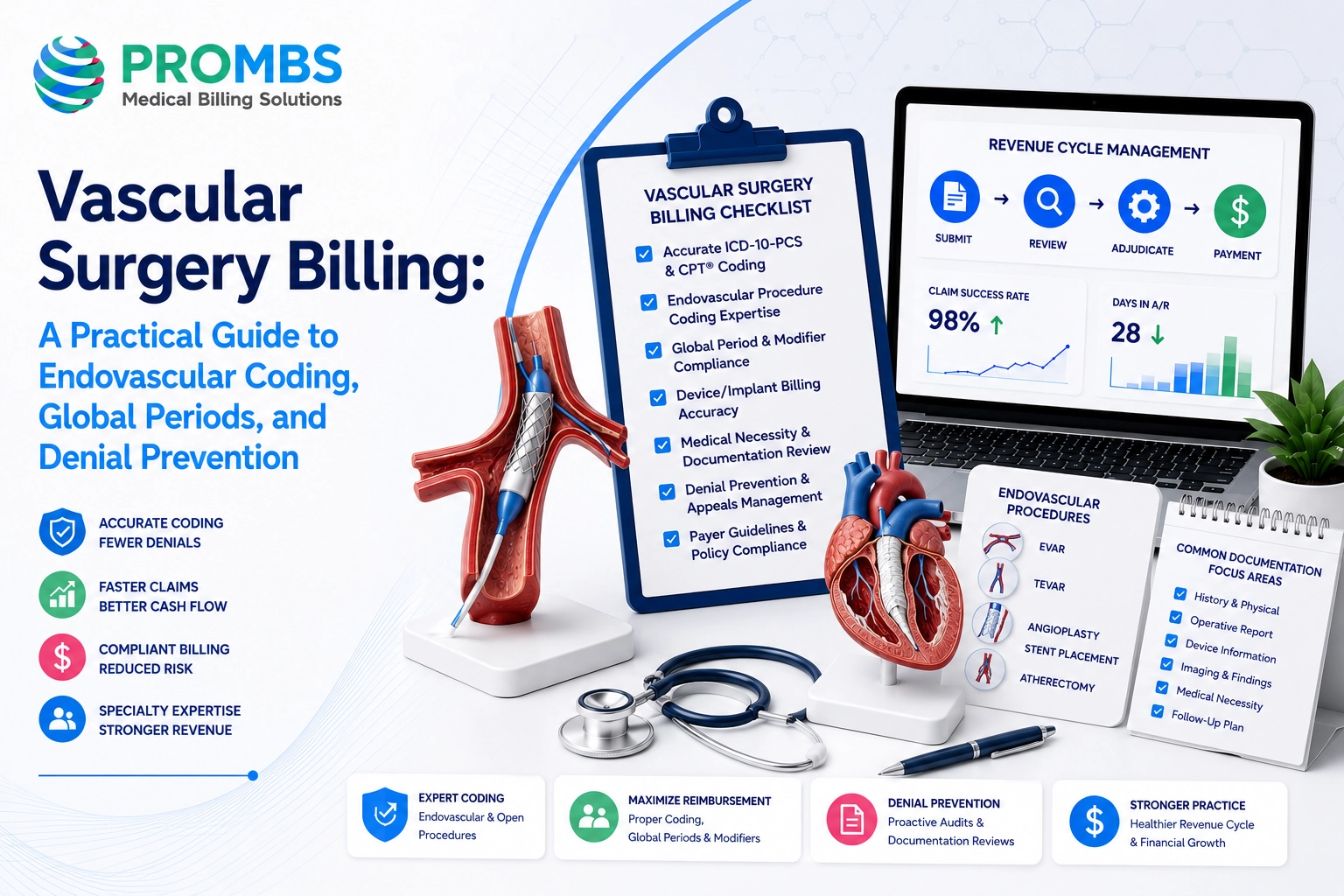
Vascular surgeons treat some of the most complex conditions within modern medicine, but the complexity does not end when the procedure is completed.
Every angioplasty, stent placement, carotid procedure, dialysis access intervention, aneurysm repair, and vascular diagnostic study creates a detailed billing process that determines whether the practice receives appropriate reimbursement.
This is where vascular surgery billing becomes critical.
Unlike billing for a routine office visit, vascular surgery claims may depend on:
- The artery or vein treated
- Anatomical territory
- Laterality
- Number of vessels treated
- Type of intervention
- Whether multiple procedures were performed
- Whether services are bundled
- Global surgical period requirements
- Modifier usage
- Medical necessity
- Prior authorization
- Operative documentation
A single vascular encounter may involve diagnostic imaging, catheter placement, angioplasty, stenting, atherectomy, or another intervention.
However, documenting several services does not automatically mean every service can be billed separately.
That is why vascular surgery practices need a billing process that understands both the clinical procedure and the coding rules surrounding it.
The challenge has become even more important in 2026 because lower extremity revascularization coding underwent major changes. The Society for Vascular Surgery now provides guidance around a new coding structure organized by vascular territories including iliac, femoropopliteal, tibial, and inframalleolar interventions.
For practices, successful reimbursement depends on connecting:
- Insurance verification
- Prior authorization
- Clinical documentation
- Operative reports
- Procedure coding
- Modifier review
- Bundling rules
- Claim submission
- Payment posting
- Denial management
- Accounts receivable follow-up
This guide explains how vascular surgery billing works, why it is difficult, where revenue is commonly placed at risk, and how practices can build stronger billing workflows around complex vascular procedures.
What Is Vascular Surgery Billing?
Vascular surgery billing is the process of documenting, coding, submitting, and managing claims for diagnostic and therapeutic services involving arteries, veins, and the vascular system.
It may include reimbursement for:
- Patient evaluations
- Vascular diagnostic studies
- Endovascular procedures
- Open vascular surgery
- Lower extremity revascularization
- Carotid interventions
- Aneurysm repair
- Dialysis access procedures
- Venous treatments
- Follow-up care
The billing process converts the clinical work performed by the vascular surgeon into standardized procedure and diagnosis codes that payers use to evaluate reimbursement.
A complete vascular surgery revenue cycle may include:
- Patient registration
- Insurance verification
- Benefit review
- Prior authorization
- Medical necessity review
- Clinical documentation
- Operative-note review
- CPT coding
- ICD-10-CM coding
- Modifier review
- Claim submission
- Payment posting
- Denial resolution
- AR follow-up
The challenge is that vascular surgery often combines multiple services within one episode of care.
For example, a patient with peripheral arterial disease may undergo:
- Initial vascular evaluation
- Non-invasive vascular testing
- Diagnostic angiography
- Catheter-based treatment
- Follow-up care
Each stage creates different documentation, coding, and payer requirements.
A billing workflow that treats these services like ordinary office claims can easily miss revenue or create preventable denials.
Why Vascular Surgery Billing Is So Complex
Vascular surgery billing is difficult because reimbursement depends heavily on what was treated, where it was treated, how it was treated, and what else occurred during the same encounter.
Small documentation differences may change how the service is coded.
The biggest areas of complexity include:
- Multiple vascular territories
- Endovascular interventions
- Open surgical procedures
- Diagnostic imaging
- Procedure bundling
- Global surgical periods
- Modifier requirements
- Prior authorization
- High-value claims
Endovascular Procedures Can Involve Multiple Billing Variables
Endovascular treatment may involve:
- Angioplasty
- Stent placement
- Atherectomy
- Thrombectomy
- Catheter-based intervention
- Imaging guidance
The coding team must understand exactly what occurred during the procedure.
That includes:
- Vessel treated
- Anatomical territory
- Side of the body
- Type of intervention
- Number of treated areas
- Additional procedures
If the operative report does not clearly describe these details, selecting the appropriate procedure code becomes more difficult.
Vascular Anatomy Directly Affects Coding
Anatomy plays a much larger role in vascular billing than in many other specialties.
A procedure performed in one vascular territory may be reported differently from a similar intervention performed in another territory.
For lower-extremity interventions, the current 2026 coding framework places significant emphasis on territories such as:
- Iliac
- Femoropopliteal
- Tibial
- Inframalleolar
The Society for Vascular Surgery has specifically created 2026 coding resources organized around these territories, highlighting how important anatomical documentation has become.
This creates a direct relationship between clinical documentation and reimbursement:
Incorrect or unclear anatomy
↓
Incorrect code selection
↓
Claim edit or underpayment
↓
Revenue risk
Open Surgery Creates Different Billing Challenges
Vascular surgeons also perform major open procedures.
These may include:
- Carotid endarterectomy
- Arterial bypass
- Vascular reconstruction
- Open aneurysm repair
Open surgical billing may involve:
- Detailed operative documentation
- Assistant surgeon considerations
- Global surgical periods
- Postoperative care
- Staged procedures
- Related and unrelated services
Because many major surgical procedures have global periods, practices must determine whether follow-up services are included in the surgical payment or may qualify for separate reporting.
Medicare recognizes 0-day, 10-day, and 90-day global surgical packages. Major procedures with a 90-day global period generally include one preoperative day, the procedure day, and 90 postoperative days.
Diagnostic and Interventional Services May Occur Together
A vascular procedure may involve both diagnostic and therapeutic work.
For example:
Diagnostic evaluation
↓
Angiography
↓
Disease identified
↓
Intervention performed
The billing team must determine which services are separately reportable and which are included in another procedure.
This is where bundling rules and National Correct Coding Initiative edits become important.
For Medicare claims, vascular procedure codes may be subject to NCCI edits and other payment rules.
Multiple documented services therefore do not automatically equal multiple separately payable services.
Major Services Involved in Vascular Surgery Billing
A vascular surgery practice may generate revenue from several different diagnostic and procedural categories.
Understanding these categories helps practices identify where specialized coding and billing controls are most important.
Lower Extremity Revascularization
Lower extremity revascularization is a major area of vascular surgery billing.
These procedures may be performed for patients with:
- Peripheral arterial disease
- Limb ischemia
- Arterial stenosis
- Arterial occlusion
Treatment may involve:
- Angioplasty
- Stenting
- Atherectomy
- Other catheter-based interventions
This area deserves particular attention in 2026 because the lower-extremity revascularization coding structure changed.
The Society for Vascular Surgery has introduced education and coding resources specifically around the new 2026 LER codeset and its reimbursement impact.
For billing teams, this makes it especially important to review:
- Vascular territory
- Procedure complexity
- Intervention performed
- Additional treatment
- Operative documentation
Older coding workflows should not simply be carried forward without review.
EVAR and Aortic Procedures
Vascular surgeons may perform complex procedures for abdominal and thoracic aortic disease.
These may include:
- Endovascular aneurysm repair
- Aortic graft placement
- Additional graft components
- Aortic interventions
- Related imaging
EVAR billing requires accurate documentation of:
- Aneurysm location
- Procedure performed
- Graft placement
- Additional components
- Associated interventions
The financial value of these procedures makes coding accuracy particularly important.
An incorrect claim may represent a much larger revenue impact than an error on a routine office visit.
Carotid Procedures
Vascular surgeons frequently manage carotid artery disease.
Services may include:
- Carotid diagnostic studies
- Carotid endarterectomy
- Endovascular carotid interventions
- Follow-up surveillance
Billing accuracy depends on documentation supporting:
- Diagnosis
- Laterality
- Procedure performed
- Medical necessity
- Related imaging
Postoperative services must also be reviewed carefully because major carotid procedures may involve a global surgical period.
Dialysis Access Procedures
Dialysis access represents another important revenue stream for many vascular surgery practices.
Services may involve:
- AV fistula creation
- AV graft creation
- Fistulograms
- Angioplasty
- Thrombectomy
- Access revisions
- Other dialysis circuit interventions
These claims can become complex because multiple services may be performed during the same access encounter.
Documentation should clearly explain:
- Type of access
- Location
- Problem identified
- Procedure performed
- Additional interventions
- Clinical outcome
Strong documentation helps the coding team understand the complete dialysis access encounter without reporting services that are already bundled.
Venous Procedures
Vascular practices may also provide treatment for venous disease.
Services can include:
- Venous ablation
- Sclerotherapy
- Phlebectomy
- Treatment of varicose veins
- Venous diagnostic studies
Venous procedure billing may depend on:
- Medical necessity
- Symptoms
- Conservative treatment history
- Laterality
- Vessel treated
- Diagnostic findings
- Payer requirements
Authorization and coverage rules can also affect whether treatment will be reimbursed.
This makes pre-service verification especially important.
Vascular Diagnostic Studies
Diagnostic testing is another major part of vascular practice revenue.
Common non-invasive vascular studies may evaluate:
- Arterial circulation
- Venous circulation
- Carotid blood flow
- Dialysis access
- Other vascular abnormalities
For Medicare, documentation must support the medical necessity for the study, and the results should be relevant to the management of the patient’s condition. CMS also notes that non-invasive vascular study codes may be subject to NCCI or OPPS edits.
This means the practice should be able to answer:
- Why was the study ordered?
- What condition was being evaluated?
- How will the results affect treatment?
- Was another diagnostic test already providing the same information?
Diagnostic testing without clear medical necessity can create reimbursement problems even when the technical service was performed correctly.
The Vascular Surgery Billing Workflow
Successful vascular surgery billing begins before the procedure takes place.
A strong workflow connects patient coverage, authorization, operative documentation, coding, and claim follow-up.
Patient Appointment
↓
Insurance Verification
↓
Authorization Review
↓
Clinical Evaluation
↓
Diagnostic Testing
↓
Surgical / Endovascular Procedure
↓
Operative Documentation
↓
Coding and Modifier Review
↓
Claim Submission
↓
Payment Posting
↓
Denial Management
↓
AR Follow-Up
Vascular Surgery Billing Workflow Explained
| Step | Purpose |
|---|---|
| Patient Appointment | Collects patient demographics and identifies the vascular condition or service required. |
| Insurance Verification | Confirms active coverage, benefits, and payer requirements. |
| Authorization Review | Determines whether diagnostic studies, surgery, or endovascular procedures require prior approval. |
| Clinical Evaluation | Documents symptoms, diagnosis, disease severity, and medical necessity. |
| Diagnostic Testing | Documents vascular studies and findings used to guide treatment decisions. |
| Procedure | Performs the open surgical, endovascular, dialysis access, or venous intervention. |
| Operative Documentation | Records vessels, anatomy, laterality, interventions, findings, and procedural details. |
| Coding and Modifier Review | Determines appropriate procedure codes, diagnosis codes, modifiers, and bundling requirements. |
| Claim Submission | Sends the completed claim to the appropriate payer. |
| Payment Posting | Records reimbursement, contractual adjustments, and patient responsibility. |
| Denial Management | Identifies why claims failed and resolves coding, authorization, documentation, or payer issues. |
| AR Follow-Up | Tracks unpaid and delayed claims until reimbursement is resolved. |
Each step affects the next.
For example:
Missing authorization
↓
Procedure performed
↓
Claim submitted
↓
Authorization denial
Or:
Incomplete operative report
↓
Coding uncertainty
↓
Incorrect claim
↓
Payment delay
A strong revenue cycle therefore focuses on preventing problems before they reach claim submission.
Why Operative Documentation Is Critical in Vascular Surgery Billing
The operative report is one of the most important documents in vascular surgery reimbursement.
It does more than prove that the procedure occurred.
It provides the information coders need to understand:
- What vessel was treated
- Where treatment occurred
- Which side was treated
- What type of intervention was performed
- Whether multiple vessels were involved
- Whether diagnostic work occurred
- Whether additional procedures were medically necessary
Weak operative documentation creates uncertainty.
When the coding team has to guess what happened during the procedure, the risk of undercoding, incorrect coding, or claim denial increases.
Anatomy and Vessel Documentation
The operative note should clearly identify the vessel or vascular territory involved.
For lower-extremity procedures, this has become especially important under the 2026 coding structure.
Documentation may need to distinguish areas such as:
- Iliac territory
- Femoropopliteal territory
- Tibial territory
- Inframalleolar territory
The coding team should not have to infer the anatomy from incomplete wording.
Clear documentation creates a stronger connection between:
Procedure performed → CPT selection → claim accuracy.
Laterality Documentation
When laterality is clinically relevant, the record should clearly identify:
- Right
- Left
- Bilateral involvement when applicable
Missing laterality can affect:
- Diagnosis coding
- Procedure coding
- Modifier selection
- Claim processing
Laterality should therefore be documented consistently across:
- Diagnostic reports
- Procedure notes
- Operative reports
- Claims
Procedure Detail
The operative note should describe exactly what was performed.
For an endovascular encounter, this may include:
- Angioplasty
- Stent placement
- Atherectomy
- Thrombectomy
- Catheter placement
- Other interventions
The record should also make it clear when several procedures occurred during the same encounter.
This allows the coder to determine whether the services are:
- Separately reportable
- Bundled
- Add-on services
- Subject to modifier requirements
Diagnostic Findings and Medical Necessity
Documentation should show why the procedure was necessary.
That may involve:
- Stenosis
- Occlusion
- Ischemia
- Aneurysm
- Vascular access dysfunction
- Venous disease
- Other clinically supported vascular conditions
For diagnostic vascular studies, CMS emphasizes that the study should provide information relevant to the patient’s clinical management and that medical necessity must be supported in the record.
The diagnosis and procedure should tell the same clinical story.
Prior Authorization in Vascular Surgery Billing
Prior authorization can have a major financial impact because many vascular procedures are high-value services.
Practices may need to verify authorization requirements for:
- Endovascular interventions
- Venous procedures
- Certain vascular imaging services
- Elective surgeries
- Other payer-controlled procedures
Authorization workflows should confirm:
- Patient eligibility
- Procedure being requested
- Diagnosis
- Approved service
- Effective dates
- Number of authorized services
- Facility or site-of-service requirements
One of the most expensive revenue-cycle mistakes occurs when a procedure is clinically appropriate but the payer’s authorization requirement was not completed correctly.
A strong workflow identifies that risk before treatment.
Global Surgical Periods and Vascular Practices
Global surgery rules deserve special attention in vascular billing because postoperative services are not always separately payable.
Medicare classifies surgical procedures using global periods that may include:
- 0 postoperative days
- 10 postoperative days
- 90 postoperative days
For major 90-day procedures, related postoperative care is generally included in the surgical package.
This becomes important when a vascular patient returns for:
- Follow-up evaluation
- Wound management
- Additional intervention
- A staged procedure
- Treatment of a separate condition
The billing team must determine whether the service is:
- Part of routine postoperative care
- A staged or related procedure
- Unrelated to the original surgery
- Otherwise separately reportable under applicable rules
Incorrectly billing routine global care can create denials or compliance risk.
Failing to identify legitimately separate services can lead to lost reimbursement.
Common Vascular Surgery Billing Challenges
Vascular surgery claims can fail for many different reasons, but the most common problems usually begin with documentation, authorization, coding, or claim structure.
| Challenge | Impact on the Practice |
|---|---|
| Incorrect Anatomical Coding | May result in incorrect procedure selection, underpayment, or claim denial. |
| Incomplete Operative Documentation | Makes it difficult to identify vessels, territories, interventions, and separately reportable services. |
| Endovascular Bundling Errors | Can cause denials when services included in another procedure are reported separately. |
| Global Period Errors | May result in denial of follow-up services or incorrect billing during postoperative care. |
| Modifier Problems | Can affect claims involving staged procedures, distinct services, bilateral treatment, or other procedural circumstances. |
| Authorization Issues | May place high-value vascular procedures at risk of nonpayment. |
| Diagnostic Study Denials | Can occur when medical necessity, diagnosis, or payer requirements are not adequately supported. |
| High-Value Claim Delays | Can significantly affect practice cash flow when complex surgical or endovascular claims remain unpaid. |
The financial impact of a vascular billing error can be much greater than the value of one denied office visit.
A single incorrectly coded intervention, missing authorization, or incomplete operative report may delay payment on a high-value procedure.
That is why vascular practices should treat billing as an extension of the clinical workflow.
The strongest process connects:
Accurate clinical documentation
↓
Correct anatomical and procedural coding
↓
Appropriate modifier and bundling review
↓
Clean claim submission
↓
Faster reimbursement
This becomes even more important in 2026 as practices adapt their lower-extremity revascularization coding workflows to the new code structure.
Vascular surgery coding requires much more than matching a procedure name with a CPT code.
Accurate reimbursement often depends on:
- The vascular territory treated
- The vessel involved
- Laterality
- The type of intervention
- Whether additional vessels were treated
- Whether diagnostic work is separately reportable
- Bundling rules
- Modifier requirements
- Global surgical rules
- Operative documentation
These details have become even more important in 2026 because lower-extremity revascularization coding underwent major restructuring.
Vascular Surgery CPT Coding in 2026
Vascular surgery practices bill across several procedure categories.
These may include:
- Endovascular revascularization
- Open arterial surgery
- Aneurysm repair
- Carotid procedures
- Dialysis access interventions
- Venous procedures
- Diagnostic vascular studies
The selected CPT code should accurately represent:
- What was performed
- Where the procedure occurred
- How complex the intervention was
- Whether multiple treatments occurred
- What the operative report supports
A common mistake is coding from the procedure schedule or short procedure description instead of reviewing the complete operative report.
For example:
Scheduled Procedure: Lower-extremity angioplasty
But the operative report may show:
- Multiple vascular territories
- Stent placement
- Atherectomy
- Additional vessel treatment
- Diagnostic angiography
Those details can materially change the coding approach.
2026 Lower Extremity Revascularization Coding Changes
One of the biggest vascular surgery coding developments in 2026 involves lower-extremity revascularization.
The previous lower-extremity intervention structure was replaced by a new code family beginning with 37254 through 37299.
The updated structure places greater emphasis on:
- Vascular territory
- Type of intervention
- Procedure complexity
- Initial treatment
- Additional treatment
- Multiple vessel involvement
For billing teams, this means older coding habits should not automatically be carried forward into 2026 claims.
Why the 2026 Changes Matter
Lower-extremity interventions may involve:
- Angioplasty
- Stenting
- Atherectomy
- Intravascular lithotripsy
- Combination treatment
Code selection now depends heavily on understanding exactly which territory was treated and what intervention occurred.
A vague operative note such as:
“Angioplasty and stenting performed in lower extremity”
may not provide enough information.
A stronger operative note identifies:
- Side treated
- Vessel
- Territory
- Lesion
- Device or intervention
- Additional vessels
- Procedure complexity
This creates a clearer pathway from:
Operative report
↓
Territory identification
↓
Procedure classification
↓
Correct CPT selection
↓
Accurate claim submission
Iliac Territory
The iliac territory may include treatment involving vessels such as:
- Common iliac artery
- Internal iliac artery
- External iliac artery
Documentation should clearly identify:
- Which vessel was treated
- Laterality
- Intervention performed
- Whether additional treatment occurred
When several iliac vessels are involved, coding should be based on the applicable 2026 rules rather than simply adding multiple procedure codes.
Femoropopliteal Territory
The femoropopliteal territory includes vascular treatment involving areas such as:
- Common femoral region when applicable to the coding framework
- Superficial femoral artery
- Popliteal artery
The operative report should explain:
- Lesion location
- Side treated
- Type of intervention
- Whether the intervention was straightforward or more complex under applicable coding rules
- Any additional treatment
Poor anatomical documentation can create uncertainty about which territory should be reported.
Tibial Territory
Tibial interventions may involve vessels such as:
- Anterior tibial artery
- Posterior tibial artery
- Peroneal artery
These procedures can become particularly complex when more than one vessel is treated.
The billing team should identify:
- Each treated vessel
- Intervention performed in each vessel
- Additional treatment
- Applicable add-on reporting
A statement such as “multiple tibial vessels treated” may not provide enough detail for accurate coding.
Inframalleolar Territory
The 2026 structure gives additional attention to inframalleolar intervention.
This is particularly relevant in complex limb-salvage cases.
Documentation should clearly identify treatment below the ankle and distinguish those interventions from tibial treatment.
This is another example of why precise anatomical documentation directly affects reimbursement.
Straightforward vs Complex Interventions
The 2026 lower-extremity framework also introduces additional distinctions around procedural complexity.
The coding team should rely on the operative report rather than assuming complexity based only on the device used.
Relevant documentation may include:
- Lesion characteristics
- Treatment performed
- Multiple interventions
- Additional vessels
- Procedural circumstances
When documentation does not clearly support the complexity reported, the claim may face payer review.
Endovascular Procedure Coding and Bundling
Vascular surgery claims often involve several services during one endovascular encounter.
A single case might include:
- Diagnostic angiography
- Catheter placement
- Angioplasty
- Stent placement
- Atherectomy
- Thrombectomy
- Imaging guidance
The key billing question is:
Which services are separately reportable and which are already included in another procedure?
Diagnostic Angiography With an Intervention
Diagnostic angiography may sometimes occur before an intervention.
However, the fact that angiography was performed does not automatically mean it can be separately billed.
The coding team should determine whether:
- A previous diagnostic study was available
- The prior study was adequate
- A new diagnostic decision was required
- The angiography was performed only to guide the intervention
When imaging is integral to the intervention, separate billing may not be appropriate.
Angioplasty and Stenting
When angioplasty and stenting occur in the same vascular territory, applicable coding rules may bundle certain components.
Practices should avoid thinking:
Angioplasty
Stent
=
Always two separately payable procedures.
Instead, coders should review the specific code structure and bundling rules that apply to the territory and intervention.
Atherectomy and Additional Interventions
Atherectomy may also occur with:
- Angioplasty
- Stenting
- Other endovascular treatment
The billing team must determine whether the selected procedure code already includes one or more of these services.
Incorrectly separating bundled services can result in:
- Claim edits
- Denials
- Repayment risk
- Additional payer review
Catheter Placement
Catheterization is another common source of confusion.
Some endovascular procedure codes include catheter-related work, while other circumstances may allow separate reporting.
The operative report should identify:
- Access site
- Catheter pathway
- Selective catheterization
- Vessel reached
- Intervention performed
Billing teams should not automatically report every documented catheter placement without reviewing applicable bundling rules.
EVAR and Aortic Procedure Billing
Endovascular aneurysm repair can generate high-value and technically complex claims.
EVAR-related services may involve:
- Main endograft placement
- Iliac components
- Extensions
- Additional vascular interventions
- Imaging
- Access-related procedures
Accurate coding depends heavily on the operative report.
EVAR Documentation Requirements
The record should clearly identify:
- Aneurysm location
- Type of repair
- Main graft placement
- Additional graft components
- Vessel involvement
- Additional interventions
- Complications when applicable
A generic statement such as “EVAR completed successfully” may not give the coding team enough information.
The documentation should allow the coder to reconstruct the procedure without guessing.
Additional Procedures During EVAR
Some patients require additional vascular treatment during the same operative session.
The coder should determine whether those services are:
- Integral to the aneurysm repair
- Separately reportable
- Subject to bundling
- Supported by a distinct clinical need
This is another area where the number of procedures documented does not necessarily equal the number of separately payable services.
Carotid Procedure Billing
Carotid disease may be treated through open or endovascular approaches.
Common services include:
- Carotid endarterectomy
- Carotid stenting
- Diagnostic carotid studies
- Postoperative surveillance
Billing requires documentation supporting:
- Laterality
- Diagnosis
- Degree or significance of disease when clinically relevant
- Procedure performed
- Medical necessity
Carotid Endarterectomy
For carotid endarterectomy, the operative record should clearly describe:
- Side treated
- Surgical approach
- Artery involved
- Procedure performed
- Additional work
Because carotid endarterectomy may fall within a major surgical global period, postoperative services also require careful review.
Carotid Stenting
Endovascular carotid treatment creates additional coding considerations involving:
- Access
- Imaging
- Stent placement
- Embolic protection where applicable
- Bundled components
Detailed procedural documentation helps prevent incorrect separation of services already included within a primary code.
Dialysis Access Billing
Dialysis access procedures are another major component of vascular surgery billing.
Patients may require repeated interventions to maintain functional vascular access.
Services may include:
- AV fistula creation
- AV graft creation
- Dialysis circuit imaging
- Angioplasty
- Thrombectomy
- Stent placement
- Access revision
Dialysis Circuit Interventions
A dialysis access encounter may involve several steps.
For example:
Access dysfunction identified
↓
Diagnostic circuit evaluation
↓
Stenosis found
↓
Angioplasty performed
↓
Thrombus treated
The billing team must determine which components are included within the dialysis circuit intervention code and which, if any, are separately reportable.
Documentation for Dialysis Access Claims
The record should identify:
- Type of access
- Anatomical location
- Clinical problem
- Diagnostic findings
- Intervention performed
- Additional treatment
- Final access status
Incomplete documentation may result in:
- Incorrect procedure selection
- Bundling errors
- Denials
- Underpayment
Venous Ablation and Varicose Vein Billing
Vascular practices may treat symptomatic venous disease through procedures such as:
- Radiofrequency ablation
- Endovenous laser treatment
- Chemical ablation
- Sclerotherapy
- Phlebectomy
Venous procedures often have significant payer-specific requirements.
Medical Necessity for Venous Procedures
Payers may require documentation of:
- Symptoms
- Functional impairment
- Venous reflux
- Duplex findings
- Conservative treatment
- Duration of symptoms
- Vessel treated
Claims may be denied when the record does not clearly establish why the procedure was medically necessary.
Laterality and Vessel Documentation
The clinical record should identify:
- Right or left side
- Vein treated
- Treatment performed
- Additional veins when applicable
This information should remain consistent across:
- Ultrasound report
- Procedure note
- Authorization
- Claim
A mismatch between these records can delay reimbursement.
Authorization for Venous Treatment
Venous procedures frequently require prior authorization.
Practices should verify:
- Approved procedure
- Approved side
- Approved vessel when specified
- Effective dates
- Number of approved treatments
Performing a procedure that differs from what was authorized may create payment problems even when the treatment was clinically appropriate.
Vascular Diagnostic Study Billing
Vascular diagnostic studies represent recurring revenue but are also frequently reviewed for medical necessity.
Services may include:
- Carotid duplex studies
- Arterial duplex studies
- Venous duplex studies
- Physiologic vascular testing
- Dialysis access studies
Billing should be supported by:
- Clinical indication
- Symptoms
- Diagnosis
- Test performed
- Findings
- Interpretation
Professional and Technical Components
Depending on how the service is performed, diagnostic studies may involve:
- Technical component
- Professional interpretation
- Global service
The claim should accurately represent which component the practice actually provided.
Incorrect component reporting can lead to:
- Duplicate billing
- Denials
- Payment recoupment
Repeat Vascular Studies
Repeat testing should be clinically supported.
Documentation should explain why another study is necessary.
Examples may include:
- Disease progression
- New symptoms
- Post-procedure surveillance
- Change in treatment plan
- Vascular access dysfunction
Routine repetition without clear medical necessity may attract payer scrutiny.
Modifier Requirements in Vascular Surgery Billing
Modifiers are particularly important in vascular surgery because they communicate circumstances that cannot always be represented through the primary procedure code alone.
Common modifier considerations include:
- Separate E/M services
- Bilateral procedures
- Staged procedures
- Distinct procedures
- Laterality
- Professional and technical components
Modifiers should never be added solely to force a claim through an edit.
The medical record must support their use.
Modifier 25
Modifier 25 may be appropriate when a significant and separately identifiable E/M service occurs on the same day as another procedure.
The record should show work beyond the normal evaluation included in the procedure.
Examples might include:
- Evaluation of an unrelated problem
- Significant new clinical assessment
- Separate medical decision-making
Automatically adding modifier 25 to every same-day office visit creates denial and compliance risk.
Modifier 50
Modifier 50 may be relevant for certain bilateral procedures when payer rules permit.
The billing team should verify:
- Whether the procedure is eligible for bilateral reporting
- Whether the payer wants modifier 50
- Whether RT and LT are required instead
- Whether units must be adjusted
Payer rules may differ, so one bilateral billing approach should not be applied universally.
Modifier 58
Modifier 58 may apply when a staged or related procedure is performed during the postoperative period under qualifying circumstances.
This can be important in vascular surgery when treatment is intentionally planned in stages.
Documentation should clearly show:
- Relationship to the original procedure
- Why additional treatment was required
- Whether the procedure was planned or more extensive
Modifier 59
Modifier 59 may indicate a distinct procedural service when applicable coding rules are met.
In vascular surgery, this can become relevant when multiple procedures occur during the same encounter.
The documentation should demonstrate a true distinction, such as:
- Separate anatomical site
- Separate lesion
- Separate encounter
- Other qualifying circumstances
Modifier 59 should not be used simply because the payer bundled two codes.
RT and LT Modifiers
Laterality modifiers help identify whether a service occurred on the:
- Right side
- Left side
They can be particularly important for:
- Lower-extremity procedures
- Venous interventions
- Diagnostic vascular studies
Laterality on the claim should match the clinical documentation and authorization.
Modifier 26 and TC
Diagnostic services may require:
- Modifier 26 for professional interpretation
- TC for technical component
when appropriate.
The practice should report only the component it actually performed.
Global Surgical Periods in Vascular Surgery
Global surgery rules are especially important for vascular practices because many major procedures include postoperative care within the surgical payment.
Global periods may include:
- 0 days
- 10 days
- 90 days
The billing team should know the global period attached to each surgical procedure.
Routine Postoperative Care
Routine follow-up related to the original surgery is generally included within the global surgical package when applicable.
Examples may include:
- Routine wound checks
- Standard postoperative evaluation
- Normal recovery monitoring
Submitting these as separate E/M claims may result in denials.
Staged Procedures
Some vascular treatment plans involve multiple procedures intentionally performed in stages.
When a staged procedure occurs during the global period, the claim may require an appropriate modifier such as modifier 58 when documentation and coding rules support it.
The operative and treatment plan should clearly show that staged treatment was anticipated.
Unrelated Procedures During the Global Period
A patient may develop a separate condition unrelated to the original surgery.
If the provider treats an unrelated problem during the global period, separate billing may be possible when documentation and modifier requirements are satisfied.
The note should clearly distinguish the unrelated condition from postoperative care.
Return to the Operating Room
Complications or other clinical circumstances may require another procedure during the postoperative period.
The billing team should determine:
- Whether the procedure is related
- Whether it requires a return to the operating room
- Which global-period modifier applies
- What documentation supports the circumstance
Global-period claims should be reviewed individually rather than relying on automatic modifier rules.
Common Vascular Surgery Billing Denials
Vascular claims may be denied for reasons ranging from missing authorization to incorrect bundling.
| Denial Reason | Why It Happens | Prevention Strategy |
|---|---|---|
| Incorrect Anatomical Coding | The vessel, territory, or laterality does not match the procedure documentation. | Review the complete operative report and confirm anatomy before code selection. |
| Lower Extremity Coding Errors | Legacy coding logic or incorrect interpretation of the 2026 LER structure is used. | Update coding workflows and educate staff on the current territory-based framework. |
| Bundling Denials | Services included within a primary intervention are reported separately. | Review NCCI edits and procedure-specific bundling rules before claim submission. |
| Modifier Denials | A modifier is missing, incorrect, or unsupported by documentation. | Validate the clinical circumstances before applying procedural modifiers. |
| Authorization Denials | Required approval is missing, expired, or does not match the procedure performed. | Confirm authorization details before the procedure date. |
| Global Period Denials | A postoperative service is billed separately when it is included in the surgical package. | Check the applicable global period and determine whether separate billing is justified. |
| Medical Necessity Denials | Documentation or diagnosis does not adequately support the procedure or diagnostic study. | Ensure clinical findings and diagnosis clearly support the billed service. |
| Diagnostic Study Denials | Repeat or non-invasive vascular testing is not adequately supported. | Document symptoms, surveillance needs, findings, and treatment impact. |
How Vascular Surgery Practices Can Prevent Claim Denials
Preventing denials requires more than correcting claims after payer rejection.
The strongest vascular revenue cycles identify billing risks before submission.
1. Review the Complete Operative Report
Coding should not rely only on:
- Procedure schedule
- Charge ticket
- Short procedure name
The operative report should be reviewed for:
- Vessel
- Territory
- Laterality
- Procedures performed
- Additional interventions
- Clinical findings
This is particularly important for complex endovascular cases.
2. Update Lower Extremity Coding Workflows for 2026
Practices should ensure that:
- Coding software is updated
- Charge sheets are updated
- Coders understand the new LER framework
- Surgeons understand new documentation needs
- Old templates do not drive outdated coding
Using an outdated workflow can create systematic errors across many claims.
3. Validate Authorization Against the Final Procedure
Authorization should not only be checked when it is obtained.
Before the procedure, verify that the approval still matches:
- Diagnosis
- Procedure
- Side
- Site of service
- Effective dates
If the clinical plan changes, authorization may also need to be updated.
4. Review Bundling Before Submission
Claims involving multiple endovascular services should be checked for:
- NCCI edits
- Included services
- Add-on codes
- Diagnostic imaging rules
- Catheterization rules
This reduces unnecessary denials and compliance risk.
5. Audit Global Period Claims
Practices should establish a process for identifying patients currently within a global surgical period.
Before billing a new service, ask:
- Is this routine postoperative care?
- Is this a staged procedure?
- Is this unrelated to the original surgery?
- Is another global-period modifier required?
This prevents both inappropriate billing and lost reimbursement.
6. Monitor High-Value Claims Separately
A delayed high-value vascular claim can have a significant effect on cash flow.
Practices may benefit from separately tracking:
- EVAR claims
- Major open surgery
- Complex endovascular cases
- Dialysis access interventions
- Other high-value procedures
Early follow-up helps prevent these claims from aging unnecessarily.
7. Analyze Denials by Procedure Type
Do not review only the overall denial rate.
Separate denials into categories such as:
- Lower-extremity interventions
- EVAR
- Carotid procedures
- Dialysis access
- Venous procedures
- Diagnostic studies
This makes it easier to identify where the revenue cycle is breaking down.
Vascular Surgery Denial Prevention Checklist
| Area | Review Question |
|---|---|
| Operative Documentation | Does the report clearly identify anatomy, laterality, intervention, and procedural details? |
| 2026 LER Coding | Is the current lower-extremity revascularization structure being used? |
| Authorization | Does the approval match the procedure, side, date, and site of service? |
| Bundling | Have NCCI and procedure-specific bundling rules been reviewed? |
| Modifiers | Does documentation support every modifier reported? |
| Global Period | Is the new service included in postoperative care or separately reportable? |
| Medical Necessity | Does the diagnosis and clinical documentation support the procedure? |
| Claim Review | Has the high-value vascular claim been reviewed before submission? |
Why Vascular Surgery Practices Need Specialty Billing Expertise
Vascular surgery billing requires a level of procedural and anatomical knowledge that goes beyond general medical billing.
A specialty billing team needs to understand:
- Vascular anatomy
- Lower-extremity territories
- Endovascular interventions
- Open surgery
- EVAR
- Dialysis access
- Venous procedures
- Diagnostic vascular testing
- Bundling rules
- Global surgical periods
- Modifier requirements
The financial impact of an error can also be much greater than in lower-value specialties.
One coding or authorization mistake may affect a high-value procedure rather than a routine office visit.
Specialty expertise helps connect:
Clinical procedure
↓
Operative documentation
↓
Correct coding
↓
Payer requirements
↓
Accurate reimbursement
This becomes especially important in 2026 as vascular practices adjust to the new lower-extremity revascularization coding framework and review older workflows that may no longer support current claims.
Accurate coding is only one part of a successful vascular surgery revenue cycle.
Even when the procedure is coded correctly, reimbursement can still be delayed by:
- Missing authorization
- Incomplete operative documentation
- Claim submission errors
- Underpayments
- Unresolved denials
- Poor AR follow-up
- Global-period mistakes
- Payer-specific requirements
For vascular surgery practices, the strongest revenue cycle connects clinical documentation, coding, authorization, billing, payment review, denial management, and AR follow-up into one coordinated process.
How Vascular Surgery Practices Can Improve Revenue Cycle Performance
Vascular surgery practices often generate high-value claims that require more attention than routine office billing.
A small workflow problem can place substantial reimbursement at risk.
For example:
Incomplete operative report
↓
Incorrect vascular territory identified
↓
Incorrect procedure coding
↓
Claim denial or underpayment
Or:
Procedure changes during surgery
↓
Authorization no longer matches final service
↓
Claim submitted
↓
Authorization denial
Improving revenue cycle performance means identifying these risks before they become unpaid claims.
1. Improve Charge Capture for Complex Procedures
Charge capture is especially important in vascular surgery because a single encounter may involve several services.
These may include:
- Diagnostic angiography
- Catheter placement
- Angioplasty
- Stenting
- Atherectomy
- Thrombectomy
- Imaging
- Additional vessel treatment
The billing team should compare the operative report with the captured charges before the claim is created.
A strong charge capture process should confirm:
- Procedure performed
- Vessel treated
- Vascular territory
- Laterality
- Additional interventions
- Applicable add-on services
Missed charges may result in underbilling.
Incorrectly added charges may create bundling or compliance problems.
The goal is to capture everything that is legitimately billable without reporting services that are already included elsewhere.
2. Build Coding Around the Operative Report
The operative report should be the primary source for vascular procedure coding.
Billing teams should avoid relying solely on:
- Scheduling information
- Procedure titles
- Charge tickets
- Brief clinical summaries
The operative note provides the details needed to understand:
- Anatomy
- Lesion location
- Laterality
- Access
- Intervention
- Additional vessels
- Imaging
- Procedural complexity
This has become even more important with the 2026 lower-extremity revascularization coding structure.
If the documentation does not clearly identify the vascular territory or procedure performed, the coding team should seek clarification rather than make assumptions.
3. Strengthen Prior Authorization Before High-Value Procedures
Authorization is one of the most important financial controls in vascular surgery billing.
Before treatment, practices should confirm:
- Active insurance
- Procedure authorization
- Approved diagnosis
- Laterality
- Site of service
- Effective dates
- Approved units or procedures
- Payer-specific requirements
Authorization should also be rechecked if the treatment plan changes.
For example:
Original authorization
↓
Angioplasty planned
↓
Clinical findings change
↓
Additional intervention required
↓
Authorization requirements reviewed again
The clinical need for a procedure does not automatically guarantee payer reimbursement.
That is why authorization and billing teams should stay connected throughout the treatment process.
4. Review Bundling and Modifiers Before Claim Submission
Complex vascular claims should receive a pre-submission review for:
- Bundled services
- NCCI edits
- Add-on codes
- Multiple procedures
- Bilateral services
- Global-period modifiers
- Professional and technical components
Modifiers should explain a legitimate clinical circumstance.
They should not be used simply because two procedures initially fail a payer edit.
A modifier review should answer:
- What happened clinically?
- Why are these services distinct?
- Does the operative report support separate reporting?
- Does the payer recognize the modifier in this situation?
This helps protect both reimbursement and coding compliance.
5. Create a Global Period Review Process
Vascular practices should know when patients are within a postoperative global period.
Before billing a follow-up service, the team should determine whether it represents:
- Routine postoperative care
- A staged procedure
- A related return to the operating room
- An unrelated service
- A separately reportable procedure
A simple global-period flag within the billing workflow can help prevent claims from being submitted incorrectly.
It can also prevent practices from overlooking separately reportable services when documentation supports them.
6. Track High-Value Claims Separately
Not every vascular claim creates the same financial exposure.
Practices may benefit from separately tracking high-value services such as:
- EVAR
- Major open vascular surgery
- Complex lower-extremity interventions
- Carotid procedures
- Dialysis access interventions
These claims should receive closer attention after submission.
The team should monitor:
- Claim acceptance
- Payer status
- Requests for medical records
- Payment
- Underpayment
- Denial
- Appeal status
Waiting until a complex claim reaches an older AR bucket can delay significant revenue.
7. Compare Payments With Expected Reimbursement
Payment posting should not end when the payer sends money.
Practices should also review whether payment appears consistent with:
- Contract terms
- Procedure billed
- Allowed amount
- Modifiers
- Multiple-procedure reductions
- Patient responsibility
A claim can be technically “paid” while still being underpaid.
This is particularly important for high-value vascular procedures where even a relatively small reimbursement variance may have a meaningful financial impact.
8. Analyze Denials by Procedure Category
A single overall denial rate does not provide enough insight.
Vascular practices should separate denials into categories such as:
- Lower-extremity interventions
- EVAR
- Carotid procedures
- Dialysis access
- Venous procedures
- Diagnostic studies
- E/M services
Then identify the root cause.
For example:
Lower-extremity denial
Potential cause:
- Incorrect territory
- Outdated coding workflow
- Modifier problem
- Bundling issue
Venous procedure denial
Potential cause:
- Missing conservative treatment documentation
- Authorization issue
- Laterality mismatch
- Medical necessity
Diagnostic study denial
Potential cause:
- Repeat testing
- Diagnosis mismatch
- Documentation gap
This helps the practice correct the workflow rather than repeatedly appealing the same denial.
9. Monitor Accounts Receivable by Procedure Type
AR should also be segmented by service category.
Important categories may include:
- Office services
- Diagnostic vascular studies
- Endovascular procedures
- Open surgery
- Dialysis access
- Venous procedures
This allows practice managers to answer questions such as:
- Which procedures are taking longest to pay?
- Which payer has the most aging surgical claims?
- Are EVAR claims remaining in AR longer than expected?
- Are venous claims frequently delayed by authorization?
- Are diagnostic studies being denied for medical necessity?
Understanding where AR is growing helps practices decide where follow-up resources should be focused.
Key Revenue Cycle Metrics for Vascular Surgery Practices
Practice owners should have regular visibility into revenue cycle performance.
Useful metrics may include:
- Clean claim rate
- Denial rate
- Days in AR
- Collection performance
- First-pass payment performance
- Authorization-related denials
- Underpayment trends
- High-value claim aging
- Payer performance
- Procedure-specific denial trends
These metrics become more useful when they lead to action.
For example:
Increasing authorization denials
↓
Review pre-service authorization process
Increasing lower-extremity coding denials
↓
Audit 2026 LER workflow
Increasing old surgical AR
↓
Strengthen high-value claim follow-up
Revenue cycle reporting should help the practice understand why revenue is delayed, not simply show totals.
In-House vs Outsourced Vascular Surgery Billing
Vascular surgery practices may manage billing internally or work with an outside revenue cycle company.
Both models can work.
The right choice depends on:
- Practice size
- Procedure volume
- Number of providers
- Internal coding expertise
- Endovascular case complexity
- Staffing resources
- Denial volume
- AR performance
- Growth plans
| Area | In-House Billing | Outsourced Vascular Surgery Billing |
|---|---|---|
| Vascular Coding Expertise | Depends on internal staff knowledge of vascular anatomy, endovascular procedures, modifiers, bundling, and global surgery rules. | Provides access to billing and coding professionals familiar with complex vascular revenue cycle requirements. |
| Operative Report Review | Internal coders must review detailed operative documentation and communicate with providers when clarification is required. | A specialized workflow can include focused operative-note review before high-value claims are submitted. |
| 2026 LER Coding | Practice must independently update coding workflows, systems, templates, and staff education. | A specialty-focused billing team can incorporate current lower-extremity coding requirements into claim review processes. |
| Prior Authorization | Internal staff tracks payer requirements, effective dates, approved procedures, and changes in treatment plans. | Authorization support can help identify coverage requirements before high-value procedures are performed. |
| Denial Management | Staff may spend significant time correcting individual payer denials. | Denial trends can be categorized by procedure and root cause to reduce recurring problems. |
| AR Follow-Up | Practice manages aging claims, payer calls, appeals, and underpayment follow-up internally. | A dedicated AR workflow can prioritize high-value vascular claims and unresolved balances. |
| Staffing | Practice manages hiring, training, turnover, coverage, and continuing education. | Billing resources can scale without maintaining the same level of internal billing infrastructure. |
| Reporting | Reporting depends on internal systems and available staff resources. | Structured reporting can provide visibility into claims, denials, AR, payer trends, and procedure performance. |
Benefits of Outsourcing Vascular Surgery Billing
Outsourcing vascular surgery billing should do more than move claim submission outside the practice.
The value comes from building a revenue cycle that understands the financial complexity of vascular care.
Access to Specialty Coding Knowledge
Vascular billing requires knowledge of:
- Vascular anatomy
- Endovascular procedures
- Lower-extremity territories
- Open surgical procedures
- EVAR
- Carotid interventions
- Dialysis access
- Venous procedures
- Diagnostic studies
- Global surgical periods
- Modifier rules
- Bundling requirements
General billing knowledge may not be enough for complex vascular claims.
A specialty-focused team can help identify issues before those claims reach the payer.
Better High-Value Claim Review
A billing mistake on a routine office visit and a mistake on a complex vascular procedure do not create the same financial impact.
High-value claims benefit from additional review of:
- Documentation
- Procedure coding
- Authorization
- Modifiers
- Bundling
- Claim structure
This helps reduce the risk that significant reimbursement becomes tied up in denials or aging AR.
Stronger Denial Prevention
A billing partner should not measure success only by how many denials are appealed.
A better approach asks why the claims were denied.
For example:
Repeated EVAR denial
↓
Root cause identified
↓
Documentation or coding workflow corrected
↓
Future claims improved
This creates a more sustainable revenue cycle.
Reduced Administrative Workload
Vascular practices already manage:
- Surgical scheduling
- Prior authorization
- Diagnostic testing
- Hospital coordination
- Operative documentation
- Postoperative care
Billing problems add another layer of administrative pressure.
Outsourcing can reduce internal workload related to:
- Claim submission
- Payer follow-up
- Denial research
- Appeals
- AR follow-up
- Payment review
Better Revenue Visibility
Practice owners should understand:
- Where claims are delayed
- Which procedures create denials
- Which payers underpay or delay claims
- Where AR is growing
- Which workflow needs attention
Structured reporting gives practices greater visibility into the financial performance of their vascular services.
When Should a Vascular Surgery Practice Consider Outsourcing Billing?
Outsourcing may be worth considering when a practice experiences:
- Increasing denial volume
- Growing accounts receivable
- Delayed high-value procedure payments
- Coding staff shortages
- Difficulty keeping up with coding changes
- Authorization workload
- Repeated modifier or bundling denials
- Limited financial reporting
- Rapid practice growth
The decision should not be based only on whether billing staff are busy.
The larger question is whether the current revenue cycle consistently captures, bills, and collects the revenue generated by the practice.
How to Choose a Vascular Surgery Billing Partner
Choosing a vascular surgery billing company requires more than comparing fees.
The partner should understand how vascular care translates into claims and reimbursement.
1. Do They Understand Vascular Anatomy and Procedural Coding?
Ask whether the team understands:
- Vascular territories
- Endovascular interventions
- Multiple-vessel treatment
- Open vascular procedures
- EVAR
- Dialysis access
- Venous procedures
A billing team that cannot interpret the basic structure of a vascular operative report may struggle with complex claims.
2. Are They Prepared for Current Coding Changes?
The practice should ask how the billing team keeps up with:
- Annual CPT updates
- NCCI edits
- Payer changes
- Modifier rules
- Lower-extremity revascularization changes
For 2026, knowledge of the updated LER coding framework is particularly important.
3. How Are Operative Reports Reviewed?
Ask whether:
- Operative reports are reviewed before coding
- Documentation gaps are identified
- Provider clarification is requested when necessary
- High-value procedures receive additional review
A strong vascular billing workflow should not depend only on charge tickets.
4. How Do They Handle Denials?
Ask:
Do you only appeal denied claims, or do you identify why the denial happened?
A strong denial management process should track issues such as:
- Coding
- Bundling
- Modifiers
- Authorization
- Medical necessity
- Global periods
- Payer-specific requirements
The goal is to prevent repeat denials.
5. How Are High-Value Claims Monitored?
Ask how the billing company follows:
- Major surgery claims
- EVAR
- Complex endovascular procedures
- Carotid interventions
- Dialysis access procedures
High-value claims should not sit unnoticed in AR.
6. What Reporting Will the Practice Receive?
Useful reports should provide visibility into:
- Claims submitted
- Payments received
- Denials
- AR aging
- Underpayments
- Payer performance
- Procedure-specific trends
Practice owners should be able to understand where reimbursement is being delayed.
7. How Does Communication Work?
The practice should know:
- Who manages the account
- How issues are escalated
- How documentation questions are communicated
- How often performance is reviewed
- How urgent payer problems are handled
Vascular billing often requires communication between providers and coders, so this process should be clear from the beginning.
How Pro Medical Billing Solutions Supports Vascular Surgery Practices
Vascular surgery billing requires a revenue cycle that understands the connection between the clinical procedure and the final payment.
A denial may begin with:
- Missing authorization
- Incomplete documentation
- Incorrect anatomical coding
- Bundling
- Modifier use
- Global-period rules
- Claim follow-up
Pro Medical Billing Solutions supports healthcare practices across revenue cycle functions such as:
- Medical billing
- Medical coding
- Insurance verification
- Prior authorization support
- Claim submission
- Payment posting
- Denial management
- Accounts receivable follow-up
- Revenue cycle management
For vascular practices, a specialty-focused workflow can place additional attention on:
- Operative documentation
- Endovascular procedure coding
- High-value claim review
- Authorization
- Denial patterns
- Aging surgical claims
The goal is not simply to submit more claims.
It is to create a process where services are accurately documented, correctly billed, closely monitored, and followed through to payment.
Learn more about Vascular Surgery Billing Services to see how specialized billing support can help manage complex vascular claims and revenue cycle challenges.
Frequently Asked Questions
What is vascular surgery billing?
Vascular surgery billing is the process of documenting, coding, submitting, and managing claims for vascular diagnostic and treatment services.
It may include:
- Endovascular interventions
- Open vascular surgery
- Lower-extremity revascularization
- EVAR
- Carotid procedures
- Dialysis access
- Venous treatment
- Diagnostic vascular studies
Because these services can involve complex anatomy, multiple procedures, modifiers, bundling, and global surgery rules, specialty billing knowledge is often important.
Why is vascular surgery billing so complex?
Vascular reimbursement may depend on:
- Vessel treated
- Anatomical territory
- Laterality
- Type of intervention
- Multiple procedures
- Bundling rules
- Modifiers
- Global periods
- Authorization
- Operative documentation
A small documentation or coding difference can change how a claim should be reported.
What changed with lower extremity revascularization coding in 2026?
The 2026 lower-extremity revascularization coding structure introduced a new CPT framework that places greater emphasis on vascular territories, interventions, additional treatment, and procedural complexity.
Practices should ensure their coding workflows, charge capture tools, and provider documentation reflect the current structure rather than relying on older coding logic.
Why are vascular surgery claims commonly denied?
Common causes include:
- Incorrect anatomical coding
- Incomplete operative documentation
- Authorization problems
- Modifier errors
- Bundling
- Global-period mistakes
- Medical necessity issues
- Diagnostic testing requirements
Reviewing complex claims before submission can prevent many of these problems.
What information should a vascular operative report include for billing?
The operative report should clearly identify information such as:
- Vessel treated
- Vascular territory
- Laterality
- Lesion or clinical finding
- Access
- Procedure performed
- Additional vessels or interventions
- Relevant imaging findings
The documentation should provide enough detail for the coder to understand the procedure without guessing.
How do global periods affect vascular surgery billing?
Certain surgical procedures include postoperative care within a global surgical package.
When a patient receives care during that period, the billing team must determine whether the service represents:
- Routine postoperative care
- A staged procedure
- A related return to the operating room
- An unrelated service
The answer determines whether separate billing and a modifier may be appropriate.
How can vascular surgery practices reduce claim denials?
Practices can reduce preventable denials by improving:
- Operative documentation
- Prior authorization
- Coding review
- Bundling review
- Modifier accuracy
- Global-period management
- Pre-submission claim checks
- Denial trend analysis
The most effective strategy is preventing the same error from repeating across future claims.
Should vascular surgery practices outsource billing?
Outsourcing may be beneficial when a vascular practice is experiencing:
- Growing AR
- High denial volume
- Delayed surgical payments
- Staffing shortages
- Coding complexity
- Authorization challenges
- Difficulty keeping up with regulatory or coding changes
The right decision depends on practice size, procedure volume, internal expertise, and revenue cycle performance.
Final Thoughts: Building a Stronger Vascular Surgery Revenue Cycle
Vascular Surgery Billing is one of the more complex areas of specialty medical billing because reimbursement depends on understanding both the clinical procedure and the rules used to report it.
A successful revenue cycle must connect:
- Insurance verification
- Authorization
- Vascular anatomy
- Operative documentation
- Procedure coding
- Modifiers
- Bundling
- Global surgical periods
- Claims
- Payments
- Denials
- AR follow-up
The 2026 lower-extremity revascularization changes make this connection even more important.
Practices cannot rely on outdated charge sheets, coding habits, or incomplete operative documentation.
They need workflows that accurately translate the surgeon’s work into a defensible claim.
A strong vascular surgery billing process helps practices:
- Improve charge capture
- Reduce preventable denials
- Protect high-value reimbursement
- Identify underpayments
- Reduce aging AR
- Improve financial visibility
- Limit unnecessary administrative work
The strongest revenue cycle does not begin after the payer denies a claim.
It begins before the patient undergoes the procedure.
By connecting authorization, documentation, coding, claim review, and follow-up, vascular surgery practices can create a more predictable path from complex clinical care to accurate reimbursement.