

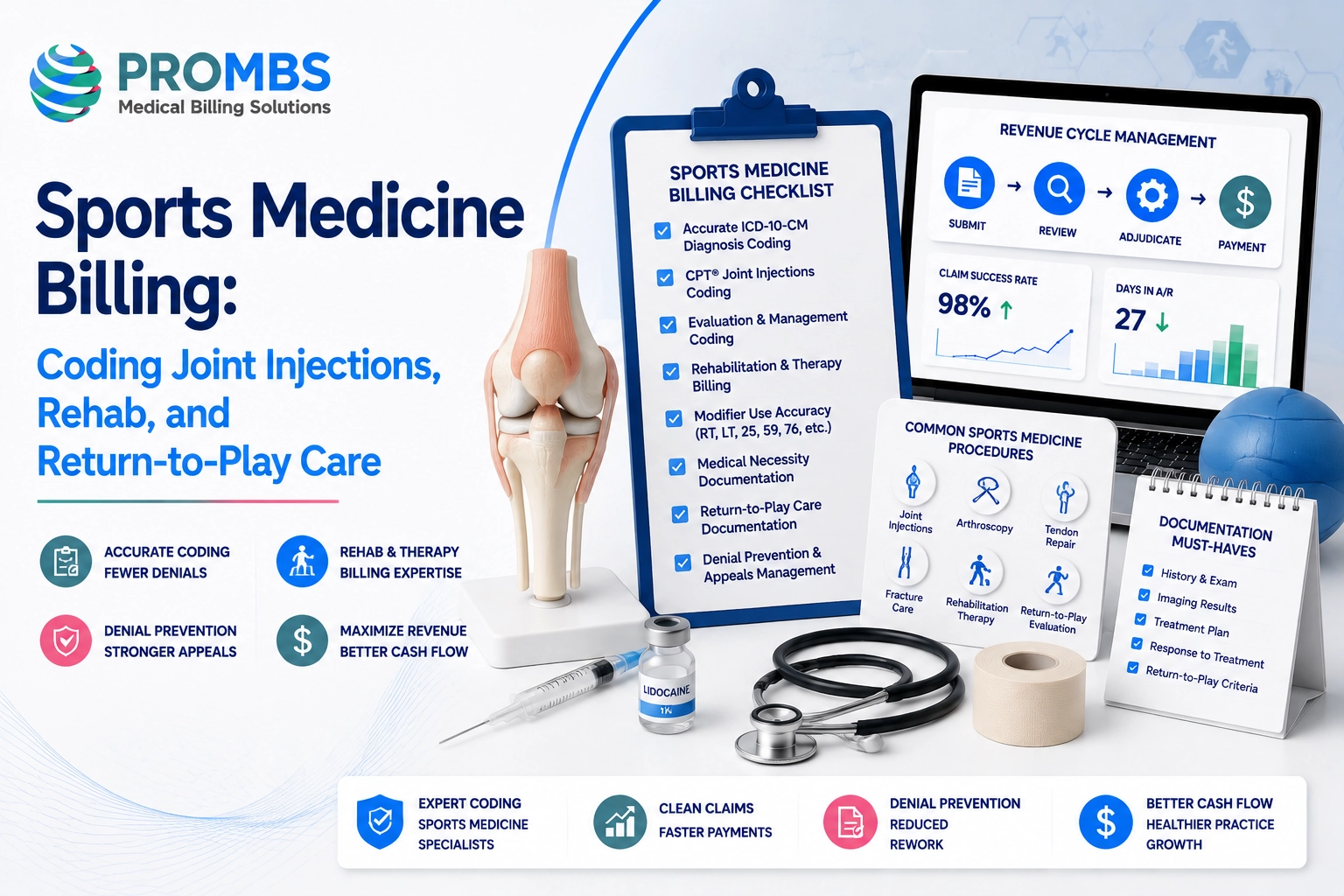
Sports medicine practices operate differently from many traditional medical specialties.
A single practice may evaluate acute injuries, manage chronic musculoskeletal conditions, perform joint injections, use diagnostic ultrasound, treat fractures, coordinate rehabilitation, prescribe braces, and manage athletes recovering from concussions.
Each of these services introduces different coding, documentation, and payer requirements.
This is why Sports Medicine Billing requires more than submitting standard office visit claims.
Accurate reimbursement may depend on correctly managing:
- Evaluation and management services
- Joint aspirations and injections
- Ultrasound-guided procedures
- Fracture care
- Casting and splinting
- Concussion management
- Return-to-play evaluations
- Sports physicals
- Rehabilitation
- Imaging
- Durable medical equipment
- Prior authorization
- Modifiers
- Medical necessity
Sports medicine physicians commonly care for both athletes and active patients with musculoskeletal injuries, fractures, concussion, tendon conditions, joint problems, and other exercise-related conditions. They may also perform joint injections, ultrasound-guided procedures, casting, rehabilitation, and return-to-play evaluations.
The broad range of services creates a billing environment where a mistake in one part of the workflow can affect reimbursement.
For example, an injection claim may be delayed when the documentation does not clearly identify the joint treated. An MRI may be performed before required authorization is confirmed. A separately billed office visit may be denied when the record does not demonstrate work beyond the procedure performed on the same date.
Sports medicine practices therefore need a revenue cycle that connects:
- Patient registration
- Insurance verification
- Prior authorization
- Clinical evaluation
- Procedure documentation
- Coding
- Claim submission
- Payment posting
- Denial management
- Accounts receivable follow-up
This guide explains how Sports Medicine Billing works, why it differs from general medical billing, which services create the most reimbursement complexity, and how practices can build stronger billing processes around sports and musculoskeletal care.
What Is Sports Medicine Billing?
Sports Medicine Billing is the process of documenting, coding, submitting, and managing claims for services provided to patients with sports-related, exercise-related, and musculoskeletal conditions.
Depending on the practice, services may include:
- Injury evaluations
- Joint injections
- Joint aspiration
- Musculoskeletal ultrasound
- Fracture care
- Casting and splinting
- Concussion management
- Sports physicals
- Rehabilitation
- Bracing
- Orthotics
- Imaging
- Follow-up care
A complete billing process may involve:
- Patient registration
- Eligibility verification
- Benefit review
- Prior authorization
- Clinical documentation
- CPT coding
- ICD-10-CM coding
- Modifier review
- Claim submission
- Payment posting
- Denial resolution
- AR follow-up
The specialty is particularly complex because these services do not all follow the same reimbursement rules.
An office visit, joint injection, brace, MRI, and rehabilitation service may each have different:
- Documentation requirements
- Coding rules
- Authorization requirements
- Modifier considerations
- Coverage policies
A sports medicine billing workflow therefore needs to understand the complete patient encounter rather than treating every service as an isolated charge.
Why Sports Medicine Billing Is Different From General Medical Billing
Sports medicine is a hybrid specialty.
It combines elements of:
- Primary care
- Orthopedics
- Musculoskeletal procedures
- Diagnostic imaging
- Rehabilitation
- DME
- Neurological injury management
That combination is what makes the revenue cycle unique.
The Overlap Between Primary Care and Orthopedic Services
Sports medicine physicians may manage conditions such as:
- Sprains
- Tendon injuries
- Joint pain
- Osteoarthritis
- Stress fractures
- Acute fractures
- Dislocations
- Overuse injuries
Some encounters may involve only evaluation and conservative treatment.
Others may involve:
- Injections
- Fracture management
- Casting
- Ultrasound
- Rehabilitation planning
The billing team must understand whether the service represents:
- E/M care
- A procedure
- Definitive fracture treatment
- An ancillary service
- A combination of several services
This distinction affects how the claim should be structured.
Procedures and Diagnostic Services May Occur During the Same Visit
A patient may arrive with shoulder pain and receive:
- Clinical evaluation
- Diagnostic ultrasound
- Joint injection
That does not necessarily mean all three services should automatically be billed separately.
The billing team needs to determine:
- What was medically necessary
- What documentation supports each service
- Whether imaging is included in another procedure code
- Whether a separate E/M service is supported
- Whether payer bundling rules apply
This makes pre-submission claim review especially important.
Rehabilitation and DME Add Additional Billing Layers
Sports medicine care often continues after the initial diagnosis or procedure.
Patients may require:
- Therapeutic exercise
- Physical therapy
- Braces
- Walking boots
- Slings
- Orthotics
- Home rehabilitation programs
These services can involve separate billing requirements related to:
- Orders
- Medical necessity
- Functional limitations
- Treatment plans
- Progress documentation
- HCPCS coding
- Payer coverage
The practice therefore needs visibility across the complete episode of care.
Athlete-Specific Services Create Additional Documentation Needs
Sports medicine also includes services that are not common in every medical specialty.
These may include:
- Concussion management
- Return-to-play evaluation
- Preparticipation physical exams
- Exercise-related medical assessment
AMSSM identifies concussion management, return-to-play decisions, pre-participation physical evaluation, rehabilitation, casting, and musculoskeletal ultrasound as part of sports medicine practice.
These encounters require documentation that reflects the specific clinical purpose of the visit.
Joint Injection and Aspiration Billing
Joint injections and aspirations are among the most important procedural services in Sports Medicine Billing.
They may be performed for conditions involving:
- Osteoarthritis
- Joint inflammation
- Effusion
- Sports injury
- Pain
- Other musculoskeletal conditions
Billing accuracy depends on several factors, including:
- Joint treated
- Size of the joint
- Laterality
- Whether aspiration occurred
- Whether injection occurred
- Whether ultrasound guidance was used
- Medication or product administered
- Documentation of medical necessity
The coding team should never rely only on a generic procedure description such as:
“Joint injection performed.”
The record should identify exactly where and how the procedure was performed.
Small, Intermediate, and Major Joint Procedures
Joint aspiration and injection coding is organized around the size and anatomical location of the joint or bursa.
Sports medicine practices may treat:
Small joints, such as certain finger or toe joints.
Intermediate joints, such as the wrist, elbow, or ankle.
Major joints, such as the shoulder, hip, or knee.
The correct code depends on the actual anatomical site and whether ultrasound guidance is incorporated into the procedure.
CMS identifies CPT codes 20600–20611 as a family covering aspiration and/or injection of different joint sizes, with or without ultrasound guidance.
This makes accurate anatomical documentation essential.
Joint Units Require Careful Review
One common billing mistake involves reporting multiple units for services performed around the same joint.
For Medicare NCCI purposes, the unit of service for the 20600–20611 family is the joint and its surrounding bursae. Multiple aspirations or injections involving the same joint and surrounding bursae do not automatically support multiple units.
For practices, this means the billing team should review:
- Number of joints treated
- Anatomical location
- Laterality
- Services performed around each joint
- Units entered on the claim
Incorrect units can lead to:
- Denials
- Claim corrections
- Overbilling concerns
- Payment delays
Ultrasound-Guided Joint Procedures
Ultrasound guidance is commonly used in sports medicine to improve visualization during joint and soft-tissue procedures.
Sports medicine physicians may use ultrasound for:
- Joint injections
- Tendon procedures
- Diagnostic evaluation
- Other image-guided treatments
AMSSM specifically recognizes diagnostic musculoskeletal ultrasound and ultrasound-guided procedures as part of sports medicine practice.
The billing challenge is determining whether ultrasound guidance is:
- Already included within the selected procedure code
- Separately reportable
- Supported by the documentation
The billing team should avoid automatically adding an imaging charge whenever ultrasound equipment was used.
The final claim should reflect the coding rules that apply to the exact procedure.
Injection Documentation
A strong joint injection record should clearly identify:
- Clinical indication
- Joint treated
- Right or left side
- Procedure performed
- Guidance used when applicable
- Medication administered
- Patient tolerance
- Relevant findings
If multiple joints are treated, each should be clearly documented.
For example, the record should distinguish between treatment involving:
- Right knee
- Left knee
- Right shoulder
rather than simply stating that “multiple joints were injected.”
Precise documentation helps the billing team determine the correct codes, units, and modifiers.
Concussion and Return-to-Play Billing
Concussion care is one of the services that separates sports medicine from a standard orthopedic billing workflow.
Sports medicine physicians may evaluate patients for:
- Sports-related concussion
- Persistent symptoms
- Balance problems
- Cognitive concerns
- Headache
- Return-to-school readiness
- Return-to-play readiness
Billing depends on what services are actually performed and documented.
Initial Concussion Evaluation
The initial encounter should document relevant information such as:
- Injury mechanism
- Symptoms
- Neurological findings
- Functional limitations
- Assessment
- Treatment plan
Depending on the encounter, the provider may also review or perform testing related to:
- Balance
- Cognitive function
- Oculomotor function
- Other concussion-related assessment
AMSSM includes interpretation of objective testing and management of return-to-play decisions within the scope of sports medicine physicians.
Follow-Up Concussion Visits
Follow-up documentation should show how the patient’s condition has changed.
Useful information may include:
- Current symptoms
- Improvement or worsening
- Activity tolerance
- School or work function
- Exercise progression
- Treatment recommendations
A generic note saying:
“Concussion follow-up, doing better”
may provide less support than documentation that explains the clinical decision-making performed during the encounter.
Return-to-Play Evaluations
Return-to-play decisions should be supported by the patient’s current clinical status.
Documentation may address:
- Symptom resolution
- Functional recovery
- Exercise tolerance
- Neurological findings
- Activity progression
- Restrictions or clearance
The purpose of the documentation is not only to support billing.
It should also clearly show why the provider made the return-to-play decision.
Sports Physical and Preparticipation Exam Billing
Preparticipation physical evaluations are another distinctive part of sports medicine.
These exams may evaluate whether a patient can safely participate in:
- School sports
- Competitive athletics
- Recreational activity
- Work-related physical activity
AMSSM includes pre-participation physical evaluation within the scope of sports medicine practice.
Billing can become confusing because coverage varies by:
- Payer
- Benefit plan
- Type of examination
- Reason for the visit
Practices should avoid assuming that every sports physical is processed the same way as a routine preventive visit.
Before the appointment, staff should determine:
- What type of exam is being requested
- Whether the patient’s plan covers it
- Whether the service is patient-pay
- Whether another medical problem is being evaluated
Documentation for Sports Physicals
The record should reflect the services actually performed.
Documentation may include:
- Medical history
- Relevant family history
- Cardiovascular assessment
- Musculoskeletal evaluation
- Previous injuries
- Current symptoms
- Participation recommendations
If a significant medical problem is addressed separately, the documentation should clearly distinguish that work from the routine participation examination.
Fracture Care, Casting, and Splinting in Sports Medicine
Sports medicine physicians often treat fractures and joint injuries without surgery.
Services may include:
- Fracture evaluation
- Reduction
- Casting
- Splinting
- Follow-up management
The key billing question is whether the provider is performing definitive fracture treatment or only providing temporary stabilization.
Definitive Fracture Care
When the provider takes responsibility for treating the fracture and its follow-up care, fracture treatment coding may apply depending on the clinical situation.
The documentation should identify:
- Bone involved
- Fracture location
- Laterality
- Treatment performed
- Manipulation when applicable
- Follow-up plan
Casting or splinting performed as part of definitive fracture treatment may be subject to bundling rules.
Initial Stabilization
In other situations, a sports medicine provider may only stabilize the injury before referring the patient elsewhere for definitive treatment.
The documentation should make this distinction clear.
This may affect whether the claim represents:
- Fracture treatment
- E/M care
- Casting or splinting
- Another applicable service
The billing team should review the provider’s actual role in the treatment episode rather than assuming that every fracture encounter follows the same billing pathway.
The Sports Medicine Billing Workflow
A strong Sports Medicine Billing workflow begins before the patient receives a procedure or diagnostic service.
The process should connect front-office verification, clinical documentation, coding, claim review, and payer follow-up.
A practical workflow includes:
- Patient registration and insurance verification
- Benefit and authorization review
- Clinical evaluation
- Diagnostic testing when necessary
- Procedure or treatment
- Documentation review
- Coding and modifier review
- Claim submission
- Payment posting
- Denial management
- AR follow-up
Sports Medicine Billing Workflow Explained
| Step | Purpose |
|---|---|
| Patient Registration | Collects patient demographics, insurance information, and the reason for the sports medicine visit. |
| Insurance Verification | Confirms active coverage, benefits, patient responsibility, and payer requirements. |
| Authorization Review | Checks whether imaging, procedures, rehabilitation, DME, or other services require approval. |
| Clinical Evaluation | Documents the patient’s injury, diagnosis, functional limitations, and treatment plan. |
| Diagnostic Testing | Records imaging, ultrasound, or other tests used to evaluate the condition. |
| Procedure or Treatment | Documents injections, fracture care, casting, rehabilitation, concussion management, or other services provided. |
| Documentation Review | Confirms that the clinical record supports medical necessity, anatomy, procedures, and services performed. |
| Coding and Modifier Review | Assigns procedure and diagnosis codes while reviewing units, modifiers, and bundling requirements. |
| Claim Submission | Sends the completed claim to the appropriate payer. |
| Payment Posting | Records payments, contractual adjustments, and patient responsibility. |
| Denial Management | Identifies and resolves coding, authorization, documentation, modifier, or coverage problems. |
| AR Follow-Up | Tracks unpaid or delayed claims until reimbursement is resolved. |
Why Documentation Is Critical in Sports Medicine Billing
Sports medicine documentation needs to support both the patient’s condition and the services performed.
Because a single encounter may involve evaluation, testing, procedures, DME, or rehabilitation, vague documentation can make it difficult for the billing team to determine what should be reported.
Joint Injection Documentation
The record should identify:
- Joint or structure treated
- Laterality
- Clinical indication
- Aspiration or injection performed
- Ultrasound guidance when applicable
- Medication or product administered
- Relevant procedure details
When multiple anatomical sites are treated, the record should distinguish each site clearly.
Concussion Documentation
Concussion records should support:
- Injury history
- Current symptoms
- Clinical findings
- Testing when applicable
- Treatment plan
- Functional status
- Return-to-play or activity recommendations
Follow-up notes should explain clinical progress rather than simply stating that the patient is improving.
Fracture Care Documentation
Fracture documentation should identify:
- Bone
- Fracture site
- Side
- Treatment provided
- Manipulation when applicable
- Casting or splinting
- Follow-up responsibility
This helps determine whether the encounter represents definitive fracture treatment or temporary stabilization.
Rehabilitation Documentation
When rehabilitation services are provided or coordinated, records should support:
- Functional limitation
- Treatment goals
- Services performed
- Patient progress
- Ongoing need for care
This becomes particularly important when therapy extends across multiple visits.
DME and Brace Documentation
When braces, boots, orthotics, or similar items are provided, documentation should support:
- Diagnosis
- Medical necessity
- Item provided
- Relevant order
- Patient use instructions when required
Incomplete DME documentation can create separate reimbursement problems even when the physician’s medical claim is processed correctly.
Common Sports Medicine Billing Challenges
Sports medicine practices face billing risks across both professional services and ancillary care.
| Challenge | Impact on the Practice |
|---|---|
| Joint Injection Coding Errors | Incorrect joint size, anatomy, units, or procedure selection may lead to claim denials or payment delays. |
| Ultrasound Billing Issues | Separate imaging charges may be denied when guidance is already included or documentation is incomplete. |
| Same-Day E/M Problems | An office visit may be bundled when documentation does not support a separately identifiable evaluation. |
| Fracture Care Errors | Claims may be incorrect when definitive fracture management is confused with temporary casting or splinting. |
| Imaging Authorization | Advanced imaging may be delayed or denied when payer authorization requirements are not met. |
| Concussion Documentation Gaps | Incomplete injury, testing, or follow-up documentation can weaken support for billed services. |
| Rehabilitation Billing Issues | Missing functional goals, treatment details, or progress documentation may affect reimbursement. |
| DME Documentation Problems | Missing orders, medical necessity, or item details may result in denied brace or equipment claims. |
Sports medicine coding becomes more complicated when one encounter combines evaluation, diagnostic testing, procedures, rehabilitation, imaging, or medical equipment.
The billing team needs to understand not only which service was performed, but also:
- The anatomical site
- Joint size
- Laterality
- Procedure technique
- Whether ultrasound guidance was used
- Number of joints treated
- Same-day E/M requirements
- Bundling rules
- Therapy time
- Prior authorization
- DME documentation
These details determine whether a claim accurately represents the care delivered.
Sports Medicine CPT Coding: What Practices Need to Know
Sports medicine practices may use CPT and HCPCS codes from several different areas because the specialty combines medical evaluation with musculoskeletal procedures and ancillary services.
Common coding categories include:
- Evaluation and management
- Joint aspiration and injection
- Tendon injections
- Trigger-point injections
- Arthroscopy
- Fracture and dislocation treatment
- Casting and splinting
- Rehabilitation
- Diagnostic imaging
- Durable medical equipment
The billing team should never select a procedure code based only on a short description such as:
“Shoulder injection”
or:
“Knee treatment”
The documentation should provide enough information to determine:
- Exact anatomical site
- Right or left side
- Whether aspiration, injection, or both occurred
- Whether imaging guidance was used
- Whether multiple joints were treated
- What additional services were performed
The stronger the documentation, the easier it becomes to build an accurate claim.
Joint Injection CPT Coding
Joint aspiration and injection services are among the most common procedures in sports medicine.
The 20600–20611 CPT family is organized around two major factors:
- The size of the joint or bursa
- Whether ultrasound guidance is included
CMS’s 2026 NCCI policy identifies 20600–20611 as a family of arthrocentesis codes covering aspiration and/or injection of different-sized joints or bursae, with or without ultrasound guidance.
| CPT Code | General Coding Category | Ultrasound Guidance |
|---|---|---|
| 20600 | Small joint or bursa aspiration/injection | No |
| 20604 | Small joint or bursa aspiration/injection | Included |
| 20605 | Intermediate joint or bursa aspiration/injection | No |
| 20606 | Intermediate joint or bursa aspiration/injection | Included |
| 20610 | Major joint or bursa aspiration/injection | No |
| 20611 | Major joint or bursa aspiration/injection | Included |
Small Joint Injection Billing
Small-joint procedures may involve areas such as certain:
- Finger joints
- Toe joints
Documentation should identify:
- Exact joint
- Side
- Procedure performed
- Clinical reason
- Guidance when applicable
The billing team should not assume that every small-joint procedure uses the same code when ultrasound guidance changes how the service is reported.
Intermediate Joint Injection Billing
Intermediate-joint procedures commonly involve areas such as:
- Wrist
- Elbow
- Ankle
The documentation should clearly distinguish the treated joint.
This matters particularly when the patient has several musculoskeletal complaints during the same encounter.
For example, documentation should make it clear whether treatment was provided to:
- Right elbow
- Left ankle
- Both sites
rather than simply stating that multiple injections were performed.
Major Joint Injection Billing
Major-joint services commonly involve:
- Knee
- Shoulder
- Hip
These are high-volume procedures in many sports medicine practices.
The clinical record should support:
- Diagnosis
- Joint treated
- Laterality
- Aspiration or injection
- Guidance used
- Medication administered
- Patient tolerance
Incomplete joint documentation can create problems with code selection, laterality, units, and medical necessity.
Units of Service for Joint Injections
One of the most important sports medicine billing rules involves the number of units reported.
CMS states that for codes 20600–20611, the unit of service is the joint and its surrounding bursae. A provider should not report additional units merely because more than one aspiration or injection is performed in the same joint or surrounding bursae.
For example, treating a shoulder joint and more than one surrounding bursa does not automatically mean multiple units of the major-joint arthrocentesis code are appropriate.
This makes it important to distinguish between:
- Several services around one joint
- Several genuinely different joints
When multiple joints are treated, documentation should clearly identify each anatomical site.
Ultrasound-Guided Injection Billing
Ultrasound is widely used in sports medicine for greater visualization during musculoskeletal procedures.
However, ultrasound use does not automatically create a separate imaging charge.
When ultrasound guidance is already incorporated into the procedure code, CMS NCCI policy states that radiologic guidance, including ultrasound, should not also be separately reported for that same procedure.
This is particularly important for codes such as:
- 20604
- 20606
- 20611
where ultrasound guidance is built into the service.
Documentation for Ultrasound-Guided Procedures
Documentation should support the guidance actually used.
The procedure note should identify:
- Anatomical target
- Ultrasound use
- Relevant visualization
- Procedure performed
- Applicable image documentation or reporting requirements
The billing team should not add an ultrasound-guidance charge simply because an ultrasound machine was present in the room.
The final claim must reflect the procedure actually documented and the rules of the selected CPT code.
Diagnostic Ultrasound vs Procedure Guidance
Sports medicine physicians may also perform a diagnostic musculoskeletal ultrasound separately from a procedure.
The billing team should determine whether the ultrasound was:
- Performed only to guide an injection, or
- A separate diagnostic study with its own medically necessary evaluation and documentation
If the guidance is already included in the procedure, it should not be unbundled.
A genuinely separate diagnostic service should have documentation supporting why it was medically necessary in addition to the procedure.
Tendon and Trigger-Point Injection Billing
Sports medicine practices frequently treat:
- Tendinopathy
- Tendon sheath inflammation
- Ligament-related pain
- Myofascial pain
- Trigger points
Common CPT codes in this area include:
- 20550 for certain tendon sheath, ligament, or aponeurosis injections
- 20551 for injections involving a tendon origin or insertion
- 20552 for trigger-point treatment involving one or two muscles
- 20553 for trigger-point treatment involving three or more muscles
The correct code depends on the structure and service actually treated.
Tendon Injection Documentation
Documentation should identify:
- Tendon or structure treated
- Anatomical location
- Laterality
- Diagnosis
- Injection performed
- Guidance when applicable
A generic statement such as:
“Tendon injection given”
may not give the billing team enough information to distinguish between different procedure categories.
Trigger-Point Injection Documentation
Trigger-point documentation should identify:
- Muscles treated
- Number of muscles
- Anatomical region
- Clinical indication
- Procedure performed
The distinction between the number of injection sites and the number of muscles is important.
Billing should follow the applicable code definition rather than simply counting every needle placement as a separate service.
CMS also notes that musculoskeletal injection codes in the 20526–20553 range should not be separately reported merely for the administration of local anesthesia used to perform another procedure.
Modifier 25 and Same-Day E/M Billing
Sports medicine frequently combines an office evaluation and a minor procedure during the same visit.
Examples include:
- Evaluation followed by knee injection
- New shoulder complaint followed by injection
- Sports injury assessment followed by splinting
- Joint pain evaluation followed by aspiration
A common mistake is assuming that an E/M visit can always be billed separately whenever a procedure occurs on the same date.
CMS’s 2026 NCCI policy states that the work involved in deciding to perform a minor procedure is generally included in the procedure payment. A significant and separately identifiable E/M service beyond that work may be reported with modifier 25 when supported.
When a Separate E/M Service May Be Supported
Documentation may support a separate E/M service when the physician performs meaningful work beyond the normal evaluation associated with the procedure.
That may include:
- Evaluation of a separate problem
- Significant additional diagnostic work
- Management of another condition
- Additional treatment planning
- Separate medical decision-making
The diagnoses do not necessarily have to be different, but the documentation must demonstrate the separately identifiable work.
When Modifier 25 Creates Risk
Modifier 25 should not be automatically added because:
- The patient is new
- The physician discussed the injection
- The physician decided to perform the procedure
- A brief examination occurred before treatment
CMS specifically states that a patient being new to the practice does not by itself justify separate E/M reporting with a minor procedure.
For sports medicine practices, same-day E/M claims should therefore receive documentation review before submission.
Arthroscopy and NCCI Bundling
Some sports medicine physicians work within orthopedic groups where surgical sports medicine procedures are also performed.
Arthroscopic claims can involve:
- Knee procedures
- Shoulder procedures
- Meniscus treatment
- Ligament treatment
- Rotator cuff procedures
- Debridement
- Loose-body removal
These services can create significant bundling issues.
Diagnostic Arthroscopy With Surgical Arthroscopy
CMS states that surgical arthroscopy includes diagnostic arthroscopy.
If diagnostic arthroscopy leads to surgical arthroscopy during the same encounter, only the surgical arthroscopy is generally reported.
This means the practice should not automatically submit separate charges simply because both diagnostic inspection and surgical treatment are described in the operative note.
Conversion From Arthroscopic to Open Procedure
Sometimes a procedure begins arthroscopically but must be converted to an open procedure.
CMS’s 2026 NCCI manual states that when an arthroscopic procedure converts to an open procedure, only the open procedure is reported.
The billing team should therefore code from the final operative report, not just the scheduled procedure.
Joint Injection or Aspiration With Arthroscopy
CMS also states that arthrocentesis codes such as 20600–20611 should not be separately reported with an open or arthroscopic procedure performed on the same joint. A procedure involving a different joint may be separately reportable when the rules and documentation support it.
This is an important denial-prevention rule for practices providing both office procedures and surgical sports medicine services.
Fracture Care, Casting, and Splinting Billing
Sports medicine practices frequently manage acute fractures and dislocations.
The billing team must distinguish between:
- Definitive fracture treatment
- Initial stabilization
- Casting or splinting
- Follow-up management
These are not interchangeable billing situations.
Definitive Fracture Treatment
When a physician provides definitive fracture treatment and assumes follow-up responsibility, the treatment code generally includes the initial cast, splint, or strapping.
CMS’s 2026 NCCI manual states that closed, percutaneous, and open fracture/dislocation treatment codes include the initial casting, splinting, or strapping, so those application codes should not be billed separately for the same treatment.
Documentation should identify:
- Bone
- Fracture location
- Laterality
- Treatment method
- Manipulation when applicable
- Follow-up responsibility
Initial Stabilization Without Definitive Treatment
A sports medicine physician may instead provide only initial stabilization and refer the patient to another physician for definitive fracture treatment.
CMS allows a different billing approach when the provider applies the initial cast, splint, or strap without other definitive fracture treatment and expects to provide only the initial care. In that situation, the applicable E/M, casting/splinting service, and supply may be reportable when all requirements are met.
The clinical record should therefore make clear who is responsible for the ongoing fracture management.
E/M With Casting or Splinting
Casting and splinting procedures are considered minor surgical procedures for Medicare purposes.
A separate E/M service must therefore be significant and separately identifiable rather than simply representing the normal work of deciding to apply the cast or splint.
This is another area where modifier 25 should be driven by documentation rather than applied automatically.
Physical Therapy and Rehabilitation Billing
Rehabilitation is an important part of sports medicine because many patients require continued care after injury or procedures.
Services may involve:
- Therapeutic exercise
- Neuromuscular re-education
- Manual therapy
- Therapeutic activities
- Functional rehabilitation
Sports medicine practices that provide rehabilitation internally need to maintain separate documentation and billing controls for therapy services.
Timed Therapy Services
Many therapy procedures are reported in 15-minute units.
Under Medicare’s timed-code methodology, when only one timed service is provided, at least 8 minutes are generally required to report one 15-minute unit. CMS uses total treatment time rules to determine additional units.
| Total Timed Treatment | Medicare Units |
|---|---|
| 8–22 minutes | 1 unit |
| 23–37 minutes | 2 units |
| 38–52 minutes | 3 units |
| 53–67 minutes | 4 units |
| 68–82 minutes | 5 units |
The medical record should support the time actually spent providing the timed service.
Rehabilitation Documentation
Strong therapy documentation should include:
- Functional limitations
- Treatment goals
- Service performed
- Time when required
- Patient response
- Progress
- Continued medical necessity
Repeatedly using identical notes across many therapy visits can make it difficult to demonstrate continued need for skilled care.
Coordination Between Physician and Therapy Billing
When a sports medicine practice provides both physician and rehabilitation services, the teams should coordinate documentation without duplicating services.
The practice should understand:
- Who performed each service
- What treatment was provided
- Whether therapy modifiers apply
- Whether multiple procedure payment rules affect reimbursement
- Whether the patient remains under an active plan of care
CMS continues to maintain annual therapy coding and payment policies for 2026, including therapy modifiers and multiple-procedure payment reduction requirements.
Imaging and Prior Authorization in Sports Medicine
Sports medicine often relies on imaging to evaluate musculoskeletal injuries.
Common studies include:
- X-rays
- MRI
- Diagnostic ultrasound
- Other advanced imaging
Prior authorization is particularly important for advanced imaging because payer requirements may depend on:
- Diagnosis
- Symptoms
- Physical examination findings
- Conservative treatment
- Previous imaging
- Site of service
The practice should verify authorization requirements before the study occurs rather than discovering them after the claim is submitted.
Common Imaging Authorization Problems
Problems may occur when:
- Authorization was never obtained
- Approval expired
- Wrong anatomical site was authorized
- Right/left side does not match
- Site of service changed
- Ordered study differs from the final study
A clean imaging workflow compares the authorization with the actual service before billing.
Diagnostic Ultrasound Documentation
When diagnostic musculoskeletal ultrasound is separately performed, documentation should support:
- Medical necessity
- Anatomical area examined
- Findings
- Clinical interpretation
- How the result affects management
The record should distinguish a diagnostic study from ultrasound used solely as procedure guidance.
DME, Braces, and Orthotics Billing
Sports medicine practices frequently prescribe or provide items such as:
- Knee braces
- Ankle braces
- Walking boots
- Slings
- Orthotics
- Other supportive equipment
These items fall under separate DMEPOS billing rules and often use HCPCS Level II codes.
A physician claim being properly documented does not automatically mean the equipment claim will also meet coverage requirements.
DME Documentation Requirements
Documentation should support:
- Diagnosis
- Medical necessity
- Item ordered
- Quantity when applicable
- Treating practitioner
- Date of order
- Practitioner signature
CMS’s current DMEPOS guidance identifies standardized written-order elements and requires the supplier to maintain supporting medical documentation.
Braces and Orthoses
Certain orthoses may have additional Medicare requirements involving:
- Face-to-face encounters
- Written orders before delivery
- Prior authorization
These requirements depend on the specific HCPCS item and current Medicare policy. CMS continues to update the list of DMEPOS items subject to these requirements, including certain orthoses.
Sports medicine practices should therefore avoid treating every brace as a simple supply charge.
The correct workflow should verify the specific item and payer requirements.
Common Sports Medicine Billing Denials
Sports medicine denials often come from recurring workflow problems rather than isolated payer mistakes.
| Denial Reason | Why It Happens | Prevention Strategy |
|---|---|---|
| Joint Injection Coding Error | The selected code does not match the joint size, anatomy, or guidance documented. | Confirm the joint, laterality, and procedure technique before code selection. |
| Incorrect Injection Units | Multiple units are reported for services involving the same joint and surrounding bursae. | Review the number of distinct joints treated before submitting units. |
| Ultrasound Bundling Denial | Separate guidance is billed when ultrasound is already included in the primary procedure. | Verify whether the selected procedure code already includes imaging guidance. |
| Modifier 25 Denial | The documentation does not support a significant, separately identifiable E/M service. | Review same-day E/M documentation before applying modifier 25. |
| Arthroscopy Bundling Denial | Diagnostic or component services are billed separately even though they are included in the surgical procedure. | Apply current NCCI rules before reporting multiple arthroscopic services. |
| Fracture Care Denial | Definitive fracture treatment is confused with initial casting or splinting. | Document the provider’s treatment role and follow-up responsibility clearly. |
| Therapy Unit Error | Timed treatment minutes do not support the units billed. | Validate documented treatment time before submitting therapy units. |
| Imaging Authorization Denial | Required approval is missing, expired, or inconsistent with the imaging performed. | Verify authorization details before advanced imaging takes place. |
| DME Documentation Denial | The order, medical necessity, or supporting records do not meet payer requirements. | Verify HCPCS-specific documentation requirements before equipment is billed. |
How Sports Medicine Practices Can Prevent Claim Denials
Preventing denials requires reviewing the complete encounter before the claim reaches the payer.
1. Verify Anatomy for Every Procedure
Procedure documentation should clearly identify:
- Joint
- Tendon
- Muscle
- Side
- Number of sites
This helps prevent coding and modifier errors.
2. Review Joint Injection Units
Before submitting 20600–20611 claims, verify:
- Number of distinct joints treated
- Whether surrounding bursae belong to the same joint
- Laterality
- Ultrasound use
- Units
This prevents inappropriate duplicate units.
3. Review Same-Day E/M Claims
When an E/M service and procedure occur on the same day, determine whether the documentation supports significant work beyond the procedure itself.
Modifier 25 should be applied only when that additional work is clearly supported.
4. Check Imaging Guidance Before Adding Separate Charges
When ultrasound or another imaging modality is used during a procedure, determine whether guidance is already included in the primary code.
This helps prevent unbundling denials.
5. Clarify the Provider’s Role in Fracture Care
The clinical note should show whether the sports medicine physician:
- Provides definitive fracture management
- Assumes follow-up responsibility
- Provides only initial stabilization
- Refers the patient for definitive treatment
This distinction affects the billing pathway.
6. Validate Therapy Time
When timed rehabilitation services are billed, treatment minutes should support the units submitted.
The practice should avoid using scheduled appointment duration as a substitute for actual treatment time.
7. Verify Authorization Before High-Risk Services
Authorization should be reviewed before:
- MRI
- Advanced imaging
- Certain procedures
- Selected DME items
- Other payer-controlled services
The approval should match the service actually provided.
8. Analyze Denials by Service Category
Practices should separate denial reporting into areas such as:
- Joint injections
- Same-day E/M
- Imaging
- Fracture care
- Rehabilitation
- DME
- Arthroscopy
This makes it easier to determine which workflow requires correction.
Sports Medicine Billing Denial Prevention Checklist
| Area | Review Question |
|---|---|
| Joint Injection | Does the code match the documented joint size, anatomy, and technique? |
| Units | Do the reported units reflect the number of separately treated joints? |
| Ultrasound | Is guidance already included in the selected procedure code? |
| Same-Day E/M | Does documentation support a significant, separately identifiable service? |
| Arthroscopy | Have diagnostic and surgical components been reviewed for NCCI bundling? |
| Fracture Care | Does documentation clearly identify definitive management or initial stabilization? |
| Therapy | Do treatment minutes and documentation support the units billed? |
| Imaging | Is required authorization active and consistent with the study performed? |
| DME | Are the order, medical necessity, and item-specific requirements complete? |
| Claim Review | Have coding, modifiers, units, authorization, and documentation been validated before submission? |
Why Sports Medicine Practices Need Specialty Billing Expertise
Sports Medicine Billing requires knowledge across several different areas of healthcare reimbursement.
A specialty-aware billing team may need to understand:
- E/M coding
- Joint injections
- Tendon procedures
- Ultrasound guidance
- Arthroscopy
- Fracture care
- Casting and splinting
- Rehabilitation
- Imaging authorization
- DME
The difficulty comes from how often these services overlap within the same patient episode.
A patient with a knee injury may require an initial evaluation, MRI, brace, joint procedure, and several rehabilitation visits. Each service follows different billing rules, but they all contribute to the same revenue cycle.
Without a coordinated process, practices may experience:
- Missed charges
- Duplicate billing
- Bundling denials
- Authorization failures
- Incorrect units
- Aging AR
A stronger Sports Medicine Billing process connects clinical documentation, coding, authorization, ancillary services, claim review, and payer follow-up so that each part of the patient’s care is accurately represented.
How Sports Medicine Practices Can Improve Revenue Cycle Performance
Revenue problems often develop when front-office, clinical, rehabilitation, and billing workflows operate separately.
A stronger process gives each team visibility into the information needed for accurate reimbursement.
1. Improve Charge Capture for Procedures and Ancillary Services
Sports medicine practices may generate charges from several service categories during the same patient journey.
These can include:
- Office visits
- Joint injections
- Ultrasound
- Casting and splinting
- Rehabilitation
- Braces and DME
- Concussion follow-up
- Diagnostic testing
Practices should compare clinical documentation with captured charges before claims are submitted.
The review should confirm:
- Service actually performed
- Anatomical site
- Laterality
- Number of joints treated
- Guidance used
- Supplies or equipment provided
- Additional services documented
Missing charges can create underbilling.
Submitting charges that are already included in another service can create bundling problems.
The goal is to accurately capture legitimate services without duplicating work already represented by another procedure code.
2. Strengthen Joint Injection Documentation
Joint injections are a major procedural area for many sports medicine practices.
A standardized procedure note can help ensure consistent documentation of:
- Diagnosis
- Joint treated
- Right or left side
- Aspiration when performed
- Injection when performed
- Ultrasound guidance when applicable
- Medication administered
- Patient response
This information helps the billing team determine the appropriate code, units, and modifiers.
Standardized documentation can also reduce the need for repeated provider clarification before claim submission.
3. Review Same-Day E/M Services Before Billing
Sports medicine practices frequently provide an evaluation and procedure during the same encounter.
These claims should receive additional review before modifier 25 is applied.
The documentation should clearly support meaningful evaluation and medical decision-making beyond the normal work associated with performing the procedure.
Practices can reduce same-day E/M denials by asking:
- Was another condition evaluated?
- Was additional diagnostic work performed?
- Was treatment planning performed beyond the procedure?
- Does the note clearly demonstrate separately identifiable work?
The modifier should reflect the documentation rather than being applied automatically.
4. Manage Authorization Before Imaging and Treatment
Authorization problems frequently affect:
- MRI
- Advanced imaging
- Selected procedures
- Certain DME
- Rehabilitation
- Other payer-controlled services
Practices should verify authorization before the service whenever required.
The authorization record should be checked for:
- Procedure or study approved
- Anatomical site
- Laterality
- Effective dates
- Site of service
- Number of visits or units when applicable
If the treatment plan changes, the authorization should be reviewed again.
This is especially important when a patient initially presents with one diagnosis but additional findings change the planned service.
5. Coordinate Physician and Rehabilitation Billing
Sports medicine practices that provide both physician services and rehabilitation need clear communication between the two areas.
The physician record may establish:
- Diagnosis
- Functional limitation
- Initial treatment plan
- Referral or therapy need
The rehabilitation record should then demonstrate:
- Treatment provided
- Time when applicable
- Functional goals
- Patient progress
- Continued medical necessity
Billing teams should also confirm that physician and therapy claims do not incorrectly duplicate services.
A coordinated workflow creates a clearer clinical record and makes payer review easier to manage.
6. Create a Separate Process for DME and Braces
Braces, boots, orthotics, and other equipment should not be treated like ordinary physician procedure charges.
Before billing DME, practices should verify:
- Correct HCPCS code
- Medical necessity
- Order requirements
- Documentation
- Delivery information when required
- Payer coverage rules
Equipment claims should also be monitored separately from physician claims because denials may originate from completely different documentation requirements.
7. Track Concussion and Return-to-Play Care as a Distinct Service Category
Concussion care may involve multiple visits over several weeks.
Practices can improve billing consistency by maintaining structured documentation around:
- Initial injury
- Symptoms
- Neurological findings
- Functional limitations
- Testing
- Activity restrictions
- Clinical progress
- Return-to-play decisions
Follow-up documentation should show what changed and why continued care was medically appropriate.
This creates stronger support for recurring evaluation services.
8. Monitor Accounts Receivable by Service Category
Reviewing total AR alone can hide important trends.
Sports medicine practices may benefit from separating AR into categories such as:
- Office visits
- Joint injections
- Imaging
- Rehabilitation
- DME
- Fracture care
- Concussion services
This helps answer practical questions such as:
- Are injection claims paying more slowly than office visits?
- Are rehabilitation claims frequently being corrected?
- Are DME claims creating disproportionate denials?
- Which payer delays advanced imaging claims?
- Are fracture-care claims aging because of coding problems?
Procedure-specific AR reporting allows the practice to focus follow-up where it is most needed.
9. Review Payments for Underpayments
Not every revenue problem appears as a denial.
A payer may process the claim but reimburse less than expected.
Practices should review:
- Allowed amounts
- Contractual adjustments
- Multiple-procedure reductions
- Therapy payment adjustments
- Modifier impact
- Patient responsibility
This is especially important for practices with a high volume of procedures and ancillary services.
A claim marked as “paid” should not automatically be considered fully resolved.
10. Analyze Denials by Root Cause
Denial reporting should identify why claims are failing.
Useful categories include:
- Joint injection coding
- Incorrect units
- Modifier 25
- Ultrasound bundling
- Fracture treatment
- Therapy units
- Imaging authorization
- DME documentation
- Medical necessity
For example, increasing joint injection denials may indicate problems with anatomy, units, or documentation. Increasing MRI denials may point to an authorization workflow problem. Repeated therapy denials may indicate issues with timed-unit documentation or medical necessity.
This type of analysis helps practices correct the underlying workflow rather than repeatedly fixing the same type of claim.
Revenue Cycle Metrics Sports Medicine Practices Should Monitor
Sports medicine practices should use reporting that reflects the different services they provide.
Useful metrics may include:
- Clean claim rate
- Denial rate
- Days in AR
- Collection performance
- First-pass payment rate
- Injection-related denials
- Authorization-related denials
- Therapy claim performance
- DME denial trends
- Underpayments
- Payer performance
- AR by service category
The purpose of reporting is to identify where reimbursement is being delayed and what operational change may be required.
Workers’ Compensation and Injury Claims in Sports Medicine
Sports medicine practices may treat patients whose injuries arise from:
- Workplace activity
- Occupational strain
- Falls
- Motor vehicle accidents
- Recreational activity
- Athletic events
These claims can require a different registration and billing process from standard commercial insurance.
Workers’ Compensation Billing
For work-related injuries, practices may need information such as:
- Employer
- Date of injury
- Workers’ compensation carrier
- Claim number
- Adjuster
- Authorized body part
- Referral
- Approved treatment
The front office should collect this information as early as possible.
Submitting the claim to the wrong payer can create significant delays.
The practice should also verify whether services such as:
- MRI
- Physical therapy
- Injections
- DME
- Specialist follow-up
require separate authorization under the workers’ compensation plan.
Accident-Related Claims
Sports medicine practices may also treat injuries connected to automobile accidents or other liability situations.
Staff should determine:
- Responsible payer
- Accident date
- Claim information
- Available coverage
- Coordination with health insurance when applicable
Requirements vary by payer and jurisdiction, so practices should avoid applying one billing workflow to every accident-related claim.
Injury Documentation
Injury-related notes should clearly describe:
- Mechanism of injury
- Anatomical area affected
- Symptoms
- Functional limitations
- Diagnosis
- Treatment plan
- Work or activity restrictions when applicable
Strong documentation helps connect the injury to the services being billed.
Regenerative Medicine and Coverage Verification
Some sports medicine practices provide regenerative or biologic treatments such as platelet-rich plasma therapy.
Coverage for these services can vary significantly between payers and benefit plans.
Before treatment, practices should verify:
- Whether the service is covered
- Whether authorization is required
- Whether the payer considers the treatment investigational or excluded
- Whether the patient will be financially responsible
- What documentation or consent is required
Practices should avoid assuming that because a procedure can be performed clinically, insurance will reimburse it.
When coverage is excluded, the patient financial process should be clear before treatment is provided.
This helps reduce:
- Unexpected balances
- Patient disputes
- Uncollectible accounts
- Billing confusion
In-House vs Outsourced Sports Medicine Billing
Sports medicine practices can manage revenue cycle functions internally or work with an outside billing company.
The appropriate model depends on:
- Number of providers
- Procedure volume
- Rehabilitation volume
- DME activity
- Imaging utilization
- Internal billing expertise
- Staffing resources
- Denial volume
- AR performance
| Area | In-House Billing | Outsourced Sports Medicine Billing |
|---|---|---|
| Specialty Knowledge | Depends on internal staff understanding of E/M coding, injections, therapy, imaging, DME, and musculoskeletal procedures. | Provides access to billing resources familiar with the different revenue streams found in sports medicine practices. |
| Joint Injection Billing | Internal staff reviews anatomy, joint size, units, ultrasound guidance, and modifiers. | A structured review process can identify injection coding and documentation issues before submission. |
| Rehabilitation Billing | Practice manages timed units, therapy modifiers, documentation, and payer requirements internally. | Billing support can help monitor therapy claims, documentation requirements, and aging balances. |
| Imaging Authorization | Practice staff tracks payer approvals, expiration dates, anatomy, and site-of-service requirements. | Authorization support can help reduce preventable imaging and procedure denials. |
| DME Billing | Staff must manage HCPCS codes, orders, medical necessity, and payer-specific equipment requirements. | A specialized workflow can help review DME documentation and billing requirements. |
| Denial Management | Internal teams may spend significant time correcting individual denied claims. | Denials can be categorized by service and root cause to identify recurring problems. |
| AR Follow-Up | Practice manages unpaid claims, payer communication, corrections, and appeals internally. | Dedicated AR follow-up can prioritize aging claims by service type and payer. |
| Staffing | Practice manages hiring, training, staff coverage, and ongoing coding education. | Billing resources can scale without maintaining the same level of internal billing infrastructure. |
Benefits of Outsourcing Sports Medicine Billing
Outsourcing can be useful when the practice needs more than basic claim submission.
The main value comes from creating a coordinated billing process around the specialty’s diverse services.
Access to Multi-Service Billing Expertise
Sports Medicine Billing may involve:
- Office visits
- Joint injections
- Ultrasound
- Fracture care
- Rehabilitation
- Imaging
- DME
- Concussion services
A billing team needs to understand how these different services interact.
General claim submission may not provide enough review for a practice with this level of service diversity.
Better Procedure Claim Accuracy
A dedicated billing workflow can review:
- Joint anatomy
- Laterality
- Units
- Guidance
- Modifiers
- Same-day E/M services
- Documentation
before claims are submitted.
This can reduce avoidable correction work later.
Stronger Ancillary Service Management
Rehabilitation, DME, and imaging can create significant revenue outside routine physician visits.
A structured process can help practices monitor:
- Therapy claims
- Equipment reimbursement
- Imaging authorizations
- Procedure denials
- Aging balances
This provides better visibility into revenue streams that may otherwise be hidden inside total collections.
Reduced Administrative Workload
Sports medicine staff already manage:
- Injured patients
- Procedure scheduling
- Athlete communication
- Imaging
- Rehabilitation coordination
- DME
- Authorization
Billing issues add additional workload.
Outsourcing may reduce time spent on:
- Claim corrections
- Payer follow-up
- Denial research
- Appeals
- AR follow-up
- Payment investigation
Better Denial Prevention
A stronger billing partner should identify patterns rather than simply processing appeals.
If multiple knee injection claims are denied, the team should investigate anatomy, units, coding, and documentation.
If rehabilitation claims repeatedly fail, the team should examine time reporting, modifiers, and medical necessity.
This turns denial management into an operational improvement process.
Improved Financial Visibility
Sports medicine practices should know which areas of the practice are performing well financially.
Useful visibility includes:
- Procedure reimbursement
- Therapy payments
- DME collections
- Imaging-related denials
- Concussion AR
- Payer-specific performance
Better reporting helps practice leaders understand where revenue needs attention.
When Should a Sports Medicine Practice Consider Outsourcing Billing?
A practice may consider outsourcing when it experiences:
- Increasing denials
- Growing AR
- Frequent injection coding problems
- Same-day E/M denials
- Rehabilitation billing challenges
- Imaging authorization workload
- DME reimbursement problems
- Staffing shortages
- Limited reporting
- Rapid growth
The decision should be based on overall revenue-cycle performance rather than simply whether billing staff are busy.
The key question is whether the current billing process consistently converts documented sports medicine services into accurate and collectible claims.
How to Choose a Sports Medicine Billing Partner
A billing company should understand the hybrid nature of sports medicine.
1. Do They Understand Musculoskeletal Procedure Billing?
Ask whether the team understands:
- Joint injections
- Aspiration
- Ultrasound-guided procedures
- Tendon injections
- Fracture care
- Casting and splinting
The billing team should be comfortable reviewing anatomy and procedure documentation.
2. Do They Understand Same-Day E/M Requirements?
Ask how the company handles modifier 25.
The team should review whether the medical record supports a significant, separately identifiable E/M service rather than automatically adding the modifier.
3. Can They Handle Rehabilitation Billing?
If the practice provides rehabilitation, ask about experience with:
- Timed services
- Therapy modifiers
- Plan-of-care requirements
- Progress documentation
- Medical necessity
Therapy billing should not be treated exactly like physician billing.
4. Can They Support Imaging Authorization?
Ask how authorization requirements are tracked for:
- MRI
- Advanced imaging
- Procedures
- Rehabilitation
- Other payer-controlled services
The practice should know how expired or mismatched approvals are identified.
5. How Do They Manage DME Claims?
If the practice provides braces or equipment, ask how the team handles:
- HCPCS codes
- Written orders
- Medical necessity
- Payer requirements
- Equipment denials
DME should be part of the revenue-cycle conversation when it represents a meaningful service line.
6. How Are Denials Analyzed?
Ask whether denials are separated into categories such as:
- Injection coding
- Modifier 25
- Imaging authorization
- Rehabilitation
- DME
- Medical necessity
This makes it possible to identify systematic problems.
7. What Reporting Will the Practice Receive?
Useful reports should show:
- Claims submitted
- Collections
- Denials
- AR aging
- Payer trends
- Service-specific performance
- Underpayments
Practice leaders should be able to understand where revenue is being delayed without reviewing individual claims manually.
How Pro Medical Billing Solutions Supports Sports Medicine Practices
Sports medicine practices require revenue cycle management that can handle several different types of services within the same organization.
Billing problems may begin with:
- Eligibility
- Authorization
- Documentation
- Procedure coding
- Units
- Modifiers
- Therapy billing
- DME requirements
- Claim follow-up
Pro Medical Billing Solutions supports healthcare organizations across revenue cycle functions such as:
- Medical billing
- Medical coding
- Insurance verification
- Prior authorization support
- Claim submission
- Payment posting
- Denial management
- Accounts receivable follow-up
- Revenue cycle management
For sports medicine practices, a structured billing workflow can place additional attention on:
- Joint injection claims
- Same-day E/M services
- Imaging authorization
- Rehabilitation billing
- DME
- Denial trends
- Aging claims
The goal is to create better visibility from the patient encounter through final reimbursement.
Frequently Asked Questions
What is Sports Medicine Billing?
Sports Medicine Billing is the process of documenting, coding, submitting, and managing claims for services provided by sports medicine practices.
It may include:
- Office visits
- Joint injections
- Ultrasound
- Concussion management
- Fracture care
- Rehabilitation
- Imaging
- DME
Why is sports medicine billing complex?
Sports medicine combines several different areas of healthcare billing.
A practice may provide medical evaluation, procedures, imaging, rehabilitation, and equipment within the same patient episode.
Each service can have different:
- Coding rules
- Documentation requirements
- Authorization requirements
- Modifiers
- Coverage policies
This makes a coordinated billing process especially important.
What are common sports medicine billing errors?
Common problems include:
- Incorrect joint injection codes
- Wrong units
- Ultrasound bundling errors
- Modifier 25 denials
- Imaging authorization problems
- Fracture care errors
- Therapy unit errors
- DME documentation gaps
How are joint injections billed?
Joint injection coding depends on factors such as:
- Joint size
- Anatomical site
- Laterality
- Whether ultrasound guidance is included
- Number of distinct joints treated
The clinical record should clearly support these details before the claim is submitted.
Can an office visit be billed with a joint injection?
A separate E/M service may be reported when the provider performs significant and separately identifiable work beyond the normal evaluation associated with the injection and applicable payer requirements are met.
The documentation should support the separate service.
How does ultrasound guidance affect sports medicine billing?
Some joint procedure codes already include ultrasound guidance.
When guidance is incorporated into the primary code, it should not be separately billed for the same procedure.
A separately performed diagnostic ultrasound may follow a different billing pathway when medical necessity and documentation support it.
How are fractures billed in sports medicine?
The billing approach depends on whether the provider:
- Performs definitive fracture treatment
- Assumes follow-up responsibility
- Provides only temporary stabilization
- Refers the patient for definitive care
Documentation should clearly describe the provider’s role.
Why are rehabilitation claims denied?
Rehabilitation claims may be denied because of:
- Incorrect timed units
- Missing functional goals
- Insufficient progress documentation
- Modifier problems
- Medical necessity concerns
- Authorization limits
Consistent therapy documentation and claim review can reduce these problems.
How does DME affect sports medicine billing?
Braces, walking boots, orthotics, and similar equipment may require separate HCPCS coding, orders, medical necessity documentation, and payer-specific requirements.
DME billing should therefore have its own review process.
Should sports medicine practices outsource billing?
Outsourcing may be useful when a practice is experiencing:
- Growing AR
- High denial volume
- Procedure coding complexity
- Rehabilitation billing problems
- Imaging authorization workload
- DME reimbursement issues
- Staffing limitations
The decision should depend on service volume, internal expertise, staffing structure, and revenue-cycle performance.
Final Thoughts: Building a Stronger Sports Medicine Revenue Cycle
Sports Medicine Billing reflects the broad range of care provided by modern sports medicine practices.
A single patient may require:
- Evaluation
- Imaging
- Injection
- Bracing
- Rehabilitation
- Concussion follow-up
- Return-to-play assessment
Each service may follow a different reimbursement pathway.
That is why the strongest sports medicine revenue cycle connects:
- Insurance verification
- Authorization
- Clinical documentation
- Procedure coding
- Modifiers
- Units
- Rehabilitation
- DME
- Claims
- Payment posting
- Denial management
- AR follow-up
Accurate billing begins with understanding exactly what service was provided and what documentation supports it.
From there, the practice needs reliable processes for authorization, coding, claim review, payment analysis, and follow-up.
A well-structured Sports Medicine Billing process can help practices:
- Improve claim accuracy
- Reduce preventable denials
- Protect procedure reimbursement
- Improve ancillary-service collections
- Reduce aging AR
- Identify underpayments
- Improve financial visibility
- Reduce administrative workload
For sports medicine practices, the goal is not simply to submit more claims.
It is to make sure every documented and medically necessary service is accurately represented, billed according to applicable requirements, and followed through to appropriate reimbursement.