

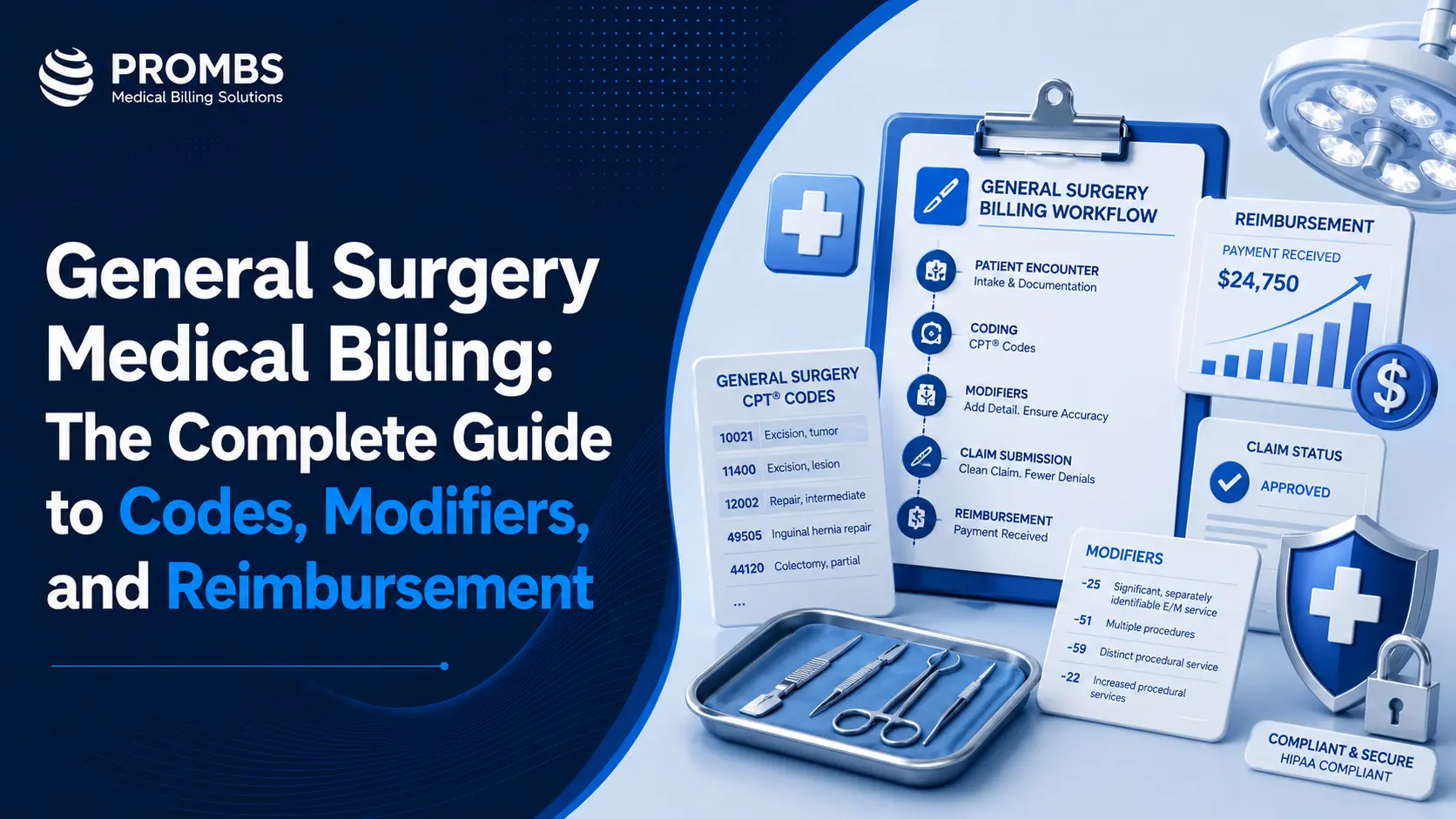
General surgery is one of the broadest specialties in medicine, and that breadth is exactly what makes its billing so unforgiving. A single general surgeon might perform a laparoscopic cholecystectomy in the morning, a hernia repair after lunch, and a skin lesion excision before the day ends. Each of those procedures carries its own CPT code family, its own global period, its own bundling rules, and its own documentation expectations. Miss one detail and a clean claim turns into a denial, an underpayment, or a compliance flag that surfaces months later during an audit.
This guide walks through what actually drives accurate general surgery reimbursement: the CPT code structure surgeons and coders work within, how the global surgical package really functions, which modifiers matter most and when to use them, the denial patterns that show up again and again in general surgery claims, and the documentation habits that keep revenue where it belongs. It is written for practice administrators, billing managers, and coders who need more than a surface-level overview.
Why General Surgery Medical Billing Is Uniquely Complex
Most surgical specialties operate inside a fairly narrow anatomical lane. Orthopedic surgeons bill primarily around the musculoskeletal system. Ophthalmologists bill around the eye. General surgery does not have that luxury. The specialty spans the abdomen, the digestive tract, the endocrine system, the skin and soft tissue, the breast, and portions of the vascular and hernia repertoire, sometimes all within the same week for the same practice.
That range means a general surgery billing team has to stay fluent in far more CPT sections than a single-system specialty would. It also means the practice is exposed to more global period scenarios, more bundling combinations, and more payer-specific quirks than most other surgical billing operations. Practices that treat General surgery medical billing like a simplified version of orthopedic or gastroenterology billing tend to lose revenue through under-coding, missed modifiers, and claims that get bundled when they should have been billed separately.
Understanding the CPT Code Ranges Used in General Surgery
General surgery draws from several sections of the CPT surgery chapter, and knowing which range a procedure falls into is the first step toward accurate coding. The specialty is not confined to a single block of codes, so coders need a working map of where common general surgery procedures live.
Integumentary System Procedures
Skin and soft tissue procedures make up a significant share of general surgery volume. Lesion excisions, wound repairs, breast biopsies, and mastectomy procedures fall here. The key coding variable is almost always size and complexity: excision codes are selected based on the measured diameter of the lesion plus margins, not the size of the incision alone, and repair codes depend on whether closure was simple, intermediate, or complex.
Digestive System Procedures
This is the core of most general surgery practices. Cholecystectomy, appendectomy, colectomy, bowel resection, and a wide range of hernia repairs live in this section. Hernia coding in particular trips up billers regularly because the code selection depends on hernia type (inguinal, femoral, umbilical, incisional, ventral), whether it is initial or recurrent, and whether it is strangulated or reducible. Using a generic hernia code instead of the correct anatomically and clinically specific one is one of the most common under-coding errors in general surgery.
Endocrine System Procedures
Thyroidectomy, parathyroidectomy, and adrenalectomy procedures fall into this range. These carry higher complexity and often involve extended operative time, which makes accurate time and complexity documentation especially important for justifying the code level selected.
Category III and Unlisted Codes
General surgeons sometimes perform newer or highly specialized techniques that do not yet have a permanent Category I code. In those cases, Category III codes or unlisted procedure codes apply. Unlisted codes require a detailed operative report and a cover letter comparing the procedure to a similar, already-valued code, since there is no fee schedule amount tied to the code itself. Claims with unlisted codes and no supporting narrative are denied or drastically underpaid almost every time.
ICD-10 Coding Considerations for General Surgery Claims
Medical necessity in general surgery lives or dies on the connection between the ICD-10 diagnosis code and the CPT procedure code. A gallbladder removal billed against a vague symptom code like unspecified abdominal pain, instead of a specific diagnosis such as cholelithiasis with cholecystitis, invites a medical necessity denial even when the surgery itself was completely appropriate.
Two patterns matter most for general surgery coders. First, specificity: payers increasingly reject unspecified codes when a more precise one is documented in the chart, so coders need to pull laterality, acuity, and complication status directly from the operative note rather than defaulting to the least specific option. Second, sequencing: when a patient presents with a symptom that leads to a definitive diagnosis during the same encounter, the definitive diagnosis should generally be the primary code, not the symptom that prompted the workup. Claims that mismatch a screening-intent diagnosis with a diagnostic-intent procedure, or vice versa, are a recurring source of denial in exactly the same way they are for gastroenterology claims, where CO-11 diagnosis and procedure mismatches remain one of the most common rejection reasons payers issue.
The Global Surgical Package: What's Included and What Isn't
The global surgical package is the single most misunderstood concept in general surgery billing, and it is responsible for more lost revenue than almost any other factor. Under the global package, the payment for a surgical procedure already includes certain pre-operative, intra-operative, and post-operative services. Anything that falls inside that bundle cannot be billed separately. Anything genuinely outside of it can and should be billed, but only with the correct modifier and supporting documentation.
The Three Global Period Categories
General surgery procedures generally fall into one of three global period lengths, according to the Medicare Physician Fee Schedule. A 0-day global period applies to minor procedures with essentially no meaningful post-operative period. A 10-day global period covers minor surgical procedures with a short recovery window. A 90-day global period applies to major surgical procedures and includes the day before surgery, the day of surgery, and 90 days following it. You can confirm the global period assigned to any specific CPT code directly through the CMS Physician Fee Schedule Look-Up Tool, which lists the global surgery indicator for every code.
What Counts as Included Care
Routine post-operative visits related to the surgery, uncomplicated follow-up care, pain management directly tied to the procedure, and normal wound checks are all included in the global fee. Billing separately for these services, even accidentally, is one of the fastest ways to trigger a payer audit.
What Falls Outside the Package
Care for an unrelated condition during the post-operative period, a planned staged procedure, an unplanned return to the operating room for a complication, and treatment of an unrelated injury or illness are all separately billable, provided the documentation clearly separates them from routine recovery and the correct modifier is appended.
Modifiers Every General Surgery Biller Must Master
If the global surgical package is the framework, modifiers are the language used to communicate exceptions to it. General surgery medical billing depends heavily on a specific set of modifiers, and using the wrong one from this group is one of the most expensive and most common coding errors in the specialty.
Modifier 22: Increased Procedural Services
Used when a procedure required substantially more physician work than usual, such as extensive adhesions, significant blood loss, or an unusually difficult anatomical presentation. This modifier requires strong narrative documentation explaining exactly why the case exceeded typical difficulty. Payers scrutinize modifier 22 heavily, and claims without a clear comparative explanation are routinely denied or reduced.
Modifier 24: Unrelated E/M Service During a Post-Operative Period
Applies when a physician sees the patient during the global period for a problem that has nothing to do with the original surgery. A patient recovering from a hernia repair who comes in with an unrelated respiratory infection is a textbook example. Without modifier 24, that visit gets bundled into the global fee and never reimbursed.
Modifier 57: Decision for Surgery
Applies to the E/M visit at which the decision to perform a major surgery (90-day global) was made, when that visit occurs the day of or the day before the procedure. Without it, the E/M service gets bundled into the surgical fee and billed for nothing.
Modifiers 58, 78, and 79: The Trio Everyone Confuses
These three modifiers govern what happens when a patient returns to the operating room during a global period, and choosing the wrong one is extremely common. Modifier 58 applies to a staged or planned related procedure, and it starts a new global period. Modifier 78 applies to an unplanned return to the operating room for a complication related to the original surgery, and it does not start a new global period. Modifier 79 applies to a procedure that is unrelated to the original surgery, and it does start a new global period. A useful way to sort them: ask whether the return to surgery was planned, whether it is related to the original procedure, and whether it required use of the operating room. Those three answers determine which modifier applies. General surgeons deal with this constantly in staged procedures, such as an initial resection followed later by a planned reversal, and in unplanned returns for post-operative complications like bleeding or wound dehiscence.
Modifier 59 and the X{EPSU} Series
Used to indicate that two procedures normally bundled together were actually distinct, whether by separate session, separate site, or separate incision. In general surgery, this shows up frequently when a laparoscopic cholecystectomy is paired with an unrelated hernia repair performed in the same operative session at a genuinely separate anatomical site. Medicare increasingly prefers the more specific X-modifiers (XE, XS, XP, XU) over the general modifier 59 when the situation fits one of those categories, and coders who default to 59 out of habit sometimes miss the chance to be more precise, which can matter during payer review.
Modifiers for Assistant Surgeons and Co-Surgeons
Complex general surgery cases, particularly extensive abdominal or oncologic procedures, sometimes require an assistant surgeon or a co-surgeon. Modifier 80, 81, or 82 applies to assistant surgeon services depending on the level of involvement, while modifier 62 applies when two surgeons of different specialties work together as primary surgeons on distinct portions of the same procedure. Each requires its own supporting documentation describing the assistant's or co-surgeon's specific role in the operative note.
Because modifier logic drives so much of general surgery reimbursement, it's worth building a written decision tree your coding team follows every time, rather than relying on memory alone. The same underlying logic that applies to modifiers 59, 25, and 91 in other specialties applies here, just mapped onto general surgery's specific procedure mix.
Common Denial Patterns in General Surgery Billing
Certain denial reasons show up in general surgery claims far more often than others, and most of them are preventable with the right front-end process.
Global Period Confusion
By far the most frequent issue. Claims for legitimate, separately billable services get written off because front-line staff assume anything happening during a global period is automatically bundled. The fix is training staff to recognize the difference between related, routine care and genuinely separate, billable services, and to apply modifiers 24, 58, 78, or 79 accordingly.
Bundling and NCCI Edits
The National Correct Coding Initiative pairs certain codes together that cannot normally be billed on the same claim. General surgery procedures frequently trigger these edits, especially when multiple procedures are performed in the same operative session. Some bundled pairs can be unbundled with a modifier when the services were truly distinct; others cannot be unbundled under any circumstances. Knowing the difference before submission prevents both lost revenue and compliance risk.
Medical Necessity Denials
These occur when the diagnosis code does not clearly justify the procedure billed. This is especially common with exploratory or diagnostic laparoscopy claims, where the ICD-10 code needs to reflect the clinical reasoning behind the procedure, not just a vague presenting symptom.
Multiple Procedure Reductions Applied Incorrectly
When multiple procedures are performed in the same session, payers typically reimburse the highest-valued procedure at 100 percent and apply a reduced percentage to subsequent procedures. Errors happen when the wrong procedure is coded as primary, or when a reduction is applied to a code that should have been exempt from it.
For teams building a broader denial prevention framework, it's worth reviewing denial trends at the code level rather than just the payer level. A structured approach to denial code categories makes it much easier to spot whether general surgery denials are concentrated in global period issues, bundling issues, or documentation gaps, since each of those requires a different fix.
Documentation Requirements That Protect Reimbursement
Every modifier, every unbundling decision, and every appeal ultimately comes down to what is written in the operative note and the surrounding chart. A handful of documentation habits make an outsized difference in general surgery billing outcomes.
The operative note should clearly state the indication for surgery, a detailed description of the technique used, any complications encountered, and an explicit statement of anatomical location and laterality where relevant. For staged or repeat procedures, the note should state directly whether the current procedure was planned at the time of the original surgery or represents an unplanned return, since that single sentence often determines whether modifier 58 or 78 applies. For increased complexity claims using modifier 22, the note needs a comparative statement, something along the lines of describing how much additional time or difficulty the case involved relative to a typical procedure of the same type, not just a statement that the case was difficult.
Pre-operative documentation matters just as much as the operative note itself. When a general surgery patient requires medical clearance before surgery, that clearance visit needs its own clean diagnostic linkage separate from the surgical diagnosis, following the same logic covered in a pre-operative clearance coding guide, so that the clearance visit and the surgical claim don't end up conflicting with each other during payer review.
Facility vs. Professional Billing for General Surgery
General surgery procedures performed in a hospital outpatient department or an ambulatory surgery center generate two separate claims: a professional claim for the surgeon's work and a facility claim for the technical resources used. These two claims follow different rules, use different fee schedules, and are frequently reviewed by different payer departments. A mismatch between the CPT code billed on the professional claim and the code billed on the facility claim is a common source of delay, particularly when a procedure's complexity changes intraoperatively and one claim gets updated while the other doesn't. Practices that perform a meaningful volume of general surgery cases in an ASC setting benefit from a coordinated review process that checks both claims against the same operative note before either one goes out the door.
Credentialing and Payer Enrollment Considerations
Even a perfectly coded general surgery claim will deny if the performing surgeon isn't properly credentialed with the billed payer, or if their enrollment doesn't cover the specific facility where the procedure took place. General surgery practices that add new surgeons, expand to a new surgical location, or begin performing procedures at a new ASC need to confirm credentialing status well before the first case is scheduled there. Credentialing delays are entirely preventable, but they remain one of the more overlooked causes of denied general surgery claims, particularly in growing multi-location practices.
Common Billing Mistakes in General Surgery Practices
A few mistakes appear again and again across general surgery practices regardless of size. Writing off separately billable post-operative visits because staff assume anything during a global period is bundled. Applying modifier 58 to an unplanned complication that should have carried modifier 78 instead, which results in an overpayment that can later be flagged as a compliance issue. Under-documenting increased complexity and leaving modifier 22 reimbursement on the table. Failing to unbundle genuinely distinct procedures performed in the same session because the correct modifier was never applied. And submitting unlisted procedure codes without the comparative narrative payers require to establish a payment amount.
Each of these is fixable with the right combination of coder training, a documented modifier decision process, and a pre-submission claim review focused specifically on global period and bundling logic.
Frequently Asked Questions
What is the global surgical package in general surgery medical billing?
The global surgical package is a bundled payment that covers a surgeon's pre-operative, intra-operative, and routine post-operative care within a set number of days, either 0, 10, or 90, depending on the procedure. Services genuinely outside that window or unrelated to the original surgery can be billed separately with the correct modifier.
When should modifier 58 be used instead of modifier 78?
Modifier 58 applies to a staged or planned related procedure performed during the global period, while modifier 78 applies to an unplanned return to the operating room for a complication of the original surgery. The deciding factor is whether the follow-up procedure was anticipated at the time of the original surgery.
Why do general surgery claims get denied so often for hernia repairs?
Hernia repair denials usually trace back to selecting a generic hernia code instead of the specific code tied to hernia type, whether it is initial or recurrent, and whether it is reducible or strangulated. Getting that classification right at the coding stage prevents most hernia-related denials.
Does general surgery medical billing require different rules for ASC versus hospital procedures?
Yes. Procedures performed in a hospital outpatient department or an ambulatory surgery center generate separate professional and facility claims, each governed by its own fee schedule and review process, and both need to stay consistent with the same operative documentation.
General surgery billing rewards precision and punishes small mistakes. If your practice is losing revenue to global period confusion, modifier errors, or bundling denials, our general surgery billing specialists can help you find where the leakage is happening.
Talk to a Billing Specialist