Quick Summary:
Left Knee Pain is common, often caused by overuse, injuries (sprains, meniscus tears), or arthritis. Immediate care includes rest, icing, and NSAIDs like ibuprofen. Seek medical attention for severe swelling, inability to bear weight, or pain lasting over 48 hours
Common Causes:
- Injury: Sprains, ligament tears (ACL/MCL), or meniscus tears.
- Chronic Conditions: Long-term issues like Osteoarthritis or gout.
- Overuse/Mechanical: Patellofemoral pain syndrome (runner's knee), tendonitis, or iliotibial band syndrome.
Immediate Relief (RICE Method):
- Rest: Avoid activities that cause pain to prevent further inflammation.
- Ice: Apply ice packs for 15-20 minutes every 3-4 hours to reduce swelling.
- Compression: Use elastic bandages or sleeves to support and stabilize the Pain Site.
- Elevation: Keep the knee raised above heart level whenever possible to assist with fluid drainage.
When to See a Doctor:
You should seek a professional evaluation if you cannot bear weight on the leg or notice significant swelling. A medical consultation is necessary if the knee feels unstable, locks, or if the pain persists beyond 48 hours. Proper diagnosis ensures that the most accurate Left Knee Pain ICD 10 code is used for your medical record.
Prevention and Treatment:
- Strengthening: Focus on quadriceps and hamstrings to provide better structural support for the joint.
- Weight Management: Reducing body weight significantly decreases stress on the joint.
- Support: Wearing proper footwear or orthotics can improve alignment.
Disclaimer: This information is for informational purposes only and does not constitute medical advice. Consult a healthcare professional for diagnosis.
Introduction
The International Classification of Diseases, 10th Revision (ICD-10) serves as the primary universal system for documenting medical diagnoses. This standardized framework allows for seamless communication between healthcare providers, insurance companies, and regulatory agencies.
Utilizing the specific Left Knee Pain ICD 10 designation is essential for maintaining high-quality clinical data and administrative accuracy. In outpatient settings, Left Knee Pain ICD 10 coding is one of the most frequently performed tasks in musculoskeletal medicine. Whether the discomfort arises from an acute injury, chronic overuse, or a degenerative joint condition, precision is non-negotiable.
Correctly identifying the Left Knee Pain ICD 10 code is the foundation for accurate documentation, tailored treatment plans, and proper financial reimbursement. As we move through 2026, staying updated on these codes helps medical practices avoid claim denials and compliance hurdles.
Consistent use of the Left Knee Pain ICD 10 entry ensures that the patient’s clinical journey is recorded with clarity and professional rigor. This direct approach to coding supports better outcomes for both the healthcare provider and the patient.
What Is the ICD 10 Code For Left Knee Pain?
The primary clinical designation for this symptom in 2026 is M25.562 - Pain in left knee. This specific Left Knee Pain ICD 10 code is utilized when discomfort is localized to the joint without a more definitive diagnosis. It serves as a vital symptom-based marker during initial patient evaluations or while waiting for diagnostic imaging results.
When using the Left Knee Pain ICD 10 framework for general or unspecified discomfort, keep these clinical points in mind:
- Primary Application: Use M25.562 when no underlying cause, such as a meniscus tear or arthritis, has been confirmed.
- Standardized Reporting: As of the 2026 reporting cycle, this code remains the universal standard for documenting ICD 10 knee pain left
- Clinical Accuracy: It allows medical professionals to maintain a clear record of symptoms before a specific pathology is established.
- Diagnostic Flexibility: This code is the most accurate ICD 10 code for left knee pain when the provider is still in the "rule-out" phase of a diagnosis.
⚠️ Alert:
Are your M25.562 claims being rejected? Read our deep dive on Left Knee Pain ICD 10 Errors That Trigger Claim Rejections to identify and fix common billing errors.
Strategic Impact: Why Precision in Left Knee Pain Coding Matters
In the 2026 value-based care landscape, the Left Knee Pain ICD 10 entry is more than an administrative label; it is a critical data point that dictates the financial and clinical success of a practice. Utilizing the specific code M25.562 (or its more definitive counterparts) ensures a seamless bridge between patient care and practice management.
By prioritizing accurate documentation, healthcare facilities realize four primary benefits:
- Optimized Reimbursement & Approval: Adhering to the CMS 2026 ICD-10-CM Official Guidelines is not just a billing requirement but a legal necessity for securing full payment for high-level evaluations.
- Comprehensive Audit Protection: The OIG’s 2026 General Compliance Program Guidance continues to prioritize the auditing of medical necessity; correct use of laterality and specificity safeguards your practice against these federal compliance reviews.
- Seamless Care Continuity: Standardized codes allow surgeons, physical therapists, and primary care teams to remain aligned, creating a clear historical data map of the patient’s progress.
- Data-Driven Outcomes: The American Medical Association (AMA) emphasizes that as clinical practice evolves, providers must leverage maximum code granularity to reflect the true complexity of patient care.
Pro Tip:
Relying too heavily on general symptom codes for chronic conditions can lead to "downcoding." Payers often view a lack of clinical progression in coding as a lack of clinical progression in treatment.
Left Knee Pain Terminologies and 2026 ICD-10 Descriptions
| Condition / Scenario | ICD-10 Code | Code Description |
|---|---|---|
| General Left Knee Pain | M25.562 | Pain in the left knee |
| Left Knee Joint Pain | M25.562 | Symptom-based code used when no underlying cause is known |
| Osteoarthritis of the Left Knee | M17.12 | Unilateral primary osteoarthritis, left knee |
| Left Knee Pain with Swelling | M25.562 + M25.362 | Pain plus clinically significant swelling of the left knee |
| Left Knee Injury (Unspecified) | S80.912A | Unspecified superficial injury of left knee, initial encounter |
| Left Knee Sprain | S83.92XA | Sprain of unspecified site of left knee, initial encounter |
| Left Knee Strain | S86.812A | Strain of muscle or tendon at the lower leg level, left leg |
| Left Knee Pain with Effusion | M25.562 + M25.462 | Pain plus fluid buildup (effusion) in the left knee |
Detailed Coding Scenarios for 2026
When documenting Left Knee Pain ICD 10 entries, healthcare providers must choose the code that best represents the patient's clinical picture. Below are the specific applications for the most common codes used in orthopedic and primary care settings.
1. General Left Knee Pain (M25.562)
2. Left Knee Osteoarthritis (M17.12)
3. Injury-Related Left Knee Pain (S80.912A)
For trauma where the exact nature of the injury is unspecified, medical professionals use the S-series codes. These left knee pain ICD 10 codes require a seventh character, where 'A' represents the initial encounter for the injury. It is common practice to pair this with an external cause code, such as a fall or accident.
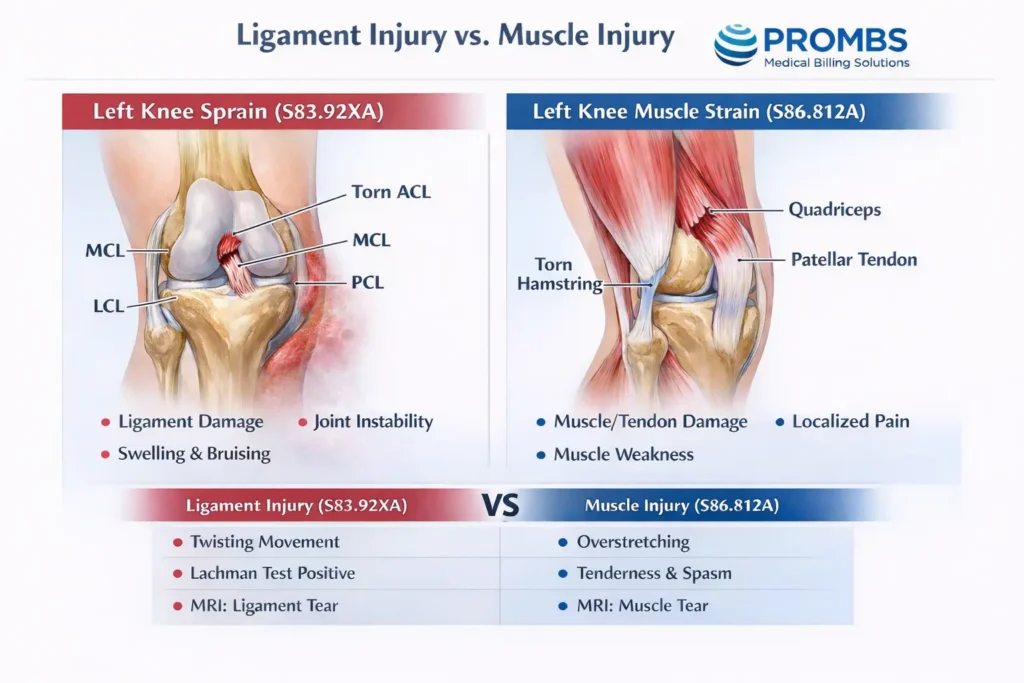
4. Sprains and Strains (S83.92XA & S86.812A)
Ligament and muscle issues require distinct ICD 10 knee pain left identifiers to ensure proper treatment tracking.
- Sprains: Use S83.92XA when ligament damage is suspected, but the specific site is not yet identified.
- Strains: Use S86.812A for muscle or tendon-related injuries at the lower leg level.
- Documentation: Clinical notes must clearly distinguish between muscle and ligament involvement to support these choices.
5. Localized Joint Swelling and Effusion
When a patient presents with fluid buildup, the ICD 10 left knee pain entry is often paired with secondary codes. M25.462 specifically identifies effusion, while M25.362 is used for general swelling. Including these additional codes helps paint a fuller clinical picture of the joint's condition.
2026 Clinical Scenarios: Coding Left Knee Pain Correctly
In medical billing, the accuracy of your documentation depends on how well you capture secondary symptoms and external causes. Using a specific Left Knee Pain ICD 10 approach ensures that the severity and origin of the condition are fully recognized by insurance payers.
1. Managing Left Knee Pain with Swelling
When a patient presents with both pain and visible swelling, dual coding is often necessary for clinical depth. You should use M25.562 for the pain and M25.362 for the localized swelling. Only use both Left Knee Pain ICD 10 entries if both symptoms are independently documented and medically significant.
2. Coding Pain Resulting from a Fall
If the discomfort follows a traumatic event like a trip or slip, you must document the mechanism of injury. Combine the Left Knee Pain ICD 10 code (M25.562) with an external cause code like W19.XXXA for an unspecified fall. This combination supports the medical necessity of the visit and improves overall billing accuracy for the initial encounter.
3. Addressing Effusion and Fluid Buildup
Joint effusion, or "water on the knee," indicates a more complex internal issue than simple surface swelling. In these cases, pair M25.562 with M25.462 to specifically identify the fluid buildup within the left knee joint. This dual-coding method ensures that the full clinical scope of the Left Knee Pain ICD 10 diagnosis is captured for the medical record.
4. Transitioning to Osteoarthritis Codes
Once a diagnosis of osteoarthritis is confirmed through imaging or examination, you should stop using symptom-only codes. Replace the general Left Knee Pain ICD 10 entry with M17.12 for unilateral primary osteoarthritis of the left knee. This shift provides necessary diagnostic clarity and prevents the "downcoding" that often leads to lower reimbursement rates.
5. Handling Unspecified Left Knee Pain
There are instances where no further detail regarding cause, severity, or specific location is available during the visit. In such cases, M25.562 remains the default and most appropriate Left Knee Pain ICD 10 designation. It serves as a reliable placeholder until further diagnostic testing provides a more specific pathological cause for the joint discomfort.
2026 ICD-10 Coding Tips for Left Knee Pain
While the core Left Knee Pain ICD 10 codes remain stable for the 2026 update, precision in reporting is more scrutinized than ever. Payers are increasingly looking for clinical specificity to justify medical necessity for imaging and physical therapy. Following these best practices for the Left Knee Pain ICD 10 entry will help maintain high administrative standards.
- Confirm Laterality: Always specify the left side to avoid using "unspecified" codes, which are frequently rejected in 2026.
- Apply Correct Extensions: For injury-related Left Knee Pain ICD 10 entries, use "A" for the initial encounter, "D" for subsequent care, and "S" for a sequela (late effect).
- Prioritize Root Causes: Match symptoms to confirmed causes as soon as possible to avoid over-reliance on the general Left Knee Pain ICD 10 code (M25.562).
- Update After Imaging: If a specialist confirms a meniscus tear or arthritis, update the record immediately to reflect the specific condition rather than just the symptom.
Let ProMBS Handle Your Medical Billing with Confidence
Medical coding and billing errors can cost your practice significant time and revenue in 2026. Our experts ensure that every Left Knee Pain ICD 10 entry is accurate, fully compliant, and processed for maximum efficiency. Partnering with professionals minimizes the administrative burden on your clinical staff.
- Personalized Consultation: Get a free session with our Billing Experts to review your Left Knee Pain ICD 10.
- Coding Precision: We provide an Expert Review of all Left Knee Pain ICD 10 and CPT codes to ensure they match clinical documentation.
- Claims Management: Our team offers ongoing support for Left Knee Pain ICD 10 claim follow-ups, appeals, and Denial Management.
- Compliance Assurance: Stay updated with the latest 2026 regulations to protect your practice from Audits.
Conclusion
The primary Left Knee Pain ICD 10 code, M25.562, remains the industry standard for 2026. However, simply knowing the code is not enough; understanding when to transition to more specific injury or disease codes is the key to clinical excellence. Accurate documentation using the Left Knee Pain ICD 10 framework is essential for maintaining clean claims and faster reimbursements.
By matching the correct Left Knee Pain ICD 10 designation to the patient's specific scenario, you ensure better care coordination and clinical clarity. Whether you are treating a simple sprain or chronic osteoarthritis, your coding should reflect the true nature of the joint disorder. High-quality Left Knee Pain ICD 10 reporting ultimately supports the financial health of your practice and the recovery of your patients.
High-quality Left Knee Pain ICD 10 reporting ultimately supports the financial health of your practice and helps you avoid Left Knee Pain ICD 10 Errors That Trigger Claim Rejections.
This content is reviewed by senior medical billing experts with 10+ years of hands-on experience across U.S. healthcare systems.
Frequently Asked Questions
What is the specific ICD 10 code for left knee pain?
The most accurate clinical code for generalized discomfort is M25.562. Healthcare providers use this designation when a patient reports pain in the left knee but a definitive diagnosis, such as a ligament tear or arthritis, remains unconfirmed through diagnostic imaging or further physical evaluation.
How do you code left knee pain caused by an injury?
Medical professionals use the S80.912A code for unspecified superficial injuries of the left knee during the initial encounter. If the injury involves a sprain, you must use S83.92XA. Always ensure your documentation includes the seventh character extension to define the specific phase of patient care.
Can you use M25.562 for left knee osteoarthritis?
You should not use M25.562 once a provider confirms osteoarthritis. Instead, apply M17.12 to denote unilateral primary osteoarthritis of the left knee. Coding the specific condition rather than the symptom ensures clinical clarity, supports medical necessity, and prevents administrative downcoding during the insurance reimbursement process.
Which code applies to left knee pain with joint swelling?
When a patient presents with both pain and swelling, you may need to report M25.562 alongside M25.362. This dual-coding approach captures the full clinical picture. If the swelling involves a significant fluid buildup within the joint, substitute the swelling code with M25.462 to indicate joint effusion.
Why does laterality matter for left knee pain ICD 10 coding?
Laterality is a critical requirement for 2026 compliance. Specifying the left side with the digit "2" at the end of the code string prevents the use of "unspecified" codes. Accurate laterality reduces the risk of claim rejections and ensures the medical record precisely reflects the patient's anatomy.
