

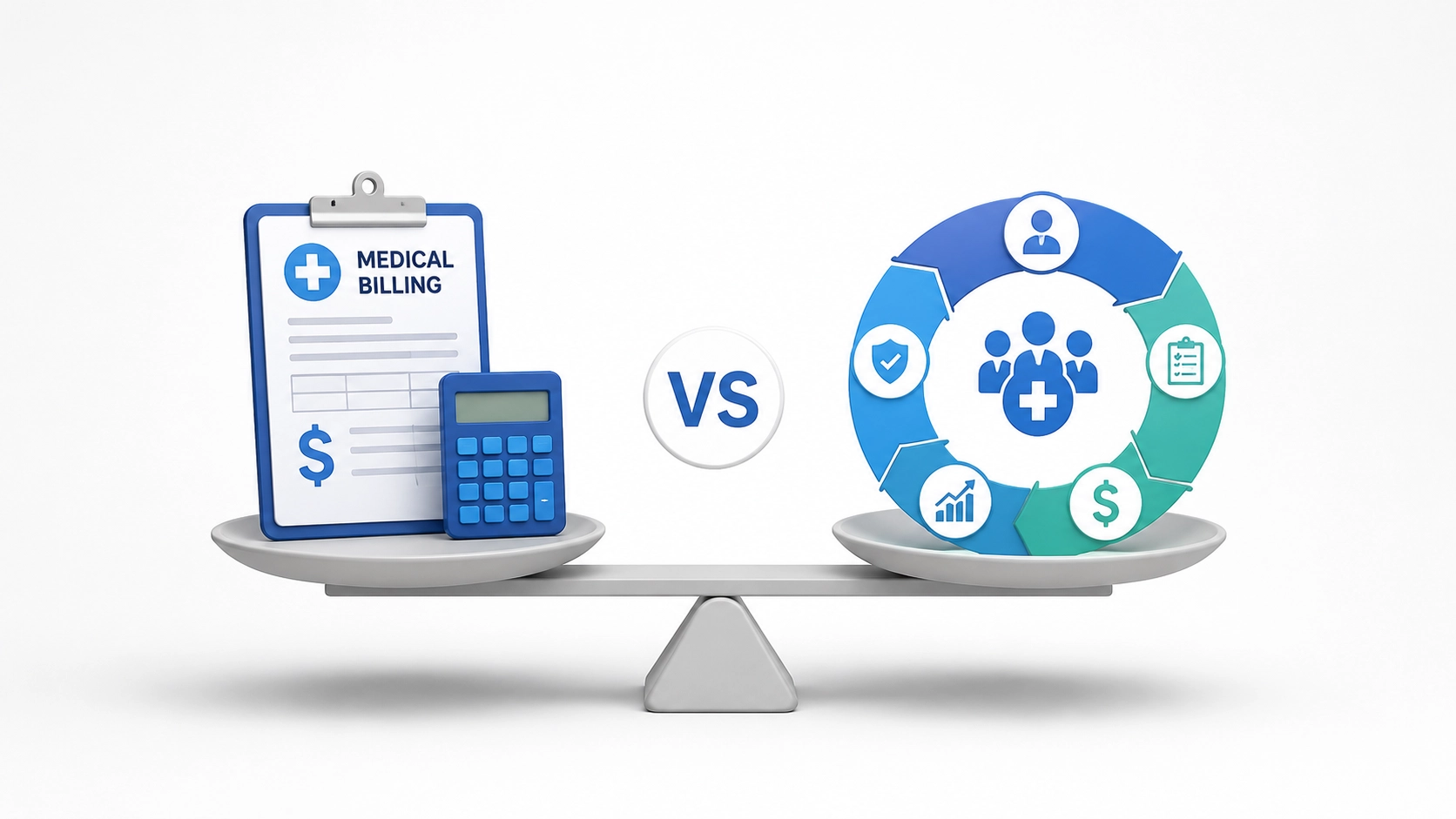
A healthcare practice can have a talented billing team, submit claims on time, and still struggle with delayed payments, increasing accounts receivable, and inconsistent cash flow.
Why?
Because successful reimbursement depends on much more than submitting claims.
Many practices confuse medical billing and revenue cycle management (RCM) because both involve payments and reimbursement. While they are closely connected, they are not the same thing.
Medical billing is one important part of the revenue cycle.
Revenue cycle management covers the entire financial journey of a patient encounter — from scheduling an appointment to collecting the final payment.
Think about it this way:
A billing team may identify that a claim was denied.
An RCM-focused approach asks:
- Why was the claim denied?
- Did insurance verification fail?
- Was authorization missing?
- Was documentation incomplete?
- Was the coding incorrect?
- How can this problem be prevented in the future?
This difference is important because many healthcare practices do not lose revenue because they cannot submit claims.
They lose revenue because problems occur earlier in the process.
Understanding the difference between medical billing vs revenue cycle management helps healthcare providers make better decisions about their financial operations and determine what type of support their practice actually needs.
The Short Answer: Medical Billing Is One Part of Revenue Cycle Management
The simplest way to understand the difference:
Medical billing focuses on collecting payment for healthcare services.
Revenue cycle management manages the complete process that creates, captures, and collects healthcare revenue.
A medical billing workflow usually begins after a patient receives care.
It focuses on activities such as:
- Reviewing codes
- Creating claims
- Submitting claims
- Posting payments
- Managing denied claims
- Following up on unpaid balances
Revenue cycle management begins much earlier.
It includes everything that affects whether a healthcare organization gets paid correctly, including:
- Patient scheduling
- Registration
- Insurance verification
- Prior authorization
- Documentation
- Coding
- Charge capture
- Billing
- Payment collection
- Reporting and analysis
What Is Medical Billing?
Medical billing is the process of converting healthcare services into claims and managing reimbursement from insurance companies and patients.
Once a provider delivers care, medical billing teams help ensure the services are properly submitted and paid.
The medical billing process typically includes:
Claim Preparation
Medical billers review information from the patient encounter, including:
- Patient details
- Provider information
- Diagnosis codes
- Procedure codes
- Charges
- Insurance information
The goal is creating an accurate claim that represents the care provided.
Claim Submission
After review, claims are submitted to insurance companies through electronic systems or clearinghouses.
The payer reviews the claim based on:
- Coverage rules
- Contract requirements
- Coding accuracy
- Medical necessity
Payment Posting
Once payment is received, billing teams record:
- Insurance payments
- Patient payments
- Adjustments
- Remaining balances
Accurate payment posting helps practices understand their financial position.
Denial Follow-Up
When claims are denied, billing teams investigate the reason and determine the next step.
Common denial reasons include:
- Coding errors
- Missing information
- Eligibility problems
- Authorization issues
- Documentation concerns
Medical billing is essential because it helps healthcare organizations receive reimbursement for services already provided.
However, it mainly focuses on the payment side of healthcare operations.
What Is Revenue Cycle Management (RCM)?
Revenue cycle management is a broader approach that manages every financial step connected to patient care.
RCM starts before the patient even enters the exam room and continues until the practice receives payment.
The goal of RCM is not only to collect money.
The goal is to create a more efficient system where revenue problems are identified and prevented.
A complete healthcare RCM process includes:
Patient Access and Scheduling
The revenue cycle begins before treatment.
This stage includes:
- Appointment scheduling
- Patient registration
- Collecting demographic information
- Gathering insurance details
Errors here can create problems later.
For example:
Incorrect insurance information may lead to claim rejection after the service has already been provided.
Insurance Verification and Eligibility
Before care is delivered, practices need to confirm:
- Active coverage
- Benefits
- Patient responsibility
- Authorization requirements
Strong eligibility processes help reduce avoidable denials and improve patient communication.
Prior Authorization Management
Some healthcare services require approval before treatment.
RCM workflows help practices manage:
- Authorization requests
- Approval tracking
- Payer communication
- Documentation requirements
Missing authorization can result in unpaid claims even when services were medically necessary.
Clinical Documentation Management
Documentation connects patient care with reimbursement.
Medical records should support:
- Services performed
- Diagnoses
- Medical necessity
- Treatment decisions
Incomplete documentation can affect coding accuracy and claim approval.
Coding and Charge Capture
RCM ensures that all services are accurately translated into billable charges.
This includes:
- CPT coding
- ICD-10 coding
- HCPCS coding
- Modifier usage
Accurate charge capture prevents missed revenue opportunities.
Claims and Payment Management
RCM includes everything involved after a claim is created:
- Claim submission
- Payment posting
- Denial resolution
- AR management
- Financial reporting
This creates a complete view of practice performance.
Medical Billing vs Revenue Cycle Management: The Core Difference
The biggest difference is the scope.
Medical billing asks:
“Did we submit the claim and receive payment?“
Revenue cycle management asks:
“How can we improve the entire process so claims are accurate, payments arrive faster, and revenue loss is minimized?“
Quick Comparison: Medical Billing vs RCM
| Area | Medical Billing | Revenue Cycle Management |
|---|---|---|
| Main Focus | Claim submission and payment collection. | Managing the complete financial lifecycle of healthcare services. |
| Starting Point | Usually begins after patient care is provided. | Begins before the patient visit and continues after payment. |
| Main Activities | Coding review, claims, payments, and denials. | Scheduling, eligibility, authorization, coding, billing, analytics, and collections. |
| Primary Goal | Receive reimbursement for services provided. | Optimize revenue performance and prevent financial leakage. |
| Scope | One part of healthcare financial operations. | A complete revenue optimization strategy. |
Where Healthcare Practices Actually Lose Revenue: Billing Problems vs RCM Problems
One of the biggest misconceptions in healthcare finance is assuming that revenue problems are always billing problems.
A practice may think:
“Our claims are being submitted, so why are we still losing revenue?”
The answer is often that the issue started earlier in the revenue cycle.
Medical billing usually handles the final stages of getting paid.
Revenue cycle management looks at the entire process to identify where revenue is being delayed, reduced, or lost.
Let’s look at some common examples.
Example 1: Claim Denials
The Billing Problem:
A claim was denied because the insurance company did not pay.
The RCM Question:
Why was the claim denied?
Possible causes:
- Insurance eligibility was not verified
- Prior authorization was missing
- Documentation did not support the service
- Coding did not match the patient’s condition
The billing team can appeal the denial, but an RCM approach focuses on preventing the same problem from happening again.
Example 2: Slow Payments
The Billing Problem:
Payments are taking too long.
The RCM Question:
Where is the delay happening?
Possible issues:
- Claims are submitted incorrectly
- Payers are requesting additional information
- Claims are not being followed up quickly
- Patient responsibility is not collected efficiently
RCM looks beyond the payment delay and improves the workflow causing the delay.
Example 3: Increasing Accounts Receivable
The Billing Problem:
Outstanding balances continue increasing.
The RCM Question:
Why is revenue getting stuck?
Possible causes:
- Weak denial management
- Poor claim tracking
- Lack of payer analysis
- Inefficient follow-up processes
A complete RCM strategy identifies the source of the problem rather than only addressing the unpaid balance.
The Difference Between Transactional Billing and Strategic RCM
A helpful way to understand the difference:
Medical Billing Is Transaction-Focused
It answers:
- Was the claim created?
- Was it submitted?
- Was payment received?
- Was the denial followed up?
Revenue Cycle Management Is Process-Focused
It answers:
- Are patients being registered correctly?
- Are eligibility issues being prevented?
- Are claims clean before submission?
- Are denials decreasing?
- Is revenue improving over time?
Medical Billing vs Revenue Cycle Management: Detailed Comparison
| Category | Medical Billing | Revenue Cycle Management |
|---|---|---|
| Purpose | Collect payment for healthcare services already provided. | Optimize the complete process that generates and collects healthcare revenue. |
| Focus Area | Claims, payments, and reimbursement. | Patient access, billing, collections, analytics, and process improvement. |
| Patient Interaction | Limited involvement after services are provided. | Begins with scheduling and continues through payment collection. |
| Revenue Problems | Addresses issues after they occur. | Identifies and prevents problems before they impact revenue. |
| Data Analysis | Usually focused on claim status and payments. | Uses reports and metrics to improve financial performance. |
| Long-Term Goal | Receive payment for submitted claims. | Create a healthier and more predictable revenue cycle. |
Which Does Your Practice Need: Medical Billing or Revenue Cycle Management?
The answer depends on where your practice is experiencing challenges.
Not every practice needs the same level of support.
Your Practice May Only Need Medical Billing Support If:
Your main challenges are:
- Claims are not being submitted correctly
- Payments are delayed after submission
- Denials need follow-up
- Payment posting is inconsistent
- Patient billing needs improvement
In this situation, improving billing processes may solve the problem.
Your Practice May Need Full Revenue Cycle Management If:
Your challenges include:
- Increasing claim denials
- Growing accounts receivable
- Poor financial visibility
- Insurance verification issues
- Authorization delays
- Difficulty tracking revenue performance
These problems usually involve multiple stages of the revenue cycle.
A Simple Decision Framework
| If Your Problem Is… | You Should Focus On… |
|---|---|
| “Claims are being denied frequently.” | RCM review, denial analysis, coding, and documentation improvement. |
| “We do not know where revenue is being lost.” | Revenue cycle reporting and performance analysis. |
| “Our billing staff is overwhelmed.” | Outsourced billing or RCM support. |
| “Payments are slower than expected.” | Claim quality, payer follow-up, and AR management. |
| “We are growing quickly.” | A scalable RCM strategy. |
Why Revenue Cycle Management Is Becoming More Important
Healthcare reimbursement continues to become more complex.
Practices now deal with:
- Changing payer policies
- Increasing documentation requirements
- More complex coding rules
- Higher administrative demands
- Growing patient financial responsibility
Because of this, simply submitting claims is no longer enough.
Healthcare organizations need systems that help them:
- Prevent revenue loss
- Improve operational efficiency
- Understand financial performance
- Make better decisions
This is where RCM provides value.
Key Revenue Cycle Management Areas That Impact Financial Performance
A strong RCM strategy focuses on improving several connected areas:
Patient Access
The revenue cycle starts before the appointment.
Important areas include:
- Scheduling accuracy
- Registration
- Insurance information collection
- Patient communication
Errors here can create problems throughout the entire process.
Eligibility and Authorization
Before services are provided, practices need to confirm:
- Insurance coverage
- Benefits
- Authorization requirements
- Patient responsibility
This reduces avoidable claim issues.
Coding and Documentation
Accurate coding requires:
- Complete provider documentation
- Correct CPT codes
- Appropriate diagnosis codes
- Proper modifiers
Coding errors can directly affect reimbursement.
Claims Management
Effective claims management includes:
- Claim review
- Submission accuracy
- Payer communication
- Rejection resolution
The goal is improving first-pass claim success.
Denial Management
Denial management focuses on:
- Identifying patterns
- Fixing root causes
- Improving workflows
- Reducing repeat denials
Analytics and Reporting
Data helps practices understand:
- Collection performance
- AR trends
- Denial rates
- Payer performance
Without reporting, practices are making financial decisions without complete information.
In-House vs Outsourced Revenue Cycle Management
Many healthcare organizations debate whether to build internal RCM teams or partner with an experienced revenue cycle company.
The best option depends on:
- Practice size
- Available resources
- Complexity of billing
- Growth goals
| Area | In-House RCM | Outsourced RCM |
|---|---|---|
| Expertise | Depends on internal staff experience and training. | Access to specialists focused on healthcare revenue cycles. |
| Staffing | Requires hiring, training, and managing employees. | Provides an experienced team without internal staffing challenges. |
| Technology | Practice manages systems and reporting tools. | Often includes established workflows and analytics. |
| Denial Prevention | May focus more on fixing problems after they happen. | Uses proactive strategies to reduce recurring issues. |
| Scalability | Growth requires additional resources. | Can adapt as practice needs change. |
Benefits of Outsourcing Revenue Cycle Management
Outsourcing revenue cycle management is not simply about transferring billing tasks to another company.
For many healthcare practices, it is about gaining access to specialized expertise, improving financial visibility, and creating stronger processes across the entire revenue cycle.
A practice may have a billing team submitting claims correctly, but still struggle with:
- High denial rates
- Slow collections
- Increasing accounts receivable
- Limited reporting
- Administrative workload
A broader RCM approach addresses these challenges by improving the systems behind reimbursement.
1. Access to Specialized Revenue Cycle Expertise
Healthcare reimbursement is constantly changing.
Practices must keep up with:
- Payer policy changes
- Coding updates
- Documentation requirements
- Authorization rules
- Compliance expectations
An experienced RCM partner provides specialists who focus on these areas daily.
This allows practices to benefit from expertise in:
- Medical billing
- Coding accuracy
- Denial prevention
- AR management
- Revenue analytics
2. Improved Revenue Visibility
One of the biggest challenges healthcare practices face is not knowing exactly where revenue problems are occurring.
A practice may know collections are lower than expected but not understand why.
A strong RCM process provides visibility into:
- Claim acceptance rates
- Denial trends
- Aging accounts receivable
- Payer performance
- Collection patterns
This information helps practice leaders make decisions based on data instead of assumptions.
3. Reduced Administrative Burden
Healthcare teams already manage significant responsibilities:
- Patient care
- Documentation
- Scheduling
- Compliance
- Staff management
- Patient communication
Managing every part of the revenue cycle internally can create additional pressure.
Outsourcing RCM allows internal teams to focus on patient care while experienced professionals manage financial workflows.
4. Better Denial Prevention
Many practices treat denials as a problem that happens after a claim fails.
A stronger RCM approach focuses on prevention.
This includes reviewing:
- Eligibility processes
- Authorization workflows
- Documentation quality
- Coding accuracy
- Payer trends
The goal is to identify why claims fail and improve the process before revenue is lost.
5. Scalability for Growing Practices
As healthcare organizations grow, their revenue cycle becomes more complex.
Growth may bring:
- More providers
- Additional locations
- Increased patient volume
- More insurance relationships
- Higher claim volume
An effective RCM solution provides processes that can scale with the practice without requiring constant internal expansion.
How Pro Medical Billing Solutions Helps Improve Revenue Cycle Management
A successful revenue cycle requires more than claim submission.
Healthcare organizations need a complete approach that connects:
- Patient access
- Documentation
- Coding
- Billing
- Payments
- Reporting
Pro Medical Billing Solutions helps healthcare practices improve revenue cycle performance through:
- Insurance verification
- Medical coding support
- Claims management
- Payment posting
- Denial management
- Accounts receivable follow-up
- Revenue cycle reporting
- Credentialing support
Our approach focuses on identifying where revenue is delayed or lost and improving the workflows responsible for financial performance.
Rather than looking at billing as an isolated activity, PROMBS helps practices manage the complete financial journey from patient visit to final payment.
Learn more about our Revenue Cycle Management Services and how a structured RCM approach can help improve practice efficiency.
Frequently Asked Questions
Is medical billing the same as revenue cycle management?
No. Medical billing is one part of revenue cycle management.
Medical billing focuses mainly on claim submission, payment posting, and reimbursement follow-up.
Revenue cycle management covers the entire financial process, including patient registration, insurance verification, authorization, coding, billing, collections, and reporting.
What is included in revenue cycle management?
Healthcare revenue cycle management typically includes:
- Patient scheduling
- Registration
- Insurance verification
- Prior authorization
- Documentation review
- Medical coding
- Charge capture
- Claim submission
- Payment posting
- Denial management
- Accounts receivable management
- Reporting and analytics
Which is better for a healthcare practice: medical billing or RCM?
It depends on the practice’s challenges.
If the main issue is claim submission or payment follow-up, improving billing processes may be enough.
If the practice struggles with denials, AR growth, poor reporting, authorization problems, or revenue leakage, a complete RCM approach may provide better results.
Can small medical practices benefit from revenue cycle management?
Yes. Small and growing practices often benefit from RCM because they may not have the internal resources to manage every part of the revenue cycle.
An effective RCM strategy can help smaller practices:
- Reduce administrative workload
- Improve collections
- Identify revenue problems
- Create more predictable cash flow
How does RCM reduce revenue loss?
RCM reduces revenue loss by identifying problems throughout the healthcare financial process.
This includes improving:
- Eligibility verification
- Documentation accuracy
- Coding processes
- Claim quality
- Denial prevention
- AR follow-up
Final Thoughts: Medical Billing vs Revenue Cycle Management
The difference between medical billing and revenue cycle management comes down to scope.
Medical billing focuses on getting healthcare services paid.
Revenue cycle management focuses on improving the entire system that creates, manages, and collects healthcare revenue.
A practice can submit claims correctly and still lose revenue if problems exist earlier in the process.
Strong RCM looks at the complete picture:
- Are patients registered correctly?
- Are insurance benefits verified?
- Are authorizations completed?
- Does documentation support services?
- Are claims accurate?
- Are denials being prevented?
- Is revenue performance being measured?
For healthcare organizations looking to improve financial performance, RCM provides a more complete approach than billing alone.
By combining accurate billing processes with proactive revenue cycle management, practices can improve collections, reduce administrative challenges, and create a healthier financial foundation.
Ready to improve your revenue cycle performance? Contact Pro Medical Billing Solutions and discover opportunities to strengthen your billing workflow.