

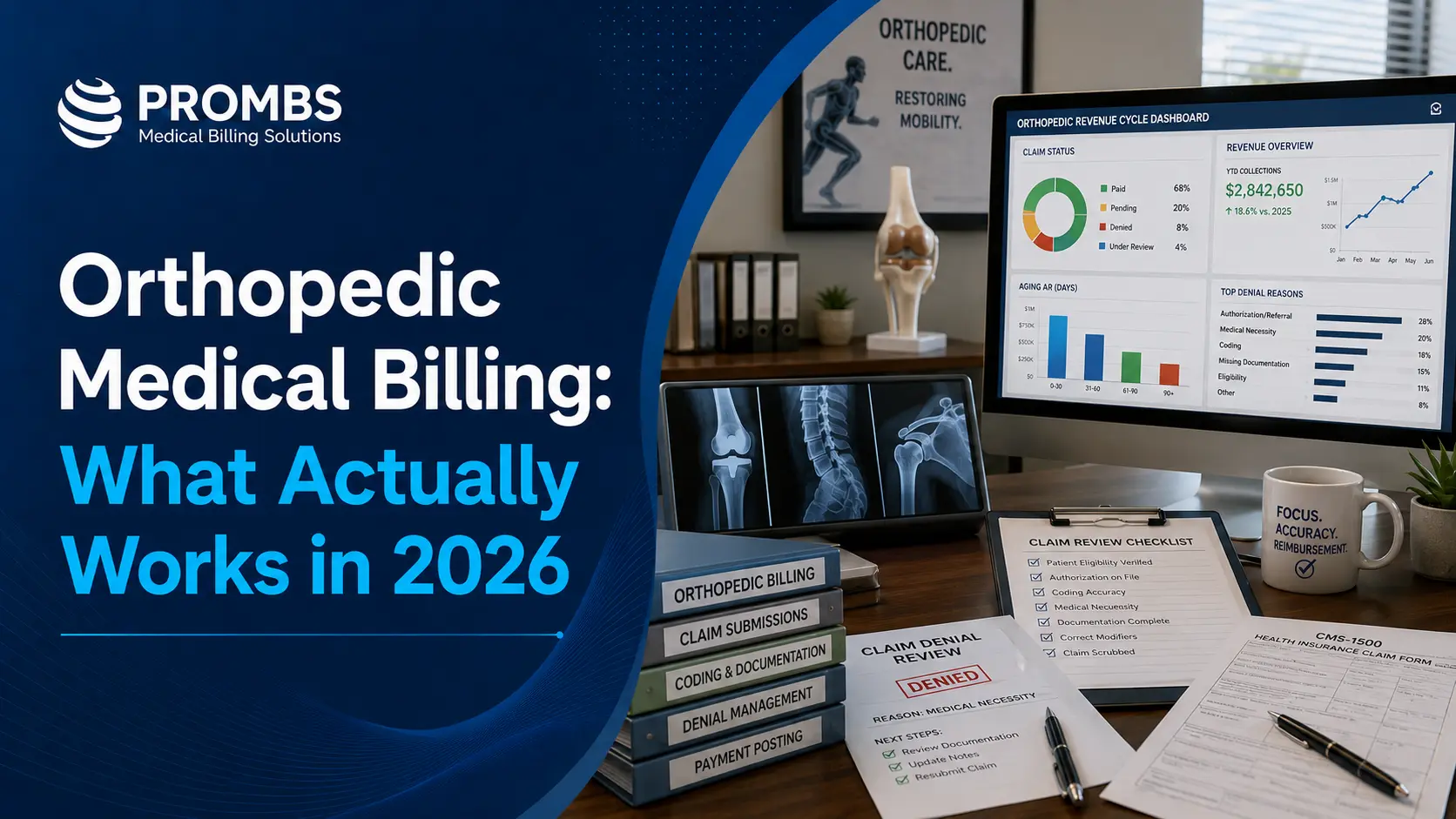
Let me be straight with you. If you are running an orthopedic practice, you already know that billing is nothing like what the textbooks describe. The reality is messy, complicated, and frankly exhausting some days. You have got surgeries scheduled, patients waiting, and a mountain of claims that seem to find new ways to get denied every single week.
I have spent years working alongside orthopedic practices of all sizes, from small single surgeon offices to large multi location groups. And I can tell you this with confidence. The practices that thrive financially are not necessarily the ones with the best surgeons or the fanciest equipment. They are the ones that have figured out how to get paid properly for the work they do.
This guide comes from real world experience, not theory. We are going to talk about what actually goes wrong in orthopedic billing, why most billing companies drop the ball, and how you can protect your practice’s revenue without losing your mind.
Why Orthopedic Billing Is Nothing Like General Medical Billing
A lot of billing companies out there will tell you they handle orthopedics. But here is the thing. Orthopedic billing has quirks that general medical billers simply do not understand. And those quirks cost you money.
Think about it this way. When a patient comes in for a knee replacement, you are not just billing for one procedure. You are dealing with the surgery itself, the implant costs, the anesthesia, the postoperative visits, and potentially complications that arise during the 90 day recovery period. Each of these pieces has its own rules, its own codes, and its own payer requirements.
General medical billers treat orthopedics like any other specialty. They apply the same cookie cutter approach they use for dermatology or internal medicine. And that is where the problems start. They miss the nuances that make orthopedic billing uniquely challenging.
Take fracture care for instance. The coding for fractures requires a seventh character that indicates the encounter type, healing status, and any complications. Get one character wrong and your claim gets denied or underpaid. It happens constantly with generalist billing teams because they just do not have the reps on this stuff.
Or consider the 90 day global period that comes with major joint replacements. During those 90 days, you cannot bill for routine postoperative care. But you can bill for new problems that arise, provided you use the right modifiers and have proper documentation. Most billing companies treat global period tracking as your problem. They just submit whatever you give them and hope for the best. That approach leaves revenue on the table every single day.
And then there are implants. Total joint replacements involve expensive hardware that comes with its own billing complexities. CMS and commercial payers require specific documentation, including invoices, for implant cost passthrough. If your billing team is not verifying that implant documentation before submission, you are going to face denials that could have been prevented with a simple checkpoint.
The bottom line is this. Orthopedic billing requires specialized knowledge that you cannot pick up from a weekend training course. You need people who have seen it all, who know the common pitfalls, and who can spot potential issues before they become claim denials.
The Three Places Where Orthopedic Practices Lose Money
After looking at hundreds of orthopedic practices over the years, I have noticed a clear pattern. There are three main areas where revenue leaks happen. Fix these and you will see a dramatic improvement in your collections.
Global Period Chaos
This is the big one. Major surgical procedures like joint replacements and spinal fusions carry a 90 day global period. During this time, you are expected to provide all routine postoperative care without billing separately. But here is where things get tricky.
If a patient develops a new problem during the global period, something unrelated to the surgery, you can bill for that separately. But you need to use the right modifier and document clearly why this is a separate service. Many practices either miss these billing opportunities entirely or bill them incorrectly and get denied.
On the flip side, some practices inadvertently bill for routine postoperative care, thinking they are following the rules. That creates compliance risk and can trigger audits from CMS or commercial payers. It is a delicate balance that requires active tracking and careful documentation review.
A good billing partner takes global period management off your plate. They track every surgical case, know exactly when the global period ends, and flag any visits that might qualify for separate billing. They also make sure you are not accidentally billing for services that should be included in the global package.
Multi Procedure Bundling Errors
Orthopedic surgeries almost always involve multiple procedures performed during the same session. You might do a knee arthroscopy, a meniscectomy, and a chondroplasty all at once. Each of these has its own CPT code, but they are not all separately billable.
NCCI edits, those are the National Correct Coding Initiative rules, define which codes can be billed together and which are considered bundled. The rules are complex and change regularly. A billing company that does not have orthopedic specific NCCI expertise will consistently get these wrong.
When you unbundle procedures that should be bundled, you generate denials. When you bundle procedures that should be separated, you leave money on the table. Either way, you lose. The only solution is having coders who live and breathe orthopedic surgery coding.
Authorization and Documentation Gaps
Commercial payers have gotten much stricter about prior authorization over the past couple of years. What used to be a quick phone call now requires extensive documentation and multiple follow ups. If your billing team is not on top of this, you will face delays and denials that could have been avoided.
Medical necessity documentation is another area where practices struggle. Payers want to see clear evidence that a procedure was medically necessary. That means detailed operative reports, imaging results, and notes from the patient’s history. If your documentation does not support the level of service you are billing, you will get denials.
The best billing partners include authorization tracking and documentation review as standard parts of their workflow. They do not wait until a claim is denied to start asking questions. They catch issues upfront and work with your clinical team to address them.
What a Great Orthopedic Billing Partner Looks Like
If you are thinking about outsourcing your billing, or if you are unhappy with your current partner, you need to know what to look for. Here are the things that actually matter.
Real Orthopedic Coding Experience
Certifications are nice, but they are not enough. You need coders who have spent years working specifically with orthopedic procedures. They should know the common pitfalls for spine surgery billing, joint replacement coding, fracture care, and arthroscopy without having to look things up every time.
Ask potential partners about their coders’ experience. How many years have they spent on orthopedic coding? What is their denial rate for complex surgical cases? Do they have experience with your specific payer mix? These questions will tell you a lot.
Net Collection Rate Performance
This is the number that really matters. Net Collection Rate measures how much of your allowed revenue you actually collect. Top performing orthopedic practices achieve NCRs between 95 and 98 percent. Anything below 92 percent means something is broken.
When you talk to potential billing partners, ask for documented NCR results from their orthopedic clients. Do not accept generic claims about being excellent. Ask for real numbers from real practices similar to yours. If they cannot provide that, consider it a red flag.
Proactive Denial Management
Every practice gets denials. The question is how quickly and effectively you address them. A good billing partner does not just resubmit denied claims and hope for the best. They analyze why denials happened and fix the root cause.
For example, if you are getting denials for missing modifiers, your billing team should identify that pattern and create a workflow to catch modifier issues before claims go out. If denials are coming from authorization problems, they should work with your front office to improve the authorization process.
Global Period Tracking
Remember what I said about global periods? Your billing partner should handle this completely. They should track every surgical case, know exactly when global periods start and end, and manage all the associated billing complexities. This should not be something your clinical staff has to worry about.
Implant Cost Recovery
Implants are expensive. And you are entitled to be reimbursed for them. But only if you submit the right documentation. A specialized orthopedic billing partner will integrate with your OR systems to capture implant costs in real time. They will verify contracted rates before claim submission and make sure all required invoices are attached.
This sounds basic, but you would be surprised how many billing companies miss it. I have seen practices leave hundreds of thousands of dollars on the table simply because implant documentation was incomplete or submitted incorrectly.
CFO Grade Reporting
Your billing partner should give you more than just a monthly summary. You need real time visibility into key performance indicators. Procedure level payer variance, implant cost recovery metrics, AR aging by case type. These metrics help you make informed decisions about your practice’s financial health.
If your billing partner cannot provide this level of reporting, you are flying blind. And in today’s healthcare environment, that is a dangerous place to be.
Common Mistakes That Kill Orthopedic Revenue
I have seen these mistakes play out again and again. Avoid them and you will be ahead of most practices.
Ignoring Fracture Coding Details
Fracture codes require precise documentation of encounter type, healing status, and complications. A missed seventh character can mean a denial or significant underpayment. Your coders need to understand fracture care coding inside and out. This is not something you can learn on the fly.
Getting Laterality Wrong
Orthopedic ICD 10 codes require anatomical site and laterality specification. It sounds simple, but mistakes happen constantly. The best practices have coding templates that flag laterality requirements and catch errors before submission.
Failing to Track NCCI Updates
NCCI edits change regularly. What was separately billable last year might be bundled this year. If your billing team is not actively monitoring these changes, you will generate denials and compliance exposure. A specialized orthopedic billing partner stays on top of these updates automatically.
Poor Documentation Practices
Detailed operative reports are essential for medical necessity documentation. If your reports do not clearly support the procedures you are billing, you will face denials and potential audits. Work with your clinical staff to ensure documentation captures everything payers need to see.
What Happens When You Choose the Wrong Billing Partner
Choosing a billing partner is one of the most important decisions you will make for your practice. Get it wrong and the consequences are serious.
Let us say your practice collects five million dollars annually. A billing company delivering 90 percent Net Collection Rate instead of 96 percent leaves three hundred thousand dollars on the table every year. Over five years, that is one and a half million dollars. Money that should be supporting your practice, your staff, and your patients.
Beyond the direct revenue loss, poor billing creates operational headaches. Your staff spends time chasing claims instead of focusing on patients. Denial rates climb. AR ages. And the overall financial stability of your practice suffers.
The right billing partner does not just submit claims. They proactively manage your revenue cycle, flag documentation gaps before submission, and reduce delays from insurers. They become a true partner in your practice’s success.
Stop Letting Orthopedic Billing Errors Drain Your Revenue
Find hidden revenue leaks, coding issues, denial patterns, and missed reimbursement opportunities with a complimentary orthopedic billing audit.
Top Orthopedic Billing Companies Worth Considering
Based on my experience working with orthopedic practices across the country, here are some companies that consistently deliver strong results.
ProMBS for Complete Orthopedic Revenue Cycle Management
ProMBS is a strong option for orthopedic practices that want more than basic claim submission. Their team supports the complete revenue cycle, including orthopedic coding, prior authorization tracking, denial management, accounts receivable follow-up, payment posting, and financial reporting.
What stands out about ProMBS is its focus on identifying revenue leaks before they become long-term problems. Their team reviews coding accuracy, modifier usage, documentation gaps, global period billing, and payer-specific claim requirements. This helps practices reduce avoidable denials and improve reimbursement consistency.
ProMBS is particularly suitable for solo orthopedic surgeons, multi-location practices, and growing orthopedic groups that need a dedicated billing team without building a large in-house department. Practices also receive regular performance reporting, allowing them to track collections, denials, aging claims, and other important revenue cycle metrics.
Is Your Orthopedic Practice Losing Revenue to Billing Errors?
Get a complimentary orthopedic billing audit to uncover coding mistakes, unresolved denials, aging claims, documentation gaps, and missed reimbursement opportunities.
MBC for Multi Surgeon Groups
MBC has built a specialized orthopedic center of excellence that focuses on the specific challenges of this specialty. Their orthopedic coders work exclusively on orthopedic claims, which means they know the nuances that generalists miss. They are particularly strong on implant cost recovery and global period management.
What I like about MBC is their documented Net Collection Rate of 97 percent or higher for orthopedic clients. That is top tier performance. Their clients average a 16 percent improvement in collections within 90 days of onboarding. For a practice collecting three million dollars, that translates to over four hundred twenty thousand dollars in additional annual revenue.
CombineHealth for AI Automation
CombineHealth uses AI to automate much of the billing process while still maintaining human oversight. Their AI coding solution identifies missing laterality, implant documentation, fracture care details, and surgical bundling issues before coding is finalized. The result is a closed loop system that continuously improves reimbursement performance.
This approach works well for practices that want to leverage technology without losing the human touch that complex orthopedic cases require.
Coronis Health for Hospital Systems
Coronis Health offers enterprise level RCM infrastructure with credible orthopedic specific experience. Their certified orthopedic surgery coders understand the complexity that generalist billing teams often miss. The limitation is that their coding model can be more generalist than some practices prefer.
ModMed Orthopedics for EHR Integration
ModMed built its platform with input from orthopedists, which shows in the user experience. Their RCM services sit on top of the same EHR, reducing data latency issues from disconnected systems. AI powered documentation and automated code suggestions with claim risk flagging before submission are real differentiators.
SpryPT for Small to Mid Size Practices
SpryPT offers AI powered coding automation with a reported 98 percent clean claim rate. Their hybrid RCM model combines automation, human coders, and real time insights. They are especially strong on orthopedic modifiers and complex surgical coding.
2026 CPT Changes You Need to Know About
The 2026 CPT changes hit musculoskeletal and spine procedures hardest. Practices that have not audited their documentation templates against these updates are carrying unquantified revenue risk.
Key changes include updated code descriptors for spine procedures, new codes for emerging orthopedic techniques, revised guidelines for fracture care coding, and changes to arthroscopy and joint procedure codes.
A specialized orthopedic billing partner should proactively update coding protocols and train their team on these changes before they take effect. If your billing partner is not talking to you about these updates, that is a concern.
Frequently Asked Questions
What Net Collection Rate should I expect from my billing company?
Top performing orthopedic practices achieve Net Collection Rates between 95 and 98 percent. The national average is closer to 93 to 94 percent. If your billing company is delivering below 92 percent, something is seriously wrong.
How do orthopedic billing companies handle implant billing?
The best ones integrate directly with OR logs to capture implant costs in real time and verify contracted rates before claim submission. This eliminates a denial category that many practices only discover during retrospective AR reviews.
What makes the best orthopedic billing companies different from general medical billers?
They specialize in implant cost recovery, global period compliance, and orthopedic specific modifier rules that generic billers consistently mishandle. Best in class orthopedic billing companies deliver NCRs between 94 and 98 percent, compared to 85 to 89 percent from generic vendors.
How does Workers Comp billing work in orthopedics?
Workers Comp and personal injury cases involve lien based collections and extended AR periods. Specialized orthopedic billers maintain dedicated units that accelerate resolution and reduce Days in AR by 40 percent or more.
How quickly can switching to a specialized orthopedic billing company improve revenue?
The best orthopedic billing companies deliver measurable improvements within 90 days. MBC clients average a 16 percent NCR improvement within 90 days of onboarding.
Final Thoughts
Orthopedic medical billing is not for amateurs. The complexity of coding, the challenges of global period management, the intricacies of implant billing, and the ever changing payer requirements demand specialized expertise.
The wrong billing partner will cost you hundreds of thousands of dollars in missed revenue and create endless headaches for your staff. The right billing partner will maximize your collections, reduce denials, and give you peace of mind.
Whether you go with an AI first automation platform, an integrated EHR native solution, or a specialty outsourced service, the benchmark for success is measurable margin recovery. That is what separates the best orthopedic billing companies from everyone else.
Take the time to evaluate your current billing situation honestly. If you are not happy with your Net Collection Rate, if denials are piling up, or if your staff is spending too much time chasing claims, it might be time for a change. Your practice and your patients deserve better.