

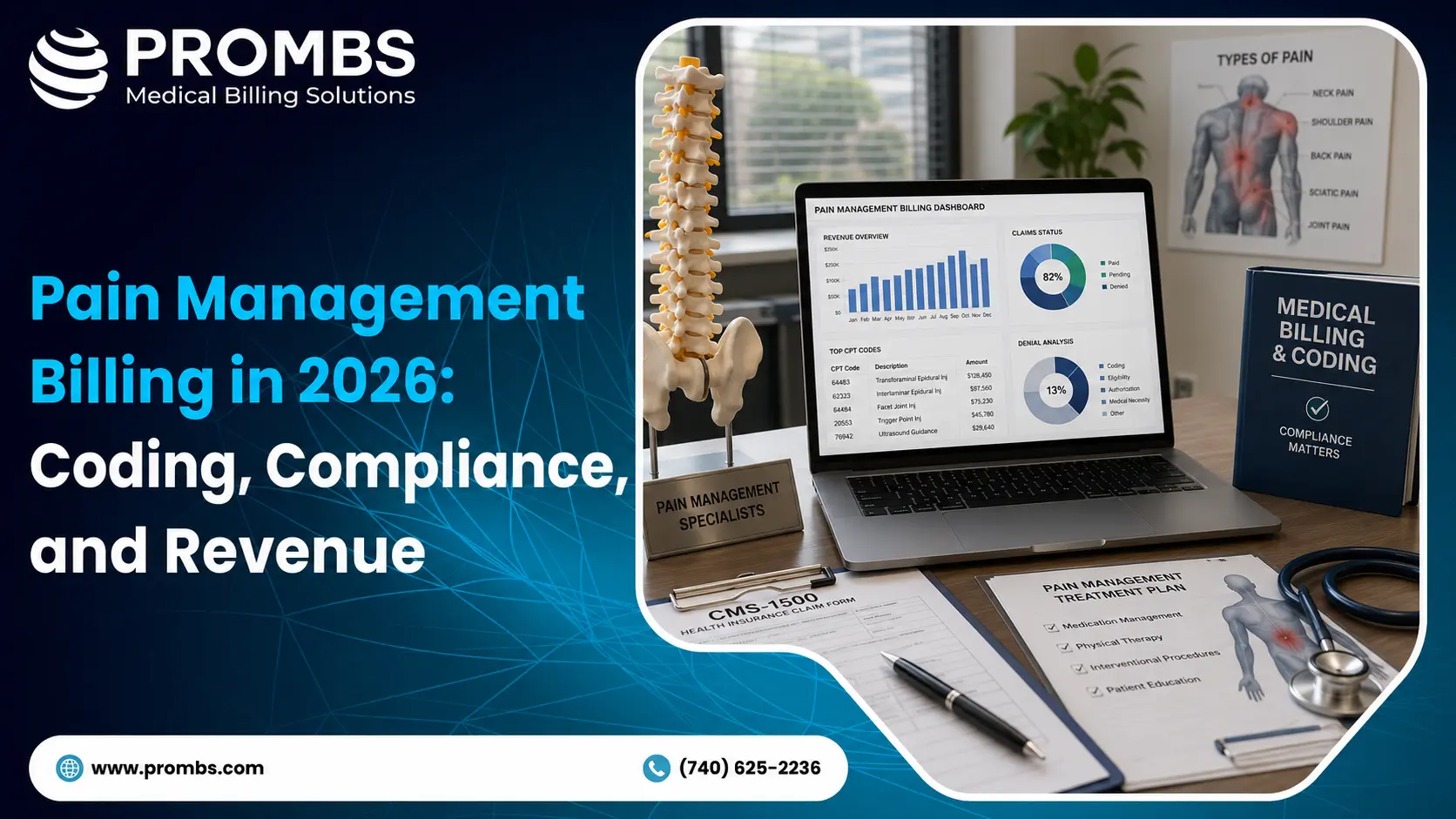
Pain management billing shapes how money moves inside a clinic more than most people expect when they first start in this specialty. It shapes stress too, and that stress builds fast. Claims face more questions than average. Payments take longer to arrive. Audits show up earlier, and more often, than they do in almost any other outpatient specialty.
Why does this happen so often? Because pain doesn’t behave like other conditions. It lingers. It shifts. It rarely has a clean ending. Patients come back next month, then the month after that, and every visit adds one more layer to a record that payers are already watching closely.
Automation now scans frequency, timing, and repetition across claims before anyone on the payer’s side even opens the file. Once a pattern gets flagged, payment slows down, even on claims that were coded correctly the first time.
This guide covers pain management billing the way it actually works in 2026: what changed in chronic pain management coding, which CPT and HCPCS codes carry the most audit risk right now, and what genuinely keeps revenue steady in a specialty that never runs in a straight line.
What Is Pain Management Billing?
Pain management billing covers the ongoing clinical services used to treat chronic or recurring pain, where reimbursement depends heavily on documentation continuity, medical necessity, and frequency justification, not just correct code selection.
Some pain fades quickly. A strain heals. A surgery ends and the chart closes. Chronic pain doesn’t work that way. It changes how patients move, sleep, and function day to day, and it forces providers to reassess and adjust the care plan again and again. That constant adjustment is exactly what creates pressure on pain management billing at every single visit, because payers want proof at each step that care is still helping and that function is still improving.
Pain services routinely draw higher utilization review than most other outpatient care. That means more eyes on every claim, even when the care itself is completely appropriate. If the documentation doesn’t track with the clinical story, claim denials start piling up fast.
Types of Pain Management Services and Treatments
Pain management is never delivered as a single service, billed once and forgotten. It’s layered care delivered over months, sometimes years, and each layer carries its own billing rules.
Evaluation visits come first. They document function, movement limits, and pain history, and they justify everything else that follows. Interventional procedures come next: epidural injections, facet joint injections, nerve blocks, trigger point injections, radiofrequency ablation, and spinal cord stimulation. These drive the bulk of clinic revenue, and they attract the closest payer review.
Medication management adds another layer, including opioid risk monitoring and urine drug testing, an area where payers have tightened their rules noticeably over the past couple of years. On top of all this sits Chronic Pain Management, a time-based monthly service billed under HCPCS G3002 and G3003, separate from a standard office visit.
Mixed service types raise coding error risk whenever documentation drifts between visits. Every note has to tie back to the treatment plan. When that link breaks, the next claim usually breaks with it.
How Pain Management Billing Practices Operate
Very few pain patients come once and leave for good. Most return monthly. Some return even more often during flare periods, and that rhythm is what shapes the entire billing workflow, from intake through appeal.
Records have to connect across visits without gaps. One thin note can quietly damage a claim two or three visits later, because reviewers read the whole trail, not just the single date of service in question. Continuity in chronic care documentation isn’t optional. Gaps raise review flags fast, and strong intake plus patient insurance verification habits are what keep those gaps from forming in the first place.
Pain Management Billing Codes: CPT and HCPCS for 2026
Coding is where pain management billing leaves the least room for error, and several code sets changed in meaningful ways for 2026.
Commonly Billed Pain Management CPT and HCPCS Codes
Note: CMS HCPCS G-codes apply to Medicare chronic pain management billing. Commercial payer rules vary, so always confirm against the current payer policy before submitting.
| Code Category | Code | Description | 2026 Billing Note |
|---|---|---|---|
| Chronic Pain Management (CMS) | G3002 | Chronic Pain Management, initial 30 minutes per month | Requires 30 or more minutes of physician or QHP time; cannot be billed the same month as CCM (99490/99491) or PCM. |
| Chronic Pain Management (CMS) | G3003 | CPM, each additional 15 minutes | Add-on to G3002, billable multiple times per month with documented medical necessity. |
| E/M Complexity Add-On | G2211 | Visit complexity for ongoing, single-condition care | Not billable with modifier 25 on the same E/M line, apart from a few preventive service exceptions. |
| Epidural Injection | 62323 | Interlaminar epidural injection, lumbar or sacral | Imaging guidance is bundled into the code; do not separately bill 77003. |
| Facet Joint | 64493 / 64490 | Lumbar or cervical paravertebral facet joint injection | 2026 descriptors now explicitly bundle imaging guidance into the code itself. |
| Facet Joint Add-On | 64494, 64495 | Additional facet joint levels | Report per additional level; document each level treated separately. |
| Radiofrequency Ablation | 64633, 64634 | Destruction of nerve by neurolytic agent, first and each additional level | High audit risk without a documented, successful trial block on file. |
| Spinal Cord Stimulation | 63650 / 63685 | Percutaneous or open trial and implant of neurostimulator | The trial must be billed and authorized separately from the permanent implant. |
| Trigger Point | 20552 | Injection(s), 1 to 2 muscle groups | Billed per session, not per muscle. |
| Trigger Point | 20553 | Injection(s), 3 or more muscle groups | High audit risk when billed with a same-day E/M. |
| Drug Testing | G0480 to G0483 | Presumptive and definitive urine drug testing | Payers increasingly want a documented clinical reason per test, not a routine panel. |
| E/M Service | 99214 | Established patient office visit | High risk for modifier 25 misuse when billed alongside a same-day procedure. |
Diagnosis Coding in Pain Care
Pain changes shape over time. Location shifts. Severity deepens. Duration stretches. The ICD-10 codes need to move with it. A diagnosis code that stays static across six months of visits tells a story that never evolved, and payers notice static stories quickly. For spine-related pain especially, coders should be precise about laterality and chronicity. The ICD-10 code for low back pain and the ICD-10 code for cervicalgia are two of the most commonly under-specified diagnoses in pain management billing.
Procedure Coding in Pain Care
Procedures drive most of a pain clinic’s revenue, and they invite the most scrutiny too. Every procedure needs clear clinical support in the chart, and frequency limits apply even when a patient’s pain hasn’t gone away. Repeating a procedure without a note explaining what changed since last time is one of the fastest routes to a denial.
Modifier Use in Pain Management Billing
Modifiers explain why care differed on a given visit, whether that’s timing, setting, or medical need. Modifier misuse remains one of the top denial causes in pain management billing, and it tends to show up in a few recurring patterns going into 2026.
Modifier 25 on an E/M billed the same day as a procedure needs documentation showing the visit was significant and separately identifiable from the pre-procedure assessment, not just a repeat of the same complaint the patient came in with. Modifier 50 covers bilateral procedures and is required by most payers instead of billing two separate line items, though a handful still prefer distinct lines per side. Modifier 59, or one of the X-modifiers, is needed when NCCI edits would otherwise bundle two pain procedures performed on the same date.
Small modifier errors cause payment delays that are out of proportion to the size of the mistake. If your team keeps seeing repeat denials tied to modifier logic, it’s worth looking at the broader patterns behind coding compliance failures, since most of them trace back to two or three recurring habits.
Pain Management Billing Challenges
Denials in this specialty rarely start big. They start with a note that assumes too much, one that doesn’t explain why care must continue today or what changed since the last visit. Payers never assume. They ask one sharp question: was this still needed, and why now?
Pain services remain a recognized high-risk billing area across outpatient care, and even claims that were coded correctly can pause for weeks while records get pulled for review. Reactive billing, fixing denials after they’ve already happened, drains a team’s time far faster than prevention does.
What clinics tend to lose without noticing is slow downcoding and silent edits. A payer pays a little less instead of denying outright, which looks like a small win in the moment but adds up to real revenue loss over a year.
Billing teams should be watching a few things every single week: denials by payer and by service type, claims that are pending for records, repeat edits tied to frequency rules, and any coding and insurance errors that keep repeating across the same handful of CPT codes.
Reimbursement Pressure in Pain Management Billing (2026 Update)
Reimbursement moves slower in pain management billing than in most specialties, and 2026 added another layer of complexity on top of that. CMS introduced a split conversion factor structure for the 2026 Physician Fee Schedule and applied a broad efficiency adjustment to non-time-based codes, which affects how many interventional pain procedures get valued going forward. Medicare still applies strict frequency and coverage limits, and commercial plans layer their own approval requirements on top of those.
Prior authorization is often the real choke point. A payer may want proof of failed conservative care, imaging support in the chart, or a clear ongoing plan rather than another repeat request. Getting prior authorization right the first time is one of the highest-leverage habits a pain clinic can build, since a single missing detail can stall payment before treatment even starts.
A simple checklist tends to hold up well under review: confirm the treatment plan matches what will actually be billed, confirm the record supports medical necessity for the service rather than just the diagnosis, and confirm the timing fits the payer’s own frequency rules.
Payments can still delay even after authorization is approved, because claims remain subject to medical record review, frequency validation, and post-approval utilization checks. Strong documentation is what shortens that wait, not persistence alone.
Compliance and Audit Risk in Pain Management Billing
Pain management billing lives under near constant review. Audits focus on frequency patterns tracked across months, not single visits. High volume by itself isn’t the problem. Poor documentation is what makes high volume look like a problem, and reviewers never see the patient. They only see the note.
Clinics tend to trigger audits unintentionally when documentation looks repetitive over time, lacks evidence of clinical change, or doesn’t explain why continued services remain medically necessary. That doesn’t mean the care was wrong. It means the clinic wasn’t ready to prove it was right. For a deeper look at exactly where pain clinics fall into this trap, our dedicated guide on audit risk in pain management billing compliance breaks it down further.
Writing for audit safety comes down to cause and effect, every single time. What did the patient report today, specifically? What did the exam show today, compared with the last visit? What failed, and what helped? Why is the current plan still the best option right now?
Beyond documentation, HIPAA compliance sits right alongside coding accuracy as a core audit exposure for pain clinics handling controlled substance records and drug testing data. It’s worth reviewing our guide to HIPAA compliance in pain management billing services if that hasn’t been checked recently.
Reduce Pain Management Billing Denials
Get a free Revenue Gap Analysis and uncover hidden coding, compliance, and reimbursement issues.
How Pain Management Billing Practices Can Protect Revenue
Revenue protection starts before a claim ever leaves the clinic. Strong pre-submission reviews catch weak notes. Authorization checks stop the easiest denials before they ever happen.
Ask two questions often, at the team level: why did this deny, and what changed this month? Regular provider feedback measurably reduces billing error rates over time. A routine medical billing audit, not just a reactive one after a payer flags something, is one of the fastest ways to find revenue leaking out quietly through downcoding and small denials. Tracking the right revenue cycle KPIs each month also makes that leakage visible before it becomes a pattern instead of an incident.
Why Specialized Pain Management Billing with Pro-MBS Matters
General billing teams tend to struggle with pain care because the rules shift constantly and the risk stays high across every code set at once: G-codes, interventional CPTs, modifiers, drug testing, and prior authorization all move together, not one at a time. A specialized team catches documentation drift early and flags payer issues before they turn into denials, which protects revenue quietly instead of chasing it after the fact.
That’s the core of how Pro-MBS supports pain management billing for practices: aligning notes, codes, and payer rules as one continuous medical billing and coding compliance framework, not a scramble every time an audit letter shows up. Strong documentation protects claims. Clean workflows protect clinics. Revenue follows clarity.
Get a Free Pain Management Billing Revenue Gap Analysis
If your clinic has been seeing slower payments, rising denial rates, or more record requests than last year, it’s worth finding out exactly where the leak is before your next audit finds it for you.
In a free Revenue Gap Analysis, Pro-MBS will:
- Review your last 90 days of G3002/G3003, interventional CPT, and E/M claims for modifier and frequency risk
- Identify which payers are downcoding or slow-paying your pain management billing claims, and why
- Flag documentation gaps before they turn into audit findings
- Give you a clear, no-obligation breakdown of recoverable revenue
No commitment, no pressure, just a clear picture of where your pain management billing actually stands today.
Frequently Asked Questions
What is the best way to handle pain management billing denials?
Stop them before they start. Review your medical records for documentation gaps every week, and make sure each note explains why the patient needs continued care today, not just that the pain is still present.
Why do pain management billing claims get stuck in review?
Payers look for repeat patterns. If your billing looks identical month over month, it draws an audit flag. Notes that clearly show how the patient’s status is changing, better or worse, keep claims moving instead of sitting in review.
How does chronic pain affect clinic revenue?
Chronic pain creates a long trail of connected medical records that all have to match. One weak note in that chain can affect reimbursement on visits that come after it, not just the visit where the gap first occurred.
What is the biggest risk in pain management billing coding for 2026?
Modifier misuse, especially modifiers 25 and 59, and outdated code descriptors. Several facet joint and imaging guidance codes changed for 2026, so every procedure still needs a clear, current clinical reason documented in the chart.
Do I still need prior authorization for interventional pain procedures in 2026?
Yes, for most payers and most interventional procedures, particularly epidural injections, facet joint injections, radiofrequency ablation, and spinal cord stimulation trials. Requirements vary by payer, so verify before scheduling, not after.
Why should a clinic choose specialized pain management billing services?
General billing teams often miss the small, frequent rule changes payers make around pain-specific codes. Specialized pain management billing catches documentation drift before it causes damage, giving your clinic steadier revenue and far less audit stress.