

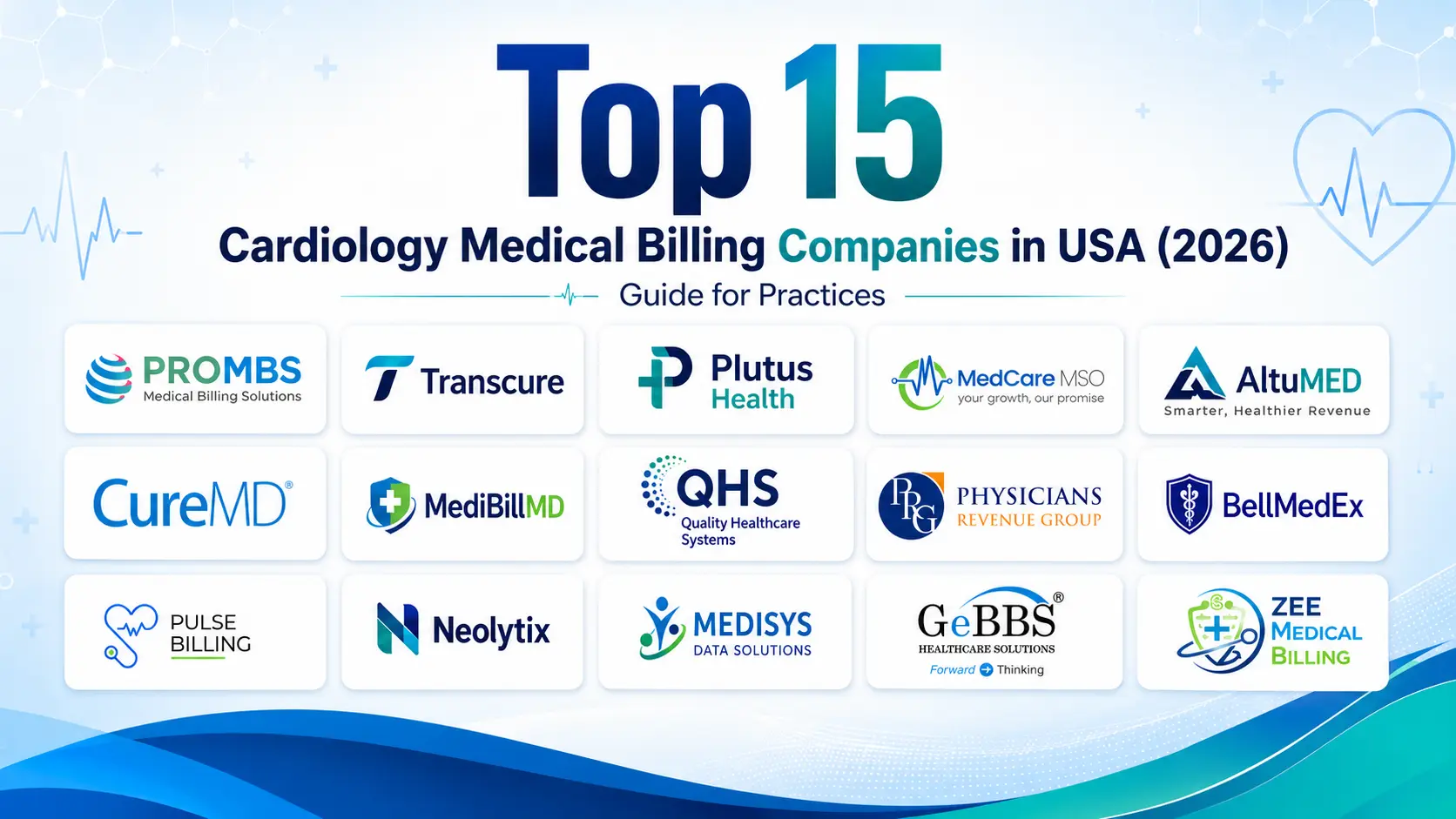
Cardiology practices lose 12 to 18 percent of earned revenue every year. Not because they see fewer patients, but because their billing setup is not built for the complexity cardiology actually demands.
The fix is not hiring more staff. It is finding a billing partner who understands cardiac catheterizations, electrophysiology studies, and remote monitoring claims at the code level. This guide ranks the top 15 cardiology billing companies in the USA for 2026, with honest analysis of what each one does well and where they fall short.
Recover Revenue Lost to Cardiology Billing Errors
Complex cardiac procedures need more than general medical billing. Get a cardiology-focused RCM review and find where denials, underpayments, and AR delays are costing your practice money.
Get a Free Cardiology Billing Audit →
Why Cardiology Billing Is Different From Every Other Specialty
Cardiology billing fails more often than other specialties for one structural reason: it is not one specialty. It is four.
- Diagnostic cardiology: EKGs, echocardiograms, nuclear stress tests, Holter monitoring
- Interventional cardiology: coronary angioplasty, stenting, cardiac catheterization
- Electrophysiology: ablations, device implants, EP studies
- Remote patient monitoring: cardiac telemetry, wearable ECG patches, implantable loop recorders
Each of these categories has its own coding logic, modifier rules, and payer policies. A biller who handles diagnostic claims well can completely mishandle an interventional procedure where modifier 26 vs TC distinctions, NCCI bundling rules, and global period restrictions all apply at the same time.
The CPT code range for cardiovascular services stretches from 92920 through 93799. Medicare, BCBS, and Aetna each maintain their own Local Coverage Determinations governing which codes are medically necessary for which diagnoses. A billing company that misses MAC-level LCD updates generates denials that never should have happened in the first place.
Here is what the numbers look like in practice:
- Cardiology denial rates run between 16 and 20 percent, compared to 8 to 11 percent in simpler specialties
- Each denied claim costs between $25 and $118 in staff time and follow-up
- Claims that age past 90 days have a collection probability below 60 percent, no matter how legitimate the original claim was
Understanding this complexity is step one. Choosing a partner built for it is step two.
What to Look For Before Comparing Any Company
Do not evaluate billing companies based on a sales pitch. Use these four criteria first.
1. Do their coders hold the CCC credential? The Certified Cardiology Coder designation from AAPC is the highest certification available specifically for cardiovascular billing. A general CPC license is not enough for interventional or electrophysiology practices.
2. What is their first-pass acceptance rate at the payer level? Internal clean claim rates mean very little. The metric that matters is first-pass acceptance at the actual payer. Industry standard sits above 95 percent. Best-in-class cardiology billing firms hit 97 to 99 percent.
3. How do they handle prior authorization? More than 85 percent of commercial payers now require pre-authorization for cardiac catheterizations, nuclear stress testing, and device implants. Authorization tracking needs to be automated, payer-specific, and proactive, not something your team chases down after the fact.
4. Do they catch underpayments? Denials are visible. Underpayments are not. Insurance companies routinely reimburse below contracted rates on complex procedures. Without contract variance analysis on every single remittance, that revenue disappears permanently and quietly.
Top 15 Cardiology Medical Billing Companies (2026)
1. Pro Medical Billing Solutions (Pro MBS)
Best overall for specialized cardiology RCM
Pro MBS is the most comprehensively built option for cardiology practices that need full revenue cycle coverage, not just claim submission. Their coders understand modifier selection for complex coronary interventions, NCCI bundling edits for multi-vessel procedures, and the documentation standards that Medicare and commercial payers require before approving high-value cardiovascular claims.
What separates Pro MBS from most of the field is their denial management philosophy. They focus on root cause analysis rather than reactive appeals. Common denial patterns get identified and eliminated at the front end before they ever become a problem. They also stay current with the 2026 CMS changes to RPM billing codes, including monthly billing cadence requirements for cardiac event monitors and implantable loop recorders. This is a revenue stream most practices are currently leaving on the table.
Their reporting gives practice managers procedure-level visibility into clean claim rates, denial trends, days in AR, and collection rates. Most clients begin seeing measurable improvement in first-pass acceptance within 60 to 90 days of onboarding.
Best for: Independent cardiology practices, interventional groups, EP programs, and multi-provider cardiovascular centers that want a specialized billing partner with transparent performance reporting.
Not Sure If Your Billing Partner Meets These Standards?
Let Pro MBS review your cardiology claims process, denial patterns, prior authorization workflow, and underpayment recovery setup before you commit to another billing vendor.
Talk to a Cardiology Billing Specialist →
2. Transcure
Best for automation-driven billing with certified oversight
Transcure combines Robotic Process Automation with AAPC-certified coders to reduce human error on high-frequency coding decisions. Their denial alert system flags potential issues before claims even leave the clearinghouse. They carry HIPAA and SOC 2 Type II compliance, which matters for practices that go through regular security audits.
Their reported first-pass approval rates and support across 400 or more providers in regional and national cardiology contracts are backed by verifiable performance data. Transcure performs best for practices with standardized procedure volumes. Very high-complexity cath labs with diverse interventional case mixes may benefit from supplemental coder oversight on non-standard procedures.
Best for: Cardiology practices seeking automation-driven billing with a documented track record across both standard and interventional cardiovascular billing.
3. Plutus Health
Best for electrophysiology and device implant billing
With more than 15 years in specialized cardiology billing and recognition in Becker’s Hospital Review, Plutus Health combines AI tools with certified coder judgment for EP study billing, device implant claims, and complex cardiovascular coding. Their workflow covers eligibility verification, prior authorization, CPT and ICD-10 coding, claim scrubbing, and payment posting.
Their service model is built for mid-size to larger cardiology groups. Very small independent practices may find the pricing structure less favorable at lower procedure volumes.
Best for: Mid-size to large cardiology practices with significant electrophysiology and device implant volume.
4. Medcare MSO
Best for West Coast practices with moderate complexity
Operating since 2012 out of Irvine, California, Medcare MSO handles full revenue cycle management with claims submitted within 48 hours of charge entry. Client-reported metrics show revenue improvements of 15 to 20 percent when transitioning from in-house billing setups.
Their clean claim rate of 88 percent trails the 95 to 99 percent range that top-tier specialized firms consistently hit. For diagnostic-heavy practices this gap is manageable. For high-complexity interventional or EP programs, it translates into real dollars walking out the door.
Best for: California and Southwest practices with moderate-complexity billing needs and high diagnostic procedure volumes.
5. AltuMED
Best first-pass acceptance rates in the industry
AltuMED’s reported 99 percent clean claim rate and 97 percent first-pass approval rate place them among the highest performers in the industry. Their AI-driven workflow for echo lab billing, cath procedures, device implants, and ablation coding has produced revenue improvements of up to 30 percent for practices switching from generalist billing.
Their strength is driving high first-pass rates that reduce total denial volume significantly. Practices with particularly complex denial resolution needs should verify their appeals process depth for non-standard interventional procedures before making a commitment.
Best for: Cardiology practices with high diagnostic and moderate interventional volumes that prioritize first-pass acceptance and operational efficiency.
6. CureMD
Best for practices already on the CureMD platform
CureMD’s AI-powered claim scrubbing resolves denial-prone coding errors before submission. Their platform reports a 98 percent acceptance rate, and their denial resolution runs about three times faster than industry average. Tight EHR integration eliminates the duplicate data entry that creates coding errors in practices relying on manual charge capture.
The key limitation is that CureMD’s full-service billing is bundled with their broader platform. Practices that want billing services without a system migration need to evaluate integration capabilities carefully before committing.
Best for: Cardiology practices using or willing to adopt CureMD’s platform, particularly those with chronic care management and remote monitoring billing requirements.
7. MediBillMD
Best for fast AR cycles with comprehensive credentialing
A 98 percent clean claim rate and average AR cycle under 30 days make MediBillMD one of the stronger performers in the field. Their certified team processes PCI claims, ablations, and remote monitoring using AI-driven workflows. They also handle full RCM including provider credentialing and old AR audits, which is valuable for practices carrying billing backlogs or credentialing gaps.
Client-reported outcomes include 10 to 15 percent revenue gains and a consistent 96 percent collection rate. Their reporting dashboards give real-time visibility into AR aging, denial trends, and collection performance across all payers.
Best for: Cardiology practices managing PCI, ablation, and remote monitoring volumes that need fast AR cycles and comprehensive credentialing support.
7. MediBillMD
Best for fast AR cycles with comprehensive credentialing
A 98 percent clean claim rate and average AR cycle under 30 days make MediBillMD one of the stronger performers in the field. Their certified team processes PCI claims, ablations, and remote monitoring using AI-driven workflows. They also handle full RCM including provider credentialing and old AR audits, which is valuable for practices carrying billing backlogs or credentialing gaps.
Client-reported outcomes include 10 to 15 percent revenue gains and a consistent 96 percent collection rate. Their reporting dashboards give real-time visibility into AR aging, denial trends, and collection performance across all payers.
Best for: Cardiology practices managing PCI, ablation, and remote monitoring volumes that need fast AR cycles and comprehensive credentialing support.
8. Quality Healthcare Systems (QHS)
Best for established electrophysiology programs
With more than 15 years in revenue cycle optimization, QHS has built specialized workflows for cardiologists, electrophysiologists, and interventional groups. Their focus on cardiology-specific modifier handling and payer policy navigation is priced between 3 and 7 percent of collections.
Their onboarding process is structured and thorough, which works well for established cardiology groups but can feel rigid for smaller or newer practices that prefer more flexibility.
Best for: Established cardiology and electrophysiology practices in North Carolina seeking a long-term RCM partnership with specialized cardiovascular coding expertise.
9. Physicians Revenue Group (PRG)
Best modifier expertise for complex procedures
PRG brings over two decades of medical billing experience to cardiovascular services. Their genuine specialty expertise shows in modifier precision. They know when modifier 26 applies versus TC, when modifier 59 is required to establish a separate diagnostic test, and when NCCI bundling edits require appeal documentation to justify separate reimbursement.
PRG performs best for larger practices and academic medical centers. Independent practices with lower procedure volumes may find the service model is structured around the operational needs of bigger groups.
Best for: Larger cardiology practices, academic medical centers, and multi-provider cardiovascular programs needing rigorous coding audit and denial prevention infrastructure.
10. BellMedEx
Best EHR-integrated option for small practices
BellMedEx focuses on small practices and academic cardiology providers with an EHR-integrated billing system that emphasizes automation and real-time eligibility verification. Their streamlined workflow from appointment scheduling through claim submission reduces the administrative burden significantly for smaller teams.
Their model is optimized for diagnostic and general cardiology workflows. Practices with large catheterization lab volumes or complex EP programs should verify their interventional coding depth before making a decision.
Best for: Small to mid-size cardiology practices and academic providers wanting EHR-integrated billing with strong front-end eligibility processes.
11. Pulse Medical Billing
Best for catheterization labs and interventional specialists
Pulse Medical Billing, based in Michigan, specializes specifically in interventional cardiology billing. Their coders understand multi-vessel interventions, bifurcation procedures, and the additional documentation requirements for complex stenting cases. They treat interventional billing as the primary focus, not a subset of general cardiology.
For practices that also need robust diagnostic cardiology billing, remote monitoring support, or full-spectrum EP coding, Pulse’s narrow specialization may not cover enough of the revenue cycle as a sole billing partner.
Best for: Catheterization labs and interventional cardiology groups seeking a billing partner whose core expertise is in high-value procedural cardiology.
12. Neolytix
Best for revenue recovery audits and billing transitions
Neolytix takes a data-driven approach focused on identifying revenue leakage before it ever becomes a denial. Their methodology involves detailed audit work to find where practices are losing revenue from bundling errors, modifier misapplication, and documentation gaps that generalist billers routinely introduce into cardiology claims.
Their value is highest at the transition point when a practice is moving from non-specialized to specialized billing. Practices that want end-to-end RCM support including credentialing and comprehensive AR management should evaluate whether their more targeted offering covers enough of the revenue cycle.
Best for: Cardiology practices conducting a revenue recovery audit or transitioning from generalist billing to specialty-focused services.
13. Medisys Data Solutions
Best for documentation improvement in California practices
Medisys focuses on reducing claim denials through documentation guidance for complex cardiology procedures. They help practices build internal documentation protocols that prevent denials before claims are submitted. This is especially valuable for cardiologists whose clinical notes are written for patient care rather than insurance approval.
Their integration capabilities have received some mixed feedback from clients. Practices with non-standard EHR setups should verify compatibility before moving forward.
Best for: California-based cardiology practices with documentation quality challenges looking for a billing partner who works closely with clinical staff.
14. GeBBS Healthcare Solutions
Best cost efficiency for multi-location health systems
GeBBS provides cardiology billing through an offshore AAPC-certified coding model with HIPAA and SOC 2 certification. For standard diagnostic and moderate interventional procedure volumes, their model offers solid cost efficiency paired with certified coder expertise.
The important consideration here is payer intelligence at the local level. Cardiology billing is heavily influenced by MAC-level LCD changes that require domestic monitoring. Practices considering GeBBS should specifically verify how their team stays current with region-specific coverage determinations.
Best for: Multi-location cardiology programs and health system-affiliated practices where cost efficiency is a primary driver and procedure complexity is moderate.
15. Zee Medical Billing
Best value pricing for independent cardiologists
Zee Medical Billing reports a 99 percent clean submission rate and 100 percent HIPAA compliance, with rates starting as low as 2.49 percent of collections. Clients typically report a 30 percent revenue increase when transitioning from in-house or generalist billing. Their platform integrates with AdvancedMD, Kareo, Practice Fusion, and several other common practice management systems.
For highly complex programs with large interventional or EP volumes, the pricing advantage needs to be weighed carefully against the specialized expertise depth that high-complexity procedures genuinely demand.
Best for: Independent cardiologists and small diagnostic-focused cardiovascular programs seeking strong billing performance at competitive pricing.
What the Best Companies Do That the Rest Miss
After reviewing all 15, four patterns consistently separate excellent cardiology RCM from average billing service.
1. RPM Revenue Capture
Most companies handle standard claim submission without much difficulty. The top performers go further. They understand the 20-minute monthly threshold requirements for remote cardiac monitoring, the device data review documentation standards, and the CPT codes specific to different monitoring modalities. This is consistent passive revenue that most practices are currently leaving uncollected.
2. Underpayment Recovery as a Standard Function
The billing industry talks about denials constantly. Underpayments are largely invisible, and they cost cardiology practices more collectively than outright denials do. Insurance companies routinely reimburse below contracted rates on complex procedures. Without regular contract variance analysis on every remittance, that revenue is gone for good. The best billing partners treat underpayment recovery as a standard part of the workflow, not something you pay extra for.
3. Front-End Authorization Intelligence
The best companies cross-reference diagnosis codes against current LCD and NCD requirements before authorization requests go out. This eliminates the “not medically necessary” denials that happen when the clinical indication is documented but not aligned with the specific payer’s current coverage language.
4. Modifier Architecture for Complex Interventions
Getting modifier selection wrong on a multi-vessel coronary intervention can cost 30 to 50 percent of the reimbursable value of a single case. Top billers understand when modifier 59 applies, when a 58 is required versus a 79, and how NCCI edits affect concurrent cardiac and vascular billing in the same session.
In-House vs. Outsourced: The Real Cost Comparison
Many cardiology practices keep billing in-house out of habit or concern about losing control of their revenue cycle. Here is what the math actually looks like when you account for everything.
The true cost of in-house cardiology billing includes specialized coder salaries and benefits, ongoing continuing education to stay current with CPT changes and payer updates, billing software licensing, clearinghouse fees, denial management staff time, and the recruitment and turnover costs that come with specialized coder positions. For practices with annual billing revenue above $3 million, the fully loaded cost of in-house billing typically runs between 8 and 12 percent of collections.
Outsourced specialized billing typically runs between 3 and 7 percent of collections, while delivering higher first-pass rates and more comprehensive denial management at the same time.
The expertise argument matters just as much as the cost. A specialized billing company employs coders who handle cardiovascular procedures every single day across dozens of practices and payers. In-house billers at a single practice, however skilled they may be, have narrower exposure to the full range of payer-level edge cases.
Pricing Guide: What Cardiology Billing Costs in 2026
| Tier | Rate | What You Get |
|---|---|---|
| Budget | 2.5 to 4% | Generalist firms, limited cardiology specialization |
| Mid-tier | 4 to 6% | Certified cardiovascular coders, full RCM coverage |
| Premium | 6 to 8% | High-complexity interventional, multi-site EP, hospital and outpatient billing |
| Flat fee | $1,000 to $5,000 per month | Predictable volume practices |
For complex programs, the incremental cost of premium billing above mid-tier pricing is typically recovered several times over through improved reimbursement and denied claims that never happen.
Red Flags When Evaluating Billing Companies
Watch carefully for these warning signs.
- They cannot provide cardiology-specific first-pass acceptance rates. They either do not track this metric or the number is not favorable. Either way, it tells you something.
- They handle more than 15 specialties at scale. Breadth at that level almost always signals shallowness in any individual specialty.
- They focus primarily on reactive denial management. The goal is claims that do not get denied in the first place, not faster appeals after they already have.
- They cannot speak specifically to 2026 CMS remote monitoring changes or current Medicare fee schedule adjustments for cardiovascular procedures. Outdated knowledge costs money.
How to Choose the Right Partner for Your Practice
Step 1: Define your procedure mix. Diagnostic-heavy practices have genuinely different needs than high-volume interventional groups. EP programs need coder expertise that is distinct from what a general cardiologist requires. Be specific about your highest-volume and highest-value procedures before evaluating anyone.
Step 2: Identify your current pain points. Denial rates above 15 percent? AR aging past 60 days? Prior authorization failures delaying care? Consistent underpayments nobody is catching? Each of these problems points to a different operational gap, and different companies address these gaps with very different levels of depth.
Step 3: Request cardiology-specific references. Excellent results in orthopedics or family medicine mean nothing for cardiovascular billing. Ask for references from programs similar to yours in specialty focus, practice size, and procedure complexity. Those are the only references that actually matter here.
Step 4: Request a billing audit before you sign anything. The best cardiology billing companies will analyze your current revenue cycle to show you where you are losing money before you commit to a contract. If a company is unwilling to demonstrate their value upfront, pay attention to that hesitation.
Frequently Asked Questions
What makes cardiology billing harder than general medical billing?
high-value procedures with complex CPT coding, frequent modifier usage, strict medical necessity requirements across multiple payer types, bundling rules under the NCCI, and regular payer audits. A single incorrectly coded cardiac catheterization can cost a practice thousands of dollars on one claim alone.
How long before a practice sees results after switching billing companies?
Most practices begin seeing improvements in clean claim rates and processing speed within 60 to 90 days. Revenue increases typically become measurable within 3 to 6 months as the new billing team works through any AR backlog and establishes optimized workflows.
What is a good first-pass acceptance rate for cardiology claims?
Industry average sits around 85 to 88 percent. Good specialized firms achieve 95 to 97 percent. Best-in-class performance reaches 98 to 99 percent. Any billing partner reporting first-pass rates below 90 percent for cardiology-specific claims is operating below the standard that specialized billing should deliver.
What CPT codes are most commonly miscoded in cardiology?
The highest-error areas are coronary angioplasty and stenting codes in the 92928 to 92944 range, where vessel-specific and approach-specific distinctions drive significant code variation. Echocardiography codes in the 93306 to 93308 range are also frequently miscoded, where component documentation determines whether a complete or limited echo is billable. Remote monitoring codes round out the top three, where monthly service thresholds and device-specific billing requirements are routinely misapplied.
Ready to Fix Cardiology Denials Before They Cost You More Revenue?
Pro MBS helps cardiology practices improve first-pass acceptance, reduce AR aging, recover underpayments, and protect high-value cardiovascular claims from preventable denials.
Schedule Your Free Consultation →
The Bottom Line
Cardiology practices that continue using generalist billing or under-resourced in-house teams will feel the pressure of 2026’s increased payer scrutiny, expanded prior authorization requirements, and CMS fee schedule changes more than anyone else in the specialty.
The companies in this guide span the full range of what the market offers, from highly specialized boutique firms to technology-forward platforms that use AI automation to drive efficiency at scale. The right choice depends on your procedure mix, your volume, and where your current revenue cycle is actually breaking down.
What the best options share is a genuine commitment to cardiology-specific expertise, proactive denial prevention over reactive appeals, transparent performance reporting, and a service model that treats the revenue your practice earns as the outcome they are accountable for.
Start with an honest look at where your current setup is falling short. Then find a partner whose capabilities are specifically built to close those gaps.