


✅ Reasons To Outsource Medical Billing?
Whether you are a practice manager, physician, or anyone overseeing billing operations for healthcare facilities, let me start by saying – I can feel your pain. Medical Billing has always been largely stressful involving maddeningly complex tasks. With each passing day, it is increasingly becoming cumbersome and convoluted. At the same time, it is imperative to have an efficient Medical Billing system in place to keep your practice financially stable and healthy.
In this blog, I will discuss the benefits of outsourcing Medical Billing and share industry-best strategies to help you simplify and streamline your billing process to achieve the most premium results.
🔹 What Makes Medical Billing Complicated?
👉Medical Billing procedure is complicated because bills contain lots of descriptions and codes that are difficult to understand. These codes keep evolving and have different implementations that make it hard for healthcare providers to keep themselves informed and updated. It involves multitudes of tasks ranging from updating patient information to dealing with claim denials. The healthcare provider has to ensure that he is paid for the healthcare services he rendered. Apart from providing exceptional healthcare services, efficient billing services are equally important to elevate the practice to perfection and stability.
Let’s talk about multiple factors that make Medical Billing so hard.
🔹 Each Payer has Its Distinctive Payment Rules.
Payment policies and claim submission requirements vary from organization to organization. What is acceptable to one payer does not necessarily mean that will be accepted by others too, leading to errors and confusion in the billing process. It requires healthcare providers to keep track of the requirements of different payers, reimbursement structures, and billing codes, making the process cumbersome.
👉 Coding System Involves Complexity
🚀 Medical Billing services in the USA largely rely on standardized coding systems such as CPT (Current Procedural Terminology), ICD-10 (International Classification of Diseases), and HCPCS (Health Common Procedure Coding System). One needs to have an entirely advanced set of skills and knowledge to give accurate coding as assigning wrong code to a diagnosis or procedure can lead to a huge revenue loss. Given the thousands of codes emerging require ongoing training and specialized knowledge for accurate coding.
Managing Accounts Receivable
💡It is important in healthcare facilities to aim to keep accounts receivable aging to fifty days or less. Your practice is likely to suffer from a heavy revenue loss if your practice struggles to timely collect accounts receivable. Your Medical Billing staff will be overworked and face difficulties in managing accounts receivable. In this regard, the most efficient option is to outsource laboratory Medical Billing. It will protect your time and resources.
👉 Claim Denials & Revenue Loss
🚀 One of the biggest issues that healthcare providers confront is managing claim denials and rejections. There are a few reasons that could lead to claim denials such as missing documentation, incorrect patient information, non-compliance with payer policies, and coding errors. These tasks create distractions and delays, preventing healthcare providers from focusing on providing exceptional healthcare services.
🧾Time-Consuming Administrative Work
💡The reason why the Medical Billing outsourcing market is thriving is because of the host of complications involved in the system. These complexities include patient eligibility verification, data entry, and follow-ups with insurance providers. Staff is required to track payments, and handle billing inquiries. Indulging in extensive administrative paperwork takes away the precious time of healthcare providers from providing better patient care and increases operational costs.
👉 Legal Issues and Compliance
Medical Billing is strictly governed under a regulatory authority called HIPAA (Health Insurance Portability and Accountability Act). The authority has its compliance requirements designed to protect patient data and ensure secure transactions. If these regulations are violated, it can lead to hefty fines and harsh legal consequences. Adherence to industry best practices and continuous training is required to ensure compliance.
👉 Tracking And Resubmitting Denials
According to one estimate, 5% of all claims are denied. Plus, 50 percent of denied claims are never submitted again. The reason behind not resubmitting is that it consumes lots of time and complexities. If your healthcare facility has a higher denial rate, you may suffer from a significant revenue loss. If the denial rate for missing documentation is high, you may need provider support and training. That is a cumbersome process in itself that distracts your attention. In such a difficult scenario, the most viable option is to outsource Medical Billing to a reliable billing company.

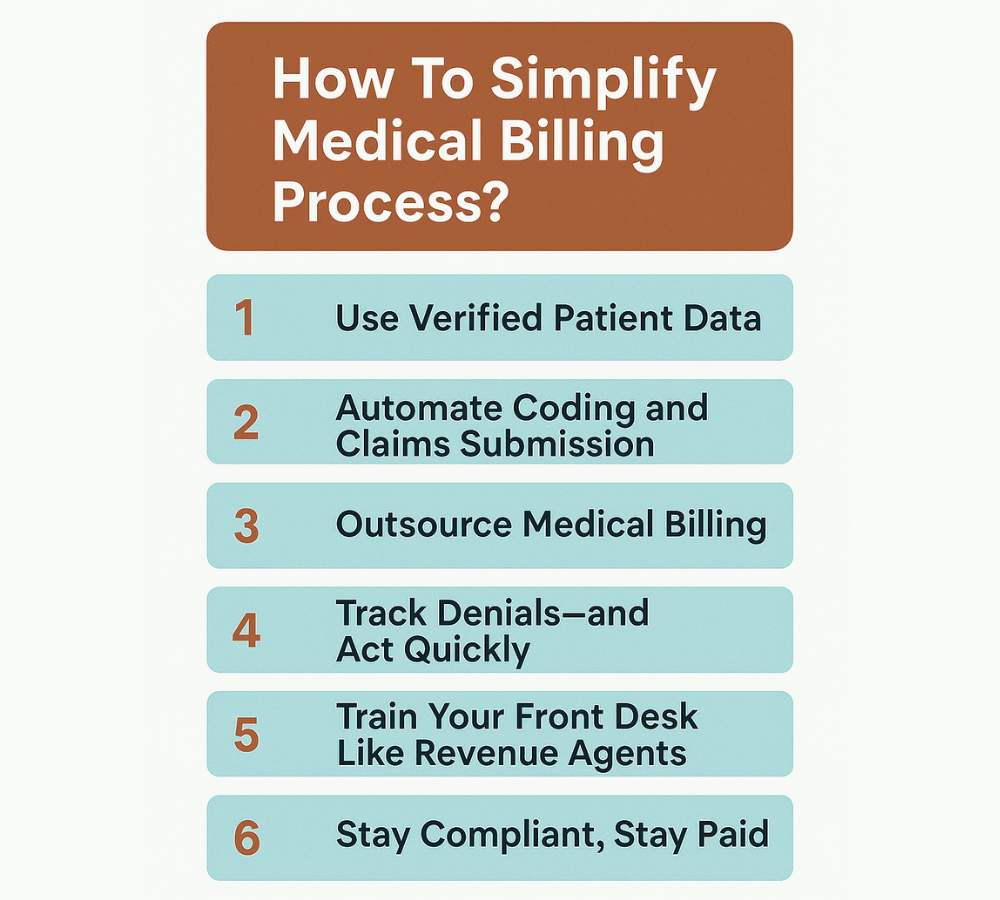
👉 How To Simplify Medical Billing Process?
In light of the complications involved in the billing process, healthcare providers must resort to adopting strategic options to simplify Medical Billing. Here are some of the effective ways to streamline your billing practices.
👉 Outsource Medical Billing Services in the USA
One of the most viable options to simplify the process is to outsource Medical Billing services to a reliable Medical Billing company. Companies with years of extensive industry experience have specialties in handling claims, compliance, and coding, allowing providers to focus on patient care. By outsourcing, you can improve your cash flow, reduce errors, and ensure timely reimbursements.
👉 Use the Latest Billing Software
Investing in technology and intelligently deploying the best software and talent can automate several aspects of the Medical Billing process, improving efficiency and reducing manual errors. Important features such as real-time eligibility verification, automated claim submission, and built-in coding assistance can significantly speed up reimbursements, and enhance accuracy.
Proper Staff Training
As I mentioned earlier, Medical Billing is an ever-evolving process, and staff should receive regular training sessions on medical coding updates, compliance regulations, and insurance policies. Continuous sessions help them stay informed about industry changes and reduce claim denials due to errors.
👉 Patient Insurance Verification Before Appointment
One of the major reasons for claim denials is outdated or incorrect patient insurance information. In this regard, your first priority should be to verify patient eligibility before appointments, ensuring that all claims are submitted with correct details, and reducing payment delays and rejections.
👉 Robust Denial Management System
Since claim denials are an inevitable part of the billing, having a robust denial management strategy is essential. Providers should prioritize analyzing denial patterns, correct recurrent issues, and promptly resubmit claims. Outsourced Medical Billing services in the USA managed by a team of competent professionals can help identify the root causes of denials and implement corrective measures.
👉 Ensure Documentation Accuracy
Proper documentation of the patient’s details is essential for successful claims processing. Patient records, procedure notes, and treatment details need to be complete and accurate to avoid coding errors, ensuring claims contain the necessary information required for approval.
👉 Outsourcing vs. In-House Medical Billing: Which One Pays Off?
When we talk about managing Medical Billing, healthcare practices face a big decision like keeping it in-house or outsourcing to experts. At first glance, handling billing internally might seem simpler, but dig a little deeper and the differences are eye-opening. Outsourcing often means faster collections, fewer errors, and lower overhead — while in-house billing offers direct control but comes with hidden costs and constant staffing challenges. Let’s break down the major differences that could impact your bottom line.
👉 Cost Comparison: Hidden Fees vs. Predictable Pricing
In-house billing might seem cheaper upfront, but hidden costs like salaries, benefits, training, and software upgrades can quickly add up. Outsourcing, on the other hand, typically offers predictable pricing — often a flat percentage of collections — making it easier to budget without surprise expenses.
👉 Staffing and Expertise: Growing Pains vs. Seasoned Professionals
Managing an in-house billing team means constant hiring, training, and handling turnover. Outsourcing connects you to teams of seasoned billing experts who live and breathe Medical Billing, keeping your collections high and your stress low.
Technology Access: Manual Methods vs. Smart Automation
In-house teams often rely on outdated or piecemeal billing systems. Outsourced billing companies invest in the latest smart automation tools, offering real-time tracking, faster claims processing, and fewer human errors — all without you having to lift a finger.
👉 Avoid Costly Mistakes: Why In-House Billing Can Be Risky
One of the major reasons for claim denials is outdated or incorrect patient insurance information. In this regard, your first priority should be to verify patient eligibility before appointments, ensuring that all claims are submitted with correct details, and reducing payment delays and rejections.
👉 Robust Denial Management System
Since claim denials are an inevitable part of the billing, having a robust denial management strategy is essential. Providers should prioritize analyzing denial patterns, correct recurrent issues, and promptly resubmit claims. Outsourced Medical Billing services in the USA managed by a team of competent professionals can help identify the root causes of denials and implement corrective measures.
👉 Ensure Documentation Accuracy
Trying to keep up with HIPAA rules, payer changes, and coding updates on your own? Managing billing internally might seem efficient—but it can quickly lead to errors, delays, and compliance headaches. Outsourcing means experts handle the complexity for you, so you stay focused on care, not codes.
👉 Why Outsource Medical Billing?
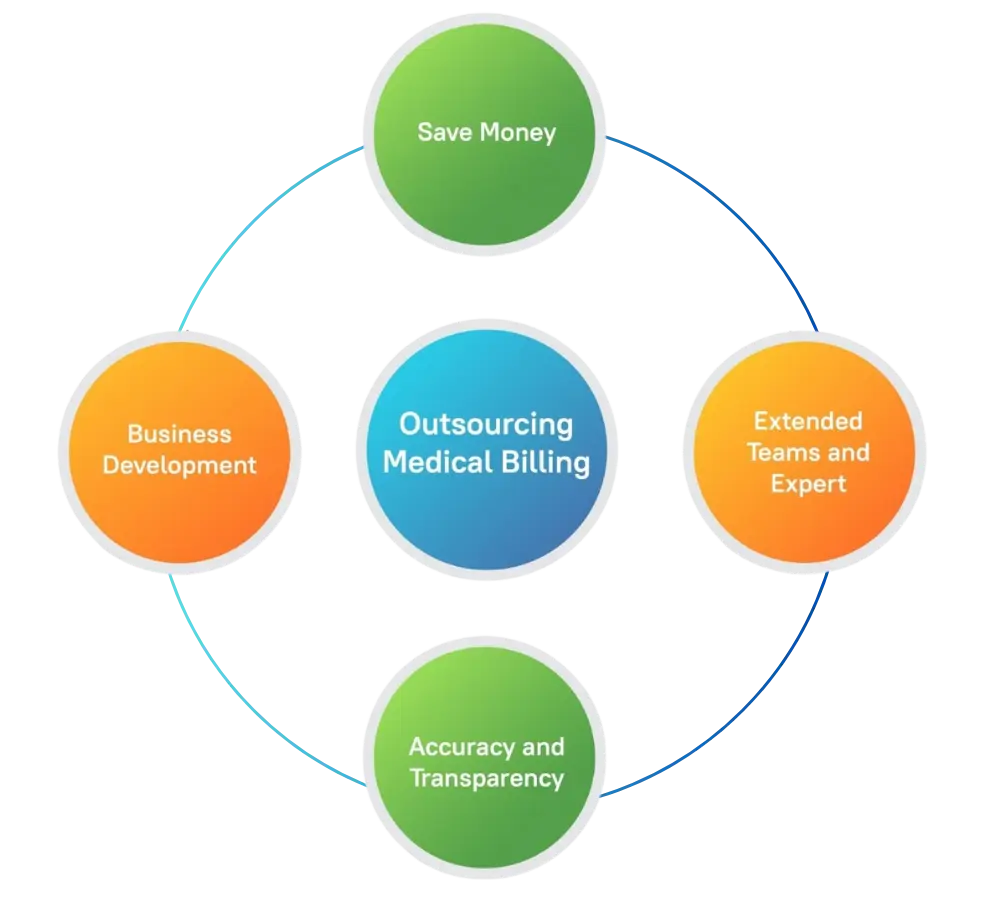
With rising administrative demands and shrinking reimbursements, healthcare providers are under pressure to do more with less. Outsourcing Medical Billing helps offload time-consuming tasks, improve claim turnaround, and reduce internal errors. It allows practices to scale without increasing staffing costs, giving them a strategic edge in today’s competitive healthcare environment.
👉 Benefits of Outsourcing Medical Billing
From lowering overhead to accelerating cash flow, the benefits of outsourcing Medical Billing are both immediate and long-term. Practices gain access to expert coders, up-to-date compliance knowledge, and high-performance technology—without the expense of maintaining an in-house billing department. Most importantly, it leads to higher accuracy and faster payments.
👉 Financial Impact: Cost Savings and Revenue Growth
Outsourcing can reduce billing-related costs by up to 30% and increase overall revenue by minimizing claim denials and improving first-pass resolution rates. With transparent reporting and optimized workflows, practices see fewer delays and more predictable income. This shift transforms billing from a cost center into a growth driver.
👉 Focus on What Matters: Patient Care
By eliminating administrative bottlenecks, providers and staff can redirect their attention to what matters most—quality patient care. Outsourcing frees up time spent on phone calls with insurers or chasing unpaid claims. This means better patient experiences, improved satisfaction scores, and more meaningful face-to-face care.
👉 Outsource Laboratory Medical Billing: A Niche Advantage
Lab billing comes with its own set of complexities, including test-specific coding, payer-specific rules, and frequent audits. Partnering with a lab-focused billing service ensures accuracy, regulatory compliance, and timely reimbursement. For diagnostic and reference labs, outsourcing can improve margins and reduce billing cycle errors dramatically.
👉 Compliance and Risk Reduction
Medical Billing errors can lead to costly audits, claim rejections, or even legal penalties. Outsourced billing partners stay current with HIPAA, ICD-10, and CPT updates to ensure your practice remains fully compliant. They implement quality checks and real-time reporting, reducing risk and increasing peace of mind.
👉 Technology Without Investment
Advanced billing software and analytics tools are essential for efficient revenue cycle management—but they’re also expensive to implement in-house. When you outsource, you instantly gain access to cutting-edge systems, automated workflows, and AI-enhanced error detection, all included with the service—no extra investment required.
The Medical Billing Outsourcing Market: A Growing Trend
💡According to market research, the global Medical Billing outsourcing market is expected to grow from $18.20 billion in 2025 to nearly $40 billion by 2032. This growth reflects a broad industry shift toward efficiency, specialization, and scalability. Practices that outsource today are positioning themselves for long-term success tomorrow.
👉 Is outsourcing Medical Billing right for your practice?
This is a puzzling question for many healthcare providers. I would suggest that the best answer to this question is to let providers decide what suits best for their needs. But based on my experience in this industry, I would suggest that by outsourcing your Medical Billing Services to a reliable billing company, you get amazing results. It saves a great deal of your time and resources. Medical Billing Companies have high infrastructure facilities, professionally competent staff, and the latest advanced technologies that give you leverage to get efficient billing services without making a huge investment. In this way, you can focus on delivering exceptional healthcare services to your patients. In this regard, Pro Medical Billing Solutions is one of the best Medical Billing Companies in the U.S. It is known for its reliability, excellent results, and highly cooperative and approachable staff.
Frequently Asked Questions
What are the main benefits of outsourcing Medical Billing?
The benefits of outsourcing Medical Billing include reduced claim denials, faster reimbursements, and up to 30% cost savings—empowering your practice to thrive.
Why should we outsource Medical Billing instead of handling it in-house?
Outsource Medical Billing to streamline operations, eliminate administrative overload, and gain access to certified billing experts without overhead costs.
Is Medical Billing outsourcing suitable for specialized services like labs?
Yes—many practices outsource laboratory Medical Billing to ensure accurate coding, quicker payments, and strict compliance with evolving lab regulations.
How does the Medical Billing outsourcing market benefit providers?
The booming Medical Billing outsourcing market offers innovative tech, data transparency, and scalable solutions that elevate practice performance.
Can outsourcing improve revenue cycle management?
Outsourcing Medical Billing brings sharper revenue cycle management with fewer errors, faster collections, and better financial forecasting.
Is outsourcing risky for small or growing practices?
Not at all—outsourcing levels the playing field by offering small practices access to enterprise-grade billing efficiency at a fraction of the cost.
Outsourcing to Pro Medical Billing Solutions means fewer billing errors, faster payments, and more time for patient care as our expert team handles coding, claim follow-ups, and reporting seamlessly—making it not just outsourcing, but a smarter way to grow your practice.