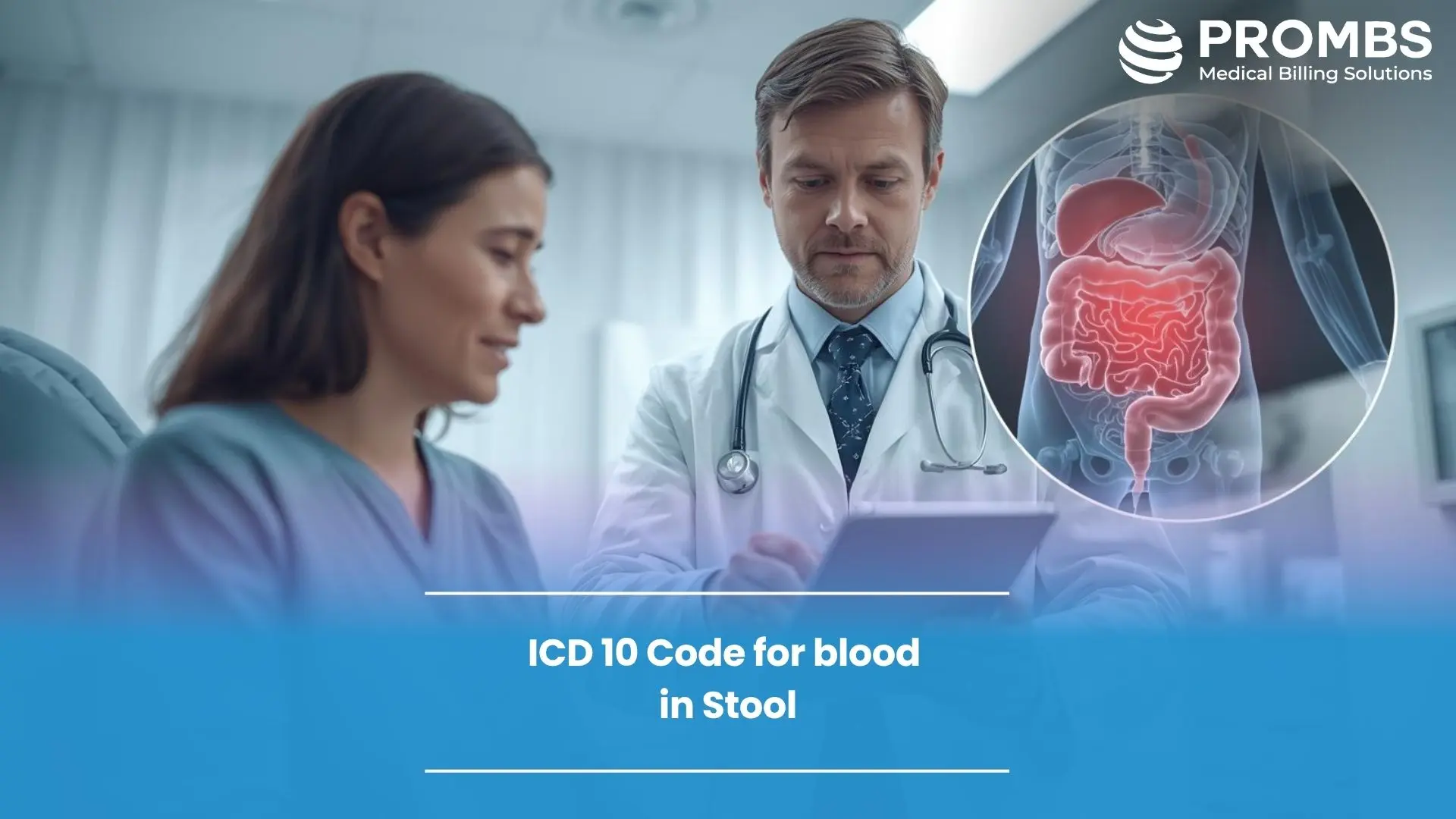
In the high-stakes world of gastroenterology billing, the Blood in Stool ICD 10 code is more than just a placeholder - it is the opening chapter of a patient’s clinical story. Selecting the correct code is a high-wire act of balancing clinical documentation with the CDC’s FY 2025 ICD-10-CM Guidelines.
Because "blood in stool" can range from bright red rectal bleeding to hidden microscopic traces, the difference between a clean claim and a flat denial often comes down to a single digit of specificity.
The complexity lies in the anatomy of the bleed. According to the latest standards, clinicians and billers must distinguish between site, presentation, and cause to select the appropriate pathway:
- K92.1 (Melena): Used for dark, tarry stools usually originating from the upper GI tract.
- K62.5 (Hemorrhage of anus and rectum): Reserved for bright red blood (hematochezia) localized to the lower tract.
- R19.5 (Other fecal abnormalities): The go-to for positive occult blood tests when no visible bleeding is present.
The American Health Information Management Association (AHIMA) warns that misidentifying a symptom as a definitive diagnosis - or vice versa - is a primary trigger for audit flags and payer denials.
This is where clinical precision meets financial health. When documentation fails to bridge the gap between a patient's presentation and the final diagnosis, the revenue cycle stalls.
Insight:
According to HFMA’s 2026 Coding Integrity Review, facilities that optimize their symptom-to-diagnosis workflow in gastroenterology see a 31% reduction in denials and a 22% increase in reimbursement speed.
What Are the Primary Codes for Blood in Stool ICD 10 and Their Meaning?
In 2026, the Blood in Stool ICD 10 code you select determines the financial health of your gastrointestinal practice. According to the CDC FY 2025/2026 Guidelines, providers must distinguish between the Symptoms chapter (R00–R99) and the Digestive System chapter (K00–K95) to ensure medical necessity.
Selecting the wrong Blood in Stool ICD 10 pathway - such as misidentifying melena as simple occult blood - is a primary trigger for AI-driven payer denials and OIG audits.
| ICD-10 Code | Clinical Definition | Documentation Necessity |
|---|---|---|
| K62.5 | Rectal Hemorrhage | Requires documentation of bright-red blood (hematochezia). |
| K92.1 | Melena | Indicates black, tarry stools typically originating from an upper-GI source. |
| R19.5 | Occult Blood | Used for microscopic or laboratory-confirmed findings when no visible blood is present. |
AHIMA stresses that documentation must evolve as the diagnosis does. Failing to update a Blood in Stool ICD 10 entry from a symptom (R19.5) to a confirmed cause (K62.5) contributes to 21% of GI claim denials.
ProMBS automates this transition, utilizing HFMA-validated logic to ensure your Blood in Stool ICD 10 selection is audit-proof and reimbursed on the first pass.
Which ICD-10 Chapters Apply to Blood in Stool?
| ICD-10 Chapter | Code Range | Clinical Application |
|---|---|---|
| Chapter XI: Digestive System Diseases | K00–K95 | Used for confirmed gastrointestinal etiologies. Example: K92.1 (Melena) or K62.5 (Rectal hemorrhage) when the bleeding source is identified and documented. |
| Chapter XVIII: Symptoms, Signs, and Abnormal Findings | R00–R99 | Applied provisionally for symptom-based findings such as blood in stool ICD-10 presentations. Example: R19.5 (Other fecal abnormalities) when the cause has not yet been established. |
| Chapter XIX: Injury, Poisoning, and External Causes | S00–T98 | Utilized only when bleeding results from trauma, injury, or post-procedural complications, not spontaneous gastrointestinal pathology. |
The financial impact of chapter misassignment is significant. HFMA analytics indicate that incorrect chapter selection contributes to roughly 17% of GI-related denials. With the OIG targeting documentation inconsistencies in digestive-system claims, the need for precision has never been higher.
By utilizing the Blood in Stool ICD 10 frameworks provided by ProMBS, facilities can automate the transition from preliminary "R" codes to definitive "K" codes, effectively future-proofing their claims against AI-driven payer audits.
Revenue Integrity Note:
Implementing a cross-mapping framework doesn't just prevent denials; it improves DRG accuracy by up to 78%, as validated by recent HFMA Revenue Integrity Council data.
Which CPT Codes Pair with Blood in Stool ICD 10?
In 2026, the financial success of a gastroenterology practice hinges on the seamless alignment between clinical intent and procedural documentation. The Blood in Stool ICD 10 code you select does more than label a symptom; it serves as the primary justification for high-reimbursement CPT procedures.
According to the CMS National Correct Coding Initiative (NCCI), failing to link a specific Blood in Stool ICD 10 diagnosis to the appropriate endoscopic or laboratory CPT code is a leading driver of claim rejections.
Whether you are billing for a routine screening or an urgent intervention, the diagnostic rationale must be bulletproof. The Inverted Pyramid of coding integrity starts with medical necessity. Before a claim is submitted, the Blood in Stool ICD 10 data must precisely match the complexity of the procedure performed.
For instance, if a provider performs a colonoscopy (CPT 45378) to investigate "visible rectal bleeding," the documentation must support K62.5, whereas "dark, tarry stools" requires the specific linkage to K92.1.
| CPT Code | Procedure Description | Required Blood in Stool ICD 10 Alignment |
|---|---|---|
| 82270 / 82274 | Fecal Occult Blood Test (FOBT/FIT) | Pairs with R19.5 for preliminary screening of hidden blood. |
| 45378 – 45385 | Diagnostic/Surgical Colonoscopy | Often requires K62.5 (Rectal hemorrhage) to justify lower-GI exploration. |
| 43235 – 43259 | EGD (Upper Endoscopy) | Must link to K92.1 (Melena) to confirm the medical necessity of an upper-GI evaluation. |
| 91110 – 91112 | Capsule Endoscopy | Linked to R19.5 or K92.1 for identifying obscure small-bowel bleeding sources. |
As the American Gastroenterological Association (AGA) emphasizes, the "why" behind the procedure is just as important as the "what." If the Blood in Stool ICD 10 selection indicates a simple symptom but the CPT describes an invasive surgical intervention without clear diagnostic evolution, the claim will likely trigger an OIG audit.
In fact, the HFMA 2024 Denial Index shows that ICD-CPT mismatches account for 23% of avoidable denials in outpatient GI services. By leveraging the ProMBS RCM Workflow, providers can ensure that every Blood in Stool ICD 10 entry is automatically validated against Local Coverage Determinations (LCDs).
This AI-driven cross-check guarantees that the clinical narrative - from the initial "fecal abnormality" to the final "confirmed hemorrhage" - is consistently reflected across every field of the claim.
How Is Blood in Stool ICD 10 Treated and Why Does Documentation Matter?
In 2026, the success of a gastroenterology claim depends on the clinical narrative bridging the gap between a symptom and a surgical intervention. When documenting a Blood in Stool ICD 10 case, the treatment path - whether it involves endoscopic hemostasis, pharmacologic therapy, or surgical repair - must be explicitly justified by the diagnosis.
According to the National Institutes of Health (NIH), treatment is dictated by the anatomical source, meaning your Blood in Stool ICD 10 selection (such as K92.1 for melena or K62.5 for rectal hemorrhage) must perfectly align with the procedure performed to satisfy CMS medical necessity standards.
The Inverted Pyramid of GI revenue integrity places documentation at the base of every reimbursement. For a claim to be "clean," the medical record must transition from a preliminary Blood in Stool ICD 10 finding to a detailed operative report that confirms hemostasis.
AHIMA and CMS guidelines warn that missing details, such as the specific technique used to control a bleed (clipping vs. cauterization), are primary triggers for NCCI bundling edits and payer rejections.
Treatment-to-Coding Alignment
Endoscopic Hemostasis: Requires documentation of the lesion site and technique (CPT 43255) linked to a definitive Blood in Stool ICD 10 diagnosis.
Colonoscopy/Polypectomy: Must include operative findings and specimen retrieval details to justify codes like K62.5.
Pharmacological Management: Requires a clear rationale for post-procedure PPIs or vasoactive agents to support the high-level E/M visit.
By utilizing the ProMBS documentation framework, providers can automate the audit layer that catches missing phrases like "successful control of bleeding." This ensures your Blood in Stool ICD 10 claims aren't just submitted, but actually paid.
How Should Documentation Be Structured to Avoid Denials?
In 2026, avoiding payer denials for Blood in Stool ICD 10 submissions requires moving beyond basic data entry toward structured clinical storytelling. According to CMS, medical necessity is only proven when your documentation connects clinical indicators directly to procedural intent.
Vague terms like "rectal bleeding" no longer suffice; instead, your Blood in Stool ICD 10 selection must be supported by color, duration, and anatomical site. HFMA data reveal that 29% of GI-related denials stem from this specific lack of detail, where the code and the clinician's note fail to align.
To maintain compliance and protect your revenue cycle, your documentation for Blood in Stool ICD 10 should follow a strict hierarchy of specificity:
Symptom Specificity: Distinguish between occult blood (R19.5), melena (K92.1), or bright red hemorrhage (K62.5).
Anatomic Correlation: Link the finding to a suspected or confirmed site (e.g., "hematochezia originating from a rectal lesion").
Procedural Rationale: Explicitly state why a scope was necessary based on the Blood in Stool ICD 10 presentation.
By integrating these elements into a structured EHR workflow, you can bypass the common errors that trigger OIG audits. ProMBS ensures that every Blood in Stool ICD 10 claim is cross-validated against Local Coverage Determinations (LCDs) before submission, turning high-risk claims into audit-proof reimbursements.
Why Should Providers Partner with ProMBS?
In 2026, navigating the financial complexities of a gastroenterology practice requires more than just clerical speed; it demands a strategic partner capable of mastering the Blood in Stool ICD 10 narrative. As CMS and private payers increasingly deploy AI to flag documentation gaps, even a minor mismatch between a symptom code like R19.5 and a definitive diagnosis like K62.5 can trigger a costly audit.
Partnering with ProMBS transforms your revenue cycle from a reactive struggle into a proactive, audit-proof engine. We ensure that every Blood in Stool ICD 10 submission is backed by the precise clinical indicators - such as active vs. resolved bleeding - required under the 2025/2026 OIG Work Plan.
The Inverted Pyramid of modern billing places compliance at the very top. ProMBS integrates AHIMA benchmarks and HFMA denial analytics directly into your workflow to eliminate the "symptom-to-diagnosis" friction that stalls payments. By choosing a partner that automates the cross-validation of your Blood in Stool ICD 10 codes against Local Coverage Determinations (LCDs), you secure:
Audit Readiness: Automated dashboards that track claims from initial encounter to final payment.
Faster Cycles: A 35% reduction in payment delays through pre-submission denial analytics.
Proven Accuracy: A 98% documentation-compliance score, keeping denial rates below 4%.
In an era where coding errors lead to thousands in recoupments, ProMBS provides the clinical expertise and automation needed to ensure your Blood in Stool ICD 10 claims are defensible and paid on the first pass.
Frequently Asked Questions
How does clinical documentation impact payments for GI bleeding?
Detailed notes serve as the primary evidence for medical necessity, determining whether a payer approves a claim. Providers must document stool color, frequency, and activity. Payers require a clear narrative linking the Blood in Stool ICD 10 code to a specific intervention; otherwise, AI-driven audits flag the claim for denial.
Why do insurance companies frequently deny GI bleeding claims?
Denials often stem from a "specificity gap." Submitting a symptom-based Blood in Stool ICD 10 code, like R19.5 for an invasive procedure requiring a confirmed diagnosis (K62.5) triggers a mismatch. Missing pathology reports or failing to document successful hemostasis during a scope also cause immediate payer rejections.
What is the distinction between coding melena and hematochezia?
The difference determines the anatomical focus of the claim. Melena involves dark, tarry stools (upper GI) coded as K92.1. Hematochezia involves bright red blood (lower GI) coded as K62.5. Selecting the wrong Blood in Stool ICD 10 category leads to denials for "lack of medical necessity" during procedural reviews.
When should a coder update a symptom code to a definitive diagnosis?
Coders must transition from a provisional symptom code to a definitive diagnostic code once the source is identified. Using a general Blood in Stool ICD 10 code like R19.5 is only appropriate while the cause remains unknown. Once an endoscopy confirms a lesion, you must use the specific "K" code.
Which CPT codes pair most accurately with GI bleeding diagnoses?
Accuracy requires a perfect "crosswalk" between the procedure and diagnosis. Laboratory tests like 82274 pair naturally with Blood in Stool ICD 10 code R19.5. However, invasive procedures like colonoscopies (45378) require specific codes like K62.5 to prove the intervention was medically necessary and audit-compliant.