Last Updated: January 29, 2026
Looking for the official clinical criteria for R63.4 ICD 10?
This guide focuses on how to document R63.4 ICD 10 correctly. For ICD 10 definitions, clinical thresholds, and when the code applies, review our R63.4 ICD 10 clinical overview.
Why Weight Loss Coding Matters in 2026
Weight loss is a clinical finding that can indicate a wide range of underlying medical conditions, from metabolic disorders to chronic diseases and even psychosocial factors.
In medical billing and coding, accurate use of the ICD 10 code for weight loss is critical for ensuring clean claim submission, compliance with payer rules, and avoiding unnecessary denials.
In 2026, payers have heightened scrutiny over nonspecific codes, making it more important than ever to apply correct documentation standards when reporting weight loss.
What is Weight Loss in Clinical Terms?
Clinically, weight loss is defined as a reduction in body mass that is either intentional (diet, exercise, medical treatment) or unintentional (disease-related).
Unintentional weight loss is especially important in coding and billing because it often signals an underlying pathology.
Symptoms Commonly Associated with Weight Loss
- Unexplained drop in body mass
- Fatigue and weakness
- Nutritional deficiencies
- Secondary symptoms based on underlying cause (e.g., malabsorption, thyroid disorders, malignancy)
Proper documentation of these symptoms allows coders to determine if ICD 10 code for weight loss (R63.4 ICD 10) is appropriate or if a more specific code should be used.
When documenting weight loss, providers should consider whether a more specific diagnosis applies. Conditions such as cachexia (R64) or malnutrition (E43) may better reflect the clinical picture once the cause is identified.
A full comparison of weight loss–related ICD 10 codes and when to transition away from R63.4 ICD 10 is covered in our R63.4 ICD 10 Clinical Criteria guide.
Why Claims with ICD 10 Code for Weight Loss Get Denied
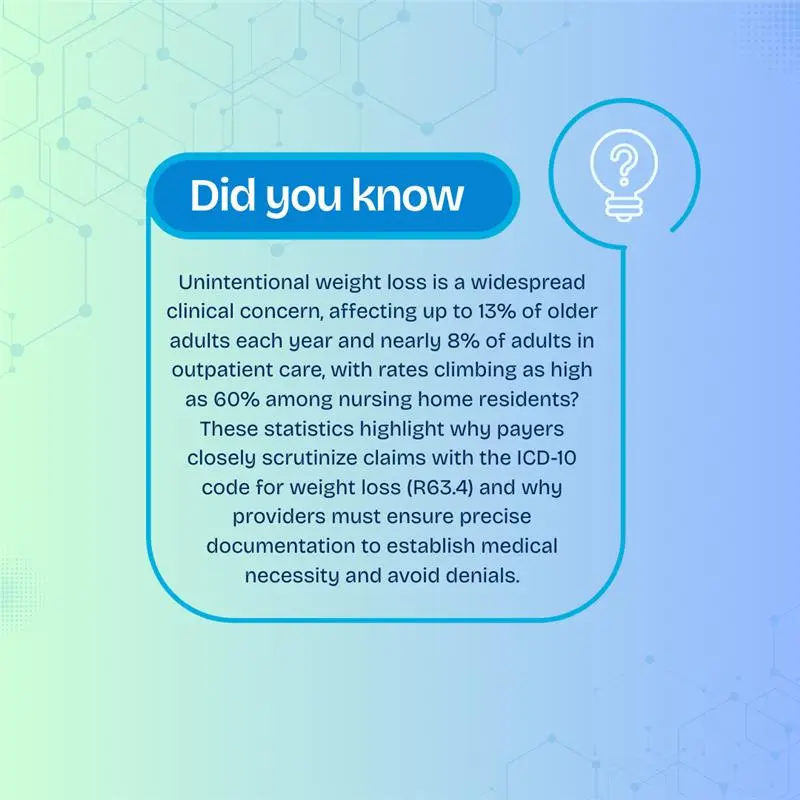
Despite being a billable diagnosis, the ICD 10 code for weight loss (R63.4 ICD 10) is a frequent trigger for denials. Payers view weight loss as a symptom code, which means it often requires stronger documentation and linkage with underlying conditions to prove medical necessity.
Below are the most common denial scenarios explained in depth:
1. Nonspecific Documentation
If a provider simply writes “weight loss” in the encounter note without describing duration, severity, or clinical suspicion, payers consider the documentation inadequate. For example:
Incorrect: “Patient presents with weight loss.”
Correct: “Patient lost 12 lbs over the past 2 months without changes in diet or exercise. Associated fatigue and anorexia noted.”
Without quantitative detail (amount of weight lost, time period) and qualitative context (associated symptoms), payers often deny claims for lack of specificity.
2. No Supporting Clinical Evidence
R63.4 ICD 10 is expected to be supported by measurable data. Denials occur when claims lack documentation, such as:
- BMI values and trends
- Nutritional or dietitian assessments
- Lab results (CBC, thyroid panel, metabolic panel)
- Imaging or referrals (CT, oncology workup, GI referral)
Payers expect that unexplained weight loss is investigated. If no supporting evidence exists in the record, the claim risks denial for medical necessity not met.
3. Linked to Intentional Weight Loss
One of the most frequent denial reasons is misuse of R63.4 ICD 10 for patients who are intentionally losing weight. For example:
- Post–bariatric surgery follow-up
- Documented dietary programs for obesity
- Lifestyle-driven weight reduction efforts
In such cases, payers deny claims because R63.4 ICD 10 is reserved for abnormal or unintentional weight loss, not planned interventions. Providers must code obesity (E66.9) or other relevant diagnoses instead.
Billing denials, audits, and payer review behavior related to R63.4 ICD 10 are explained in detail in our Weight Loss ICD 10 Billing Rules guide. This page focuses only on definition, appropriate use, and documentation basics.
Documentation Requirements for R63.4 (ICD 10 Code for Weight Loss)
1. Specify “Unintentional” or “Abnormal”
Providers must clearly state whether the weight loss is unintentional, unexplained, or abnormal, since payers differentiate between medically significant weight changes and intentional ones.
R63.4 ICD 10 should never be used for cases where weight reduction is due to diet, exercise, or bariatric surgery, as that falls under separate Z-codes or obesity-related codes. Without this clarification, claims are at high risk of rejection.
2. Document Duration and Degree
The extent and timeframe of weight loss must be quantified in the record, for example: “patient lost 15 lbs (10% of body weight) over the last 6 months.”
This level of detail helps establish the abnormality as clinically relevant and supports medical necessity when billing.
Vague statements like “weight loss present” are insufficient and lead to denials, especially when payers require measurable benchmarks.
3. Capture Associated Symptoms
Unintentional weight loss often occurs with other clinical signs such as fatigue, loss of appetite, malabsorption, or systemic illness.
Linking R63.4 ICD 10 with related symptoms provides a clearer clinical picture for auditors and payers, strengthening the claim.
Omitting such details may make the condition look isolated or non-medically significant, reducing the likelihood of reimbursement.
4. Note Differential Diagnoses
Since unexplained weight loss is usually a symptom of an underlying condition (e.g., cancer, hyperthyroidism, depression, malnutrition), documentation should reflect that providers are considering or ruling out potential causes.
Listing suspected diagnoses alongside R63.4 ICD 10 demonstrates clinical judgment, helps coders select correct secondary codes, and prevents payers from flagging the claim as incomplete.
5. Provide BMI or Anthropometric Data
Objective measures like BMI trends, body fat percentage, or serial weight records should be included whenever possible. These serve as quantifiable evidence to support that the loss is clinically significant rather than subjective.
For example, noting a drop from BMI 24 to 20 within a year adds weight (literally) to the claim, making it harder for payers to dispute.
6. Clarify Intentional Weight Loss
If weight reduction is due to lifestyle changes, medical diets, or surgical interventions, this must be documented and coded differently (using obesity or Z-codes).
Using R63.4 ICD 10 in these cases misrepresents the clinical scenario and almost always results in denials. Providers should clearly distinguish between therapeutic weight reduction and pathological loss to guide coders correctly.
7. Coder Review of Clinical Records
Coders should carefully review progress notes, nutrition consults, and lab reports before assigning R63.4 ICD 10. This ensures that documentation supports the abnormality, avoids miscoding, and complies with payer guidelines.
Coders should also confirm that linked CPT/HCPCS services (such as nutrition therapy or lab testing) align with the diagnosis to prevent mismatch-based denials.
How to Read Key Sections in Payer EOBs for Weight Loss Claims
When providers bill with ICD 10 code R63.4 ICD 10 (Abnormal Weight Loss), the Explanation of Benefits (EOB) becomes the first checkpoint for understanding payment outcomes.
The allowed amount shows what the payer considers reimbursable, while adjustments reveal reductions tied to policy rules or contractual agreements.
Beyond payment numbers, the most important part is the remark codes. Payers often flag issues like “diagnosis not specific enough,” “documentation does not support medical necessity,” or “service not covered for this diagnosis.” These codes explain why a claim was reduced or denied.
Coders and billers should cross-check billed charges, allowed amounts, and remark codes line by line. This step helps identify if the denial stems from missing documentation, coding misuse, or payer-specific policy exclusions, allowing the team to correct the claim or prepare a strong appeal.
PRO-MBS: How We Help Providers Bill Weight Loss Codes Accurately
Our Pro-MBS specializes in navigating coding challenges for symptom-based claims like R63.4 ICD 10 (ICD 10 code for weight loss). Our expert billers and coders ensure:
- Precise Coding: Correct use of R63.4 ICD 10, R64, and related codes to reflect true clinical findings.
- Audit-Proof Documentation: Guidance for providers on how to document duration, severity, and underlying conditions.
- Denial Management: Proactive appeal strategies when payers deny weight loss claims.
- Revenue Cycle Optimization: Seamless integration of symptom-based coding into broader RCM workflows.
Partner with Pro-MBS to reduce denials and maximize reimbursement for weight loss-related encounters.
Related Resources: