
Dermatology billing is the specialized medical coding process of translating skin-related procedures, such as biopsies, excisions, and Mohs surgery, into standardized CPT and ICD-10 codes for insurance reimbursement. Due to the high-volume nature of the specialty, it requires strict documentation of lesion size, anatomical location, and pathological type.
Key Requirements for Successful Dermatology Billing:
- Documentation Precision: Accurate recording of pre-anesthesia lesion diameter plus clinical margins is mandatory for excision reimbursement.
- Medical Necessity: Clear differentiation between medically necessary procedures (e.g., symptomatic inflamed cysts) and non-reimbursable cosmetic services (e.g., skin tag removal).
- Modifier Accuracy: Expert application of Modifier 25 (Significant, Separately Identifiable E/M Service) and Modifier 59 (Distinct Procedural Service) to prevent automated "Bot Audit" denials.
- Surgical Bundling Rules: Mastery of Global Period requirements to ensure post-operative wound checks are not improperly unbundled.
Introduction
The dermatology landscape in 2026 is a paradox of high-tech progress and high-stakes financial risk. While the "One Big Beautiful Bill Act" provided a welcome 2.5% increase to the Medicare conversion factor, it arrived alongside a wave of aggressive "algorithmic audits" and a radical restructuring of how dermatology’s highest-cost supplies are reimbursed.
If you are a practice leader, the biggest threats to your revenue are no longer just simple coding errors; they are structural shifts in the dermatology billing environment. Here are the four critical risks that demand your attention this year.
The Skin Substitute "Reimbursement Cliff" & The Non-Reimbursable Waste Rule
As of January 1, 2026, CMS has fundamentally changed the payment model for cellular and tissue-based products (CTPs).
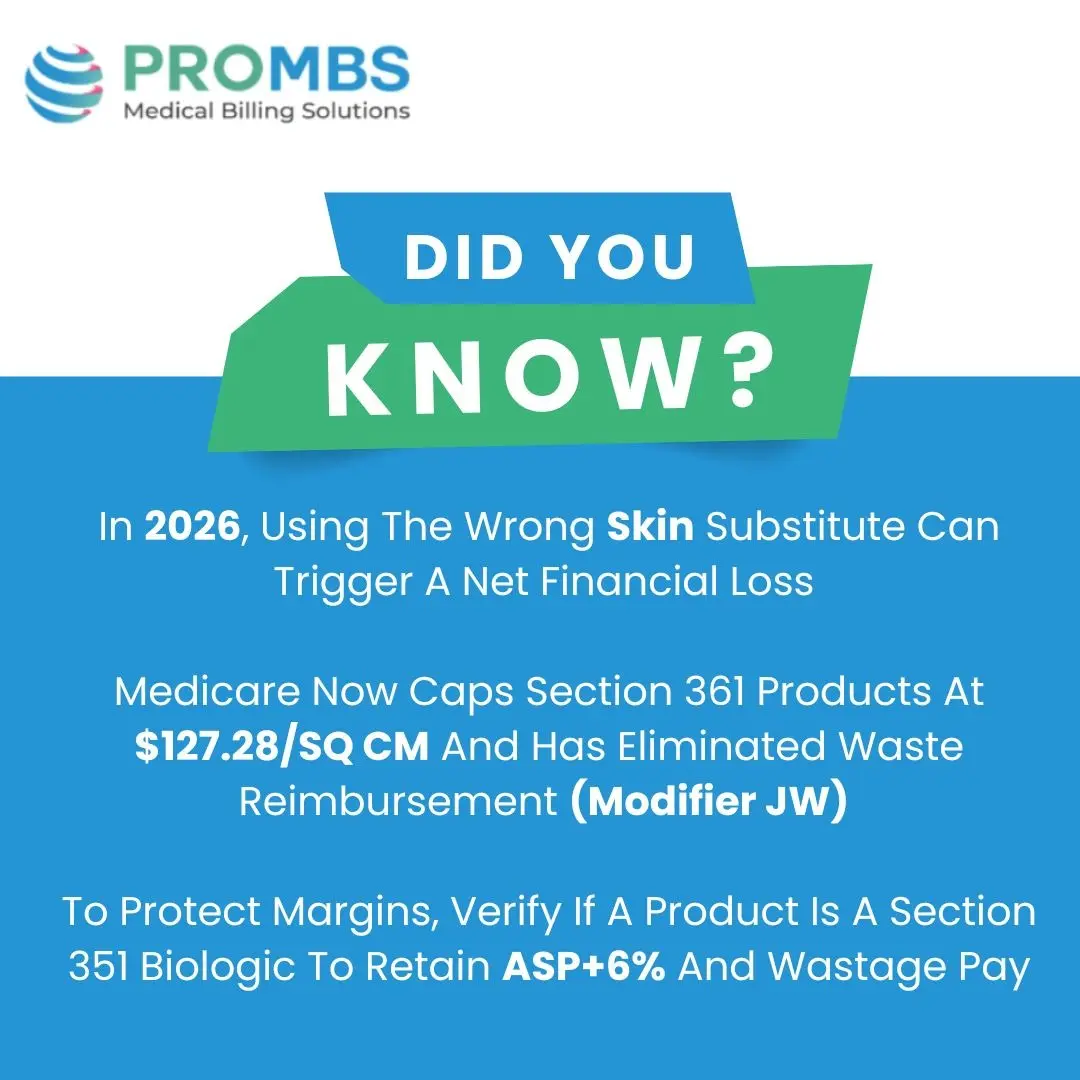
Most skin substitutes have been reclassified from high-margin biologics to "incident-to" medical supplies, a shift that has immediate implications for dermatology billing and practice profitability.
- The Flat Rate: Reimbursement is now capped at a national rate of $127.28 per sq. cm.
- The "Zero-Waste" Risk: In a major 2026 policy shift, Medicare no longer reimburses for discarded or unused portions of non-BLA skin substitutes. This means Modifier JW and JZ are no longer applicable for these supplies. You only get paid for what is actually applied to the patient.
- The Section 351 Exception: Only products licensed as biologicals under Section 351 of the PHS Act (true BLAs) retain the ASP + 6% reimbursement model and waste-reporting eligibility.
- Leader Strategy: Audit your inventory to distinguish between "361 HCT/Ps" (flat rate/no waste pay) and "351 Biologics" (ASP+6%). If your team is still billing for wastage on 361 products, you are courting an immediate audit.
Pro Tip: Implement "Documentation Defensiveness" for Ambient AI
Payer algorithms are now trained to detect verbatim phrases from AI scribes. Ensure your providers add patient-specific anatomical data points to every note to prove the encounter was "significantly separate" and avoid "cloned note" denials.
AI-Powered "Bot Audits" for Modifier 25 in Dermatology Billing
Payers have fully weaponized AI in 2026. Automated "bot audits" now scan every claim for Modifier 25 (Significant, Separately Identifiable E/M Service) by cross-referencing clinical notes for "cloned" documentation.
- The Risk: If your documentation for a biopsy doesn't clearly differentiate the Medical Decision Making (MDM) from the procedure itself, the payer's AI will auto-deny the E/M portion. Dermatology medical billing continues to see some of the highest outpatient denial rates (averaging 11.8%) due to these inconsistencies.
- The Fix: Your dermatology medical billing and coding workflow must mandate unique MDM headers for every procedural encounter.
The Telehealth "Place of Service" Trap in Dermatology Billing
Telehealth is a permanent fixture in 2026 for acne management and post-op checks, but the "Place of Service" (POS) requirements have fragmented.
- The Risk: Medicare currently accepts POS 11 (Office) with Modifier 95, but many commercial payers have reverted to requiring POS 10 (Patient’s Home) or POS 02.
- The Impact: Mislabeling the POS is currently a top-three reason for medical billing for dermatology rejections. A single clerical oversight across a high-volume week of telederm can create a massive AR backlog.
The 51% Biologic Denial Barrier
Prior authorization (PA) denial rates for complex biologics and JAK inhibitors have hit a staggering 51% this year.
- The Risk: High-cost specialty drugs are now funneled through "Step Therapy 2.0," requiring documented failure of at least three traditional therapies.
- The Strategy: Many practices are moving toward a specialized dermatology billing company that offers dedicated PA tracking. If your internal staff is spending more than 15 minutes per PA, you are losing money on labor alone.
The Global Period & Telehealth Overlap in Dermatology Billing
With telehealth now a permanent fixture in 2026, a new technical risk has emerged: Global Period Unbundling.
- The Risk: Payers are increasingly denying telehealth follow-ups (99212-99215) for post-procedure "wound checks." If the visit occurs within the 10-day or 90-day global period of an excision or Mohs surgery, it is considered part of the surgical package and is non-billable.
- The Fix: Your billing team must scrub every telederm claim against the patient’s recent procedural history to prevent "double-dipping" flags that trigger Program Integrity reviews.
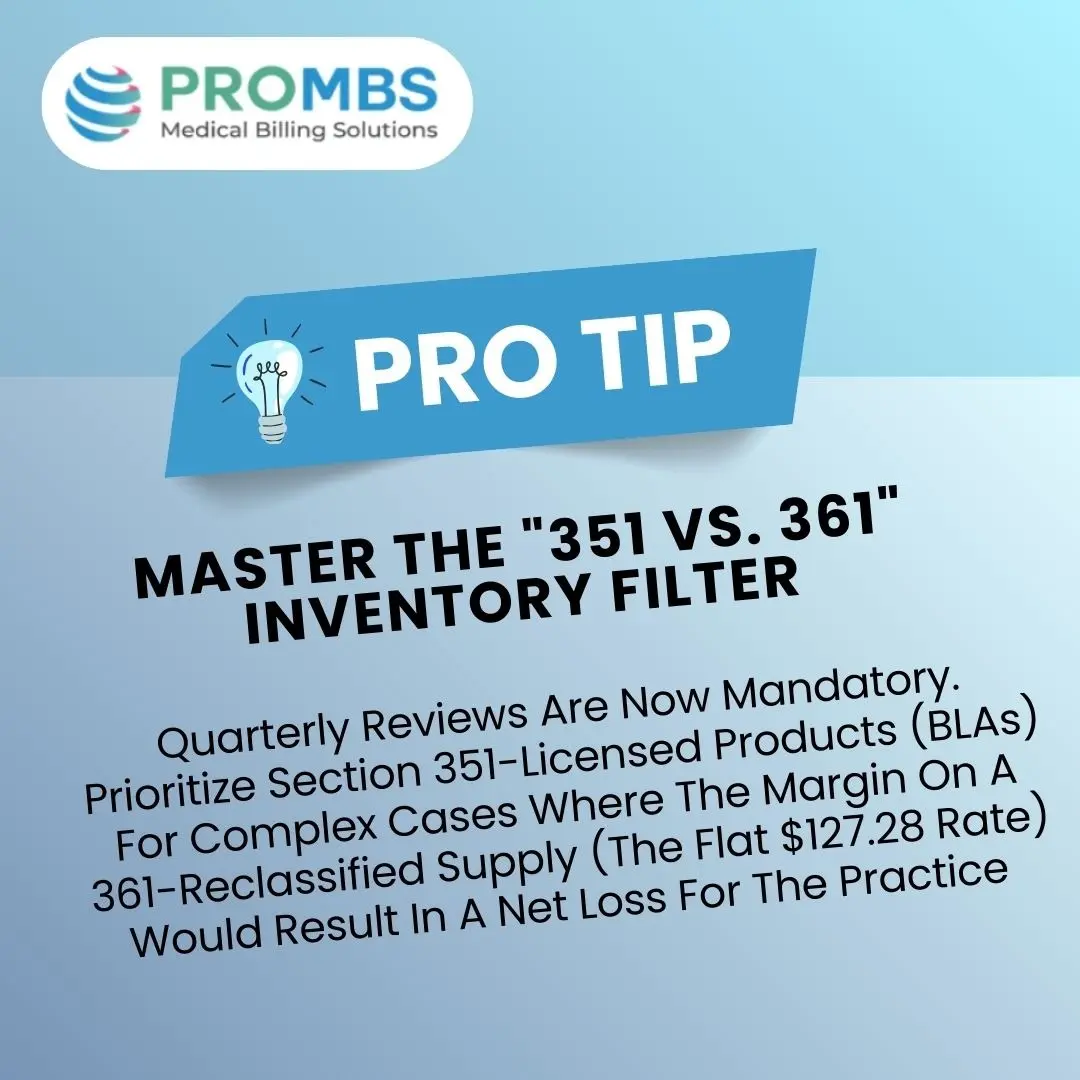
Pro Tip: Master the "351 vs. 361" Inventory Filter
Quarterly reviews are now mandatory. Prioritize Section 351-licensed products (BLAs) for complex cases where the margin on a 361-reclassified supply (the flat $127.28 rate) would result in a net loss for the practice.
2026 Performance Benchmarks for Practice Leaders
To maintain financial health, your dermatology medical billing services (whether in-house or outsourced) should hit these targets:
| KPI Metric | 2026 Ideal Benchmark | Why it Matters |
|---|---|---|
| Clean Claim Rate | 96% or higher | Prevents cash flow interruptions. |
| Days in AR | 30–40 days | Essential for high-overhead specialty drug management. |
| Denial Rate | Below 5% | High rates trigger Medicare "Program Integrity" audits. |
| Net Collection Rate | Above 95% | Measures the actual efficiency of your revenue cycle. |
Choosing the Right Dermatology Billing Partner in 2026
In 2026, a generalist medical billing dermatology firm is a liability. When vetting a dermatology medical billing company, ask three non-negotiable questions:
- "Do you have certified dermatology coders (CPCD) who understand Mohs and complex repairs?"
- "How does your system handle the 2026 quarterly skin substitute price updates?"
- "Can you provide a proactive dermatology billing cheat sheet for my clinical staff every six months?"
Pro Tip: Capture the New "Short-Term" RPM Revenue
The 2026 CPT set introduced Code 99445, allowing you to bill for remote monitoring of as little as 2–15 days. Use this for high-risk patients on new JAK inhibitors or post-op wound tracking to create a new, compliant revenue stream.
Partner with ProMBS: Your Solution to the 2026 Billing Minefield
Managing these 2026 risks requires more than just standard software; it requires a partner that lives and breathes dermatology compliance. ProMBS (Pro Medical Billing Solutions) is the industry's leading answer to these structural shifts.
By partnering with ProMBS, your practice gains:
- Dermatology-Specialized Coding: Our CPCD-certified experts understand the critical distinction between 351 and 361 skin substitutes, ensuring you never misapply the ASP+6% model.
- The 99% First-Pass Advantage: While industry denial rates climb, ProMBS maintains a 99% clean claim rate through proactive "bot-resistant" scrubbing that defeats AI-driven audits.
- Automated Waste Management: We handle the complex 2026 documentation requirements for applied vs. discarded CTP units, protecting you from overpayment recoupments.
- Advanced Denial Recovery: We don't just manage denials; we eliminate root causes like POS 10/11 mismatches and global period overlaps.
The Bottom Line:
Success in 2026 requires moving from reactive billing to predictive revenue cycle management. If your current process isn't providing granular data on denial reasons, you are likely leaving 10-15% of your revenue on the table. Don't let 2026 be the year your revenue plateaus due to outdated dermatology billing practices.
Ready to bulletproof your 2026 revenue?
Management of lumbar spondylosis is typically conservativeWe'll identify your "reimbursement cliff" risks before they impact your bottom line. , focusing on functional restoration.
Frequently Asked Questions
How does the 2026 dual conversion factor affect dermatology reimbursements?
The "One Big Beautiful Bill Act" introduced a split Medicare conversion factor for 2026. While practitioners in Advanced Alternative Payment Models (APMs) receive a higher rate ($33.59), those in traditional fee-for-service models receive $33.42. For dermatology leaders, this means a 2.5% temporary statutory increase is partially offset by a -2.5% "efficiency adjustment" on procedural codes, making high-volume surgical accuracy more critical than ever to maintain net margins.
Can I still bill for skin substitute wastage using Modifier JW in 2026?
Only for Section 351-licensed biologics (BLAs). Under the 2026 CMS "Zero-Waste" policy, most skin substitutes (Section 361 HCT/Ps) are now reimbursed as "incident-to" medical supplies at a flat rate of $127.28/sq cm. Because these are no longer classified as drugs or biologicals, Medicare has discontinued waste reimbursement for them, rendering Modifiers JW and JZ inapplicable for these specific supplies.
What is the difference between CPT 99445 and 99454 for remote monitoring?
Both codes cover the monthly supply of Remote Physiologic Monitoring (RPM) devices, but they are defined by patient engagement levels. CPT 99445 is the new 2026 "short-term" code for patients who transmit data for 2–15 days in a 30-day period. CPT 99454 remains the standard for 16 or more days of data. They are mutually exclusive; you must choose one based on the actual number of transmission days to avoid "double-billing" audit flags.
How do I prevent AI-driven "Bot Audit" denials for Modifier 25?
Payer algorithms in 2026 specifically flag "cloned documentation" where E/M notes for a procedure look identical across different patients. To defeat these bots, ensure your Medical Decision Making (MDM) section includes patient-specific anatomical data and a clear "separately identifiable" clinical rationale that proves the evaluation went beyond the standard pre-operative work inherent to the biopsy or excision.
Why are specialized CPCD-certified coders preferred over generalist billers in 2026?
Generalist billers often miss the nuanced 2026 quarterly price updates for skin substitutes and the complex "unbundling" rules for Mohs surgery. A Certified Professional Coder-Dermatology (CPCD) is trained to identify specific site-specific repair codes and global period overlaps that generalists overlook, directly preventing the high-frequency denials that trigger "Program Integrity" audits.