Last Updated: January 2026 | Reviewed by Medical Coding Experts
Dysphagia ICD 10 is one of the most common and most misunderstood diagnosis codes. Many providers document swallowing trouble without realizing how much detail coding needs.
Small wording gaps can lead to denials, delays, and lost payment. This guide explains Dysphagia ICD 10 using plain language and real examples.
You will learn what dysphagia means, why payers care, and how ICD-10 organizes codes. If you are new to coding or clinical documentation, start here.
What Is Dysphagia? (Simple Explanation)
Dysphagia means trouble swallowing food, liquid, or pills. People often say food feels stuck or goes down the wrong way.
Some patients cough, choke, or avoid eating because swallowing feels unsafe. Dysphagia is not a disease. It is a symptom that points to another problem. That problem may be neurological, muscular, or structural.
In coding, this matters a lot. Dysphagia ICD 10 captures the symptom when the provider documents it. Coders use the same codes for difficulty swallowing ICD 10.
Did You Know:
ICD-10 treats “difficulty swallowing” and dysphagia as the same problem. So when a provider writes either term, coders still use Dysphagia ICD 10 or the correct ICD 10 code for dysphagia.
Why Dysphagia Matters in Medical Coding and Billing
Dysphagia affects patient safety, but it also affects payment. Swallow studies, imaging, and therapy cost money. Payers want proof that these services are needed.
When documentation is weak, claims get denied. When coding lacks detail, audits become more likely. That is why ICD 10 dysphagia must match the record exactly.
Payers follow rules from the Centers for Medicare & Medicaid Services. They also align coding guidance with standards from the American Medical Association. Both expect clear symptoms and clear diagnosis links.
How ICD-10 Classifies Dysphagia
ICD-10 does not group all swallowing problems together. It separates dysphagia by where the problem happens. The official ICD-10-CM code set, maintained by the CDC and CMS, requires this specificity.
Some patients struggle to start swallowing. Others swallow fine but feel food stick later. ICD-10 codes reflect these differences.
Laterality and the swallowing phase matter in many cases. ICD-10 avoids vague terms on purpose. That is why ICD 10 for dysphagia requires detail.
In short, Dysphagia ICD 10 codes are used to report swallowing difficulty as a symptom. Correct code selection depends on the swallowing phase, duration, and documented cause. Payers expect specificity as care progresses.
ICD 10 Code for Dysphagia (Core Code Overview)
The main ICD 10 code for dysphagia starts with R13. This code group captures swallowing problems as a symptom, not a disease. Providers use it when patients report trouble moving food or liquid safely.
The base code works when details are missing early on. Doctors may use it during the first visit or while tests are pending. It allows care to begin without delaying coding for answers.
Long-term use of unspecified codes is risky. Payers expect updates once providers learn more about the problem. Using vague Dysphagia ICD 10 codes for too long raises concern.
ICD 10 Dysphagia Codes List
ICD-10 breaks dysphagia into types based on how swallowing works. Knowing these types helps coders choose the safest and most accurate option. Correct selection protects payment and supports proper care under Dysphagia ICD 10.
The table below shows how common patient-reported swallowing symptoms map to the correct Dysphagia ICD 10 codes based on the affected swallowing phase.
| Patient Symptom / Clinical Phrase | Anatomical Phase | Correct ICD-10 Code |
|---|---|---|
| Food gets stuck in mouth or cheeks | Oral phase | R13.11 |
| Coughing or choking immediately upon swallowing | Pharyngeal phase | R13.12 |
| Food feels stuck in the mid-chest | Esophageal phase | R13.13 |
| Problem swallowing (no location specified) | Unspecified | R13.10 |
| Difficulty swallowing after a stroke | Stroke sequela | I69.391 |
Oropharyngeal Dysphagia (R13.11)
Oropharyngeal dysphagia (R13.11) is a common Dysphagia ICD 10 subtype that specifically targets the oral phase of swallowing. Patients struggle to move food into the throat while eating. Providers may note poor tongue control or delayed swallowing. This type often appears after a stroke or other neurological injury.
Pharyngeal Dysphagia (R13.12)
Pharyngeal dysphagia (R13.12) is the primary code for airway protection issue that affects the throat during swallowing. Food may go the wrong way instead of going down.
Patients may cough or choke while eating. Correct ICD 10 for dysphagia coding supports the medical necessity of instrumental swallow studies (FEES/MBSS).
Esophageal Dysphagia (R13.13)
Esophageal dysphagia (R13.13) is a common Dysphagia ICD 10 subtype that happens after food is swallowed. It is often triggered by mechanical obstructions or motility disorders like achalasia. Food may feel stuck in the chest. Patients may need to drink water to push food down. This problem is often linked to conditions like GERD or esophageal stricture.
Pharyngoesophageal Dysphagia (R13.14)
Other and Unspecified Dysphagia (R13.10, R13.19)
Unspecified dysphagia (R13.10) applies when the phase of swallowing isn't documented. Other dysphagia (R13.19) is used for multi-stage swallowing issues. These should only be used for a short time; long-term use raises payer scrutiny.
This table shows how dysphagia location affects payer review and claim safety.
| Dysphagia Type | ICD-10 Code | Payer Reimbursement Risk |
|---|---|---|
| Oropharyngeal dysphagia | R13.11 | Low (highly specific) |
| Pharyngeal dysphagia | R13.12 | Low (highly specific) |
| Esophageal dysphagia | R13.13 | Medium (often requires linked etiology) |
| Pharyngoesophageal dysphagia | R13.14 | Low (high clinical specificity) |
| Unspecified dysphagia | R13.10 | High (increased denial and audit risk) |
Coders should always match provider notes to the correct type. Specific codes reduce denials tied to difficulty swallowing ICD 10 claims. Clear coding strengthens compliance under ICD 10 for dysphagia rules.
ICD 10 Code for Difficulty Swallowing
Providers often write “difficulty swallowing” in patient notes. ICD-10 treats this wording the same as dysphagia. There is no separate diagnosis just for plain language terms.
When providers use simple words, coding still follows medical rules. Coders must connect those words to Dysphagia ICD 10 correctly. This step keeps claims clear and prevents confusion later.
Search terms like 'difficulty swallowing ICD 10' map directly to the R13 code family. Clear mapping protects payment and supports proper care.
Insight: Coders translate provider language into diagnosis codes. Clear wording helps link difficulty swallowing ICD 10 to the right Dysphagia ICD 10 code.
Common Clinical Scenarios Where Dysphagia Is Diagnosed
Dysphagia appears across many care settings. Seeing real examples helps beginners understand how providers document swallowing problems. These situations show when Dysphagia ICD 10 applies in daily practice.
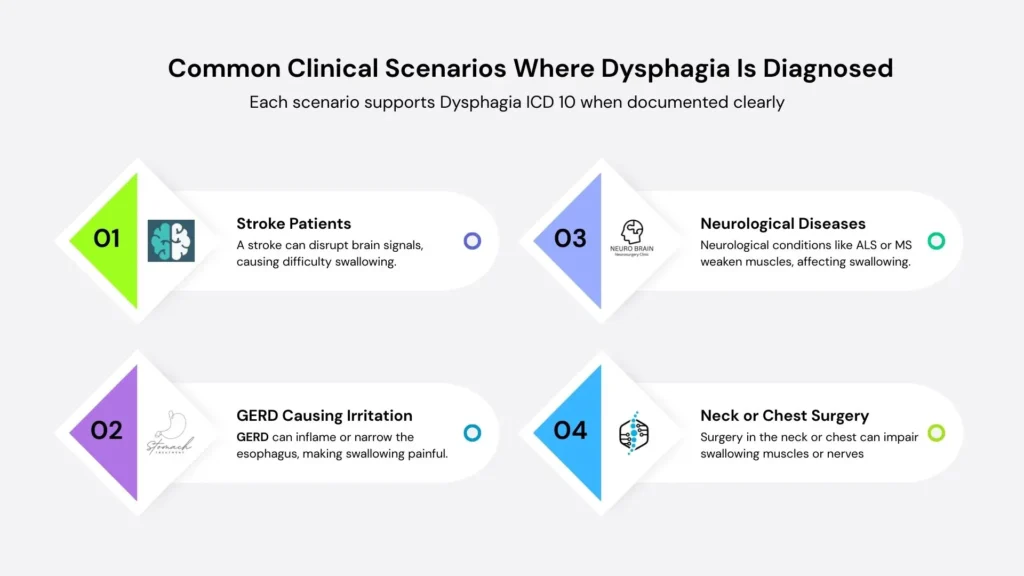
The examples below reflect common reasons providers diagnose swallowing difficulty.
- Stroke patients with sudden swallowing trouble
- Neurological diseases that weaken muscles
- GERD causing narrowing or irritation
- Surgery near the neck or chest
Each scenario supports Dysphagia ICD 10 when documented clearly. Clear notes also help coders choose the correct ICD 10 code for dysphagia without risk.
Documentation Requirements for Dysphagia ICD 10
Strong documentation drives accurate coding. Every detail matters because payers read the record closely. Clear notes help connect care to Dysphagia ICD 10 correctly.
Providers must note which phase of swallowing is affected. They should document duration and progression. Linked conditions strengthen the medical necessity for testing or therapy.
Coders rely on these details to avoid denials. Good documentation helps coders assign the right ICD 10 code for dysphagia the first time.
This table shows what providers should include and why it helps coding.
| Documentation Item | Why It Helps |
|---|---|
| Swallow phase | Improves code accuracy |
| Duration | Supports necessity |
| Progression | Justifies therapy |
| Linked conditions | Reduces denials |
Pro-Tip:
Don’t just document "dysphagia." By adding one word like Oropharyngeal (R13.11), Pharyngeal (R13.12), or Esophageal (R13.13), you significantly decrease the likelihood of a "medical necessity" denial.
Dysphagia ICD 10 and Medical Necessity
Payers review dysphagia claims carefully. Testing and therapy costs are high for swallowing problems. Clear Dysphagia ICD 10 use helps justify these services.
Speech therapy and instrumental swallow studies (like MBSS or FEES) often requires dysphagia documentation. Swallow studies need clear diagnosis support in the medical record. Accurate ICD 10 code for dysphagia helps prove medical need.
Weak documentation weakens payment approval. Strong notes protect reimbursement and reduce delays. Clear records also support difficulty swallowing ICD 10 claims.
Common Coding Mistakes With Dysphagia ICD 10
Beginners often repeat the same errors. Learning them early saves time and money. These mistakes also increase the risk for Dysphagia ICD 10 claims.
The issues below appear often in daily coding work.
- Using unspecified codes for too long
- Coding symptoms when diagnoses exist
- Missing links to stroke or surgery
- Copying notes without updates
Each mistake weakens the claim and slows payment. Accurate ICD 10 code for dysphagia use depends on clean, current notes.
2026 Compliance Alert: The “Code First” Rule
In 2026, if the dysphagia is a result of a Cerebrovascular Disease (Stroke), you must sequence the neurological deficit code first (e.g., I69.391) followed by the R13 code. Reversing this order is the #1 cause of "Sequence Error" denials in 2026.
Dysphagia ICD-10 vs Related Swallowing Conditions
Not all swallowing complaints equal dysphagia. Some symptoms sound similar but mean different things. These differences matter when using Dysphagia ICD 10 correctly.
Odynophagia (R07.0) means painful swallowing, not blocked swallowing. Globus sensation (F45.8) means a lump feeling without true swallowing trouble. Neither condition always fits the difficulty swallowing ICD 10 rules.
These conditions use different codes in ICD-10. They should not replace Dysphagia ICD 10 without clear proof. Using the wrong code can lead to denials or audits.
Key Takeaways for Practice Owners, Doctors, and Students
Dysphagia ICD 10 captures swallowing difficulty, not a disease. It applies when patients struggle to move food or liquid safely. Specific codes protect revenue and support compliance efforts.
Documentation drives coding accuracy every time. Clear notes help coders select the right ICD 10 code for dysphagia. Good records support care, therapy, and timely payment.
Learning dysphagia coding early builds strong habits. Those habits reduce errors under ICD 10 for dysphagia rules. They also protect patients and practice finances.
This content is reviewed by senior medical billing and coding experts with 10+ years of hands-on experience across U.S. healthcare systems.
Frequently Asked Questions
What does Dysphagia ICD 10 mean in simple terms?
Dysphagia ICD 10 means trouble swallowing food or liquid. Doctors use it when patients report choking, coughing, or food sticking. It records a symptom, not a disease, for billing and care planning.
Is difficulty swallowing the same as dysphagia in ICD-10?
Yes, ICD-10 treats them the same. When notes say difficulty swallowing, coders still use ICD 10 code for dysphagia. This rule applies to difficulty swallowing ICD 10 and ICD 10 for difficulty swallowing.
Why does correct dysphagia coding matter?
Correct ICD 10 dysphagia coding supports therapy, testing, and payment. Wrong or vague codes raise denial and audit risk. Clear notes help coders choose the right ICD 10 for dysphagia.
Which code do I use for 'food sticking in the throat'?
If the food sticks at the base of the throat/upper chest transition, use R13.14 (Pharyngoesophageal). If it is strictly in the throat, use R13.12 (Pharyngeal).