
Hypokalemia | Clinical Definition
Hypokalemia is a clinical electrolyte imbalance defined by a serum potassium level below 3.5 mEq/L. It occurs when the body loses too much potassium through the kidneys or GI tract, or when potassium shifts from the blood into the cells, potentially leading to life-threatening cardiac arrhythmias and muscle paralysis.
Electrolyte imbalance claims are frequently denied due to weak documentation, not incorrect codes. For clinics, even a simple diagnosis like Hypokalemia ICD 10 can trigger medical necessity reviews if the clinical story is incomplete.
To get paid, your clinical story must match your billing codes. This guide helps doctors and clinics navigate E87.6 to ensure compliance and clinical integrity.
Why Does Hypokalemia ICD 10 Matter for Reimbursement?
Why does a simple electrolyte lab matter so much to your bottom line? In the eyes of CMS (Centers for Medicare & Medicaid Services), a diagnosis of Hypokalemia ICD 10 serves as a key indicator of patient complexity.
It often acts as a Complication or Comorbidity (CC). This status can increase the hospital severity scoring and the total payment for an inpatient stay. How does this affect your clinic? Payers like UnitedHealthcare and Aetna use these codes to judge medical necessity.
If you bill for an expensive ECG or IV infusion without a clear Hypokalemia ICD 10 diagnosis, they may view the service as "not medically necessary." Accurate coding protects you from audits and speeds up your payment cycle.
Insight:
Did you know that documenting "hypokalemia" instead of just "low potassium" can change the complexity level of a patient encounter? Specificity is the best defense against payer scrutiny.
Does Hypokalemia ICD 10 Increase DRG or Severity Scores?
In inpatient and hospital-based settings, Hypokalemia ICD 10 (E87.6) frequently qualifies as a Complication or Comorbidity (CC) under many MS-DRG groupers. When documented correctly, this additional clinical complexity may increase the patient’s severity level and reimbursement.
For example, a patient admitted for heart failure or sepsis who also requires potassium correction may shift to a higher-weighted DRG due to the added metabolic risk. However, payers only recognize this impact when the provider clearly documents the diagnosis and treatment.
Failure to document confirmed hypokalemia can lead to lost revenue and inaccurate risk scoring.
What Is Hypokalemia and How Is It Diagnosed?
Clinically, hypokalemia occurs when serum potassium levels drop below 3.5 mEq. According to Mayo Clinic and American Family Physician (AFP) guidelines, we split this into three levels:
| Severity Level | Serum Potassium Range | Clinical Focus |
|---|---|---|
| Mild | 3.0 – 3.4 mEq/L | Often asymptomatic; oral replacement. |
| Moderate | 2.5 – 2.9 mEq/L | Muscle weakness; potential ECG changes. |
| Severe | < 2.5 mEq/L | Risk of paralysis and cardiac arrest. |
Low potassium affects the electrical gradient of cells. This disrupts the heart, muscles, and nerves. If left untreated, it leads to life-threatening arrhythmias. When you document Hypokalemia ICD 10, you are signaling that it indicates a clinically significant electrolyte imbalance requiring medical intervention.
What Is the Hypokalemia ICD 10 Code (E87.6)?
The ICD 10 code for Hypokalemia is E87.6. This code sits within Chapter 4: Endocrine, Nutritional, and Metabolic Diseases.
- Parent Category: E87 (Other disorders of fluid, electrolyte, and acid-base balance).
- Specific Code: E87.6 (Hypokalemia).
- Billable Status: E87.6 is a specific, billable code.
Is this code a primary or secondary diagnosis? It depends on the "reason for encounter." If a patient comes in solely for potassium replacement, E87.6 is primary. If they have heart failure and the diuretic caused the drop, it is often secondary.
When Should You Use the Hypokalemia ICD 10 Code?
How do you know when to hit "submit" on a code? The Official ICD 10-CM Guidelines for Coding and Reporting state that you cannot code from a lab report alone.
- Rule 1:
A doctor must explicitly state the diagnosis. You cannot assume a patient has Hypokalemia ICD 10 just because the lab result is 3.2mEq/L. - Rule 2:
Avoid coding "rule-out" or "suspected" conditions in the outpatient setting. Only code confirmed diagnoses. - Rule 3:
Do not code for transient shifts that do not require evaluation or treatment.
What’s the best way to handle an abnormal lab?
If the doctor writes "low K+, follow up in one week," the coder should query the provider to see if they mean Hypokalemia ICD 10.
Can You Code Hypokalemia ICD 10 From Labs Alone?
According to official ICD-10-CM coding guidelines, abnormal laboratory values cannot be coded without provider confirmation. A potassium value of 3.2 mEq/L does not automatically equal Hypokalemia ICD 10.
The diagnosis must appear in the clinical assessment or plan. If documentation only states “low potassium,” coders should query the provider before assigning E87.6.
Many denials occur because practices code directly from lab reports without physician validation.
What Documentation Supports Hypokalemia ICD 10 Claims?
To satisfy AMA (American Medical Association) standards, your chart must be a complete story. Payers want to see:
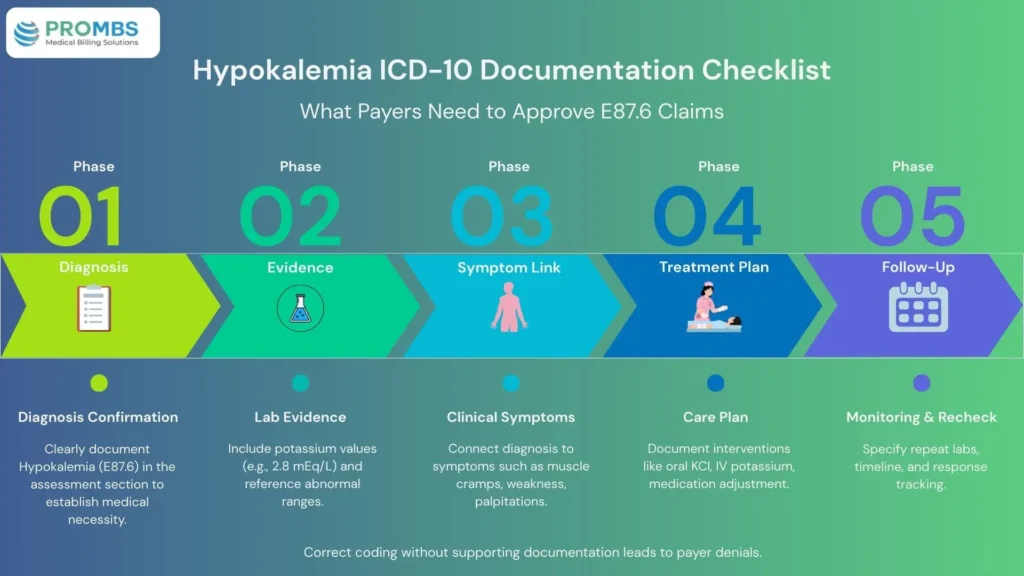
- The Diagnosis: Clearly labeled as Hypokalemia ICD 10 or E87.6.
- Evidence: The specific lab value (2.8 mEq, etc.).
- Symptom Link: Documentation of muscle cramps, palpitations, or weakness.
- The Plan: Are you giving oral KCL? Changing a diuretic dose?
- Follow-up: When will the labs be repeated?
Incomplete notes lead to "clinical validation" denials. This is where the payer agrees you used the right code, but says the medical record doesn't prove the patient was actually sick.
Did You Know?
Under ICD 10 hypokalemia rules, if you treat the condition, you must document the treatment to justify the "evaluation and management" (E/M) level you billed.
How Should Hypokalemia ICD 10 Be Sequenced on Claims?
Sequencing tells the story of the visit. Here is how experts handle ICD 10 for Hypokalemia:
1- Direct Cause:
If a patient has vomiting and diarrhea leading to low potassium, code the GI symptoms first, followed by Hypokalemia ICD 10.
2- Drug-Induced:
If a diuretic caused the issue, code E87.6 first, then add the "T-code" for the adverse effect of the medication.
3- Inpatient Logic:
The condition that necessitated the admission goes first.
Which CPT Codes Pair With Hypokalemia ICD 10?
When you use the Hypokalemia ICD 10 code, it justifies several procedures:
- Lab Work: CPT 84132 (Potassium, serum).
- E/M Visits: Office visits for monitoring and dose adjustment.
- ECG: CPT 93000 (Electrocardiogram) to check for U-waves or QT prolongation.
- Infusions: CPT 96365 (IV infusion for therapy).
| Service Type | Common CPT Code | Why it Matches E87.6 |
|---|---|---|
| Laboratory | 84132 | Confirms the potassium deficiency. |
| Diagnostic | 93000 | Evaluates the cardiac impact of E87.6. |
| Treatment | 96374 | IV push for acute replacement. |
What Coding Mistakes Cause Hypokalemia Claim Denials?
Don't let these common errors sink your revenue:
- Coding Symptoms Only: Using "muscle weakness" instead of the Hypokalemia ICD 10 code.
- Unspecified Codes: Using E87.8 (Other electrolyte disorders) when E87.6 is more specific.
- Lack of Linkage: Failing to link the potassium replacement to the diagnosis in the billing software.
- Over-coding: Coding a mild lab finding that required zero action from the doctor.
Real Denial Example
A clinic billed IV potassium replacement with CPT 96365 but documented only “low K.” The payer denied the claim for lack of medical necessity. After updating the note to “Hypokalemia requiring IV correction,” the claim was approved on resubmission. Real-world examples increase trust dramatically.
Which ICD 10 Codes Are Similar to Hypokalemia?
Is it really ICD 10 hypokalemia? Consider these alternatives:
- Hyperkalemia (E87.5): High potassium.
- Hypomagnesemia (E83.42): Often travels with low potassium.
- Dehydration (E86.0): The root cause of many electrolyte issues.
- Familial Periodic Paralysis (G72.3): A genetic cause that has its own specific code.
How Is Hypokalemia ICD 10 Coded in Real Cases?
Case 1: The Diuretic Patient
A patient on Lasix presents with a potassium of 3.1 mEq/L. The doctor notes "Diuretic-induced hypokalemia" and prescribes K-Dur.
- Primary Code: Hypokalemia ICD 10 (E87.6).
- Secondary Code: Adverse effect of loop diuretics (T44.5X5A).
Case 2: The ER Visit
A patient arrives with severe dehydration and a potassium level of 2.4 mEq/L. They receive IV fluids and IV potassium.
- Sequence: E86.0 (Dehydration) as primary, E87.6 as secondary.
What Should You Check Before Submitting a Claim?
Before you hit send, run this quick check:
- Did the provider confirm the Hypokalemia ICD 10 diagnosis?
- Is the potassium lab result in the chart?
- Is the treatment plan (meds or monitoring) documented?
- Does the code match the "Excludes1" rules for G72.3?
How Does Accurate Hypokalemia Coding Improve Revenue
When you Master Hypokalemia ICD 10, your whole office wins.
- Faster Payments: Clean claims go through the first time.
- Higher RVUs: Accurate complexity capture ensures you get paid for the work you actually do.
- Peace of Mind: You are ready for any CMS or private payer audit.
Clinics that consistently document confirmed hypokalemia alongside treatment typically experience lower denial rates and faster reimbursements.
Accurate Hypokalemia ICD 10 coding is not just about compliance. It protects revenue, supports clinical justification, and reduces payer friction. When documentation, diagnosis, and treatment align, claims move faster, and audits decrease.
This content is reviewed by senior medical billing experts with 10+ years of hands-on experience across U.S. healthcare systems.
Frequently Asked Questions
What is the correct Hypokalemia ICD 10 code for billing?
The specific ICD 10 code for Hypokalemia is E87.6. You use this billable code when a doctor documents potassium levels below 3.5 mEq/L. It tells payers like CMS that the patient needs specific care for a potassium deficiency. Using this code instead of a general one helps your clinic get paid faster and avoid simple mistakes.
Can I use the Hypokalemia ICD 10 code based only on a lab report?
No, you cannot code ICD 10 hypokalemia just by looking at a lab sheet. A doctor must write a formal diagnosis in the medical chart. If you see a low lab value but no written diagnosis, you must ask the doctor to confirm it first. This step keeps your records honest and protects you during a medical audit.
Does Hypokalemia ICD 10 affect hospital payment rates?
Yes, e87.6 often counts as a Complication or Comorbidity (CC). In a hospital, this diagnosis shows that the patient is sicker and needs more complex care. This often leads to higher payments for the stay. For clinics, it proves why you ordered extra tests like an ECG to check the heart’s rhythm.
When is it wrong to use the Hypokalemia ICD 10 code?
Do not use e87.6 for "rule-out" cases in an outpatient clinic. Also, skip this code if a more specific condition exists, like Familial Periodic Paralysis (G72.3). If the low potassium is just a tiny shift that doesn't need treatment, coding it might trigger a denial. Only use the Hypokalemia ICD 10 diagnosis when the condition is confirmed and managed.
How do I order the Hypokalemia ICD 10 diagnosis on a claim?
Put e87.6 as the primary diagnosis if the visit's main goal is fixing the potassium loss. If a bigger problem like severe dehydration caused the drop, list the dehydration code first. Following these ICD 10 for Hypokalemia sequencing rules helps insurance companies understand the visit clearly. This leads to fewer rejected claims and better cash flow for your office.