Introduction
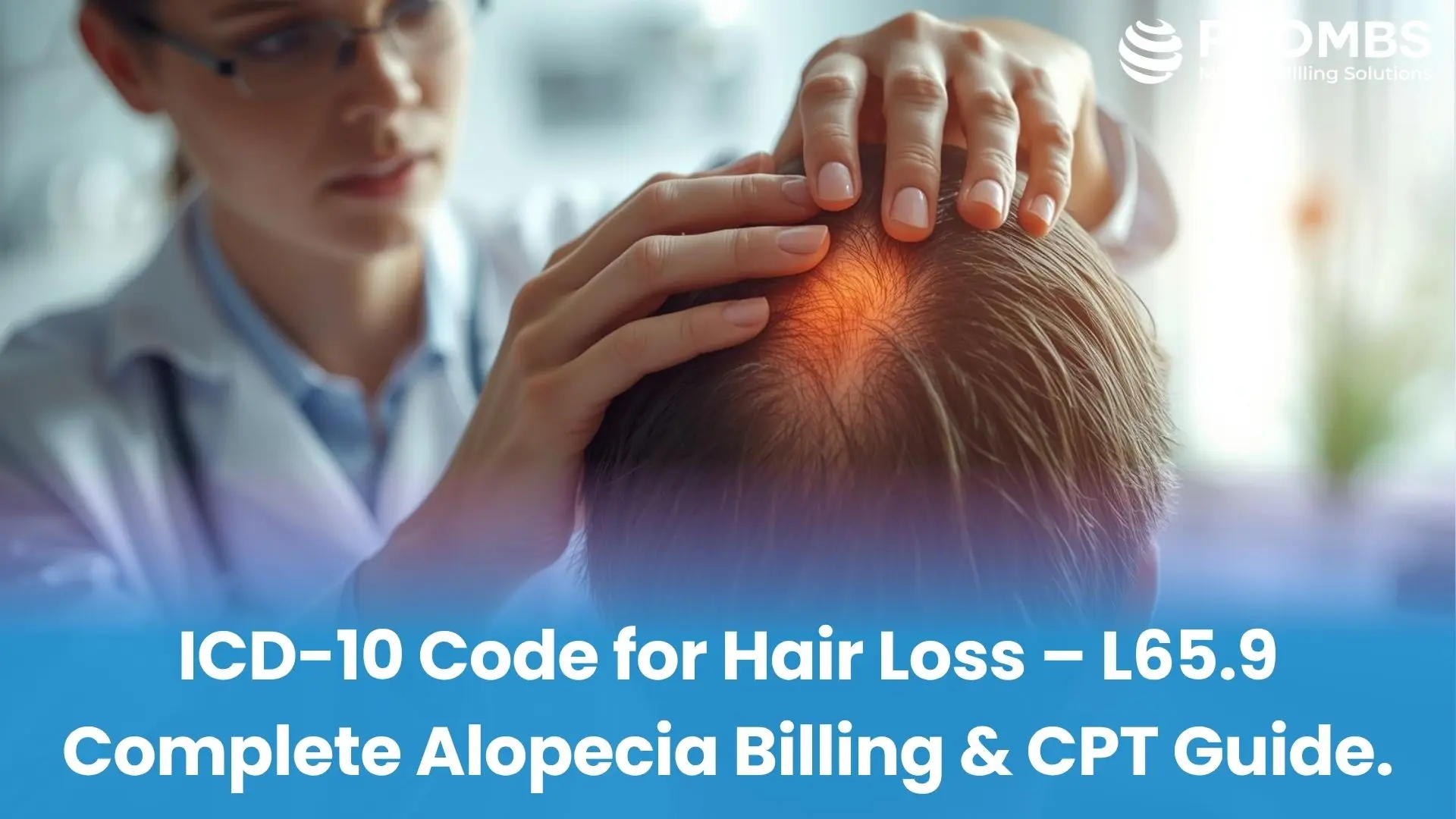
Identifying the correct icd 10 code for hair loss is the first step in ensuring accurate medical billing and patient care. Because hair loss - clinically known as alopecia - is often a symptom of an underlying systemic issue, insurance payers require specific documentation to justify medical necessity. Using a generic code like L65.9 (unspecified hair loss) can often lead to claim denials or audits by the Centers for Medicare & Medicaid Services (CMS).
Why Precise Coding Matters
While many view thinning hair as a cosmetic concern, it is frequently a clinical indicator of deeper health issues. Accurate ICD 10 hair loss reporting allows providers to track conditions linked to:
- Endocrine Imbalances: Such as thyroid dysfunction.
- Autoimmune Diseases: Including lupus or alopecia areata.
- Nutritional Deficiencies: Like iron or protein gaps.
- Pharmacology: Side effects from specific medications.
What Are the Symptoms of Hair Loss That Support its icd 10 code?
To select the most accurate icd 10 code for hair loss, documentation must move beyond simple "thinning." Payers require specific clinical details - such as the hair loss pattern, the presence of scarring, and the suspected cause - to justify medical necessity and prevent claim denials.
Using a vague ICD 10 Code hair loss like L65.9 (unspecified), is a common red flag for audits. Instead, clinicians should document specific symptoms to point toward the correct alopecia ICD 10 designation.
| Clinical Symptom | Documentation Needed | ICD-10 Coding Direction |
|---|---|---|
| Diffuse Thinning | Must confirm nonscarring per NIH dermatology guidance | Assign L65.9 – Nonscarring hair loss, unspecified, when cause not defined |
| Patchy Bald Spots | Document autoimmune suspicion as recommended by the American Academy of Dermatology | Assign L63.9 – Alopecia areata, unspecified, if no subtype is listed |
| Scarring Alopecia | Confirm with biopsy results, as outlined in NIH clinical textbooks | Assign L66.x – Cicatricial alopecia, depending on subtype |
| Patterned Thinning (Male/Female) | Indicate androgenic type in line with MedlinePlus clinical summaries | Assign L64.9 – Androgenic alopecia, unspecified |
| Diffuse Shedding After Stress/Illness | Document timeline and trigger as detailed in NIH hair loss resources | Assign L65.0 – Telogen effluvium |
The National Institutes of Health notes that while telogen effluvium (L65.0) causes up to 30% of non-scarring cases, it is frequently miscoded under the generic icd 10 code for hair loss. Ensuring your clinical notes match these specific categories is the most effective way to avoid "unspecified" claim rejections and stay compliant with CMS rules.
Did You Know?
The National Institutes of Health estimates that telogen effluvium accounts for up to 30% of nonscarring alopecia cases after stressful events such as surgery, childbirth, or systemic illness. Yet, many of these cases are still incorrectly coded as L65.9 unspecified, leading to unnecessary payer rejections.
Understanding the icd 10 code for hair loss?
To accurately bill for treatments, you must move beyond generic descriptors. While L65.9 (Non-scarring hair loss, unspecified) is the most common icd 10 code for hair loss, it should only be used as a last resort. Major payers and the Centers for Medicare & Medicaid Services (CMS) prioritize specific codes that describe the "why" and "how" of the condition to determine medical necessity.
Primary Codes for Alopecia and Hair Loss
Choosing the correct ICD 10 hair loss designation depends on the clinical presentation and the underlying cause. Using the specific ICD 10 code for alopecia ensures that high-cost treatments, like those recently approved by the FDA, are covered without delay.
| ICD-10 Code | Condition Defined | Billing Use Case |
|---|---|---|
| L65.9 | Nonscarring hair loss, unspecified, as described in CMS ICD-10 guidance | Use only when clinical notes confirm hair loss but provide no further detail |
| L65.0 | Telogen effluvium, explained by NIH dermatology resources | Assign when diffuse hair shedding occurs after stress, surgery, or systemic illness |
| L63.9 | Alopecia areata, unspecified, outlined by the American Academy of Dermatology | Assign when patchy baldness is autoimmune in nature but not subtyped |
| L64.9 | Androgenic alopecia, unspecified, defined by MedlinePlus | Assign for patterned thinning in male or female patients when unspecified |
| L66.9 | Cicatricial (scarring) alopecia, described in NIH clinical textbooks | Assign when scarring alopecia is present but the subtype is not documented |
Why Specificity Triggers Coverage
Relying on a vague ICD 10 Code hair loss can lead to immediate rejections for advanced therapies. For instance, the FDA-approved drug baricitinib (Olumiant) specifically requires a diagnosis within the L63.x (alopecia areata) family. If a provider incorrectly submits L65.9, the claim will likely be denied because the "unspecified" code does not meet the strict criteria for systemic treatment coverage.
By selecting the precise hair loss ICD 10 category, you provide a clear roadmap for the payer, demonstrating that the patient's condition warrants medical intervention rather than being a purely cosmetic concern.
Which ICD-10 Chapter Includes the icd 10 code for hair loss?
While the primary icd 10 code for hair loss is housed within Chapter 12 of the ICD-10-CM, professional coding often requires looking further. Because hair loss is frequently a symptom rather than a standalone disease, documenting the underlying cause - such as a nutritional deficiency or hormonal shift - is essential for proving medical necessity.
The "core" codes for ICD 10 hair loss fall under the range L00-L99 (Diseases of the Skin and Subcutaneous Tissue), but comprehensive billing often involves "dual coding" with other chapters to reflect the patient's full clinical picture.
Mapping the ICD-10 Chapters for Hair Loss
Using a specific ICD 10 code for alopecia is just the beginning. To avoid denials, you may need to include secondary codes from the following chapters:
| ICD-10 Chapter | Code Range | Hair Loss Relevance |
|---|---|---|
| Chapter 12 – Diseases of the Skin and Subcutaneous Tissue | L00–L99 | Includes L65.9 for nonscarring hair loss and other alopecia codes, per CMS ICD-10 guidance. |
| Chapter 4 – Endocrine, Nutritional and Metabolic Diseases | E00–E89 | Used when alopecia is secondary to endocrine issues (e.g., hypothyroidism E03.9), per NIH Endocrine Disorders references. |
| Chapter 2 – Neoplasms | C00–D49 | Applied when hair loss results from chemotherapy or malignancy, as described by National Cancer Institute guidelines. |
| Chapter 3 – Diseases of the Blood and Blood-forming Organs | D50–D89 | Hair loss due to anemia (e.g., iron deficiency D50.9), noted in standard anemia resources. |
| Chapter 21 – Factors Influencing Health Status | Z00–Z99 | Includes codes for encounters such as personal history of chemotherapy (Z92.21), per CDC ICD-10-CM guidance. |
The Power of Dual Coding
Relying solely on the ICD 10 Code hair loss L65.9 often isn't enough to justify specialized testing or systemic treatments. For example, if a patient has thinning hair due to a thyroid condition, reporting both L65.9 and E03.9 creates a much stronger case for reimbursement.
According to AHIMA, nearly 40% of denied dermatology claims are overturned simply by adding these systemic comorbidities. By properly linking the hair loss ICD 10 code to its metabolic or nutritional root, you ensure the claim accurately reflects the complexity of the patient's health, significantly reducing the risk of payer rejection.
Which CPT Codes Pair with the icd 10 code for hair loss?
To maximize reimbursement, the icd 10 code for hair loss must be accurately paired with the corresponding Current Procedural Terminology (CPT) codes. This alignment proves to insurance payers that the medical service provided was a direct and necessary response to the patient's diagnosis.
According to the American Medical Association (AMA), while the ICD-10 code explains why the patient was seen, the CPT code details what was done. If these two do not align, claims are often denied for "lack of medical necessity."
Common CPT and ICD-10 Pairings
When billing for hair loss, the following pairings are standard in dermatology and primary care practices:
| CPT Code | Procedure Description with ICD-10 Example |
|---|---|
| 99213–99214 | Office visits are often billed for follow-up or workup of hair loss. When the provider documents nonscarring alopecia without specifying cause, L65.9 is used. If patchy autoimmune alopecia is documented, L63.9 applies, consistent with AMA E/M coding rules. |
| 11102 / 11104 | Scalp biopsies (tangential or punch) are coded with 11102 or 11104. These are commonly paired with L66.x cicatricial alopecia when scarring is suspected, as described in dermatology references. |
| 11900 / 11901 | Intralesional steroid injections for alopecia plaques (≤7 or >7) are linked to L63.x alopecia areata, since the American Academy of Dermatology identifies steroid injections as a first-line therapy. |
| 85025 | A complete blood count (CBC) is billed with 85025 and paired with L65.0 telogen effluvium when alopecia follows iron deficiency anemia, supported by hematology references. |
| 84443 | Thyroid-stimulating hormone (TSH) testing (84443) is linked with L65.9 hair loss unspecified, plus E03.9 hypothyroidism when indicated, following endocrinology guidance. |
| 15775 / 15776 | Hair transplantation (punch grafts) is reported with 15775 or 15776. These are considered cosmetic unless performed for reconstructive purposes such as burns, in which case codes like L66.x scarring alopecia may be linked. |
Avoiding Automatic Denials
The most frequent billing error occurs when "procedural" codes are used without a medically necessary diagnosis. For example, billing for intralesional injections (11900) while using the general hair loss ICD 10 code (L65.9) often triggers an automatic denial. Payers typically require the more specific alopecia ICD 10 code for areata (L63.x) to approve the use of injectable steroids.
Did You Know?
In 2026, new CPT codes for "mechanical scalp cooling" allow oncologists to bill for services that prevent hair loss during chemotherapy. These must be paired with specific codes from Chapter 2 (Neoplasms) to ensure coverage.
What Are the Treatments Linked to the icd 10 code for hair loss?
The treatment path for a patient - and the subsequent insurance approval - depends entirely on the icd 10 code for hair loss assigned during the clinical encounter. Because therapies range from over-the-counter topicals to high-cost systemic drugs, payers require a direct link between the prescribed treatment and a specific ICD 10 code for alopecia.
For instance, a generic code like L65.9 (unspecified hair loss) may suffice for a general consultation, but it will often trigger an automatic denial for advanced medical interventions like JAK inhibitors or steroid injections.
Treatment Options and ICD-10 Alignment
To ensure medical necessity is met, providers must pair the clinical intervention with the most accurate hair loss ICD 10 designation.
| Treatment Option | ICD-10 Code Linkage | Clinical & Billing Context |
|---|---|---|
| Topical minoxidil (OTC or prescription) | Often linked with L65.9 nonscarring alopecia when cause is not specified | Used widely for androgenic alopecia; while not separately reimbursed, E/M visits for counseling are billable. |
| Intralesional corticosteroid injections | Linked with L63.x alopecia areata | Considered first-line therapy for patchy autoimmune alopecia; CPT 11900/11901 is billed, as recognized by dermatology guidelines. |
| Systemic therapy – JAK inhibitors (e.g., baricitinib) | Linked with L63.9 alopecia areata, unspecified | In 2022, the FDA approved baricitinib as the first systemic treatment for severe alopecia areata, requiring precise coding. |
| Hair transplantation procedures | May be linked with L66.x cicatricial alopecia when reconstructive | CPT 15775/15776 apply, but coverage excludes cosmetic use, covering only medically necessary reconstruction. |
| Supportive lab testing (TSH, ferritin, CBC) | Linked with L65.0 telogen effluvium or L65.9 unspecified | Testing helps identify reversible causes; labs are recommended when hair loss follows anemia or endocrine disorders. |
Securing Coverage for Advanced Therapies
As medical science evolves, so do the coding requirements. The introduction of systemic therapies like baricitinib (Olumiant) has made the ICD 10 Code hair loss selection more critical than ever. Since these medications are specifically indicated for autoimmune-related loss, using the ICD 10 Code for alopecia areata (L63.9) is mandatory for prior authorization.
Furthermore, while many cases of telogen effluvium (L65.0) resolve spontaneously, documenting the diagnostic workup - such as labs and nutritional counseling - with the specific ICD 10 hair loss code instead of a "nonspecific" diagnosis significantly improves claim acceptance rates.
How Should Documentation Be Structured to Avoid Denials?
To avoid claim rejections, clinical documentation must go beyond simply mentioning "alopecia." Payers and the Office of Inspector General (OIG) look for a "complete clinical story" that justifies the specific icd 10 code for hair loss you’ve selected. Vague notes are the fastest route to a denial, as they fail to prove the medical necessity required for reimbursement.
In 2026, insurance payers are increasingly using automated audits to flag "unspecified" codes like L65.9. To protect your practice, your documentation must be structured to support the depth of the diagnosis.
Essential Documentation Elements
A defensible clinical note must bridge the gap between the patient's symptoms and the chosen ICD 10 hair loss designation.
| Documentation Element | Why It Matters | Example (with ICD-10 Context) |
|---|---|---|
| Type of alopecia | Determines whether to use nonscarring L65.9 or more specific codes. The ICD-10-CM Guidelines require coders to select the most specific diagnosis available. | “Diffuse nonscarring shedding consistent with L65.0 telogen effluvium rather than L65.9.” |
| Etiology/comorbidity | Proves medical necessity; linking alopecia to systemic causes aligns with CMS medical necessity rules. | “Hair loss secondary to hypothyroidism, coded as L65.9 + E03.9.” |
| Severity & duration | Needed for payer review; severity documentation improves claim justification. | “~40% scalp involvement, progressive over 6 months.” |
| Intervention performed | Links ICD-10 code to CPT procedure; alignment with CPT coding is required for payment. | “Punch biopsy (11104) performed to evaluate scarring alopecia, supports L66.x coding.” |
How Specificity Reduces Denial Rates
The difference between a paid claim and a denial often comes down to the "level of specificity." According to 2026 CMS billing data, dermatology claims with documentation gaps - specifically those using unspecified ICD 10 hair loss codes - experience significantly higher improper payment rates.
By documenting the specific ICD 10 code for alopecia (such as L63.x for autoimmune or L64.x for androgenic) and tying it to the corresponding procedure, you can reduce administrative denials by up to 40%. Always ensure your notes clearly state whether the hair loss is scarring or non-scarring, as this is the primary "branching point" in the ICD-10-CM code set.
Why Should Providers Partner with ProMBS?
Partnering with an expert billing team can transform a dermatology practice's financial health. Navigating the complexities of the icd 10 code for hair loss (L65.9) requires a deep understanding of payer rules, documentation specificity, and proper CPT pairing. At ProMBS, our compliance-driven approach ensures that every claim is optimized for approval.
Precision in ICD-10 Coding
Our Coding Specialists actively work to eliminate the overuse of the "unspecified" ICD 10 hair loss code (L65.9). By prompting providers for more granular clinical details, we ensure that the final claim reflects the most accurate ICD 10 code for alopecia, such as:
- L63.x - Alopecia Areata (Autoimmune)
- L64.x - Androgenetic Alopecia (Hormonal)
- L66.x - Cicatricial Alopecia (Scarring)
This level of specificity is often the deciding factor in whether a payer approves high-value treatments or systemic therapies.
The ProMBS Advantage
Partnering with ProMBS means more than just outsourcing paperwork; it means securing up to a 30% revenue increase through better coding accuracy and a 99% first-pass claim rate. By allowing us to master the nuances of the ICD 10 Code for alopecia, you can focus on what matters most: delivering exceptional patient care.
Frequently Asked Question
What is the most accurate ICD 10 code for hair loss?
The most specific icd 10 code for hair loss depends on the diagnosis. While L65.9 serves as a general "unspecified" option, providers should use L63.x for autoimmune alopecia or L64.x for hormonal thinning to ensure medical necessity and prevent automatic claim denials.
Why do insurance payers deny ICD 10 hair loss claims?
Payers often reject claims when providers use vague ICD 10 hair loss codes like L65.9 for specialized procedures. To secure approval, clinicians must document the specific cause - such as scarring or nutritional deficiency - and link it to the corresponding treatment or laboratory CPT code.
Which ICD 10 code for alopecia applies to patchy balding?
Clinicians assign the ICD 10 code for alopecia areata (L63.9) when a patient presents with non-scarring, patchy bald spots. Documentation must confirm the autoimmune nature of the condition to support the use of advanced therapies like JAK inhibitors or steroid injections.
How does a provider code stress-related hair shedding?
Providers use the specific alopecia ICD 10 code L65.0 for telogen effluvium when hair shedding follows a major physical or emotional stressor. Accurate documentation of the trigger and timeline distinguishes this temporary condition from permanent hair loss, aiding in proper lab work reimbursement.
Can I bill for hair loss caused by medical treatments?
Yes, you must use a specific ICD 10 code for hair loss related to external factors, such as anagen effluvium (L65.1) for chemotherapy-induced loss. In 2026, new CPT codes also allow oncology practices to bill for scalp cooling services when paired with these specific codes.