
In the 2026 reimbursement landscape, M25.562 claim denials are often the result of automated payer edits rather than manual review. This guide is specifically designed for billing professionals and Revenue Cycle Managers (RCMs), addressing high rejection rates for symptom-based coding.
Before troubleshooting your specific denials, ensure you are utilizing the correct 2026 ICD 10 Code for Left Knee Pain based on the latest CMS laterality requirements."
Why does this happen so often? Because payers read intent, not just codes. They scan logic. They scan patterns. They scan gaps. This code looks simple. But it carries weight. Use it wrong, and the claim never moves.
This guide explains why claims of this code fail in 2025. It shows what payers expect. It explains how to fix issues early. It follows national billing expectations, according to CMS guidance, and documentation rules defined under AMA ICD coding standards.
What Is Left Knee Pain ICD-10?
ICD-10 code for left knee pain refers to ICD-10-CM code M25.562, which is used to report pain localized to the left knee when no confirmed diagnosis has been established.
This code is meant for initial evaluation. It signals uncertainty. It tells payers the cause is not yet known. Because it is a symptom code, it faces stricter review rules as reflected in CMS payment rules on payment integrity.
Why Do These Claims Get Rejected So Fast?
Left Knee Pain ICD-10 claims are rejected quickly when symptom codes fail automated payer edits due to missing intent, weak progression, or documentation that does not justify medical necessity.
Claims of this code often die at the front door. Why so fast? Because machines decide first. Payers use automated edits. These edits do not read stories. They read structure.
If logic breaks, the claim stops. No nurse review. No physician review. Just a rejection notice. Symptom codes like M25.562 receive higher scrutiny according to CMS guidance, and weak intent triggers instant rejection.
For a deep dive into the initial selection process, refer to our complete 2026 knee pain coding reference guide
What Is the Most Common Coding Error?
The most common Left Knee Pain ICD-10 coding error is reporting M25.562 without a documented assessment, diagnostic plan, or clinical next step that supports ongoing care.
The biggest mistake is using this code without a clear plan. No testing plan. No care direction. No reason to return. Payers see this as symptom-only billing. They flag it. They reject it.
Why does this matter? Because, within AMA coding standards, intent must be documented. Pain alone is not enough. Action must follow.
Why Does Overusing Symptom Codes Cause Denials?
This error builds quietly. Visit after visit. Same code. Same note.
Repeated Symptom Coding Across Visits
Why is the pain code still used? Payers ask this question every day. Pain codes signal first-contact care. They do not support long treatment cycles under AMA ICD coding standards.
No Escalation to Condition-Specific Codes
Was arthritis suspected? Was imaging ordered? Was a ligament issue noted? If yes, the code must move. When it does not, edits fire. Medical necessity looks weak. Claims fail. This logic follows CMS guidance on payment growth rules. No progression means no reason to pay.
When Is Left Knee Pain ICD-10 the Wrong Code?
ICD-10 code for left knee pain is the wrong code when an injury, trauma, or structural condition is known, because CMS requires condition-specific or injury codes instead of symptom reporting.
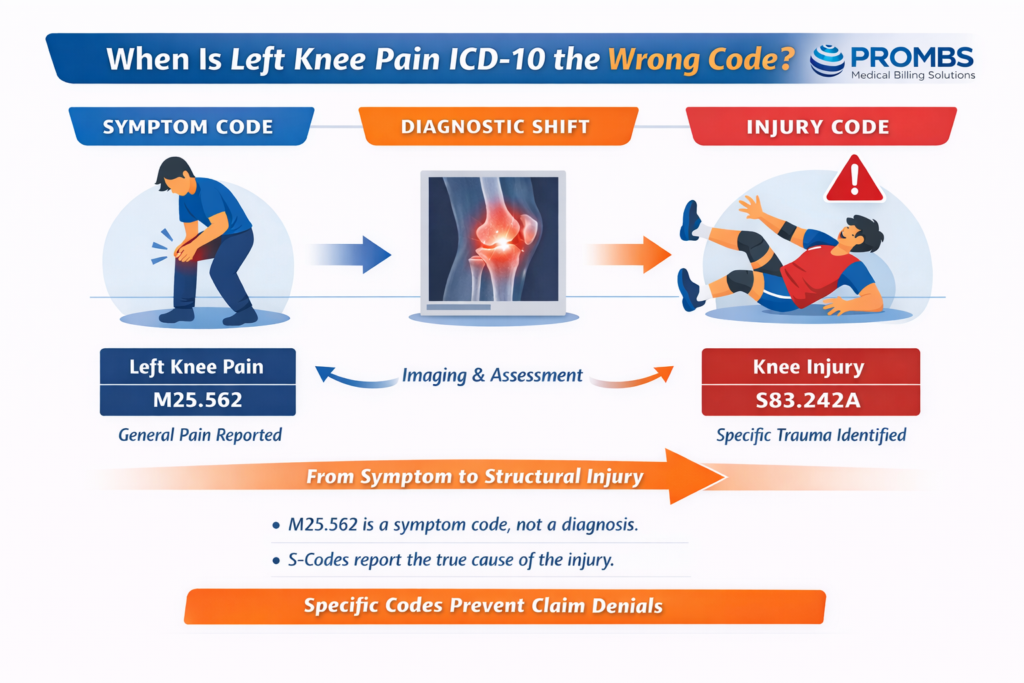
Was there a fall? A twist? A sports injury? Then this code is wrong. Injury cases require injury codes. These are S-codes. They tell the full story. Using pain instead of injury creates conflict, and claims stop according to CMS guidance on injury reporting.
To prevent knee pain billing errors, your documentation must reflect a clear transition from a symptom (M25.562) to a definitive diagnosis once imaging is reviewed.
| Clinical Scenario | Code Type to Use | Example Code |
|---|---|---|
| Undiagnosed knee pain | Symptom code | M25.562 (Left knee pain) |
| Traumatic knee injury | Injury (S-code) | S83.242A (Medial meniscus tear) |
| Chronic knee condition | Disease code | M17.12 (Unilateral osteoarthritis) |
| External event involved | External cause code | W10.9XXA (Fall on stairs) |
This comparison shows how quickly the wrong code choice leads to front-end rejection.
Why Are External Cause Codes Often Missing?
If trauma is documented, payers expect more. External cause codes explain how the injury happened. They answer payer questions early.
Without them, the story breaks. Notes and diagnosis clash. Rejections follow. This expectation comes directly from CMS trauma coding rules. It is not optional.
How Do Wrong Encounter Types Break Injury Claims?
Encounter errors look small. They cost big.
Common failures include:
- Initial encounter codes used after active treatment has already started
- Follow-up visits incorrectly coded as first-contact care
- Incorrect seventh character selection on injury codes
ICD-10 Injury 7th Character Quick Reference
| 7th Character | Meaning | When to Use |
|---|---|---|
| A | Initial encounter | Active treatment phase, including ED visits, surgery, or first evaluation |
| D | Subsequent encounter | Routine recovery care such as follow-ups, therapy visits, or cast changes |
| S | Sequela | Complications or conditions that occur as a direct result of the injury |
These errors break payment logic instantly. They follow AMA ICD coding standards for injury encounters.
Why Does an Assessment and Plan Matter?
Payers ask simple questions. What was assessed? What was checked? What happens next? Assessment and plan show purpose. They show direction. They justify payment.
No plan means no need. This logic comes straight from CMS guidance on audit standards. Even basic care must be written. Rest, imaging, and referral. Each one matters.
When Should You Stop Using Left Knee Pain ICD-10?
Was a diagnosis confirmed? Then pain must step aside. Symptom codes belong to early visits. They do not belong to final answers.
Common examples include:
- Arthritis
- Cartilage damage
- Ligament disorders
Using a pain code instead of a disease code triggers edits. Sometimes denials follow. Often downcoding occurs. This aligns Under AMA ICD coding standards on coding hierarchy.
Why Do Follow-Up Visits Get Rejected?
Why is pain still the code? Payers notice patterns. Once the cause is known, codes must shift. Follow-up visits require clarity. Not repeated symptoms.
Automated edits track visit history. Repeated pain codes trigger flags. This is a known CMS rejection pattern.
How Can You Prevent Claim Rejections?
Preventing rejections of this code requires intent, progression, and alignment at every visit. Prevention starts before submission. Small checks protect revenue.
- Confirm laterality every visit
- Escalate codes once findings exist
- Match documentation to diagnosis intent
- Align visit type with code selection
These steps reduce front-end edits. They keep claims moving.
How Does Pro MBS Prevent Coding Denials?
Prevention beats recovery. Every time. Pro-MBS reviews coding logic before claims go out. Not after rejection hits. Our team aligns notes with codes. They apply payer-specific rules. They close gaps early. This process follows CMS payment logic. It respects AMA coding standards. It protects revenue without pressure.
Rejections for Left Knee Pain ICD 10 are rarely random; they follow predictable patterns of missing intent or weak clinical progression. By matching your documentation to diagnostic intent and utilizing our 2026 Left Knee Pain ICD 10 Reference Guide, you can eliminate front-end edits.
Ready to stop M25.562 claim denials before they start? Let Pro-MBS perform a comprehensive audit of your high-volume musculoskeletal claims.
Frequently Asked Questions
Why does Left Knee Pain ICD 10 get rejected so often?
Left Knee Pain ICD 10 is a symptom code, not a diagnosis. Payers expect intent, progression, or diagnostic movement. Without that, automated edits trigger a left knee pain claim rejection fast. Pro-MBS helps fix these gaps before claims go out.
What is the most common M25.562 Coding Errors issue?
The top M25.562 Coding Errors problem is missing assessment and plan. Pain alone does not justify repeat visits or testing. This leads directly to medical billing claim rejections. Pro-MBS reviews documentation before submission.
How do ICD-10 knee pain denial reasons affect follow-up visits?
Most ICD-10 knee pain denial reasons happen in follow-ups. Once a cause is known, symptom codes must stop. Continuing pain codes signals weak medical necessity. Pro-MBS ensures visit-to-visit coding stays compliant.
When does Left Knee Pain ICD 10 become the wrong code?
Left Knee Pain ICD 10 is wrong when injury or disease is identified. Trauma, arthritis, or internal damage need specific codes. Using pain instead causes immediate knee pain billing errors. Pro-MBS guides correct escalation every time.
Why do injury cases trigger medical billing claim rejections?
Injury claims fail when encounter types or 7th characters are wrong. Initial and subsequent visits are often misused. These errors stop claims before review starts. Pro-MBS audits injury logic before submission.
Can missing external cause codes cause a left knee pain claim rejection?
Yes. Trauma without external cause codes creates conflicts. Payers see incomplete injury reporting and reject early. This is a common but preventable mistake. Pro-MBS checks injury context before billing.
How can providers avoid repeat knee pain billing errors?
Avoid repeat knee pain billing errors by coding with intent. Document evaluation, escalation, or resolution clearly. Align diagnosis with visit purpose every time. Pro-MBS helps stop denials before they start.
