
Introduction
Modifier 25 determines whether a same-day evaluation and management visit is reimbursed or automatically bundled into a procedure payment. For many practices, the correct use of Modifier-25 directly affects whether the provider is paid for the clinical evaluation performed during the encounter.
In a typical visit, a patient presents with a concern. The physician evaluates the symptoms, performs an examination, and begins medical decision-making. During that same encounter, the provider may also perform a procedure based on the assessment.
When the claim reaches the payer, the visit and the procedure occur on the same date of service. Without Modifier 25, the payer often assumes the evaluation was routine pre-procedural work and bundles the office visit into the procedural payment.
The official modifier-25 description states that the visit must represent a separately identifiable E/M service that goes beyond the standard work included in the procedure. When this distinction is not clearly documented, claims are bundled, reimbursements are reduced, and Modifier-25 denials become common across many specialties.
While Modifier-25 is a critical tool for same-day reimbursement, it is just one component of the broader system of Medical Billing Modifiers used to categorize clinical services.
What Is Modifier 25 in Medical Billing?
Modifier 25 is reported when a physician performs a Separately Identifiable Evaluation and Management (E/M) Service on the Same Day as a Procedure. The modifier signals to the payer that the visit involved independent clinical assessment and decision-making beyond the routine work already included in the procedure’s global payment.
The official Modifier 25 Description from the American Medical Association (AMA) states that the E/M service must be Significant and Separately Identifiable. This means the provider performed additional history, examination, or medical decision-making that was not required solely to prepare for the procedure.
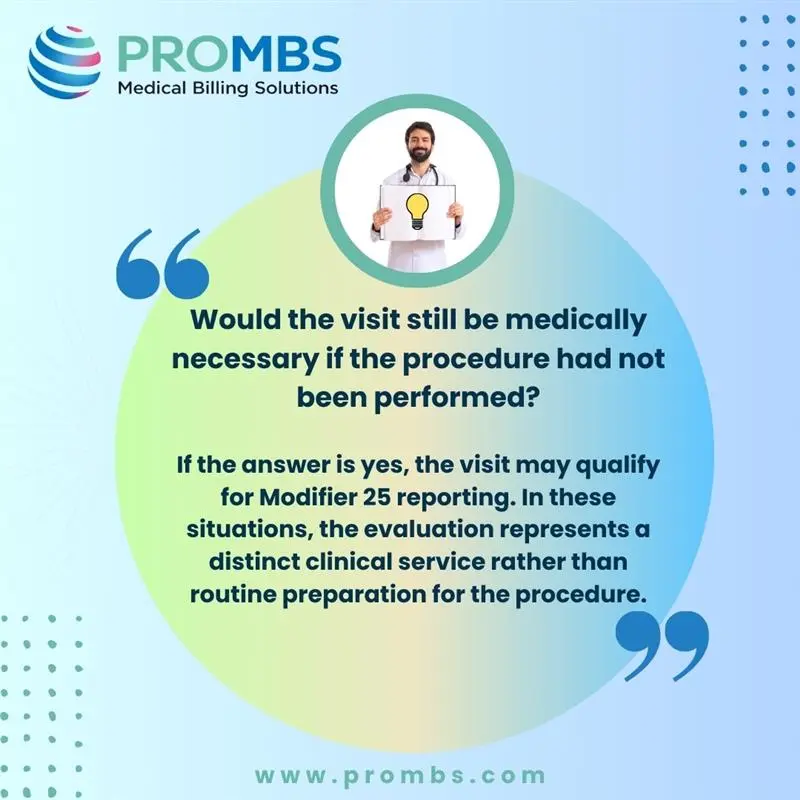
In practical terms, the 25 Modifier Definition requires that the visit stand on its own from a clinical perspective. If the procedure had not been performed, the encounter would still represent a legitimate E/M service addressing a patient's problem.
For billing teams reviewing documentation, understanding What is Modifier 25 - is essential to prevent bundling errors. When applied correctly, Modifier-25 allows the payer to evaluate the visit independently instead of automatically including it within the procedural payment.
Why Is Modifier 25 Used in Medical Billing?
Most payer adjudication systems automatically bundle same-day visits with procedures. When an E/M code and a procedural CPT code appear on the same claim, the system often assumes the evaluation was routine pre-procedural work.
This automated bundling frequently leads to Modifier 25 Denials or unpaid E/M services if the modifier is not reported correctly.
However, many encounters involve legitimate clinical evaluation before a procedure is performed. The provider may review symptoms, assess a new complaint, evaluate risk factors, or determine whether a procedure is medically necessary.
By appending Modifier 25, the billing team instructs the payer to review the visit as an independent service. The modifier confirms that the physician performed a Separately Identifiable E/M service that goes beyond standard procedural preparation.
When Should Modifier 25 Be Used on a Same-Day Visit?
Modifier 25 should be used when the provider performs a clinical evaluation that exceeds the routine assessment required before a procedure.
During the visit, the physician may evaluate symptoms, review patient history, examine the condition, and determine an appropriate treatment plan. If the clinical work represents a meaningful assessment that guides care decisions, the encounter may qualify for a separately identifiable E/M service.
A practical documentation test is often used by coders and compliance teams:
When Should Modifier 25 Not Be Used?
Modifier 25 should not be reported when the evaluation performed is limited to the standard preparation required before a procedure.
Activities such as reviewing vital signs, confirming the procedural site, explaining the procedure, or obtaining consent are considered Pre-Procedural Work. These services are already included in the procedure’s global payment and do not qualify as a separately identifiable E/M service.
When Modifier 25 is appended to visits that only include routine procedural preparation, payer systems frequently reject the claim. These situations commonly trigger Modifier 25 Denials, compliance audits, and payment recoupments.
Proper documentation must clearly demonstrate that the visit involved additional clinical assessment beyond the work normally required to perform the procedure.
Why Do Modifier 25 Claims Get Denied?
Many providers only ask What is Modifier-25 after they receive a denial for a same-day visit. In most cases, the denial is not caused by the procedure itself. It occurs because the documentation does not clearly support a Separately Identifiable E/M service.
Modifier-25 tells the payer that the physician performed meaningful evaluation and medical decision-making in addition to the procedure. When the visit note does not clearly show that independent work occurred, payer systems assume the evaluation was routine procedural preparation and automatically bundle the service.
According to the AMA’s Modifier-25 Description, the E/M service must be Significant and Separately Identifiable from the procedure. When documentation does not meet this requirement, the claim may be bundled or denied.
Common Reasons for Modifier 25 Denials
Most Modifier 25 denials in 2026 occur for predictable documentation and coding reasons:
- Unclear Patient Problem in the Visit Note: The documentation does not explain the complaint or condition that required evaluation.
- No Visible Medical Decision-Making: The note lacks evidence that the provider evaluated options, assessed risk, or determined a treatment plan.
- Visit Documentation Mixed with the Procedure Note: When both services are written together, the payer cannot identify two separate services.
- Routine Procedural Preparation Documented as an E/M Visit: Activities such as vitals, consent, or procedural explanation are already included in the procedure’s global payment.
- No Proof of A Separately Identifiable E/M Service: If the visit would not stand on its own without the procedure, Modifier 25 is not supported.
To prevent denials, the visit note must clearly show why the Patient Was Evaluated and What Clinical Decisions Were Made. The procedure note should then document only the performance of the procedure itself.
When documentation clearly separates these services, Modifier 25 allows the payer to review the visit independently rather than bundling it into the procedural payment.
Modifier 25 Documentation: Pass vs. Fail Examples
Understanding Modifier 25 often becomes easier when reviewing real clinical documentation scenarios. Payers do not evaluate the modifier alone. They evaluate the Documentation Behind the Visit. The key question reviewers ask is whether the encounter involved a Separately Identifiable E/M Service beyond routine procedural preparation.
The examples below show how documentation determines whether Modifier 25 is supported.
| Clinical Scenario | Documentation Status | Why |
|---|---|---|
| Patient presents for a scheduled knee injection. During the visit, the physician also evaluates and treats a new, unrelated skin rash. | PASS (Append Modifier 25) | The rash required a separate history, examination, and medical decision-making unrelated to the injection procedure. |
| Patient presents for a scheduled knee injection. The provider checks vital signs and confirms the knee pain before performing the procedure. | FAIL (Do NOT use Modifier 25) | This represents a routine pre-procedural evaluation already included in the procedure’s global payment. |
| Patient presents for evaluation of migraine symptoms. During the visit, the physician determines that a trigger point injection is medically necessary and performs it. | PASS (Append Modifier 25) | The clinical decision to perform the procedure occurred during the evaluation of the migraine condition. |
These scenarios demonstrate the practical rule used by coders and compliance teams:
If the visit would still have clinical value even without the procedure, Modifier 25 may be appropriate. If the documentation only reflects routine preparation for the procedure, the modifier should not be reported.
Common Modifier 25 Billing Scenarios
Modifier-25 frequently appears in outpatient encounters where evaluation and treatment occur during the same visit. These scenarios occur across multiple specialties, which is why payers review them closely.
Common clinical situations include:
- A physician evaluates a new complaint during an office visit and performs a minor procedure.
- A provider assesses worsening symptoms and performs an injection during the same encounter.
- A patient presents for evaluation, and the provider determines a procedure is necessary after clinical assessment.
In each of these cases, the visit must represent a separately identifiable E/M service. The documentation must show that the physician performed an independent evaluation and medical decision-making before the procedure.
What Triggers Reviews and Audits for Modifier 25?
Payers actively monitor the use of Modifier 25 because it directly affects reimbursement. Most reviews occur when documentation patterns suggest the modifier is being applied without sufficient clinical justification.
Common triggers include:
- Routine documentation that appears procedural in nature
- Visit notes that look copied or repeated across encounters
- High frequency of Modifier 25 usage by a single provider
- Visit documentation that does not show independent medical decision-making
- Procedure and E/M documentation combined into one note
When these patterns appear, payer systems may flag claims for review. This often leads to increased denials, medical record requests, or delayed reimbursements.
Does Modifier 25 Increase Audit Risk?
Modifier 25 itself does not automatically create audit risk. However, incorrect or excessive use can attract payer attention over time.
Insurance carriers monitor billing patterns using automated review systems. If a provider consistently reports Modifier 25 at a rate significantly higher than peers in the same specialty, the billing pattern may be flagged for review.
Key audit indicators include:
- Frequent reporting of Modifier-25 with the same procedure codes
- Repetitive documentation patterns across patient encounters
- Lack of evidence supporting a separately identifiable E/M service
According to guidance from the Centers for Medicare & Medicaid Services, audits usually begin when billing trends stand out over time rather than because of a single claim.
Routine internal documentation reviews help prevent these patterns from developing.
Modifier 25 vs Modifier 59 : What Is the Difference?
Although both modifiers affect reimbursement, they serve completely different coding purposes.
- Modifier-25 applies to evaluation and management services when a separately identifiable visit occurs on the same day as a procedure.
- Modifier 59 applies to procedural services when two procedures must be reported separately because they occur at different anatomical sites or represent distinct services.
Using the wrong modifier can signal to the payer that coding rules were misunderstood. This often results in claim delays, additional review, or denials.
Understanding the Difference Between Modifier 25 and 59 is essential, as using them interchangeably is a primary trigger for Office of Inspector General (OIG) audits.
Modifier 25 vs G2211: The 2026 CMS Rule
One of the most important compliance updates affecting Modifier 25 involves the G2211 complexity add-on code. Beginning in 2025 and continuing into 2026, the Center for Medicaid and Medicare Services (CMS) clarified how these two codes interact when a visit and a procedure occur on the same day.
Because both codes affect reimbursement for evaluation and management services, payer systems now closely review claims where Modifier 25 and G2211 appear together.
The 2026 G2211 Decision Matrix
If a procedure is performed (Global Period 0): Append Modifier 25 to the E/M visit. G2211 cannot be billed on the same encounter.
If NO procedure is performed: G2211 may be reported if the visit represents complex, longitudinal care management.
The Exception:
Rare preventive visits may technically allow both codes. However, most commercial payer systems deny this combination, and many practices experience a very high denial rate when Modifier 25 and G2211 appear together.
For compliance and denial prevention, many coding teams follow a simple operational rule:
If Modifier-25 is required because a procedure was performed, G2211 should generally not be reported on the same claim.
Separating these codes correctly helps prevent automated payer edits, claim delays, and post-payment audits.
How Incorrect Modifier 25 Usage Affects Revenue
Improper use of Modifier 25 can affect revenue in two ways.
- First, when the modifier is not applied when it should be, legitimate E/M visits are bundled into procedures and never reimbursed.
- Second, when Modifier 25 is overused without proper documentation, payer systems may initiate reviews, deny claims, or request refunds after payment.
Both situations disrupt cash flow and increase administrative workload within the revenue cycle. Over time, repeated bundling or denials can significantly reduce practice collections.
Best Practices for Using Modifier 25 Correctly
Successful use of Modifier-25 depends on strong documentation and consistent internal review.
Effective practices include:
- Ensure the visit note clearly explains the patient complaint.
- Document the physician’s clinical evaluation and decision-making.
- Separate the visit documentation from the procedure note.
- Review same-day visit claims before submission.
- Monitor Modifier 25 usage trends across providers.
Billing teams should not only verify that the modifier appears on the claim but also confirm that the documentation supports the separately identifiable E/M service requirement.
How ProMBS Helps Practices Manage Modifier 25 Billing
Improve your documentation accuracy and reduce denials by strengthening your coding compliance strategy across every claim.
At ProMBS, we help healthcare providers protect legitimate visit revenue by ensuring Modifier-25 is applied correctly and supported by documentation.
Our billing specialists:
- Review visit documentation before claims submission
- Monitor Modifier 25 usage patterns across providers
- Identify documentation gaps that lead to denials
- Strengthen compliance with payer and CMS guidelines
By correcting documentation issues early, practices reduce Modifier 25 denials, improve reimbursement accuracy, and maintain steady revenue cycle performance.
With ProMBS managing the billing process, providers can focus on patient care while we ensure the clinical work performed during same-day visits is properly recognized and reimbursed.
Frequently Asked Questions
What is Modifier-25 in medical billing?
Modifier-25 is used when a provider performs a separately identifiable evaluation and management (E/M) service on the same day as a procedure. The modifier tells the payer that the visit involved independent clinical evaluation and decision-making that goes beyond routine procedural preparation. When Modifier-25 is properly supported by documentation, the payer may reimburse the visit separately instead of bundling it into the procedure payment.
Can Modifier-25 be used on the same day as a procedure?
Yes. Modifier-25 is specifically designed for situations where a provider performs both an E/M visit and a procedure during the same encounter. The key requirement is that the visit must represent a separately identifiable E/M service. The physician must evaluate the patient’s condition, perform a clinical assessment, and make medical decisions that are not simply part of preparing for the procedure.
What documentation is required for Modifier-25?
Proper documentation must clearly demonstrate that the visit represents a separately identifiable E/M service. The visit note should describe the patient’s complaint, the evaluation performed, and the provider’s medical decision-making. The procedure note should document only the performance of the procedure. If the documentation does not show that the visit could stand on its own clinically, Modifier 25 may not be supported, and the claim may be bundled.
Why does Modifier 25 get denied so often?
Modifier 25 denials most commonly occur when documentation does not clearly support the visit as a separate service. If the clinical note reads like routine procedural preparation, payer systems assume the evaluation was included in the procedure’s global payment. Even when real evaluation occurs, unclear documentation can cause the visit to be bundled or denied.
Does using Modifier 25 increase audit risk?
Using Modifier 25 does not automatically create audit risk. However, frequent or unsupported use may attract payer review over time. Insurance carriers monitor billing patterns across providers and specialties. When Modifier 25 appears at unusually high rates without strong documentation, payers may request medical records or conduct claim reviews.
Can Modifier 25 and G2211 be billed together?
In most cases, Modifier 25 and G2211 should not be billed together. Current CMS guidance for 2025–2026 indicates that when a procedure is performed and the E/M visit requires Modifier 25, the complexity add-on code G2211 is generally not allowed. While rare preventive care scenarios may permit both codes, many commercial payer systems automatically deny this combination.
How can billing support help with Modifier 25
Professional billing support helps practices manage Modifier 25 more effectively by reviewing documentation, monitoring usage patterns, and identifying potential denial risks before claims are submitted. By ensuring that visit notes support a separately identifiable E/M service, billing specialists reduce denials, prevent bundling errors, and help maintain consistent reimbursement for same-day visits.
- Our Latest Posts
