


What Are Coding Compliance Failures in Healthcare?
Coding compliance failures occur when medical claims do not align with current ICD-10-CM, CPT, and HCPCS guidelines, or when documentation fails to support the services billed. These errors, whether intentional or accidental, create significant financial and legal liabilities for healthcare providers.
Common causes of coding compliance failures include:
-
Upcoding: Billing for a higher-level service or more complex procedure than is documented or medically necessary to inflate reimbursement.
-
Unbundling: Reporting individual component codes for a procedure that should be billed under a single, comprehensive code.
-
Documentation Gaps: Lacking sufficient clinical notes or provider signatures to justify medical necessity for the services rendered.
-
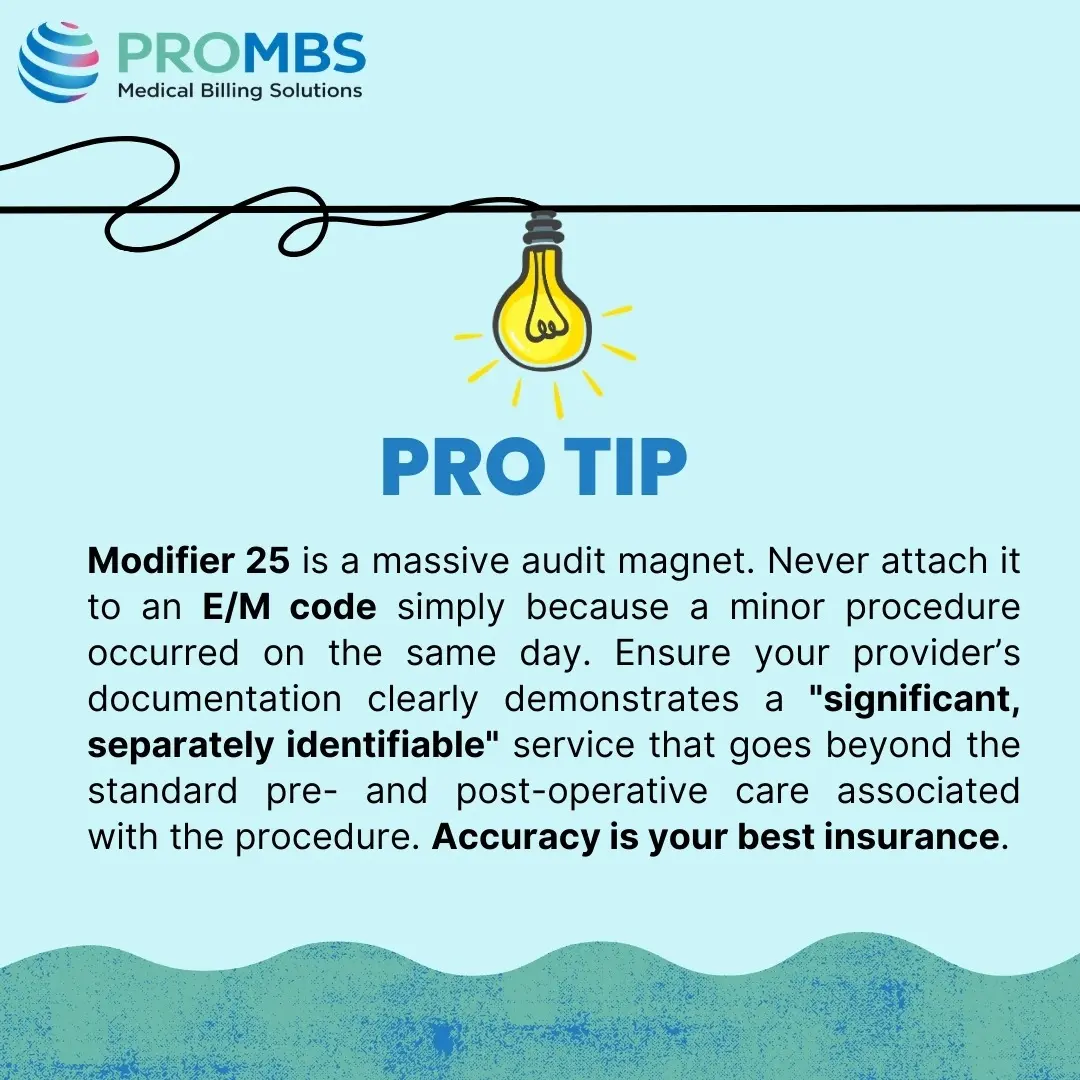
Modifier Misuse: Inappropriately applying modifiers (e.g., -25 or -59) to bypass NCCI (National Correct Coding Initiative) edits or payer bundling rules.
-
Using Outdated Code Sets: Submitting claims with discontinued or invalid codes that do not reflect current regulatory standards.
The primary risks of these failures are:
-
Increased Claim Denials: Automated payer edits reject non-compliant claims, leading to delayed revenue.
-
Audit Exposure: Recurring patterns of errors trigger investigations by the OIG (Office of Inspector General) or private payers.
-
Financial Penalties: Practices may be forced to pay back “overpayments” and face significant fines or legal action.
Introduction
Coding errors are silently draining your practice’s bottom line. Every time a diagnosis code, procedure code, or modifier is even slightly off, your revenue cycle hits a wall. Instead of getting paid for the high-quality care you provide, your team is left chasing denials, resubmitting claims, and managing massive administrative burnout.
In today’s healthcare environment, insurance companies utilize advanced automated systems that scan claims in seconds. These systems don’t just look for typos—they check for clinical consistency. If your coding doesn’t perfectly match your medical documentation, your claim is flagged, denied, or worse, earmarked for a long-term Healthcare Coding Compliance Audit.
For busy practice leaders, managers, and physicians, these aren’t just “billing issues”—they are high-stakes operational risks that threaten your financial stability and reputation.
The True Cost of Coding Errors
Industry data shows that roughly 25–30% of all claim denials are entirely preventable. These aren’t denied because of patient eligibility or coverage issues; they are denied because of internal coding and documentation gaps.
When these errors pile up, they create “red flags” for insurance companies. Repeated patterns of incorrect modifiers or unsupported diagnosis codes often trigger intensive record requests and demands for money back (recoupments).
The result is a constant state of “catch-up,” where your office staff spends more time fixing mistakes than focusing on patient care. This creates a hidden tax on your practice—the cost of wasted time, delayed cash flow, and the stress of potential regulatory scrutiny.
Understanding the Regulatory Landscape
Coding compliance is not a static process. It is governed by a complex web of national standards, including the ICD-10-CM, CPT, and HCPCS Level II code sets, as well as the National Correct Coding Initiative (NCCI) edits.
Payers frequently update their medical necessity policies, and failure to stay ahead of these updates is one of the most common reasons practices face “unexpected” denials. When your practice operates in a vacuum, you are essentially flying blind against a payer system that is constantly being refined by predictive analytics.
Common Traps That Trigger Audits
Most Medical Coding Compliance failures stem from a disconnect between what happened in the exam room and what was submitted on the claim. If the documentation doesn’t tell the full story, the insurance company will assume the service wasn’t performed or wasn’t necessary.
Here are the most frequent culprits:
1. Diagnosis-Procedure Mismatch
Insurance companies enforce strict “medical necessity” rules. If you bill for an expensive diagnostic test but provide a diagnosis code that doesn’t logically warrant that test, the claim will be denied automatically.
2. Modifier Misuse
Modifiers are essential for telling the payer why a service was different. For example, using Modifier 25 incorrectly (to claim an extra visit on the same day as a procedure) is one of the most common targets for commercial payer audits.
3. Unspecified Coding
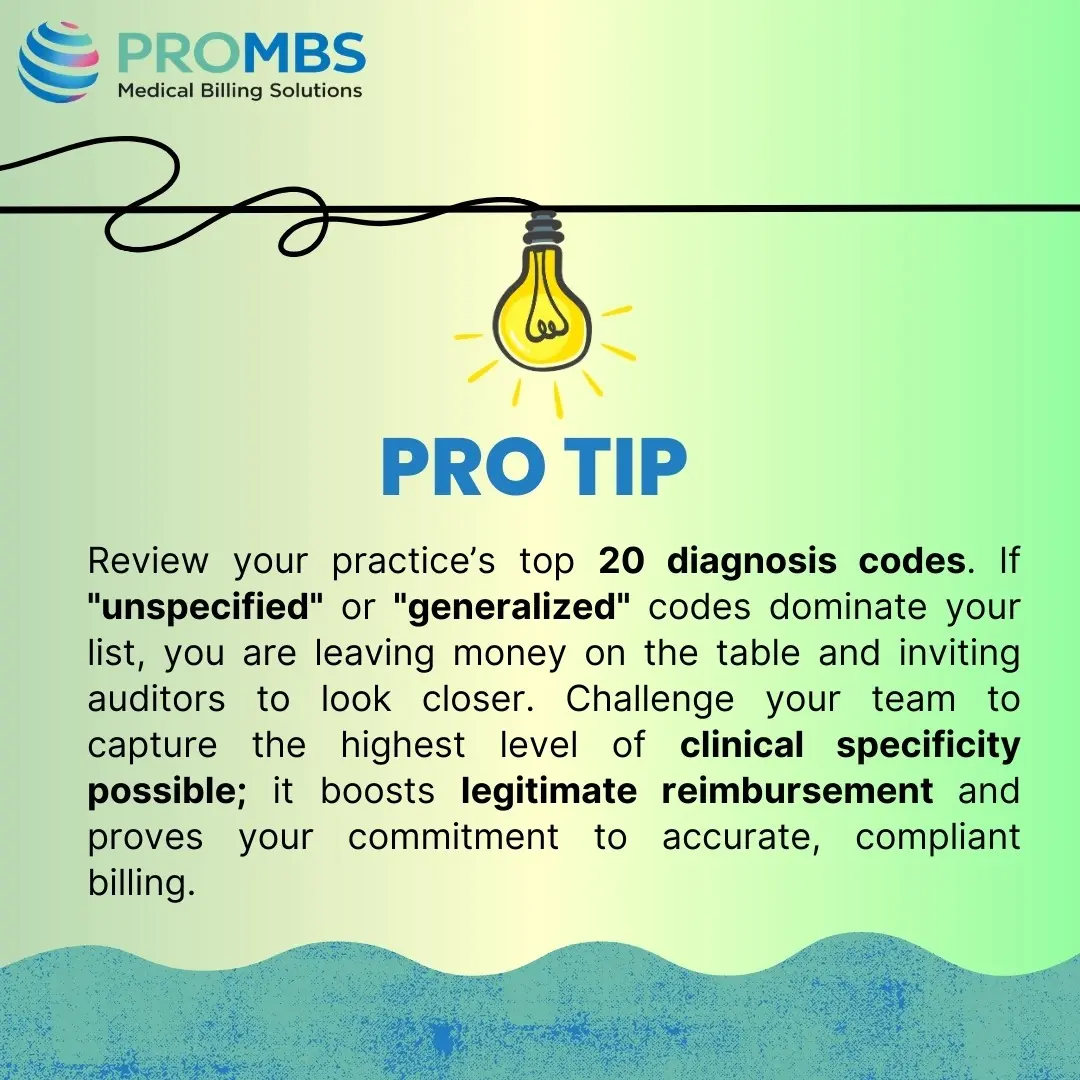
Using vague “unspecified” diagnosis codes when the clinical chart actually contains enough detail to support a more specific code is a major red flag. It suggests to auditors that your practice is not paying attention to detail, which often leads to deeper investigations.
4. Documentation Gaps
Failing to document the full scope of a visit is dangerous. If you provide a high-level service but your note only describes a basic one, you lose money. Conversely, if you bill for a high-level service but your note is missing key elements, you are committing “up-coding,” which is a serious compliance violation.
Struggling with coding compliance errors? Our certified coding team performs proactive audits that catch mistakes before payers do.
Get Your Free Bleeding Revenue Scan today
Billing Accuracy vs. Coding Compliance: The Vital Distinction
It is a common myth that if a claim is “cleanly” formatted (i.e., no typos in the patient’s name or insurance ID), it will be paid. There is a vital distinction between Billing Accuracy and Coding and Compliance.
| Feature | Billing Accuracy | Coding Compliance |
|---|---|---|
| Focus | Administrative Data | Clinical Logic |
| Goal | Claim “cleanliness” (no errors) | Justification of care (evidence) |
| Risk | Simple rejections | Audits & Recoupments |
A claim can be perfectly formatted, but if the medical record does not support the level of care claimed, the payer will eventually come looking for their money back. You need both excellence in administrative billing and rigour in coding compliance to survive.
The Role of Clinical Documentation Improvement (CDI)
Clinical Documentation Improvement (CDI) is the bridge between the clinical encounter and the final bill. Without a robust CDI program, providers may use “shorthand” in their notes that does not accurately reflect the patient’s acuity.
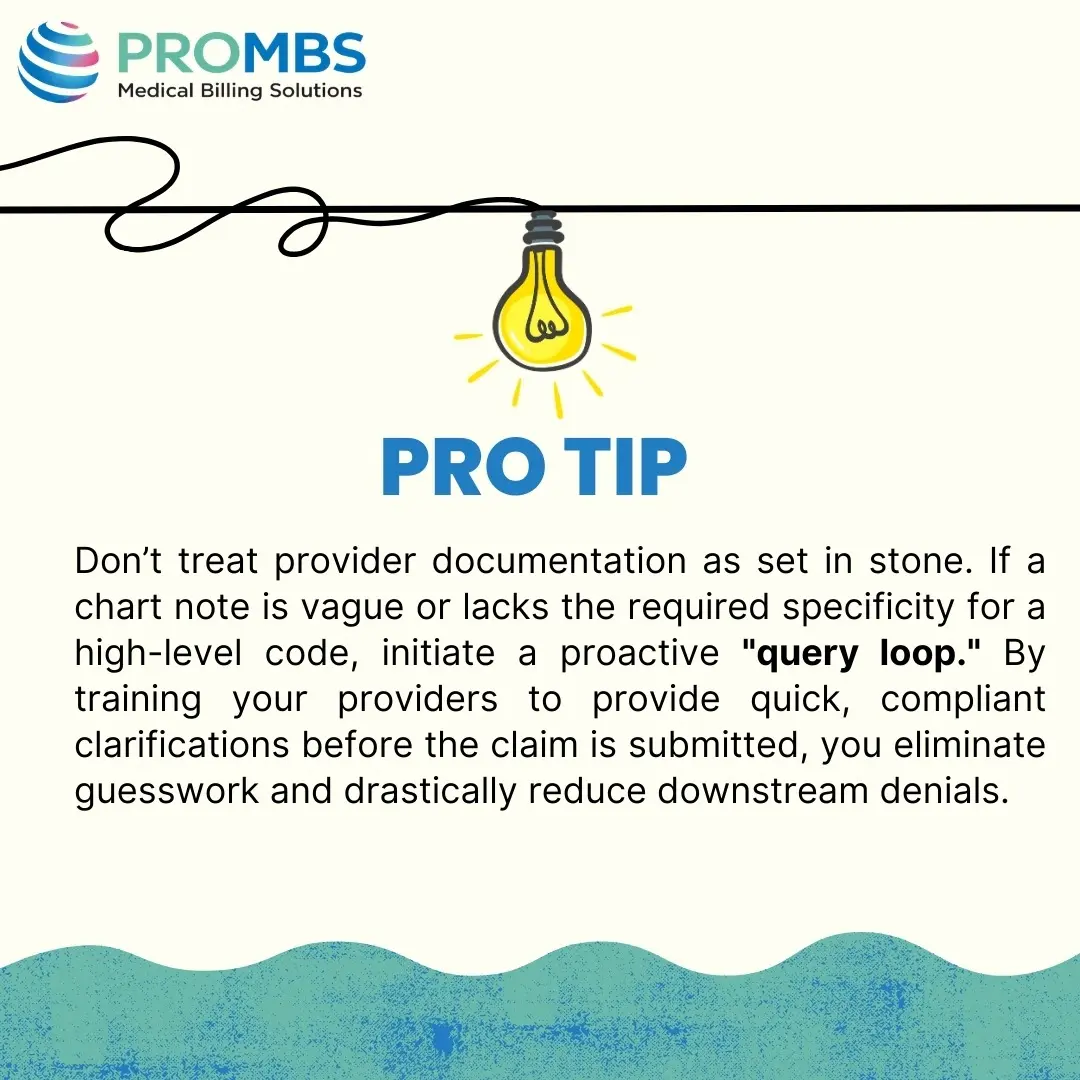
Implementing a workflow where coders can query providers when notes are ambiguous is one of the single most effective ways to ensure compliance while simultaneously maximizing legitimate reimbursement.
Why Technology Alone Isn’t Enough
Many practices are turning to “automated scrubbers” and AI tools to catch errors. While these tools are excellent for identifying missing fields, they cannot interpret the clinical nuances of a patient encounter.
A computer cannot tell if your provider’s documentation truly supports a specific service level or if a procedure was performed under complex circumstances. This is where the Hybrid Approach becomes essential.
At ProMBS, we combine high-speed claim-scrubbing technology with a team of certified human experts. This ensures that every claim submitted is not only “clean” from a data perspective but also clinically defensible.
The Financial Impact: Beyond Denials
The financial impact of poor coding compliance extends beyond just a few denied claims. It impacts your practice in several critical ways:
- Increased Accounts Receivable Days: When claims are denied, they sit in your “Pending” queue, tying up your working capital.
- Administrative Strain: Your staff spends hours on the phone with insurance reps rather than helping patients at the front desk.
- Recoupment Risk: If an audit reveals a pattern of over-billing, insurers can demand the return of payments made months or even years ago. This can devastate a practice’s quarterly budget.
- Provider Burnout: Physicians who feel the constant pressure to document perfectly for the sake of billing—without support—are more likely to experience burnout.
Strategies for Strengthening Your Internal Processes
Medical practices can reduce their risk by improving internal processes before an auditor ever sends a letter. Consider these steps:
- Conduct Regular Internal Audits: Don’t wait for the government or an insurer to find your mistakes. Hire a professional to conduct a mock audit annually.
- Improve Provider Documentation: Educate your doctors on how their notes translate into revenue. Often, simple improvements in charting can increase accuracy and decrease compliance risk.
- Train Coding Staff: Coding rules change constantly. Ensure your team is attending regular training on the latest CPT and ICD-10 guidelines.
- Improve Communication: Create a “query loop” where coders can ask providers for clarification on vague documentation before the claim is sent.
Protect Your Practice with Pro-MBS
Outsourcing your Revenue Cycle Management (RCM) isn’t just about saving time; it’s about moving from a reactive billing cycle to a proactive, revenue-positive operation. When you partner with Pro-MBS, you aren’t just hiring a service; you are gaining a partner who shares the risk and understands the complexity of modern healthcare.
Get Your Free Revenue Audit Today
When you partner with us, you gain:
- Proactive Denials Prevention: We identify and fix coding gaps before the claim ever reaches the insurance company.
- Certified Expertise: Our coders are certified and updated on the latest NCCI edits and payer-specific requirements, ensuring you don’t have to keep up with the constant industry changes.
- Audit Protection: By maintaining pristine documentation and accurate coding, we build a “defensive wall” around your practice, significantly reducing the likelihood of payer scrutiny.
- Stable Revenue: With fewer denials and faster processing, your cash flow becomes predictable, allowing you to invest back into your practice’s growth and patient experience.
Take Control of Your Revenue Today
You didn’t go into medicine to spend your days debating modifier usage with insurance adjusters. You started your practice to help patients. Let our specialists handle the complexity of Coding and Compliance while you stay focused on clinical outcomes.
Medical billing has become too complex to manage casually. As payer oversight continues to tighten, those who rely on outdated or manual processes will be the most vulnerable to audits. By outsourcing your billing to an experienced partner, you can stop the financial leaks and gain peace of mind knowing that your revenue cycle is being managed by experts.
Ready to stop the leaks in your revenue cycle?
Contact ProMBS today for a complimentary coding health assessment
and see how our hybrid approach can reduce your denial rate and secure your practice’s financial future.
Frequently Asked Questions
What is coding compliance in healthcare?
Coding compliance refers to ensuring that diagnosis codes, procedure codes, and modifiers accurately represent the services documented in a patient’s medical record. It requires adherence to ICD-10-CM, CPT, HCPCS, and NCCI guidelines so that claims meet payer medical necessity rules and remain defensible during audits or documentation reviews.
Why is coding compliance important for medical practices?
Coding compliance protects medical practices from claim denials, payer recoupments, and regulatory penalties. When documentation and coding accurately reflect patient care, claims pass payer validation more easily. Strong compliance programs also improve revenue cycle stability by reducing administrative rework, preventing audit risks, and supporting accurate reimbursement.
What are common coding compliance mistakes that trigger audits?
Frequent coding compliance mistakes include modifier misuse, diagnosis-procedure mismatches, excessive unspecified codes, and documentation that does not support the billed service level. Payers detect these patterns through automated claim reviews. Repeated inconsistencies often trigger record requests or formal healthcare coding compliance audits.
How can healthcare providers improve coding compliance?
Healthcare providers can strengthen coding compliance by improving clinical documentation, conducting periodic internal coding audits, and training staff on updated ICD-10 and CPT guidelines. Establishing a documentation query process between coders and clinicians also ensures that claims reflect accurate clinical details before submission to payers.