

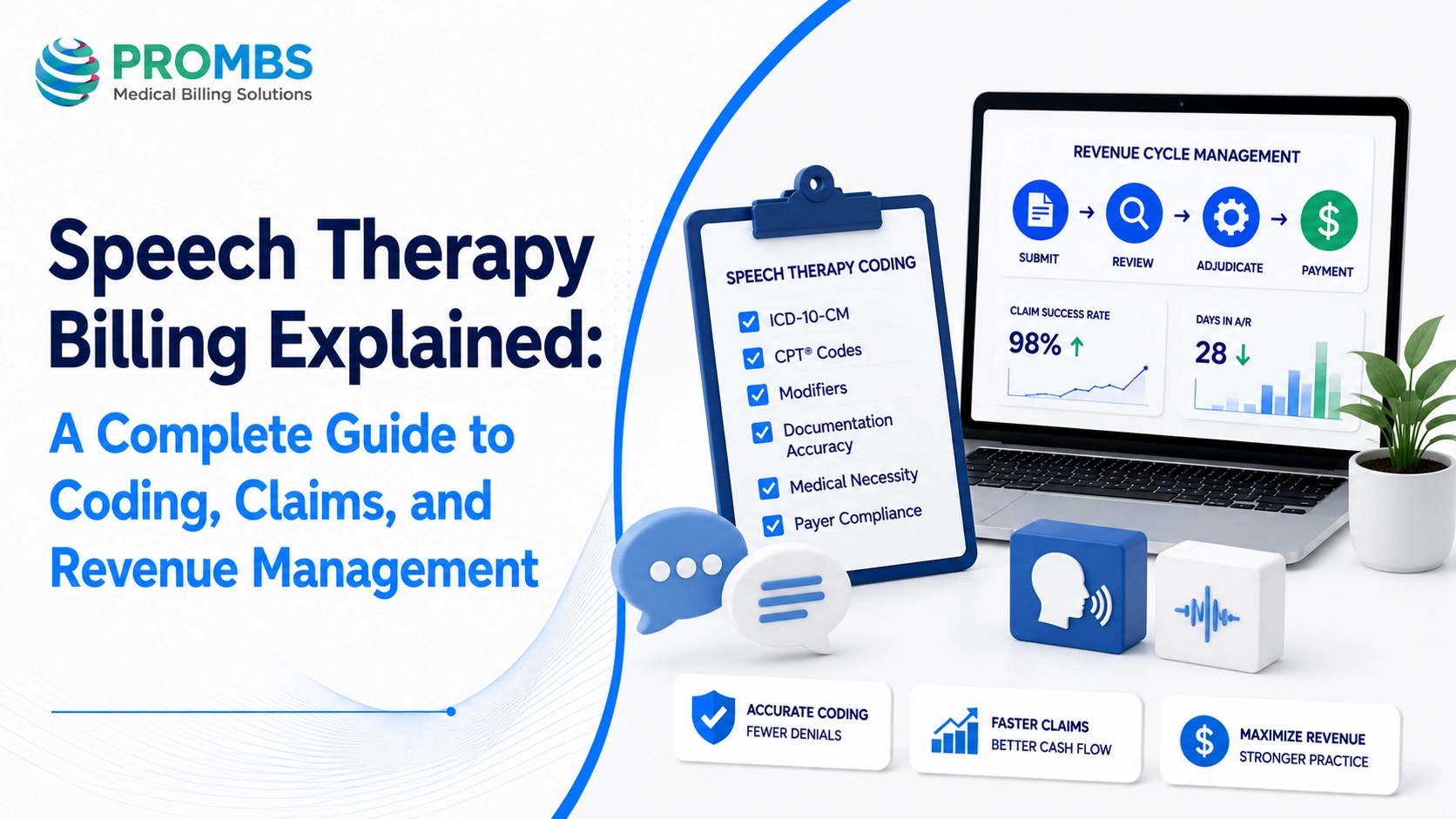
Running a successful speech therapy practice requires more than providing quality care to patients.
Behind every evaluation, therapy session, and treatment plan is a complex billing process that determines whether the practice receives accurate and timely reimbursement.
This is where speech therapy billing becomes essential.
Speech-language pathology billing requires specialized knowledge because reimbursement depends on accurately connecting:
- Clinical documentation
- CPT coding
- Diagnosis coding
- Medical necessity
- Payer requirements
- Modifier usage
- Claim submission rules
A small mistake in coding or documentation can lead to:
- Claim denials
- Payment delays
- Reduced reimbursement
- Additional administrative workload
Speech therapy services are evaluated by payers based on whether documentation supports the medical necessity of the service, the skilled nature of treatment, and the relationship between diagnosis, treatment goals, and billed codes.
For speech therapy practices, successful reimbursement requires more than submitting claims.
It requires a complete revenue cycle process that connects:
- Patient intake
- Insurance verification
- Authorization management
- Clinical evaluation
- Treatment documentation
- Coding
- Claim submission
- Payment posting
- Denial management
- Accounts receivable follow-up
This guide explains how speech therapy billing works, why it is complex, common challenges practices face, and how speech-language pathology organizations can improve their revenue cycle performance.
What Is Speech Therapy Billing?
Speech therapy billing is the process of documenting, coding, submitting, and managing claims for speech-language pathology services.
It allows speech therapy providers to receive reimbursement for services designed to evaluate and treat communication, speech, language, voice, cognitive, and swallowing disorders.
Speech therapy billing may include services such as:
- Speech evaluations
- Language assessments
- Speech sound treatment
- Voice therapy
- Fluency treatment
- Cognitive communication therapy
- Swallowing and feeding therapy
- Augmentative and alternative communication (AAC) services
The billing process converts clinical services into standardized codes that insurance companies use to determine reimbursement.
A complete speech therapy billing workflow includes:
- Patient registration
- Insurance verification
- Benefit review
- Authorization confirmation
- Clinical documentation review
- CPT coding
- ICD-10 diagnosis coding
- Modifier review
- Claim submission
- Payment posting
- Denial resolution
Speech therapy billing requires close coordination between clinicians and billing teams because reimbursement depends on whether documentation supports the services billed.
Why Speech Therapy Billing Is Different From General Medical Billing
Speech therapy billing has unique challenges that separate it from traditional medical billing.
The biggest differences include:
- Therapy-specific CPT codes
- Documentation-heavy reimbursement requirements
- Functional outcome tracking
- Medical necessity requirements
- Timed and untimed service considerations
- Payer-specific therapy rules
Unlike some specialties where billing mainly depends on procedures performed, speech therapy reimbursement depends heavily on demonstrating the clinical need and skilled nature of the therapy.
Payers may review:
- Why therapy was needed
- What treatment was provided
- How the patient responded
- Whether goals are measurable
- Whether continued treatment is justified
Strong documentation helps prove that services were medically necessary and that skilled intervention was provided.
CPT Coding Requirements in Speech Therapy Billing
Accurate CPT coding is one of the most important parts of successful speech therapy billing.
Speech therapy practices commonly bill services related to:
- Speech and language evaluations
- Speech and language treatment
- Swallowing assessment and treatment
- Cognitive communication therapy
- Communication device evaluations
Common speech therapy CPT categories include:
- Evaluation services
- Individual treatment services
- Group therapy services
- Swallowing therapy services
- AAC-related services
Examples of commonly used speech therapy CPT codes include:
- 92507 – Speech, language, voice, communication, and/or auditory processing treatment
- 92508 – Group speech, language, voice, communication, and/or auditory processing treatment
- 92526 – Treatment of swallowing dysfunction and oral function
Incorrect CPT selection can result in:
- Claim rejection
- Incorrect reimbursement
- Additional payer review
Diagnosis Coding and Medical Necessity in Speech Therapy Billing
ICD-10 diagnosis coding explains the condition being treated and supports the medical necessity of speech therapy services.
Diagnosis coding may include conditions related to:
- Speech disorders
- Language disorders
- Voice disorders
- Swallowing disorders
- Cognitive communication disorders
- Developmental conditions
The diagnosis code should accurately reflect the patient’s condition and support the treatment being provided.
A mismatch between diagnosis coding and therapy services can lead to:
- Claim denials
- Payment delays
- Medical necessity concerns
Documentation Requirements for Speech Therapy Billing
Documentation is one of the biggest factors affecting speech therapy reimbursement.
A strong speech therapy note should clearly support:
- Patient condition
- Treatment goals
- Skilled intervention
- Services provided
- Patient progress
Evaluation Documentation
Speech evaluations should include:
- Patient history
- Assessment findings
- Diagnostic information
- Clinical interpretation
- Treatment recommendations
Treatment Documentation
Therapy notes should include:
- Date of service
- Treatment provided
- Goals addressed
- Patient response
- Progress toward goals
Medical Necessity Support
Documentation should explain:
- Why therapy is needed
- How services improve function
- Why skilled intervention is required
Incomplete documentation can make it difficult for payers to verify medical necessity and may contribute to claim denials.
Modifier and Payer Requirements
Speech therapy billing may require careful attention to:
- Modifier requirements
- Place of service codes
- Medicare therapy rules
- Telehealth billing requirements
- Payer-specific policies
Incorrect modifier usage can create:
- Claim processing delays
- Payment reductions
- Rejected claims
A strong billing workflow reviews payer requirements before claims are submitted.
Common Speech Therapy Services That Require Billing Expertise
Speech therapy practices provide several services that require accurate billing workflows.
Speech and Language Therapy
These services address challenges related to:
- Speech production
- Language development
- Communication skills
Billing requires documentation showing:
- Functional limitations
- Treatment goals
- Patient progress
Swallowing and Feeding Therapy
Speech-language pathologists often provide swallowing services for patients with:
- Dysphagia
- Feeding difficulties
- Swallowing disorders
Documentation should support:
- Assessment findings
- Treatment provided
- Patient response
Cognitive Communication Therapy
These services address communication difficulties related to:
- Brain injury
- Neurological conditions
- Cognitive impairments
Billing requires documentation supporting:
- Cognitive challenges
- Treatment goals
- Functional improvement
Augmentative and Alternative Communication (AAC) Services
AAC-related services may involve:
- Communication device evaluation
- Device training
- Patient communication strategies
These services require accurate coding and detailed documentation.
Speech Therapy Billing Workflow Explained
| Step | Purpose |
|---|---|
| Patient Intake | Collects patient information and insurance details. |
| Insurance Verification | Confirms coverage, benefits, and payer requirements. |
| Authorization Review | Ensures required approvals are obtained before treatment. |
| Evaluation | Documents patient condition and therapy needs. |
| Treatment Documentation | Records services provided and patient progress. |
| Coding Review | Ensures CPT and diagnosis codes are accurate. |
| Claim Submission | Sends accurate claims to insurance companies. |
| Payment Posting | Records payments and adjustments. |
| Denial Management | Resolves claim issues and prevents repeat problems. |
| AR Follow-Up | Manages unpaid claims and delayed reimbursement. |
Why Documentation Is Critical in Speech Therapy Billing
Documentation is the foundation of successful reimbursement.
Speech therapy records should clearly support:
- The patient’s condition
- The need for skilled therapy
- The services provided
- The progress achieved
Important documentation includes:
Patient Assessment Details
Records should include:
- Clinical findings
- Functional limitations
- Assessment results
- Treatment recommendations
Treatment Goals
Documentation should explain:
- Short-term goals
- Long-term goals
- Functional outcomes
- Progress toward goals
Session Details
Therapy notes should include:
- Services performed
- Patient response
- Skilled interventions used
- Progress measurements
Provider Information
Documentation should identify:
- Treating clinician
- Credentials
- Applicable supervision requirements
Common Speech Therapy Billing Challenges
| Challenge | Impact on Practices |
|---|---|
| Coding Errors | Can lead to denied or underpaid claims. |
| Documentation Gaps | May prevent payers from verifying medical necessity. |
| Authorization Problems | Can result in unpaid services. |
| Modifier Errors | May delay claim processing. |
| Incorrect Diagnosis Coding | Can create reimbursement issues. |
| Denials | Increase administrative workload and delay revenue. |
Speech Therapy CPT Coding: What Practices Need to Know
Accurate CPT coding is one of the most important parts of speech therapy billing.
CPT codes communicate:
- The type of service provided
- The treatment performed
- The time involved when applicable
- The level of clinical work completed
Speech therapy practices commonly use CPT codes for:
- Speech and language evaluations
- Speech and language treatment
- Swallowing assessments
- Swallowing treatment
- Cognitive communication services
- Communication device evaluations
The selected CPT code should always match:
- The documented service
- The patient’s condition
- The treatment goals
- The provider performing the service
Incorrect CPT coding can result in:
- Claim denials
- Underpayments
- Additional payer review
- Compliance concerns
Common Speech Therapy CPT Codes
92507: Speech, Language, Voice, Communication, and/or Auditory Processing Treatment
This code is commonly used for individual speech therapy treatment.
Documentation should support:
- The communication problem being treated
- Therapy goals
- Intervention provided
- Patient progress
Common issues include:
- Missing treatment details
- Weak progress documentation
- Lack of medical necessity support
92508: Group Speech, Language, Voice, Communication, and/or Auditory Processing Treatment
This code applies to group speech therapy services.
Documentation should include:
- Group setting details
- Services provided
- Patient participation
- Treatment goals
Practices should ensure that group services are accurately documented and billed according to payer requirements.
92526: Treatment of Swallowing Dysfunction and Oral Function
This code is commonly used for swallowing and feeding therapy.
Documentation should support:
- Swallowing diagnosis
- Treatment provided
- Patient response
- Functional improvement
Incomplete swallowing documentation may create reimbursement challenges.
Speech and Language Evaluation Codes
Evaluation services require documentation supporting:
- Reason for evaluation
- Assessment performed
- Clinical findings
- Treatment recommendations
A detailed evaluation helps establish medical necessity and supports future treatment services.
ICD-10 Coding Considerations in Speech Therapy Billing
ICD-10 diagnosis coding explains why speech therapy services are medically necessary.
Accurate diagnosis coding helps payers understand:
- The patient’s condition
- Functional limitations
- Reason for treatment
- Need for continued therapy
Common diagnosis categories may include:
- Speech disorders
- Language disorders
- Voice disorders
- Cognitive communication disorders
- Swallowing disorders
- Developmental conditions
A diagnosis code should accurately reflect the patient’s condition and align with the services provided.
A mismatch between diagnosis coding and treatment documentation can lead to:
- Claim denials
- Medical necessity reviews
- Payment delays
Modifier Requirements in Speech Therapy Billing
Modifiers provide additional information about how a service was delivered or billed.
Speech therapy billing may involve modifier considerations related to:
- Medicare therapy requirements
- Telehealth services
- Multiple services provided during the same visit
- Payer-specific billing rules
Common modifier problems include:
- Missing modifiers
- Incorrect modifier usage
- Documentation not supporting the modifier
A strong billing workflow reviews payer-specific modifier requirements before claim submission.
Medicare Requirements for Speech Therapy Billing
Medicare speech therapy billing requires careful attention to documentation, medical necessity, and therapy requirements.
Practices should ensure records support:
- The need for skilled therapy
- The patient’s functional limitations
- Treatment goals
- Progress toward improvement
- Continued need for services
Medicare therapy documentation should clearly demonstrate that the services provided require the skill and expertise of a qualified speech-language pathologist.
Common Speech Therapy Billing Challenges
Speech therapy practices face several billing challenges that can affect reimbursement.
1. Documentation Gaps
Documentation issues are among the most common causes of claim problems.
Examples include:
- Missing treatment details
- Unclear therapy goals
- Lack of progress updates
- Incomplete evaluation notes
Impact:
- Claim delays
- Medical necessity questions
- Denials
Prevention:
- Standardized documentation processes
- Regular chart reviews
- Provider education
2. Incorrect CPT Coding
Coding mistakes can happen when:
- The wrong procedure code is selected
- Documentation does not support the billed service
- Multiple services are incorrectly reported
Impact:
- Underpayments
- Claim rejection
- Additional payer review
Prevention:
- Regular coding audits
- Documentation review
- Billing education
3. Authorization Issues
Some speech therapy services require prior authorization depending on the payer and patient plan.
Common problems include:
- Authorization not obtained
- Authorization expiration
- Incorrect approved units
- Services exceeding approved limits
Impact:
- Unpaid services
- Claim denials
- Revenue loss
Prevention:
- Track authorization periods
- Monitor remaining visits or units
- Review payer requirements
4. Medical Necessity Denials
Payers may deny claims when documentation does not clearly explain why therapy is required.
Common causes:
- Weak treatment justification
- Lack of measurable goals
- Insufficient progress documentation
Prevention:
- Document functional outcomes
- Clearly define treatment goals
- Maintain detailed progress notes
5. Modifier and Billing Rule Errors
Incorrect modifier usage can create claim processing problems.
Common issues:
- Missing modifiers
- Incorrect payer-specific requirements
- Inconsistent documentation
Prevention:
- Review payer guidelines
- Perform claim checks before submission
Common Speech Therapy Billing Denials and Prevention Strategies
| Denial Reason | Why It Happens | Prevention Strategy |
|---|---|---|
| Incorrect CPT Coding | The billed code does not match the service provided. | Review coding accuracy before claim submission. |
| Documentation Issues | Records do not support medical necessity. | Maintain detailed evaluation and treatment notes. |
| Authorization Problems | Required approval was missing or expired. | Track authorization requirements and timelines. |
| Diagnosis Coding Errors | Diagnosis does not support the therapy provided. | Ensure ICD-10 codes match patient conditions. |
| Modifier Errors | Required billing details are missing or incorrect. | Review payer-specific modifier requirements. |
| Timely Filing Issues | Claims are submitted after payer deadlines. | Monitor claim submission timelines. |
How Speech Therapy Practices Can Prevent Claim Denials
Reducing denials requires improving processes before claims are submitted.
1. Review Documentation Before Billing
Before submitting claims, practices should verify:
- Treatment notes
- Therapy goals
- Progress documentation
- Medical necessity support
Strong documentation creates stronger claims.
2. Perform Regular Coding Audits
Coding reviews help identify:
- CPT coding errors
- Documentation mismatches
- Training opportunities
Regular audits improve accuracy and reduce repeated billing problems.
3. Monitor Authorization Requirements
Practices should track:
- Approved services
- Authorization dates
- Remaining visits
- Payer requirements
This prevents billing for services that may not be covered.
4. Analyze Denial Patterns
Practices should look beyond individual denied claims.
They should analyze:
- Most common denial reasons
- Problematic payers
- Frequently denied services
- Documentation issues
This helps solve the root causes behind recurring denials.
Speech Therapy Billing Denial Prevention Checklist
| Area | Review Question |
|---|---|
| Documentation | Do therapy notes support the service provided? |
| Coding | Do CPT codes match the documented treatment? |
| Diagnosis | Does the diagnosis support medical necessity? |
| Authorization | Are required approvals active? |
| Modifiers | Are payer-specific requirements followed? |
| Claims | Are claims reviewed before submission? |
Why Speech Therapy Practices Need Specialty Billing Expertise
Speech therapy billing requires knowledge beyond general medical billing.
A specialized billing team understands:
- Speech therapy CPT codes
- Documentation requirements
- Payer guidelines
- Authorization challenges
- Denial prevention strategies
- Revenue cycle workflows
Without specialty knowledge, practices may experience:
- Lost reimbursement
- Increased denials
- Administrative workload
- Delayed payments
A specialty-focused billing approach helps speech therapy practices ensure services are accurately documented, correctly billed, and properly reimbursed.
How Speech Therapy Practices Can Improve Revenue Cycle Performance
Speech therapy practices often face revenue challenges that are not caused by a lack of patient care, but by problems within the billing workflow.
A claim may fail because of issues that started earlier in the process.
1. Improve Documentation Workflows
Documentation is the foundation of successful speech therapy reimbursement.
Practices should create consistent documentation standards that capture:
- Patient condition
- Functional limitations
- Treatment goals
- Services performed
- Patient progress
Strong documentation helps:
- Support medical necessity
- Improve claim accuracy
- Reduce payer questions
- Prevent avoidable denials
Speech therapy providers should ensure that clinical notes clearly connect the treatment provided with the patient’s functional improvement goals.
2. Strengthen Authorization Management
Authorization requirements are a common challenge for speech therapy practices.
Depending on the payer, practices may need approval before providing certain services.
Common authorization challenges include:
- Expired authorizations
- Incorrect approved visits
- Missing approvals
- Services exceeding approved limits
Practices should maintain processes for:
- Tracking authorization dates
- Monitoring approved visits
- Reviewing payer requirements
- Requesting renewals on time
Better authorization management helps prevent unpaid services.
3. Perform Regular Coding Reviews
Speech therapy billing involves multiple CPT codes and payer-specific requirements.
Regular coding reviews help identify:
- Incorrect CPT selection
- Documentation mismatches
- Modifier issues
- Billing inconsistencies
Coding audits help practices improve:
- Accuracy
- Compliance
- Reimbursement consistency
The goal is not only finding mistakes but improving the workflow that creates those mistakes.
4. Create a Proactive Denial Management Strategy
Many practices focus on denied claims only after revenue has already been delayed.
A stronger approach focuses on prevention.
A proactive denial management strategy includes:
- Tracking denial reasons
- Reviewing payer trends
- Identifying repeated issues
- Improving internal workflows
For example:
If a practice frequently receives denials because therapy notes do not support medical necessity, the solution is improving documentation practices rather than only appealing claims.
5. Monitor Accounts Receivable Performance
Unpaid claims can impact a speech therapy practice’s cash flow.
Practices should regularly monitor:
- Aging claims
- Outstanding balances
- Denied claims
- Payment delays
- Insurance follow-up
A strong AR management process helps practices recover revenue faster and maintain predictable cash flow.
6. Use Revenue Cycle Reporting
Without proper reporting, practices may not understand where revenue problems exist.
Important speech therapy billing metrics include:
- Clean claim rate
- Denial rate
- Days in AR
- Collection rate
- Top denial reasons
- Payer performance
Revenue cycle reports help practice owners make better financial decisions.
In-House vs Outsourced Speech Therapy Billing
Many speech therapy practices evaluate whether to manage billing internally or partner with a specialized billing company.
Both options can work, but the right choice depends on:
- Practice size
- Number of providers
- Claim volume
- Internal expertise
- Growth goals
In-House Billing vs Outsourced Speech Therapy Billing
| Area | In-House Billing | Outsourced Speech Therapy Billing |
|---|---|---|
| Specialty Knowledge | Depends on internal understanding of speech therapy coding and payer requirements. | Provides access to specialists familiar with speech therapy billing challenges. |
| Coding Accuracy | Requires ongoing training and internal reviews. | Provides dedicated coding support and claim reviews. |
| Authorization Management | Practice manages approvals and tracking internally. | Provides support for authorization monitoring and payer requirements. |
| Denial Management | Staff may focus on fixing problems after denials occur. | Uses proactive strategies to identify and prevent recurring denials. |
| Scalability | Growth requires additional billing staff and resources. | Support can expand as practice needs increase. |
| Reporting | Practice manages financial tracking internally. | Provides revenue cycle insights and performance reporting. |
Benefits of Outsourcing Speech Therapy Billing
Outsourcing speech therapy billing is not only about reducing administrative tasks.
The right billing partner can help practices improve their complete revenue cycle.
Access to Speech Therapy Billing Expertise
Speech therapy billing requires knowledge of:
- CPT coding requirements
- Documentation standards
- Payer guidelines
- Authorization workflows
- Denial prevention strategies
A specialty-focused billing team understands these challenges and helps practices maintain accurate billing processes.
Improved Claim Accuracy
A dedicated billing team can review:
- CPT codes
- Diagnosis codes
- Documentation support
- Modifier requirements
- Claim details
This helps reduce errors before claims are submitted.
Better Denial Prevention
A strong billing partner does more than recover denied claims.
They analyze:
- Why claims fail
- Which payers create challenges
- Which services are frequently denied
- Which workflows need improvement
This helps practices reduce repeated reimbursement problems.
Reduced Administrative Workload
Speech therapy providers already manage:
- Patient care
- Evaluations
- Treatment sessions
- Documentation
- Progress tracking
Managing billing issues internally adds additional pressure.
Outsourcing allows providers to focus more on patient care while billing specialists manage revenue cycle responsibilities.
Improved Revenue Visibility
Many practices know their collections but do not fully understand:
- Why claims are delayed
- Where denials occur
- Which payers create problems
- How financial performance changes
A structured billing partner provides better insight into:
- Claims performance
- Denial trends
- AR status
- Payment patterns
How to Choose a Speech Therapy Billing Partner
Choosing a speech therapy billing company requires evaluating more than pricing.
A strong partner should understand the unique challenges of speech-language pathology billing.
1. Do They Understand Speech Therapy Billing?
Ask whether they understand:
- Speech therapy CPT codes
- Documentation requirements
- Authorization workflows
- Medicare therapy rules
- Payer-specific requirements
General medical billing experience may not be enough.
2. How Do They Handle Denials?
Ask:
“Do you only appeal denied claims, or do you analyze why denials happen?”
A strong billing partner should provide:
- Denial tracking
- Root cause analysis
- Appeal support
- Prevention strategies
3. What Reporting Do They Provide?
Practices should have visibility into:
- Claims
- Payments
- Denials
- AR performance
- Collection trends
Reporting should help practice owners understand financial performance.
4. How Does Communication Work?
A successful billing relationship requires clear communication.
Practices should understand:
- Who manages the account
- How updates are provided
- How issues are escalated
- How performance is reviewed
How Pro Medical Billing Solutions Supports Speech Therapy Practices
Speech therapy practices need a billing partner that understands the connection between:
- Clinical documentation
- CPT coding
- Authorization requirements
- Claim management
- Denial prevention
- Revenue cycle performance
Pro Medical Billing Solutions helps speech therapy organizations improve billing operations through:
- Speech therapy billing support
- Medical coding assistance
- Insurance verification
- Authorization support
- Claims management
- Denial management
- Payment posting
- Accounts receivable follow-up
- Revenue cycle reporting
Our approach focuses on improving the processes behind reimbursement challenges.
Instead of only fixing denied claims, PROMBS helps practices identify why billing issues occur and create stronger revenue cycle workflows.
Learn more about our Medical Billing Services and how specialized billing support can help healthcare organizations improve financial performance.
Frequently Asked Questions
What is speech therapy billing?
Speech therapy billing is the process of documenting, coding, submitting, and managing claims for speech-language pathology services.
It includes patient verification, authorization management, CPT coding, claim submission, payment posting, and denial management.
Why is speech therapy billing complex?
Speech therapy billing is complex because reimbursement depends on:
- Accurate CPT coding
- Documentation quality
- Medical necessity
- Authorization requirements
- Payer-specific rules
Small errors can lead to delayed payments or denied claims.
What are common speech therapy billing challenges?
Common challenges include:
- Incorrect CPT coding
- Documentation gaps
- Authorization problems
- Modifier errors
- Diagnosis coding issues
- Claim denials
How can speech therapy practices reduce claim denials?
Practices can reduce denials by improving:
- Documentation workflows
- Coding accuracy
- Authorization tracking
- Claim reviews
- Denial analysis
Should speech therapy practices outsource billing?
Outsourcing may help speech therapy practices access specialty billing expertise, reduce administrative workload, improve claim accuracy, and strengthen revenue cycle performance.
It can be especially useful for practices dealing with increasing denials, complex payer requirements, or limited internal billing resources.
Final Thoughts: Building a Stronger Speech Therapy Revenue Cycle
Speech therapy billing requires more than submitting claims.
The combination of CPT coding requirements, documentation standards, authorization challenges, and payer rules makes revenue cycle management a critical part of speech therapy practice success.
A strong speech therapy billing process helps practices:
- Improve claim accuracy
- Reduce avoidable denials
- Protect reimbursement
- Improve AR performance
- Gain better financial visibility
Whether a speech therapy practice is struggling with coding challenges, delayed payments, or administrative workload, a specialty-focused billing approach can help create a more predictable revenue cycle.
With the right processes and expertise, speech therapy providers can focus more on delivering quality care while maintaining stronger financial operations.