

A physician examines a patient, recommends treatment, and documents the medical condition. The service is provided, the claim is submitted, and the practice expects reimbursement.
Instead, the insurance company denies the claim because the treatment was not considered medically necessary.
For healthcare practices, this can be frustrating. The physician believed the service was appropriate, but the payer’s decision does not reflect that clinical judgment.
In many cases, the issue is not necessarily that the treatment was inappropriate. The submitted documentation may not clearly explain why the patient needed that particular service or demonstrate how the treatment met the payer’s coverage requirements.
A medical necessity denial appeal gives the practice an opportunity to challenge the payment decision using relevant clinical records, diagnostic findings, treatment history, and other supporting evidence.
However, simply resubmitting the same records or writing that a procedure was medically necessary may not be enough.
The appeal must address the actual reason for denial and explain how the documented clinical facts support coverage under the applicable rules.
What Is a Medical Necessity Denial Appeal?
A medical necessity denial appeal is a formal request asking an insurance payer to reconsider its decision to deny coverage or payment for a healthcare service based on medical necessity requirements.
It involves reviewing the payer’s decision and presenting relevant clinical evidence explaining why the service was appropriate for the patient’s documented condition.
For example, a patient may receive an MRI after experiencing persistent symptoms that have not improved with previous treatment.
The insurance company denies the claim because its review does not establish that the imaging study met the applicable medical necessity criteria.
The physician may have documented the reason for ordering the MRI, but the original claim review might not have included all relevant examination findings or treatment history.
In that situation, the billing team should review the denial and coordinate with the physician to determine whether the medical record contains the evidence required by the payer.
If the documentation supports the applicable criteria, the practice may have grounds to challenge the denial.
The purpose of the appeal is to demonstrate why the original payment decision should be reconsidered, not simply to repeat that the physician recommended the service.
An effective medical necessity denial appeal requires collaboration between clinical staff, coding specialists, and the billing team.
Pro Medical Billing Solutions (PROMBS) supports healthcare practices through denial investigation, documentation review, and appeal management. By identifying the actual reason for nonpayment, our team helps practices determine what information is needed before pursuing an appeal.
Why Do Insurance Companies Deny Claims for Medical Necessity?
Insurance companies evaluate medical necessity using the patient’s benefits, applicable coverage policies, and clinical information available for review.
A service may be clinically reasonable, but that does not automatically mean it satisfies every requirement for reimbursement under a particular insurance plan.
Medical necessity denials commonly occur for several reasons.
Insufficient Clinical Documentation
The medical record may describe the service performed without explaining the clinical circumstances that made it necessary.
For example, a physician may document that a diagnostic test was ordered because the patient reported pain.
However, the payer’s policy may require additional information, such as the duration of symptoms, relevant examination findings, previous treatment, or specific clinical indications.
If those details are absent from the records reviewed by the payer, the claim may be denied.
Treatment Does Not Meet Payer Coverage Criteria
Some insurance policies define specific circumstances under which a test, procedure, or treatment is covered.
A payer may require evidence of a particular diagnosis, functional limitation, severity level, or previous treatment attempt.
When the documentation does not establish those criteria, the payer may determine that the service does not qualify for payment.
This does not automatically establish whether the physician’s clinical judgment was correct or incorrect. It identifies a disagreement or gap between the available evidence and the payer’s coverage determination.
Missing Evidence of Previous Treatment
Certain services require documentation showing that other appropriate treatments were attempted or considered before a more advanced intervention.
For example, a payer may require evidence of conservative treatment before approving particular imaging studies or procedures, depending on the patient’s condition and the policy’s exceptions.
If the medical record does not describe the previous treatment, its duration, or the patient’s response, the payer may conclude that the necessary clinical criteria were not demonstrated.
Coding and Documentation Do Not Align
Medical necessity denials can also involve differences between the diagnosis reported on the claim and the clinical condition described in the medical record.
For example, the physician’s documentation may describe neurological symptoms, but the claim may include an incomplete or inaccurate diagnosis code.
The billing team should determine whether the problem involves a genuine coverage decision or a correctable coding error.
PROMBS’s medical coding services help practices review coding accuracy and documentation alignment, which are important for preventing avoidable denials.
However, coding should never be modified solely to satisfy an insurer when the change is not supported by the medical record.
How Medical Necessity Denials Affect Practice Revenue
Medical necessity denials affect more than the payment associated with a single claim.
Every unresolved denial requires staff time, supporting records, payer communication, and additional follow-up.
When a practice receives these denials regularly, the administrative workload can become substantial.
Delayed Reimbursement and Aging A/R
Consider a specialty practice with 12 medical necessity denials carrying an estimated allowable reimbursement of $1,500 each.
That represents $18,000 in potential reimbursement awaiting further review.
These amounts are illustrative and do not represent guaranteed recoverable revenue.
Some claims may be eligible for payment after appeal, while others may remain noncovered under the applicable rules.
However, if the practice does not investigate these denials promptly, otherwise valid recovery opportunities may be missed.
Unresolved balances can also move into older accounts receivable categories, making collections less predictable.
PROMBS supports healthcare providers through revenue cycle management services that connect claim tracking, denial management, payment posting, and A/R follow-up.
This coordinated process helps practices identify outstanding claims and determine which accounts require additional documentation or payer review.
Repeated Appeals Increase Administrative Costs
A poorly prepared appeal may fail to address the actual reason for denial.
If the practice submits incomplete documentation, the payer may uphold its decision, leaving staff to prepare another request or pursue a further review where permitted.
This creates repeated work for physicians, billing specialists, and administrative employees.
An organized documentation process can reduce avoidable rework and help practices submit a more complete appeal the first time.
The priority should be submitting relevant evidence, not simply increasing the number of documents attached.
What Supporting Documentation Should Practices Submit?
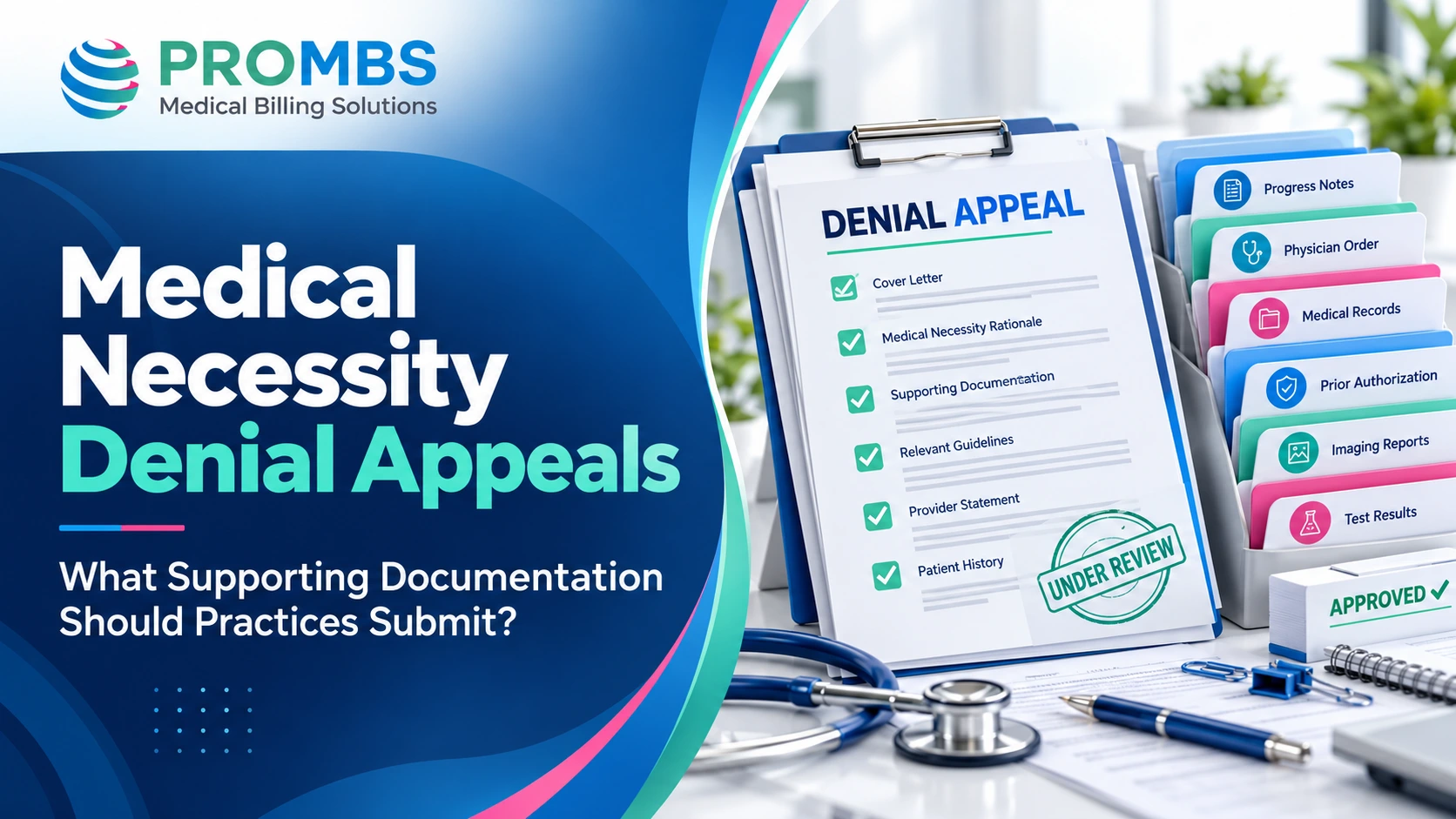
A medical necessity denial appeal should include clinical records that establish the patient’s condition, explain why the service was needed, and demonstrate how the treatment meets applicable coverage criteria.
The exact documentation depends on the denied service, insurance plan, and reason for the payer’s decision.
For example, a diagnostic imaging appeal may require examination findings and previous treatment history. A surgical appeal may need an operative report, specialist consultation, and evidence supporting the procedure’s clinical indication.
The following documents are commonly relevant.
Physician Notes and Clinical History
Physician notes often provide the foundation of a medical necessity appeal.
They explain what the patient was experiencing, what the clinician found during the examination, and why the treatment was recommended.
Depending on the service, relevant documentation may include:
- Presenting symptoms and their duration.
- Relevant medical and surgical history.
- Physical examination findings.
- Clinical assessment and diagnosis.
- Functional limitations or changes in the patient’s condition.
- The physician’s assessment and treatment plan.
For example, a note stating only “patient experiencing back pain” may not provide enough information to evaluate coverage for a particular imaging study.
A more detailed record describing the symptoms, examination findings, treatment history, and clinical reason for imaging provides a clearer basis for review.
However, the documentation still must satisfy the specific policy requirements that apply to the service.
The billing team should identify missing or unclear information and refer it to the appropriate clinician. It should not create clinical findings or alter medical records to obtain reimbursement.
Diagnostic Results and Objective Findings
Diagnostic evidence helps demonstrate the clinical findings underlying a physician’s treatment decision.
Depending on the condition and service, supporting records may include laboratory results, imaging reports, pathology findings, diagnostic assessments, or other relevant test results.
For example, a medical necessity appeal involving a specialist procedure may benefit from test results that establish the severity or nature of the patient’s condition.
These records can help connect the reported diagnosis with the treatment provided.
However, not every appeal requires imaging or laboratory evidence.
Some medical conditions are diagnosed primarily through clinical evaluation, and the applicable coverage policy determines what supporting evidence is necessary.
The goal is to submit information that answers the payer’s specific concern rather than attaching every available test result.
Previous Treatments and Patient Response
Treatment history can be particularly important when the payer’s coverage policy requires evidence that other appropriate options were attempted, considered, or found unsuitable.
The medical record should describe relevant previous treatment, the patient’s response, and why further intervention was appropriate.
For example, a patient may have received medication, physical therapy, or another treatment before undergoing a procedure.
If the applicable policy requires documentation of previous management, the appeal should identify where that information appears in the clinical record.
Relevant details may include:
- Previous treatment or intervention.
- Duration of treatment when relevant.
- Patient response and clinical outcomes.
- Reasons treatment was discontinued or changed.
- Contraindications or clinical reasons certain alternatives were unsuitable.
These requirements vary by service and payer.
Practices should not assume that conservative treatment is mandatory for every procedure or that a particular treatment duration applies to all patients.
Letter of Medical Necessity and Clinical Justification
A letter of medical necessity is a written explanation from the treating provider describing why a particular healthcare service was clinically appropriate.
It can help connect information scattered across several records into a clear medical explanation.
An effective letter generally identifies the patient’s condition, the service provided, the relevant clinical findings, and the reasons the treatment was appropriate.
It should also address the specific criteria or concerns cited in the denial.
For example, if the payer denied a procedure because the available documentation did not establish sufficient functional impairment, the physician’s explanation should reference the recorded findings relevant to that requirement.
The letter should be consistent with the medical record and should not introduce unsupported clinical facts.
Importantly, a letter of medical necessity does not automatically replace required medical records or guarantee payment.
Aetna’s official provider appeals guidance identifies medical records, office notes, remittance information, and a clear explanation of the disputed decision as important supporting materials.
PROMBS helps practices coordinate the billing and administrative components of appeal preparation while working with treating providers for the clinical information needed to support the request.
How Payer Coverage Policies Determine Medical Necessity
One of the most important parts of a medical necessity appeal is understanding which coverage policy the insurer used to deny the claim.
A well-written clinical explanation may still be insufficient if it does not address the policy’s requirements.
Medicare National and Local Coverage Determinations
Original Medicare uses National Coverage Determinations (NCDs) and Local Coverage Determinations (LCDs) to establish coverage requirements for certain services.
An NCD establishes national Medicare coverage policy.
An LCD is issued by a Medicare Administrative Contractor and explains whether a particular service is considered reasonable and necessary within the contractor’s jurisdiction, consistent with applicable national requirements.
These policies may identify clinical indications, limitations, and circumstances that affect coverage.
The official CMS Medicare Coverage Database allows providers to search for relevant NCDs, LCDs, and associated billing and coding articles.
For Medicare medical necessity appeals, practices should identify the applicable coverage policy and review the requirements in effect for the date of service.
The appeal should then connect the documented clinical facts to the relevant criteria.
Commercial Payer Medical Policies
Commercial insurers maintain their own medical coverage policies, subject to applicable contracts, benefits, and legal requirements.
A procedure covered under one insurance plan may have different requirements under another.
Some insurers publish clinical policy bulletins or medical policy documents explaining when specific services qualify for coverage.
Before preparing an appeal, the billing team should review the relevant policy and determine whether the patient’s medical record supports the disputed service.
If the payer applied an incorrect policy, overlooked relevant documentation, or made a decision inconsistent with applicable requirements, those issues may provide grounds for reconsideration.
Why Policy-Based Documentation Matters
A strong medical necessity denial appeal does not rely solely on the statement that a physician considered the service necessary.
It explains why the documented clinical circumstances satisfy the applicable coverage requirements or why the payer’s determination should otherwise be reconsidered.
For example, if a policy requires evidence of a particular clinical finding, the appeal should identify the relevant documentation and explain its significance.
If an exception applies, the clinician should explain the documented circumstances supporting that exception.
This approach helps reviewers locate the relevant evidence without searching through an entire patient record.
A targeted medical billing and coding audit can help practices identify whether recurring medical necessity denials involve documentation gaps, coding inconsistencies, or misunderstanding of payer requirements.
The next step is turning that clinical evidence into a properly organized appeal.
How to Prepare a Medical Necessity Denial Appeal Step by Step
Preparing a medical necessity denial appeal requires more than collecting the patient’s medical records and sending them to the insurance company.
The billing team must understand why the claim was denied, identify the applicable coverage requirements, and work with the treating provider to present clinical evidence that addresses the payer’s concerns.
A strong medical necessity appeal connects three things: the reason for denial, the payer’s coverage criteria, and the patient’s documented clinical condition.
Without that connection, even a large collection of medical records may fail to explain why the original decision should be reconsidered.
Step 1: Review the Exact Reason for Denial
Start by examining the Explanation of Benefits (EOB), Electronic Remittance Advice (ERA), or formal denial letter.
The first task is confirming whether the claim was actually denied for medical necessity or whether the problem involves coding, authorization, coverage, or missing information.
For example, Claim Adjustment Reason Code (CARC) 50 generally indicates that the payer considers a service noncovered because it does not meet medical necessity requirements.
However, the billing team should also review any accompanying Remittance Advice Remark Codes (RARCs) and written explanations.
A denial involving missing medical records may require a different response from one where the payer reviewed the clinical evidence and concluded that the service did not meet its coverage criteria.
PROMBS helps practices investigate these differences through its denial management services, supporting the identification of claim errors, missing documentation, and disputed payer decisions.
Step 2: Identify the Applicable Coverage Policy
After confirming the reason for denial, review the medical policy the insurer used to evaluate the claim.
For Original Medicare, this may involve a National Coverage Determination (NCD), Local Coverage Determination (LCD), or other applicable Medicare requirements.
Commercial insurers may use their own clinical policies and plan-specific coverage criteria.
The billing team should verify which policy applied on the date of service and identify the requirement the payer believes was not satisfied.
For example, a policy may require evidence of persistent symptoms, particular examination findings, or unsuccessful previous treatment before covering a specific procedure.
If the medical record supports those requirements, the appeal should explain where that evidence appears.
Practices can search Medicare coverage policies through the CMS Medicare Coverage Database.
Step 3: Gather Relevant Clinical Evidence
Once the coverage criteria are understood, the billing team should coordinate with the treating provider to collect the relevant medical records.
These may include consultation notes, examination findings, diagnostic reports, treatment history, procedure documentation, and a physician’s explanation of medical necessity.
The records should support the actual service performed and the patient’s clinical condition at the time of treatment.
If the payer denied an imaging study because the submitted documentation did not establish the required clinical indications, the appeal should focus on the examination findings, symptoms, and treatment history relevant to that decision.
Submitting unrelated medical records can make the review unnecessarily complicated without strengthening the argument.
PROMBS supports the administrative and billing aspects of this process by helping practices organize claim information, identify documentation gaps, and coordinate appeal preparation.
Clinical judgments and explanations of why a service was medically necessary should come from the treating provider or another appropriately qualified clinician.
Step 4: Confirm the Appeal Process and Submission Requirements
Before submitting the appeal, verify the correct payer department, required forms, submission method, and applicable deadline.
Different insurance plans may distinguish between claim corrections, reconsideration requests, and formal appeals.
For Original Medicare, the CMS first-level redetermination process allows an eligible party to challenge an initial claim determination through the appropriate Medicare Administrative Contractor.
Commercial payers may require submission through an online provider portal, a designated appeals department, or another approved method.
After submission, retain the confirmation number, date, and supporting records.
The appeal should remain in an active follow-up queue until the payer provides a determination.
How to Match Clinical Documentation With Payer Coverage Criteria
One of the most important steps in a medical necessity denial appeal is demonstrating how the patient’s documented condition satisfies the relevant coverage requirements.
Simply submitting clinical notes may not be enough if the payer cannot identify the information supporting the service.
For example, suppose a patient receives a diagnostic imaging study after experiencing symptoms that have not improved with previous treatment.
The payer denies the claim because its review did not establish that the service met the applicable medical necessity criteria.
The billing team should first determine which specific criteria were not demonstrated.
The clinical team can then identify the relevant examination findings, symptoms, treatment history, and reasons the physician selected the imaging study.
The appeal should explain how those documented findings relate to the policy, rather than relying on a general statement that the test was necessary.
Connect Each Denial Concern With Supporting Evidence
The following framework can help practices organize documentation for a medical necessity review.
| Payer’s concern | Relevant supporting documentation |
|---|---|
| Clinical indication not established | Physician assessment, symptoms, examination findings, and diagnosis |
| Previous treatment not demonstrated | Treatment history, response to care, and documented reasons alternatives were unsuitable |
| Severity of condition unclear | Objective findings, functional limitations, diagnostic results, and relevant clinical observations |
| Procedure justification insufficient | Specialist consultation, clinical assessment, treatment plan, and procedure-related documentation |
| Documentation does not support reported service | Clinical records, applicable orders, procedure notes, and coding review |
The documentation required will vary according to the service and payer.
Not every procedure requires previous conservative treatment, and not every medical condition can be demonstrated through imaging or laboratory results.
Use the Policy That Applied on the Date of Service
Coverage policies can change over time.
A practice preparing an appeal several months after treatment should verify that it is using the policy applicable to the service date.
For Original Medicare, CMS publishes coverage determinations and related billing guidance that can help providers identify the relevant requirements.
Commercial insurers may also maintain medical policies with effective dates, revisions, and plan-specific limitations.
The appeal should cite the applicable policy accurately and explain how the patient’s documented circumstances support coverage.
If the insurer appears to have applied an incorrect policy or overlooked relevant clinical information, the appeal should identify that issue directly.
A well-supported argument is generally more useful than repeatedly stating that the physician considered the treatment necessary.
How to Write an Effective Medical Necessity Appeal Letter
A medical necessity appeal letter explains why the healthcare practice disagrees with the payer’s determination and identifies the evidence supporting reconsideration.
The most effective appeal letters are specific, clinically supported, and directly connected to the stated reason for denial.
They should not rely on emotional language or lengthy explanations unrelated to the patient’s treatment.
Begin With the Claim and Denial Information
The opening section should identify the patient, claim, service date, and denied procedure.
It should also include the appropriate claim reference information and the reason the practice is requesting reconsideration.
For example:
“The claim for the service provided on the specified date was denied because the payer determined that medical necessity requirements were not met. We request review of this determination based on the enclosed clinical documentation.”
The final letter should identify the actual patient, claim number, and specific service rather than using generic wording.
Explain the Clinical Reason for Treatment
The next section should describe the patient’s condition and the clinical circumstances supporting the service.
This explanation should come from, or be reviewed by, the treating clinician.
For example, if a procedure was performed because the patient’s condition had progressed despite appropriate treatment, the appeal should explain that clinical progression and identify the relevant supporting records.
It should also clarify why the selected intervention was appropriate for the patient’s documented condition.
The explanation must remain consistent with the original medical record.
Address the Payer’s Specific Coverage Criteria
An effective appeal should identify which clinical findings support the relevant policy requirements.
For example, instead of writing:
“The procedure was medically necessary because the physician recommended it.”
A stronger explanation would identify the applicable criterion, the documented clinical finding, and the location of that evidence in the medical record.
The appeal might explain that the clinical notes document persistent symptoms, relevant examination abnormalities, and the physician’s reasoning for the intervention, with references to the attached records.
This approach allows the reviewer to understand the specific basis for the request.
End With a Clear Request for Reconsideration
The closing section should request review of the denied service based on the supporting documentation.
It should identify the enclosed records and provide an appropriate contact for follow-up.
Where the payer’s rules allow, the practice may also request review by a clinician with relevant expertise when the dispute involves complex clinical judgment.
However, a peer-to-peer discussion should not be assumed to replace a required formal appeal or extend its deadline.
Through medical billing and denial management support, PROMBS helps practices manage the claim information, supporting materials, submission records, and payer follow-up associated with appeals.
This allows the treating provider to concentrate on the clinical justification while the billing team manages the administrative process.
What Should a Complete Medical Necessity Appeal Packet Include?
A complete appeal packet should make it easy for the payer to identify the disputed claim, understand the reason for disagreement, and review the relevant clinical evidence.
Aetna’s official provider dispute and appeals guidance, for example, identifies clinical records, office notes, original claim information, and an explanation of the disputed decision among the materials used in its appeal process.
Requirements may differ by plan and appeal type.
Medical Necessity Appeal Documentation Checklist
Use this checklist as a starting point, then adjust it to the payer’s specific requirements.
- Payer denial letter, EOB, or relevant remittance information.*Completed appeal form or other required written request.
-
Patient, member, claim, provider, and date-of-service information.
-
Identification of the denied CPT or HCPCS codes.
-
Appeal letter explaining the reason for disagreement.
-
Relevant physician notes and clinical assessments.
-
Diagnostic results supporting the disputed service.
-
Previous treatment history and patient response, where applicable.
-
Letter of medical necessity or physician explanation, when useful or required.
-
Applicable coverage policy references and supporting clinical evidence.
-
Authorization approval and related records, if relevant to the denial.
-
Submission confirmation and documentation of payer follow-up.
Before submission, verify that the clinical records match the patient, service dates, and services being appealed.
The practice should also confirm that documents are legible, properly authenticated when required, and transmitted through an approved secure channel.
Avoid attaching unrelated patient information merely to increase the size of the submission.
For an Original Medicare redetermination, CMS instructs appellants to include documentation that supports their argument against the initial determination.
The objective is to submit sufficient, relevant evidence so the payer can evaluate the disputed service accurately.
Common Documentation Mistakes That Lead to Repeated Denials
Some medical necessity appeals are unsuccessful because the submitted records do not address the reason the claim was denied.
Others fail because the records are incomplete, the appeal follows the wrong administrative process, or the payer’s policy requirements were misunderstood.
Sending the Same Records Without Addressing the Denial
If the payer already reviewed the documentation and determined that the service did not meet its medical necessity criteria, simply submitting the same records again may not resolve the disagreement.
The appeal should identify whether the payer overlooked relevant information, applied an incorrect criterion, or reached a determination that the practice has a supported basis to dispute.
If important records were missing from the original review, the submission should explain how the additional information addresses the identified concern.
Providing a Generic Letter of Medical Necessity
A letter stating that treatment was necessary does not automatically demonstrate compliance with an insurer’s coverage policy.
The treating physician should explain the relevant clinical circumstances and connect them to the specific decision being challenged.
A detailed clinical explanation supported by the medical record is more useful than a broad statement that could apply to almost any patient.
Missing Clinical Details or Inconsistent Records
An appeal may become difficult to support when the documentation lacks essential findings or different records contain conflicting information.
For example, a diagnostic procedure may be described in one note but appear under a different service description in the claim.
These discrepancies should be investigated through an appropriate clinical or coding review.
Medical records must not be retrospectively rewritten, backdated, or supplemented with fabricated findings to support reimbursement.
Any legitimate clarification or late entry must follow applicable documentation requirements and preserve an accurate record of when the information was entered.
CMS’s Evaluation and Management Services guidance emphasizes documentation that supports the services and codes reported on claims.
Failing to Track Appeal Submission and Follow-Up
Even a well-prepared appeal can create problems when the practice does not retain proof of submission or monitor its status.
Payers may request additional documentation, issue another determination, or require further action within a specified timeframe.
A billing team should record the appeal submission date, confirmation details, next expected action, and applicable follow-up requirements.
PROMBS supports practices through denial tracking and accounts receivable follow-up, helping maintain visibility into unresolved claims and outstanding appeal activity.
When to Correct, Reconsider or Formally Appeal a Denied Claim
Not every claim associated with medical necessity concerns requires the same type of response.
The correct action depends on whether the original claim contained an error, the payer requires administrative review, or the medical necessity determination itself is being challenged.
Choosing the wrong process can result in unnecessary delays and missed recovery opportunities.
When a Corrected Claim Is Appropriate
A corrected claim may be appropriate when the original submission contains inaccurate billing information.
For example, a claim may have an incorrect diagnosis code that does not accurately represent the condition documented by the physician.
Qualified coding staff should review the medical record and determine whether a supported correction is necessary.
If the payer permits a corrected claim for that type of issue, the practice should follow the applicable submission instructions.
However, a corrected claim should not be used to change the reported diagnosis to something unsupported merely because the original code resulted in a denial.
When to Request Reconsideration
Some commercial insurance companies offer a reconsideration or provider dispute process before, or separate from, a formal appeal.
This process may be appropriate when the practice believes the payer overlooked information or made an administrative or payment determination that requires review.
For example, the practice may have submitted clinical documentation that was not considered during processing.
The billing team should review the payer’s instructions to determine whether reconsideration is available and whether it is the correct route.
Aetna, for example, distinguishes provider reconsiderations from appeals in its published procedures.
However, these distinctions are payer-specific and should not be treated as universal requirements.
When a Formal Medical Necessity Appeal Is Necessary
A formal appeal is generally appropriate when the practice is challenging an actual coverage or payment determination.
For example, an insurer may deny a procedure because it concludes that the patient’s documented condition does not satisfy its medical necessity criteria.
If the treating provider believes the documentation supports coverage, the practice may pursue the applicable appeal process.
The appeal should explain why the determination is disputed and provide the relevant evidence.
For Original Medicare, CMS permits eligible parties to request a first-level redetermination of an initial claim determination. Minor claim errors or omissions may instead be addressed through the appropriate reopening or correction process.
The practice must also confirm that the person submitting the appeal has the required authority and follows the applicable deadline and submission rules.
How PROMBS Helps Practices Choose the Appropriate Next Step
When a claim is denied, the billing team should first determine whether the issue is administrative, coding-related, or clinical.
PROMBS supports healthcare practices by reviewing denial information, coordinating billing corrections, organizing appeal documentation, and following up with payers.
Our denial management services help practices investigate why claims were denied and pursue appropriate actions based on the payer’s requirements.
For medical necessity disputes, the treating clinician provides the clinical justification while the billing and revenue cycle teams manage the related administrative process.
The purpose is to help practices submit better-supported requests, reduce repeated billing work, and protect legitimate reimbursement opportunities.
An effective medical necessity denial appeal is not measured by how many pages the practice submits. It depends on whether the evidence addresses the disputed decision, supports the clinical service, and reaches the correct payer review process.
Medical Necessity Appeal Deadlines: Medicare vs. Commercial Payers
A medical necessity denial appeal may have strong clinical evidence, but submitting it after the applicable deadline can put reimbursement at risk.
Medical practices should review appeal requirements as soon as the denial is received. Waiting until an account reaches an older A/R category can leave very little time to gather records, obtain the physician’s explanation, and submit the appeal correctly.
Appeal deadlines depend on the insurance program, the type of determination, and who is filing the appeal.
Original Medicare Appeal Deadlines
For Original Medicare, the first level of appeal is called a redetermination.
According to the Centers for Medicare & Medicaid Services, an eligible party generally has 120 days from receiving the initial claim determination to request a redetermination.
The request must identify the disputed claim and explain why the original decision should be reconsidered.
If the first-level appeal is unsuccessful, an eligible party generally has 180 days from receiving the redetermination decision to request a second-level reconsideration by a Qualified Independent Contractor.
These appeal deadlines are separate from Medicare’s original claim filing requirements.
Medicare Advantage and Commercial Insurance Appeals
Medicare Advantage plans have a different appeal process.
For example, CMS generally allows 65 calendar days from the date of an adverse organization determination notice to request a Medicare Advantage enrollee reconsideration.
However, provider payment disputes do not always follow the same rules as enrollee appeals. Healthcare practices must verify the applicable process and their authority to file.
For many commercial health plans subject to Affordable Care Act internal appeal protections, members generally have at least 180 days after receiving a denial notice to request an internal appeal.
Provider-initiated contractual disputes may follow different deadlines.
The following comparison provides a starting point.
| Insurance category | General appeal timeframe |
|---|---|
| Original Medicare, first-level redetermination | 120 days from receipt of initial claim determination |
| Original Medicare, second-level reconsideration | 180 days from receipt of redetermination decision |
| Medicare Advantage enrollee reconsideration | 65 calendar days from the adverse organization determination notice |
| ACA-protected commercial plan member internal appeal | Generally 180 days after denial notice |
| Provider contractual disputes and Medicaid appeals | Varies by payer, contract, state, and appeal type |
These are general rules, not universal deadlines for every medical claim.
Practices should always follow the requirements applicable to the specific denial.
The official HealthCare.gov internal appeals guidance explains the consumer appeal process, including documentation and timing requirements.
PROMBS helps healthcare practices manage denial follow-up and track relevant payer deadlines through its revenue cycle management services. This supports timely action while clinical teams prepare the evidence needed for medical necessity reviews.
How to Track Appeals and Recover Aging Medical A/R
Medical necessity denials can become a significant accounts receivable problem when practices submit appeals but fail to monitor their progress.
An appeal submission is not the same as receiving payment.
The insurer may request additional records, issue another adverse determination, or approve only part of the disputed claim.
For this reason, denied accounts should remain in a structured follow-up process until their financial status is resolved.
Create a Dedicated Medical Necessity Appeal Queue
Billing teams should maintain a separate work queue for medical necessity denials.
Each account should identify the payer, denied service, claim balance, appeal deadline, submission status, responsible employee, and next follow-up action.
For example, consider a $2,400 claim denied for medical necessity.
The physician’s documentation supports the disputed service, but the appeal deadline is only five days away.
That account may require more immediate attention than a larger claim that has already been appealed and is awaiting the payer’s determination.
The objective is to prioritize accounts according to their recovery opportunity and time remaining, not simply their age or billed amount.
A structured revenue cycle management process helps connect denial tracking with A/R follow-up so that unresolved appeals do not disappear into general outstanding claim reports.
Monitor Appeal Status and Payer Responses
After submitting an appeal, billing teams should retain proof of submission and confirm that the payer received the request.
The account should then be monitored for additional documentation requests, review decisions, and payment updates.
If the payer upholds the denial, staff should determine whether a further review is available and whether the clinical evidence supports continuing the dispute.
Not every denied claim is recoverable. Practices should evaluate coverage, documentation, payer rules, and remaining appeal rights before committing additional resources.
Measure Actual Reimbursement Recovery
Practices should distinguish between disputed reimbursement and money successfully collected.
For example, if a billing team appeals $20,000 in denied claims and receives $8,000 in payment, the actual recovered amount is $8,000.
The remaining $12,000 may include pending appeals, upheld denials, or other unresolved balances. It should not automatically be recorded as recovered or permanently lost.
PROMBS supports practices through payer follow-up, denial investigation, payment posting, and outstanding A/R management.
These connected activities help administrators understand which medical necessity appeals have produced payment and which accounts still require action.
What Should a Medical Necessity Documentation Audit Include?
A documentation audit helps healthcare practices understand why medical necessity denials occur and whether the existing medical records support an appeal.
Rather than reviewing every claim in the same way, practices should focus on the conditions, services, providers, and payers associated with repeated denials.
An effective audit determines whether the problem involves missing clinical evidence, incorrect coding, misunderstood coverage requirements, or an unsupported payer determination.
Review the Documentation Available at the Time of Service
The audit should examine the original medical record and identify the clinical information supporting the disputed treatment.
This may include the patient’s history, symptoms, examination findings, diagnostic results, and previous treatments.
One important distinction is whether the necessary evidence existed but was not sent to the payer, or whether the required clinical information was never documented.
If the information exists, the practice may be able to submit it through the appropriate appeal process.
If it does not exist, the billing team cannot simply create clinical findings after the fact to justify the claim.
Any legitimate clarification must comply with medical record documentation requirements and accurately reflect the care provided.
Compare Clinical Evidence With Payer Policies
The audit should identify the policy used to deny the claim and compare its requirements with the documented clinical circumstances.
For example, a payer may deny a procedure because its review did not establish the required severity of the patient’s condition.
If the clinical notes contain relevant findings that were overlooked, those records may support an appeal.
If the documentation does not establish the required criteria, the practice should investigate whether another valid coverage basis exists before pursuing further review.
Identify Recurring Documentation Gaps
Repeated medical necessity denials may indicate a broader workflow issue.
For example, a specialty practice may consistently document a diagnosis but omit the functional limitations or treatment history required by certain payer policies.
A medical billing and coding audit can help identify these recurring patterns.
PROMBS reviews billing accuracy, denial trends, coding inconsistencies, and revenue cycle processes to help practices understand where corrective action is needed.
The findings should guide improvements in documentation workflows without encouraging unnecessary or unsupported charting.
How to Prevent Repeated Medical Necessity Denials
Appeals are important for recovering eligible payments, but preventing avoidable denials can reduce administrative work and improve the consistency of collections.
Many medical necessity problems begin before the claim is submitted.
Practices may misunderstand payer policies, overlook clinical documentation requirements, or submit diagnosis codes that do not accurately reflect the documented condition.
Improving these earlier stages helps reduce preventable claim disputes.
Verify Medical Necessity Requirements Before Treatment
For services with specific coverage requirements, the clinical and administrative teams should review the applicable payer policy before the service is performed.
This helps identify relevant documentation, authorization, and coverage conditions.
For example, certain imaging studies or procedures may require documented clinical findings or evidence of previous treatment, depending on the payer’s policy.
When the requirements are understood early, the clinical team can ensure the medical record accurately captures the relevant information obtained during patient care.
However, prior authorization approval should not be treated as a universal guarantee of payment.
Improve Communication Between Clinical and Billing Teams
Billing specialists cannot independently determine clinical medical necessity when the record does not provide sufficient information.
If a claim requires additional clinical clarification, the appropriate provider should review the request.
A clear communication process helps billing teams identify documentation gaps without making unsupported clinical assumptions.
PROMBS’s medical coding services support accurate CPT, ICD-10, and HCPCS coding aligned with clinical documentation and payer requirements.
This coordination can help practices reduce coding-related denials that might otherwise be mistaken for medical necessity disputes.
Review Denial Trends by Payer and Service
Practices should monitor whether medical necessity denials are concentrated in particular procedures, diagnosis combinations, providers, or insurance plans.
For example, if one payer repeatedly denies a specific diagnostic service, the billing team should review the current coverage policy and the documentation submitted with those claims.
If several physicians receive similar denials, the practice may need to clarify documentation expectations across the department.
Regular denial reviews help identify problems before they affect a larger number of claims.
The goal is to reduce avoidable denials while continuing to submit accurate, medically supported claims.
How Pro Medical Billing Solutions Helps Practices Manage Denial Appeals
Medical necessity appeals can become difficult to manage when healthcare practices must coordinate clinical documentation, payer policies, coding reviews, and administrative deadlines.
A physician may have sufficient evidence supporting a service, but the billing team still needs to identify the correct appeal process, prepare the submission, and monitor the claim through resolution.
Pro Medical Billing Solutions (PROMBS) provides medical billing, denial management, and revenue cycle support for healthcare practices across the United States.
Our approach focuses on identifying why claims were denied, organizing appropriate follow-up, and helping practices pursue legitimate reimbursement opportunities.
Medical Necessity Denial Investigation
PROMBS helps practices review remittance information, payer denial explanations, and claim histories to determine why reimbursement was refused.
This includes distinguishing medical necessity disputes from coding errors, missing authorization, and other administrative claim problems.
Identifying the correct issue helps avoid unnecessary resubmissions and directs the account toward the appropriate resolution process.
Documentation Coordination and Appeal Preparation
A successful medical necessity denial appeal requires supporting evidence that addresses the payer’s specific determination.
PROMBS helps practices organize relevant billing information, identify missing administrative documentation, coordinate with clinical staff, and prepare the materials needed for appropriate payer review.
The treating physician remains responsible for the clinical judgment and medical justification supporting the disputed service.
Our role is to help connect the necessary information with an organized appeals workflow.
Appeal Tracking and Accounts Receivable Follow-Up
Submitting the appeal is only one step.
PROMBS supports ongoing tracking, payer communication, payment reconciliation, and A/R follow-up to help practices maintain visibility into outstanding accounts.
When an appeal is unsuccessful, our billing team can help determine whether further administrative action is available under the applicable payer rules.
This approach helps practices avoid losing track of claims while managing everyday billing responsibilities.
Denial Prevention and Revenue Cycle Improvement
Our work also focuses on identifying recurring denial patterns.
By reviewing coding accuracy, documentation gaps, payer requirements, and claim processing trends, PROMBS helps practices recognize workflow problems that contribute to repeated denials.
The objective is not simply to appeal more claims. It is to support accurate submissions, appropriate reimbursement, and a more reliable revenue cycle.
Frequently Asked Questions About Medical Necessity Denial Appeals
What documentation is needed for a medical necessity denial appeal?
A medical necessity appeal generally requires the denial notice, relevant clinical records, and an explanation of why the disputed service meets applicable coverage requirements.
Supporting documentation may include physician notes, examination findings, diagnostic results, treatment history, and a letter of medical necessity.
The exact requirements depend on the payer and service.
Can a medical necessity denial be overturned?
Yes. A medical necessity denial may be overturned when the appeal demonstrates that the service meets the applicable coverage requirements or that the original payer determination was incorrect.
However, submitting an appeal does not guarantee payment. The decision depends on the clinical evidence, coverage rules, and applicable appeal process.
Is a letter of medical necessity enough to win an appeal?
Not necessarily.
A letter of medical necessity can explain the physician’s clinical reasoning, but payers may also require medical records and other supporting evidence.
The letter should be consistent with the patient’s documented condition and directly address the reason for denial.
How long does a medical necessity appeal take?
Processing times depend on the insurance program, the type of appeal, and whether the request is urgent.
For example, HealthCare.gov explains that qualifying commercial health plan internal appeals generally must be decided within 60 days for services already received, subject to the applicable rules.
Provider payment disputes and Medicare appeal processes may have different timelines.
What happens if a medical necessity appeal is denied again?
The practice should review the new determination and identify whether another level of appeal or dispute is available.
For Original Medicare, an eligible party dissatisfied with a first-level redetermination may request a second-level reconsideration by a Qualified Independent Contractor within the applicable timeframe.
Further review should be based on the available evidence and relevant appeal rights.
Can a medical billing company submit a medical necessity appeal?
A medical billing company may assist with preparing and submitting appeals when authorized and permitted by the payer’s requirements.
However, the treating clinician should provide the clinical explanation supporting medical necessity.
The payer may also require specific authorization, representative documentation, or participation by an eligible party.
How can PROMBS help reduce medical necessity denials?
PROMBS provides denial analysis, coding support, documentation coordination, appeal preparation assistance, payer follow-up, and accounts receivable management.
These services help practices investigate denied claims, pursue eligible reimbursement, and identify recurring billing problems that contribute to revenue delays.
Recover Denied Revenue With a Free PROMBS Billing Audit
Medical necessity denials do not always mean that a healthcare service was inappropriate or that reimbursement is permanently lost.
Sometimes, the insurer did not receive sufficient clinical information. In other cases, the payer may have overlooked relevant evidence or applied coverage requirements incorrectly.
Understanding the denial reason and submitting the appropriate documentation can make an important difference.
A strong medical necessity denial appeal connects the patient’s documented condition, the treatment provided, and the applicable coverage criteria.
Medical practices can improve this process by reviewing denials promptly, coordinating with clinical staff, maintaining complete appeal records, and monitoring deadlines.
When these steps become part of the regular billing workflow, practices can reduce unnecessary rework and focus on legitimate reimbursement opportunities.