

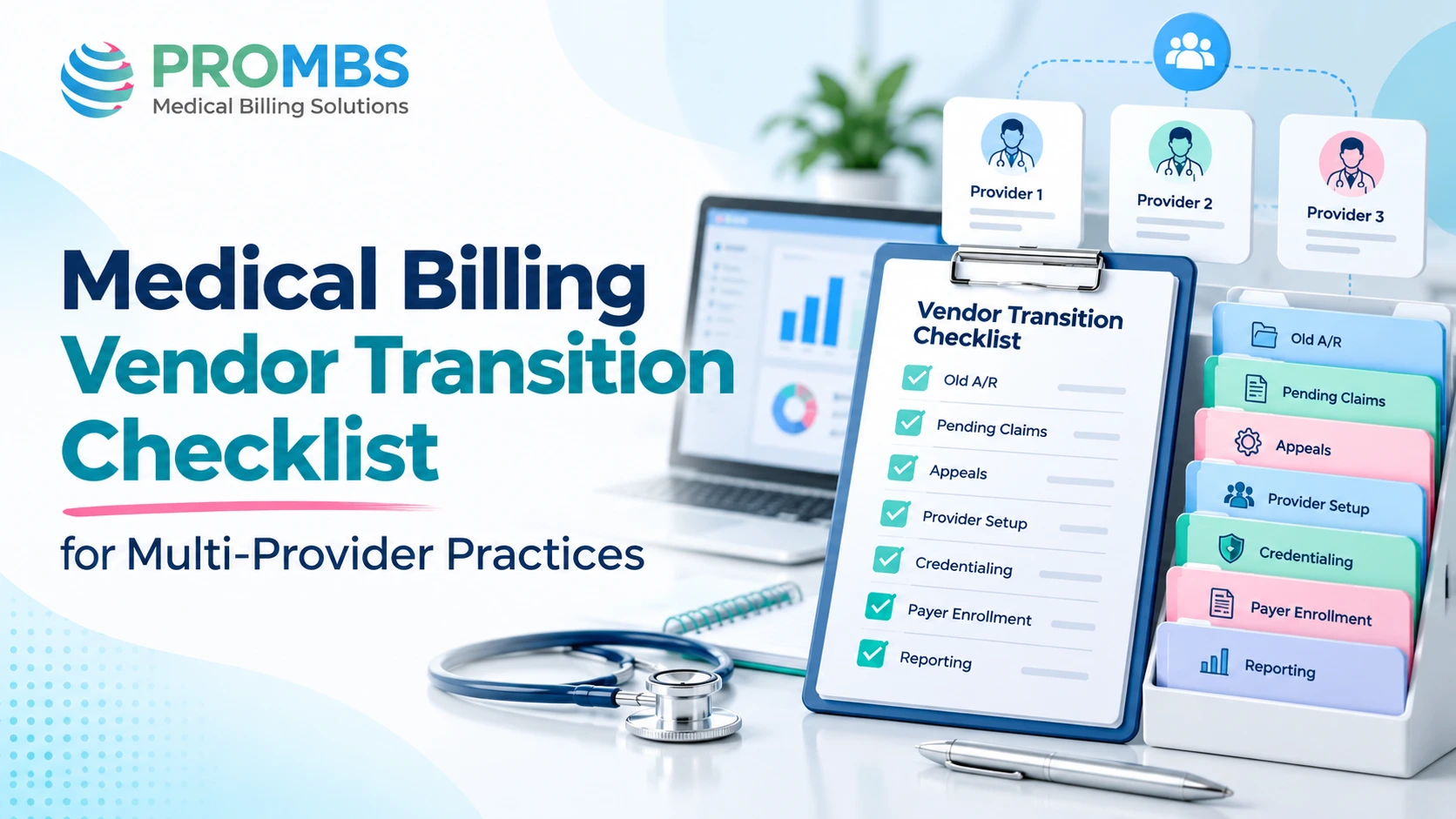
Switching medical billing companies can become complicated when a practice has multiple physicians, locations, and insurance contracts.
One provider may be enrolled with Medicare under the practice’s billing group, while another has different commercial payer participation. A third may perform procedures at multiple facilities with separate billing requirements.
If the incoming billing company overlooks these differences, claims may be rejected or denied even when the medical coding is correct.
A medical billing transition checklist should verify provider and payer information, system access, outstanding claims, payment arrangements, and billing responsibilities before the new vendor starts submitting live claims.
For multi-provider practices, the goal is not simply to transfer patient records and begin processing charges. Every provider, payer relationship, and service location must be ready for the new billing workflow.
This guide explains what practices should prepare before switching vendors, how to organize the transition, and which checks help protect reimbursement during implementation.
What Should a Medical Billing Transition Checklist Include?
A medical billing transition checklist is a structured plan for transferring billing responsibilities from one vendor to another while maintaining claim accuracy, payment continuity, and access to necessary records.
For multi-provider practices, the checklist must address both practice-wide operations and individual provider requirements.
Before switching vendors, healthcare administrators should complete these essential preparations:
-
Assign a transition manager and establish the billing cutover date.
-
Verify provider NPIs, billing entities, TINs, practice locations, and payer enrollment information.
-
Record current collections, denial rates, outstanding A/R, and claim submission performance.
-
Inventory EHR, practice management, clearinghouse, and payer portal access.
-
Securely collect historical claims, payment records, open balances, and relevant billing data.
-
Establish responsibility for existing claims, appeals, and accounts receivable.
-
Confirm applicable EDI, ERA, and EFT arrangements before go-live.
-
Schedule claim testing, reporting validation, and final implementation approval.
Completing these steps helps practices identify unresolved issues before the incoming vendor becomes responsible for daily claims.
However, a checklist is only useful when each task has a responsible person and a verified completion status.
Pro Medical Billing Solutions (PROMBS) supports healthcare providers through revenue cycle management services that include billing, coding, payer enrollment, claim processing, payment posting, and A/R follow-up.
For a practice changing billing partners, these connected services can support the transition from initial billing assessment through ongoing revenue cycle management.
Why Multi-Provider Billing Transitions Require More Planning
A single-provider practice may have a relatively straightforward billing structure.
Multi-provider groups often manage different specialties, insurance contracts, service locations, and provider enrollment arrangements.
This creates more opportunities for information mismatches during a vendor transition.
Provider Enrollment Does Not Always Apply Across Every Location
Consider a medical group with six physicians working at two offices.
Four physicians may participate with a particular commercial payer at both locations, while two may have different enrollment or network arrangements.
If the incoming billing vendor assumes all six providers have identical payer participation, some claims may encounter enrollment-related problems.
The new billing team must verify the actual billing relationships rather than relying only on a general list of participating insurance companies.
An active National Provider Identifier (NPI) does not, by itself, prove that a physician is enrolled, appropriately affiliated, or participating under a specific payer contract.
Different Specialties May Need Different Billing Workflows
A group containing primary care physicians, orthopedic surgeons, and behavioral health providers may use different coding, documentation, authorization, and claim submission processes.
For example, surgical billing may involve global periods and procedure modifiers, while behavioral health claims may involve different service codes and payer requirements.
A new billing vendor must understand those differences before assuming responsibility for coding and claim processing.
The practice should document which services are handled by each provider, which payers require additional verification, and whether specialty-specific claim edits are already configured.
One Incorrect Configuration Can Affect Multiple Claims
Suppose an incoming billing company configures the wrong billing group information for a physician.
If the mistake affects several claims, the practice could experience repeated rejections or payment delays before anyone identifies the underlying problem.
This is why provider-level validation should occur before the vendor begins processing the full claim volume.
A well-planned medical billing transition checklist should treat every provider-payer-location relationship as something to verify, rather than assuming that practice-wide access automatically means every provider is ready.
What Should Practices Complete Before Changing Billing Vendors?
The preparation stage should establish who is responsible for the transition, what billing data must be preserved, and whether the incoming vendor has the information needed to manage each provider correctly.
Review Contracts and Establish Transition Ownership
Start by reviewing the current billing agreement.
Determine the termination notice period, data export arrangements, applicable service fees, and any contractual responsibilities that continue after the agreement ends.
The practice should also identify whether the existing vendor will continue handling certain unresolved claims during a defined transition period.
Next, appoint one person to coordinate the implementation.
For a multi-provider practice, this may be the practice administrator, RCM director, or another authorized operations manager.
That person should oversee the transition schedule, coordinate both vendors, and confirm that outstanding issues have assigned owners.
The implementation plan should establish:
- The final date for routine submissions by the outgoing vendor.
- The first date the incoming vendor will submit applicable claims.
- Responsibility for encounters completed near the cutover.
- Who approves provider configurations and system access.
- How unresolved issues will be escalated before go-live.
A vendor transition should not depend on informal assumptions about which company is responsible for a claim.
Record Baseline Collections, Denials and A/R
Before making changes, document the practice’s current billing performance.
This provides a baseline for evaluating whether the transition affects collections, claim quality, or outstanding receivables.
Useful measurements include monthly collections, claim rejection rates, adjudicated denial rates, net days in A/R, aging balances, and unbilled encounters.
Ideally, review several months of historical results rather than relying on one reporting period.
A multi-provider group should also separate relevant measurements by provider, location, specialty, and payer.
For example, a practice may have reasonable overall collections while one physician has a significantly higher percentage of claims older than 90 days.
If the vendor transition combines all provider data into a single report, that problem may become harder to identify.
PROMBS provides medical billing services that include reporting, payment posting, denial tracking, and accounts receivable follow-up.
These services can help practices evaluate billing performance and maintain visibility into unresolved claims.
Inventory Provider, Location and Payer Information
The most important preparation document for a multi-provider transition is a provider-payer-location inventory.
This record identifies how each physician should be billed under the relevant insurance arrangements.
It should include the rendering provider’s NPI, applicable billing organization, tax identification number, service locations, taxonomy information, payer relationships, and effective dates.
The following example illustrates how a practice might organize its review.
| Provider and location | Payer | Pre-transition verification |
|---|---|---|
| Provider A, Main Office | Medicare | Rendering NPI, group relationship, Medicare enrollment, EDI setup |
| Provider B, Satellite Clinic | Commercial Payer A | Network participation, TIN, service location, effective date |
| Provider C, Surgery Center | Commercial Payer B | Provider affiliation, facility details, authorization and billing requirements |
Illustrative provider records, not actual enrollment information.
For each relationship, the practice should record whether the information has been verified, requires clarification, or needs additional action.
The CMS Medicare EDI enrollment guidance explains that providers and organizations submitting Medicare electronic transactions, including those using billing services or clearinghouses, must meet applicable EDI enrollment requirements. It also recognizes certain organizational enrollment arrangements.
This means practices should verify their existing Medicare electronic billing authorization and any contractor-specific requirements when changing the party that submits claims.
Similarly, commercial payer participation and electronic submission arrangements should be reviewed according to the individual payer’s procedures.
PROMBS’s physician credentialing services support provider enrollment, payer credentialing, recredentialing, and related administrative requirements.
Confirming these details early helps avoid treating a provider enrollment issue as a routine claim submission error after go-live.
What Billing Data Must Be Collected Before the Cutover?
A new billing company needs accurate historical and current information to understand the practice’s revenue cycle.
However, transferring large amounts of data without a clear plan can lead to missing records, duplicate transactions, or inconsistent reporting.
The practice should identify which information the incoming vendor genuinely needs and how it will be transferred securely.
Collect Active Billing and Claim Records
The transition dataset should include outstanding charges, unsubmitted encounters, accepted claims still processing, denials, appeals, and open accounts receivable.
The incoming vendor may also require relevant claim submission histories, payer claim control numbers, remittance records, and previous follow-up notes.
These records help the new billing team distinguish claims that need action from accounts already processed or resolved.
For example, an old balance without its related payment or denial history may appear collectible even when the payer has already issued the appropriate adjustment.
A complete account history provides the context needed for accurate follow-up.
Preserve Payment and Adjustment History
Historical payment information is essential when reconciling collections across the transition.
The practice should preserve insurance payments, patient payments, contractual adjustments, refunds, recoupments, and other relevant financial transactions.
Where available and needed, the transition should also account for electronic remittance advice data and reconciliation records.
A new vendor should not begin payment posting with incomplete historical balances that could lead to duplicate adjustments or incorrect patient statements.
Validate the Data Before Accepting the Transfer
A data export should not be considered complete merely because the outgoing vendor delivered a file.
The practice should compare record counts and financial control totals between the original system and the transferred data.
For example, if the source billing system shows 1,250 open insurance claims, the receiving team should investigate why an imported report contains fewer records.
Some differences may be legitimate, but they must be explained.
The practice should also verify that claim status histories, provider assignments, payer information, and outstanding balances remain accurate after migration.
Data migration is complete only when the transferred information has been reconciled and can be used reliably for billing operations.
Detailed system access and transaction testing will be addressed in Part 2.
How Should Practices Protect Open Claims and Historical A/R?
Historical accounts receivable deserves special attention during a vendor transition because claims may remain unresolved long after the original billing company stops working with the practice.
At the cutover date, the practice may have claims awaiting adjudication, rejected submissions, unresolved denials, pending appeals, and unpaid patient balances.
These accounts need an agreed owner.
For example, the outgoing vendor may remain responsible for claims submitted before a defined date, while the incoming vendor handles new claims. Alternatively, the practice may transfer designated historical accounts to the new billing company.
Either approach requires a clear agreement about responsibilities.
A claim should not be handled by two vendors simultaneously without coordination, and no outstanding account should be left without an assigned follow-up process.
For a deeper explanation of this issue, see PROMBS’s existing guide on switching medical billing companies and managing old A/R.
The new transition plan should focus on implementing and verifying those responsibilities across every provider and location.
HIPAA, Data Access and Business Associate Agreements
Medical billing transitions involve protected health information (PHI), so secure access and appropriate contractual arrangements are essential.
Before transferring patient information, practices should confirm that the incoming billing vendor has an appropriate Business Associate Agreement (BAA) and that access is limited to authorized activities.
The U.S. Department of Health and Human Services explains that BAAs must address permitted uses and disclosures of PHI, appropriate safeguards, and responsibilities when the agreement terminates.
Maintain Secure Access During the Transition
Practices should use authorized, appropriately secured methods to transfer billing data and grant system access.
Individual user accounts and role-based permissions help organizations identify who accessed or changed sensitive records.
Existing access should not be removed before necessary records have been preserved and the responsibilities for outstanding claims are clear.
At the same time, unnecessary access for the outgoing vendor should be revoked when it is no longer authorized or needed.
Confirm Data Return and Retention Arrangements
The outgoing vendor’s BAA and service agreement should explain how patient information is returned or securely destroyed when the relationship ends.
HIPAA generally requires BAAs to address return or destruction of PHI upon termination where feasible. When that is not feasible, applicable protections and limitations on further use must continue.
The practice should also consider applicable record-retention obligations before requesting destruction of information.
HHS guidance makes clear that a business associate generally cannot improperly block a covered entity’s access to PHI maintained on its behalf.
A medical billing transition should therefore preserve both patient information security and the practice’s continuing access to records needed for care, billing, and compliance.
Confirm Readiness Before Moving to Implementation
Before the incoming billing vendor begins processing live claims, the practice should be able to confirm that:
- Transition responsibilities and the cutover date are documented.
- Provider, payer, and location records are inventoried.
- Historical billing and financial data have been preserved and reconciled.
- Open claims and A/R accounts have assigned owners.
- Necessary contractual, BAA, and access arrangements are established.
These checks create the foundation for the technical implementation.
A medical billing transition checklist is most effective when it verifies readiness for each provider rather than treating the entire medical group as one billing account.
How to Validate Every Provider Before Switching Billing Vendors
Before a new billing vendor submits claims, a multi-provider practice should verify each provider’s NPI, billing entity, payer enrollment, service location, and electronic submission arrangements.
Completing this verification at the practice level alone is not enough.
A group may have ten physicians billing under the same tax identification number (TIN), but their payer participation, specialties, and approved practice locations may differ.
If the incoming billing company uses an incorrect configuration for even one physician, that provider’s claims may experience repeated rejections or denials.
A reliable medical billing transition checklist should therefore include a provider-by-provider readiness review.
Verify Rendering and Billing NPIs, TINs and Practice Locations
Start by confirming the identifiers associated with each provider.
An individual physician generally has a Type 1 NPI, while an eligible healthcare organization may have a Type 2 NPI.
Depending on the claim and billing arrangement, both the rendering provider and billing organization information may need to be reported.
For example, a practice with eight physicians operating from three locations should not assume that the same billing configuration applies to every provider.
The incoming vendor should verify the appropriate:
- Individual rendering provider NPI.
- Billing organization NPI and TIN.
- Provider taxonomy information.
- Service facility information and place-of-service requirements.
- Provider relationship with the billing group.
- Payer-specific identification or enrollment information.
These details should be compared with verified payer records and the configuration in the practice management system.
An NPI listing alone does not establish active participation with an insurance company.
PROMBS supports provider enrollment and payer relationship management through its physician credentialing services.
Verifying these relationships during onboarding helps practices identify configuration problems before they affect live claims.
Check Payer Enrollment, Participation and Effective Dates
Provider enrollment should be verified separately for each relevant payer.
A physician may be properly enrolled with Medicare but have a different effective date or network arrangement with a commercial insurance company.
Similarly, enrollment under one billing group does not automatically establish participation under another TIN.
The incoming billing team should review the payer’s records to confirm whether the provider is enrolled, appropriately affiliated, and eligible to bill under the intended arrangement.
The review should also verify effective dates, service locations, and any pending enrollment updates.
Consider the following illustrative readiness record for a medical group.
| Provider and location | Payer | Verification result | Action before go-live |
|---|---|---|---|
| Provider A, Main Office | Medicare | Enrollment verified | Confirm EDI submission authorization |
| Provider B, Satellite Clinic | Commercial Payer A | Location status unclear | Verify approved service location |
| Provider C, Main Office | Commercial Payer B | Group affiliation pending | Confirm effective date and affiliation |
| Provider D, Surgery Center | Commercial Payer C | Participation verified | Test applicable claim configuration |
Example only. These are not actual provider enrollment records.
The purpose of this record is to identify which provider-payer-location combinations are ready and which require additional verification.
The billing team should not assume that a pending enrollment problem can be corrected after claims are submitted.
Review Specialty-Specific Coding and Charge Capture Requirements
Multi-provider groups may have specialties with different billing requirements.
For example, a practice with orthopedic surgeons, internal medicine physicians, and behavioral health providers may need different claim edits, documentation checks, and procedure workflows.
Before go-live, the incoming vendor should understand which services the practice performs and how charges enter the billing system.
Review the use of CPT and HCPCS codes, ICD-10 diagnoses, modifiers, units, and applicable place-of-service information.
The team should also determine whether the practice has unresolved coding holds, delayed encounters, or recurring claim errors that require attention.
PROMBS provides medical coding services tailored to specialty-specific documentation and billing requirements.
Aligning coding and charge capture workflows during onboarding helps prevent the incoming vendor from repeating problems that already existed under the previous arrangement.
How to Transfer EHR, Practice Management and Clearinghouse Access
A billing company cannot manage claims effectively without access to the systems used to document services, prepare claims, transmit transactions, and monitor reimbursement.
However, providing login credentials is not the same as completing system onboarding.
A successful billing system transition requires verified user access, accurate provider configurations, working payer connections, and a tested process for exchanging billing data.
Establish Secure EHR and Practice Management Access
The incoming billing team should receive access appropriate to its assigned responsibilities.
For example, coding staff may need clinical documentation access, while payment posting specialists need the tools required to review remittance records and reconcile payments.
Practices should use individual accounts, appropriate permissions, and available multifactor authentication rather than shared credentials.
System access should be tested before the cutover.
A billing specialist should be able to retrieve an eligible encounter, review the necessary information, prepare a claim, and confirm that the transaction is ready for submission.
The practice should also verify that relevant actions can be tracked through available system audit logs.
The HHS business associate guidance outlines contractual responsibilities for protecting PHI when healthcare organizations work with service providers such as billing companies.
Verify Clearinghouse and Payer Connections
The next step is confirming how the new billing vendor will send electronic claims.
Practices should identify the clearinghouse, submitter identification arrangements, payer IDs, and any payer-specific electronic enrollment requirements.
For Medicare, CMS EDI enrollment guidance explains that providers using electronic transactions, including those working through billing services or clearinghouses, must satisfy applicable enrollment requirements.
CMS also requires providers to notify the appropriate Medicare contractor when their authorized billing-service or clearinghouse representation changes.
Therefore, changing vendors may involve more than updating a clearinghouse login.
The practice should verify whether new authorization records, submitter arrangements, or contractor-specific updates are required.
Commercial payers may have different electronic enrollment procedures.
An important 2026 Medicare consideration: CMS requires valid HETS EDI enrollment for each NPI used in Medicare eligibility verification as of May 11, 2026.
Practices changing their eligibility-verification vendor or clearinghouse should confirm the affected provider relationships under the CMS HETS enrollment requirements.
This requirement concerns Medicare eligibility transactions and should not be confused with ordinary claim submission enrollment.
Prevent Duplicate Billing Access and Submissions
During a vendor transition, both billing companies may temporarily have access to certain records.
That arrangement can be necessary when the outgoing company continues working historical A/R while the incoming company begins handling new encounters.
However, responsibility must be clearly separated.
For example, if the incoming vendor submits a claim that the outgoing vendor already transmitted, the payer may identify the second claim as a duplicate.
To reduce that risk, the practice should maintain a shared cutover record showing which claims and encounters belong to each team.
The practice should also establish who can create, edit, submit, correct, or appeal claims in each system.
Access for the outgoing vendor should be reduced or revoked as its authorized responsibilities end, while preserving necessary records and audit history.
How to Test Claims Before the New Billing Vendor Goes Live
Testing is one of the most important steps in a multi-provider billing transition.
A practice should not assume that a new system is ready simply because the vendor can generate a claim file.
The entire electronic workflow must be verified.
Before go-live, the billing team should confirm that claims can be generated correctly, transmitted through the intended connection, acknowledged at the appropriate level, and tracked after submission.
Where payers and clearinghouses provide approved testing environments, practices should use those arrangements rather than sending fictitious patient claims through production systems.
Validate 837 Submission and 999/277CA Responses
The X12 837 transaction is the standard electronic format used to submit healthcare claims.
Common claim formats include 837P for professional services and 837I for institutional claims.
The incoming billing vendor should verify that the applicable claim type is generated correctly for the practice’s services.
Testing should include representative provider, payer, and location combinations, particularly those with different billing entities or specialty requirements.
The team must also understand the responses produced after transmission.
A 999 acknowledgment is not the same as payer acceptance of an individual claim.
The 999 primarily communicates whether an electronic transaction meets applicable implementation and syntax requirements.
The 277CA communicates claim acknowledgment information, including whether individual claims were accepted or rejected for adjudication.
According to X12’s official interpretation, a successful 999 does not establish that the payer accepted the claim for business processing. A later acknowledgment, such as a 277CA, provides that information.
For example, a clearinghouse may successfully transmit a file while the payer subsequently rejects an individual claim because of invalid enrollment information.
If the billing team checks only the 999 response, it may incorrectly assume the claim is progressing toward payment.
The incoming vendor should confirm that the system can retrieve these responses, identify rejected claims, and route exceptions to the appropriate work queue.
Even a claim accepted through a 277CA is not guaranteed payment. Final adjudication occurs later.
Confirm ERA, EFT and Payment Posting Workflows
Claim transmission is only one part of the transition.
The practice must also verify how payments and remittance information will be received and recorded.
Electronic Remittance Advice (ERA) is commonly delivered through the X12 835 transaction.
It explains payer adjudication, including payments, adjustments, and other claim-level details.
Electronic Funds Transfer (EFT) moves the actual payment to the designated financial institution.
These processes are related but distinct.
A practice may have functioning claim submission while ERA delivery or payment posting is not yet properly configured.
Before go-live, verify:
- ERA delivery arrangements for relevant payers.
- Access to historical and new remittance records.
- EFT enrollment and the practice’s designated bank account.
- Payment posting mappings and adjustment codes.
- Reconciliation between payer remittances, posted transactions, and bank deposits.
- Responsibility for unresolved remittances from the outgoing vendor.
The CMS Health Care Payment and Remittance Advice guidance confirms that Medicare ERAs use the X12 835 format.
Its EFT guidance separately explains how electronic Medicare payments are directed to providers’ financial institutions.
Changing a billing company does not automatically mean a practice must change its bank account.
If a payment account change is necessary, it should be authorized by the practice and independently verified through a trusted channel before any change is implemented.
PROMBS supports electronic claim submission, payment posting, ERA reconciliation, and A/R follow-up through its medical billing services.
These activities help connect the submission process with accurate financial reporting after the transition.
Check Reporting and Reconciliation Across Providers
A multi-provider practice should also confirm that the incoming vendor can report financial performance at the appropriate level.
For example, a group with eight physicians should be able to identify claims and collections by individual provider where its systems and billing arrangements support that detail.
Reports should also distinguish relevant payer, location, specialty, and billing entity information.
If a practice historically collected payments under several billing entities, the new reporting structure must preserve that distinction.
Before go-live, compare a selection of source records with the incoming system.
Check encounter counts, charge totals, outstanding balances, provider assignments, and relevant payment information.
Any differences should be investigated before relying on the new reporting system for financial decisions.
Who Owns Each Task During the Vendor Handoff?
A transition can fail even when the technical configuration is correct if no one knows who is responsible for unresolved tasks.
For multi-provider practices, responsibility should be assigned before implementation begins.
Practice Administrator or Transition Manager
The practice should appoint an authorized person to oversee the transition.
This person approves the timeline, coordinates stakeholders, reviews unresolved issues, and provides final go-live approval.
They should also confirm who has authority to approve sensitive changes involving payment accounts, payer enrollment, or system access.
Outgoing Billing Vendor
The outgoing vendor should complete the responsibilities specified in its agreement.
These may include delivering agreed billing records, documenting pending work, providing claim histories, and continuing designated follow-up during the transition.
The practice should confirm which accounts remain under the outgoing vendor’s responsibility and for how long.
Incoming Billing Vendor
The new vendor should configure provider and payer information, establish applicable electronic connections, review workflows, and complete required testing.
It should document any unresolved readiness issues and identify the action needed before processing the affected claims.
For example, if a physician’s enrollment under a commercial payer remains unverified, that issue should appear in the transition tracking record.
Clearinghouse, EHR and Payer Representatives
Some tasks require coordination with outside systems or insurers.
The clearinghouse may need to activate connections or investigate electronic transaction errors.
The EHR vendor may need to adjust billing interfaces or user permissions.
Insurance payers may need to confirm enrollment, claim submission arrangements, or ERA delivery.
Each outside dependency should have an assigned internal owner who follows the issue through completion.
A task is not complete simply because someone submitted a request. It is complete when the required result has been verified.
Multi-Provider Billing Transition: Final Go-Live Checklist
The final stage of the medical billing transition checklist is determining whether the incoming billing vendor can begin processing live claims without introducing avoidable reimbursement risks.
Go-live readiness should be confirmed using documented evidence, not verbal assurances.
Provider and Payer Readiness
-
Every provider’s rendering NPI and applicable billing entity have been verified.
-
TINs, taxonomy details, and service locations are correctly configured.
-
Required payer enrollments, group relationships, and effective dates have been reviewed.
-
Medicare and commercial electronic submission requirements are satisfied for the intended claims.
-
Specialty-specific billing rules and claim edits have been configured.
Systems and Transaction Readiness
-
EHR and practice management access has been tested using authorized accounts.
-
Clearinghouse and payer connections are active for the intended claim submissions.
-
Applicable 837 transactions have been validated through approved testing or verification procedures.
-
The billing team can interpret and act on 999 and 277CA acknowledgments.
-
ERA delivery and EFT arrangements have been verified.
-
Payment posting and reporting workflows have been reconciled.
Operational and Financial Readiness
-
The cutover date and claim ownership rules are documented.
-
Unbilled encounters and outstanding A/R have assigned owners.
-
Historical billing records have been transferred and reconciled.
-
Duplicate submission controls are established.
-
Staff know how to escalate claim rejections, enrollment issues, and missing remittances.
-
The practice administrator has reviewed unresolved risks and approved the go-live plan.
When Should a Practice Delay Go-Live?
A practice should reconsider the planned launch when a critical problem could prevent accurate claim submission or disrupt payment reconciliation.
Examples include an unverified provider billing relationship, a missing required EDI authorization, an inactive payer connection, or unresolved payment routing information.
For a large group, a staged transition may be appropriate.
For example, providers with verified configurations may move to the new billing workflow while another provider’s unresolved enrollment issue is addressed separately.
However, staged implementation requires clear controls to prevent duplicate submissions and ensure that every encounter has a responsible billing team.
The decision should consider claim deadlines, patient billing continuity, and the practice’s operational requirements.
A Successful Transition Starts With Provider-Level Verification
Switching billing vendors is not complete when the incoming company receives its first batch of claims.
For multi-provider practices, success depends on confirming that the correct information moves through the entire billing process.
Provider enrollment, electronic submission, claim acknowledgments, remittance delivery, and reporting must work together.
A structured medical billing transition checklist helps practice administrators identify which configurations are ready, which require attention, and whether the practice can proceed with confidence.
PROMBS supports healthcare groups through coordinated revenue cycle management, provider enrollment, claim processing, coding, payment posting, and reporting services.
Our approach is designed to help practices maintain visibility across their revenue cycle while transitioning billing responsibilities.
How to Manage the First 30, 60 and 90 Days After a Medical Billing Transition
After switching medical billing vendors, multi-provider practices should monitor claim submissions, payer acceptance, payment posting, outstanding A/R, and provider-specific performance throughout the first 90 days.
Completing the vendor cutover does not mean the transition is finished.
The new billing company may have access to the EHR, clearinghouse, and payer portals, but the practice still needs to verify that claims are processing correctly and payments are reaching the appropriate accounts.
For multi-provider groups, this means reviewing billing performance at both the practice and individual provider levels.
A structured medical billing transition checklist should therefore include a post-transition monitoring plan.
The first 30, 60, and 90 days provide useful checkpoints, although actual timelines depend on claim volume, payer processing cycles, and the practice’s billing arrangements.
First 30 Days: Confirm Claims Are Moving Correctly
During the first month, the priority is identifying operational problems that could prevent claims from reaching insurance payers.
The billing team should review daily submission activity and investigate claims that remain unbilled, rejected, or pending due to configuration issues.
For example, a medical group may have eight physicians with active claim submission arrangements.
Seven physicians’ claims are processing normally, but one physician’s claims are being rejected because the payer does not recognize the submitted billing relationship.
If management reviews only the group’s total claim volume, the problem may not appear significant.
However, that individual physician could experience serious reimbursement delays.
The first-month review should focus on:
- Whether completed encounters are entering the billing workflow.
- Whether submitted claims receive appropriate acknowledgments.
- Whether any providers have unusual rejection patterns.
- Whether payment posting and remittance delivery are functioning.
- Whether unresolved accounts have assigned follow-up responsibilities.
PROMBS supports these activities through its medical billing services, including claim monitoring, electronic submission support, payment posting, and insurance follow-up.
Days 31–60: Evaluate Denials, Payments and Provider Performance
Once the initial submission process is functioning, the practice should evaluate how claims are moving through payer adjudication.
This includes reviewing denial reasons, payment delays, outstanding balances, and early collection trends.
For example, a specialty group may notice that claims submitted for its primary care physicians are processing normally, while surgical claims require repeated corrections.
The issue could involve missing modifiers, specialty-specific claim edits, or differences in payer requirements.
A targeted review can help identify the cause before the problem affects additional claims.
During this stage, compare current performance with the baseline established before the transition.
However, avoid treating every short-term change in collections as evidence that the new vendor is performing better or worse.
Insurance payments received during the first month may relate to claims submitted by the previous vendor.
Similarly, claims submitted by the incoming vendor may not generate payments until a later reporting period.
Billing teams should distinguish payment-date reporting from claim cohorts based on service or submission dates.
Days 61–90: Review Financial Stability and Resolve Remaining Gaps
By the third month, the practice should have enough operational information to identify recurring issues that require attention.
The billing team should review whether submission problems are decreasing, whether payer-specific denials remain elevated, and whether outstanding receivables are moving toward resolution.
Management should also confirm that the transition’s original responsibilities have been completed.
For example, if the outgoing vendor was assigned to manage historical appeals, the practice should verify whether those accounts are still receiving appropriate follow-up.
Any remaining access, reporting, or payment reconciliation issues should have documented owners and resolution plans.
The goal is to establish a stable billing workflow, not simply reach the 90-day mark.
Some issues may require continued monitoring beyond this period, especially when claims have lengthy payer processing or appeal timelines.
Which Billing KPIs Should Multi-Provider Practices Monitor?
A successful billing transition should be evaluated using measurable financial and operational results.
Total monthly collections matter, but they cannot independently show whether each provider’s claims are processing correctly.
Multi-provider practices should track clean claim rate, payer acceptance, denial rate, charge lag, collections, and accounts receivable by provider, payer, and location whenever the reporting data supports those comparisons.
The following metrics provide a practical starting point.
| Billing KPI | What it helps identify |
|---|---|
| Clean claim rate | Claims passing billing edits without manual correction |
| Payer claim acceptance rate | Claims accepted for adjudication after electronic submission |
| Initial rejection rate | Claims rejected before adjudication |
| Adjudicated denial rate | Payer decisions refusing payment on processed claims |
| Charge lag | Delays between the service date and charge posting |
| Net days in A/R | Overall efficiency of outstanding revenue collection |
| A/R over 90 days | Older receivables requiring investigation |
| Payment posting and reconciliation exceptions | Remittances or deposits that have not been properly matched |
The HFMA MAP Keys provides standardized revenue cycle KPI definitions, including clean claim rate, charge lag, and net days in A/R.
Practices should apply consistent definitions when comparing results before and after a vendor transition.
For example, a clearinghouse acceptance percentage should not be treated as interchangeable with a clean claim rate or first-pass resolution rate.
These metrics measure different stages of the revenue cycle.
Compare Individual Providers Instead of Relying on Practice Averages
Consider a medical group with six providers.
The practice’s overall payer claim acceptance rate appears stable after the transition.
However, closer analysis reveals that claims for one provider are experiencing significantly more rejections than claims for the others.
An investigation identifies an incorrect payer-specific billing configuration.
Without provider-level reporting, management might not recognize the problem until the affected accounts begin aging.
This illustrates why a medical billing transition checklist should include individual provider reporting as part of the monitoring process.
PROMBS provides revenue cycle management services that support billing reporting, denial analysis, claim tracking, and accounts receivable management.
These services help practices identify whether problems are affecting an individual provider, location, specialty, or payer rather than treating the entire group as one billing operation.
How to Identify Missing Claims, Payments and Provider-Specific Errors
After a vendor transition, billing data may exist across the previous vendor’s records, the incoming billing system, clearinghouse reports, payer portals, and bank deposits.
If these sources are not reconciled, missing claims or payment discrepancies may go unnoticed.
A reliable investigation should follow the complete path from a completed patient encounter to final reimbursement.
Reconcile Completed Encounters With Submitted Claims
Start by comparing completed visits and procedures with the billing system’s charge entry records.
For example, suppose a practice identifies 1,200 completed encounters eligible for billing during a reporting period.
The billing team confirms that 1,170 encounters have progressed to the appropriate billing stage, while 30 remain unresolved.
Those 30 encounters require investigation.
Some may be waiting for clinical documentation, while others may have been missed during the system transition.
Not every encounter produces exactly one claim, so the team should reconcile encounters and charges using the practice’s actual billing workflow rather than assuming a one-to-one relationship.
The objective is to account for every billable service and identify encounters that have not reached the correct next step.
Match Electronic Claims With Payer Acknowledgments
Next, compare submitted claims with clearinghouse and payer acknowledgment records.
The incoming billing vendor should be able to identify whether electronic transactions passed the initial formatting checks and whether individual claims were accepted for adjudication.
A successful 999 transaction acknowledgment does not guarantee that an individual claim was accepted by the payer.
The 277CA provides additional claim-level acknowledgment information.
If claims were transmitted but rejected, the billing team should investigate the reason and correct the underlying issue through the appropriate process.
For multi-provider groups, rejection patterns should be reviewed by rendering provider, billing entity, and payer.
Reconcile Remittances, Payments and Bank Deposits
A claim may be processed and paid even when the incoming billing system does not receive or correctly post the corresponding remittance information.
For example, an insurance payment may reach the practice’s bank account while the related electronic remittance advice is still being delivered to the previous vendor.
The funds have arrived, but the new billing system may continue showing an outstanding patient balance.
To identify this problem, the billing team should compare payer payment records, electronic remittances, posted transactions, and bank deposits.
According to CMS payment and remittance guidance, Medicare electronic remittance advice uses the X12 835 format.
The payment transfer itself is handled separately through the applicable EFT process.
Accurate reconciliation helps practices avoid duplicate patient statements, unexplained credit balances, and inaccurate A/R reports.
What Should a Post-Transition Medical Billing Audit Include?
A post-transition billing audit examines whether the new vendor’s processes are functioning correctly and whether the practice’s financial records remain accurate.
For a multi-provider group, the audit should include representative claims from different providers, locations, specialties, and payer relationships.
The audit should verify that every completed service has an appropriate billing outcome, every submitted claim can be tracked, and every payment is properly reconciled.
Review Provider and Payer Configuration Accuracy
Begin by comparing the incoming vendor’s billing configurations with verified provider enrollment records.
Check that rendering and billing NPIs, TINs, service locations, taxonomy information, and applicable payer relationships are accurate.
Review any claims rejected because of enrollment or billing entity problems.
If multiple claims share the same issue, investigate the configuration rather than correcting every claim individually.
Verify Historical and Current A/R Balances
Compare the closing A/R report from the outgoing vendor with the opening balances accepted by the incoming billing team.
Any differences should be explained and documented.
The audit should also distinguish accounts that remain under the previous vendor’s responsibility from those transferred to the new company.
For example, if an older denied claim appears in both vendors’ work queues, the practice should confirm who owns the next action.
This helps prevent duplicate appeals, inconsistent follow-up, and missed filing deadlines.
Examine Claim Rejections, Denials and Missing Charges
Review claims that were held, rejected, or denied during the transition.
Determine whether the problems resulted from incorrect provider configurations, missing documentation, payer enrollment issues, coding errors, or existing billing weaknesses.
Also examine completed encounters that have not reached claim submission.
Unbilled services may not appear in standard billed A/R aging reports, making separate charge capture reviews essential.
Confirm Financial and Access Controls
Finally, verify that payments and adjustments are reconciled, authorized users have the appropriate system permissions, and the practice can retrieve records required for ongoing operations.
Access held by the outgoing vendor should reflect only its remaining authorized responsibilities.
Under HHS business associate guidance, business associate agreements must address appropriate PHI safeguards and return or destruction of protected information upon termination where feasible.
Practices should also consider applicable legal retention requirements and contractual arrangements.
PROMBS provides medical billing and coding audit services to help healthcare practices identify billing inconsistencies, coding problems, unresolved claims, and potential revenue cycle weaknesses.
A post-transition audit can help determine whether implementation problems have been resolved or require further corrective action.
How to Prevent Revenue Loss During Vendor Transitions
Medical billing transitions can affect cash flow when claims are not submitted on time, payer connections fail, or outstanding accounts lose clear ownership.
Preventing these problems requires coordination before and after go-live.
Maintain a Single Source of Responsibility for Each Claim
Every claim should have an assigned billing owner, regardless of whether it originated before or after the transition.
The outgoing vendor may continue handling older receivables while the incoming team manages newly completed services.
However, the practice should know which company is responsible for each claim and how updates will be documented.
This is particularly important for denied claims approaching reconsideration or appeal deadlines.
Prioritize Time-Sensitive Outstanding Accounts
During a transition, billing teams may focus heavily on new claims while older accounts continue aging.
A better approach is to identify accounts requiring immediate attention based on remaining deadlines, expected collectible balances, and unresolved payer issues.
For example, a valid appeal approaching its deadline may require action before a larger claim that is still undergoing routine processing.
PROMBS’s denial management services support denial investigation, payer follow-up, and appropriate appeal management.
Protect Payment Routing and Reconciliation
Changes to remittance delivery or electronic payment arrangements should be carefully controlled.
The practice should independently verify any authorized EFT changes through trusted payer or financial institution channels.
It should also monitor whether payments from claims submitted before the cutover are still reaching the correct account and entering the appropriate billing records.
A new billing company should not automatically trigger unnecessary changes to the practice’s designated bank account.
Establish Weekly Exception Reviews
During the early transition period, a short weekly review can help management identify unresolved issues before they affect more claims.
A useful review should answer:
- Which providers or payers have unusual claim rejection patterns?
- Are completed encounters accumulating without submission?
- Have expected remittances or payment records failed to arrive?
- Which A/R accounts are approaching important deadlines?
- Who owns each unresolved problem, and when will it be reviewed again?
These questions help make the medical billing transition checklist an ongoing control process rather than a document completed at go-live.
How Pro Medical Billing Solutions Supports Multi-Provider Transitions
Switching medical billing companies can place additional pressure on practice administrators who already manage providers, employees, patient care operations, and financial performance.
The transition becomes more complicated when a group operates multiple specialties, locations, or billing entities.
Pro Medical Billing Solutions provides medical billing and revenue cycle management support to healthcare practices across the United States.
Our services help providers manage important activities throughout the billing process, from enrollment verification and charge entry to claim submission, payment posting, denial management, and accounts receivable follow-up.
Provider Enrollment and Payer Readiness
One of the most important steps in onboarding a multi-provider practice is verifying provider information.
PROMBS offers physician credentialing services that support payer enrollment, credentialing, recredentialing, and related administrative processes.
These services help practices investigate provider enrollment and participation issues that may affect reimbursement.
For groups operating across multiple locations, reviewing payer relationships and billing configurations can help identify potential claim problems before submission.
Claim Processing and Billing Workflow Support
PROMBS provides end-to-end medical billing support, including charge entry, claim scrubbing, electronic submissions, rejection handling, and claim status monitoring.
For practices changing vendors, these activities help establish an organized billing workflow for new encounters.
Our team also supports specialty-specific coding requirements and billing documentation reviews.
The objective is to identify issues early and reduce avoidable submission errors.
Payment Posting and A/R Follow-Up
A successful vendor transition requires accurate financial records after claims have been submitted.
PROMBS supports payment posting, remittance reconciliation, denial follow-up, and aging accounts receivable management.
Our billing specialists help investigate unpaid claims, payer processing delays, and outstanding reimbursement opportunities.
These services support continuity when practices must manage claims originating under different billing arrangements.
Billing Analytics and Performance Transparency
Multi-provider practices need to know whether each physician’s claims are moving through the revenue cycle correctly.
PROMBS provides billing reports and revenue cycle performance analysis to help practices monitor collections, denials, outstanding balances, and other important financial indicators.
By combining reporting with operational billing support, our team helps practice leadership identify performance gaps and prioritize necessary improvements.
A well-executed medical billing transition checklist should connect provider-level verification, accurate claim processing, financial reconciliation, and ongoing reporting.
That is the foundation of an organized transition and a more transparent revenue cycle.
Frequently Asked Questions About Medical Billing Vendor Transitions
How long does it take to switch medical billing companies?
The timeline depends on the number of providers, payer relationships, practice locations, software systems, and outstanding billing tasks.
A relatively simple practice may complete implementation faster than a large group with multiple specialties.
The first 30, 60, and 90 days after go-live are useful monitoring checkpoints, but they are not universal implementation deadlines.
What is the most important step in a medical billing transition checklist?
For multi-provider practices, one of the most important steps is verifying the billing configuration of every provider.
This includes NPIs, TINs, payer participation, enrollment effective dates, and practice locations.
The transition should also confirm electronic submission readiness, historical A/R ownership, and accurate payment reconciliation.
Can a medical practice switch billing vendors without changing its EHR?
Yes. A practice can often change billing companies while continuing to use its existing EHR and practice management systems.
The incoming vendor must receive appropriate access and establish any necessary billing interfaces or clearinghouse arrangements.
Compatibility and technical requirements should be confirmed during onboarding.
What happens to old A/R when switching billing companies?
Historical A/R remains the practice’s financial responsibility, but operational follow-up can be assigned to the outgoing vendor, the incoming vendor, or another authorized team.
The arrangement should be documented before the cutover.
Every unresolved claim should have a clear owner and an appropriate next action.
Does switching billing companies require new Medicare enrollment?
Not necessarily. Changing a billing vendor does not automatically require each physician to complete a new Medicare provider enrollment.
However, the practice must verify applicable EDI authorization, submitter arrangements, and any changes that need to be reported to the Medicare Administrative Contractor.
The requirements depend on the existing enrollment and the new billing configuration.
How can practices tell whether a billing transition is successful?
Practices should confirm that claims are being submitted accurately, payer acknowledgments are received, payments are reconciled, and outstanding accounts have assigned owners.
Performance should be monitored by provider and payer, using consistent KPI definitions.
Collection trends should also be interpreted in light of normal payment processing delays.
When should a practice conduct a post-transition billing audit?
An initial reconciliation should occur around go-live, with additional reviews during the first 30, 60, and 90 days.
A more detailed audit may be necessary if the practice identifies missing claims, unexpected payment differences, provider-specific rejections, or growing A/R.
The frequency and scope should reflect the complexity of the transition.
Can PROMBS help multi-provider practices change billing companies?
Yes. PROMBS provides medical billing, coding, provider credentialing, claim processing, payment posting, denial management, A/R follow-up, and billing audit services.
These services can support practices evaluating a new billing partner and establishing more organized revenue cycle workflows.
Plan a Safer Medical Billing Transition With PROMBS
Changing medical billing vendors should help a practice improve its operations, not create additional claim problems or financial uncertainty.
For multi-provider practices, a successful transition requires more than transferring records and giving the new billing company access to existing software.
Every provider’s billing information must be accurate. Electronic claim connections must function correctly. Existing accounts receivable must have clear ownership, and payments must continue to be reconciled.
A structured medical billing transition checklist brings these responsibilities together and helps practice administrators understand what must be completed before and after go-live.
By validating provider-payer relationships, testing billing workflows, monitoring financial performance, and reviewing unresolved accounts, practices can reduce avoidable transition risks.