

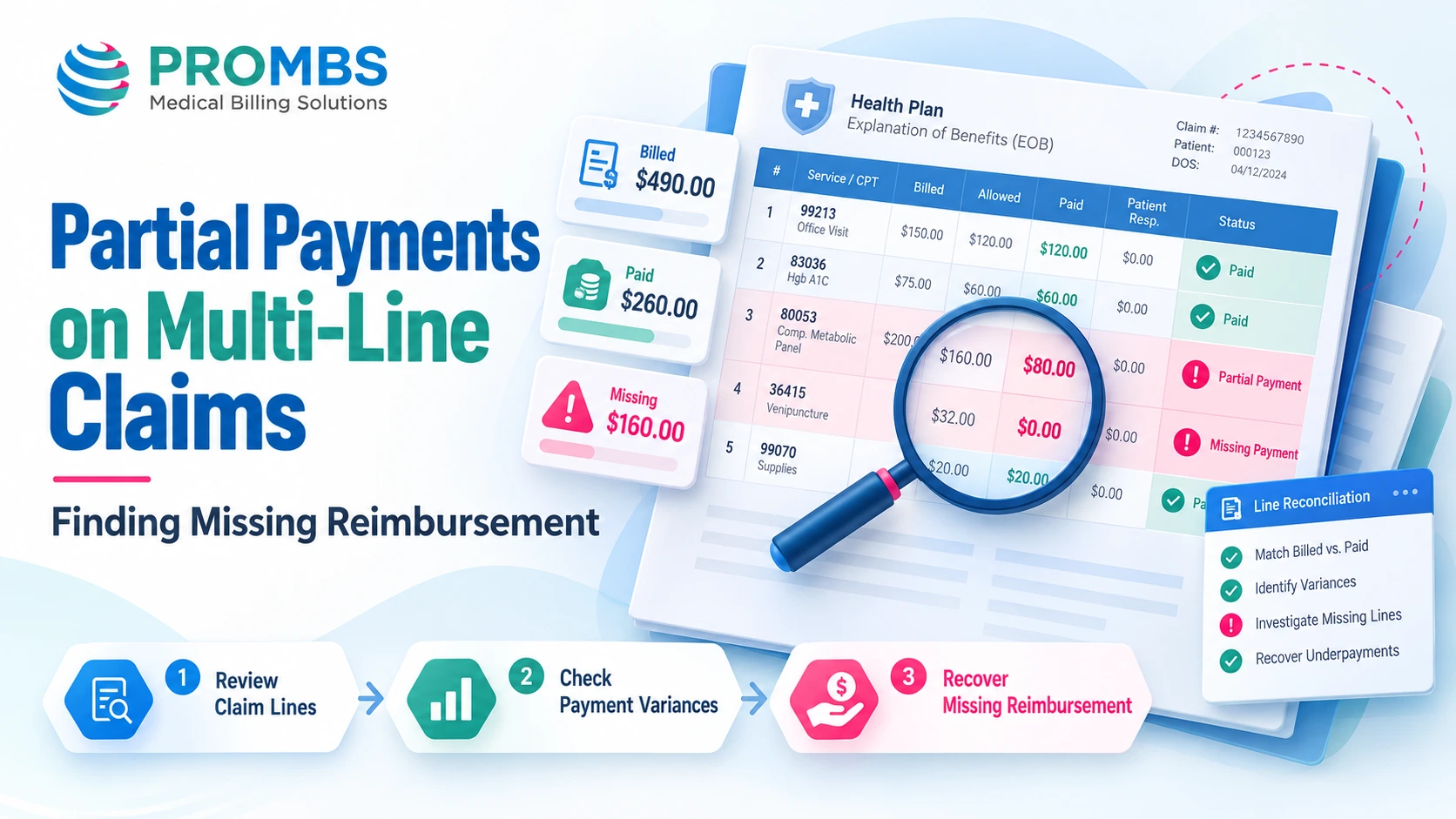
A medical practice submits a claim containing four procedures and receives a payment from the insurance company. The billing system marks the claim as paid, the payment posting team records the remittance, and the account appears to be moving toward completion. However, one procedure received no reimbursement, another was paid below the expected contracted rate, and the remaining services were processed correctly.
If nobody reviews the individual service lines, those differences can remain unnoticed. The practice may close the claim without investigating an incorrect adjustment or leave a legitimate insurance balance unresolved in accounts receivable. In other cases, staff might incorrectly identify a valid contractual reduction as missing revenue and submit an unnecessary appeal.
This is what makes partial payment medical claims particularly challenging. A positive insurance payment does not necessarily mean every service on the claim was reimbursed correctly. At the same time, receiving less than the total billed charges does not automatically indicate that the insurer owes additional money.
The billing team must examine how each procedure was adjudicated, compare the payment against applicable contractual and coverage requirements, and determine whether any additional reimbursement is actually supported.
This guide explains why multi-line medical claims receive partial payments, how service-level adjustments affect reimbursement, and which records healthcare practices should review before deciding whether a payment discrepancy requires correction, payer follow-up, or no further action.
What Are Partial Payment Medical Claims?
A partial payment occurs when an insurer pays less than the total billed amount on a medical claim. This can happen for many legitimate reasons, including contractual adjustments, deductible and coinsurance amounts, procedure-specific payment reductions, or coverage restrictions.
In everyday medical billing, however, the term is often used to describe claims containing multiple service lines where the payer reimburses some procedures but reduces, denies, or does not separately pay others.
For example, a physician’s office may submit a claim containing an evaluation and management service, a diagnostic procedure, and another separately reported service. The insurer might pay the office visit, apply a multiple-procedure reduction to one procedure, and deny the third line because it considers the service included in another procedure’s payment.
The practice receives an insurance payment, but the individual service lines have different adjudication results.
That is why the total payment amount alone cannot establish whether the claim was processed correctly. The team must understand what happened to each billed service.
A Partially Paid Claim Is Not Always an Underpaid Claim
The distinction between partial payment and underpayment is essential.
A claim is partially paid whenever the insurer reimburses less than the total submitted charges. An underpayment, by contrast, generally means the payer provided less than the amount properly owed under the applicable contract, benefit provisions, coding rules, or payment requirements.
Suppose a medical practice bills $600 for a procedure, but its contracted allowed amount is $400. The insurer pays $320 and correctly assigns $80 to patient coinsurance.
Although the practice received only $320 against a $600 charge, that difference does not automatically indicate an underpayment. The remaining amounts may consist of a legitimate $200 contractual adjustment and $80 in applicable patient responsibility.
Now consider the same procedure with a verified contractual allowance of $400. If the payer incorrectly allows $300, the billing team has a possible reimbursement discrepancy. Whether additional insurer payment is owed depends on the actual contract terms, applicable reductions, and patient cost-sharing calculation.
The goal is to identify the correct allowed and payable amounts, not simply pursue every difference between charges and payments.
Why Multi-Line Medical Claims Can Be Paid and Denied at the Same Time
Medical claims often contain several CPT or HCPCS service lines representing procedures, evaluations, treatments, or supplies provided during an encounter. Insurers evaluate these services according to the applicable benefits, coding requirements, contractual rates, and payment policies.
As a result, different lines on the same claim may receive different outcomes.
An insurer might reimburse one service in full under its payment methodology, reduce another because multiple procedures were performed, assign patient cost-sharing to a third, and deny a fourth due to a coding or coverage issue.
The claim may still receive a positive payment, even though one or more lines require further review.
Claim-Level Status Can Hide Service-Line Problems
A practice management system may display a claim as paid because the insurer issued a payment for the claim as a whole.
That status can be useful for identifying whether the claim received reimbursement, but it may not reveal whether every individual procedure was adjudicated as expected.
For example, a claim with five services may receive payment on four lines while the fifth is denied. If the billing system automatically closes the insurance portion of the account based on its posting rules, staff may not recognize the remaining unresolved service.
The problem becomes more difficult when the unpaid line is automatically adjusted or transferred to patient responsibility without an appropriate review.
A positive claim payment should not be treated as proof that every service line has reached the correct financial outcome.
The billing team needs a process for identifying line-level denials, unexpected payment reductions, and unresolved reimbursement variances even when the overall claim status shows payment.
Why Separate Procedures Receive Different Payment Decisions
Insurers may apply different rules to services reported on the same claim.
A diagnostic procedure may be covered while another is excluded under the patient’s benefits. A procedure may qualify for reimbursement but receive a reduced allowance because of multiple-procedure rules. A service may be considered included in another payment, or the payer may request additional information before processing a particular line.
These outcomes should not be grouped together as a single partial-payment problem.
A valid contractual reduction requires a different response from a payer error. A coding mistake may require a corrected claim, while a disputed bundling decision may need a review of the applicable coding edit and documentation.
Recognizing those differences is the first step toward accurate reimbursement follow-up.
Understanding Billed Charges, Allowed Amounts, and Insurance Payments
A reliable investigation begins with the financial meaning of each amount appearing on the claim and remittance. These figures represent different parts of the billing process, and confusing them can lead to incorrect underpayment calculations.
The billed charge is the amount the healthcare provider submits for a service.
The allowed amount is the amount recognized for payment under the applicable payer contract, fee schedule, or other reimbursement methodology.
The insurance payment is the amount the payer actually reimburses after considering the relevant payment and cost-sharing requirements.
The contractual adjustment generally represents a reduction required by the applicable reimbursement arrangement.
The patient responsibility may include deductible, copayment, or coinsurance amounts, subject to governing plan rules, provider agreements, and patient billing protections.
These distinctions become especially important when different service lines have different contracted rates or adjustment reasons.
Example: A Multi-Line Claim With Correct Partial Payment
Consider a hypothetical claim containing three procedures.
| Financial component | Procedure A | Procedure B | Procedure C |
|---|---|---|---|
| Billed charge | $400 | $300 | $200 |
| Allowed amount | $280 | $210 | $140 |
| Contractual adjustment | $120 | $90 | $60 |
| Insurance payment | $224 | $168 | $112 |
| Patient coinsurance | $56 | $42 | $28 |
The practice submitted $900 in total charges and received $504 from the insurer.
That does not mean $396 in reimbursement is missing.
Under the simplified assumptions used here, the claim includes $270 in contractual adjustments and $126 in patient coinsurance. All three services were adjudicated consistently with the stated allowances and an illustrative 20% coinsurance calculation.
The insurer’s $504 payment may therefore be correct.
Real claims can involve deductibles, noncovered services, multiple-procedure reductions, other payers, and different contractual methodologies. Those factors must be evaluated before deciding that a payment variance exists.
Why the Difference Between Charges and Payments Can Be Misleading
Many medical practices initially identify potential underpayments by comparing billed charges with insurance payments.
That comparison is useful for basic financial reconciliation, but it cannot independently determine whether the payer complied with its reimbursement obligations.
A practice billing $1,000 may have a contractual allowance of $600. If the insurer correctly pays $480 and assigns $120 to valid patient cost-sharing, the $520 difference between charges and payment does not represent $520 in collectible insurer reimbursement.
Instead, the billing team must establish what the insurer should have paid under the actual terms.
For meaningful reimbursement analysis, the expected contractual allowance, permitted payment reductions, coverage rules, and cost-sharing allocation are more relevant than the original billed charge alone.
Common Reasons for Partial Payments on Medical Claims
Partial payments can arise from legitimate adjudication rules, claim errors, or incorrect payer processing. The challenge is determining which explanation applies to the particular service line.
1. Contractual Adjustments and Fee Schedule Differences
Insurance companies typically process covered services according to a contracted rate, fee schedule, or other applicable reimbursement arrangement.
When the submitted charge exceeds the recognized amount, the payer may apply an adjustment. CARC 45 commonly appears when charges exceed the applicable fee schedule, maximum allowable amount, or contracted arrangement.
However, the presence of CARC 45 does not prove that the payer used the correct rate.
A practice may have an updated contract, specialty-specific reimbursement terms, or a fee schedule effective on the date of service. If the payer applied an outdated or incorrect allowance, the payment may require further investigation.
The billing team should compare the actual allowed amount with the appropriate contractual methodology before deciding whether the reduction is valid.
2. Multiple-Procedure Payment Reductions
When multiple procedures are performed during the same encounter, the payer may apply a multiple-procedure payment methodology.
Depending on the services and governing reimbursement rules, one procedure may receive the applicable primary allowance while additional procedures receive reduced payment.
CARC 59 can indicate processing under multiple or concurrent procedure rules.
The reduction is not automatically an underpayment. However, staff should verify that the correct procedures were subject to the policy, that the payer used the appropriate ranking or calculation, and that the reduction was not applied incorrectly.
A payment difference deserves attention when the actual adjudication conflicts with the applicable payment methodology, not merely because the second procedure received less reimbursement.
3. Bundled or Included Services
An insurer may determine that a service is included in the payment for another procedure.
CARC 97 can indicate that payment for a service is included in the allowance or payment for another service or procedure.
This may be correct under applicable coding and reimbursement rules. For example, some services are not separately payable when performed together under the same circumstances.
However, coding edits have specific conditions, and a service may sometimes qualify for separate reporting when documentation and applicable modifier rules support it.
CMS maintains the National Correct Coding Initiative to promote correct coding and prevent inappropriate payments.
Practices should verify the relevant coding rules and payer policy before deciding that a bundled service was denied incorrectly. Modifiers should accurately describe the care provided and should never be added merely to bypass an edit.
4. Patient Deductibles and Coinsurance
A payer may approve a service but assign some or all of the allowed amount to patient responsibility.
For example, a $250 allowed amount may be allocated entirely to the deductible if the patient’s applicable deductible has not been satisfied.
The insurer could therefore pay nothing on that particular service while paying other lines on the same claim.
This does not automatically represent missing insurer reimbursement.
Before classifying the line as underpaid, the practice should verify whether the payer applied the correct benefit and cost-sharing information. The final patient balance must also comply with applicable contracts and legal protections.
5. Individual Service-Line Denials
A claim may receive payment for some procedures while the insurer denies another because of missing information, coverage restrictions, authorization requirements, or coding issues.
These denials require a different investigation from a contractual underpayment.
The team should review the specific adjustment reason, supporting remark information, service documentation, and applicable payer requirements.
If the claim was submitted incorrectly, a correction may be appropriate. If the payer applied an incorrect policy or denied a properly reported service, reprocessing or an appeal may be justified.
If the denial is valid, the practice should determine the appropriate account disposition rather than repeatedly resubmitting the same information.
How to Read the 835 ERA for Multi-Line Payment Discrepancies
The electronic remittance advice, commonly called the 835 ERA, communicates the insurer’s adjudication and payment information.
A multi-line claim investigation should use the ERA rather than relying exclusively on a simplified payment summary displayed in the practice management system.
The CMS Health Care Payment and Remittance Advice guidance describes the electronic transaction used to communicate payments and adjustments.
The 835 contains different levels of financial information, and understanding those levels helps identify where the discrepancy occurred.
Claim-Level Versus Service-Line Information
The CLP segment provides claim-level payment and processing information.
The SVC segment, when present, provides service-line adjudication information. It helps billing teams examine how the payer handled individual procedures instead of relying solely on the claim total.
CAS information identifies adjustment groups, reason codes, and adjustment amounts at the applicable level. Additional remark information may explain an adjudication decision.
Provider-level adjustments, reported through PLB information, can also affect the overall remittance and deposit without representing a change in payment for a specific procedure.
This distinction matters when the bank deposit is smaller than expected. An offset related to an earlier payment recovery, for example, should not automatically be classified as an underpayment of a current claim line.
Understanding Adjustment Groups
Common adjustment groups include:
- CO: Contractual Obligation, generally identifying an adjustment associated with payer-provider arrangements.
- PR: Patient Responsibility, identifying an amount assigned to the patient under the applicable adjudication.
- OA: Other Adjustment, used for adjustment circumstances that do not fall within the other designated groups.
- PI: Payer Initiated Reduction, identifying certain payer-initiated adjustments.
These groups provide context, but they do not independently determine whether the payer was correct or whether the practice may legally bill the patient.
The full reason code, remark information, benefit provisions, and provider agreement must still be reviewed.
For example, a service line displaying CO-97 may require coding and bundling review, while one displaying PR-related deductible information calls for verification of the patient’s applicable cost-sharing.
Treating all unpaid service lines as the same type of denial can lead to unnecessary appeals or incorrect patient statements.
Recognizing Potential Missing Reimbursement on a Paid Claim
The first sign of a payment problem may be an insurance balance that remains open after posting. However, some of the most significant discrepancies arise when the billing system closes the claim automatically, even though an individual service was adjudicated below its expected allowance.
A useful review compares the submitted procedures with the service lines on the remittance. The team should confirm that every billed service has an identifiable adjudication outcome, that charges and units correspond to the original claim, and that adjustments were interpreted correctly.
Next, compare the payer’s allowed amounts with the applicable contract or reimbursement methodology. Any difference should be investigated in light of modifiers, multiple-procedure rules, benefit limitations, network status, and other relevant conditions.
A variance should be classified before it becomes a recovery target.
An apparent $100 difference may represent a legitimate contractual reduction, an incorrect allowance, an improperly denied service, or an internal payment posting error. Each produces a different next step.
Do Not Confuse Payment Posting Errors With Payer Underpayments
Suppose an insurer correctly pays $350 on a multi-line claim, but the practice management system posts only $300 because one service-line amount was omitted during posting.
The missing $50 is not additional reimbursement owed by the insurer. It is an internal reconciliation issue.
By contrast, if the payer actually remitted $300 when the validated contractual calculation supports $350 in insurer liability, there may be a genuine payment discrepancy.
The billing team should therefore reconcile the ERA against both the payer’s adjudication and the practice’s posted transaction history.
This prevents unnecessary disputes and ensures that payment posting problems are addressed without asking the payer to reimburse money it already paid.
Identify the Correct Follow-Up Category
After reviewing the claim, assign each questionable line to a specific category:
- Valid contractual or policy reduction requiring accurate posting.
- Supported patient cost-sharing requiring the appropriate account treatment.
- Potential payer underpayment requiring contract verification.
- Denied service requiring coding, coverage, or documentation review.
- Internal payment posting discrepancy requiring reconciliation.
- Unresolved payer decision requiring additional information.
The classification should identify the next owner and action.
For example, a questionable bundled-service denial may require coding review, while an incorrect contracted allowance may need payer contract analysis. An internal posting discrepancy belongs with payment reconciliation rather than insurance appeals.
This approach supports more accurate reporting of payment variances and reduces repeated follow-up on claims that were adjudicated correctly.
What Should a Billing Team Do After Finding a Partially Paid Claim?
Once a multi-line claim is identified for review, the billing specialist should retrieve the complete remittance and compare it with the original submitted services.
Confirm the relevant payer, patient, dates of service, procedure codes, units, modifiers, and adjudicated amounts. Then determine which services were paid, reduced, denied, or assigned to patient responsibility.
For lines that appear underpaid, retrieve the applicable reimbursement terms and calculate the amount that should have been allowed under those terms. Do not estimate additional reimbursement from billed charges alone.
For denied services, verify whether the submitted claim was accurate and whether the payer applied the appropriate rules. If an error is identified, determine whether the next action should be a corrected claim, reprocessing request, or appeal under the payer’s requirements.
Finally, document the potential discrepancy separately from money actually recovered. A disputed allowance is not additional revenue until the payer reaches a favorable determination and any additional payment is received and posted.
Healthcare practices reviewing recurring partial payment medical claims can benefit from a consistent billing and payment reconciliation process. PROMBS’s medical billing services support claim processing, payment posting, and insurance follow-up, while its denial management services address claims requiring further investigation.
A reliable process should identify the service lines that need attention without disturbing correctly adjudicated portions of the claim.
How to Reconcile Partial Payments on Multi-Line Medical Claims
When an insurance company issues partial payment on a multi-line claim, the billing team needs to establish how each procedure was processed before deciding whether additional reimbursement is due. The total claim payment provides only part of the financial picture. An insurer may have paid some services correctly, reduced others under its contractual rules, and denied one or more lines that require further investigation.
The most reliable approach is to reconcile the original claim against the complete electronic remittance advice (ERA), validate the applicable reimbursement methodology, and document any unexplained differences at the service-line level.
This process should begin with the original submitted charges, procedure codes, modifiers, units, and dates of service. Staff should then compare those details with the payer’s adjudication, including allowed amounts, actual insurance payments, contractual adjustments, patient responsibility, and claim adjustment reason codes.
The objective is not to challenge every reduction. It is to determine which amounts are correct, which require clarification, and which represent a supportable opportunity for additional reimbursement.
Step 1: Match Every Submitted Service With Its Adjudication
Retrieve the original claim and identify each submitted procedure or service line. Compare those lines with the payer’s 835 ERA or EOB.
Confirm that the remittance addresses all submitted services and that the procedure codes, units, modifiers, and charges correspond to the original claim. Some payers may report adjudicated procedure information differently from the original submission, so the team should use available line-control information and other supporting claim details rather than assuming that every line will appear in the same order.
If a service appears to be missing, determine whether it was combined, denied, adjusted, or reported elsewhere in the adjudication. Do not assume that the absence of a separate payment means the payer overlooked the service.
Step 2: Reconcile Financial Amounts
For each service line, compare the original billed amount with the adjudicated allowed amount, insurance payment, and adjustments.
The team should verify that the financial components balance according to the applicable remittance rules. For a straightforward claim, billed charges are accounted for through insurer payments and reported adjustments. More complex adjudications may include reversals, coordination-of-benefits activity, or other transactions that require additional reconciliation.
Pay particular attention to the difference between contractual adjustments and patient responsibility. A deductible amount is not an insurer underpayment merely because the payer did not issue money for that portion of the allowed charge.
Step 3: Validate Expected Reimbursement
Once the actual adjudication is clear, determine what the payer should have allowed under the applicable reimbursement arrangement.
This may require reviewing the contracted fee schedule, effective date, service location, provider status, modifiers, units, and any relevant multiple-procedure or bundling policy.
An expected allowed amount should not be calculated from a generic Medicare percentage unless the actual payer contract uses that methodology. Commercial agreements can include different rates, carve-outs, percentage-of-charge arrangements, and other provisions.
Only after establishing the correct reimbursement terms can the practice calculate a meaningful variance.
Step 4: Classify the Difference Before Taking Action
A discrepancy may involve an incorrectly applied rate, a denied procedure, a valid contractual reduction, or a payment posting problem.
Each category requires a different resolution. A coding error may need a corrected claim, an inaccurate payer allowance may need reprocessing or contractual review, and a payment already issued but posted incorrectly should be addressed internally.
The following claim examples demonstrate why the distinction matters.
Claim Example 1: Three Procedures Paid and One Service Line Denied
Consider a hypothetical outpatient claim containing four services. The practice receives payment for three procedures, while the fourth is denied.
| Service | Billed charge | Adjudicated allowed amount | Insurer payment | Initial result |
|---|---|---|---|---|
| Procedure A | $400 | $280 | $280 | Paid |
| Procedure B | $300 | $210 | $210 | Paid |
| Procedure C | $250 | $175 | $175 | Paid |
| Procedure D | $200 | $0 | $0 | Denied |
| Total | $1,150 | $665 | $665 | Partially paid |
For simplicity, assume no deductible or coinsurance applies to the three paid lines.
The insurer issued $665, so the claim has a positive payment. However, Procedure D received no reimbursement.
The billing team should not conclude that the missing reimbursement is $200 simply because that was the submitted charge. It must determine why the fourth service was denied and whether the service qualifies for separate payment.
Investigating the Unpaid Procedure
Begin with Procedure D’s adjustment group, reason code, and any accompanying remark information.
If the payer applied CARC 97, it may have determined that the service was included in another procedure’s payment. The team should review the applicable coding edit, payer policy, and clinical documentation to establish whether the bundling decision was correct.
If the procedure was properly bundled, there may be no additional insurer reimbursement due.
If the service qualifies for separate reporting under the relevant coding requirements, the team should check whether the original claim contained the necessary accurate information, including a supported modifier when applicable.
The next action may be a payer-approved corrected claim or a documented review of the payer’s determination.
The three correctly paid lines should remain intact unless the payer’s procedures require a transaction affecting the entire claim. Staff should understand those requirements before submitting a replacement, because an improperly submitted correction may create reversals, duplicate records, or additional payment delays.
Claim Example 2: The Insurer Applies the Wrong Contracted Rate
A different problem occurs when the payer reimburses a service but uses an allowance that appears inconsistent with the provider’s contract.
Suppose a practice bills three procedures, all of which receive positive payment. The billing team compares the adjudication with the contracted fee schedule effective on the service date.
| Service | Expected allowed amount | Actual allowed amount | Difference |
|---|---|---|---|
| Procedure A | $300 | $300 | $0 |
| Procedure B | $240 | $180 | $60 |
| Procedure C | $160 | $160 | $0 |
| Total | $700 | $640 | $60 |
The investigation identifies a potential $60 allowed-amount variance on Procedure B.
Assume the applicable contract confirms the expected $240 allowance, no other valid reductions apply, and the patient has a 20% coinsurance obligation.
Under the original $180 allowance, the insurer would pay $144 and assign $36 to patient coinsurance.
Under the corrected $240 allowance, the insurer would pay $192 and assign $48 to patient coinsurance.
The potential additional insurer reimbursement would therefore be $48, while the remaining $12 difference reflects the change in patient cost-sharing under these simplified assumptions.
Confirm the Contract Before Disputing the Payment
The team should confirm that the $240 expected allowance applies to the actual procedure, modifier, provider, location, and date of service.
Check whether an updated fee schedule became effective during the contract period. A reimbursement rate appearing in a current contract document may not apply to a claim performed before that rate became effective.
The practice should also verify whether Procedure B was subject to a valid multiple-procedure reduction or another contractual provision that changes its payment.
If the evidence confirms an incorrect rate, staff can prepare a payer-specific reimbursement inquiry or dispute identifying the applicable contract provision and the amount in question.
The practice should report the $48 as potential additional insurer payment, not recovered revenue. It becomes actual additional collections only after the payer issues and the practice posts the payment.
Claim Example 3: A Valid Multiple-Procedure Payment Reduction
Not every procedure paid below its standard fee schedule represents an underpayment.
Certain services are subject to multiple-procedure payment policies that change reimbursement when qualifying procedures are performed together.
For example, assume a hypothetical contract pays 100% of the applicable allowance for the highest-ranked eligible procedure and 50% of the allowance for a second qualifying procedure performed during the same encounter.
This is an illustrative contract arrangement, not a universal rule.
The practice submits two procedures with standard allowances of $500 and $300.
Under the stated terms, the payer allows $500 for the first procedure and $150 for the second, producing a combined allowance of $650.
Although the standard allowances total $800, the $150 difference may be a valid reduction under the agreed reimbursement methodology.
When a Multiple-Procedure Reduction Requires Review
Suppose the payer instead allows $500 for the first procedure and $90 for the second.
The billing team should determine why the second procedure received a larger reduction than the applicable contractual method appears to permit.
It should verify the procedure ranking, dates, units, modifiers, and whether another policy also affects the allowance. The payer’s explanation may include CARC 59, which relates to processing under multiple or concurrent procedure rules.
If the contract and governing policy support a $150 allowance and no other reduction applies, the $90 allowance presents a potential $60 variance.
The amount of additional insurer reimbursement would still depend on the applicable cost-sharing and coordination requirements.
The important distinction is that the first reduction may be valid, while the second may require investigation.
Practices should evaluate the actual payment methodology before classifying a multiple-procedure adjustment as missing revenue.
Claim Example 4: A Bundled Procedure May Have Been Processed Incorrectly
A patient receives two procedures during the same encounter, and the insurer pays the first while denying the second under a bundling edit.
The remittance reports that the denied service is included in the payment for another procedure.
In some circumstances, this decision may follow the applicable coding rules. In others, separate reporting may be permitted when the services were distinct and the documentation supports that distinction.
The billing team should review the relevant code pair, payer policy, and any applicable National Correct Coding Initiative procedure-to-procedure edit.
CMS maintains NCCI procedure-to-procedure edits to address inappropriate code combinations under Medicare. Commercial insurers may apply their own policies, so the applicable payer rules must also be considered.
Determine Whether Separate Payment Is Permitted
Review the clinical records to establish what was performed, why it was performed, and whether the services were independently reportable.
Where an applicable coding edit permits a modifier under qualifying circumstances, the modifier must accurately describe the distinct service and be supported by the documentation.
It should never be added solely because the insurer denied the line.
If the original claim omitted valid coding information, the payer may require a corrected claim. If the original submission was accurate but the payer applied the wrong edit, a reconsideration or appeal may be appropriate.
A favorable decision is possible only when the facts and governing rules support separate payment.
If the bundling decision is valid, the unpaid line should not be counted as recoverable insurer revenue.
Claim Example 5: A Payment Posting Error Looks Like an Insurance Underpayment
Sometimes the insurer pays correctly, but the practice management system does not reflect the full payment.
Consider a claim containing three procedures. The payer’s 835 ERA shows payments of $180, $120, and $90, totaling $390.
However, the billing system records $180, $120, and $40, totaling $340.
The account now shows a $50 difference between the payment communicated on the ERA and the amount recorded in the billing system.
The billing team may initially believe the payer underpaid the third procedure.
However, the source remittance shows that the insurer already issued the correct $90 payment for that line.
The $50 discrepancy is an internal payment posting problem, assuming the corresponding payment was actually received and no later adjustment changed it.
Verify the ERA, Deposit, and Posting Records
Staff should reconcile the source ERA against the posting transactions and the associated electronic funds transfer or other payment record.
Check whether the missing $50 was posted to another account, allocated to the wrong service line, held in an unapplied payment account, or omitted because of an automated posting rule.
Also investigate whether a provider-level adjustment affected the remittance payment. A PLB adjustment may reduce the overall deposit without changing the adjudicated payment reported for a particular claim.
If the ERA and payment records confirm that the payer fulfilled its obligation, the appropriate response is an internal reconciliation correction, not a request for another insurance payment.
This is why claim-level and service-line adjudication should be reconciled separately from the total bank deposit.
Understanding CARC and RARC Information on Partially Paid Claims
Claim adjustment reason codes identify why a payer adjusted a service or claim. Remittance advice remark codes can provide additional details, including information needed to understand a specific denial or reduction.
For multi-line claims, billing teams should examine the adjustment information associated with the affected service rather than relying only on a general claim status.
CARC 45 may indicate an adjustment based on the applicable fee schedule or contracted allowance. CARC 59 can indicate multiple-procedure processing. CARC 97 addresses services included in payment for another service or procedure. CARC 16 may indicate missing or incorrect information, while CARC 96 concerns noncovered charges.
Each code requires context.
A contractual adjustment code does not independently prove that the correct contracted rate was applied. Similarly, a bundling-related code does not prove that the denied procedure was ineligible for separate payment under every circumstance.
The official X12 Claim Adjustment Reason Codes provide standardized definitions. The team should read the applicable group code, remark information, provider agreement, and payer policy before choosing a resolution.
Avoid Classifying Every Reduced Line as a Denial
A payer may reduce payment for a service while still approving it under its reimbursement methodology.
A valid multiple-procedure reduction is not the same as a service-line denial. A correct deductible allocation is not an insurer underpayment. A contractual allowance lower than the billed charge is not necessarily evidence of payer error.
Accurate classification helps avoid unnecessary appeals and prevents management reports from treating legitimate adjustments as lost revenue.
Corrected Claim, Reprocessing Request, or Payment Appeal?
Once a payment discrepancy has been verified, the billing team should select the appropriate response based on the source of the problem.
A corrected claim may be appropriate when the provider submitted inaccurate information, such as an incorrect modifier, unit count, or procedure code. The correction must be supported by clinical documentation and submitted through the payer’s approved process.
A reprocessing or contractual reimbursement request may be appropriate when the original claim was accurate but the payer applied an incorrect fee schedule, allowance, or adjudication rule.
A formal appeal may be appropriate when the payer’s adverse determination conflicts with applicable coverage provisions, coding rules, or other requirements, and the decision is reviewable through that payer’s process.
An internal posting correction is appropriate when the insurer paid correctly but the practice recorded the payment incorrectly.
Do Not Disturb Correctly Paid Lines Without Understanding the Payer’s Process
A multi-line claim may have several services that were adjudicated correctly and only one line requiring correction.
The practice should determine whether the payer allows service-line reconsideration, requires a replacement of the complete claim, or uses another adjustment procedure.
Some replacement transactions can reverse or supersede an earlier adjudication. Staff should therefore preserve the original claim number, remittance, payment details, and submission history before making changes.
Do not assume that a corrected claim resets the timely filing period or that every payer accepts the same replacement procedure.
Building an Evidence Packet for Missing Reimbursement
A well-supported reimbursement inquiry should explain exactly what the practice believes was processed incorrectly.
For a contractual underpayment, the packet may include the original claim, relevant remittance, applicable contract or fee schedule provision, effective date, and calculation showing the expected and actual allowances.
For an incorrectly denied procedure, it may include the medical documentation, code descriptions, relevant modifiers, payer policy, and adjustment explanation.
For a disputed multiple-procedure reduction, identify the applicable payment methodology and demonstrate where the calculation appears inconsistent with its terms.
Use the payer’s designated submission channel and include only the protected health information necessary for the review.
The explanation should specify the action requested. For example, a request might ask the payer to review Procedure B’s allowance against a particular contract schedule effective on the service date.
This is more useful than a general statement that the claim was partially paid.
Calculating Supportable Additional Reimbursement
After completing the investigation, the billing team should distinguish among three financial figures.
The allowed-amount variance measures the difference between the verified expected allowance and the payer’s actual allowance.
The potential additional insurer payment estimates what the insurer might owe if the discrepancy is corrected, after considering appropriate cost-sharing and other payment rules.
The actual recovered reimbursement is the additional insurer payment received and posted after the issue is resolved, net of related reversals or refunds.
These amounts are not interchangeable.
A claim with a $100 allowed-amount variance may result in less than $100 of additional insurer payment. A valid contractual adjustment may produce no recoverable amount at all. A favorable payer review may also remain unpaid until the resulting remittance and payment are issued.
Practices should use validated amounts when prioritizing follow-up rather than assuming every unpaid billed charge represents collectible revenue.
Final Reconciliation After the Payer Reviews a Partially Paid Claim
The investigation is not complete when a payer agrees to reconsider a payment.
The billing team should obtain the revised EOB or ERA and compare it with the original adjudication. Verify whether the disputed service’s allowed amount, insurer payment, contractual adjustment, or patient responsibility changed.
If the payer issues an additional payment, confirm that the money was received and posted to the correct claim and service line. If the payer reverses the original adjudication and replaces it, reconcile both transactions rather than recording the replacement as an entirely new payment.
The final account should also reflect the correct patient balance under the applicable plan, contract, and billing protections.
For a denied line that remains nonpayable, document the determination and establish the appropriate financial disposition. For a valid underpayment that is still unresolved, retain a clear follow-up status and the relevant payer deadline.
PROMBS’s revenue cycle management services support broader coordination of payment posting, accounts receivable, and insurance follow-up. These activities are especially important when multi-line claims contain a mixture of correctly paid services and unresolved reimbursement discrepancies.
How to Prevent Unnoticed Partial Payments in Medical Billing
Preventing missing reimbursement on multi-line claims requires more than accurate claim submission. A practice also needs a reliable process for reviewing how insurers adjudicate each service after payment is issued. When the billing system marks a claim as paid, it should not automatically mean that every procedure has been reimbursed correctly or that all remaining balances are ready for adjustment.
The challenge is that partially paid claims often look routine. The insurer sends an electronic remittance, payment is deposited, and the account moves through the normal posting workflow. However, one service line may have received an incorrect contractual allowance, another may have been denied, and a third may have been reduced under a payment policy that requires further verification.
These discrepancies can remain unresolved when staff concentrate only on claims with no payment. A successful prevention strategy should therefore include both denied claims and claims that received positive reimbursement but contain unexpected service-line results.
The objective is not to challenge every contractual adjustment. It is to make sure that every billed service reaches an accurate, documented financial outcome.
Review Every Service Line Before Closing the Claim
The payment posting process should account for each service submitted on a multi-line claim. Staff should identify whether the procedure was paid, reduced, denied, assigned to patient responsibility, or otherwise adjusted.
An insurance payment may satisfy the payer’s obligation for some services while leaving others unresolved. For that reason, the practice management system should not rely exclusively on the total claim payment to determine whether an account requires additional review.
If a claim contains five procedures and four are reimbursed, the fifth should have a documented adjudication outcome. When that outcome cannot be explained by the remittance and applicable rules, the line should remain available for investigation rather than disappearing into a general contractual adjustment.
This approach also prevents unnecessary follow-up. A procedure that was correctly included in another payment does not need to remain in the insurance A/R queue indefinitely. The team should confirm the adjustment and close the line appropriately.
Create Exception Rules for Unexpected Payment Differences
Not every partially paid claim needs extensive manual review. Practices can use defined exception criteria to identify cases where further investigation is more valuable.
For example, a claim may require review when the payer’s allowed amount differs from a validated contractual expectation, an otherwise paid claim contains an unexplained denied line, or the adjudicated units do not match the submitted units.
Other exceptions may include missing adjustment information, an unexpected zero-paid procedure, a payment posting imbalance, or a payer reduction inconsistent with the applicable reimbursement methodology.
The exception queue should record the reason for review and the evidence required to resolve it. An incorrect contractual rate may need fee schedule verification, while a bundling-related denial may require coding review.
By separating these issues, the practice avoids sending every partial-payment account to the same generic denial queue.
Establish a Service-Line Payment Verification Workflow
A dependable payment verification process connects the original claim, electronic remittance, payer contract, and posted financial transactions.
When these records are reviewed independently, billing teams can identify missing reimbursement without confusing legitimate adjustments with payer errors.
Confirm the Submitted Services and Adjudicated Results
Begin by matching every submitted CPT or HCPCS service line with the corresponding adjudication information. Verify procedure codes, modifiers, units, charges, rendering provider information, and dates of service.
The electronic remittance should provide sufficient information to determine how the insurer handled each service. Where the payer reports adjudicated information differently from the original submission, use the available claim references and service-line identifiers to establish the correct relationship.
If the payer combined, changed, or denied a service, document that determination rather than assuming the line was omitted.
Compare Actual Payment With Expected Reimbursement
After verifying the adjudication, compare the allowed amount with the reimbursement expected under the applicable contract or payment policy.
This comparison should account for relevant fee schedule dates, modifiers, service location, procedure ranking, and any permitted multiple-procedure reductions.
A difference between billed charges and the actual payment should not automatically trigger an underpayment dispute.
For example, a procedure billed at $500 may have a valid contracted allowance of $320. If the payer correctly assigns $64 to coinsurance and pays $256, the insurer has satisfied its payment obligation under those simplified assumptions.
A potential problem exists when the payer’s calculation conflicts with the applicable reimbursement rules, not merely when payment is lower than the submitted charge.
Reconcile the ERA With Payment Posting
The posting team should verify that actual insurer payments, adjustments, and patient responsibility amounts have been recorded correctly.
If the payer’s ERA shows $400 in claim payments but the billing system records only $350, the practice should investigate the difference before opening a payer underpayment dispute.
The team must also account for payment reversals, replacement remittances, and provider-level adjustments.
An EFT deposit may differ from the sum of current claim payments because of adjustments reported at the provider level. Such differences should be reconciled using the appropriate remittance and payment records, rather than automatically assigned to an individual service line.
A consistent reconciliation process prevents internal posting errors from being incorrectly reported as missing insurance reimbursement.
Keep Payer Contracts and Fee Schedules Updated
Accurate underpayment detection depends on knowing what the insurer was contractually required to allow and pay.
If the practice uses an outdated fee schedule or applies the wrong reimbursement methodology, its payment variance reports may produce misleading results.
For example, a contracted amount may change at the beginning of a new agreement period. A claim performed before that effective date may be payable under the previous schedule, while later services may qualify for updated rates.
The billing team should maintain reliable records of contract effective dates, fee schedules, applicable modifiers, and reimbursement provisions.
Understand Contractual Payment Methodologies
Not every contract reimburses services using a simple fixed fee per CPT code.
Some agreements use percentages of a published fee schedule, negotiated rates for specific procedures, multiple-procedure reductions, bundled payments, or other reimbursement arrangements.
A service-line comparison must reflect the actual methodology.
The practice should also distinguish contract-based underpayments from claims affected by benefit restrictions, patient cost-sharing, or coordination with other insurance.
When the contract’s expected payment cannot be established reliably, the variance should remain under investigation rather than being classified as confirmed recoverable revenue.
Review Contract Changes Before They Affect Claims
When payer contracts are renewed or amended, relevant billing and payment posting teams should receive updated reimbursement information.
This is particularly important when a payer changes its fee schedule, modifies a reimbursement provision, or introduces new procedure-specific payment rules.
Practices should retain historical rates so older claims can be evaluated under the terms applicable on their dates of service.
A current fee schedule should not be used indiscriminately to calculate expected reimbursement for every previously submitted claim.
KPIs for Monitoring Partial Payments and Missing Reimbursement
A useful revenue cycle dashboard should identify where payment discrepancies occur and distinguish suspected underpayments from actual additional collections.
General denial counts are not enough because many incorrectly reimbursed services receive positive payment and never appear in a traditional denial report.
The following indicators can help practices measure service-line payment accuracy.
| KPI | Suggested calculation | What it measures |
|---|---|---|
| Service-line payment variance rate | Service lines with an unresolved difference from validated expected reimbursement ÷ adjudicated service lines reviewed × 100 | Frequency of potential payment discrepancies |
| Partially denied claim rate | Multi-line claims with at least one denied line and at least one paid line ÷ adjudicated multi-line claims × 100 | How often positive-pay claims contain denied services |
| Contractual underpayment confirmation rate | Investigated payment variances confirmed as payer underpayments ÷ completed payment variance investigations × 100 | Accuracy of suspected underpayment identification |
| ERA reconciliation accuracy | Reviewed service lines posted correctly against source remittance information ÷ service lines reviewed × 100 | Quality of payment posting |
| Supported resolution rate | Closed payment variance cases with documented financial dispositions ÷ closed cases reviewed × 100 | Completeness of investigations |
| Net additional insurer collections | Additional payments received and posted after supported recovery actions, net of related reversals | Actual financial recovery |
These are recommended operational measures, not universal industry benchmarks.
A practice should define its reporting periods and avoid counting multiple adjustments or reprocessed versions of the same service as separate reimbursement opportunities.
Example: Evaluating Partial-Payment Performance
Consider a hypothetical practice reviewing 1,500 adjudicated service lines. Forty-five show differences from validated expected reimbursement and enter an exception queue.
After investigation, the team determines that twenty differences reflect valid contractual reductions, ten involve internal payment posting errors, eight involve confirmed payer underpayments, and seven require additional documentation or payer clarification.
The practice should not classify all forty-five as recoverable revenue.
The twenty valid reductions require appropriate posting, and the ten internal discrepancies require reconciliation rather than another insurance payment.
The eight confirmed underpayments may support payer follow-up, but their potential reimbursement should be reported separately from actual collections.
If successful reviews eventually produce $2,150 in additional insurer payments that are received and posted, that amount represents realized recovery. Cases still awaiting a final determination should remain in the pending category.
This classification helps management identify whether the main problem is payer underpayment, inaccurate posting, or recurring misunderstanding of contractual adjustments.
Conduct a Monthly Multi-Line Claim Reimbursement Audit
A monthly reimbursement audit can identify payment problems that routine claim follow-up misses.
The review should include claims with positive insurance payments, not only completely denied or unpaid claims.
A useful sample may include high-value multi-line claims, claims with unexpected contractual adjustments, denied procedures within otherwise paid claims, and accounts closed through automated posting rules.
The purpose is to validate whether every service received the correct financial disposition.
Review the Original Claim and Complete Remittance
For each selected claim, compare the originally submitted services with the final 835 ERA or EOB.
Confirm the billed procedures, units, modifiers, charges, allowed amounts, payer payments, adjustment reasons, and patient responsibility.
Investigate any service that lacks a clear adjudication outcome.
Where the payer applied multiple-procedure or bundling rules, verify whether the relevant policy was applied correctly.
For contractual payment differences, compare the allowed amounts against the fee schedule or reimbursement methodology effective on the date of service.
The review should identify specific discrepancies instead of using a broad label such as “insurance underpaid.”
Audit Payment Posting and Closed Accounts
A claim may be closed with a zero balance even when the underlying payment was recorded incorrectly.
For example, an automated posting rule may have written off a remaining amount because it interpreted an adjustment code incorrectly. Alternatively, a payment may have been applied to the wrong procedure or another encounter.
The audit should confirm that payments match the source remittance and that adjustments are supported by the applicable contract, payer determination, and accounting requirements.
Patient balances should also be reviewed when a disputed service was transferred to patient responsibility.
A reduced or denied payment does not automatically make the entire unpaid charge collectible from the patient. Provider agreements, benefit provisions, and applicable federal or state protections may limit financial responsibility.
Identify Repeated Causes and Assign Corrective Actions
When multiple claims show the same reimbursement discrepancy, determine whether they share a payer, procedure, contract period, modifier, or billing workflow.
For instance, several claims may reveal that one payer consistently applies an outdated fee schedule to a particular procedure.
Another pattern may involve payment posting software incorrectly categorizing an adjustment code.
Each finding should have an assigned owner and a documented next action.
A contract variance may require payer relations follow-up, while an automated posting issue may need a system configuration review.
The next monthly audit should confirm whether the corrective action reduced similar discrepancies.
Managing Denied Service Lines Without Disturbing Correctly Paid Procedures
One of the most important responsibilities in partial-payment follow-up is preserving the financial accuracy of services the payer already adjudicated correctly.
A multi-line claim may have four paid procedures and one denied line. If the disputed service requires correction, the billing team should determine whether the payer accepts a service-specific review or requires a replacement transaction affecting the entire claim.
Submitting a new original claim for the denied procedure may be inappropriate when that service already exists on an accepted claim. Likewise, replacing a complete claim without understanding the payer’s procedure may lead to payment reversals or new processing problems.
Before taking action, document the original claim number, paid service lines, adjustments, and disputed amount.
If the payer reprocesses the claim, compare the replacement remittance with the original and reconcile any reversals, new payments, and revised patient responsibility.
A successful dispute should produce a verified financial result, not duplicate postings or an unexplained increase in accounts receivable.
How PROMBS Helps Practices Identify Missing Reimbursement
Multi-line reimbursement problems are often difficult to identify because payment posting, denial follow-up, coding, and contract review may be handled by different people.
A practice can receive insurance payment and still have unresolved service-line discrepancies that require further attention.
Pro Medical Billing Solutions (PROMBS) provides medical billing, denial management, and revenue cycle services that can help healthcare practices maintain more consistent claim processing and reimbursement follow-up.
The objective is to identify supportable payment issues, correct inaccurate records, and improve the overall billing workflow.
Medical Billing and Payment Posting Support
PROMBS’s medical billing services support claim submission, insurance follow-up, and payment posting activities.
These functions are important when a claim contains several procedures with different adjudication results.
A consistent payment posting workflow can help ensure that payments and adjustments are recorded against the appropriate claims and service lines, while unexplained discrepancies remain available for review.
The practice should be able to distinguish money already paid by the insurer from additional reimbursement that may still be owed.
Denial Investigation and Payer Follow-Up
Through its denial management services, PROMBS supports the investigation of denied claims and payer follow-up.
For multi-line claims, the investigation may involve an incorrectly denied procedure, a missing modifier supported by the clinical record, an inaccurate coverage determination, or a disputed contractual adjustment.
The appropriate resolution depends on the evidence.
Some claims require a valid correction, others a reprocessing request or appeal, while legitimately denied services need accurate financial disposition rather than repeated submissions.
Revenue Cycle Reporting and Billing Audits
PROMBS’s revenue cycle management services support coordination across the claim and payment lifecycle.
Its medical billing and coding audit services can also help practices evaluate billing accuracy and recurring payment-related problems.
For organizations experiencing frequent partial payments, a focused review can examine service-line adjudications, adjustment handling, unresolved insurance balances, and the consistency of payment posting.
These findings can help practices identify areas where reimbursement follow-up and internal billing processes may need improvement.
Frequently Asked Questions About Partial Payment Medical Claims
1. What does partial payment mean in medical billing?
Partial payment means the insurer reimbursed less than the total billed amount. On a multi-line claim, this may involve payment for some procedures and denial or reduction of others. Partial payment does not automatically indicate an insurer error because contractual adjustments, cost-sharing, and other valid payment rules can explain the difference.
2. Why does insurance pay some CPT codes but deny others?
Insurers adjudicate services according to applicable benefits, coding rules, authorization requirements, and reimbursement policies. A procedure may be separately payable while another is bundled, excluded, or missing required information. The billing team should review the adjustment reason and supporting documentation for each affected service.
3. How can a practice identify an underpaid service line?
Compare the payer’s actual allowance and payment with the reimbursement expected under the applicable contract and payment rules. Account for modifiers, multiple-procedure reductions, deductibles, coinsurance, and other adjustments. A confirmed difference may support further investigation, but billed charges alone do not establish underpayment.
4. Does a partially paid claim always require an appeal?
No. Some partial payments are correct. Others involve inaccurate claim information that may need correction, administrative processing errors that may require reprocessing, or internal payment posting discrepancies. A formal appeal is appropriate only when the payer’s determination is reviewable and the evidence supports the dispute.
5. Can one procedure be denied while the rest of the claim is paid?
Yes. A payer can issue positive payment for a multi-line claim while denying one or more individual services. The billing team should examine the remittance at the service-line level and determine whether the unpaid procedure requires correction, review, or a valid adjustment.
6. What does CO-97 mean on a partially paid claim?
CO-97 generally indicates that payment for a service is included in the allowance or payment for another service or procedure. The team should verify the relevant coding and payer rules before deciding whether the bundling decision is appropriate. A modifier should be used only when supported by the documented services and applicable reporting requirements.
7. Can the insurer’s payment be correct even when the deposit is smaller than expected?
Yes. Provider-level adjustments, offsets, and other remittance transactions may affect the overall deposit without changing the payment adjudicated for a particular service line. The practice should reconcile the 835 ERA, payment information, and posting records before assuming an individual claim was underpaid.
8. How do I calculate missing reimbursement on a multi-line claim?
First, calculate the verified expected allowance and compare it with the actual allowance for each affected line. Then determine the potential additional insurer liability after considering valid cost-sharing, coordination, and payment rules. The difference between billed charges and the insurer’s payment is not necessarily recoverable reimbursement.
9. Can a patient be billed for the unpaid portion of a partially paid claim?
Not automatically. The remaining balance may include contractual adjustments, denied charges, patient cost-sharing, or amounts still under payer review. Patient billing depends on the applicable adjudication, provider agreement, and legal protections. The account should be reconciled before the practice determines what can appropriately be charged to the patient.
Request a Free PROMBS Medical Billing Audit
Partial payments on multi-line claims are not always easy to recognize as reimbursement problems. A claim may show positive insurance payment while individual services remain underpaid, denied, or incorrectly adjusted.
The most effective approach is to verify each service-line adjudication, compare expected reimbursement with the applicable payer rules, and follow supported discrepancies through final payment reconciliation.
If your practice is experiencing recurring partial claim payments, questionable contractual adjustments, or unresolved balances on otherwise paid claims, PROMBS can help evaluate your billing workflow.