

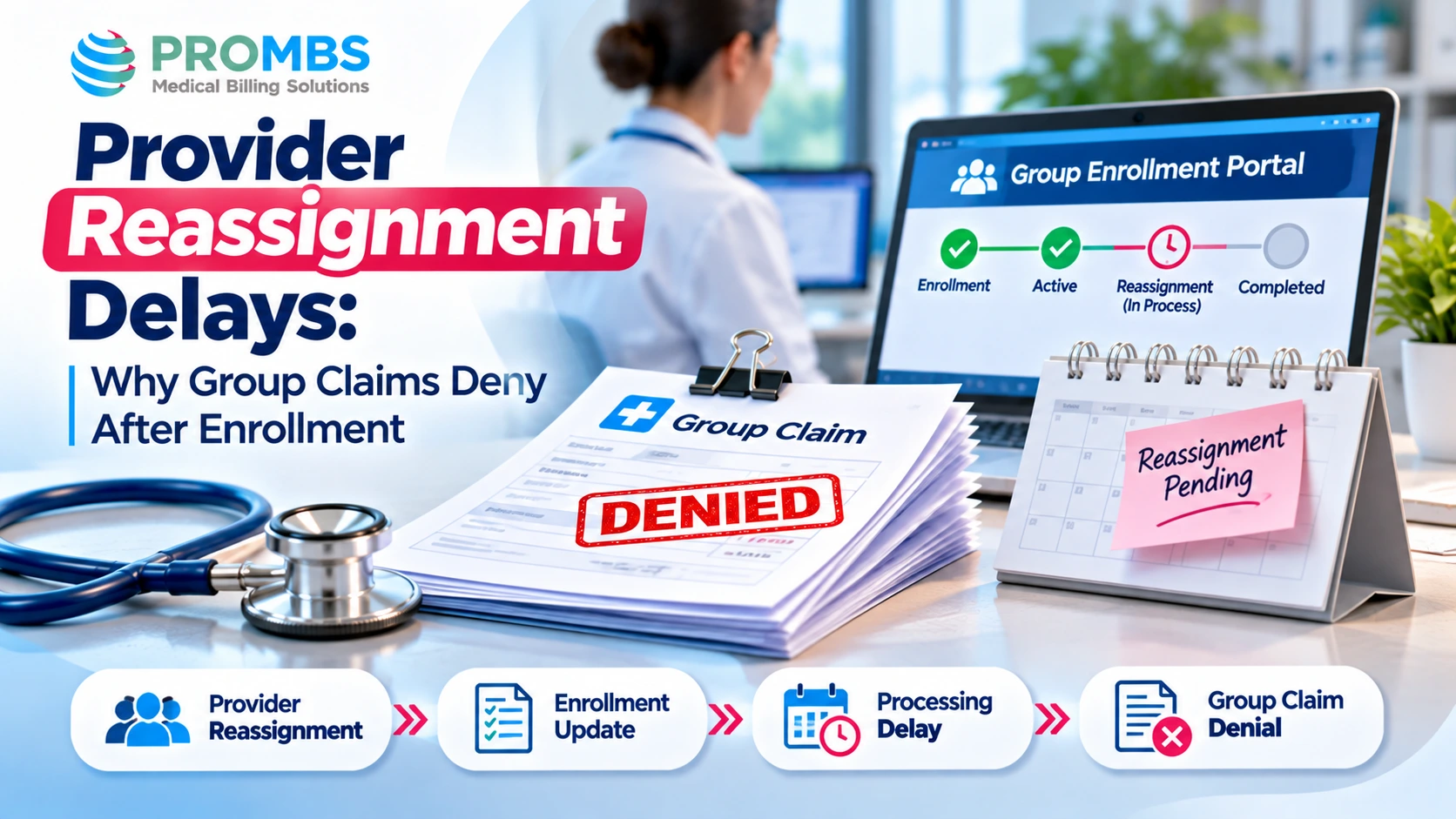
A medical group hires a physician, completes the credentialing process, and receives confirmation that the provider is enrolled in Medicare. The physician begins seeing patients, and the billing department submits claims using the physician’s individual NPI and the group’s billing information.
Everything appears ready for reimbursement.
However, several claims are rejected or denied because Medicare does not recognize an active reassignment relationship between the physician and the group for the relevant dates of service.
The physician’s individual enrollment is approved. The group is enrolled. Both National Provider Identifiers (NPIs) are valid.
Yet the group cannot receive payment for the affected services because a separate enrollment requirement remains unresolved.
Provider reassignment denials occur when the required relationship allowing an individual practitioner to reassign Medicare payment benefits to an eligible organization is missing, inactive, or not effective for the services being billed.
This problem is particularly important when practices hire new physicians, add providers to existing group enrollments, change billing organizations, or transfer practitioners between medical groups.
A successful individual enrollment does not automatically establish every group reassignment relationship.
Healthcare practices must confirm that the practitioner, receiving organization, and applicable billing dates are correctly recognized before treating group claims as ready for submission.
This guide explains why reassignment delays occur, how Medicare’s enrollment process works, and what practices should verify to reduce avoidable group claim denials.
What Are Provider Reassignment Denials?
Provider reassignment denials are claim-processing or payment problems associated with a missing, inactive, or otherwise invalid reassignment of benefits between an individual healthcare practitioner and an eligible billing organization.
Under Medicare’s reassignment rules, an eligible practitioner may authorize a qualified organization, such as an employer or group practice, to receive Medicare payment for services the practitioner furnishes.
For this arrangement to function correctly, the appropriate Medicare enrollment and reassignment requirements must be satisfied.
For example, a physician may be individually enrolled in Medicare but begin working for a new medical group.
The physician’s individual enrollment does not automatically mean that the new group is recognized as the recipient of reassigned payments.
The practice must establish the appropriate reassignment relationship through Medicare’s enrollment process.
If the group submits claims before that relationship is correctly established for the dates involved, payment problems may occur.
Why These Denials Are Different From General Enrollment Errors
A general provider enrollment denial may involve an inactive individual enrollment, an incorrect practice location, or an unresolved Medicare application.
A reassignment-related denial focuses on the relationship between the practitioner and the organization receiving payment.
The individual provider may have valid Medicare billing privileges while the reassignment to a particular group is missing.
Similarly, the group may have active Medicare enrollment without an approved reassignment from the practitioner.
Understanding this distinction helps billing teams investigate the actual problem instead of repeatedly correcting unrelated claim fields.
Why Group Claims Deny Even After Individual Enrollment Is Approved
The most common misunderstanding is assuming that a physician’s Medicare enrollment approval automatically authorizes every affiliated group to bill for the physician’s services.
Individual enrollment and reassignment of benefits are related, but they are separate requirements.
An individual practitioner must meet Medicare enrollment requirements, while the group receiving reassigned payments must also be eligible under the applicable rules.
The reassignment establishes which organization may submit claims and receive Medicare payment for the practitioner’s qualifying services.
Individual Enrollment Does Not Automatically Establish Group Payment Rights
Consider a physician who has maintained an active Medicare enrollment for several years.
The physician joins a new multispecialty group and begins furnishing services under the group’s operations.
Although the physician’s individual enrollment remains active, the new group must ensure that Medicare recognizes the appropriate reassignment.
The physician’s active NPI and Medicare enrollment history do not independently establish that the new organization can receive payment.
This is why enrollment teams should verify the actual group relationship rather than rely solely on an individual provider’s approval status.
Group Enrollment Does Not Automatically Include Every Practitioner
A medical group may have an approved organizational enrollment and valid billing information.
However, that does not mean every newly hired practitioner has an active reassignment to the organization.
The group should track the status of each practitioner’s relationship separately.
This is particularly important for organizations experiencing frequent staffing changes or adding several practitioners at the same time.
An enrollment team may complete the organization’s registration while individual reassignment applications remain pending or require additional information.
Submitting claims without recognizing these differences can create preventable accounts receivable problems.
Medicare Enrollment vs. Reassignment of Benefits
Medicare enrollment establishes the relevant practitioner’s or organization’s participation and billing privileges under applicable requirements.
Reassignment of benefits allows an eligible organization to receive Medicare payment for services furnished by an individual practitioner under a qualifying arrangement.
The two processes serve different administrative purposes.
| Requirement | Individual Medicare enrollment | Medicare reassignment of benefits |
|---|---|---|
| Primary purpose | Establishes the practitioner’s Medicare enrollment and billing privileges | Establishes an eligible party’s ability to receive payment for the practitioner’s services |
| Main relationship | Practitioner and Medicare program | Practitioner and receiving organization |
| Relevant records | Individual enrollment details and billing privileges | Specific reassignment relationship and applicable dates |
| Common application pathway | PECOS or CMS-855I | PECOS or reassignment sections of CMS-855I |
| Common billing concern | Individual enrollment is inactive or incomplete | Group is not recognized as the appropriate recipient of payment |
The distinction matters because the billing team must verify both requirements before submitting affected claims.
CMS explains the current process in its official Medicare Provider Enrollment Application, CMS-855I.
Reassignment and the Group Billing Relationship
An eligible practitioner may reassign benefits to a qualifying group or organization under applicable Medicare requirements.
The receiving organization is commonly called the reassignee, while the practitioner transferring the payment right is the reassignor.
The relationship must be established correctly in Medicare’s enrollment records.
A practitioner may also have more than one reassignment relationship when the arrangements satisfy applicable requirements.
For example, a physician working with two eligible medical groups may need separate reassignment records for each group.
An approved relationship with Group A does not automatically establish a reassignment to Group B.
Each relationship should be verified independently.
How CMS-855I and PECOS Reassignment Work
Medicare reassignment information is submitted through the Provider Enrollment, Chain, and Ownership System (PECOS) or the current CMS-855I application.
The process identifies the individual practitioner and the eligible organization receiving the reassigned benefits.
The Medicare Administrative Contractor (MAC) reviews the submitted information and processes the application according to applicable enrollment requirements.
CMS-855R Has Been Discontinued
A significant administrative change involves the former CMS-855R reassignment form.
CMS has discontinued CMS-855R and consolidated reassignment reporting into CMS-855I.
Practitioners and eligible organizations can use the appropriate CMS-855I process or PECOS to add, change, or terminate reassignment relationships.
The group’s organizational enrollment may involve CMS-855B, but that does not replace the need to establish the relevant practitioner’s reassignment.
The official CMS Program Integrity Manual, Chapter 10 explains current reassignment processing requirements.
Why Submission Is Not the Same as Approval
An enrollment specialist may submit a reassignment application and receive confirmation that Medicare accepted the submission for processing.
However, a submission acknowledgment does not necessarily mean the reassignment has been approved.
The contractor may identify missing information, request clarification, or determine that additional requirements must be satisfied.
The enrollment team should distinguish among an application that has been submitted, one undergoing review, and an approved reassignment.
The billing department should not treat a pending application as an active relationship without confirming the applicable status and billing dates.
Common Reasons Reassignment Remains Pending or Incomplete
Reassignment delays can result from administrative errors, incomplete applications, or changes that have not been properly reflected in Medicare enrollment records.
The issue may be difficult to identify when the physician and group both appear to have valid enrollment information.
Incomplete Application Information
A reassignment application may require additional information or corrections before the contractor can complete its review.
For example, the practitioner and group information may not match the relevant enrollment records.
Required sections or certifications may also be incomplete.
When the MAC requests additional information, the enrollment team should respond through the prescribed process and retain the relevant confirmation.
Failure to complete application development requirements can result in rejection and may affect the effective date of a subsequently approved reassignment.
Incorrect Group Information
A practitioner may be linked to the wrong organization or an outdated group record.
This can occur when a medical organization operates multiple entities or changes its billing structure.
The enrollment team should confirm the exact legal organization receiving reassigned benefits.
It should also verify the relevant Medicare enrollment identifiers rather than assuming that a familiar group name refers to the correct entity.
Reassignment Not Updated After a Provider Transition
A physician may leave one group and join another.
The former relationship may be terminated, while the new reassignment has not yet been approved.
If the new group submits claims without verifying its relationship, the claims may encounter payment problems.
Practices should coordinate provider transitions so reassignment changes are tracked alongside employment dates and billing arrangements.
Reassignment Terminated in Error
An authorized enrollment change may accidentally terminate the wrong practitioner’s reassignment.
Because the practitioner remains individually enrolled, the error may not be immediately apparent.
The billing team may discover the problem only when Medicare no longer recognizes the organization as the payment recipient.
Correcting a mistaken termination may require a new approved application or another remedy available under the applicable process.
Importantly, discovering that the termination was accidental does not automatically establish entitlement to an earlier reassignment effective date.
Medicare Reassignment Effective Dates and Retrospective Billing
Effective dates are among the most important considerations when investigating reassignment-related group claim denials.
A practitioner may begin working for a medical group before Medicare establishes the reassignment’s effective date.
The organization must determine which dates of service fall within the permitted billing period.
How the Effective Date Is Determined
Under the current version of 42 CFR § 424.522, the reassignment effective date generally follows the applicable practitioner enrollment effective-date rule.
The relevant date is the later of the date of filing of an application that is subsequently approved or the date the practitioner first began furnishing services at the new practice location.
The physician’s employment start date does not automatically control the reassignment effective date.
The practice should verify the official determination rather than calculate billing eligibility from its internal hiring records alone.
When Retrospective Billing May Be Allowed
Applicable Medicare rules may permit retrospective billing for qualifying services before the reassignment effective date.
Under the ordinary circumstances described in 42 CFR § 424.521(a)(1), that period may extend up to 30 days before the effective date when the requirements are met.
A separate provision addresses qualifying presidentially declared disaster circumstances.
Retrospective billing is conditional. It is not an automatic right to bill every service performed before approval.
The practice should verify the authorized billing period before submitting claims for earlier dates.
Why Effective-Date Gaps Create Financial Risk
Suppose a physician begins seeing patients under a new group before the reassignment application is submitted.
The group may expect Medicare payment for every encounter beginning with the physician’s first workday.
However, the official reassignment date and any permitted retrospective billing period may not cover the entire interval.
The practice should not assume that a later approval automatically validates all earlier claims.
The correct approach is to review the official effective date, applicable retrospective billing eligibility, and each affected date of service.
This distinction is especially important when reassignment processing has been delayed or an earlier application was rejected.
When an Approved Provider Is Not Yet Ready for Group Billing
A physician’s Medicare approval letter is important, but the group should not rely on it as the sole evidence of billing readiness.
Before releasing group claims, the enrollment and billing teams should establish whether the specific reassignment relationship is active and whether the services fall within the applicable dates.
A practical review should confirm the practitioner’s individual enrollment, the receiving group’s enrollment, the approved reassignment relationship, and the effective dates.
The claim should also identify the appropriate rendering and billing providers under Medicare’s requirements.
These checks address different issues and should not be treated as interchangeable.
Confirm the Reassignment Before Releasing Claims
When reassignment approval is pending, the practice should determine the appropriate claim-hold or other compliant billing strategy.
The team must consider Medicare timely filing requirements and avoid assuming that claims can be submitted indefinitely after approval.
Likewise, it should not submit claims under another practitioner’s identifier or use inaccurate billing details to work around an enrollment problem.
Any claim submission must reflect the actual practitioner, service, and authorized billing arrangement.
Maintain a Clear Enrollment-to-Billing Handoff
The credentialing or enrollment department should communicate approval status and billing dates to the billing team.
The information should identify the practitioner, receiving organization, and relevant reassignment details.
The billing team should then verify that the claim configuration is consistent with the approved relationship.
A generic notification stating that a provider is “Medicare approved” may be insufficient if it does not clarify the group reassignment.
PROMBS’s physician credentialing services support healthcare practices managing provider reassignment denials, enrollment records, and payer-related administrative requirements.
By coordinating credentialing information with medical billing activities, practices can identify reassignment problems before they develop into larger collections backlogs.
The important principle is that individual enrollment approval and confirmed group payment eligibility are separate checkpoints.’
How to Verify an Approved Medicare Reassignment in PECOS
When a medical group experiences claim denials after a physician’s Medicare enrollment is approved, the first step is to confirm whether the appropriate reassignment relationship exists.
An individual practitioner’s active Medicare enrollment does not automatically establish that a particular medical group is authorized to receive payment for the practitioner’s services.
The billing team should verify the reassignment status before correcting claims or submitting additional billing information.
Medicare maintains these relationships through the Provider Enrollment, Chain, and Ownership System (PECOS).
PECOS allows authorized users to review enrollment information, manage reassignment applications, and identify the organizations associated with a practitioner’s Medicare billing arrangements.
Check the Reassignment Relationship
The enrollment specialist should access PECOS using appropriate authorized credentials and locate the practitioner’s enrollment and reassignment information.
Review the available reassignment records to determine whether the relationship with the intended billing organization is approved, pending, terminated, or otherwise inactive.
The relationship should identify the correct practitioner and receiving organization.
An application listed as pending does not establish that Medicare has approved the reassignment.
Similarly, an approval associated with another medical group does not automatically authorize the current group to bill for the practitioner’s services.
CMS’s PECOS enrollment guidance explains how authorized users can review and update enrollment information.
Confirm the Reassignment Effective Date
Once the relationship is identified, verify the applicable effective date and any authorized retrospective billing period.
A reassignment may be approved but still fail to support group claims for earlier dates of service.
For example, the medical group may have submitted claims for services performed before the reassignment became effective.
The billing team should compare the official dates against the actual treatment dates rather than assume that the physician’s employment start date determines Medicare payment eligibility.
If the approval notice is unclear, the enrollment team should contact the relevant Medicare Administrative Contractor (MAC) for clarification.
Retain the Approval Documentation
The organization should retain the applicable enrollment approval letter and supporting reassignment information.
This documentation is useful when the billing team needs to investigate a claim-processing problem.
The approval record may help establish that Medicare recognized the correct group relationship during the relevant billing period.
However, an approval letter does not guarantee payment for every claim. The submitted services must still satisfy applicable Medicare billing, coverage, and payment requirements.
Confirming the Practitioner, Group, and Billing Dates
A reassignment investigation should verify the relationship between the individual practitioner and the organization receiving payment.
The following information should be reviewed before making corrections.
| Verification area | Information to confirm |
|---|---|
| Individual practitioner | Correct practitioner, NPI, and active Medicare enrollment |
| Receiving organization | Correct legal business entity and group enrollment |
| Reassignment status | Approved relationship to the intended organization |
| Effective date | Date Medicare recognizes the reassignment |
| Retrospective billing | Earlier billing dates expressly permitted under applicable rules |
| Termination date | Whether the relationship ended before the service |
| Claim details | Correct rendering practitioner, billing group, and date of service |
This review helps distinguish a genuine reassignment problem from incorrect claim configuration.
A practice may have an approved reassignment while its billing software submits the wrong group information.
Conversely, the claim may contain accurate NPI and TIN information, but the required reassignment relationship may not exist for the relevant service date.
The first situation involves claim data. The second involves Medicare enrollment and reassignment status.
Both can affect reimbursement, but the resolution process differs.
For a broader discussion of provider identifiers, see PROMBS’s article on rendering provider mismatches.
Example 1: Physician Enrollment Approved but Group Reassignment Missing
Consider a hypothetical internal medicine practice that hires a physician who is already enrolled in Medicare.
The physician begins providing services under the group’s operations.
The enrollment department confirms that the individual practitioner has active Medicare billing privileges.
Based on that confirmation, the billing team begins submitting claims through the group’s billing account.
Several claims are subsequently denied because Medicare does not recognize an applicable reassignment to the new group.
What Caused the Problem?
The practice verified the physician’s individual enrollment but did not establish that the reassignment to the receiving organization had been approved.
The physician’s Medicare enrollment remained valid, but the group payment relationship was incomplete.
The problem does not necessarily involve an incorrect diagnosis, procedure code, or clinical record.
It involves the administrative relationship required for the group to receive payment.
How the Practice Should Investigate
The enrollment team should review the practitioner’s PECOS records and determine whether a reassignment application was submitted.
If an application exists, verify its status and identify whether the contractor requested additional information.
If no application was submitted, the practice should initiate the appropriate reassignment process through PECOS or CMS-855I.
Once Medicare approves the relationship, the billing team should review the official effective date and determine which claims fall within the permitted billing period.
The organization should not assume that every previously denied claim becomes payable automatically.
Claims must be evaluated against the approved dates and applicable Medicare requirements.
Example 2: A Reassignment Application Is Rejected or Delayed
A medical group submits a reassignment application for a newly hired nurse practitioner.
The enrollment specialist receives an acknowledgment showing that the application was submitted.
The practice assumes the submission is sufficient and begins accumulating claims for services performed by the practitioner.
However, the Medicare contractor identifies missing information and requests additional documentation.
The required response is not completed, and the application is rejected.
The organization later submits a new application, which is approved.
The problem is that the subsequent application may establish a different effective date from the original submission.
Why a Rejected Application Matters
A rejected reassignment application does not necessarily preserve the filing date for a later application.
The relevant effective date must be determined according to the requirements governing the application that is ultimately approved.
This can create a period during which the practitioner furnished services but the receiving organization may not be eligible for Medicare payment.
A Real October 2026 Medicare Decision
In Cynthia Evans, FNP-C, DAB CR7003, issued on October 26, 2026, a nurse practitioner requested an earlier reassignment date following a subsequently approved application.
The practitioner filed the approved reassignment application on February 11, 2026.
The decision established February 11, 2026, as the applicable reassignment effective date, with retrospective billing permitted beginning January 12, 2026.
The practitioner sought an earlier date corresponding to when services had begun, but the administrative law judge upheld the determination under the applicable regulations.
The case demonstrates why a provider’s actual service start date does not independently establish the earliest billable reassignment date.
Read the HHS Departmental Appeals Board decision, DAB CR7003.
Preventing Application Rejections
Enrollment teams should monitor applications until a final determination is received.
When a MAC requests additional information, the organization should identify the deadline and ensure an authorized employee completes the response.
The team should retain submission confirmations, correspondence, and approval notices.
A reassignment should not be marked complete simply because the application entered the processing system.
Example 3: Group Reassignment Terminated by Mistake
A physician has an established reassignment relationship with a medical group.
During an administrative update, the group accidentally terminates the physician’s reassignment.
The physician continues providing services, and the billing department submits claims using the existing group configuration.
The practice later discovers that the enrollment relationship is no longer active.
The organization corrects its internal records and submits a new reassignment application.
However, the question remains whether Medicare can recognize the relationship for the entire period affected by the mistaken termination.
A Real Case Involving an Incorrect Termination
On October 26, 2026, the HHS Departmental Appeals Board issued Megan Miller, DAB CR7004.
The case involved a physician whose Medicare reassignment to Mercy Health Physicians Cincinnati, LLC, had been terminated by mistake.
The physician subsequently filed a reassignment application on May 22, 2026.
Medicare approved the application with a May 22 effective date and allowed retrospective billing beginning April 22, 2026.
The physician requested an earlier date corresponding to the mistaken termination, but the administrative law judge upheld the later effective date and permitted retrospective billing period.
The decision illustrates an important limitation: an administrative mistake does not automatically establish entitlement to an earlier Medicare reassignment effective date.
See HHS Departmental Appeals Board, DAB CR7004.
What Practices Should Learn From This Case
Organizations should not terminate reassignment relationships without verifying the affected practitioner and group.
When a termination error occurs, the enrollment team should investigate immediately and contact the MAC about the applicable correction and review procedures.
The practice should retain evidence of the original relationship, termination, subsequent application, and final determination.
However, it should not assume that an accidental termination can always be reversed with unlimited retroactive billing.
The permitted dates must be established through the applicable Medicare process.
Separating Recoverable Group Claims From Dates Outside Billing Eligibility
After Medicare approves a reassignment, the billing team should identify which outstanding claims fall within the permitted billing period.
This step is essential because an approved relationship may not cover every date on which the practitioner furnished services.
The practice should create a claim-level review of the affected encounters.
A useful analysis separates claims into three categories.
Claims Within the Approved Billing Period
These are claims for services furnished on dates supported by the official reassignment determination and any applicable retrospective billing authorization.
If the services otherwise meet Medicare requirements, the billing team can determine the proper submission or correction process.
The practice should verify whether the original claims were rejected, denied, or remain pending before taking action.
A claim previously returned as unprocessable may require a different response from a claim that received an appealable denial.
Claims Requiring Further Enrollment Verification
Some accounts may involve unclear effective dates, inconsistent contractor information, or a reassignment that was processed but not correctly reflected in the relevant claims system.
These claims should remain under investigation until the appropriate MAC confirms the applicable enrollment status and billing dates.
The practice should not automatically write off the balances or submit replacement claims without understanding the problem.
Claims Outside the Permitted Billing Period
Other services may fall before the authorized reassignment billing period.
In those situations, the group should not assume that a new claim or corrected claim will produce reimbursement.
The enrollment team should determine whether any appropriate enrollment review or other lawful billing route exists.
If the relevant rules do not permit payment for the dates involved, the organization should follow its financial and compliance procedures.
The practice must not change the actual date of service or identify an incorrect rendering provider to make the claim appear eligible.
Corrected Claims vs. Reprocessing vs. Enrollment Appeals
One reason provider reassignment denials remain unresolved is that billing teams sometimes use the wrong corrective process.
A claim correction, administrative reprocessing request, and enrollment appeal address different problems.
When a Corrected Claim May Be Appropriate
A corrected claim may be appropriate when the original claim contains inaccurate information and the payer’s rules permit correction.
For example, the reassignment may be valid, but the claim was submitted using an incorrect billing organization identifier.
The billing team should verify the proper claim configuration before submitting a correction.
However, correcting claim information cannot create a reassignment relationship that did not exist.
A corrected claim must accurately reflect the practitioner who furnished the services and the organization legally entitled to bill.
When Administrative Reprocessing May Be Appropriate
Reprocessing may be appropriate when the reassignment was valid for the relevant date but the claim was processed using incomplete or incorrect enrollment information.
The practice should verify the approved relationship and gather the supporting records.
The MAC can then advise whether the account qualifies for an administrative correction or another applicable review process.
The practice should retain the contractor’s instructions and monitor the resulting claim determination.
When an Enrollment Appeal Is Required
If the dispute concerns the reassignment effective date or another appealable Medicare enrollment determination, the applicable enrollment appeal procedures may be relevant.
These are different from appeals of individual claim payment decisions.
An enrollment reconsideration generally follows the specific requirements and deadlines stated in the enrollment determination notice.
For an appealable Original Medicare claim determination, redetermination is generally the first level of the claim appeals process.
CMS generally allows 120 days from receipt of the initial claim determination to request a redetermination, subject to applicable rules and exceptions.
The team should identify which determination is being challenged before selecting an appeal process.
See CMS guidance on Medicare redeterminations.
Preserving Medicare Timely Filing and Review Deadlines
Reassignment problems can create additional financial risk when claims remain unresolved near their filing deadlines.
Original Medicare generally requires claims to be filed within 12 months of the date of service, subject to limited exceptions.
An enrollment application that remains pending does not automatically suspend or extend the claim filing deadline.
Therefore, practices should track filing dates while coordinating the reassignment process.
The billing team should determine the correct submission strategy with the MAC when enrollment delays threaten timely filing.
It should not assume that holding claims until approval will preserve reimbursement rights.
Likewise, repeatedly submitting rejected claims without addressing the reassignment problem may fail to resolve the issue.
CMS’s Medicare professional claim filing guidance explains the general filing requirement.
Monitor Claim Status After Reassignment Approval
Once the reassignment is approved, the billing team should not assume previously affected claims will automatically be paid.
Each claim should be reviewed to determine whether resubmission, correction, reprocessing, or another action is necessary.
The practice should document the claim’s original status, the enrollment determination, the corrective action, and the subsequent payer response.
If payment is issued, reconcile the electronic remittance with the actual payment received.
If the claim remains denied, investigate the applicable reason rather than repeat the same submission.
Avoid Premature Patient Balance Transfers
A claim denied because of an enrollment or reassignment problem does not automatically become the patient’s responsibility.
Medicare billing rules and applicable provider obligations may restrict charging beneficiaries for amounts affected by provider billing failures.
Before transferring any balance, the practice should review the specific determination and applicable Medicare requirements.
The financial disposition should reflect the actual payment rules rather than the administrative inconvenience of the denial.
Building an Accurate Reassignment Claim Recovery Worklist
A medical group experiencing multiple reassignment-related denials should organize the affected claims by practitioner, receiving organization, and date of service.
The purpose is to identify the accounts that share the same enrollment issue and determine the appropriate action for each.
A useful worklist should identify the relevant claim reference, practitioner, group, service date, claim status, reassignment effective date, and next action.
The billing team should also distinguish rejected claims from adjudicated denials.
This avoids treating every affected account as though it requires the same correction.
For example, claims within an approved billing period may require proper resubmission, while a disputed effective-date determination may need enrollment review before the related claims can be resolved.
A centralized worklist allows credentialing and billing employees to coordinate these actions without relying on disconnected email updates.
PROMBS’s physician credentialing services support provider enrollment and credentialing administration.
Its medical billing services support claim processing and insurance follow-up.
Coordinating these functions can help practices identify the relationship between enrollment records and outstanding claims.
The objective is not simply to resubmit denied claims. It is to establish which organization is entitled to payment, which service dates are supported, and which resolution method is appropriate.
gnment Readiness Checklist
A standardized checklist can help prevent important enrollment details from being overlooked during provider onboarding.
| Verification requirement | Action before group billing |
|---|---|
| Individual Medicare enrollment | Confirm active billing privileges |
| Group Medicare enrollment | Verify the correct receiving organization |
| Reassignment approval | Confirm the practitioner-to-group relationship |
| Effective date | Verify the official reassignment date |
| Retrospective billing eligibility | Confirm whether earlier dates are permitted |
| Practitioner identifiers | Match the correct individual NPI |
| Group billing information | Verify the intended group identifiers |
| Practice location | Confirm applicable enrollment information |
| Claim release | Document authorization to begin group billing |
The checklist should be completed for each applicable practitioner-group relationship.
A physician working for multiple organizations may have separate reassignment records. Approval for one group does not automatically establish billing eligibility for another.
Coordinating Credentialing, Enrollment, and Billing Teams
Reassignment problems frequently arise when departments maintain different versions of a provider’s enrollment status.
The credentialing team may consider onboarding complete because the practitioner has been individually approved.
The billing team may interpret that notification as authorization to submit group claims.
Meanwhile, the reassignment application may still be under review.
A centralized process should distinguish these milestones.
Enrollment Team Responsibilities
The enrollment team should manage reassignment submissions, monitor PECOS and Medicare Administrative Contractor communications, and respond to requests for additional information.
Once the reassignment is approved, the team should record the official effective date and any permitted retrospective billing period.
It should also notify billing personnel about rejected applications, terminations, or changes affecting existing relationships.
Billing Team Responsibilities
The billing team should confirm that approved reassignment information matches the practice management system.
Before releasing affected claims, staff should verify the practitioner, receiving organization, and applicable service dates.
When a claim is rejected or denied, the team should investigate whether the issue concerns enrollment status, reassignment dates, or incorrect claim information.
The distinction matters because a corrected claim cannot independently establish missing Medicare billing eligibility.
Tracking Reassignment Approvals and Provider Changes
Provider reassignment records require continued monitoring after initial approval.
A physician may move to another group, change practice locations, or end a qualifying relationship.
These changes can affect the Medicare enrollment information supporting group claims.
Practices should maintain an authorized tracking system containing the practitioner’s identifiers, receiving organization, reassignment status, effective date, relevant correspondence, and any termination information.
Monitor Application Development Requests
When a Medicare contractor requests additional information, the enrollment team should assign an owner and monitor the response deadline.
An incomplete application may be rejected, potentially affecting the effective date of a later approved submission.
Staff should retain application confirmations and contractor correspondence.
A reassignment should remain classified as pending until the official determination supports another status.
Control Reassignment Terminations
Termination requests should receive careful review before submission.
An incorrect termination may interrupt the relationship supporting the group’s billing.
The organization should verify the practitioner, receiving group, and intended termination date before making the change.
If a termination error occurs, the enrollment team should contact the appropriate MAC promptly to determine available corrective procedures.
Practices should not assume that a mistaken termination can always be reversed retroactively.
KPIs for Provider Reassignment and Group Billing Accuracy
Performance monitoring helps practices identify delays between provider onboarding and approved group billing.
The following measures can support internal reporting.
| KPI | Suggested calculation | Purpose |
|---|---|---|
| Reassignment verification rate | Applicable practitioners with verified reassignment records ÷ applicable practitioners reviewed × 100 | Measures enrollment verification completeness |
| First-pass application approval rate | Reassignment applications approved without rejection ÷ applications receiving final decisions × 100 | Identifies application quality problems |
| Reassignment-related initial denial rate | Claims initially denied for confirmed reassignment issues ÷ comparable initially adjudicated group claims × 100 | Measures billing impact |
| Enrollment-to-billing delay | Days from the relevant onboarding milestone to confirmed group billing readiness | Identifies administrative delays |
| Reassignment claim resolution rate | Affected claims reaching a final supported disposition ÷ claims eligible for resolution during the period × 100 | Measures claim recovery progress |
These are suggested internal performance indicators, not universal Medicare benchmarks.
Reporting should distinguish claims that are recoverable through correction or review from services outside the permitted billing period.
It should also separate actual additional collections from reimbursement that remains disputed or pending.
Conducting a Monthly Enrollment and Reassignment Audit
A monthly audit can identify reassignment problems before they affect a larger volume of claims.
The review should include recently onboarded practitioners, active group relationships, selected terminated reassignments, and claims previously denied for enrollment-related reasons.
Verify Active Relationships
Compare the internal provider roster with the Medicare reassignment information available to authorized enrollment personnel.
Confirm that each practitioner has the appropriate relationship with the organization receiving payment.
Investigate discrepancies involving missing approvals, unexpected terminations, or inconsistent effective dates.
Review Recently Submitted Group Claims
Select claims submitted for newly affiliated practitioners and verify that the service dates fall within the applicable billing period.
Check that the rendering and billing information matches the approved arrangement.
When discrepancies appear, determine whether they originated in enrollment processing or claim configuration.
Evaluate Corrective Actions
For previously denied claims, confirm that the team identified the actual cause and selected the appropriate resolution process.
Review whether corrected claims, reprocessing requests, or appeals were submitted when supported.
The audit should also identify recurring problems and assign corrective actions to the responsible department.
How PROMBS Supports Provider Enrollment and Group Claim Accuracy
Medicare reassignment problems can create payment delays even when practitioners and medical groups have completed other enrollment requirements.
Preventing these issues requires accurate records, timely communication, and coordination between credentialing and billing teams.
Pro Medical Billing Solutions (PROMBS) provides credentialing, medical billing, and denial management services that can support healthcare practices managing provider enrollment and reimbursement challenges.
Physician Credentialing Services
PROMBS’s physician credentialing services support provider enrollment and payer-related administrative processes.
Coordinated enrollment tracking can help practices identify outstanding reassignment requirements before group claims are released.
Medical Billing and Denial Management
PROMBS’s medical billing services support claim processing and insurance follow-up.
Its denial management services support investigation of denied claims and appropriate payer communication.
When group claims encounter reassignment-related problems, the objective is to establish the actual enrollment status, determine the applicable billing dates, and pursue only supported corrective actions.
Medical Billing and Coding Audits
PROMBS’s medical billing and coding audit services can help practices evaluate recurring claim-processing concerns.
A focused review may identify gaps between provider onboarding, reassignment verification, claim configuration, and payment reconciliation.
Addressing these issues can improve billing accuracy and reduce preventable administrative rework.
Frequently Asked Questions About Provider Reassignment Denials
1. Why are group claims denied after a physician’s Medicare enrollment is approved?
The physician’s individual Medicare enrollment may be active while the required reassignment to the receiving group is missing, inactive, or not effective for the billed service date. Practices should verify the specific practitioner-to-group relationship rather than rely only on individual enrollment approval.
2. Can a physician be enrolled in Medicare without an approved group reassignment?
Yes. Individual Medicare enrollment and reassignment of benefits are separate requirements. A practitioner may have active individual billing privileges without an approved reassignment to a particular medical group.
3. How can a practice check Medicare reassignment status?
Authorized enrollment personnel can review available reassignment information through PECOS and relevant Medicare contractor records. The practice should confirm the relationship, approval status, effective date, and receiving organization.
4. Is CMS-855R still required for Medicare reassignment?
No. CMS discontinued the separate CMS-855R application. Reassignment information is now handled through PECOS or the appropriate CMS-855I process.
5. Can Medicare reassignment be backdated?
Applicable Medicare rules may permit limited retrospective billing when the relevant requirements are met. However, an approved reassignment does not automatically authorize billing for every service performed before its effective date.
6. Can a physician reassign Medicare benefits to multiple groups?
Yes, when the arrangements satisfy applicable Medicare requirements. Each practitioner-to-organization reassignment must be properly established and maintained.
7. Can group claims be resubmitted after reassignment approval?
Some affected claims may qualify for appropriate submission, correction, or reprocessing when the services fall within the permitted billing period and satisfy other Medicare requirements. The correct procedure depends on the claim’s status and the applicable enrollment determination.
8. What happens when a reassignment is terminated by mistake?
The practice should investigate the termination and contact the relevant Medicare contractor about available corrective procedures. An administrative mistake does not automatically establish entitlement to an earlier effective date or unlimited retrospective billing.
9. How can practices prevent reassignment-related billing delays?
Practices can reduce avoidable problems by confirming individual enrollment, group enrollment, approved reassignment relationships, effective dates, and claim configuration before releasing claims. Monitoring PECOS communications and coordinating credentialing with billing are equally important.
Request a Free PROMBS Medical Billing Audit
Provider reassignment delays can affect group reimbursement even when a physician’s individual Medicare enrollment is approved.
The most effective prevention strategy is to verify the specific practitioner-to-group relationship, confirm the permitted billing dates, and maintain a reliable handoff between enrollment and billing personnel.
When problems occur, practices should investigate the enrollment record before correcting claims or pursuing payment.
If your medical group is experiencing reassignment-related denials, provider onboarding delays, or unresolved Medicare claims, PROMBS can help evaluate the processes contributing to those issues.