

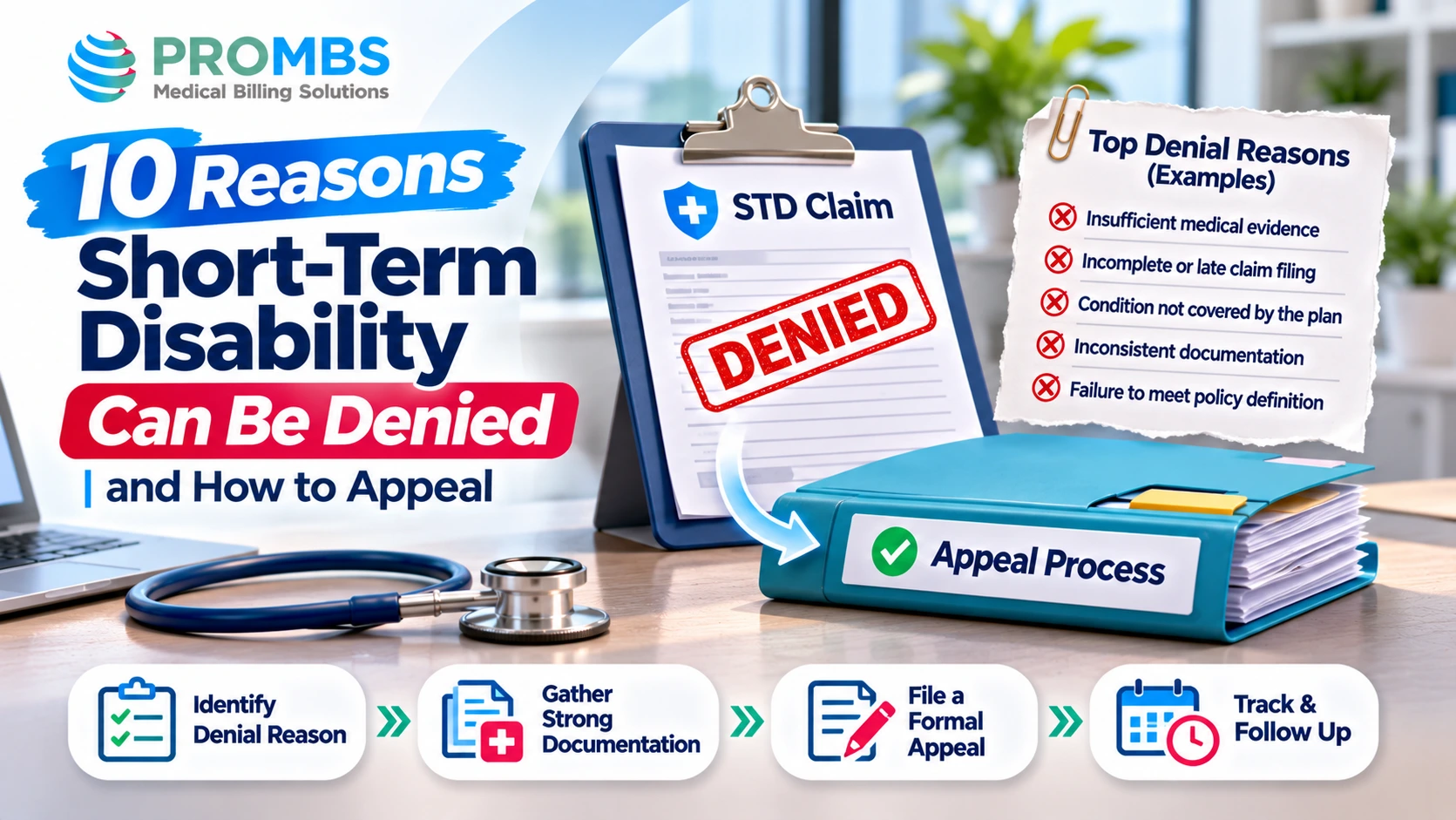
Receiving a short-term disability denial can create financial uncertainty at a time when an employee is already dealing with an illness, injury, surgery, or another medical condition that affects the ability to work. Many people assume that a physician’s diagnosis or recommendation to take time off automatically establishes eligibility for disability benefits. Unfortunately, that is not always how disability insurance works.
Short-term disability insurance generally provides partial income replacement to eligible individuals who cannot work for a covered period because of a qualifying medical condition. However, coverage depends on the insurance policy, employment eligibility, medical evidence, and the requirements for establishing disability.
A claim may be denied even when the employee has a genuine medical condition, receives ongoing treatment, and has been advised by a healthcare provider to remain away from work.
Understanding the reasons short-term disability can be denied is the first step toward identifying whether a denial resulted from inadequate documentation, failure to satisfy policy requirements, an administrative error, or a disagreement about the employee’s ability to work.
For healthcare providers, medical documentation also plays an important role. Physicians, occupational medicine specialists, and medical practices may be asked to provide treatment records, functional assessments, physician statements, and other supporting information. Incomplete or inconsistent documentation can make it more difficult for an insurer to evaluate the claim accurately.
This guide explains the most common denial reasons, the medical evidence insurers consider, and how individuals can evaluate a denial before preparing an appeal.
What Is Short-Term Disability Insurance?
Short-term disability insurance is a form of income-protection coverage that may replace a portion of an eligible employee’s earnings when a qualifying medical condition prevents the employee from working.
Coverage may be provided through an employer-sponsored benefit plan, an individual insurance policy, or a state program, depending on the individual’s circumstances.
Unlike medical insurance, which generally helps pay for covered healthcare services, short-term disability insurance focuses on the employee’s inability to earn income because of a covered disability.
This distinction is important because a medical condition can qualify for treatment under health insurance without necessarily satisfying a disability policy’s definition of inability to work.
For example, a patient may receive treatment for severe back pain and have several documented medical appointments. However, the disability insurer may still require information explaining why the condition prevents the individual from performing specific occupational duties.
The diagnosis establishes the medical condition. The disability evaluation establishes how that condition affects work-related functioning.
How Short-Term Disability Benefits Generally Work
Although policies vary, the process commonly involves several stages.
An employee experiences a medical condition that limits the ability to work and submits a disability claim. The insurer or plan administrator then reviews eligibility, the policy’s disability definition, medical records, employer information, and other required documentation.
Some policies also include an elimination period, meaning a specified waiting period must pass before benefit payments begin.
If the claim satisfies the applicable requirements, benefits may be approved for a defined period. Continued benefits may require updated medical records demonstrating that the employee remains disabled under the policy.
If the insurer determines that one or more requirements have not been satisfied, it may deny the claim or discontinue previously approved benefits.
Why Can Short-Term Disability Be Denied?
Short-term disability benefits can be denied for medical, administrative, contractual, or eligibility-related reasons.
Some denials involve incomplete paperwork or insufficient medical evidence. Others result from exclusions, coverage limitations, disagreement about the person’s functional abilities, or failure to meet the policy’s procedural requirements.
Importantly, a denial does not necessarily mean the employee is healthy or that the reported medical condition is not genuine.
It means the insurer or plan administrator has determined that the submitted claim does not satisfy one or more applicable benefit requirements.
The distinction becomes clearer when examining the most common denial scenarios.
1. Insufficient Medical Documentation
One of the most important reasons short-term disability claims are denied is insufficient medical evidence supporting the claimed inability to work.
A diagnosis alone may not explain the severity of a condition, the resulting functional restrictions, or the expected duration of disability.
For example, an employee may have a documented spinal condition accompanied by significant pain. However, the submitted medical records might contain only the diagnosis, prescription details, and brief recommendations for rest.
The insurer may need additional information establishing why the condition prevents the employee from performing their actual occupational responsibilities.
What Medical Evidence May Be Missing?
Depending on the condition and policy, relevant evidence may include:
- Detailed physician examination findings
- Clinical history and treatment records
- Diagnostic test results, when relevant
- Documented functional limitations
- Work restrictions
- Treatment response
- Medication-related limitations
- Expected recovery period
- Follow-up assessments
- A completed attending physician statement
The necessary evidence depends on the medical condition. Not every disability can be established through imaging, laboratory testing, or another objective diagnostic study.
For conditions involving pain, fatigue, cognitive impairment, or fluctuating symptoms, longitudinal treatment records and detailed functional assessments may be especially important.
Example of an Insufficient Medical Record
Consider an employee who works in a warehouse and develops a significant lower-back condition.
The physician’s note states:
“Patient has lower-back pain and should remain off work.”
Although that recommendation may be clinically appropriate, the insurer might request further information about the employee’s physical limitations.
A more informative medical record could explain the patient’s ability to lift, bend, stand, walk, and perform repetitive movements, along with the clinical basis for those restrictions.
This additional detail helps connect the medical condition to the requirements of the employee’s job.
Healthcare providers can improve the clarity of disability-related documentation by recording relevant functional limitations during routine clinical encounters.
For practices handling occupational health assessments, PROMBS’s Occupational Medicine Billing Guide discusses how work restrictions, functional assessments, and related documentation support occupational health workflows.
2. The Medical Condition Does Not Meet the Policy’s Definition of Disability
Another common reason for denial is the insurer’s determination that the claimant does not meet the contractual definition of disability.
This can happen even when the individual has a diagnosed illness or injury.
Disability policies may use different definitions of what it means to be unable to work.
Some policies focus on the employee’s ability to perform the material duties of their regular occupation. Other policies may impose different requirements or distinctions based on the type of coverage.
The actual policy language controls the evaluation.
Why Job Duties Matter
The same medical condition may affect two employees very differently.
Consider two people who both have a significant knee injury.
The first employee works in a warehouse, where the position requires prolonged standing, frequent walking, climbing, lifting, and physical movement.
The second employee performs primarily desk-based duties with limited physical activity.
The same physical restrictions could have substantially different occupational consequences.
That does not automatically establish whether either employee is entitled to benefits. It illustrates why insurers consider the relationship between a medical condition and the duties covered by the disability policy.
Diagnosis vs. Functional Disability
Medical documentation should distinguish between:
Medical diagnosis: What condition does the employee have?
Functional limitation: What physical, cognitive, or psychological activities are affected?
Occupational restriction: Which essential or material job responsibilities cannot be performed?
Expected duration: How long are those limitations reasonably expected to continue?
If the records establish a diagnosis but do not explain its occupational impact, the insurer may conclude that the disability requirement has not been demonstrated.
3. Incomplete or Incorrect Claim Paperwork
Short-term disability claims often require information from several parties.
Depending on the plan, these may include:
- Employee claim form
- Employer statement
- Attending physician statement
- Medical authorization forms
- Work history
- Earnings information
- Date of disability onset
- Expected return-to-work date
Missing, incomplete, or inconsistent information can delay processing and may ultimately contribute to a denial.
For example, the employee may report that the disability began on June 10, while the employer’s paperwork identifies June 15 and the physician’s documentation does not establish restrictions until June 18.
These differences may require clarification because the onset date can affect eligibility, the elimination period, and the period for which benefits are claimed.
Physician Documentation Errors
Common documentation problems include incomplete forms, missing dates, unclear work restrictions, inconsistent recovery estimates, and failure to address questions the insurer specifically requested.
A physician’s office may also send only an initial office note when the insurer requires a completed functional assessment or additional treatment records.
Not every missing document justifies a final denial without further notice or review. The applicable plan’s procedures determine what notice and opportunities to supplement the claim must be provided.
Nevertheless, submitting a complete, internally consistent claim package reduces avoidable administrative disputes.
4. Failure to Meet Eligibility Requirements
Short-term disability coverage is not automatically available to every employee.
Eligibility may depend on employment status, enrollment, hours worked, coverage effective dates, premium requirements, or other policy provisions.
A claimant may have a legitimate disability but still be denied benefits because the individual was not covered when the disability began.
Common Eligibility Problems
Examples include:
- Coverage had not become effective.
- The employee was not enrolled in the applicable plan.
- Required employment eligibility conditions were not met.
- Coverage terminated before the relevant disability date.
- Required premiums were not paid, where applicable.
- The individual was excluded from the covered employee class.
Eligibility rules vary significantly among employer-sponsored plans, individual insurance policies, and state disability programs.
For example, an employee who develops a medical condition shortly after beginning a new job should verify whether disability coverage was already effective.
An employer offering short-term disability insurance does not necessarily mean every employee becomes eligible on the first day of employment.
Why the Disability Onset Date Matters
The date the employee became disabled can determine whether coverage was in force.
If the coverage effective date is July 1 but the claimed disability began June 20, the insurer may deny the claim under the policy’s eligibility provisions.
However, the insurer should apply the actual policy terms and the evidence establishing the disability onset date.
The correct date should reflect the underlying facts, not be changed merely to fit coverage requirements.
5. Missing Claim Submission Deadlines
Disability insurance policies generally establish procedures and deadlines for filing claims and providing supporting information.
A claimant may be required to notify the employer or insurer within a specified period after becoming disabled.
Missing a deadline can create a dispute over whether the claim was submitted in accordance with the policy.
Why Claims Are Sometimes Submitted Late
Several circumstances can contribute to delayed filing.
An employee may be hospitalized, recovering from surgery, experiencing significant symptoms, or unaware of the specific filing requirements.
Another delay may occur when the claimant submits an employee statement but assumes the physician or employer will automatically complete and submit the remaining paperwork.
In reality, the plan may require separate information from each party.
How to Reduce Filing Problems
Employees should review the applicable policy documents, confirm filing instructions, keep copies of submissions, and obtain confirmation that required forms were received.
If a deadline was missed, the claimant should review whether the plan permits exceptions, whether timely notice requirements were satisfied, and whether applicable law affects the insurer’s ability to reject the claim.
A filing deadline for an initial disability claim should not be confused with the deadline for appealing a denial.
These are separate procedural requirements.
6. Pre-Existing Condition Exclusions
Some short-term disability policies contain provisions limiting or excluding benefits associated with certain pre-existing medical conditions.
Whether an exclusion applies depends on the policy language and the circumstances.
For example, a policy may define a pre-existing condition by reference to medical treatment, consultation, symptoms, or prescribed medication during a specified period before coverage began.
The policy may then impose additional conditions concerning when a disability related to that condition begins.
Not every policy contains the same exclusion, and some may not include one at all.
Example of a Pre-Existing Condition Dispute
Suppose an employee received treatment for a back condition before disability coverage became effective.
Several months later, the employee develops severe symptoms and becomes unable to perform certain job duties.
The insurer may review whether the claim falls within a pre-existing condition exclusion.
However, the existence of earlier treatment does not automatically establish that the exclusion applies.
The decision depends on the specific contractual definition, relevant dates, medical relationship between the conditions, and other applicable requirements.
What Should Be Reviewed?
A claimant facing this type of denial should examine the policy provision relied upon, the coverage effective date, relevant treatment history, and the medical evidence connecting the earlier condition to the current disability.
The goal is to determine whether the insurer has applied the exclusion correctly rather than assuming every previously diagnosed condition is automatically disqualified.
7. The Claim Falls Under a Policy Exclusion or Limitation
Disability insurance policies may exclude certain circumstances or impose limitations on particular categories of claims.
The restrictions vary significantly by insurer, product, and plan.
Depending on the policy, exclusions or limitations might concern:
- Certain causes of disability
- Work-related injuries covered under another program
- Specific activities or circumstances
- Particular categories of medical conditions
- Defined benefit durations
- Other contractual restrictions
The existence and enforceability of a particular exclusion must be assessed under the actual policy and applicable law.
Why the Exact Policy Language Matters
A claim should not be denied based on a general assumption that a particular diagnosis is excluded.
The insurer must rely on applicable coverage terms.
For instance, a plan may distinguish between disabilities caused by occupational injuries and disabilities arising outside employment.
If the employee’s condition is work-related, workers’ compensation benefits may also be relevant. However, workers’ compensation and short-term disability insurance are separate benefit systems with different eligibility and payment rules.
For medical practices, accurately recording whether an injury occurred at work can help clarify the clinical history and financial pathways involved.
PROMBS’s Occupational Medicine Billing Services address the separate billing workflows associated with work injuries, employer-paid services, and applicable health insurance claims.
8. Inconsistent Medical Records or Claim Information
An insurer may question a claim when the medical records, employee statements, employer information, and other evidence appear inconsistent.
For example, a claimant may report an inability to stand for more than a few minutes, while a physician’s office note describes substantially greater functional tolerance.
Such discrepancies may be explainable, but they can raise questions about the reliability or completeness of the submitted evidence.
Common Sources of Inconsistency
Potential problems include conflicting disability onset dates, different descriptions of work limitations, missing explanations for symptom changes, inconsistent medication histories, and records that do not clearly identify the employee’s actual job responsibilities.
Inconsistencies can also result from routine documentation practices rather than deliberate misrepresentation.
A brief medical note may describe how the patient functioned on one particular day without capturing how symptoms fluctuate across the week.
Likewise, an employee may have limited capacity for certain household activities while remaining unable to perform sustained work duties.
These differences require contextual evaluation.
What Makes Medical Documentation More Reliable?
The most helpful records explain the clinical findings, functional restrictions, treatment history, and changes over time.
Documentation should accurately reflect what the clinician observed and what the patient reported, while distinguishing those two sources when necessary.
Consistency does not mean every medical note must repeat identical wording.
It means the records should present a medically coherent account of the employee’s condition and its functional consequences.
9. Failure to Satisfy the Elimination Period or Other Benefit Conditions
Many short-term disability policies include an elimination period.
This is the waiting period between the beginning of a covered disability and the date benefits may become payable.
For example, a policy may require an employee to remain disabled for a specified number of days before payments begin.
If the employee returns to work before satisfying the applicable elimination-period rules, benefits may not become payable.
However, the treatment of intermittent disability, partial return to work, or recurrent disability depends on the policy.
Why This Can Cause Confusion
An employee may believe that missing several workdays automatically entitles them to disability payments.
But if the policy includes a longer elimination period, the absence may not satisfy the requirement for benefits to begin.
Similarly, returning to work for part of a day may have different consequences under different policies.
A denial based on this issue should be evaluated against the policy’s definition of disability, waiting-period provisions, and any rules concerning partial or recurring disability.
10. Treatment Gaps, Insufficient Ongoing Evidence, or Failure to Cooperate With the Review
Some disability claims are denied or discontinued because the insurer concludes that the available evidence no longer establishes continuing disability.
This may happen after benefits have already been approved for an initial period.
The insurer may request additional medical records, progress notes, functional assessments, or other information to determine whether the claimant remains eligible.
When the requested information is unavailable, incomplete, or does not establish continuing limitations, the insurer may challenge further payment.
Treatment Gaps
A lengthy gap in medical treatment may prompt questions about whether the employee continues to have limitations that satisfy the policy.
However, a treatment gap does not automatically mean the person has recovered.
Financial barriers, appointment availability, clinical treatment decisions, and other circumstances may explain why care was interrupted.
The insurer should evaluate the available evidence and relevant policy requirements rather than treating every gap as definitive proof of work capacity.
Ongoing Medical Evidence
A disability that was established during an initial period may require additional documentation if the employee remains unable to work.
For example, an employee recovering from surgery may initially receive benefits based on surgical records and anticipated recovery time.
If recovery takes longer than expected, updated clinical findings and functional restrictions may be needed to support an extension.
Healthcare providers should document the actual recovery course, including complications, improvement, persistent limitations, and anticipated work capacity.
Failure to Respond to Information Requests
Claims can also be affected when required forms, records, or other requested information are not provided in accordance with applicable plan procedures.
Employees should therefore maintain communication with the plan administrator and their treating providers when additional documentation is requested.
The goal is not to generate unnecessary medical visits or tests solely for insurance purposes. It is to ensure that existing medical evidence and clinically appropriate follow-up accurately reflect the patient’s condition.
What the 10 Denial Reasons Have in Common
Although these denial reasons appear different, they generally fall into four categories.
| Denial Category | Examples | Main Question |
|---|---|---|
| Medical evidence | Insufficient records, unclear functional restrictions, inconsistent documentation | Does the evidence establish disability under the policy? |
| Coverage and eligibility | Coverage not effective, excluded employee class, pre-existing condition provisions | Was the claimant eligible for the claimed benefits? |
| Policy requirements | Exclusions, elimination period, contractual limitations | Does the claim satisfy the policy’s specific terms? |
| Administrative requirements | Incomplete forms, late submissions, missing requested information | Was the claim submitted and supported according to applicable procedures? |
This classification is useful because the appropriate response depends on the actual reason for denial.
A claim denied because of incomplete medical documentation may require additional physician records. A denial based on policy eligibility requires examination of coverage provisions and employment information. A claim rejected under an exclusion requires review of the exact contractual terms.
Submitting more medical records will not necessarily resolve an eligibility problem, just as correcting a filing error will not automatically establish functional disability.
Why Medical Documentation Deserves Particular Attention
Medical documentation plays an important role in disability claims because insurers need to understand the relationship between a medical condition and an employee’s ability to perform work.
The most useful documentation does not simply repeat a diagnosis.
It explains the clinical findings, functional consequences, work restrictions, treatment progress, and relevant duration of limitations.
For healthcare practices, this creates an important distinction between clinical documentation for disability-benefit determinations and documentation used to bill for medical services.
The two may rely on some of the same medical records, but they serve different purposes and are evaluated under different rules.
PROMBS discusses documentation quality in its guide to medical necessity denial appeals, where clinical findings and supporting records are essential to addressing healthcare reimbursement denials. That is a separate process from appealing an employee’s short-term disability benefits decision, even though careful clinical documentation matters in both contexts.
Ultimately, understanding the reasons for a short-term disability denial is only the starting point. A successful response requires identifying the exact basis of the decision and determining what evidence, policy interpretation, or administrative correction is relevant.
Why Medical Evidence Plays a Critical Role in Short-Term Disability Denials
Medical evidence is often central to a short-term disability claim because an insurance company must determine whether the claimant’s condition satisfies the disability definition established by the applicable policy.
A diagnosis may confirm that an employee has a medical condition, but it does not always establish how severely that condition affects the employee’s ability to work. Insurers may therefore examine treatment records, clinical findings, occupational responsibilities, and functional restrictions to determine whether the employee qualifies for benefits.
This explains why two individuals with the same medical diagnosis may receive different disability determinations.
Their symptoms, functional abilities, occupational demands, treatment responses, and insurance policies may differ substantially.
For individuals researching the reasons short term disability can be denied, understanding the relationship between medical evidence and occupational functioning is particularly important.
The objective is not to submit the largest possible collection of medical records. It is to provide accurate, relevant evidence addressing the specific requirements of the disability policy.
Can Short-Term Disability Be Denied Even With a Doctor’s Note?
Yes. A short-term disability claim can be denied even when a licensed physician has recommended that the employee remain away from work.
A doctor’s note is relevant medical evidence, but the insurer may require additional information to evaluate whether the employee meets the policy’s definition of disability.
For example, a note stating that an employee should remain off work for four weeks may establish the physician’s recommendation without explaining the clinical findings or functional restrictions supporting that recommendation.
The insurer may ask why the individual cannot perform the material duties of the occupation during that period.
What Makes a Doctor’s Note More Informative?
A useful medical statement may identify the diagnosed condition, relevant examination findings, documented functional limitations, anticipated duration of restrictions, and treatment plan.
For an employee recovering from orthopedic surgery, the physician may document restrictions involving prolonged standing, lifting, walking, bending, or other activities relevant to the employee’s occupation.
For someone experiencing a neurological condition, the documentation may need to address concentration, balance, coordination, fatigue, or other clinically supported limitations.
The appropriate details depend on the condition. Medical records should reflect the clinician’s actual findings rather than being written to satisfy an expected insurance outcome.
A Practical Example
Consider an employee who undergoes shoulder surgery and applies for short-term disability benefits.
The physician provides a note recommending six weeks away from work.
The insurer requests clarification because the note does not describe the employee’s occupational responsibilities or recovery restrictions.
The employee works in a warehouse and regularly lifts heavy packages.
A more complete physician statement may document postoperative lifting restrictions, limitations in arm movement, restrictions involving repetitive overhead activities, and the expected recovery timeline.
These details help explain why the employee may be unable to perform the relevant job duties during recovery.
The additional documentation does not guarantee approval, but it provides the insurer with a more complete basis for evaluating the claim.
What Is an Attending Physician Statement?
An attending physician statement, often called an APS, is a medical form or report used by disability insurers to obtain information from a healthcare professional involved in the claimant’s care.
The form may ask for details regarding the medical condition, treatment history, clinical findings, functional limitations, expected recovery, and ability to resume occupational activities.
Different insurers use different forms, and the information requested may vary according to the policy and type of disability.
What Information Does an Attending Physician Statement Usually Include?
An APS may request:
- Primary diagnosis and relevant secondary conditions
- Date symptoms or disability-related limitations began
- Relevant examination findings
- Diagnostic testing and clinical observations
- Treatment provided and planned
- Medication information and relevant side effects
- Physical or cognitive functional restrictions
- Dates when work limitations apply
- Estimated recovery or reassessment date
- Expected capacity to return to work
The physician should complete the statement using information supported by the patient’s medical history and clinical assessment.
A well-completed APS can provide important context that may not be apparent from brief office notes.
Why Incomplete Physician Statements Can Cause Problems
An incomplete APS may leave the insurer unable to determine whether the claimant satisfies a policy requirement.
For example, a form may identify the diagnosis but leave the functional-capacity section unanswered.
The insurer might understand the medical condition but still lack information about how it affects the employee’s occupation.
Similarly, a physician may indicate that the patient should not work but provide no explanation of the relevant restrictions or duration.
When an insurer requests missing information, the claimant and healthcare provider should review the request carefully and determine what accurate clinical information is available.
Medical practices that routinely complete occupational assessments can benefit from consistent documentation procedures. PROMBS’s Occupational Medicine Billing Guide addresses documentation and billing considerations associated with occupational health services.
However, completing an APS for an employee’s income-replacement benefits is distinct from submitting a healthcare reimbursement claim.
How Insurers Evaluate Functional Limitations
Functional limitations describe how a medical condition affects the individual’s ability to perform specific activities.
These limitations may involve physical movement, endurance, cognitive functioning, communication, concentration, or other capabilities relevant to employment.
A disability insurer may review these restrictions to determine whether the claimant can perform the duties considered under the policy.
Physical Functional Limitations
Physical limitations may include reduced lifting capacity, restricted mobility, difficulty standing or walking, limited use of an extremity, or inability to tolerate particular positions for sustained periods.
For example, an employee recovering from foot surgery may be restricted from prolonged weight-bearing activities.
The relevance of that restriction depends partly on the employee’s occupational responsibilities.
A position requiring continuous movement may be affected differently from one involving predominantly seated work.
Cognitive and Psychological Limitations
Some medical conditions affect concentration, memory, processing speed, decision-making, communication, emotional regulation, or the ability to sustain attention.
These limitations may be relevant to occupations requiring continuous cognitive performance, safety-sensitive decision-making, or sustained interpersonal interaction.
For example, a clinician may document significant concentration difficulties associated with a medical condition.
The insurer may then evaluate whether those documented limitations satisfy the applicable policy’s disability requirements.
A mental health diagnosis should not be dismissed solely because it lacks a particular laboratory or imaging finding. The available clinical evidence, functional impact, treatment history, and policy provisions must be considered.
Limitations That Change Over Time
Functional ability is not always constant.
A patient recovering from surgery may gradually improve. Another patient may experience fluctuating symptoms, intermittent exacerbations, or medication-related effects.
Medical records should capture meaningful changes in the patient’s condition.
For example, the fact that an employee can occasionally perform a limited activity does not necessarily demonstrate the ability to sustain all required work duties throughout a normal work schedule.
The relevant question is whether the documented capabilities and restrictions satisfy the applicable disability definition during the period being claimed.
Diagnosis vs. Inability to Work: Understanding the Difference
A medical diagnosis identifies a condition.
A disability determination evaluates whether the consequences of that condition meet the policy’s requirements for occupational incapacity.
This distinction is one of the most important aspects of short-term disability claim evaluation.
Consider three employees diagnosed with the same medical condition.
One may experience mild symptoms and continue working without significant restrictions.
Another may require temporary modifications to work responsibilities.
A third may experience limitations that prevent the performance of material occupational duties.
The diagnosis is the same, but the functional consequences differ.
This is why medical evidence should connect the clinical condition to the employee’s actual limitations rather than relying on the diagnosis alone.
Why Occupational Information Matters
The insurer may need to understand the employee’s work schedule, physical responsibilities, cognitive demands, and essential or material job duties.
For example, medical restrictions against operating heavy equipment may be particularly relevant for an employee whose role involves machinery.
The same restrictions may have different implications for an employee whose duties do not involve operating equipment.
Accurate employer information is therefore important alongside clinical documentation.
The treating physician should describe the patient’s clinical restrictions, while the employer provides reliable information about the occupation.
The insurer or plan administrator then makes the benefit determination under the applicable policy.
What Medical Records Should Support a Short-Term Disability Claim?
The records needed depend on the diagnosis, claimed disability period, and policy requirements.
A complete medical file is not necessarily the same as a useful disability evidence package.
The relevant documentation should help the reviewer understand the medical condition, its functional consequences, and the period during which the employee reports being unable to work.
| Medical Evidence | How It May Support the Claim |
|---|---|
| Physician examination notes | Establish clinical findings, symptoms, and treatment assessments |
| Diagnostic testing | Provide relevant objective findings when appropriate |
| Attending physician statement | Connect medical information with functional and occupational restrictions |
| Specialist consultation | Add clinical assessment for complex conditions |
| Treatment records | Demonstrate care provided and response to treatment |
| Medication records | Identify treatment and clinically documented side effects |
| Functional assessment | Describe limitations affecting relevant activities |
| Surgical or hospital records | Establish procedures, complications, and recovery information |
| Progress notes | Show changes in condition over the claimed period |
| Work restriction documentation | Explain clinically supported limitations relevant to employment |
Not every claim requires every document in this table.
For example, a condition that is primarily assessed through clinical history and examination should not be assumed unsupported merely because a particular diagnostic test is unavailable.
The most useful evidence is relevant, clinically appropriate, and responsive to the insurer’s stated concerns.
Why Medical Records Sometimes Fail to Establish Disability
A claim may contain substantial medical documentation yet still fail to establish the policy’s definition of disability.
This can occur when records primarily describe treatment without explaining functional limitations.
For example, office notes may show repeated appointments, prescriptions, and referrals but provide little information about the employee’s ability to sit, stand, concentrate, lift, communicate, or perform other occupational activities.
The records demonstrate that the individual received medical care, but the insurer may determine that the evidence does not establish the claimed inability to work.
Missing Functional Details
A physician may document that the patient reports significant pain without assessing relevant functional restrictions.
Pain can be clinically meaningful and disabling, but the insurer may seek additional explanation about its impact on the person’s occupational activities.
When clinically appropriate, documentation may address the activities affected, symptom patterns, examination findings, treatment response, and limitations observed or reported.
Unclear Disability Duration
Some medical records establish an initial period of restrictions but do not explain why those restrictions continued.
Suppose a patient was initially restricted from work for two weeks following a procedure.
The employee later requests an additional month of disability benefits, but no updated records explain the extended recovery period.
The insurer may request further evidence supporting continued disability.
Conflicting Recovery Information
One medical note may indicate that the patient is recovering as expected, while another recommends an extended work absence.
These statements are not necessarily contradictory.
Recovery can be progressing while meaningful occupational limitations remain.
However, additional explanation may help the insurer understand why the employee cannot yet perform relevant work duties despite clinical improvement.
Why Treatment History Matters in Disability Reviews
Disability insurers may review a claimant’s treatment history to understand the severity, progression, and expected duration of a condition.
The records may show whether treatment was initiated, whether it produced improvement, and whether the patient’s restrictions changed over time.
A consistent treatment history can provide context for an ongoing disability claim, but treatment frequency alone does not determine eligibility.
For example, an employee recovering from a fracture may require fewer medical appointments as healing progresses while still remaining unable to perform physically demanding duties.
Similarly, an employee with a chronic condition may have substantial limitations even if available treatment options are limited.
When There Is a Gap in Treatment
An insurer may question a period during which the claimant has little documented medical follow-up.
However, a gap should be evaluated in context.
Possible explanations include appointment delays, financial limitations, transportation problems, clinical instructions, or a period when additional visits were not medically necessary.
The claimant should provide accurate information about relevant circumstances if the insurer raises the issue.
The absence of frequent medical appointments should not automatically be interpreted as evidence that the claimant could return to work.
How to Understand a Short-Term Disability Denial Letter
A denial letter is one of the most important documents in determining what to do next.
It should explain why the claim was denied and identify the applicable review or appeal procedure.
For disability plans governed by the Employee Retirement Income Security Act (ERISA), federal claim-procedure rules establish requirements concerning denial notices, access to relevant claim documents, and opportunities to appeal.
The US Department of Labor provides guidance on these requirements in its Filing a Claim for Your Health or Disability Benefits publication.
However, ERISA rules do not necessarily apply in the same way to individual disability policies, government plans, state disability programs, or every employer arrangement.
Identify the Exact Reason for Denial
The first step is to determine whether the insurer denied the claim because of:
- Insufficient medical evidence
- Failure to meet the disability definition
- Incomplete documentation
- Eligibility restrictions
- Policy exclusions
- Filing requirements
- Lack of evidence supporting continued disability
This classification matters because each reason requires a different response.
For example, submitting additional medical records may help address an evidence-related denial.
It may not resolve a denial based entirely on the claimant’s coverage effective date.
Review the Policy Provision Cited
A denial should be compared against the actual policy or plan document.
If the insurer states that the employee does not satisfy the disability definition, the claimant should identify what that definition requires.
If an exclusion is cited, the exact language and relevant dates should be reviewed.
The goal is to understand the contractual basis of the decision before deciding what information is needed.
Identify the Evidence the Insurer Considered
A claimant may discover that important medical records were not included in the original review.
For example, the insurer may have reviewed an initial office visit but not a later specialist report that documented continuing functional restrictions.
If that report is relevant and supports the claim, it may be important during the appeal.
For applicable ERISA plans, claimants generally have rights to request relevant documents and records without charge. These protections help individuals understand the evidence underlying the decision.
How to Match the Denial Reason With the Right Evidence
The most effective response addresses the stated problem rather than sending unrelated records.
Denial: Insufficient Medical Evidence
Review whether the insurer received relevant examination findings, treatment records, functional restrictions, and physician statements.
If important existing records were omitted, determine how to provide them through the applicable review process.
Denial: Employee Can Perform Occupational Duties
Compare the insurer’s conclusion with the documented job requirements and clinically supported limitations.
If the insurer misunderstood the employee’s duties or relied on incomplete functional evidence, those discrepancies may need to be addressed.
Denial: Disability Period Not Supported
Review whether the medical records establish restrictions throughout the specific period being claimed.
Evidence supporting an initial absence does not necessarily establish every subsequent week of disability.
Updated clinical information may be relevant when benefits are sought for an extended period.
Denial: Inconsistent Medical Information
Identify the precise inconsistency.
For example, an insurer may interpret a note describing improvement as proof of full occupational recovery.
If the clinical record supports a different interpretation, the treating provider may be able to clarify the documented functional status.
Such clarification must remain accurate and should not introduce unsupported findings.
Denial: Eligibility or Policy Exclusion
Review the applicable policy, coverage dates, employment information, and facts underlying the exclusion.
Additional medical documentation may be relevant in some cases, but the primary dispute may concern contract interpretation or eligibility rather than clinical severity.
Practical Example: Responding to a Denial for Insufficient Functional Evidence
Consider an illustrative case involving an employee who works as a delivery driver.
The employee experiences a medical condition associated with significant dizziness and receives a physician’s recommendation to stop working temporarily.
The insurer initially denies the disability claim, stating that the submitted medical records do not sufficiently establish inability to perform occupational duties.
What the Initial Documentation Shows
The original records include the diagnosis, medication information, and a recommendation for temporary work absence.
However, they contain limited information about driving safety, symptom frequency, and the functional restrictions relevant to the employee’s occupation.
What the Claimant Should Review
The claimant should examine the policy’s disability definition, the job requirements, and the medical information the insurer actually considered.
The claimant may also review whether relevant examination findings, specialist assessments, or documented restrictions were omitted.
How Relevant Clinical Evidence May Help
If the treating clinician has documented recurrent dizziness, balance difficulties, or other relevant findings, that information may help explain the occupational consequences of the condition.
The employer’s description of the delivery role may further establish the specific duties under review.
The purpose is not to change the diagnosis or generate artificial restrictions.
It is to ensure the insurer evaluates the actual evidence in the context of the employee’s work responsibilities.
Whether the claim ultimately qualifies for benefits still depends on the applicable policy and the complete record.
Can an Insurance Company Reject a Treating Physician’s Opinion?
An insurer may reach a different conclusion from the treating physician about whether the claimant satisfies the disability policy.
A treating physician’s opinion is important evidence, but it does not automatically determine entitlement to disability benefits.
The physician assesses the patient’s medical condition and clinically supported limitations.
The insurer or plan administrator evaluates that information against the policy’s benefit requirements.
Disagreements may arise over the interpretation of medical findings, the severity of occupational restrictions, the expected duration of disability, or the completeness of the available evidence.
For applicable ERISA disability plans, the federal claims regulation establishes procedural protections intended to support a full and fair review. These include independent appeal review and appropriate medical consultation when a denial involves medical judgment.
A claimant should therefore examine the insurer’s stated reasoning and determine whether the underlying evidence was accurately considered.
Medical Privacy and the Role of Healthcare Providers
Disability claim reviews often involve sensitive medical records.
Healthcare providers should use appropriate authorization and disclosure procedures when responding to requests from disability insurers, employers, or third-party administrators.
The information disclosed should be accurate, relevant, and handled according to applicable privacy requirements.
A disability insurer’s request for information should not automatically be treated as permission to disclose every record in a patient’s chart.
Medical practices should determine what authorization or other legal basis permits the disclosure and follow appropriate safeguards.
Healthcare Providers Should Document, Not Determine Insurance Eligibility
Physicians and other treating professionals have an important role in explaining the clinical condition, treatment, and functional limitations.
However, the final disability-benefit determination generally belongs to the insurer or plan administrator under the applicable policy.
Healthcare providers should not guarantee that an employee’s disability benefits will be approved.
Their responsibility is to provide medically accurate information and respond appropriately to legitimate documentation requests.
How Better Documentation Helps Healthcare Practices
Although short-term disability benefits are different from medical billing reimbursement, both processes depend on the reliability of clinical records.
For healthcare practices, recurring requests for missing information can create administrative work, delay responses, and lead to repeated communication with patients, insurers, employers, or administrators.
Clear documentation helps reduce unnecessary clarification requests and makes relevant information easier to retrieve.
PROMBS supports healthcare providers with medical billing, coding, and revenue cycle workflows. Our article on medical necessity denial appeals explains the importance of connecting clinical records with a payer’s stated requirements when disputing healthcare reimbursement denials.
That is a separate process from appealing short-term disability income benefits, but it illustrates a shared documentation principle: the evidence should address the specific question being evaluated.
For occupational medicine practices, clearly documented clinical findings and work restrictions can also support accurate handling of services involving employment-related health assessments.
The goal is to maintain records that accurately communicate the care provided and any clinically supported functional limitations, without adding unnecessary administrative complexity.
Key Takeaway: Evidence Must Address the Actual Reason for Denial
The central lesson is that more paperwork does not necessarily produce a stronger disability claim.
The evidence must be relevant to the policy’s requirements and responsive to the insurer’s decision.
If the denial concerns functional limitations, documentation should address those limitations.
If it concerns the disability period, the records should establish the relevant timeline.
If it concerns eligibility or a policy exclusion, the claimant should examine the applicable coverage terms.
A careful review of the denial letter, policy provisions, occupational duties, and medical evidence provides a more reliable foundation for determining the appropriate next steps.
or Filing an Appeal
One of the most important considerations is the filing deadline.
For disability benefit plans subject to the federal ERISA claims regulation, claimants generally must be given at least 180 days after receiving an adverse benefit determination to submit an appeal.
This is an important protection, but it should not be confused with a universal deadline for every short-term disability policy.
Individual insurance policies, state disability programs, government plans, and other arrangements may follow different procedures.
The claimant should confirm the deadline stated in the denial notice and compare it with the applicable plan requirements.
Why Waiting Can Create Problems
Even when the appeal period is relatively long, delaying the review may make it harder to collect supporting records.
Medical providers may need time to prepare documentation. Employers may need to supply occupational information, and additional clinical records may need to be obtained from hospitals or specialists.
The claimant should begin organizing relevant evidence promptly rather than assuming everything can be completed shortly before the deadline.
A request for documents or an informal conversation with the insurer should not be assumed to extend the appeal deadline.
Step 3: Obtain the Records Used to Deny the Claim
A claimant should understand what information the insurer actually reviewed.
An insurer may base its decision on a limited selection of medical records, an attending physician statement, an internal medical review, occupational information, or another assessment.
For applicable ERISA plans, claimants may request relevant claim documents and records without charge.
This can help determine whether the insurer overlooked important evidence or relied on an incomplete understanding of the employee’s condition.
Relevant materials may include the claim application, medical records, physician statements, applicable policy provisions, internal claim evaluations, and medical or vocational assessments used in the determination.
Why Reviewing the Claim File Matters
Suppose an insurer concludes that an employee can return to work based on an earlier medical examination.
However, a subsequent specialist report documents continuing limitations that were not included in the insurer’s review.
That missing information may be relevant to an appeal.
The claimant should identify what was omitted and determine whether the existing medical evidence addresses the reason for denial.
The goal is not merely to gather additional paperwork. It is to understand the factual and contractual basis of the original decision.
Step 4: Collect Medical Evidence That Addresses the Denial
Medical documentation should be selected according to the insurer’s stated concerns.
If the claim was denied because functional limitations were not adequately established, the appeal should focus on clinically supported restrictions and their effect on the employee’s occupational duties.
If the insurer disputed the duration of disability, the records should explain the medical condition and relevant limitations throughout the period being claimed.
Useful evidence may include:
- Updated physician assessments
- Attending physician statements
- Relevant specialist reports
- Examination findings
- Functional limitations
- Occupational restrictions
- Treatment progress notes
- Diagnostic results when clinically relevant
- Medication-related limitations
- Hospital or surgical records
The quality and relevance of this evidence matter more than the number of documents submitted.
For example, an employee recovering from surgery may benefit from documentation explaining the expected healing period, postoperative restrictions, complications, and anticipated progression toward work activities.
An employee with a neurological or psychological condition may require a different form of clinical assessment to explain the documented limitations.
Evidence should accurately reflect the condition. Claimants and healthcare providers should never fabricate symptoms, exaggerate restrictions, or alter medical records to obtain benefits.
Step 5: Connect Medical Limitations to Actual Job Duties
A common weakness in disability appeals is the failure to explain how the medical condition affects occupational functioning.
Medical records may establish that an employee experiences significant symptoms, but the insurer may still question whether those symptoms prevent the employee from performing the duties identified in the policy.
An effective appeal should therefore consider the relationship between the clinical restrictions and the employee’s actual work responsibilities.
Example: Physical Occupational Demands
An employee who works in construction may be unable to perform the job following an orthopedic injury that significantly restricts lifting, climbing, bending, or prolonged standing.
Documentation describing those restrictions may be more informative than a general statement that the employee is experiencing pain.
Example: Cognitive Occupational Demands
An employee whose occupation requires sustained attention, complex decision-making, or safety-sensitive tasks may be affected by clinically documented cognitive limitations.
The medical evidence should describe those limitations accurately and explain their expected duration when possible.
Whether the restrictions satisfy the applicable disability policy remains a separate contractual determination.
Step 6: Prepare a Clear Short-Term Disability Appeal Letter
An appeal letter should be professional, specific, and directly connected to the stated reason for denial.
A useful letter identifies the claim and explains why reconsideration is requested.
It should not rely exclusively on statements such as “the employee is genuinely sick” or “the physician recommended time off.”
Instead, it should connect the policy requirements with relevant clinical evidence and occupational restrictions.
What Should the Letter Include?
An organized appeal letter may contain the following information:
Claim identification: Claimant name, claim number, insurer, and relevant disability dates.
Reason for denial: A brief explanation of the determination being challenged.
Policy requirement: The relevant disability definition or other provision identified in the denial.
Supporting evidence: An explanation of the medical records and other information addressing the disputed issue.
Occupational impact: Clinically supported restrictions affecting the employee’s relevant job responsibilities.
Requested action: A clear request for reconsideration of the benefit decision.
Enclosures: A description of the supporting documents submitted with the appeal.
Avoid Generic Appeal Letters
A generic appeal letter may repeat that the employee has a medical condition without addressing why the insurer rejected the claim.
For example, if the insurer determined that the employee could perform regular occupational duties, the appeal should explain which documented restrictions are inconsistent with that conclusion.
If the denial concerns an exclusion, the claimant should focus on the specific policy language and relevant facts.
The most effective appeal is tailored to the actual determination.
Step 7: Submit the Appeal Through the Correct Procedure
The insurer or plan administrator may require appeals to be submitted through a particular address, portal, electronic system, or other designated method.
The claimant should follow those instructions and retain evidence that the appeal was received.
Useful records include submission confirmations, correspondence, copies of the appeal package, and any acknowledgments from the insurer.
The claimant should also confirm whether all relevant documents were included.
Submitting the appeal is an important milestone, but it does not guarantee approval.
The insurer must still evaluate the evidence under the applicable policy and claims procedure.
Step 8: Monitor the Appeal and Respond to Additional Information Requests
After submission, the claimant should monitor the status of the appeal.
The insurer may request clarification concerning medical records, occupational duties, treatment history, or other relevant information.
Any response should be accurate and submitted within the applicable timeframe.
For ERISA-covered disability plans subject to the federal claims regulation, an appeal generally must be decided within 45 days, with an additional extension of up to 45 days permitted when special circumstances justify it and proper advance notice is provided. Certain collectively bargained plans have special procedural rules.
An extension should not be assumed to apply automatically to every appeal.
The plan must follow the relevant notification requirements.
What If New Medical Evidence Is Used During the Appeal?
Applicable ERISA disability regulations provide additional procedural protections when new or additional evidence or reasoning is considered during an adverse appeal review.
The claimant generally must receive that information sufficiently in advance of the decision to have a reasonable opportunity to respond.
This helps prevent decisions from relying on new evidence that the claimant had no meaningful opportunity to address.
What Happens After a Short-Term Disability Appeal?
The outcome depends on the insurer’s review of the submitted evidence and the applicable policy.
Appeal Approved
If the insurer reverses its decision, the claimant may become eligible for benefits covering the approved disability period, subject to the policy’s waiting period, benefit limits, offsets, and other applicable provisions.
The claimant should review the approval notice carefully to understand the dates and benefits covered.
Appeal Partially Approved
An insurer may approve some of the disputed period while denying another portion.
For example, benefits may be approved for the immediate recovery period following surgery but not for a later period if the insurer concludes that continued disability has not been established.
The claimant should review the reasoning for any remaining adverse determination.
Appeal Denied
If the insurer upholds the denial, the written decision should explain the result and identify applicable further review rights.
Depending on the policy and governing law, additional options may include a voluntary review procedure, assistance from a regulator, or legal action.
There is no universal second appeal or external-review process that applies to every short-term disability policy.
For ERISA-covered plans, claimants generally must complete required internal administrative review procedures before pursuing a benefits lawsuit, subject to applicable exceptions.
A claimant considering further action may benefit from advice from a qualified disability-benefits attorney, particularly when complex policy provisions or procedural disputes are involved.
Can a Short-Term Disability Denial Be Overturned?
Yes. A denial may be overturned when a review establishes that the claimant satisfies the applicable policy requirements or that the original decision was incorrect.
Potential reasons for a different outcome include relevant medical evidence that was not initially considered, clarification of documented functional limitations, correction of eligibility information, or an incorrect interpretation of the policy.
However, no particular diagnosis, doctor’s note, or appeal letter guarantees approval.
The outcome depends on the complete evidence and applicable coverage requirements.
What If the Insurance Company Still Refuses to Pay?
A continued denial should be evaluated according to the type of insurance arrangement.
For an ERISA-covered employer-sponsored plan, the US Department of Labor’s Employee Benefits Security Administration provides information about participant rights and claims procedures.
The Department’s Filing a Claim for Your Health or Disability Benefits guidance explains the federal appeal framework and potential options following an unsuccessful review.
For individual disability policies, state insurance laws and regulatory complaint procedures may be relevant.
State temporary disability programs follow their own administrative rules.
Claimants should identify which system governs their benefits before choosing the next step.
A complaint to a regulator should not be assumed to preserve or extend a contractual or legal deadline.
How to Prevent Avoidable Short-Term Disability Claim Denials
Not every denial is preventable. A claimant may genuinely fail to meet a policy’s eligibility conditions or disability definition.
However, many administrative and documentation problems can be reduced through better preparation.
Understand the Policy Before Filing
Employees should review the disability definition, eligibility requirements, elimination period, exclusions, benefit duration, and claim procedures.
Understanding the policy helps clarify what the insurer needs to evaluate.
Submit Complete and Accurate Information
Claim forms should contain consistent dates, accurate employment information, and complete responses to relevant questions.
The claimant should verify that required employer and physician statements have been submitted.
Explain Work-Related Functional Limitations
Medical documentation is often more useful when it identifies relevant functional restrictions rather than relying only on a diagnosis.
The treating clinician should accurately document the patient’s condition and medically supported limitations.
Maintain Appropriate Medical Follow-Up
Medical follow-up should reflect the patient’s clinical needs.
When ongoing disability benefits are sought, current medical records may help establish whether relevant restrictions remain.
The objective is accurate medical documentation, not unnecessary appointments.
Respond Promptly to Information Requests
Requests for clarification or additional documentation should be reviewed promptly.
If information cannot be provided within the requested period, the claimant should contact the insurer or plan administrator to understand available options.
Keep a Complete Claim Record
Maintaining copies of correspondence, forms, medical records, and insurer decisions can help resolve disagreements about what was submitted and when.
These practices cannot eliminate every denial, but they can reduce avoidable uncertainty during the claims process.
The Role of Healthcare Providers in Disability Documentation
Healthcare providers frequently contribute important clinical evidence to disability determinations.
Physicians may be asked to explain a diagnosis, evaluate functional capacity, complete an attending physician statement, or provide information concerning treatment and recovery.
For occupational medicine practices, these responsibilities may overlap with work-status evaluations, return-to-work assessments, and other employment-related health services.
However, short-term disability benefit determinations and medical billing reimbursement claims remain separate processes.
A disability insurer evaluates whether an employee qualifies for income-replacement benefits.
A healthcare payer evaluates whether a medical service qualifies for coverage and reimbursement.
The distinction is important because the documentation and appeal requirements are not interchangeable.
PROMBS’s Occupational Medicine Billing Guide explains how healthcare practices manage workers’ compensation, employer-paid services, work-related clinical documentation, and associated billing workflows.
Although occupational medicine documentation may support a patient’s disability-benefits application, billing professionals should not assume responsibility for determining the employee’s eligibility under a separate disability insurance policy.
How PROMBS Supports Healthcare Practices With Documentation and Billing Accuracy
Healthcare practices treating employees with work-related injuries, physical limitations, or complex medical conditions often manage demanding administrative workflows.
These may involve employer information, workers’ compensation details, clinical documentation, claim coding, authorization, medical billing, and payer follow-up.
Pro Medical Billing Solutions (PROMBS) supports healthcare providers in managing these revenue-cycle responsibilities.
Accurate Medical Billing and Coding
PROMBS helps practices align medical billing and coding with documented clinical services and applicable payer requirements.
Accurate claim information reduces preventable errors that can delay healthcare reimbursement.
Occupational Medicine Billing Support
Our Occupational Medicine Billing Services support practices managing workplace injury claims, employer-sponsored health services, and occupational healthcare billing.
This includes identifying the correct payer pathway, supporting accurate charge capture, and managing billing requirements associated with occupational health services.
Documentation and Claim Review
Clinical documentation can affect whether a healthcare reimbursement claim satisfies payer requirements.
PROMBS helps practices identify documentation-related billing issues and coordinate appropriate claim corrections or appeal support.
Our guide to Medical Necessity Denial Appeals discusses how healthcare providers can address reimbursement denials using relevant clinical evidence.
That medical billing appeal process is distinct from an employee’s appeal of short-term disability income benefits.
Denial Management and Revenue Cycle Improvement
PROMBS supports healthcare practices with claim denial investigation, payer follow-up, accounts receivable management, and revenue-cycle process improvement.
These services are intended to help providers manage medical reimbursement more accurately and efficiently.
They should not be confused with legal representation or administration of employees’ short-term disability insurance appeals.
Frequently Asked Questions About Short-Term Disability Denials
What are the most common reasons short-term disability can be denied?
Common reasons include insufficient medical documentation, failure to satisfy the policy’s disability definition, incomplete paperwork, eligibility restrictions, filing problems, policy exclusions, inconsistent information, and inadequate evidence supporting continued disability.
The exact reason should be identified from the insurer’s written decision.
Can short-term disability be denied even if a doctor recommends time off?
Yes. A physician’s recommendation is relevant evidence, but the insurer may require additional documentation demonstrating that the employee meets the applicable policy’s definition of disability.
The recommendation should be evaluated alongside clinical findings and relevant functional restrictions.
How do you appeal a short-term disability denial?
Begin by reviewing the denial letter and policy provisions. Confirm the appeal deadline, obtain relevant claim documents, identify the evidence needed to address the denial, prepare a clear appeal, and submit it through the required procedure.
How long do you have to appeal a short-term disability denial?
For applicable ERISA-covered disability plans, claimants must generally receive at least 180 days to submit an initial appeal after receiving an adverse benefit determination.
Other insurance arrangements may have different deadlines, so the specific policy and governing rules should always be checked.
Can insufficient medical evidence cause a disability denial?
Yes. If the records do not establish the functional limitations or disability period required by the policy, the insurer may deny the claim.
Additional relevant documentation may help clarify the medical circumstances.
Can you appeal a denial based on a pre-existing condition?
A claimant may be able to appeal such a determination.
The review should focus on the specific policy exclusion, coverage dates, medical history, and whether the insurer correctly applied the relevant terms.
Does short-term disability cover every medical condition?
No. Coverage depends on the policy’s definition of disability, eligibility requirements, exclusions, and other provisions.
A medical diagnosis alone does not automatically establish entitlement to benefits.
What happens if a short-term disability appeal is denied?
Further options depend on the applicable plan and law.
These may include additional voluntary review, regulatory assistance, or legal proceedings after required administrative remedies have been exhausted.
Is short-term disability the same as workers’ compensation?
No. Short-term disability generally concerns income-replacement benefits under an applicable disability insurance arrangement.
Workers’ compensation concerns benefits associated with qualifying work-related injuries or illnesses under the relevant workers’ compensation system.
The two may involve different eligibility requirements, payment rules, and administrative procedures.
Can an employer approve short-term disability benefits?
An employer may administer aspects of a disability benefit arrangement, but whether it can approve a claim depends on the particular plan structure and decision-making authority.
Some plans are administered by insurers or third-party claims administrators, while others are self-funded or employer-administered.
Employees should identify who has authority to make the benefit determination under their plan.
Final Thoughts: Understanding a Denial Is the First Step Toward an Effective Appeal
Short-term disability denials can create serious financial uncertainty, particularly when an employee is unable to return to work because of a medical condition.
However, not every denial results from the same problem.
Some involve missing documentation. Others concern policy eligibility, contractual exclusions, inconsistent records, filing requirements, or disagreement about the extent of functional disability.
The appropriate response depends on understanding the precise reason for the insurer’s decision.
The most effective approach is to review the policy, examine the denial, identify the relevant evidence, and respond through the correct procedure before the applicable deadline.
Medical documentation should establish the clinical circumstances accurately, while employment information should clarify the occupational requirements affected by the condition.
Together, these records can help insurers evaluate disability claims based on a more complete understanding of the facts.
For healthcare providers, the broader lesson is that reliable clinical documentation and organized administrative workflows matter beyond the individual appointment.
Clear records can support appropriate patient care, occupational assessments, and accurate healthcare billing, while reducing avoidable administrative confusion.
The goal is not simply to challenge a denial. It is to ensure that every decision is based on the correct policy requirements, complete relevant evidence, and an accurate understanding of the individual’s medical and occupational circumstances.
Strengthen Your Practice’s Medical Billing and Documentation Workflows
Managing occupational health services, payer requirements, and complex claim documentation should not prevent your practice from focusing on patient care.