

A medical practice receives a request from an insurance company asking for additional clinical documentation before a claim can be processed. The letter reaches the front office, but the billing department is not notified immediately. By the time an employee reviews the request, several days have passed, and the practice has limited time remaining to prepare the necessary records.
The problem is not necessarily the medical documentation or the claim itself. It is the absence of a reliable process for receiving, reviewing, and responding to insurance communications. When important notices move between departments without clear ownership, even routine administrative requests can develop into more complicated reimbursement issues.
Healthcare practices receive many types of correspondence from Medicare, Medicaid, and commercial insurance companies. These communications may involve medical records requests, claim denials, payment discrepancies, audits, appeals, or changes in provider enrollment requirements. Each communication serves a different purpose, and some require action within a specific timeframe.
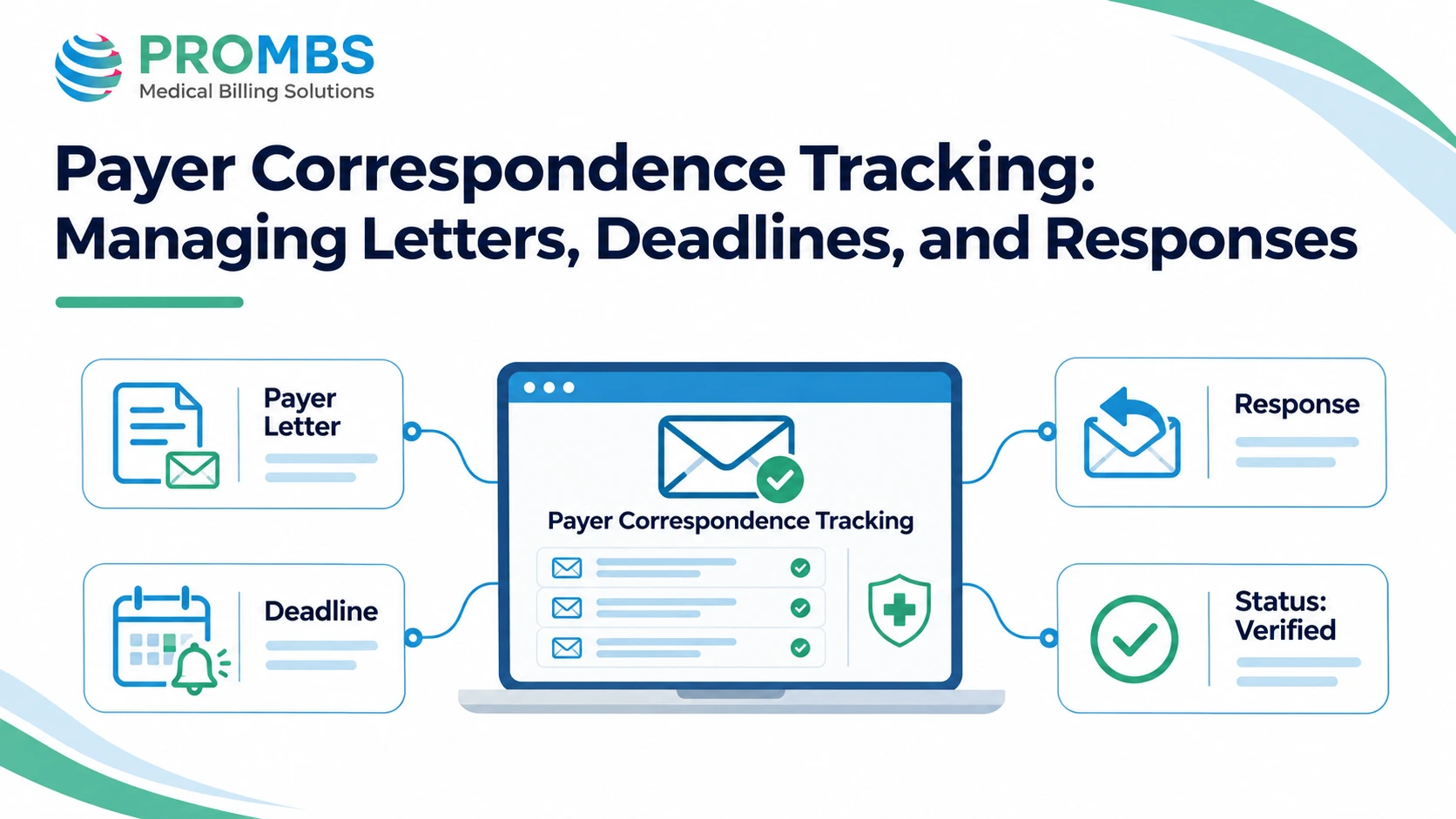
Payer correspondence tracking helps medical billing teams organize these communications, identify necessary actions, assign responsibilities, and maintain a record of what happened. A well managed process gives staff the information they need to respond appropriately and follow unresolved issues through to their outcome.
For medical practices, the objective is not simply to save insurance letters. It is to make sure important requests are recognized, handled by the appropriate employees, and connected to the claims or administrative matters they affect.
What Is Payer Correspondence Tracking in Medical Billing?
Payer correspondence tracking is the process of receiving, organizing, documenting, assigning, and monitoring communications between healthcare providers and insurance payers. It helps medical practices identify which letters or electronic messages require action, what information must be provided, who is responsible, and whether the issue has been resolved.
In medical billing, insurance correspondence frequently contains information that cannot be identified from a basic claim status report alone. A claim might appear pending in the billing system while a separate payer notice explains that additional records are necessary before the insurer can make a payment determination.
Without an organized correspondence process, the billing team may continue checking the claim’s status without realizing that the payer is waiting for information from the practice.
Effective tracking connects each relevant communication to its associated claim, patient account, provider enrollment record, or administrative matter. This gives employees a clearer understanding of the situation and reduces the need to reconstruct previous interactions.
What Counts as Payer Correspondence?
Payer correspondence includes written or electronic communications exchanged between an insurance company and a healthcare provider or its authorized representatives.
These communications may arrive as mailed letters, electronic documents, secure payer portal messages, or other approved forms of communication. Some are informational, while others require the practice to submit documents, correct information, respond to a payment determination, or take another administrative action.
For example, a commercial insurer may send a letter requesting operative reports to support a surgical claim. Medicare may issue an Additional Documentation Request (ADR) during medical review. A Medicaid managed care plan may notify a practice about an enrollment issue affecting its participation records.
These communications differ in purpose, but each may require the practice to recognize the issue and document its handling.
A useful tracking system also records meaningful outgoing communications. When a practice responds to a payer notice, the submission date, response method, supporting documents, and available confirmation details become part of the correspondence history.
This allows another billing employee to determine what has already been completed and what remains outstanding.
Why Payer Correspondence Is Part of Revenue Cycle Management
Revenue cycle management involves more than preparing claims and recording insurance payments. It also requires monitoring issues that prevent accepted claims from reaching final adjudication or reimbursement.
Payer correspondence provides important information about those issues. A documentation request may explain why a claim remains under review, while a denial notice may identify a coverage or medical necessity dispute that requires investigation.
For example, suppose a cardiology practice submits a claim for a diagnostic procedure. The insurer accepts the claim but requests additional records before completing its review.
If the request is received, assigned, and answered correctly, the insurer can continue evaluating the claim. If the correspondence is overlooked, payment may remain delayed, and the claim could eventually be denied under the payer’s applicable rules.
The billing department therefore needs access to payer correspondence alongside claim status, submission records, payment information, and accounts receivable activity.
This connection becomes especially important when a practice manages hundreds or thousands of claims across several insurance networks.
An organized correspondence process supports payer correspondence tracking within broader accounts receivable management by helping employees identify outstanding requests, document payer responses, and determine appropriate next actions.
Payer Correspondence Versus EOBs and ERAs
Payer correspondence is sometimes confused with Explanation of Benefits (EOB) documents and Electronic Remittance Advice (ERA). Although these records are related, they do not serve exactly the same purpose.
An EOB generally explains how an insurance company processed a claim, including covered charges, adjustments, payments, and potential patient responsibility. These explanations are commonly provided to health plan members.
An ERA is the electronic payment and remittance information sent to a healthcare provider. It contains claim adjudication details, payment amounts, adjustments, and standardized codes that help billing systems reconcile insurance payments.
Payer correspondence, in contrast, may communicate an administrative request or issue requiring a separate response. A medical records request, audit notice, or provider enrollment correction may arrive independently of the regular remittance process.
However, the categories can overlap. An ERA can report a denial that requires further action, while a separate letter may provide supporting details about the same decision.
| Communication | Primary Purpose | Common Billing Action |
|---|---|---|
| EOB | Explains claim processing and member financial responsibility | Review the determination and answer related questions |
| ERA | Provides electronic adjudication and payment information | Post payments, reconcile adjustments, and investigate exceptions |
| Medical records request | Requests documentation needed for claim review | Gather and submit the specified records |
| Denial or appeal letter | Communicates a payment decision or review outcome | Evaluate the determination and applicable response options |
| Audit or overpayment notice | Identifies a review, payment concern, or recovery action | Verify the notice and follow the required review process |
According to the Centers for Medicare & Medicaid Services, remittance advice communicates claim adjudication results and adjustment information. Administrative correspondence may require additional actions beyond normal payment posting.
Recognizing these differences helps billing teams route communications to the appropriate department rather than treating every insurance document as a routine payment record.
What Types of Payer Correspondence Should Medical Practices Track?
Healthcare providers receive correspondence for many reasons, and the required response depends on the subject of the communication.
Some notices involve a single outstanding claim. Others relate to an entire group of claims, the practice’s enrollment status, or a payer’s review of previously issued payments.
Medical practices should distinguish these categories because a general status inquiry, a medical necessity review, and an overpayment determination cannot always be handled through the same workflow.
Medical Records Requests and Additional Documentation Requests
Insurance companies may request medical records when they need additional information to evaluate a claim.
The requested material can include office notes, operative reports, diagnostic results, treatment plans, or other documentation relevant to the services billed.
For Original Medicare, an Additional Documentation Request may be issued during a medical review process. CMS explains that the appropriate response timeframe depends on the type of review and the responsible contractor.
A medical practice receiving such a notice should confirm the affected claim, review the requested documentation, identify the applicable deadline, and determine who will prepare the response.
The tracking record should also preserve evidence that the documentation was submitted through the appropriate channel.
Failure to respond adequately within the required timeframe can result in an adverse claim decision, making timely handling particularly important.
For more information about these requests, see our guide to additional documentation requests in medical billing.
Claim Denial Letters and Appeal Decisions
A denial notice communicates that an insurance payer has decided not to reimburse some or all of the services associated with a claim.
The denial may involve coverage restrictions, medical necessity, eligibility, authorization, coding, or another payment requirement.
Although many denials are reported through remittance advice, some payers provide separate correspondence explaining the determination or requesting further action.
The billing department should identify the affected claim, review the payer’s stated reason, and determine whether a corrected claim, reconsideration, or formal appeal is appropriate.
Appeal decision letters also require attention because they communicate the outcome of a previous dispute. A favorable decision may require monitoring subsequent claim processing, while an unfavorable decision may present further review options or a final determination.
Tracking both the original notice and subsequent decisions helps prevent employees from repeating actions or overlooking remaining opportunities.
Audit Notices and Postpayment Reviews
Insurance companies and government healthcare programs may review claims after payment to determine whether the services were billed and reimbursed appropriately.
An audit notice can request medical records, explain the scope of a review, communicate findings, or identify additional steps required from the provider.
These notices may involve one claim or a larger group of accounts, depending on the review.
The practice should determine which department is responsible for coordinating the response and whether the correspondence requires assistance from clinical staff, compliance personnel, or billing specialists.
Maintaining complete records is especially important when a review involves several communications over an extended period.
Overpayment, Recoupment, and Refund Requests
An overpayment notice indicates that an insurance payer believes it paid more than the amount properly due under the applicable rules or contract.
The notice may identify affected claims, the amount in question, the basis for the determination, and the available response options.
A recoupment notice may also explain the payer’s intention to recover funds through deductions from future reimbursements or another permitted recovery method.
Medical practices should not treat every overpayment letter as an instruction to issue an immediate refund without reviewing the notice. The billing department should verify the payment history, relevant claims, applicable rules, and any available review or dispute procedures.
These notices can have important financial consequences, particularly when the payer seeks recovery across multiple claims.
The practice should preserve the original correspondence and track any response, repayment, appeal, or final resolution.
Prior Authorization and Medical Necessity Communications
Insurance payers may send notices about authorization requests, coverage determinations, or medical necessity reviews.
Some communications concern services that have not yet been provided, while others arise during claim processing.
For example, a payer may request additional clinical information to support an authorization request. In another situation, the insurer may question whether documentation supports the medical necessity of a billed service.
These notices should be directed to employees who can coordinate with the clinical and authorization teams.
When an authorization issue affects a pending claim, the billing team should also maintain a connection between the correspondence and the relevant claim record.
Credentialing, Enrollment, and Policy Change Notices
Not all payer correspondence is associated with a specific claim.
Insurance companies may notify healthcare providers about changes to participation requirements, provider demographic information, credentialing records, or administrative policies.
For example, a payer may request confirmation of a practice address, updated provider roster, or supporting documentation for an enrollment change.
Some communications may simply announce an upcoming policy change, while others require the provider to complete an action by a stated date.
These letters should be reviewed by the appropriate credentialing, contracting, or practice administration personnel.
Even when no immediate billing correction is necessary, maintaining the notice in an accessible record can help employees understand subsequent payer requirements.
Why Poor Payer Correspondence Tracking Causes Revenue Problems
A medical billing department may have experienced employees and reliable claim submission processes but still encounter avoidable delays when payer communications are not properly managed.
The problem is often not the lack of information. It is that important information remains separated from the employees responsible for acting on it.
When correspondence is scattered across paper files, email inboxes, payer portals, and individual employee notes, practices can lose visibility into requests that directly affect reimbursement.
Missed Documentation and Appeal Deadlines
Certain payer communications contain deadlines for submitting records, requesting reviews, or responding to adverse decisions.
The applicable timeframe depends on the payer, program, type of request, and relevant notice.
If the practice receives a time sensitive letter but fails to assign it promptly, the available response period continues passing while the document remains unattended.
This creates a risk that the practice may lose an available administrative option or face an unfavorable claim determination.
A dependable tracking system should make these requests visible immediately and record the deadline based on the applicable payer instructions.
Unresolved Claims and Growing Accounts Receivable
Insurance correspondence frequently provides the explanation for why an otherwise submitted claim remains unpaid.
Without reviewing the notice, the billing department may continue treating the claim as a routine pending account.
Consider a physical therapy practice with several claims awaiting medical records review. The accounts receivable report shows outstanding balances, but the assigned billing specialist does not know that the insurer has already requested treatment documentation.
Repeated status inquiries will not address the underlying issue until the documentation request is identified and handled.
This is how correspondence management can affect accounts receivable performance. Claims may continue aging while the necessary action remains unknown or incomplete.
Duplicate Follow Ups and Lost Information
Poor documentation can lead multiple employees to contact the same insurance company about the same issue.
One employee may submit the requested records without recording the confirmation. Another employee, unaware of the submission, may contact the payer again or prepare duplicate documentation.
This consumes staff time and can make the claim history more difficult to interpret.
A centralized correspondence record should allow authorized employees to see what was received, which actions were completed, and what response is still expected from the payer.
Disconnected Communication Between Departments
Insurance correspondence often requires information from several teams.
A billing specialist may receive an audit request, but the necessary medical records are maintained by clinical staff. A credentialing notice may require documentation from practice administration, while a payment dispute may need review by the accounts receivable department.
Without a clear process for transferring responsibility, correspondence can remain unresolved even when everyone involved is aware that a request exists.
The practice needs a defined owner for each actionable item and a method for confirming when another department has completed its part.
This supports accountability without requiring every employee to manage the entire issue independently.
Lack of Evidence When Disputes Arise
A payer may ask when documentation was submitted, whether an earlier request received a response, or what information was communicated during a previous inquiry.
If the practice cannot produce reliable records, employees may have difficulty demonstrating the actions that were taken.
Submission confirmations, correspondence dates, payer reference numbers, and documented outcomes create a clearer administrative history.
These records do not guarantee that a payer will reverse a decision, but they can help the practice investigate disputes and determine what happened.
Where Does Payer Correspondence Come From?
Medical practices should identify all channels through which insurance communications are received.
Depending on the payer and the type of notice, important information may arrive through traditional mail, secure electronic systems, fax, approved email channels, or payer representatives.
A correspondence process that monitors only one channel can miss requests delivered elsewhere.
Paper Mail and Correspondence Processing Centers
Traditional mail remains an important communication method for many healthcare organizations.
Insurance companies may send audit letters, overpayment determinations, credentialing notices, and other formal communications to the practice’s registered correspondence address.
These letters should be opened, reviewed, and directed to the appropriate team without unnecessary delay.
For organizations operating several locations, administrators should verify that each payer has the correct mailing address and that correspondence sent to satellite offices reaches the responsible department.
A designated mail processing procedure can help prevent important letters from remaining in administrative files.
Payer Portals and Secure Electronic Communications
Many insurance companies provide online portals through which healthcare professionals can access claim information, retrieve letters, and submit documentation.
These portals may contain communications that are not immediately visible in the practice management system.
For example, a billing employee checking an outstanding claim may discover a documentation request stored in the insurer’s portal.
Practices should identify which portals require regular monitoring and determine who is responsible for reviewing new communications.
Access should be maintained through authorized accounts, with appropriate controls over patient and claim information.
Fax, Approved Email Channels, and Payer Representatives
Some insurance companies continue to communicate through fax or approved email systems for particular administrative processes.
Payer representatives may also provide instructions during telephone conversations or respond to existing inquiries.
Although a phone call is not the same as a formal written notice, significant information received during the conversation should be documented in the associated claim or correspondence record.
The billing department should record any available payer reference number, the substance of the response, and the next required action.
When a formal written submission or appeal is required, a telephone conversation alone should not be assumed to satisfy that requirement.
Remittance Related Notices and Attached Documentation
Some correspondence is discovered while employees review payment records rather than through a traditional inbox.
For example, remittance information may identify a claim denial requiring investigation, while the payer may separately provide a letter explaining the medical review decision.
The payment posting team and the denial management department should be able to connect these records when they concern the same claim.
This helps employees understand the full processing history and determine whether the issue requires a billing correction, supporting documentation, or another appropriate response.
Building a More Reliable Foundation for Payer Communication
Effective correspondence management begins with recognizing that insurance letters and electronic notices are part of the practice’s revenue cycle, not merely administrative paperwork.
Every actionable communication should be accessible to the responsible department, connected to the appropriate claim or provider record, and handled according to the requirements of the payer.
For practices managing multiple providers and insurance networks, consistency becomes increasingly important. Employees need to know where communications are received, how they are categorized, and which department is responsible for addressing them.
Once these responsibilities are established, the practice can develop a structured workflow for recording correspondence, assigning deadlines, documenting responses, and monitoring unresolved requests.
How to Track Payer Correspondence Step by Step
Receiving an insurance payer’s letter is only the beginning of the correspondence management process. The medical billing team must determine why the communication was issued, whether it requires action, and what needs to happen before the matter can be considered resolved.
A practice may receive several communications about the same claim. The insurer might first request clinical documentation, later acknowledge receiving the records, and eventually issue a payment determination. If each communication is handled independently, employees can lose track of the overall issue or repeat work that has already been completed.
An effective payer correspondence tracking workflow connects these interactions within one documented history. It establishes a consistent process for identifying requests, assigning ownership, monitoring deadlines, and confirming outcomes.
The following eight steps can help medical practices create a more dependable correspondence management system.
Step 1: Receive and Capture Correspondence From Every Approved Channel
The first responsibility is making sure important insurance communications reach the appropriate employees.
Payer correspondence may arrive through postal mail, electronic payer portals, fax, approved email systems, or other authorized communication channels. Some practices receive letters at a central billing office, while others have correspondence delivered directly to individual clinic locations.
When there is no established intake process, a notice may remain in a local office even though the billing department is responsible for responding.
Medical practices should identify every channel through which their insurance payers send communications and assign responsibility for monitoring those channels.
For example, the billing office may review incoming correspondence daily, while designated employees monitor payer portals for new messages. If a clinic location receives an insurance letter, the front office should know how to forward it securely to the responsible department.
Every actionable notice should be captured in the practice’s authorized system with enough identifying information to connect it to the appropriate claim or administrative record.
The objective is to create one reliable point of reference, even when the original communications arrive through different channels.
Step 2: Classify Correspondence by Type and Urgency
Once a communication has been received, the next step is understanding what the payer is requesting.
Not every insurance letter requires the same response. A payment review notice may require financial investigation, while an additional documentation request may need clinical records from the provider. A routine provider directory notice may require no immediate billing action.
Classifying correspondence helps the practice identify the correct department and determine whether the communication contains a time sensitive requirement.
Common categories include medical records requests, claim denials, appeal determinations, payment disputes, audit notices, recoupment letters, enrollment updates, and informational announcements.
Consider two letters received from the same insurer on the same day. One announces a future policy update, while the other requests supporting documentation for a claim under medical review.
The first letter may need to be reviewed and retained for reference. The second requires an assigned employee, a verified response deadline, and a clear action plan.
Separating these categories prevents urgent requests from becoming buried among routine administrative notices.
Step 3: Record the Payer, Claim, Dates, and Required Information
After classification, the correspondence should be entered into a tracking record.
The record needs to identify the insurance company, affected claim or administrative matter, date of the notice, date received, requested action, and responsible employee. When the communication involves a claim, the practice should connect it to the appropriate account and payer claim reference.
One of the most important distinctions is the difference between the date printed on the notice and the date the practice actually received it.
These dates may affect how the practice interprets a response period. However, the deadline must always be calculated according to the applicable payer instructions and governing requirements.
For example, a letter might be dated November 10 but arrive at the practice on November 14. The billing specialist should document both dates rather than assuming the response period begins when the employee opens the document.
The record should also identify what information the payer needs. A note stating “insurance letter received” provides little direction, while an entry explaining that an operative report and supporting treatment notes are required gives the responsible employee a clear task.
Accurate documentation at this stage reduces confusion when the request moves between departments.
Step 4: Assign Ownership and a Clear Next Action
Every correspondence item requiring action should have an accountable owner.
This does not mean one employee must personally complete every part of the response. A billing specialist may need assistance from clinical staff, coding personnel, medical records employees, or practice administration.
However, someone must remain responsible for coordinating the work and confirming that the issue progresses.
Consider an insurance payer requesting clinical records for a diagnostic procedure. The billing specialist identifies the request, while the medical records department gathers the relevant documents. The clinical team may also need to verify that the documentation is complete.
If responsibility is assigned only to a shared departmental inbox, each employee may assume another person is handling the request.
A better approach is to designate one employee to coordinate the response, identify the supporting departments, and record the next required action.
The tracking entry should explain the task clearly. Instead of writing “follow up with insurance,” it might state that the assigned specialist must obtain the signed procedure report, verify the requested service dates, and submit the documents through the payer’s approved channel.
This creates accountability and allows supervisors to identify requests that are not progressing.
Step 5: Verify the Applicable Response Deadline
A correspondence tracking process must distinguish actual payer deadlines from the practice’s internal follow up schedule.
Insurance companies and government healthcare programs establish different response periods depending on the type of request. A medical records request, formal appeal, audit response, and provider enrollment correction may each operate under different rules.
For example, current CMS guidance generally provides 45 calendar days to respond to certain Medicare Administrative Contractor medical review requests, while Unified Program Integrity Contractor requests generally provide 30 calendar days.
These examples should not be used as universal deadlines for every Medicare communication or other insurance payer.
The billing specialist should read the actual notice, identify the applicable review process, and verify when the required response must be received or submitted.
The tracking system should record the confirmed deadline separately from an internal reminder date. A team may decide to review an outstanding request several days before it is due, but that reminder does not change the insurer’s actual requirement.
If an employee discovers correspondence shortly before a verified deadline, the request should be escalated promptly so the practice can determine what action is still available.
Step 6: Prepare and Submit the Appropriate Response
After the required action and deadline have been established, the responsible employee should coordinate the response.
For medical records requests, this may involve collecting clinical notes, procedure reports, diagnostic information, and other documents relevant to the payer’s review.
For claim denials, the billing department may need to investigate the determination and decide whether a corrected claim, reconsideration, or appeal is appropriate.
Other communications may require updated enrollment documents, verification of payment history, or a response to an audit finding.
The response should address the issue identified in the original notice rather than relying on a standard document packet for every situation.
For example, if an insurer requests an operative report to support a surgical claim, sending unrelated records without reviewing the specific request may not help the payer complete its assessment.
Before submission, the assigned employee should verify the affected claim, required documentation, accepted submission channel, and applicable instructions.
CMS allows several submission methods for specified Medicare documentation reviews, including approved contractor portals and the Electronic Submission of Medical Documentation (esMD) process where applicable. Commercial insurers may use different methods.
The practice should follow the instructions for the specific request and retain evidence of the response.
Step 7: Confirm Receipt and Continue Follow Up
Submitting documents is not the same as confirming that the payer received and accepted them for review.
A fax confirmation may establish successful transmission, while an online portal may generate a submission acknowledgment. Neither necessarily means the insurance company has finished reviewing the information.
The billing employee should record the available confirmation number, transmission date, submission method, and any other evidence showing that the response was delivered through the approved channel.
When the payer does not provide immediate acknowledgment, the practice should determine whether an additional verification step is necessary.
For example, a billing specialist submits requested medical records through an insurer’s portal. The system displays a confirmation number, which is saved in the tracking record. During a later inquiry, the insurer confirms that the documentation is attached to the claim but remains under review.
The correspondence should remain open because the underlying claim issue has not reached its final outcome.
The tracking record should show the last completed action and identify the next follow up date based on the payer’s response and applicable requirements.
This distinction prevents practices from confusing administrative activity with actual resolution.
Step 8: Close the Correspondence Only After Documenting the Outcome
A correspondence item should not automatically be marked completed because an employee sent a document or contacted the payer.
The appropriate closure point depends on the purpose of the communication.
An informational letter may be closed after the necessary review and distribution. A documentation request related to a pending claim may remain open until the practice confirms the payer’s disposition or transfers the unresolved issue into an accountable claim resolution workflow.
An audit notice may require additional follow up even after the initial response is submitted.
Before closing an actionable item, the responsible employee should document what happened, whether the necessary response was accepted, and whether any additional work remains.
For example, if a claim is denied after medical review, the documentation request may have been fulfilled, but the denial may create a separate appeal or investigation task.
The practice can close the original correspondence only when the related issue is appropriately resolved or the remaining responsibility has been formally transferred and recorded.
This approach prevents unresolved claims from disappearing simply because one administrative step was completed.
What Information Should Be Included in a Payer Correspondence Tracking Log?
A correspondence tracking log gives the billing team a consistent way to organize insurance communications and monitor outstanding responsibilities.
The log may be maintained within an authorized practice management system, revenue cycle platform, document management application, or another appropriately secured environment.
Regardless of the technology used, the information should be sufficient for another authorized employee to understand the issue without repeating the entire investigation.
A useful payer correspondence tracking template should include the following fields.
| Tracking Field | Information to Record |
|---|---|
| Correspondence ID | Unique internal reference for the communication |
| Date received | Date the practice received the notice |
| Notice date | Date stated on the payer communication |
| Insurance payer | Payer and relevant insurance plan |
| Claim or account reference | Internal claim identifier and payer claim reference when applicable |
| Correspondence category | Documentation request, denial, audit, appeal, or other issue |
| Required action | What the practice must investigate, submit, or complete |
| Verified deadline | Applicable response date and its source |
| Assigned owner | Employee responsible for coordinating the item |
| Current status | Present stage of the correspondence workflow |
| Last completed action | Most recent documented activity |
| Next follow up date | Date the issue should be reviewed again |
| Submission confirmation | Payer reference, acknowledgment, or transmission record |
| Final outcome | Resolution, payer determination, or documented transfer to another workflow |
The purpose of the tracking log is not to duplicate every detail already available in the EHR or billing system. Instead, it should provide an organized view of the correspondence and a secure link to the records required for the task.
Patient information should remain in approved systems with appropriate access controls. A tracking spreadsheet or shared worklist should not become an unsecured collection of medical records or protected health information.
Example of a Correspondence Tracking Entry
Consider a fictional orthopedic practice that receives a request for an operative report associated with a pending insurance claim.
The billing team creates a correspondence record and identifies the responsible employee.
| Field | Illustrative Entry |
|---|---|
| Correspondence category | Additional documentation request |
| Insurance payer | Commercial Payer A |
| Claim reference | Internal Claim 1042 |
| Required action | Submit operative report and requested clinical notes |
| Assigned owner | A/R Specialist |
| Deadline | Verified from payer notice |
| Current status | Awaiting clinical documentation |
| Next action | Confirm records are complete and submit through approved portal |
The claim reference is an illustrative internal identifier, and no real patient information is included.
Once the documentation is submitted, the employee updates the record with the submission confirmation and next follow up action.
If another employee reviews the account later, the tracking history provides enough information to determine what has already occurred.
This is especially helpful for larger billing teams where several employees may work with the same insurance payer.
How Should Payer Correspondence Be Prioritized?
Not every correspondence item requires immediate action, but every actionable notice should be assessed for urgency.
The most effective approach is to consider the verified deadline, nature of the request, financial exposure, and current claim status.
A practice may choose to use internal priority levels, provided that these labels do not replace the actual requirements established by the payer.
Requests Approaching a Verified Deadline
Correspondence with an approaching response deadline should receive prompt attention, particularly when additional documents must be collected from another department.
A request that appears simple may require several days of coordination if the medical records department must retrieve archived information or obtain a completed clinical report.
The tracking system should make the verified deadline visible and identify any incomplete tasks that could prevent a timely response.
High Impact Audit and Recoupment Notices
Audit findings and recoupment notices can affect previously issued payments and may involve multiple claims.
These communications often require a more detailed financial or compliance review than routine claim inquiries.
The practice should identify the relevant review rights, applicable deadlines, and employees authorized to make decisions about disputes or repayment.
A large dollar amount can justify closer management attention, but urgency should still be evaluated alongside the actual deadline and nature of the notice.
Claims Awaiting Medical Documentation
Documentation requests associated with pending claims should be prioritized according to their review requirements and the effort needed to prepare an adequate response.
For example, obtaining signed records from several clinicians may require more coordination than retrieving a completed office note already stored in the EHR.
The correspondence owner should anticipate these dependencies and request the necessary records early enough to meet the payer’s instructions.
Unresolved Appeals and Payer Responses
Appeal communications should be monitored according to the applicable review process.
A payer may acknowledge receiving an appeal without issuing a determination immediately. The tracking record should distinguish the acknowledgment from the final decision.
When a decision arrives, the billing team should review the outcome and determine whether further action is necessary.
For additional information about appeal evidence and filing issues, see our guide to timely filing denial appeals.
Routine Informational Communications
Some insurance communications do not require an immediate claim level response.
Examples include general provider announcements, certain policy updates, and routine administrative notices.
These communications should still be directed to the appropriate department when they could affect practice operations.
However, they should not displace time sensitive claim reviews or other correspondence requiring action before a verified deadline.
How to Document Payer Calls, Emails, and Portal Messages
Written letters are only one part of communication between medical practices and insurance companies.
A billing specialist may need to call a payer to clarify a request, review the status of previously submitted documents, or investigate why an issue remains unresolved.
These interactions should be documented so the practice maintains an accurate history of its follow up activities.
Record Meaningful Information From Every Payer Interaction
A useful payer communication note should identify the date, contact method, insurance company, and claim or correspondence reference.
When available, it should include the payer representative’s name or department and the reference number associated with the conversation.
Most importantly, the note should explain the actual information received and the next action.
For example, documenting that an employee called the insurer provides little information to the next person reviewing the account.
A more useful entry would explain that the payer confirmed receiving the requested records, stated that the claim remains under medical review, and provided a reference number for subsequent inquiries.
The employee should record the next review date and identify whether additional action is required from the practice.
Maintain Submission Evidence for Emails and Portals
When a payer allows documentation through an approved electronic channel, employees should preserve the relevant submission evidence.
This may include a portal acknowledgment, secure message confirmation, or another record accepted by the payer.
Screenshots and downloaded confirmations containing protected information should be maintained only within approved systems.
A confirmation that a message was transmitted should not be treated as proof that the insurer approved the request.
The tracking record should distinguish successful submission, payer acknowledgment, review in progress, and final determination.
Avoid Repeated Contacts Without a Defined Purpose
Repeatedly calling an insurance company does not necessarily move an unresolved issue toward completion.
If a payer has already confirmed that documentation is under review, the next contact should have a clear purpose, such as verifying whether a decision has been issued or whether additional information is required.
If the payer provides contradictory responses, the employee should document the differences and determine whether a supervisor or payer escalation is necessary.
A complete correspondence history helps employees ask specific questions rather than restarting the same conversation.
How to Manage Correspondence Across Multiple Billing Staff
As medical practices grow, correspondence management becomes a shared operational responsibility.
One employee may monitor incoming payer notices, another may prepare documentation, and a third may handle claim appeals or payment disputes.
Without clear ownership and communication between these employees, an insurance request can remain unresolved even when several team members have reviewed it.
Define Departmental Responsibilities
The practice should establish which department handles each general correspondence category.
For example, medical records personnel may retrieve documentation, while the billing department coordinates claim related responses. Credentialing staff may manage enrollment notices, and the denial management team may investigate adverse payment determinations.
These roles should be understood before an urgent request arrives.
However, departmental involvement should not eliminate individual accountability. Each actionable correspondence item should have one designated owner responsible for monitoring progress.
Establish a Consistent Handoff Process
When a task moves between employees, the receiving person should be able to identify the original issue, work already completed, remaining requirements, and applicable deadline.
A handoff should not consist only of forwarding the insurer’s letter without explanation.
For example, when a billing specialist requests clinical records, the medical records team should receive the relevant document requirements and the internal completion date.
Once the records are provided, the correspondence owner should verify their completeness and continue the submission process.
A clear handoff procedure reduces repeated requests and uncertainty about who is responsible.
Review Outstanding Correspondence and Escalations
Supervisors should regularly review items that remain open, particularly those approaching deadlines or waiting on another department.
The review should identify correspondence without a responsible employee, requests that have not progressed, and items where payer responses remain unclear.
An escalation should include the original request, previous actions, available reference numbers, and the specific decision or assistance required.
Management should also distinguish between a delay caused by the practice and one caused by an insurer’s ongoing review.
This makes it easier to address operational problems without assigning responsibility incorrectly.
Manual Tracking Versus Automated Correspondence Management
Medical practices can manage payer correspondence through manual processes, automated systems, or a combination of both.
The appropriate approach depends on the volume of communications, available software, staffing, security requirements, and complexity of the billing operation.
A smaller practice may be able to manage a limited correspondence workload through an approved document management system and structured worklist.
A larger organization receiving numerous notices across several insurance networks may need more advanced tools to capture documents, route tasks, and monitor outstanding requests.
Manual Correspondence Tracking
Manual tracking commonly involves employees reviewing incoming letters and portal messages, entering relevant details, assigning work, and updating records as the issue progresses.
This approach can provide flexibility because staff can apply professional judgment when classifying unusual requests or interpreting complicated payer instructions.
However, manual processes rely heavily on consistent employee documentation.
If staff forget to enter correspondence, update a deadline, or record a submission confirmation, the tracking system may no longer reflect the actual status of the work.
Practices using manual worklists should establish standardized fields, restricted access, clear ownership, and routine quality reviews.
A general purpose spreadsheet should only be used when it has been approved for the intended information and protected by appropriate safeguards.
Automated Correspondence Management
Automated systems can assist with collecting documents, extracting selected information, assigning tasks, and generating workflow notifications.
For example, document processing software may identify the payer name, correspondence category, or claim reference and suggest an appropriate work queue.
Some revenue cycle platforms also support task assignments, status changes, and reminders linked to claims.
These capabilities can reduce manual administrative work, but they do not eliminate the need for human review.
An automated system may classify a notice incorrectly, overlook an unusual deadline, or fail to recognize that an appeal requires a specific response process.
The practice must therefore verify critical details and maintain employee responsibility for decisions affecting claims, deadlines, or reimbursement.
Choosing the Right Tracking Approach
| Consideration | Manual Tracking | Automated Tracking |
|---|---|---|
| Correspondence intake | Employees review and enter notices | Supported channels may capture documents automatically |
| Classification | Staff categorize communications | Software may suggest categories |
| Deadline management | Employees record and monitor dates | Systems may generate alerts from configured dates |
| Task assignment | Manual assignment to employees | Rules may route tasks to designated queues |
| Follow up documentation | Staff update records | Workflow activity may be captured automatically |
| Quality control | Supervisor reviews | System checks combined with human verification |
| Main limitation | Dependence on consistent manual entry | Dependence on accurate setup, integrations, and validation |
Regardless of the technology, the practice should establish a documented process for reviewing important communications, protecting information, and verifying that outstanding requests are resolved appropriately.
According to the HHS guidance on the HIPAA minimum necessary requirement, covered entities generally need policies and procedures limiting unnecessary access to and disclosure of protected health information. Organizations should apply the relevant privacy and security requirements when selecting tools and managing correspondence records.
Turning Correspondence Records Into Actionable Billing Work
A reliable payer correspondence tracking process should make it easy for billing employees to answer several basic questions: What did the payer request? Who is responsible? When is the response due? What has already been completed? What needs to happen next?
When this information is consistently maintained, correspondence becomes part of the practice’s organized claims management workflow rather than a collection of disconnected letters and messages.
The tracking process also provides management with a clearer view of unresolved requests, delayed responses, and issues requiring additional attention.
However, organizing correspondence is only one part of improving revenue cycle operations. Medical practices must also determine whether deadlines are being met, whether responses are reaching insurers, and whether unresolved communications are contributing to claim delays.
How to Prevent Missed Payer Correspondence Deadlines
One of the most important responsibilities in payer correspondence tracking is identifying communications that require a response within a specific period. A medical practice may receive an insurance letter, recognize that additional information is needed, and still miss the applicable deadline because the request was not assigned or monitored properly.
Deadlines can be especially challenging when several departments contribute to the response. A medical records request may require documentation from a physician, while an appeal may involve billing specialists, coding personnel, and practice administrators. When these responsibilities are not coordinated, valuable response time can be lost.
Medical practices need a process that identifies the applicable deadline, records the event that starts the response period, and assigns sufficient time for preparing and submitting the required information.
Understand Payer Specific Response Windows
Insurance companies and government healthcare programs do not follow one universal correspondence deadline.
The required response period depends on the type of notice, payer, coverage program, and applicable contractual or regulatory requirements.
For Original Medicare, the Centers for Medicare & Medicaid Services establishes specific timeframes for different medical review requests.
| Medicare Review Type | General Response Period |
|---|---|
| Medicare Administrative Contractor prepayment review | 45 calendar days |
| Unified Program Integrity Contractor prepayment review | 30 calendar days |
| MAC, SMRC, or RAC postpayment review | 45 calendar days |
| UPIC postpayment review | 30 calendar days |
| First level Medicare redetermination request | Generally 120 days from receipt of the initial determination |
These periods apply to the specified Medicare processes and should not be treated as standard deadlines for commercial insurance companies or every type of Medicare correspondence.
CMS also recognizes certain circumstances in which late documentation may be accepted for good cause. Practices should not assume an extension is automatic or rely on that possibility instead of responding within the required period.
The official CMS Additional Documentation Request guidance explains the applicable medical review requirements.
Medicare, Medicaid, and Commercial Payer Differences
Original Medicare, state Medicaid programs, Medicare Advantage plans, and commercial insurers operate under different administrative requirements.
For example, the standard first level Original Medicare redetermination deadline is generally 120 days after receipt of the initial determination. CMS ordinarily presumes that the determination notice was received five calendar days after its date unless evidence establishes otherwise.
However, that rule should not be applied automatically to a Medicaid managed care appeal or a commercial insurance dispute.
Those organizations may establish different response periods depending on the applicable plan, provider agreement, state requirements, and nature of the determination.
A medical practice should maintain payer specific instructions rather than use one standard deadline for every insurance communication.
Record the Date That Starts Each Deadline
A correspondence log should distinguish the notice date, actual date received, applicable triggering event, and verified response deadline.
These dates are not always interchangeable.
For example, the response period for one type of notice may begin when the letter is issued, while another may be calculated from receipt of an initial determination or another defined event.
The billing specialist should review the actual notice and governing requirements before calculating the due date.
If the practice receives correspondence after a significant delivery delay, the employee should document the circumstances and determine whether the applicable rules provide a remedy or require an immediate response.
Create Escalation Reminders Before Deadlines Expire
Internal reminders help prevent important correspondence from remaining unattended until the last day.
A practice may establish an initial review deadline, a documentation collection deadline, and a final verification point before the payer’s required submission date.
These are internal operating targets rather than additional regulatory deadlines.
For instance, a request requiring clinical documentation from several providers should be escalated earlier than a routine inquiry that can be completed by one billing specialist.
The correspondence owner should verify that the response is complete, correctly identified, and submitted through an approved channel.
An item should remain visible until the submission is confirmed and any further payer action is monitored.
How Payer Correspondence Tracking Supports Denial Management
Insurance correspondence plays an important role in determining why claims remain unpaid and what action may be available to resolve them.
A denial can be communicated through electronic remittance information, a separate payer notice, or both. When these records are not connected, employees may investigate the claim without reviewing important details about the insurer’s determination.
A reliable correspondence history helps the denial management team understand what happened before the decision and what actions have already been taken.
Identify Denial Notices Requiring Action
Not every denied claim requires a formal appeal.
Some denials may be resolved through an appropriate corrected claim, while others require additional documentation, reconsideration, or a formal review process.
The billing specialist should evaluate the payer’s denial reason, applicable claim adjustment codes, supporting correspondence, and available correction or appeal procedures.
A claim rejection also needs to be distinguished from an adjudicated denial because the available remedies can differ.
The objective is to identify the correct resolution process rather than automatically appeal every unpaid claim.
Connect Payer Letters to Claim History
Each relevant correspondence item should be connected to the claim’s submission history, acknowledgments, previous payer responses, and remittance information.
Consider a claim denied for insufficient documentation. The practice’s correspondence record shows that the requested medical records were submitted before the verified deadline, but the payer’s response suggests the documentation was not available during review.
The billing team can investigate whether the submission reached the correct department, was associated with the correct claim, and contained the required records.
Without that documented history, employees may struggle to determine whether the issue resulted from an incomplete response, a submission problem, or the payer’s review findings.
Verify Appeal Submissions and Payer Acknowledgments
Submitting an appeal does not necessarily mean the insurance company has accepted it as complete or issued a decision.
The correspondence tracking record should identify the appeal submission method, date, reference number, supporting documents, and available acknowledgment.
When appropriate, the billing team should verify that the appeal was received and determine whether the payer requires additional information.
For more information about identifying recurring problems behind unsuccessful claims, see our guide to denial root cause analysis.
Follow Through Until the Claim Reaches an Appropriate Disposition
A correspondence task may be administratively completed while the associated claim remains unresolved.
For example, an insurance company may confirm that an appeal was received, but the determination and resulting payment remain outstanding.
The practice should maintain an accountable follow up process until the payer issues its decision and the resulting financial activity is appropriately reviewed.
A favorable appeal decision may still require verification of claim reprocessing and payment posting. An unfavorable decision may require evaluation of further review rights or an appropriate financial disposition.
The purpose of tracking is to preserve visibility throughout the process, not merely to record that an employee contacted the insurer.
Common Mistakes in Payer Correspondence Management
Several recurring administrative problems can make insurance correspondence more difficult to manage.
One common mistake is leaving communications in shared inboxes without assigning responsibility. Employees may review the notice, but no one takes ownership of collecting the necessary documents or completing the response.
Another problem is failing to preserve payer reference numbers and submission confirmations. When the insurer later questions whether documentation was received, the billing team may have difficulty reconstructing the interaction.
Incorrect deadline calculations can also create unnecessary risk, especially when employees use a generic response period rather than the actual payer requirements.
Some practices close correspondence immediately after sending records, even though the insurance company has not completed its review. This can remove an unresolved claim from active follow up.
Finally, disconnected departmental records can cause duplicate work. Billing, medical records, and denial management personnel may each maintain different information about the same request.
The solution is a shared, secure workflow with clear ownership, verified deadlines, consistent documentation, and defined closure requirements.
How to Measure Payer Correspondence Tracking Performance
A tracking process should provide management with more than a list of insurance letters.
It should help the practice determine whether communications are being identified promptly, assigned correctly, addressed within applicable deadlines, and followed through to resolution.
A small set of consistent performance measures can reveal problems that would otherwise remain hidden within individual claim accounts.
Recommended Payer Correspondence KPIs
| KPI | Suggested Measurement | Operational Purpose |
|---|---|---|
| Correspondence intake time | Average time between receipt and entry into the authorized tracking system | Measures intake efficiency |
| Assignment completion rate | Actionable items with a designated owner ÷ total actionable items × 100 | Measures accountability |
| Deadline compliance rate | Required responses completed within the applicable deadline ÷ responses due during the period × 100 | Measures timely response performance |
| Open correspondence backlog | Total unresolved actionable correspondence at the reporting date | Identifies outstanding workload |
| Correspondence aging | Time elapsed since receipt for unresolved items | Highlights requests remaining open |
| Follow up completion rate | Scheduled follow ups completed on time ÷ total scheduled follow ups due × 100 | Measures workflow consistency |
| Documented resolution rate | Closed items with sufficient outcome documentation ÷ total closed items × 100 | Measures closure documentation quality |
These metrics are suggested operational measures, not universal CMS or industry performance benchmarks.
Practices should define how each metric is calculated and apply the same criteria consistently when comparing reporting periods.
Review Performance by Payer and Correspondence Type
Overall statistics may conceal important differences between insurance companies or types of requests.
A practice may process routine provider notices promptly while medical documentation requests remain open for extended periods.
Similarly, one insurer may require more follow up because its documentation review process involves additional steps.
Management should examine correspondence trends by payer, request category, responsible department, and current status.
The goal is to identify which parts of the workflow need improvement rather than simply increase the number of outgoing calls or completed tasks.
HIPAA Considerations for Storing Payer Correspondence
Insurance correspondence frequently contains protected health information, including patient identifiers, claim details, diagnoses, service dates, and clinical documentation.
Medical practices must handle this information according to applicable HIPAA requirements and their organizational security policies.
The HHS HIPAA Security Rule guidance explains the administrative, physical, and technical safeguards required to protect electronic protected health information.
Secure Storage and Authorized Employee Access
Correspondence containing protected information should be maintained in systems approved for the intended purpose.
Employees should access the information needed to perform their assigned responsibilities, with permissions established according to organizational policies and applicable privacy requirements.
Practices should avoid storing patient correspondence in personal email accounts, publicly accessible folders, or unauthorized spreadsheet applications.
If an external billing company or technology provider handles protected information on behalf of a covered entity, the organization should evaluate the applicable business associate requirements, including the need for a compliant business associate agreement.
Appropriate Information Sharing
When responding to insurance payers, billing teams should verify that information is transmitted through the appropriate authorized channel.
The HIPAA minimum necessary standard generally requires reasonable efforts to limit protected information to what is needed for the intended purpose, subject to recognized exceptions.
For example, a request for selected clinical records does not automatically justify sending unrelated medical information.
The practice should follow the payer’s legitimate documentation requirements while applying the relevant privacy standards.
Record Retention and Disposal
Medical practices should maintain correspondence according to applicable state laws, federal program requirements, payer agreements, organizational retention schedules, and any relevant audit or litigation hold.
HIPAA does not establish one universal retention period for all patient medical records. HHS specifically explains that medical record retention periods are generally governed by state law.
The HIPAA Security Rule does require certain security policies, procedures, and related documentation to be retained for six years after creation or the date last in effect, whichever is later. That rule should not be mistaken for a universal six year retention requirement for every payer letter or medical record.
Organizations should determine which requirements apply to each record category and use secure disposal methods when retention is no longer required.
Payer Correspondence Tracking Checklist for Medical Practices
A practical correspondence checklist should cover daily intake, active case management, and periodic quality review.
| Review Stage | Recommended Action |
|---|---|
| Daily intake | Review designated mail, payer portals, and approved electronic channels |
| Daily intake | Record new actionable notices and identify their corresponding claims |
| Daily intake | Classify requests and verify applicable deadlines |
| Task assignment | Assign an accountable employee and document the required action |
| Response preparation | Coordinate documentation with the appropriate departments |
| Response submission | Verify completeness and use the payer’s approved submission method |
| Confirmation | Record submission evidence and available payer acknowledgment |
| Follow up | Review outstanding items according to verified requirements |
| Resolution | Document the outcome and connect it to claim or payment status |
| Periodic quality review | Examine overdue items, unresolved correspondence, and workflow problems |
A supervisor should periodically verify that open items have appropriate ownership, accurate deadlines, and meaningful next actions.
The checklist should also be updated when payer requirements change or the practice identifies a recurring administrative issue.
Frequently Asked Questions About Payer Correspondence Tracking
What Is Payer Correspondence in Medical Billing?
Payer correspondence includes written and electronic communications between healthcare providers and insurance companies. These may involve documentation requests, claim denials, appeals, audits, payment disputes, enrollment changes, and other administrative matters that require review or action.
How Do You Track Insurance Company Letters?
Medical practices can track insurance letters through an authorized system that records the payer, correspondence type, date received, affected claim, required action, verified deadline, assigned employee, and current status. Each meaningful response and final outcome should also be documented.
What Is the Best Way to Organize Payer Correspondence?
A centralized tracking process with consistent categories, clear ownership, secure document storage, and scheduled follow up is generally more reliable than disconnected files or individual employee notes. The appropriate software depends on the practice’s operational needs and security requirements.
Which Payer Notices Require Immediate Attention?
Notices involving approaching deadlines, audits, recoupments, additional documentation requests, and available appeal rights may require prompt review. Urgency should be determined by the actual requirements, potential consequences, and time needed to prepare a complete response.
How Should Medical Practices Track Appeal Deadlines?
Practices should identify the applicable payer appeal rules, record the event that starts the appeal period, calculate the verified deadline, and assign responsibility for preparing the request. Internal reminders should allow sufficient time for documentation, submission, and confirmation.
Can Tracking Software Help Manage Payer Correspondence?
Yes. Appropriate software can support document capture, task assignment, reminders, reporting, and correspondence status monitoring. However, employees still need to verify critical information, particularly payer deadlines, clinical documentation requirements, and appeal procedures.
How Long Should Payer Correspondence Records Be Retained?
There is no single retention period that applies to every type of payer correspondence. Practices should review applicable state laws, Medicare or Medicaid requirements, contractual obligations, and organizational policies. Relevant records may also need to be preserved when an audit, dispute, or legal hold is active.
How Can Payer Correspondence Tracking Improve A/R Follow Up?
Organized correspondence records help billing employees identify outstanding payer requests, understand previous actions, and determine what is preventing claim resolution. This can reduce repeated investigations and help teams focus on accounts requiring documentation, follow up, or another appropriate administrative action.
Conclusion: Keep Payer Communications Organized and Claims Moving
Insurance correspondence is an important part of medical billing operations because it frequently explains why claims remain pending, what documentation is required, and which actions may be necessary to resolve reimbursement issues.
A dependable process begins with timely intake and continues through classification, ownership, deadline verification, response submission, and documented resolution.
For medical practices handling multiple insurers and a growing number of claims, consistent payer correspondence tracking can improve visibility into outstanding requests and reduce avoidable administrative delays.
The greatest value comes from connecting communications to actual claim outcomes. A letter should not disappear from the workflow simply because it was opened, and an unresolved claim should not be considered complete simply because a response was submitted.
With clear responsibilities, accurate tracking records, and regular management reviews, healthcare organizations can maintain better control over payer interactions and support more reliable revenue cycle operations.