

A multispecialty medical practice prepares a batch of insurance claims for submission. The billing department has completed charge entry, assigned procedure codes, and verified the required claim information. Everything appears ready until a quality assurance reviewer examines a small selection of claims and discovers that several contain an incorrect place of service code.
The reviewer investigates further and finds that the errors are not isolated. A recently updated billing template is assigning the wrong location code to claims associated with an entire provider group. Without the review, the same mistake could have affected many additional claims before anyone noticed a pattern in clearinghouse responses or payer denials.
This is why medical billing quality assurance matters before claims leave the practice. A reliable QA process does more than identify individual mistakes. It helps billing teams recognize recurring errors, investigate their sources, and correct the affected workflow before inaccurate information reaches insurance payers.
Healthcare organizations process claims involving different specialties, providers, insurance companies, and coding requirements. Even experienced billing professionals can encounter problems when documentation is incomplete, payer rules change, or software configurations introduce unexpected errors.
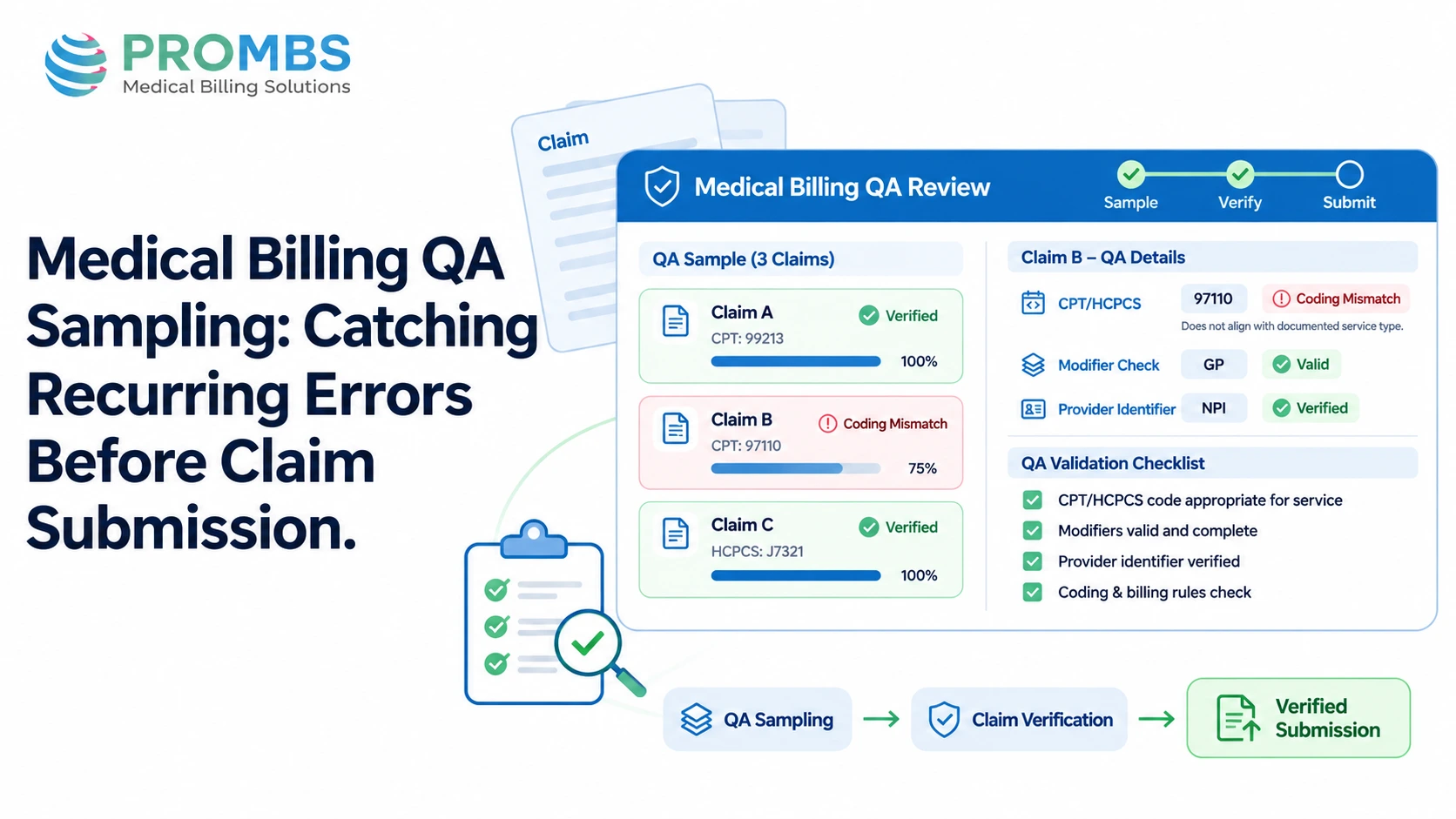
Medical billing QA sampling provides a structured way to evaluate selected claims before submission. When those samples are chosen carefully and reviewed against appropriate standards, they can reveal weaknesses that routine claim preparation may overlook.
What Is Medical Billing Quality Assurance?
Medical billing quality assurance is the systematic process of evaluating and improving the accuracy, consistency, and reliability of medical billing operations.
It involves reviewing how claims are prepared, identifying errors or potential compliance concerns, monitoring recurring problems, and verifying that corrective actions produce the intended improvements.
In practice, quality assurance examines more than whether a claim contains the correct diagnosis and procedure codes. It also considers the information and processes supporting the claim, including patient registration, insurance verification, clinical documentation, charge capture, provider enrollment, and claim submission requirements.
For example, an incorrect subscriber identifier may originate during registration, while an inappropriate modifier may result from a coding mistake or outdated charge entry rule.
Both problems can appear on the final insurance claim, but their underlying causes require different corrective actions.
A structured medical billing quality assurance process helps organizations evaluate these errors before they become repeated billing problems.
What Medical Billing QA Is Designed to Accomplish
The primary objective of medical billing QA is to establish confidence that claims are prepared according to applicable coding, documentation, and payer requirements.
A QA reviewer compares selected claims with the supporting information available in the practice’s authorized systems. This may include encounter documentation, insurance eligibility records, authorization details, charge information, and current coding instructions.
When the reviewer identifies a discrepancy, the issue should be evaluated before the claim is released.
For example, a claim may contain a procedure code that does not appear to agree with the documented service. The appropriate next step is to verify the documentation and coding requirements rather than automatically replacing the code with one that produces a more favorable reimbursement.
Quality assurance should promote accurate billing, not simply reduce denials by changing claims to satisfy automated payer edits.
The process also helps management determine whether errors are concentrated among particular services, billing templates, insurance plans, or operational workflows.
Quality Assurance Versus Quality Control
Quality assurance and quality control are closely related, but they emphasize different responsibilities.
Quality assurance focuses on the processes used to produce accurate claims. Quality control focuses on inspecting specific claims or outputs to identify defects.
For example, establishing standardized coding instructions, reviewer training, and procedures for handling documentation discrepancies are quality assurance activities.
Reviewing a selected claim to verify the diagnosis, modifier, and place of service is a quality control activity within that broader QA program.
Both functions are necessary.
A practice that performs claim inspections without improving its processes may discover the same errors repeatedly. Conversely, a practice that maintains written billing procedures but rarely verifies their effectiveness may overlook problems that develop during daily operations.
Pre-submission claim sampling brings these functions together. Reviewers identify problems in selected claims, while QA leaders use the findings to determine whether existing controls need improvement.
Why QA Sampling Matters Before Claim Submission
Reviewing every field of every claim through a detailed manual process may be impractical for medical organizations processing large claim volumes.
QA sampling allows the practice to select a defined group of claims for additional examination before submission.
The sample may include randomly selected claims, claims associated with known billing risks, or both.
A random sample can help evaluate performance across a defined claim population when the selection method is appropriate. A focused sample can investigate specific concerns, such as recent coding changes, new billing employees, or repeated modifier errors.
However, a small sample cannot guarantee that every remaining claim is accurate.
The value of sampling lies in its ability to identify problems that warrant additional investigation. When several reviewed claims share the same error, the practice can examine other claims generated through the affected workflow rather than correcting only the sampled records.
Medical Billing QA Sampling vs. Claim Scrubbing vs. Billing Audits
Medical practices often use claim scrubbing, quality reviews, and billing audits to identify problems. Although these activities support billing accuracy, they do not serve exactly the same purpose.
Understanding their differences helps organizations establish controls at the appropriate stages of the revenue cycle.
Automated Claim Scrubbing
Claim scrubbing generally involves automated checks applied to claim data before submission.
These checks may identify missing required fields, invalid code combinations, incomplete identifiers, or other issues based on configured billing and payer rules.
For example, a claim scrubbing system may flag an invalid procedure code or a missing required modifier.
However, automated validation has limitations.
A claim may contain technically valid codes while the clinical documentation does not support the billed services. Similarly, an automated edit may not recognize that a diagnosis was entered incorrectly when the code itself is valid.
The Centers for Medicare & Medicaid Services maintains the National Correct Coding Initiative, which includes procedure code combination edits and Medically Unlikely Edits.
CMS explains that NCCI edits address correct coding rather than medical necessity and do not function as a prior authorization program.
Passing automated edits therefore does not establish that every billed service satisfies documentation, coverage, or medical necessity requirements.
Manual Pre-Submission QA Sampling
Manual QA sampling involves qualified reviewers examining selected prepared claims and their supporting information before the claims are released.
Unlike automated scrubbing, this process can include clinical documentation review, coding judgment, and evaluation of how information moved through the billing workflow.
For example, a reviewer may identify an evaluation and management service that appears inconsistent with the documented medical decision making.
The claim might pass basic automated validation because the reported code is active and the required fields are populated.
A qualified reviewer can examine the relevant documentation and determine whether the reported level is supported or requires further clarification.
Manual QA can therefore identify problems that depend on context rather than simple data validation.
Retrospective Billing and Coding Audits
Retrospective audits generally examine claims or billing activity after submission, adjudication, payment, or another defined stage of processing.
They may focus on coding accuracy, compliance, reimbursement, documentation, or broader financial and operational risks.
For example, an organization may investigate whether a group of previously submitted claims followed the coding requirements applicable to the services billed.
These reviews can reveal historical problems and potential corrective obligations. However, they cannot prevent the original claims from having been submitted.
Pre-submission QA sampling provides an earlier opportunity to identify and address errors.
| Review Method | Typical Timing | Main Purpose | Important Limitation |
|---|---|---|---|
| Automated claim scrubbing | Before claim submission | Identify errors using configured validation rules | Cannot independently confirm all clinical and documentation requirements |
| Manual QA sampling | Before selected claims are released | Evaluate claim accuracy and identify recurring workflow errors | Findings depend on sample selection and reviewer competence |
| Retrospective billing audit | After the defined billing activity | Evaluate historical accuracy, compliance, or reimbursement concerns | Errors may already have affected submitted or paid claims |
A comprehensive quality program can use all three methods. The key is understanding what each process can establish and where additional review is necessary.
Where Does Quality Assurance Fit Into the Medical Billing Workflow?
Medical billing accuracy depends on information generated throughout the patient’s encounter and the subsequent billing process.
An error appearing on a claim may originate several steps before the billing department begins preparing it.
For that reason, quality assurance should consider the complete sequence of information used to create a claim rather than focus exclusively on the final electronic transaction.
Patient Registration and Insurance Information
The billing process begins with accurate patient and coverage information.
Registration mistakes involving patient demographics, subscriber identifiers, insurance plans, or coordination of benefits can create problems when claims reach the payer.
For example, a patient may have updated insurance coverage, but the practice continues using the previous plan information.
The claim may be coded correctly and fully supported by the medical record, yet the billing process can still fail because the wrong insurance information was submitted.
During QA sampling, reviewers should verify relevant registration details against the available coverage information and applicable payer requirements.
When the same insurance selection error appears repeatedly, the practice should investigate whether its registration procedures or system configuration need correction.
Clinical Documentation and Coding
Accurate coding depends on documentation that supports the services furnished.
Medical coders must select applicable ICD-10-CM, CPT, and HCPCS codes based on the clinical record and current coding requirements.
QA reviewers should assess whether the selected codes are supported and whether important details are missing or inconsistent.
For example, a surgical procedure may require a particular coding distinction based on the documented technique or anatomical location.
If the documentation does not establish the necessary information, the reviewer may need to request appropriate clinical clarification rather than make an unsupported assumption.
Clinical documentation concerns may also require review by an appropriately qualified clinician, particularly when the issue involves medical necessity.
The HHS Office of Inspector General’s General Compliance Program Guidance emphasizes risk based auditing and monitoring, including appropriate expertise for reviewing medical necessity concerns.
Charge Entry and Claim Preparation
Once services have been documented and coded, the billing team records the applicable charges and prepares the insurance claim.
Errors at this stage may involve incorrect units, duplicate charges, unsupported modifiers, or inconsistencies between the documented encounter and the charge entry record.
For example, a clinic may use a charge template that automatically adds a modifier to a particular procedure.
If the modifier is no longer appropriate for certain services, multiple claims may contain the same error even though employees followed the existing template.
QA sampling can identify the issue before submission and provide evidence that the template requires review.
Practices should also maintain an appropriate charge capture reconciliation process to identify documented services that have not received the correct billing disposition.
However, a missing charge or an additional service should not automatically be treated as separately payable. Applicable bundling and other reporting requirements must still be considered.
Pre-Submission QA Review and Claim Release
The pre-submission review is the stage where selected claims undergo additional verification before release.
The QA reviewer examines the information relevant to the defined review objective and documents any confirmed findings.
When a significant error is identified, the affected claim should be corrected through the appropriate process before submission.
If the finding suggests a broader problem, the team should determine whether similar claims also require examination.
This process needs clear responsibility and reasonable turnaround expectations.
Holding claims without assigning corrective actions can create unnecessary billing delays, while releasing claims with unresolved significant errors can create avoidable payer issues.
Post-Submission Monitoring for Future QA Findings
Even after claims are submitted, the practice should monitor acknowledgments, rejections, denials, and other available processing information.
These results can reveal weaknesses that were not detected during pre-submission sampling.
For example, repeated payer rejections involving a particular provider identifier may indicate that the billing system contains outdated enrollment information.
The practice can use those findings to adjust future QA reviews and determine whether additional claims need attention.
Post-submission results should inform the QA program without replacing the preventive reviews performed before claims leave the practice.
What Errors Can Medical Billing QA Sampling Detect?
A useful QA review examines errors according to their source and potential effect on billing accuracy.
Some errors involve information missing from a claim, while others concern whether the reported service is supported by documentation or complies with applicable payer requirements.
The following categories are particularly relevant to medical billing quality control.
| Error Category | Example of a Potential Problem | QA Verification |
|---|---|---|
| Patient demographics | Incorrect subscriber information | Compare against verified registration and coverage records |
| Insurance eligibility | Wrong payer or coverage order | Review applicable eligibility and coordination of benefits information |
| Provider identification | Incorrect rendering provider NPI | Verify billing relationships and enrollment information |
| Diagnosis coding | Unsupported or inaccurate ICD-10-CM code | Compare codes with documented conditions |
| Procedure coding | Incorrect CPT or HCPCS code | Review the documented service and applicable coding instructions |
| Modifiers | Modifier used without sufficient support | Verify code requirements and clinical circumstances |
| Place of service | Wrong office or hospital setting | Confirm the actual service location and applicable POS rules |
| Authorization | Approval does not cover the billed service | Review authorization details and payer requirements |
| Service units | Unsupported or duplicated units | Compare reported quantities with documentation |
| Clinical documentation | Missing information needed to support a service | Identify the appropriate clarification or review |
| Payer requirements | Claim does not meet a current plan-specific rule | Verify applicable submission and coverage requirements |
Finding an error does not automatically establish that a claim would have been denied.
Some problems can lead to electronic rejections, while others may result in denials, incorrect payments, or compliance concerns. Certain discrepancies may be resolved before submission without any payer involvement.
The reviewer should identify the actual problem rather than classify every finding as a future denial.
This distinction makes QA reporting more useful for management because it separates confirmed billing defects from assumptions about how an insurer might process a claim.
Why Do Recurring Billing Errors Go Undetected?
A practice may correct claim errors every day without recognizing that the same problem continues affecting new accounts.
This happens when corrections are treated as isolated tasks and the underlying workflow is not investigated.
Pre-submission QA becomes more valuable when reviewers identify patterns rather than simply count the number of claims corrected.
Repeated Errors Caused by Incorrect Templates
Billing templates can improve consistency, but an incorrect template can also reproduce the same mistake across many claims.
For example, a newly configured provider profile may assign an outdated place of service code whenever a particular clinic location is selected.
Employees may not recognize the problem because the value appears automatically during charge entry.
If a QA sample identifies several claims sharing that error, management should examine other claims generated through the same configuration.
Correcting only the sampled claims would leave the original problem unresolved.
Outdated Payer Rules and Software Configurations
Medical billing requirements change as insurers update coverage policies, procedure edits, and administrative instructions.
A workflow that was appropriate previously may no longer reflect the current requirements.
For example, Medicare NCCI procedure edits and unit edits are updated periodically, and billing teams need to use the applicable files for the date of service.
However, a practice should not assume that every new payer edit establishes a broader medical necessity requirement.
The QA process should verify the actual rule, determine which claims it affects, and confirm whether billing system updates are necessary.
Incomplete Communication Between Clinical and Billing Teams
Some errors arise because clinically important information does not reach the billing department.
A physician may update the documented procedure, but the charge entry team continues working from an earlier scheduling record.
Similarly, the authorization department may approve one procedure while the clinical team ultimately performs a different service.
These situations require communication and verification, not simply a coding correction made without clinical support.
QA sampling can reveal where information was lost and which department needs to participate in the corrective action.
Overreliance on Clearinghouse Acceptance
A clearinghouse acknowledgment indicates whether a claim satisfied specified electronic submission requirements and processing checks.
It does not guarantee that the insurer will pay the claim or that the reported services are supported by the medical record.
For example, a claim containing an unsupported modifier may pass an initial electronic validation process but still fail a subsequent coding or coverage review.
Medical practices should therefore distinguish successful claim transmission from accurate billing and appropriate reimbursement.
A strong QA program evaluates the claim before submission while continuing to monitor actual payer outcomes.
Who Should Perform Medical Billing QA Reviews?
Effective quality assurance requires employees who understand the billing process and have the expertise needed to evaluate the information being reviewed.
Not every QA issue requires the same professional qualifications.
A registration discrepancy may be reviewed by an experienced billing specialist, while a complex procedural coding concern may require a qualified medical coder.
Questions involving clinical appropriateness or medical necessity may require review by an appropriately credentialed clinician.
Billing Quality Analysts and Supervisors
Billing quality analysts commonly review claim completeness, insurance information, billing workflows, authorization details, and other administrative requirements.
They should understand how claims move through the practice management system and how specific errors affect claim preparation.
Supervisors help establish review standards, assign unresolved issues, and determine when a finding requires broader investigation.
Their responsibility includes making sure errors are addressed consistently rather than allowing each reviewer to develop an independent approach.
Qualified Medical Coders
Coding quality reviews require familiarity with current coding guidelines, documentation requirements, and relevant payer policies.
Qualified coders can assess procedure selection, diagnosis coding, modifiers, and other coding details that require professional judgment.
For example, an experienced coder may identify that a reported service is not adequately supported by the documentation, even though the claim contains valid codes.
The reviewer should document the basis for the finding and pursue the appropriate clarification or correction process.
Clinical Reviewers for Medical Necessity Questions
Some QA findings cannot be resolved through administrative or coding review alone.
When the issue involves whether the documented clinical circumstances support the medical necessity of a service, an appropriately qualified clinician may need to participate.
For example, a billing specialist may notice that the documented treatment does not appear to correspond with the service being billed.
The specialist can flag the discrepancy, but should not independently rewrite clinical information or make unsupported clinical determinations.
A defined escalation process allows these concerns to be reviewed by the appropriate professional.
Independent Review and Quality Calibration
Reviewer consistency is essential when several employees perform QA.
Two reviewers examining comparable claims should apply the same approved coding and review standards.
Periodic quality calibration can help identify disagreements, clarify review criteria, and improve consistency.
For example, if reviewers disagree about whether a modifier is supported, the team should examine the relevant documentation and authoritative coding instructions before finalizing the finding.
A disputed interpretation should not automatically be counted as a confirmed error.
Independent or secondary review may be especially useful when evaluating complex claims, reviewing previously identified patterns, or determining whether corrective actions have worked.
Building a Foundation for Effective QA Sampling
A medical billing QA program should establish clear review objectives, assign qualified reviewers, and define how findings are recorded and resolved.
However, the review process must also be practical. Selecting claims without considering the practice’s actual risks may overlook recurring problems, while reviewing only high-risk claims can produce a misleading picture of overall billing accuracy.
The next step is developing a sampling method that distinguishes routine quality monitoring from targeted investigations.
The practice must determine which claims are eligible for review, how samples will be selected, what information reviewers should verify, and when findings require additional claims to be examined.
Most importantly, QA sampling should lead to documented corrections and improvements rather than become another reporting exercise.
How to Perform Medical Billing QA Sampling Step by Step
A medical billing quality assurance program becomes useful when reviewers follow a consistent process for selecting claims, examining documentation, recording errors, and determining which claims require correction before submission.
Without a defined workflow, QA sampling can become another routine administrative task. Reviewers may inspect a handful of claims, correct obvious mistakes, and release them without recognizing that the same problem could affect other accounts.
A structured sampling process allows medical practices to evaluate claim accuracy while investigating potential problems across providers, specialties, insurance plans, and billing workflows.
The following nine steps provide a practical approach to pre submission medical billing QA sampling.
Step 1: Define the Population of Claims Ready for Submission
Before selecting a sample, the billing manager should identify the claims eligible for review.
The population may include all claims prepared during a particular period, claims associated with a specific specialty, or transactions awaiting release from a defined billing queue.
For example, a multispecialty practice may prepare 600 claims during a billing cycle. Those claims could include office visits, diagnostic procedures, outpatient services, and other billable encounters.
The QA team should determine which claims belong to the review population and whether any have already been submitted or require further documentation.
A clear population definition prevents reviewers from unintentionally excluding difficult claims or repeatedly selecting the same type of account.
When the review involves only a particular payer or provider, that limitation should be documented so the findings are interpreted appropriately.
Step 2: Establish the QA Review Objective
Every sample should have a clear purpose.
A routine review may evaluate general claim preparation accuracy across a practice. Another review may investigate repeated modifier errors, incorrect provider identifiers, or concerns involving a recently introduced billing workflow.
The objective determines which records should be selected and what information the reviewer must examine.
For example, if the practice wants to evaluate overall claim quality, selecting only high value surgical claims would provide an incomplete picture.
However, if the objective is to investigate modifier errors affecting surgical services, a focused sample involving those procedures may be appropriate.
The QA supervisor should document the review objective before selecting claims. This creates consistency and helps management distinguish general quality monitoring from investigations of specific problems.
Step 3: Select Random and Risk Based Samples
Random and risk based sampling serve different purposes.
Random selection can provide broader visibility into a defined claim population, provided the sampling design is suitable for the intended conclusions.
Risk based sampling concentrates on transactions that may have a greater likelihood of error or carry greater billing and compliance consequences.
For example, a practice may randomly select claims from its routine submission queue while separately reviewing claims involving new employees, complex modifiers, or recently changed payer requirements.
Both approaches can be useful, but their results should remain distinguishable.
Combining a deliberately high risk sample with a random sample and reporting one overall accuracy percentage can distort the picture of normal billing performance.
The practice should record how each claim was selected and what the corresponding review results actually represent.
Step 4: Determine an Appropriate Sample Size
There is no universal percentage of medical claims that every practice must review for internal quality assurance.
The appropriate sample size depends on claim volume, review objectives, operational risks, available resources, and whether the organization intends to make statistically supported conclusions.
A smaller practice may use a different sampling approach from a hospital billing department processing thousands of claims.
For example, a billing manager could initially select 30 claims from a population of 600 prepared claims for an internal exploratory review, then examine additional claims associated with identified risks.
That selection is an illustrative operating decision, not a CMS requirement or a statistically validated estimate of the entire population’s error rate.
If the practice needs defensible statistical conclusions, the sample must be designed using an appropriate method that considers factors such as confidence level, precision, population characteristics, and selection probability.
The AAPC guidance on medical auditing emphasizes that sample size should reflect the audit’s purpose, scope, and risk exposure.
Step 5: Review Claims Against Source Documentation
Once claims have been selected, the QA reviewer should compare each claim against the information supporting its preparation.
The review may include patient registration records, insurance eligibility information, clinical documentation, procedure coding, provider enrollment details, authorization records, and applicable payer instructions.
For example, a claim containing an evaluation and management code should be reviewed against the documentation supporting the reported service.
The reviewer should verify that the diagnosis and procedure codes accurately reflect the record and that applicable modifiers, service units, and provider identifiers are appropriate.
When documentation is incomplete or unclear, the reviewer should follow the practice’s established clarification process.
The purpose is to establish whether the claim accurately represents the services furnished, not to change codes simply because another selection might produce higher reimbursement or avoid a payer edit.
Step 6: Record and Classify QA Findings
Every confirmed error should be documented consistently.
The tracking record should identify the claim, review criteria, nature of the error, applicable reference or standard, and required next action.
For example, if a reviewer finds an incorrect place of service code, the record should identify the actual service setting, reported code, and information supporting the finding.
The practice should also distinguish confirmed errors from questions requiring further investigation.
A reviewer who disagrees with a coding decision has not necessarily identified an actual defect. The concern may require a second qualified review before it is counted as an error.
Clear classification makes it easier to identify recurring problems without inflating defect counts through unverified findings.
Step 7: Correct Affected Claims Before Release
When a significant error is confirmed, the affected claim should be corrected through the appropriate process before submission.
For example, a billing specialist may correct an inaccurate subscriber identifier after verifying the patient’s coverage information.
A coding discrepancy may require review by a qualified coder or clinical clarification before the claim can be released.
The practice should establish clear claim hold procedures so unresolved issues remain visible and assigned.
At the same time, QA should not create unnecessary delays by leaving claims in a review queue without an accountable owner.
Supervisors should monitor outstanding corrections and consider applicable timely filing requirements when prioritizing the work.
Step 8: Expand the Review When Recurring Errors Appear
One of the most valuable functions of QA sampling is identifying errors that may extend beyond the selected claims.
Suppose a reviewer examines several claims from the same provider group and discovers that an incorrect modifier appears repeatedly.
The problem may originate from a billing template, a coding misunderstanding, or another workflow issue.
Rather than correcting only the sampled claims, the QA supervisor should identify other potentially affected claims.
The expanded review may focus on the same CPT code, modifier, provider, location, payer, or charge entry configuration.
If evidence suggests that the error affects an entire group of prepared claims, a broader or complete review of that group may be necessary before release.
This approach helps the practice address the extent of the problem instead of relying on an assumption that the sampled claims are the only affected transactions.
Step 9: Document the Outcome and Release Verified Claims
After the review and required corrections are completed, the QA team should document the final disposition.
The tracking record should show which claims were reviewed, which errors were confirmed, what corrections were made, and whether additional claims required investigation.
Claims should be released only when the applicable review requirements have been satisfied or any remaining concerns have been resolved through the appropriate authorized process.
The QA supervisor should also record whether a recurring error requires a separate corrective action.
This creates a clear distinction between completing the immediate claim review and addressing a wider operational problem.
Random Sampling vs. Risk Based Sampling in Medical Billing
Medical practices often need both general quality monitoring and focused investigations.
Random sampling can help identify errors across routine claim preparation, while risk based sampling helps investigate areas where specific problems are more likely or potentially more consequential.
Neither method automatically replaces the other.
When Random Sampling Is Appropriate
Random sampling is useful when the practice wants to review a defined claim population without selecting records based on suspected errors.
For example, a practice may use a reproducible random selection process to choose claims prepared during the preceding week.
Depending on the objective, the team may also use a properly designed stratified sample to ensure relevant specialties, payers, or providers receive appropriate representation.
The selection method should be documented before reviewers examine the claims.
A random sample can support broader quality monitoring, but statistically reliable estimates still depend on an appropriate sample design and sufficient size.
When Targeted Sampling Is More Useful
Targeted sampling concentrates review efforts on specific risks.
A practice may focus on claims involving a newly implemented billing system, an unfamiliar procedure code, a particular provider, or a recurring denial category.
For example, if several claims involving a diagnostic service were recently rejected because of modifier errors, a focused review can determine whether similar prepared claims contain the same problem.
The objective is to investigate that risk rather than calculate an overall practice accuracy rate.
Targeted sampling is especially valuable when an error is concentrated in a relatively small claim group that routine random sampling might overlook.
How to Combine Both Methods
A medical practice can maintain two review streams.
The first supports routine quality monitoring through appropriately selected baseline samples. The second investigates identified risks through focused reviews.
Each stream should have its own sample definition, review objective, and results.
For example, a practice preparing 600 claims might select 30 claims through a documented random process and separately examine 20 claims associated with a newly configured modifier rule.
The targeted review findings should not be added to the random findings and presented as one representative accuracy rate for all 600 claims.
Management can compare the separate results to understand general performance and specific operational risks.
When a Broader Review Becomes Necessary
Expanded review may be appropriate when the sampled errors suggest a larger system problem.
Suppose the QA team discovers that a billing template has applied an incorrect modifier to claims involving a particular procedure.
The supervisor should identify the dates when the template was active, the services affected, and the claims generated during that period.
If the issue could affect all claims produced through that configuration, a full review of the identified group may be more appropriate than selecting another small sample.
The scope should reflect the verified problem and any applicable compliance obligations.
How Many Claims Should Be Included in a QA Sample?
A sample should be large enough to support the intended review objective while remaining manageable for the organization.
For routine internal monitoring, practices may choose sample sizes according to their claim volume, staffing, and identified risks. For statistical estimation, a formally designed sample may be necessary.
The distinction matters because reviewing a small number of claims can reveal a real error without establishing how frequently that error occurs across the entire population.
Factors That Affect Sample Size
The QA manager should consider the number of prepared claims, diversity of services, payer requirements, coding complexity, and previous error patterns.
A practice performing primarily routine office visits may have different review needs from a multispecialty organization managing surgeries, diagnostic services, and procedures requiring complex modifiers.
Recent changes also matter.
New billing employees, system configurations, provider enrollment changes, and revised payer policies may justify increased review activity.
Sample size and selection should be adjusted to the actual risk rather than maintained as an arbitrary percentage.
Higher Risk Providers and New Billing Workflows
Additional review may be appropriate when employees begin handling unfamiliar claim types or when the organization introduces a new billing configuration.
For example, a medical practice implementing a new charge entry template may temporarily expand QA for claims generated through that template.
The additional review can help determine whether the configuration is functioning correctly.
As the team gains evidence that the process is stable, management may reassess the review approach.
A fixed sampling percentage should not replace professional judgment about the risks associated with the workflow.
Medical Billing Pre Submission QA Checklist
A consistent checklist helps reviewers apply the same standards across comparable claims.
The following checklist can be adapted to the practice’s specialties, payer contracts, and billing systems.
| Review Area | Key QA Question |
|---|---|
| Patient information | Do the identifying details match verified records? |
| Insurance coverage | Is the correct payer and coverage order reported? |
| Provider information | Are the required NPIs and billing relationships accurate? |
| Diagnosis coding | Are ICD-10-CM codes supported by documentation? |
| Procedure coding | Do CPT and HCPCS codes reflect the services furnished? |
| Modifiers | Are the modifiers appropriate and supported? |
| Authorization | Does the approval apply to the billed services when required? |
| Units and charges | Are reported quantities accurate and supported? |
| Clinical documentation | Does the medical record support the claim? |
| Submission requirements | Are the applicable claim format and payer rules satisfied? |
Not every claim needs an identical review of every category.
The checklist should reflect the audit objective and the services involved. For example, a focused modifier review may require detailed examination of procedural documentation, while a registration quality review may concentrate on insurance and demographic accuracy.
However, reviewers should follow the defined scope consistently and escalate significant concerns discovered outside the original review objective.
How Should Medical Billing QA Errors Be Scored?
Medical billing departments should establish consistent criteria for determining the severity of confirmed findings.
An effective scoring method distinguishes errors that require immediate attention from less consequential administrative issues.
These classifications are internal management tools rather than universal CMS definitions.
Critical Errors Requiring Immediate Attention
Critical findings may involve substantial compliance concerns, unsupported services, potentially improper claims, or serious problems affecting billing accuracy.
For example, a claim prepared for a service that the available documentation does not support may require immediate escalation.
The reviewer should avoid making unsupported conclusions about fraud or intent. Instead, the issue should be evaluated by qualified personnel according to the organization’s compliance procedures.
Major Billing Accuracy Errors
Major findings may involve incorrect procedure codes, unsupported modifiers, wrong billing provider information, or authorization discrepancies that could materially affect claim processing.
These errors generally require correction before the claim is released.
For example, an incorrect modifier applied to an otherwise valid service may create a coding problem even when the underlying procedure was documented properly.
The QA reviewer should identify the correct reporting requirements and coordinate the necessary correction.
Minor Administrative Errors
Minor findings may involve incomplete internal notes or documentation inconsistencies that do not alter the accuracy of the submitted claim.
However, an apparently small error should not automatically be classified as minor.
An incorrect demographic field, for example, may prevent accurate patient or insurance identification and therefore require more serious attention.
Severity should depend on the actual consequences and the practice’s approved review criteria.
Confirmed Errors Versus Reviewer Disagreements
When reviewers disagree about coding or documentation, the finding should remain under review until qualified personnel resolve it.
The practice should document the reason for disagreement and the authoritative rule or evidence used to reach the final decision.
This helps improve consistency and prevents unverified interpretations from distorting QA reports.
A claim containing several confirmed errors can be counted as one defective claim for claim level accuracy reporting while its individual errors are tracked separately by category. The practice should document these definitions before calculating its QA metrics.
What Should a Medical Billing QA Tracking Sheet Include?
A QA tracking sheet should capture enough information to establish what was reviewed, what was found, and how the issue was handled.
| Tracking Field | Purpose |
|---|---|
| QA reference number | Identifies the review |
| Claim reference | Links to the claim in the approved system |
| Sample category | Random, targeted, or expanded review |
| Reviewer | Identifies the person completing the review |
| Error category | Describes the confirmed problem |
| Severity | Records the assigned review classification |
| Supporting rule | Identifies the relevant coding or payer requirement |
| Root cause status | Shows whether the underlying cause is confirmed or under investigation |
| Assigned owner | Identifies who must complete the next action |
| Correction status | Records whether the affected claim was corrected |
| Verification status | Confirms the disposition of the reviewed claim |
Patient information and clinical documents should remain in authorized systems with appropriate privacy and security controls.
The tracking sheet should use secure references rather than unnecessarily duplicating protected health information.
Practices should also retain the review period and population definition so the findings can be interpreted accurately.
Example: QA Sampling Identifies a Recurring Modifier Error
Consider a fictional multispecialty practice that provides office visits and minor procedures.
The billing department recently updated a charge entry template to streamline claim preparation.
During a routine pre submission QA review, a coding specialist notices that modifier 25 has been automatically appended to several evaluation and management claims involving same day procedures.
The reviewer examines the supporting clinical documentation and discovers that some claims do not demonstrate a significant, separately identifiable E/M service beyond the work normally associated with the procedure.
Under Medicare NCCI guidance, modifier 25 is appropriate only when the separately reported E/M service meets the applicable requirements. Its use is not justified simply because a procedure and office visit occurred on the same date.
How the QA Team Investigates
The reviewer documents the questionable modifier assignments and asks the coding supervisor to verify the findings.
After examining the relevant records, the supervisor confirms that the modifier was applied without sufficient support on several selected claims.
The team then investigates whether those claims were prepared by the same employee or generated through a shared system configuration.
The review reveals that the updated charge entry template automatically applies modifier 25 whenever certain E/M and minor procedure codes appear together.
Because the underlying rule does not evaluate whether the E/M service was separately identifiable, the configuration creates a risk of repeated incorrect reporting.
The team identifies the period when the template was active and locates other potentially affected claims.
What Happens to the Affected Claims?
The practice places the relevant prepared claims into a controlled review queue.
Qualified coders examine the documentation and determine whether the E/M service and modifier are properly supported.
Claims with unsupported reporting are corrected according to the documented services and applicable coding requirements.
Claims that satisfy the criteria for separately reporting the E/M service can proceed after verification.
The objective is not to remove modifier 25 from every claim automatically. It is to ensure that each claim accurately reflects the services furnished.
The billing manager also identifies whether any claims generated through the affected template were already submitted. Those claims require appropriate retrospective evaluation and correction when necessary.
Correcting the Underlying Workflow
The practice reviews the configuration responsible for automatically assigning modifier 25.
The billing and coding teams determine how the software should support appropriate modifier selection without replacing the required documentation review.
The updated process is tested against representative scenarios before routine use resumes.
Employees also receive clarification about the documentation and reporting requirements for separately identifiable E/M services.
This ensures that the correction addresses both the system configuration and the operational procedures used to prepare claims.
Verifying the Improvement
After implementing the changes, the QA team reviews a new selection of claims generated through the updated workflow.
The reviewers examine whether the modifier is applied appropriately and whether the documentation supports each selected service.
If similar errors continue, the team investigates whether another problem remains in the configuration, documentation process, or staff instructions.
The practice also retains the original findings and follow up results so management can determine whether the corrective action was effective.
This example illustrates the real purpose of medical billing QA sampling. A small group of reviewed claims can identify a recurring issue that affects a much larger part of the billing operation.
However, the initial sample does not establish how many additional claims are incorrect. The full scope must be determined through an appropriate investigation.
The CMS NCCI modifier guidance provides authoritative information about modifier 25 and other modifiers used in Medicare claim reporting.
Moving From Claim Review to Lasting Quality Improvement
A successful pre submission review should produce two outcomes: accurate handling of the claims examined and meaningful information about the processes that created them.
Correcting individual claims is necessary, but recurring errors should lead to further investigation.
A billing team that repeatedly fixes the same modifier, provider identifier, or authorization error without correcting its source will continue spending time on avoidable rework.
By maintaining separate random and targeted samples, documenting confirmed findings, and expanding reviews when appropriate, practices can establish a more dependable billing quality process.
What Happens When a QA Sample Reveals Recurring Errors?
Finding an incorrect claim is only the beginning of a successful medical billing quality assurance review. When the same mistake appears across multiple claims, the billing team needs to determine whether those errors share an underlying cause and how many additional accounts may be affected.
For example, a reviewer may identify several claims containing an incorrect place of service code. Correcting those claims prevents the known errors from reaching the payer, but it does not establish why the same code appeared repeatedly.
The QA supervisor should investigate whether the problem originated from an incorrect billing template, outdated location information, or another process failure. The objective is to prevent the error from continuing rather than repeatedly correcting its consequences.
Confirm the Finding and Determine Its Scope
Before expanding the review, the QA team should confirm that the identified error is valid.
A qualified reviewer should compare the reported information with the clinical documentation, applicable coding rules, and payer requirements.
Once the finding is confirmed, the supervisor should identify characteristics shared by the affected claims. These may include the same provider, procedure code, modifier, payer, service location, or billing configuration.
For example, if four claims contain the same incorrect location code, the team should determine whether those claims were generated through a common provider profile.
Other claims produced through that profile may require examination, even when they were not part of the original sample.
Identify the Underlying Cause
Recurring errors can originate at different stages of the revenue cycle.
An incorrect modifier may result from a coding misunderstanding, while an authorization mismatch may begin when a procedure changes without notification to the authorization department.
Similarly, an incorrect provider identifier may originate from outdated enrollment information rather than an individual billing employee’s mistake.
The QA team should review the available evidence before assigning responsibility.
This approach is closely related to denial root cause analysis, although pre submission QA identifies problems before they reach the insurer rather than waiting for the payer’s denial response.
Correct the Affected Claims and Assign Ownership
Once the scope of the problem is understood, the practice should establish a controlled correction process.
Claims with confirmed errors should be corrected by appropriately qualified personnel. Claims requiring further investigation should remain assigned to a responsible employee rather than becoming unmonitored items in a billing queue.
If the error involves a system configuration, the billing manager may need assistance from the EHR administrator or software support team.
A corrective action should identify the verified problem, the required change, the responsible owner, and the method for confirming that the issue has been resolved.
Repeat the Review to Verify Improvement
Implementing a correction does not automatically establish that the problem has been eliminated.
After a billing template is updated or staff receive revised coding guidance, the QA team should review new claims generated through the affected workflow.
The review should determine whether the original error continues appearing and whether the change introduced any unexpected problems.
If the findings remain inconsistent, the supervisor should investigate further before reducing the additional review.
Successful quality improvement requires evidence that subsequent claims are more accurate, not simply confirmation that a corrective action was assigned.
How to Measure Medical Billing QA Performance
Medical billing QA programs should measure both individual claim accuracy and the effectiveness of the review process.
A practice may examine hundreds of claims, but the number reviewed does not independently establish that billing quality is improving.
Management needs consistent metrics that explain the frequency of confirmed errors, how quickly corrections are completed, and whether previously identified problems continue affecting new claims.
Recommended Medical Billing QA Metrics
| QA Metric | What It Measures |
|---|---|
| Sampled claim accuracy rate | Percentage of reviewed claims meeting all defined review criteria |
| Critical error rate | Percentage of reviewed claims containing at least one confirmed critical error |
| Error frequency by category | Number of confirmed findings involving coding, modifiers, eligibility, authorization, or other areas |
| Repeat error rate | Frequency of a previously identified defect within a defined comparable claim population |
| Correction completion rate | Percentage of confirmed findings corrected and verified within the reporting period |
| QA turnaround time | Time required to review and release claims through the defined process |
| Reviewer agreement rate | Consistency between qualified reviewers applying the same criteria |
| First pass claim acceptance rate | Percentage of submitted claims accepted on their first submission attempt, measured separately from QA accuracy |
These are practical management indicators rather than universal CMS performance standards. Each practice should establish consistent definitions before comparing results across reporting periods.
How to Calculate the Sampled Claim Accuracy Rate
The sampled claim accuracy rate measures the percentage of reviewed claims that satisfy the established QA criteria.
The basic calculation is:
Sampled Claim Accuracy Rate = (Claims Passing QA ÷ Total Claims Reviewed) × 100
Suppose a billing department randomly selects 40 claims and discovers that three contain confirmed errors.
The remaining 37 claims pass the defined review criteria, producing a sampled accuracy rate of 92.5%.
That result describes the reviewed claims. It should not automatically be presented as the precise accuracy rate for the entire practice because statistical reliability depends on sample design, population size, and other factors.
If the practice also conducts a separate targeted review of high risk claims, those findings should be reported independently.
Monitor Repeat Errors and Reviewer Consistency
A useful QA report identifies which mistakes continue appearing after corrective actions have been implemented.
For example, a practice may discover that repeated eligibility errors have declined, while modifier problems remain concentrated in one specialty.
Management should review these findings alongside the previous corrective actions and determine whether additional investigation is necessary.
Reviewer consistency also matters. When qualified reviewers reach different conclusions about comparable claims, the practice should examine the relevant documentation and coding requirements before finalizing its accuracy statistics.
Do Not Confuse Claim Acceptance With Billing Accuracy
A clearinghouse or payer may accept a claim that still contains unsupported coding or documentation problems.
Similarly, an accurately prepared claim may encounter a payer processing issue unrelated to the practice’s QA performance.
CMS explains that National Correct Coding Initiative edits address specified coding issues rather than functioning as comprehensive medical necessity or authorization reviews.
Therefore, first pass acceptance should remain a downstream operational indicator rather than replace detailed claim quality measurements.
How to Turn QA Findings Into Corrective Actions
Quality assurance is most valuable when the organization uses confirmed findings to improve its billing processes.
A recurring error should lead to an investigation of the workflow that produced it, followed by a corrective action appropriate to the verified cause.
Provide Targeted Staff Education
When errors originate from misunderstanding coding or billing requirements, focused education may be appropriate.
For example, a coding reviewer may discover that several employees are applying a modifier incorrectly because they are using outdated instructions.
The practice should verify the current requirements, clarify the correct reporting method, and review subsequent claims to confirm improvement.
Staff education should address the identified issue rather than repeat general training unrelated to the actual error.
Update Billing Templates and System Settings
Recurring errors may arise from software configurations that automatically populate claim fields.
An outdated place of service setting, incorrect provider identifier, or inappropriate default modifier can affect numerous claims.
The responsible team should validate the required change, update the system, and test the revised configuration before releasing affected claims.
Documentation of the change helps future reviewers understand what was corrected and when the new process became effective.
Review Current Payer Requirements
Insurance companies periodically revise coverage policies, claim processing requirements, and coding instructions.
When QA reviewers identify errors involving specific payers, the billing department should verify whether the applicable rules have changed.
For Medicare, NCCI procedure edits and Medically Unlikely Edits are generally updated quarterly. Practices should use the appropriate current guidance for the services being billed.
However, a payer denial or automated edit should not be accepted as proof of incorrect coding without reviewing the relevant requirements.
Improve Communication Between Departments
Some recurring billing errors originate outside the billing department.
For example, the clinical team may change a planned procedure after the authorization department obtains approval, but the updated information may not reach the appropriate employee.
The resulting claim could accurately reflect the service performed while failing the payer’s authorization requirements.
In these situations, corrective action should address communication and responsibility between departments.
Monitor New Claims After the Correction
After training, configuration updates, or workflow changes, the QA team should review claims produced under the revised process.
The purpose is to determine whether the original defect has stopped recurring.
Where appropriate, the supervisor should compare similar claim groups before and after implementation rather than relying on a general accuracy percentage.
How Often Should Medical Billing QA Sampling Be Performed?
Medical practices should establish QA review schedules according to their billing volume, operational complexity, and identified risks.
There is no universal CMS requirement directing every medical practice to manually review a fixed percentage of claims each week or month.
A stable billing operation may use regular baseline sampling, while a newly implemented workflow may require more frequent or extensive reviews.
Routine Sampling for Established Workflows
Practices should conduct reviews regularly enough to identify emerging problems before they affect substantial claim volumes.
A weekly review may be practical for certain billing departments, while others may use more frequent sampling based on their submission schedules.
The practice should document its review frequency and adjust it when the available quality information indicates a need.
Increase Reviews After Operational Changes
Changes in staffing, software, payer requirements, or charge entry procedures can introduce new billing risks.
For example, a medical organization implementing a new practice management system may temporarily expand its claim reviews while verifying that provider information, procedure codes, and claim configurations are functioning correctly.
As the new workflow becomes more stable, management can reassess the additional review requirements.
Conduct Focused Sampling After Recurring Denials
Post submission problems can also identify areas needing more pre submission attention.
If a practice repeatedly receives coding denials involving a particular procedure, QA reviewers may examine newly prepared claims containing that code.
The purpose is to determine whether the issue originates in claim preparation and whether the team can prevent future errors.
Common Mistakes in Medical Billing Quality Assurance
One frequent mistake is selecting claims based on convenience rather than a defined sampling method.
If reviewers consistently choose simple claims or familiar procedures, the results may overlook problems involving more complicated services.
Another mistake is combining random and targeted review findings into one general accuracy percentage. Targeted claims are intentionally selected because they involve specific risks, so their results may not represent the larger claim population.
Inconsistent scoring also creates problems when reviewers apply different definitions of critical, major, or minor errors.
Practices should establish common criteria and provide a process for resolving disputed findings before including them in final performance reports.
Finally, excessive claim holds can create unnecessary submission delays. QA should identify and address meaningful problems without allowing reviewed claims to remain indefinitely in an unresolved queue.
The objective is a reliable review process that supports accurate and timely claim submission.
HIPAA and Compliance Considerations for Medical Billing QA
Medical billing QA frequently requires access to protected health information, including patient identifiers, diagnoses, procedures, and clinical documentation.
Practices must protect this information according to applicable HIPAA requirements and organizational security procedures.
Limit Access to Authorized Reviewers
QA employees should have access to the information necessary to perform their assigned responsibilities.
The HIPAA Privacy Rule’s minimum necessary requirements generally apply to protected health information used for payment and healthcare operations, subject to applicable exceptions.
The practice should maintain appropriate workforce access policies rather than giving every billing employee unrestricted access to all clinical records.
Use Secure Tracking and Documentation Systems
QA findings containing protected health information should remain in approved, appropriately secured systems.
Organizations should establish suitable access controls, activity logging, and safeguards for electronic information.
The HHS HIPAA Security Rule guidance describes the administrative, physical, and technical protections required for electronic protected health information.
If an external company performs QA using protected health information, the practice should also address applicable business associate requirements.
Maintain Documented Compliance Procedures
QA reviews should preserve evidence supporting confirmed findings, claim corrections, and important compliance decisions.
The HHS Office of Inspector General’s General Compliance Program Guidance encourages risk based auditing, monitoring, and corrective actions as part of an effective compliance program.
That guidance is voluntary and does not establish a universal claim sampling percentage.
If a review identifies potentially improper submitted or paid claims, the practice should involve appropriate compliance personnel and evaluate any applicable correction or repayment obligations.
Medical Billing QA Sampling Checklist for Practice Managers
An effective review process should cover claim selection, verification, corrective action, and follow up.
| Review Stage | Practice Manager Checklist |
|---|---|
| Sampling preparation | Define the claim population, objectives, and review criteria |
| Claim selection | Distinguish random, targeted, and expanded samples |
| QA review | Verify source documentation, coding, provider information, and applicable payer requirements |
| Error documentation | Record confirmed findings, severity, and supporting evidence |
| Claim correction | Assign and verify necessary corrections before release |
| Recurring error investigation | Identify affected claim groups and possible process failures |
| Corrective action | Assign an owner, required improvement, and verification method |
| Performance monitoring | Review QA metrics, recurring defects, and reviewer consistency |
| Follow up review | Confirm whether corrective actions improved subsequent claims |
This checklist should be adapted to the practice’s specialties, billing systems, and compliance responsibilities.
It should also be reviewed periodically as operational risks and payer requirements change.
Frequently Asked Questions About Medical Billing Quality Assurance
What Is Medical Billing Quality Assurance?
Medical billing quality assurance is the process of evaluating and improving billing accuracy, consistency, and compliance. It includes reviewing claims, identifying errors, investigating recurring problems, and verifying corrective actions.
How Is QA Sampling Different From a Billing Audit?
Pre submission QA sampling examines selected prepared claims before they reach insurance payers. Billing audits may address broader coding, compliance, documentation, and reimbursement questions and can involve historical claims.
What Percentage of Claims Should a Medical Practice Review?
There is no universal percentage appropriate for every medical practice. Sample selection should reflect the organization’s review objectives, claim volume, complexity, and operational risks. Statistically representative conclusions require an appropriate sampling design.
Can Claim Scrubbing Replace Manual QA?
No. Automated claim scrubbing can identify many coding and data validation issues, but it cannot independently confirm every clinical documentation, medical necessity, or payer requirement. Qualified manual review remains valuable for concerns requiring professional judgment.
What Errors Should QA Reviewers Prioritize?
Reviewers should prioritize confirmed problems involving potentially improper billing, unsupported services, significant coding inaccuracies, authorization discrepancies, and other issues with meaningful compliance or reimbursement consequences. The exact priorities depend on the practice’s identified risks.
How Do You Calculate a Medical Billing QA Accuracy Rate?
Divide the number of claims passing the defined review criteria by the total number of claims reviewed, then multiply by 100. Random and targeted sample results should be reported separately when their selection methods and objectives differ.
How Often Should Medical Billing QA Be Performed?
QA should occur regularly enough to identify problems before substantial claim volumes are affected. Practices may increase review frequency after software changes, new staff assignments, significant coding updates, or recurring denial patterns.
How Can QA Sampling Reduce Repeat Claim Denials?
QA sampling can identify recurring coding, authorization, provider information, and documentation errors before submission. When practices correct the underlying causes and verify the changes, they can reduce preventable problems that might otherwise result in repeated rejections or denials.
Conclusion: Find Recurring Errors Before They Reach the Payer
Medical billing quality assurance helps healthcare organizations identify errors before claims are submitted, but its greatest value comes from preventing those problems from recurring.
A carefully selected sample can reveal incorrect coding, unsupported modifiers, authorization discrepancies, or system configurations affecting additional claims.
Correcting the selected claims is only part of the responsibility. Billing teams also need to investigate the underlying cause, implement appropriate changes, and verify that new claims reflect those improvements.
With consistent review standards, meaningful performance measurements, and qualified oversight, medical practices can strengthen billing accuracy while reducing avoidable rework and reimbursement delays.