

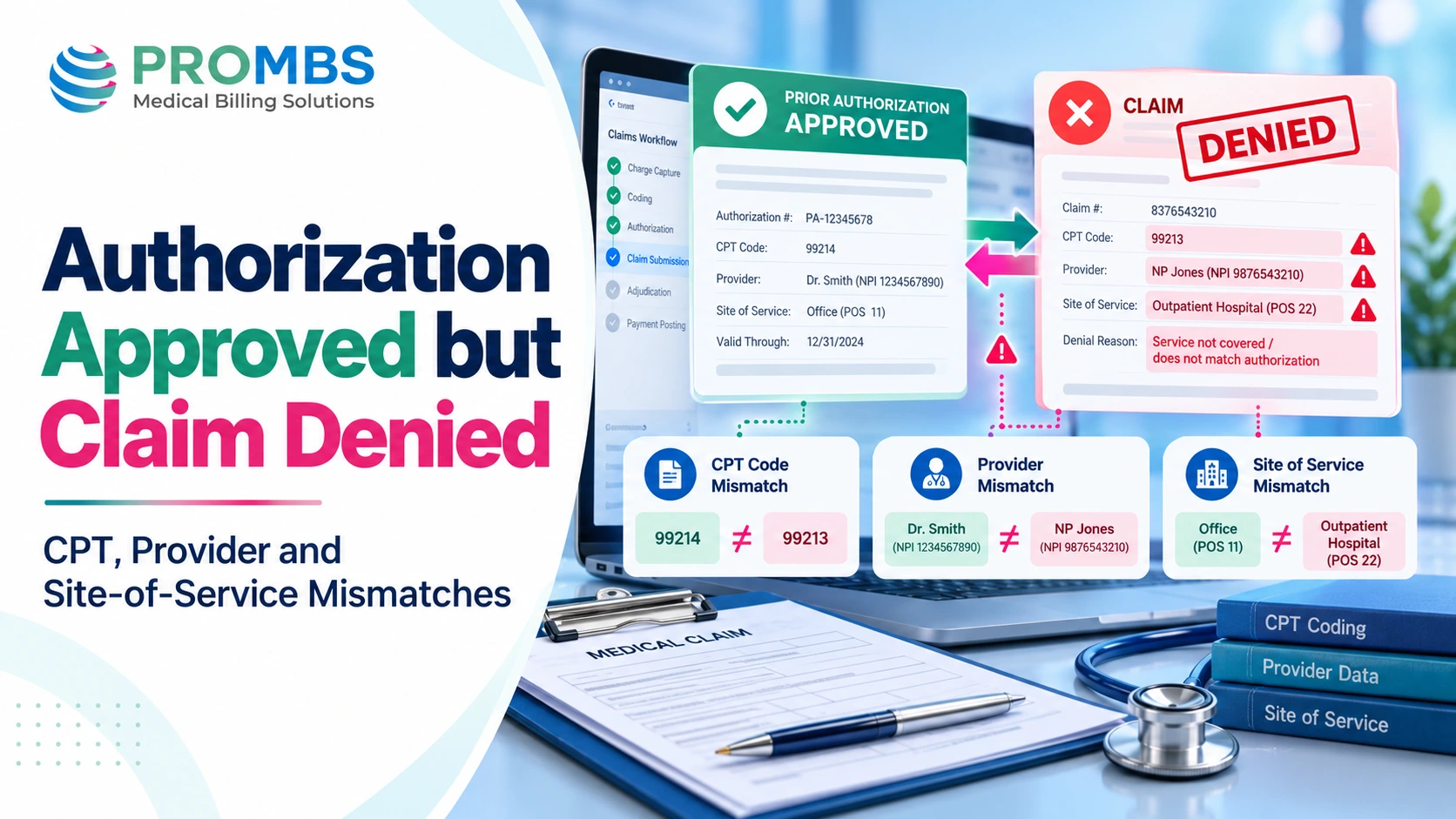
Your medical practice obtains prior authorization for a procedure, receives an approval number, and schedules the patient for treatment. The service is completed, the claim is submitted, and everything appears to be in order.
Then the insurance company denies the claim.
For billing teams, this can be particularly frustrating because the payer already approved the service before it was performed. Yet an approved authorization does not always mean the final claim meets every requirement for payment.
The problem often comes down to a difference between what the insurance company approved and what the practice ultimately billed.
The CPT code may have changed, a different physician may have performed the procedure, or the patient may have received treatment at another facility.
Understanding these differences helps medical practices identify the actual reason for a denial, challenge incorrect payer decisions, and prevent avoidable reimbursement delays.
Why Can a Claim Be Denied After Prior Authorization Is Approved?
A claim can be denied after prior authorization approval when the service billed does not match the approved procedure, rendering provider, facility, dates, or other authorization conditions. Claims can also be denied for separate coverage, coding, or eligibility reasons.
In medical billing, the situation is often described as “authorization approved but claim denied.” It means the practice has evidence of advance approval, but the submitted claim has not received the expected payment.
Prior authorization and claim processing are two separate stages of the revenue cycle.
During authorization, the payer reviews the requested service and determines whether it meets the applicable approval criteria.
During claim processing, the payer evaluates the service actually billed, the provider information, the patient’s coverage, the supporting documentation, and other payment requirements.
Consider a patient scheduled for an imaging procedure.
The insurance company approves the original request. However, before the appointment, the physician changes the order to a different study based on updated clinical findings.
The imaging center performs the revised study and bills the appropriate CPT code.
If the authorization was never updated to reflect that change, the payer may deny the claim because the approved procedure and billed procedure do not match.
The medical service may have been appropriate, and the claim may accurately reflect the treatment provided. The problem is that the approval record does not necessarily cover the revised service.
This is why prior authorization management should include reviewing the approved details against the final service, not simply recording the authorization number.
Does Prior Authorization Guarantee Insurance Payment?
No. Prior authorization generally confirms approval for a requested service under specific conditions, but it does not automatically guarantee claim payment.
For example, a service may be approved while the patient has active insurance coverage. If the patient’s coverage changes before the service date, the claim may require a different eligibility or benefit determination.
Similarly, an authorization for one provider or facility may not automatically apply to another provider or treatment location.
Health insurers also distinguish authorization decisions from other claim requirements.
Aetna’s precertification guidance, for example, explains that authorization requirements and coverage decisions depend on the applicable plan, services, and contractual arrangements.
However, an approved authorization should never be ignored when investigating a denial.
Certain Medicare Advantage rules and other applicable protections can limit when a payer may reverse a previously approved medical necessity determination. Billing teams should therefore examine the approval, denial reason, plan rules, and governing requirements before accepting a denial as valid.
The practical question is not simply whether authorization was approved.
It is whether the authorization covered the service as performed and whether the payer has a valid reason to withhold payment.
CPT and HCPCS Code Mismatches Between Approval and Claim
A CPT or HCPCS mismatch occurs when the procedure reported on the insurance claim differs from the service recorded in the prior authorization approval.
This is particularly relevant for surgical procedures, diagnostic imaging, interventional treatments, and other services where the final clinical approach may differ from the original plan.
When the Approved Procedure Differs From the Performed Procedure
Consider a patient who receives authorization for an MRI without contrast.
After further clinical evaluation, the physician determines that an MRI with and without contrast is appropriate instead.
The radiology department performs the updated study and submits the correct claim based on the actual service.
However, the authorization still reflects the original imaging procedure.
Depending on the payer’s rules and the specific approval, the difference may trigger an authorization mismatch denial.
The problem is not necessarily that the claim was coded incorrectly. The final code may accurately describe the performed service.
Instead, the approval may need to be reviewed or updated to cover the revised procedure.
Practices should never change the CPT code merely to match an existing authorization when doing so would misrepresent the service actually performed.
Additional Procedures and Units Can Create Problems
CPT mismatches are not limited to entirely different procedures.
They can also involve additional services, changes in treatment scope, or units exceeding the approved quantity.
For example, a payer may authorize a defined number of therapy visits or treatment units. If the practice exceeds that amount without obtaining any required additional approval, subsequent claims may be denied.
Similar problems can develop when a surgeon performs an additional procedure that was not included in the original authorization.
Whether an amendment is required depends on the payer’s policy, the specific service, and the circumstances of the change.
Billing teams should therefore review the authorization against the completed procedure report before releasing a claim.
Rendering Provider, NPI and Facility Mismatches
An approved authorization may also be connected to a specific healthcare provider, medical group, or facility.
If the information on the submitted claim differs from the authorization record, the payer may be unable to match the claim to its approval.
Rendering Provider NPI Does Not Match
The National Provider Identifier (NPI) is a unique identification number assigned to healthcare providers in the United States.
Providers and organizations may have different roles in medical claims, including rendering, billing, referring, and ordering providers.
These distinctions matter because an authorization may identify the professional expected to perform the service.
For example, a medical practice receives approval for a procedure to be performed by Dr. Smith.
Before the appointment, Dr. Smith becomes unavailable, and Dr. Jones performs the procedure instead.
The claim correctly identifies Dr. Jones as the rendering provider. However, the original authorization remains associated with Dr. Smith.
Depending on the payer’s requirements, the claim may be denied because the approved provider information differs from the actual rendering provider.
The correct response is to review whether the authorization applies to the replacement provider and whether the payer requires an update.
It would be inappropriate to change the rendering provider on the claim simply to match the authorization when another provider actually performed the service.
Billing Provider and Group Information May Also Matter
Some authorization-related claim problems involve the billing organization’s NPI, tax identification number, or contracted provider group rather than the individual rendering physician.
For example, a physician may practice at multiple locations or under different organizational arrangements.
An authorization issued under one group may not automatically apply to a claim submitted under another.
A provider can also have an active NPI without being correctly enrolled, credentialed, or linked to the patient’s specific insurance network.
These are separate issues that billing teams must investigate rather than assuming an NPI match resolves every provider-related denial.
The CMS provider and assignment guidance explains the importance of correctly reporting provider information on professional claims.
Site-of-Service Changes That Trigger Claim Denials
A site-of-service mismatch occurs when the treatment location or setting differs from the information approved by the insurance company.
These problems commonly affect procedures that can be performed in different healthcare settings.
For example, a procedure may be scheduled and authorized at an ambulatory surgical center but later moved to a hospital outpatient department.
The clinical procedure may remain unchanged, but the setting, facility identity, authorization requirements, and reimbursement arrangements can differ.
If the authorization was issued for the original location, the claim may require additional review before payment.
Why Place-of-Service Codes Matter
The Centers for Medicare & Medicaid Services maintains standardized place-of-service codes used on professional healthcare claims.
Examples include:
| POS code | Healthcare setting |
|---|---|
| 11 | Physician office |
| 22 | On-campus outpatient hospital |
| 24 | Ambulatory surgical center |
These codes describe where the professional service was performed.
The official CMS Place of Service Code Set provides the applicable definitions.
However, the place-of-service code and the specific authorized facility are not the same thing.
A claim may report the correct POS code but still have an authorization issue because the payer approved a different facility.
Likewise, an approved facility does not justify reporting an incorrect POS code.
Practices experiencing recurring place-of-service billing errors should review both the actual treatment location and the payer’s authorization requirements.
How Authorization Mismatches Affect Reimbursement and Accounts Receivable
When a claim is denied despite prior authorization, the financial impact extends beyond the delayed payment.
Billing staff must investigate the denial, retrieve authorization records, communicate with the payer, and determine whether the claim needs correction, reconsideration, or an appeal.
This creates additional administrative work for services that have already been provided.
Delayed Collections and Growing A/R
Authorization mismatch denials can leave otherwise payable claims unresolved for extended periods.
If the practice does not have a structured follow-up process, the affected balances may move into older accounts receivable categories.
This can make monthly collections less predictable, particularly for practices that rely on reimbursement from high-value procedures.
Increased Risk of Missed Appeal Deadlines
Every denial requires timely investigation.
Payers have different requirements for corrected claims, reconsiderations, authorization updates, and formal appeals.
If the billing team spends too much time determining which department is responsible for the issue, the practice may lose valuable time within an applicable filing or appeal window.
An approved authorization can provide important supporting evidence, but it does not eliminate the need to follow the correct dispute process.
Repeated Denials Point to a Workflow Problem
When the same authorization mismatch appears repeatedly, the problem may begin before the claim reaches the billing department.
For example, the scheduling team may change a procedure location without notifying the authorization specialist.
Alternatively, a procedure may change after the original approval, but no one checks whether the authorization must be updated.
These situations show why authorization, scheduling, clinical documentation, coding, and billing cannot operate independently.
A stronger process connects the original approval to the final service and checks for differences before the claim is submitted.
How to Compare an Approved Authorization With a Denied Claim
When an insurance company denies a claim despite an existing authorization, the first step is to compare what the payer approved with what the medical practice actually submitted.
Billing teams sometimes respond by calling the payer and providing the authorization number again. That may resolve a claim where the number was missing or entered incorrectly, but it will not necessarily fix a mismatch involving the procedure, provider, or treatment location.
The investigation should begin with three records: the original authorization approval, the clinical documentation describing the service performed, and the denied claim.
Start by reviewing the Explanation of Benefits (EOB) or Electronic Remittance Advice (ERA) to understand why the claim was denied.
The Centers for Medicare & Medicaid Services explains that remittance advice uses Claim Adjustment Reason Codes (CARCs) and Remittance Advice Remark Codes (RARCs) to communicate payment adjustments and related explanations.
These codes help identify the issue, but staff may still need to contact the payer to confirm which authorization field failed validation.
What Information Should the Billing Team Compare?
A practical authorization-to-claim review should include the following details.
| Information | What to verify |
|---|---|
| Patient and insurance | Member ID, payer, and applicable health plan |
| CPT/HCPCS codes | Approved services compared with actual billed procedures |
| Provider details | Rendering provider NPI, billing group, and applicable provider affiliations |
| Facility information | Approved facility compared with actual treatment location |
| Place of service | Correct POS code and any payer-specific site requirements |
| Authorization period | Approved dates compared with the actual date of service |
| Units or visits | Approved quantity compared with the amount billed |
If the records do not match, the next step is identifying whether the claim contains an error or the authorization needs further review.
For example, cases labeled “authorization approved claim denied” may initially appear to involve missing authorization. A closer investigation could reveal that the approval exists but is associated with a different facility.
Finding the specific mismatch prevents unnecessary claim resubmissions and helps the team choose the correct resolution process.
Correcting CPT, Modifier and Procedure Changes
CPT and HCPCS code mismatches require careful investigation because the service that was authorized may differ from the service ultimately performed.
The first question is whether the submitted claim accurately represents the treatment documented in the patient’s medical record.
When the Claim Contains an Incorrect CPT Code
If the billing team selected the wrong procedure code, qualified coding staff should review the documentation and identify the appropriate correction.
A corrected claim may be necessary when the original submission did not accurately describe the service performed.
However, coding changes must be supported by clinical documentation and applicable coding guidance.
The practice should never substitute the authorized procedure code for the actual procedure code simply to secure payment.
When the Procedure Changed After Authorization
Sometimes, the original CPT code was correct when authorization was requested, but the physician later performed a different procedure.
For example, a patient may be scheduled for one outpatient treatment but require a different intervention after further clinical evaluation.
The final claim must reflect the actual service provided.
In this situation, the authorization specialist should determine whether the payer allows the approval to be amended or requires another authorization request.
These rules vary by insurer.
For example, Priority Health’s current authorization change guidance allows certain changes to dates, units, providers, or facilities on existing medical authorizations, but requires a new authorization when procedure or diagnosis codes must be added or updated.
This is a payer-specific example, not a universal rule.
Other insurers may apply different requirements, including restrictions on changes requested after treatment.
Can an Incorrect Modifier Cause an Authorization Denial?
Yes, a modifier-related coding issue can contribute to a denial, although the modifier itself is not always part of the authorization approval.
Certain modifiers describe important circumstances, such as a distinct procedural service, laterality, or another characteristic of the treatment.
If a modifier is missing or incorrect, the claim may fail a coding edit or payer review.
The billing team should determine whether the denial truly involves authorization or whether it is a separate coding issue.
An incorrect modifier should be corrected only when supported by the medical record and relevant payer rules.
Resolving Provider NPI and Site-of-Service Mismatches
A medical procedure can be accurately coded and still be denied when the provider or facility listed on the claim differs from the authorization record.
These discrepancies often begin during scheduling changes, provider substitutions, or facility transfers.
What If a Different Physician Performs the Authorized Procedure?
Consider a patient whose procedure was authorized under one physician but performed by another physician within the same medical group.
The billing team should first verify that the claim correctly identifies the professional who performed the service.
Next, the authorization specialist should determine whether the payer’s approval was attached to an individual rendering provider, a group, or another participating entity.
If the authorization requires a provider-specific update, the practice should contact the payer and follow the applicable process.
Do not alter the rendering NPI to match the approval if doing so would incorrectly identify who performed the service.
The investigation should also confirm that the actual provider was appropriately enrolled or recognized under the patient’s insurance plan.
An authorization mismatch and a credentialing problem may produce similar payment difficulties, but they require different solutions.
How to Fix an Approved Facility or Site-of-Service Mismatch
A site-of-service mismatch usually begins when a procedure is moved from one facility to another without confirming whether the existing authorization remains valid.
For example, a procedure originally approved at an ambulatory surgical center may be performed at a hospital outpatient department.
Both locations may provide outpatient treatment, but they have different facility identities, billing arrangements, and place-of-service classifications.
According to the CMS Place of Service Code Set, POS 22 identifies an on-campus outpatient hospital, while POS 24 identifies an ambulatory surgical center.
The practice should verify two separate items:
- Whether the claim correctly identifies where the patient actually received treatment.
- Whether the authorization applies to that facility and setting.
If the facility changed, contact the payer to determine whether an authorization amendment is available or another resolution is required.
A correct POS code does not automatically mean the treatment location was authorized.
Similarly, an authorization for a particular facility does not justify reporting a different location on the claim.
Practices with recurring discrepancies should examine their prior authorization and verification workflow to ensure scheduling changes are communicated before services are performed.
Checking Authorization Dates, Units and Coverage Changes
Not every claim denied after approval involves a CPT code or provider mismatch.
Some denials occur because the service date, authorized quantity, or patient’s insurance information differs from the original approval.
Authorization Effective Dates
Every authorization has an applicable period or scope of approval.
A procedure performed outside its approved dates may require additional authorization review.
For example, a patient receives approval for treatment during a specified period. The appointment is postponed, but the authorization specialist is not informed.
When the procedure eventually takes place, the original approval may no longer cover the service date.
The billing team should verify whether the approval was extended or whether another valid authorization exists.
Approved Units and Treatment Visits
Authorization may also be limited to a particular number of visits, units, or treatment sessions.
Suppose a patient receives approval for six therapy visits, but the practice submits a claim for a seventh visit without confirming whether additional authorization is required.
Depending on the plan’s rules, the claim may be denied because the approved quantity has been exceeded.
Practices should track authorization usage throughout treatment rather than waiting until the final claim is submitted.
Changes in Patient Insurance Coverage
An authorization issued by one insurer may not apply after a patient changes insurance plans.
Even when the physician and treatment remain the same, the new payer may have different authorization requirements.
Verifying eligibility and benefits before treatment helps identify these changes.
It is also important to distinguish between a mismatch denial and a genuine coverage issue. Updating an authorization number will not resolve a claim when the patient’s plan did not cover the service on the date it was performed.
When to Correct, Resubmit or Appeal a Denied Claim
Not every authorization-related denial should be handled through the same process.
The correct response depends on whether the error is in the claim, the authorization record, or the payer’s decision.
When a Corrected Claim Is Appropriate
A corrected claim may be appropriate when the submitted claim contains an actual billing error.
Examples include an incorrect authorization number, unsupported or inaccurate coding, or a mistake in the reported provider or service location.
Before correcting the claim, confirm the documentation and follow the payer’s replacement claim instructions.
Repeatedly submitting identical claims without addressing the underlying issue can create duplicate processing problems.
When to Request Authorization Review
An authorization review may be necessary when the claim accurately reflects the treatment but the approval contains outdated information.
The billing team should contact the payer to determine whether an amendment, administrative review, or another permitted process is available.
An insurer is not necessarily required to backdate or retroactively change an approval.
The practice must follow the applicable requirements and preserve records of the original request, approval, and subsequent changes.
When a Formal Appeal Is the Better Option
A formal appeal may be appropriate when the claim and authorization are consistent, but the payer still refuses payment.
For example, the payer may deny a service as unauthorized even though its records show approval for the same patient, procedure, provider, location, and treatment date.
The appeal should clearly identify the denial reason and include relevant evidence:
- Original authorization approval and reference number.
- Denied claim and remittance details.
- Medical records supporting the performed service.
- Documentation of applicable authorization changes.
- Relevant payer policy or contractual provisions.
Practices should verify the correct appeal route and deadline rather than assuming every payer follows the same process.
Important Medicare Advantage Protection
A previously approved service deserves additional attention when a Medicare Advantage plan later denies it based on medical necessity.
Under 42 CFR § 422.138(c), a Medicare Advantage organization generally cannot later deny coverage for a previously approved covered item or service solely because it determines the service was not medically necessary, subject to specified reopening exceptions.
This protection does not automatically resolve unrelated claim errors, coverage limitations, or services outside the scope of the original approval.
However, it is an important consideration when investigating a denial based on medical necessity after an approval covering the service.
For an authorization approved claim denied case involving Medicare Advantage, billing teams should examine the original determination and the precise reason for denial before deciding whether to correct, dispute, or appeal the claim.
Pre-Submission Checks That Prevent Authorization Mismatches
The most reliable way to reduce these denials is to compare the final service information against the authorization before submitting the claim.
This review should occur after clinical documentation and coding are complete, particularly when the treatment plan changed after approval.
A practical workflow includes confirming that the authorization is linked to the correct patient and plan, the approved procedure matches the documented treatment, and the provider and facility information are accurate.
The team should also review service dates, authorized units, and relevant payer requirements.
If a discrepancy is discovered, the claim should be routed to the appropriate staff member for investigation rather than released automatically.
Connect Scheduling, Authorization and Billing Teams
Many preventable mismatches originate because different departments work with different versions of the same treatment information.
The scheduling team may know the procedure location changed, but the authorization team may still have the original facility on record.
Similarly, the physician may update a treatment plan without notifying the staff responsible for obtaining authorization.
A better workflow ensures that material changes trigger an authorization review before the claim is released.
Billing teams should also document the outcome of each review, including payer confirmation numbers and any updated approval details.
This creates a clearer record when questions arise later.
Monitor Repeated Authorization Mismatch Denials
Practices should not treat every denial as an isolated incident.
If a particular provider, facility, or procedure generates repeated authorization discrepancies, management should investigate the process responsible for the recurring problem.
For example, frequent facility mismatch denials may indicate that scheduling changes are not reaching the authorization department.
Repeated CPT mismatches may point to missing communication between physicians, coders, and authorization specialists.
A structured denial management process can help practices identify these patterns and prevent the same issues from continuing.
Fixing the individual claim helps recover payment. Fixing the workflow helps prevent the next denial.
How to Prevent Claims From Being Denied After Authorization Approval
Preventing authorization-related denials requires more than obtaining approval before a procedure. Medical practices must also confirm that the approved information matches the service ultimately performed and billed.
A valid authorization number is only one part of that process.
For example, a practice may obtain authorization for a surgical procedure at a particular facility. If the patient is later transferred to another location, the original approval may need to be reviewed or updated before treatment, depending on the payer’s requirements.
The most effective prevention strategy is to connect authorization tracking with scheduling, clinical documentation, coding, and claim submission.
Verify Authorization Details Before the Service
Before a scheduled procedure, the authorization team should confirm the approved CPT or HCPCS codes, rendering provider, facility, service dates, and authorized units.
Any changes should be reviewed against the payer’s requirements.
If the treatment plan changes, staff should determine whether the existing approval remains applicable or whether an amendment or new request is necessary.
This is particularly important for imaging centers, outpatient surgical facilities, specialty practices, and other providers where procedures and treatment locations frequently change.
Perform a Final Authorization-to-Claim Review
Even when the original approval was accurate, the final claim may contain different information.
Practices should compare the completed clinical documentation with the authorization record before releasing claims that require approval.
This review should confirm that the billed procedure matches the service performed and that provider and location information is accurate.
When discrepancies are identified, the billing team should investigate them rather than changing otherwise accurate claim information simply to match the authorization.
Maintain Clear Authorization Records
Every approval should be stored in a location accessible to authorized billing staff.
The record should include the authorization number, approved services, provider and facility information, effective dates, applicable limits, and any amendments.
If the payer provides additional instructions by telephone or through its portal, staff should document the reference number, date, and relevant details.
Accurate records make it easier to investigate denials and demonstrate what the insurer originally approved.
What Should an Authorization-to-Claim Audit Include?
An authorization-to-claim audit examines whether approved services were accurately reflected in the claims submitted to insurance companies.
Unlike a general denial audit, it focuses specifically on discrepancies between payer approval records and the final billing information.
A review of “authorization approved claim denied” cases should determine whether the denial resulted from a claim error, an outdated authorization, or an incorrect payer decision.
Review Approval and Claim Records
The audit should compare authorization information with the actual clinical service and submitted claim.
| Audit area | What the billing team should examine |
|---|---|
| CPT/HCPCS codes | Whether the authorized and performed procedures match |
| Provider information | Rendering NPI, billing group, and applicable payer enrollment |
| Facility and POS | Approved facility, actual service location, and reported POS code |
| Authorization validity | Effective dates, approved units, and any changes |
| Denial documentation | Payer adjustment codes, approval records, and previous follow-up |
Not every difference automatically makes a claim invalid. The team must determine whether the payer requires an exact match or permits a particular variation.
Identify Repeated Denial Patterns
An effective audit should also examine whether similar mismatches occur across several claims.
For example, repeated facility-related denials may indicate that scheduling changes are not being communicated to the authorization department.
Frequent CPT mismatches may suggest that treatment plans are being updated without a corresponding authorization review.
By identifying these patterns, practices can correct workflow problems rather than repeatedly resolving individual denials.
Separate Administrative Errors From Disputed Denials
A claim denied because an authorization number was entered incorrectly requires a different response from one denied despite an applicable approval.
The first may need a corrected claim or administrative adjustment.
The second may require a formal dispute supported by the original authorization and applicable payer rules.
A structured medical billing and coding audit can help practices identify these differences, assess billing accuracy, and prioritize appropriate corrective action.
Tracking Authorization Denials and Aging Accounts Receivable
A claim denied after authorization approval can remain in accounts receivable while the billing team investigates what happened.
When several claims are affected, these delays can create a noticeable gap between services provided and payments collected.
For example, suppose a practice has 15 authorization-related denied claims with an estimated allowable reimbursement of $1,200 each.
That represents $18,000 in potentially collectible reimbursement awaiting resolution.
This is an illustrative example, not a guaranteed recovery amount. Actual collections depend on coverage, contractual allowances, documentation, payer decisions, and appeal eligibility.
The longer these claims remain unresolved, the more important it becomes to monitor deadlines and assign clear ownership.
Prioritize Denied Claims by Deadline and Recovery Potential
Billing teams should not rely exclusively on the dollar amount of a denied claim when deciding which account to review first.
A smaller claim approaching its appeal deadline may require more immediate action than a higher-value claim with sufficient time remaining.
An effective A/R follow-up process considers:
- The payer’s correction, reconsideration, or appeal deadline.
- The claim’s current age and denial reason.
- Whether the authorization and clinical records support payment.
- The potential reimbursement and effort required for resolution.
- Whether previous follow-up or a formal dispute is already pending.
Every denied claim should have a documented next action and a responsible staff member.
It is also important to distinguish payer deadlines. For example, CMS Medicare Advantage reconsideration guidance generally allows 65 calendar days from the notice of an adverse organization determination to request an enrollee reconsideration. That deadline should not automatically be applied to every provider payment dispute or commercial insurance claim.
Measure More Than the Total Denial Rate
Practices should track authorization-related denials separately from coding, eligibility, and medical necessity denials.
Useful metrics include the authorization mismatch denial rate, percentage of denials successfully resolved, days required for resolution, and outstanding authorization-related A/R.
The practice should also monitor repeat denials involving the same providers, facilities, or procedures.
These measurements help administrators understand whether process improvements are actually reducing payment delays.
A falling denial count may indicate progress, but leadership should also confirm that collections are improving and unresolved balances are not simply being written off.
How to Recover Payment When the Authorization Was Valid
Sometimes, the clinical service, provider, facility, and treatment dates all match the original approval, yet the insurer still denies the claim.
In these situations, billing teams should request clarification instead of assuming the denial is correct.
Start with the payer’s explanation and the relevant adjustment codes. The CMS Health Care Payment and Remittance Advice guidance explains how adjustment and remark codes communicate the reasons for claim payment decisions.
If the denial appears inconsistent with the approval, the practice should prepare supporting documentation and follow the appropriate reconsideration or appeal process.
The appeal should identify exactly what the insurer approved, what service was performed, and why the denial appears incorrect.
For Medicare Advantage claims, additional protections may apply. Under 42 CFR § 422.138(c), a Medicare Advantage organization generally cannot later deny coverage solely on medical necessity grounds for a previously approved covered item or service, subject to specified reopening exceptions.
However, this protection does not automatically guarantee payment when the claim involves a different service, incorrect billing information, or another independent coverage issue.
Practices should preserve the original approval and review the applicable regulations when disputing such denials.
An approved authorization is important evidence, but a successful recovery depends on showing that the billed service meets the applicable payment requirements.
How Pro Medical Billing Solutions Helps Resolve Authorization-Related Denials
Managing authorization-related denials requires coordination between several departments. The authorization specialist may have the approval record, the clinical team holds the treatment documentation, and the billing department receives the denial.
When these teams do not share information efficiently, otherwise resolvable claims can remain unpaid.
Pro Medical Billing Solutions (PROMBS) supports healthcare practices through prior authorization, medical coding, denial management, and accounts receivable follow-up.
Through its verification and prior authorization services, PROMBS helps practices manage payer requirements, authorization records, and approval-related workflows.
Its denial management services focus on identifying the reasons claims were denied, reviewing supporting documentation, and pursuing appropriate corrections or appeals.
PROMBS also supports ongoing revenue cycle management, helping practices connect billing accuracy, claim tracking, and payer follow-up.
For practices experiencing recurring CPT, provider, or facility mismatches, the objective is to identify where the process breaks down and make those problems less likely to happen again.
A well-managed authorization process should support accurate claims, clearer accountability, and more predictable reimbursement.
Frequently Asked Questions About Approved Authorization Claim Denials
What does “authorization approved claim denied” mean?
It means an insurer approved a requested service before treatment but later denied the submitted claim. This can happen because the billed CPT code, rendering provider, facility, dates, or other payment requirements do not match the approval or the applicable plan rules.
Can insurance deny a claim after prior authorization approval?
Yes. An approved authorization does not automatically guarantee payment. However, insurers must follow applicable coverage rules, contracts, and legal protections. Certain Medicare Advantage medical necessity denials are restricted after a covered service has already received approval.
What happens if the CPT code does not match the authorization?
The payer may deny the claim if the billed procedure differs from the authorized service. The practice should verify that the claim accurately reflects the treatment performed, then determine whether the authorization can be updated or another resolution is available.
The CPT code should never be changed solely to match the approval if the change would misrepresent the actual service.
Can a different rendering provider cause an authorization denial?
Yes. Some payers issue authorizations linked to a specific rendering provider, medical group, or facility.
If another provider performs the service, the billing team should verify whether the original authorization remains valid or requires an update.
Can an authorization be changed after a procedure?
Some insurers allow certain authorization changes after treatment, while others restrict amendments or require requests before the service.
The availability of a correction depends on the payer’s policy, the nature of the change, and any applicable regulatory requirements. Retroactive approval should never be assumed.
Should a practice resubmit or appeal a claim denied after authorization?
If the original claim contains an actual billing error, a corrected claim may be appropriate.
If the claim accurately reflects the authorized service and the payer appears to have made an incorrect determination, reconsideration or a formal appeal may be necessary.
The billing team should review the denial reason and follow the payer’s specific instructions before choosing either approach.
Identify Authorization Gaps Before They Affect Your Revenue
Obtaining prior authorization is an important step in the medical billing process, but it is not the end of the responsibility.
A claim can still be denied when the approved procedure, provider, facility, or treatment details do not match the final billing record.
These denials can delay reimbursement, increase administrative work, and leave otherwise collectible revenue in accounts receivable.
Medical practices can reduce these problems by reviewing authorization details before treatment, comparing final claims with approvals, and investigating recurring denial patterns.
When an approved authorization and denied claim appear inconsistent, identifying the precise reason is the first step toward an appropriate resolution.