

Choosing an urgent care billing company isn’t just a back-office decision. The wrong fit can leave staff correcting eligibility errors, tracking missing charges, answering confused patients, and chasing claims that should have been paid weeks ago.
The best choice depends on what your clinic needs. Pro Medical Billing Solutions, or ProMBS, is our top overall option for centers that want full-service billing, specialty coding, old A/R recovery, and compatibility with an existing EHR. Experity stands out for an urgent-care-specific technology ecosystem. AdvancedMD Medical Billing, athenahealth, and NextGen may fit practices already using their platforms.
This guide compares 15 urgent care billing companies by specialization, workflow coverage, integration, scalability, and pricing transparency. It also shows you what to verify before trusting a vendor with your revenue cycle.
Editorial disclosure: ProMBS publishes this article and is included in the ranking. We place ProMBS first based on the criteria described below and publicly available service information. Vendor claims, including our own, should be confirmed through a written proposal, sample reports, references, and contract review.
The Best Urgent Care Billing Companies at a Glance
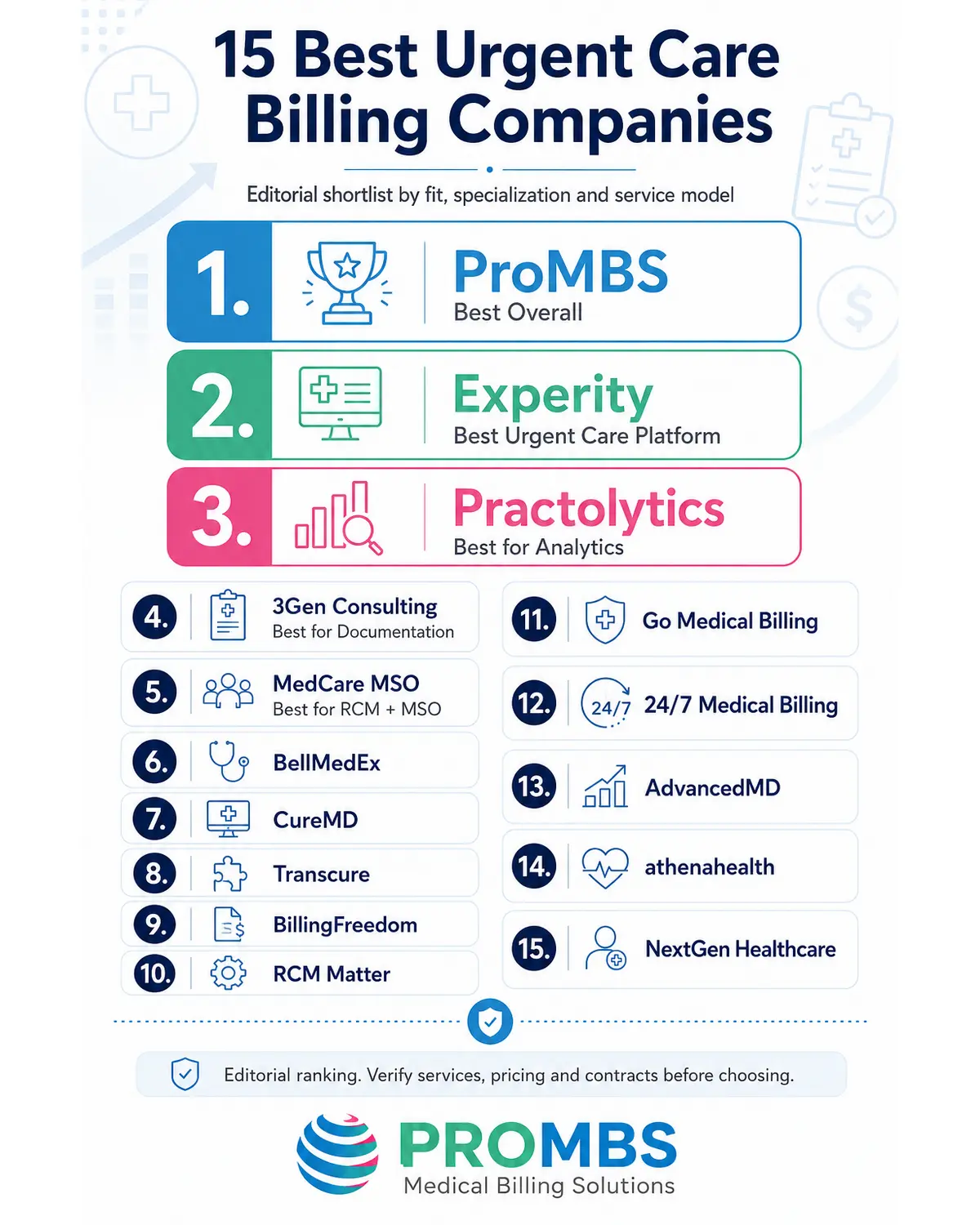
| Rank | Company | Editorial score | Best fit | Service model | Pricing visibility |
|---|---|---|---|---|---|
| 1 | ProMBS | 4.9/5 | Best overall for independent and multi-site urgent care | Full-service outsourced RCM | Starts at 2.49% of monthly collections; scope affects price |
| 2 | Experity | 4.8/5 | Clinics wanting an urgent-care-specific platform and RCM | Integrated urgent care software and billing | Custom quote |
| 3 | Practolytics | 4.7/5 | High-volume and multi-location organizations | Full-service RCM with analytics | Percentage-based or custom quote |
| 4 | 3Gen Consulting | 4.6/5 | Groups needing coding, documentation, and workflow depth | RCM, coding, consulting, and automation | Custom quote |
| 5 | MedCare MSO | 4.6/5 | Practices needing billing plus credentialing and A/R support | End-to-end RCM and MSO services | Custom quote |
| 6 | BellMedEx | 4.5/5 | Clinics seeking billing, software, clearinghouse, and credentialing options | Managed services plus technology | Custom quote |
| 7 | CureMD | 4.5/5 | Practices that want billing tied to a unified platform | EHR, PM, AI tools, and RCM | Percentage-based or custom quote |
| 8 | Transcure | 4.4/5 | Growing groups with broad coverage and eligibility needs | Full-service RCM with automation | Percentage-based or custom quote |
| 9 | BillingFreedom | 4.3/5 | Independent practices wanting a flexible outsourced team | Billing, coding, A/R, and credentialing | Custom quote |
| 10 | RCM Matter | 4.3/5 | Clinics that want modular services or software support | Modular RCM and billing software | Custom quote |
| 11 | Go Medical Billing | 4.2/5 | Cost-conscious clinics comparing lower starting rates | Full-service medical billing | Publicly advertises a starting percentage |
| 12 | 24/7 Medical Billing Services | 4.1/5 | Clinics prioritizing extended support coverage | Multi-specialty outsourced billing | Custom quote |
| 13 | AdvancedMD Medical Billing | 4.1/5 | Practices already using or considering AdvancedMD Medical Billing | Platform-integrated managed billing | Percentage of collections; custom quote |
| 14 | athenahealth | 4.0/5 | Larger groups seeking network-enabled enterprise RCM | Integrated enterprise platform and RCM | Custom quote |
| 15 | NextGen Healthcare | 4.0/5 | Mid-size and enterprise groups with complex operations | Integrated EHR, PM, and managed RCM | Custom quote |
How We Evaluated Each Company
No public comparison can replace a clinic-specific review. This ranking is a qualitative assessment of company websites and service pages. We gave the most weight to:
- Urgent-care-specific coding and billing knowledge.
- Coverage from eligibility and charge capture through payment posting, denials, patient billing, and A/R.
- Ability to work with common EHR and practice management systems.
- Reporting clarity and access to underlying financial data.
- Support for single-site clinics, seasonal volume changes, and multi-location growth.
- Pricing and contract transparency.
We didn’t treat advertised performance claims as independently verified. Ask how each metric is defined and whether the vendor can show results from a similar urgent care organization.
The scores above are ProMBS editorial fit scores based on these criteria. They are not Google, Trustpilot, or customer-review ratings.
Why Urgent Care Billing Requires More Than General Medical Billing
Urgent care sits between primary care and emergency medicine, but its billing has distinct pressure points. Walk-ins leave little time for advance eligibility checks. One encounter may include an E/M service, X-rays, rapid tests, injections, supplies, or a minor procedure. If the chart closes before every charge is captured, revenue disappears quietly.
The official CMS Place of Service Code Set defines POS 20 as an urgent care facility. The correct claim setup still depends on the organization, location, payer contract, and service. Hospital-owned departments, freestanding centers, telehealth visits, and occupational medicine encounters may follow different rules.
Other pressure points include:
- Real-time eligibility, copay, deductible, and network verification.
- Proper documentation when an E/M service and a procedure occur on the same date.
- Payer-specific handling of S9083, S9088, and standard E/M codes.
- Separate capture of point-of-care tests, drug administration, supplies, and imaging.
- Workers’ compensation and employer-paid occupational health services.
- Patient estimates, self-pay packages, statements, payment plans, and follow-up.
- Short filing windows and rapid denial response across a high claim volume.
In practice, many clinics don’t have one dramatic failure. They have fifty small leaks: a missed test, an eligibility error, a bundled E/M service, a late workers’ compensation form, and growing patient balances.
1. ProMBS – Pro Medical Billing Solutions
★★★★★ 4.9/5 ProMBS editorial fit score
Pro Medical Billing Solutions, or ProMBS, is our top overall choice for urgent care clinics that want full-service revenue cycle support without replacing a working EHR. Its urgent care billing services cover eligibility, charge capture, coding, claim submission, payment posting, denial follow-up, patient billing, reporting, and older A/R recovery.
The company supports single-location practices and multi-site groups. Its urgent-care workflow accounts for episodic visits, same-day procedures, point-of-care tests, payer-specific rules, and high claim volume. ProMBS also offers a free billing review, giving a clinic a way to identify leakage before committing to a transition.
Not Sure Where Urgent Care Revenue Is Getting Stuck?
ProMBS can review eligibility, charge capture, denials, aging A/R, and patient billing to show where delays begin.
Request a Free Urgent Care Billing Review
Standout advantage: End-to-end urgent care billing inside the clinic’s existing EHR or practice management system.
| Category | Details |
|---|---|
| Best for |
|
| Key highlights |
|
| Service model | Full-service outsourced RCM with optional targeted billing support |
| Public pricing | Starts at 2.49% of monthly collections; final pricing depends on volume and scope |
| Consider before choosing | Confirm whether eligibility, patient statements, credentialing, and old A/R are included in the quoted percentage |
2. Experity
★★★★★ 4.8/5 ProMBS editorial fit score
Experity is one of the most urgent-care-specific options in this comparison. Rather than adapting a general medical platform, it combines clinical documentation, practice management, patient engagement, analytics, and RCM around the day-to-day flow of urgent care.
This alignment can reduce duplicate entry and interface gaps between registration, charting, charge capture, and claims. Experity is particularly relevant to multi-location operators that want a standardized technology and billing environment across every center.
Standout advantage: A purpose-built urgent care platform connected directly to managed revenue cycle services.
| Category | Details |
|---|---|
| Best for |
|
| Key highlights |
|
| Service model | Integrated urgent care software and managed RCM |
| Public pricing | Custom quote |
| Consider before choosing | Calculate the combined cost of software, implementation, interfaces, training, RCM, and contract commitments |
3. Practolytics
★★★★★ 4.7/5 ProMBS editorial fit score
Practolytics offers a broad urgent care revenue cycle workflow, including eligibility, coding, claim scrubbing, payment posting, denial management, patient billing, and real-time reporting. Its public materials also indicate compatibility with commonly used systems such as Experity, athenahealth, eClinicalWorks, and AdvancedMD Medical Billing.
The reporting depth makes Practolytics a useful option for groups that need to compare performance by payer, provider, location, or service line. It may be especially valuable when leadership wants consistent billing processes across several centers.
Standout advantage: Full-cycle billing combined with detailed operational and financial visibility.
| Category | Details |
|---|---|
| Best for |
|
| Key highlights |
|
| Service model | Full-service RCM with analytics and practice support |
| Public pricing | Percentage-based pricing language is published; obtain a current custom quote |
| Consider before choosing | Request urgent-care-only performance definitions, comparable client references, and a sample dashboard |
4. 3Gen Consulting
★★★★★ 4.6/5 ProMBS editorial fit score
3Gen Consulting stands out when a clinic’s problems start before claim submission. Its urgent care capabilities include patient access, coding, billing, A/R management, clinical documentation improvement, analytics, credentialing, payer contract review, and workflow automation.
That broader revenue-integrity approach can help groups address missed procedures, weak documentation, inconsistent E/M selection, and recurring denial patterns. It is a strong option for organizations that want to repair the process behind the claims rather than only add billing capacity.
Standout advantage: Deep support for coding, documentation, auditing, and upstream revenue leakage.
| Category | Details |
|---|---|
| Best for |
|
| Key highlights |
|
| Service model | RCM, coding, consulting, revenue integrity, and technology |
| Public pricing | Custom quote |
| Consider before choosing | Confirm whether the proposal covers full RCM, selected services, consulting, technology, or a combination |
5. MedCare MSO
★★★★★ 4.6/5 ProMBS editorial fit score
MedCare MSO offers a wide range of urgent care services, including verification, charge capture, coding, claim submission, payment posting, denials, patient billing, reporting, credentialing, contract support, and older A/R recovery.
The service mix may suit a growing clinic that is adding providers, joining new payer networks, or trying to clean up receivables without interrupting current operations. Its front-end support is also relevant when registration and insurance errors are creating avoidable denials.
Standout advantage: Billing, credentialing, contracting, and A/R support available through one relationship.
| Category | Details |
|---|---|
| Best for |
|
| Key highlights |
|
| Service model | Full-service RCM and broader MSO support |
| Public pricing | Custom quote |
| Consider before choosing | Ask who will be assigned, how much urgent care experience that team has, and how advertised metrics are calculated |
6. BellMedEx
★★★★☆ 4.5/5 ProMBS editorial fit score
BellMedEx combines managed billing with medical coding, audits, credentialing, clearinghouse services, eligibility tools, and EHR or practice management options. Its urgent care materials address walk-in visits, after-hours care, occupational medicine, telemedicine, denials, and patient responsibility.
The broad stack may appeal to a new clinic or a practice that wants to reduce the number of vendors involved in its revenue cycle. It can also provide a path for organizations considering both a billing change and a technology change.
Standout advantage: Billing, clearinghouse, credentialing, audit, and software options under one vendor.
| Category | Details |
|---|---|
| Best for |
|
| Key highlights |
|
| Service model | Managed services combined with billing technology |
| Public pricing | Custom quote |
| Consider before choosing | Separate the cost and scope of software, clearinghouse, credentialing, implementation, and managed billing |
7. CureMD
★★★★☆ 4.5/5 ProMBS editorial fit score
CureMD combines EHR, practice management, patient tools, AI-assisted workflows, credentialing, and managed revenue cycle services. Its urgent care offering focuses on high-volume encounters, diagnostics, after-hours services, claim checks, collections, and continuous support.
The integrated model can make accountability simpler because the clinical software and billing service sit in the same environment. It is most relevant when a practice wants to replace disconnected systems, not merely change its billing team.
Standout advantage: A unified clinical, operational, and billing platform with managed RCM support.
| Category | Details |
|---|---|
| Best for |
|
| Key highlights |
|
| Service model | Unified healthcare platform with managed RCM |
| Public pricing | Percentage-based examples appear in public materials; request a current quote |
| Consider before choosing | Compare the complete platform and implementation cost, then confirm migration and termination assistance |
8. Transcure
★★★★☆ 4.4/5 ProMBS editorial fit score
Transcure promotes a large billing workforce, familiarity with multiple EHR systems, nationwide coverage, automation, and continuous eligibility support. Its urgent care services address E/M downcoding, POS 20, same-day procedures, imaging, labs, injections, and high walk-in volume.
The company may suit a growing organization that needs extra capacity during seasonal demand or across several locations. Its eligibility emphasis is useful because even a strong back-end team cannot fully repair incorrect coverage information collected at check-in.
Standout advantage: Scalable staffing and front-end eligibility support across a broad technology footprint.
| Category | Details |
|---|---|
| Best for |
|
| Key highlights |
|
| Service model | Full-service RCM with automation and large-team delivery |
| Public pricing | Public materials reference percentage-based pricing; obtain a current quote |
| Consider before choosing | Ask whether coders, denial specialists, and account managers are dedicated or pooled, and verify quality-control methods |
9. BillingFreedom
★★★★☆ 4.3/5 ProMBS editorial fit score
BillingFreedom offers medical billing, coding, A/R, denial appeals, eligibility, credentialing, reporting, and virtual support. It also promotes compatibility with common EHR systems, which can reduce disruption for an independent clinic that wants to preserve its current workflow.
Its service menu supports full outsourcing or targeted help. A practice can retain an internal biller while using BillingFreedom for denials, older receivables, eligibility, or credentialing.
Standout advantage: Flexible full-service or targeted support for independent practices.
| Category | Details |
|---|---|
| Best for |
|
| Key highlights |
|
| Service model | Outsourced billing with modular support options |
| Public pricing | Custom quote |
| Consider before choosing | Establish a clinic-specific baseline and clarify minimums, old A/R fees, patient communication, and staffing coverage |
10. RCM Matter
★★★★☆ 4.3/5 ProMBS editorial fit score
RCM Matter provides billing, coding, eligibility, payment posting, patient statements, credentialing, denial management, and A/R follow-up. It also offers CureAR software. Its urgent care page discusses walk-in visits, diagnostic tests, minor procedures, injuries, and vaccines.
The modular service structure may suit a clinic that wants to outsource selected functions instead of replacing its whole revenue cycle. For example, the practice could retain registration and coding while outsourcing claim follow-up and patient statements.
Standout advantage: Modular services for clinics that want to keep part of the revenue cycle in-house.
| Category | Details |
|---|---|
| Best for |
|
| Key highlights |
|
| Service model | Modular RCM services and billing software |
| Public pricing | Custom quote |
| Consider before choosing | Request a complete claim-lifecycle demonstration and sample reports for denials, aging, and patient balances |
11. Go Medical Billing
★★★★☆ 4.2/5 ProMBS editorial fit score
Go Medical Billing promotes a low starting percentage, month-to-month flexibility, and full-service billing without requiring clinics to use a proprietary EHR. Its urgent care content discusses charge capture, eligibility, workers’ compensation, occupational medicine, denials, and A/R.
The offer may appeal to cost-conscious clinics that want to keep their current software. Still, a low percentage only represents good value when coding, appeals, patient billing, and follow-up are included.
Standout advantage: A lower advertised entry price with EHR flexibility and month-to-month positioning.
| Category | Details |
|---|---|
| Best for |
|
| Key highlights |
|
| Service model | Full-service outsourced medical billing |
| Public pricing | Publicly advertises a starting percentage; verify the current rate and inclusions |
| Consider before choosing | Confirm minimums, exclusions, patient billing, credentialing, old A/R, security controls, and urgent care references |
12. 24/7 Medical Billing Services
★★★★☆ 4.1/5 ProMBS editorial fit score
24/7 Medical Billing Services provides claim submission, coding, eligibility, preauthorization, payment posting, denial management, A/R follow-up, audits, and reporting. Its primary differentiator is continuous support across multiple specialties and states.
That availability may be useful for urgent care organizations operating evenings, weekends, or several time zones. The company can also offer more backup coverage than a small internal billing team.
Standout advantage: Extended availability and broad operational coverage.
| Category | Details |
|---|---|
| Best for |
|
| Key highlights |
|
| Service model | Multi-specialty outsourced billing and RCM |
| Public pricing | Custom quote |
| Consider before choosing | Public information is more general than urgent-care-specific, so verify POS 20, same-day services, point-of-care tests, and workers’ compensation experience |
13. AdvancedMD Medical Billing
★★★★☆ 4.1/5 ProMBS editorial fit score
AdvancedMD Medical Billing offers managed billing alongside its EHR, practice management, scheduling, claims, eligibility, patient engagement, analytics, and A/R tools. Its percentage-based RCM service keeps clinical and financial reporting inside the same platform.
The strongest fit is a clinic already using AdvancedMD Medical Billing or planning to consolidate its systems. Real-time data flow may reduce duplicate entry, and the company offers flexibility for practices moving between in-house and outsourced billing.
Standout advantage: Managed billing integrated directly with a widely used practice platform.
| Category | Details |
|---|---|
| Best for |
|
| Key highlights |
|
| Service model | Platform-integrated managed billing |
| Public pricing | Percentage of collections; official materials cite a typical range around 4% to 8% |
| Consider before choosing | Validate the assigned team’s urgent care experience and compare the complete platform cost with an independent urgent care medical billing company |
14. athenahealth
★★★★☆ 4.0/5 ProMBS editorial fit score
athenahealth combines clinical, operational, patient, and revenue cycle tools across a large healthcare network. Its RCM offering can suit multi-site groups that need standardized work queues, payer insight, enterprise reporting, and a platform that can support growth.
The value goes beyond sending claims. Connected data can help an organization identify payer behavior, manage exceptions, and compare results across locations. That breadth may be unnecessary for a small standalone clinic.
Standout advantage: Network-enabled data and enterprise workflow standardization.
| Category | Details |
| Best for |
|
| Key highlights |
|
| Service model | Enterprise platform with integrated RCM |
| Public pricing | Custom quote |
| Consider before choosing | Examine implementation, interfaces, customization, contract terms, and the handling of occupational medicine and local payer rules |
15. NextGen Healthcare
★★★★☆ 4.0/5 ProMBS editorial fit score
NextGen Healthcare offers EHR, practice management, analytics, patient engagement, and managed RCM. It may fit multi-specialty groups, health-system-affiliated clinics, or urgent care networks already using NextGen and seeking a more connected billing operation.
Its enterprise capabilities can centralize work and reporting across sites. The tradeoff is a larger implementation and governance footprint than a standalone billing company.
Standout advantage: Connected RCM for mid-size and enterprise organizations already invested in NextGen.
| Category | Details |
| Best for |
|
| Key highlights |
|
| Service model | Integrated EHR, practice management, and managed RCM |
| Public pricing | Custom quote |
| Consider before choosing | Verify urgent-care-specific staffing, charge-edit feedback, included services, data access, reporting flexibility, and termination support |
Which Company Type Fits Your Urgent Care Clinic?
| Your Situation | Companies To Consider First | Why |
|---|---|---|
| Keep the current EHR and outsource full billing | ProMBS, Practolytics, MedCare MSO, Transcure | Service-led models can work within existing systems |
| Adopt an urgent-care-specific platform | Experity | The clinical and financial environment is purpose-built for urgent care |
| Combine EHR, PM, and managed billing | CureMD, AdvancedMD Medical Billing, athenahealth, NextGen | One vendor can connect clinical and revenue workflows |
| Fix documentation and recurring coding problems | 3Gen Consulting, ProMBS | Stronger focus on audits, coding feedback, and upstream workflow |
| Get targeted A/R or denial help | ProMBS, MedCare MSO, BillingFreedom, RCM Matter | Modular or recovery-focused services are available |
| Support occupational medicine or workers’ compensation | ProMBS, Experity, 3Gen Consulting, BellMedEx | Public materials show attention to non-standard urgent care payer workflows |
Seven Questions to Ask Before Hiring a Billing Company
1. What exactly is included in the fee?
Request a line-by-line scope. Coding, eligibility, appeals, patient calls, statements, credentialing, clearinghouse charges, software, and old A/R may be separate.
2. Can you show urgent-care-only performance?
Ask for first-pass payment, denials, days in A/R, A/R over 90 days, net collection, charge lag, and patient collections. A company-wide average tells you little about your clinic.
For a deeper framework, use these revenue cycle KPIs to standardize the definitions before comparing proposals.
3. How do you handle common urgent care encounters?
Give each vendor the same situations:
- E/M plus laceration repair.
- X-ray with professional and technical components.
- Rapid lab testing and send-out testing.
- Injection with drug and administration charges.
- Workers’ compensation or employer-paid occupational health visit.
- Self-pay patient needing an estimate.
Listen for payer-specific reasoning, documentation needs, and escalation steps. The correct use of Modifier 25 depends on documentation supporting a separately identifiable E/M service.
4. Will you work inside our current system?
Clarify whether the vendor uses your EHR, builds an interface, requires its software, or transfers batches. Ask who pays for and supports interfaces.
5. What will our staff still own?
A common challenge is assuming “full service” means “no internal work.” Someone must still close charts, answer documentation questions, approve refunds, fix registration issues, and coordinate enrollment. Put ownership in writing.
6. How is patient billing handled?
Review statements, calls, payment plans, digital payments, languages, disputes, and financial assistance. Accurate patient insurance verification and a compliant Good Faith Estimate workflow can prevent confusion and bad debt.
7. What happens to our data if we leave?
Address data ownership, exports, transition help, pending claims, report access, and patient balances. Require an appropriate business associate agreement. HHS provides a useful model business associate agreement.
Metrics That Make Vendor Comparisons Fair
| Metric | What It Reveals | What To Clarify |
|---|---|---|
| First-pass payment rate | Claims paid without rejection, denial, or rework | Whether “accepted” is being confused with “paid” |
| Denial rate | Share of claims or dollars denied | Claim-based versus dollar-based calculation |
| Net collection rate | How much collectible revenue is actually collected | Exclusion of contractual adjustments |
| Days in A/R | Speed of reimbursement | Whether patient balances are included |
| A/R over 90 days | Depth of unresolved receivables | Insurance versus patient A/R |
| Charge lag | Time from visit to claim-ready charge | Whether unsigned charts are excluded |
| Appeal overturn rate | Effectiveness of denial recovery | Which denial types and dollars are included |
Use a three- to six-month baseline and set targets by payer and location. Don’t credit improvement created by writing off old balances or removing difficult claims from the denominator.
Common Mistakes When Comparing Urgent Care Billing Outsourcing Companies
When comparing urgent care billing outsourcing companies, remember that the cheapest percentage becomes expensive if it excludes coding, patient billing, or appeals. A sophisticated platform can also disappoint if its workflow doesn’t fit.
Avoid these common mistakes:
- Choosing from a sales demo without speaking to references.
- Comparing clean-claim rates that use different definitions.
- Accepting a guaranteed revenue increase without a documented baseline.
- Ignoring old A/R, credit balances, refunds, and underpayments.
- Failing to review security, data access, and termination support.
- Assuming every payer accepts the same urgent care codes or modifiers.
- Leaving provider documentation outside the improvement plan.
- Switching vendors without a claim-inventory and transition checklist.
Before switching, run a medical billing audit checklist. It gives the new company a clear baseline and exposes enrollment, chart, or registration problems.
Choose the Partner That Can Prove Its Fit
The best medical billing companies for urgent care clinics don’t just send claims. They understand how registration, documentation, coding, payer rules, patient communication, and follow-up affect one another.
Start with the actual problem. A low rate won’t fix weak charge capture. Fragmented software may justify an integrated platform. A clinic keeping its EHR may prefer a service-led partner.
Shortlist three companies. Give each the same scenarios, baseline, and scope. Compare evidence, accountability, total cost, and transition risk.
Turn Your Billing Data Into a Clear Action Plan
ProMBS can review denied claims, aging A/R, eligibility gaps, charge capture, payer follow-up, and patient billing before you commit to a change.
Schedule Your Free Practice Consultation
FAQs About Urgent Care Billing Companies
How much does an urgent care billing company charge?
Many companies charge a percentage of collections. Others use flat, per-provider, per-claim, or enterprise pricing. Public materials show a broad range, often roughly 2.5% to 9%. Confirm whether coding, eligibility, statements, credentialing, software, clearinghouse costs, and old A/R are included.
Should an urgent care clinic outsource medical billing?
Outsourcing can make sense when denials rise, follow-up is inconsistent, turnover hurts claim work, or the clinic lacks specialty coders. In-house billing may fit practices with stable leadership, strong controls, enough volume, and reliable backup coverage.
What should an urgent care billing services company handle?
A full-service urgent care billing services company should support eligibility, coding, charge review, claims, posting, denials, appeals, A/R, patient billing, reporting, and enrollment coordination. Some clinics only need coding or A/R support.
How long does it take to switch billing companies?
A focused transition may take a few weeks. A platform or multi-site migration can take longer. Timing depends on access, interfaces, enrollment, data, chart backlog, and claims in flight. Use a written cutover plan so every claim keeps an owner.