

Understanding the No Surprises Act in 2025
The No Surprises Act 2025 represents one of the most significant healthcare billing reforms in recent history. First enacted in 2022, the law was designed to protect patients from surprise billing, large, unexpected medical charges that arise when patients unknowingly receive care from out-of-network providers or facilities. Such bills created both financial hardship and mistrust […]
Medical Billing Audit Checklist for Providers
In the modern healthcare environment, billing accuracy is no longer just about reimbursement, it’s about compliance, audit readiness, and long-term financial integrity. Even minor errors in coding or documentation can lead to delayed payments, denials, or worse, external investigations. To safeguard against these risks, healthcare providers rely on a medical billing audit checklist. A structured […]
NCCI Edits & MUEs: 2025 Essentials for Coders

In the world of medical billing, even small coding errors can translate into denials, compliance investigations, and revenue leakage. Two of the most important safeguards against improper billing are National Correct Coding Initiative (NCCI) edits and Medically Unlikely Edits (MUEs). Both were developed by the Centers for Medicare & Medicaid Services (CMS), and both directly […]
POS Code Errors: Avoid Billing Denials in 2025
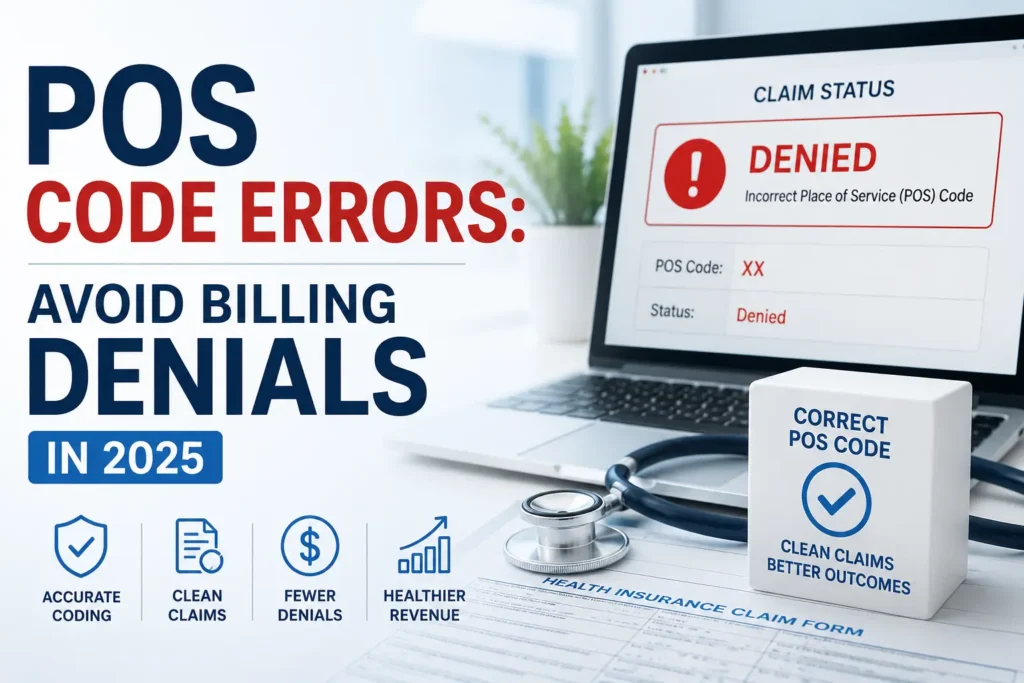
Billing denials are one of the most common and costly challenges for healthcare organizations. While coding mistakes involving CPT and ICD-10 often get the spotlight, POS code errors are an equally significant driver of lost revenue. Place of Service (POS) codes identify where a patient was treated, whether in a physician’s office, inpatient hospital, telehealth […]
ICD 10 Code for Leg Pain (M79.606) | 2025 Billing Guide
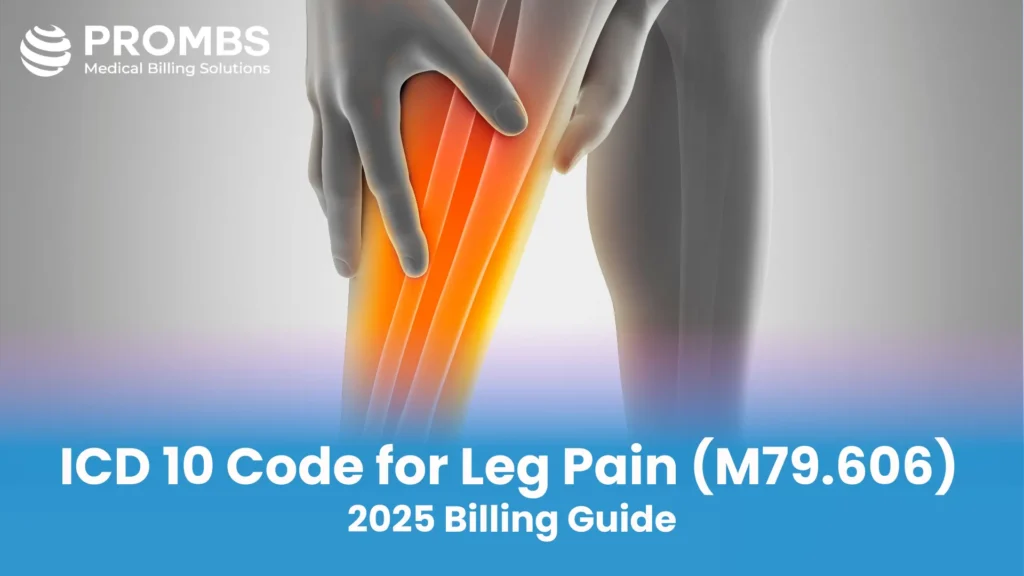
Leg pain is one of the most common complaints in U.S. healthcare, presenting across primary care, orthopedic, neurology, and emergency departments. From a billing and coding perspective, accurately assigning the ICD 10 code for leg pain is crucial for claim approval, payer compliance, and reimbursement integrity. When documentation is vague, coders often struggle between using […]
Denied Claims in Home Health Billing: Causes and Fixes

If your home health agency (HHA) delivers excellent clinical care yet struggles with unpredictable cash flow, the culprit is often avoidable denials. Unlike office-based services, home health billing sits at the intersection of certification rules, clinical assessment instruments, payment groupers, and episode-based timelines. That complexity means home health denied claims rarely stem from a single […]
ICD 10 Code for Headache: Complete Billing Guide 2026

Quick Answer: Head Pain ICD 10 The primary ICD-10-CM code for unspecified headache is R51.9 (Headache, unspecified), used when a precise diagnosis is not documented. For more specific, classified headaches (such as migraines, cluster, or tension), codes in the G43–G44 range are used. R51.0 is used for headaches with an orthostatic component. Common Head Pain ICD-10 Codes R51.9: Headache, unspecified […]
In-House vs. Outsourced Medical Billing

The debate around In-House vs. Outsourced Medical Billing has become one of the most pressing financial decisions for healthcare providers in 2025. With rising administrative costs, payer scrutiny, and complex compliance requirements, practices are under pressure to identify the most cost-effective and sustainable approach to medical billing. This article provides an expert, data-backed comparison of […]
ICD 10 Code for Iron Deficiency Anemia Complete Guide
Quick Answer: Anemia ICD 10 Anemia is primarily coded in ICD-10-CM under category D64 (Other and unspecified anemias) and D50–D53 (Nutritional anemias). The most common code for unspecified anemia is D64.9, while iron deficiency anemia is coded under D50. Specific types require specific codes, such as D50.0 for blood loss and D64.89 for other specified anemias. Key Anemia ICD 10 […]