

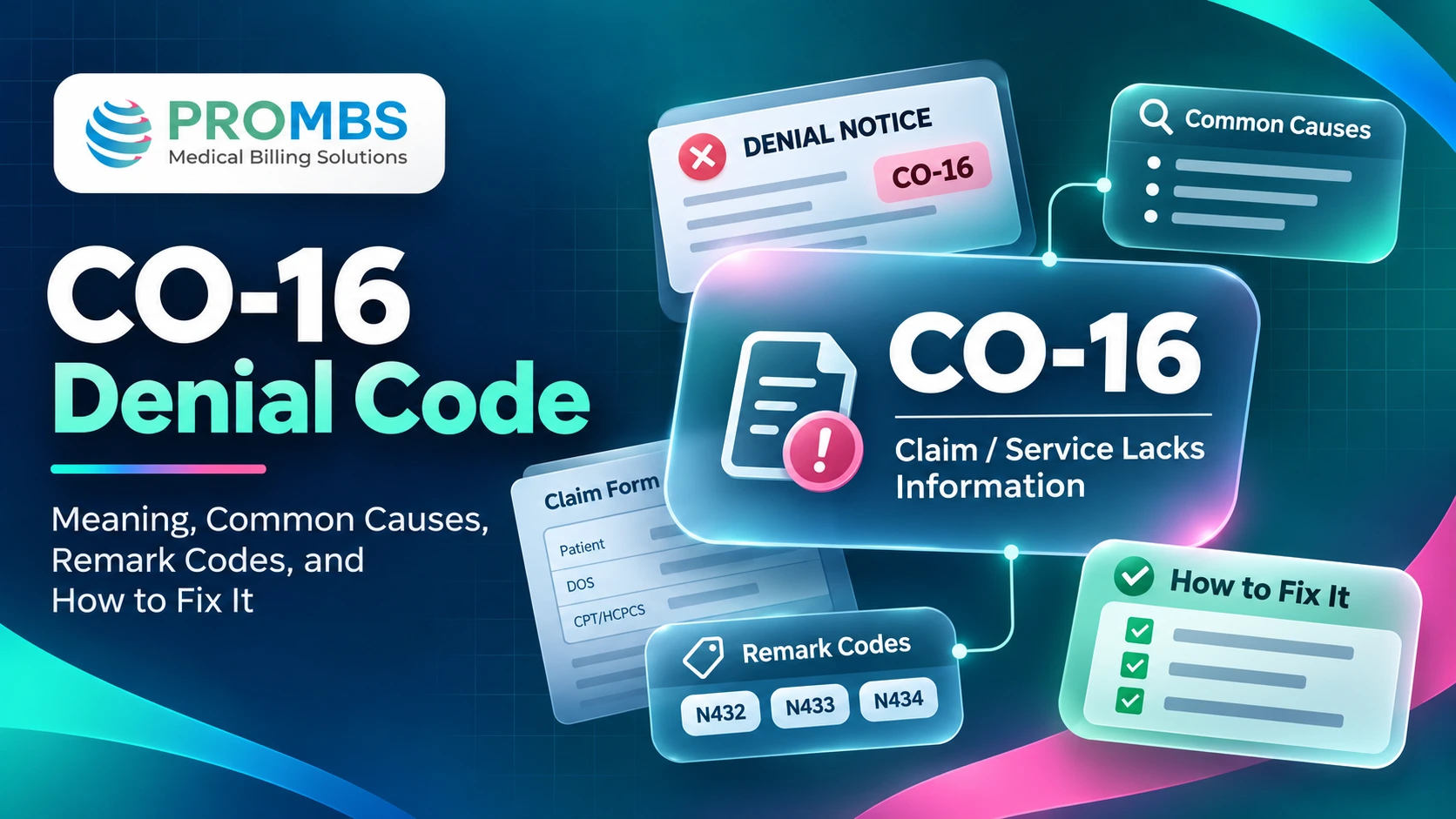
A medical practice submits a claim for services that were properly documented, accurately coded, and provided to an insured patient. The billing team expects the payer to process the claim, but the electronic remittance returns an adjustment identified as CO-16. Payment remains unresolved, and the accounts receivable balance continues aging.
The clinical service may have been appropriate, the patient may have had active coverage, and the provider may have been eligible for reimbursement. Yet the claim contains information that the payer considers missing, invalid, incomplete, or inconsistent.
This is what makes CO-16 particularly frustrating. It does not necessarily indicate that the service was medically unnecessary, excluded from coverage, or improperly performed. Instead, the payer has identified a problem with the information required to process the claim.
According to the official CO-16 denial code definition published by X12, Claim Adjustment Reason Code 16 identifies a claim or service that lacks necessary information or contains submission or billing errors.
However, CO-16 alone does not identify the specific problem.
The accompanying Remittance Advice Remark Code (RARC), or another permitted reject-reason code, provides additional information needed to investigate the adjustment. Without reviewing that information, billing teams risk correcting the wrong field, resubmitting a claim unnecessarily, or creating another denial.
For healthcare practices, the consequences extend beyond an individual unpaid claim. Recurring information errors can increase administrative costs, delay insurance collections, consume A/R follow-up resources, and expose weaknesses in patient registration, coding, provider enrollment, and electronic claim submission.
Understanding what CO-16 means, why it occurs, and how to interpret the corresponding remark code is the foundation of an effective resolution process.
What Is the CO-16 Denial Code in Medical Billing?
CO-16 is commonly used to describe a medical claim adjustment in which the payer identifies missing information or a submission or billing error.
The code combines two different elements:
CO: Contractual Obligation, which is a Claim Adjustment Group Code.
16: A Claim Adjustment Reason Code (CARC) indicating that the claim or service lacks information or contains a submission or billing error.
The standardized CARC 16 definition is maintained by X12, the organization responsible for the healthcare transaction standards used in electronic claims and remittances.
In practical terms, the payer is communicating that some aspect of the claim information needs attention before the relevant payment issue can be resolved.
The affected information may involve patient identification, provider identifiers, procedure codes, dates of service, place of service, or other information required for adjudication.
However, the exact issue must be determined from the accompanying remark code and payer-specific explanation.
Does CO-16 Mean the Claim Was Denied?
CO-16 is commonly described as a denial code, but its precise meaning depends on the payer’s processing status and the remittance.
For example, Medicare contractors may use CO-16 with specific remark codes when a claim is returned as unprocessable because required information is missing or invalid.
An unprocessable claim generally requires correction and submission through the appropriate new-claim process rather than a formal appeal of the unprocessable determination.
A different payer may use CARC 16 in another adjustment scenario, making the associated remittance information essential.
Therefore, the billing team should not assume that every CO-16 response represents the same claim status or requires the same correction method.
The appropriate action depends on whether the payer rejected the claim before adjudication, returned it as unprocessable, or completed another reviewable determination.
What Does CO-16 Mean on an EOB or ERA?
When CO-16 appears on an Explanation of Benefits (EOB) or Electronic Remittance Advice (ERA), it identifies an information-related adjustment.
The most important question is:
Which information does the payer believe is missing, incomplete, or invalid?
For example, a payer may identify a problem involving the rendering provider’s identifier. Another payer may identify an incorrect procedure code or missing service-date information.
Both situations could involve CARC 16, but they require different corrections.
This is why reviewing only the adjustment amount and reason code is insufficient.
The billing team should examine the complete remittance, including any associated RARCs, claim-level details, service-line information, and payer explanations.
CO-16 Is Not a Medical Necessity Determination
An information-related claim error should not automatically be interpreted as evidence that the payer rejected the medical necessity of the service.
A medical necessity denial concerns whether a service satisfies the payer’s applicable clinical coverage requirements.
CO-16 concerns the information or submission details needed to process a claim.
These issues should be investigated separately.
For a detailed explanation of clinical reimbursement disputes, PROMBS also covers medical necessity denial appeals and the evidence providers may need when contesting a payer’s medical necessity determination.
Why CO-16 Must Be Read With a Remark Code
CARC 16 is intentionally broad.
It identifies a category of claim information problems without specifying every possible error.
The official X12 usage instructions require at least one accompanying qualifying remark code or other permitted reject-reason code. An informational RARC marked as an alert does not satisfy that requirement.
A Remittance Advice Remark Code provides more specific information about the issue.
For example, the remark may indicate that the rendering provider identifier is invalid, the procedure code is incomplete, or required service-date information is missing.
The billing team can then investigate the appropriate claim field instead of searching the entire transaction for an unspecified error.
What Is a RARC in Medical Billing?
A Remittance Advice Remark Code is a standardized code used to explain an adjustment or communicate other remittance-processing information.
RARCs are maintained by X12.
Some provide supplemental explanations for claim adjustments. Others convey informational messages.
When investigating a CO-16 adjustment, the relevant supplemental remark code is often the strongest starting point for identifying the specific problem.
Official code descriptions can be reviewed through the X12 Remittance Advice Remark Codes reference.
Common CO-16 Remark Codes
Different remark codes point to different claim deficiencies.
The following examples illustrate how an accompanying RARC can guide the investigation.
| Remark Code | Meaning | Primary Area to Review |
|---|---|---|
| N290 | Missing, incomplete, or invalid rendering provider primary identifier | Rendering provider information |
| N265 | Missing, incomplete, or invalid ordering provider primary identifier | Ordering provider information |
| M51 | Missing, incomplete, or invalid procedure code | CPT/HCPCS reporting |
| M52 | Missing, incomplete, or invalid beginning date of service | Service dates |
| M53 | Missing, incomplete, or invalid days or units of service | Billed units and quantities |
| M77 | Missing, incomplete, invalid, or inappropriate place of service | POS information |
| N288 | Missing, incomplete, or invalid rendering provider taxonomy | Rendering provider taxonomy |
These definitions indicate the area that needs investigation. They do not establish that every payer uses each code in precisely the same combination.
Example: CO-16 With N290
Suppose a cardiology practice submits a claim with the rendering physician’s NPI missing from the required claim location.
The payer returns CO-16 with N290.
The billing team should verify the rendering provider identifier, confirm the information required by the payer, and examine the corresponding fields in the submitted claim.
The appropriate correction may involve an incorrect provider mapping, a missing identifier, or another submission issue.
Simply changing the diagnosis or submitting an appeal addressing medical necessity would not resolve the identified problem.
Example: CO-16 With M51
A medical practice submits a service using a procedure code that is incomplete or invalid for the applicable billing circumstances.
The payer returns CARC 16 with M51.
The billing team should verify the procedure code against the service actually documented and the coding requirements applicable to the date of service.
If the code was entered incorrectly, the claim should be corrected through the payer’s appropriate process.
However, coders should not replace a valid code with an inaccurate alternative merely to obtain payment.
Most Common Causes of CO-16 Denials
CO-16 can arise from several points in the claim creation and submission workflow.
Some problems begin during patient registration, while others originate in provider master data, coding, claim generation, or electronic transaction configuration.
Identifying the source of the problem is important because correcting one account does not necessarily prevent the same error from affecting additional claims.
1. Missing or Incorrect Patient Information
Patient identification errors can interfere with claim processing when required information is missing or does not satisfy the payer’s validation rules.
Potential issues include incorrect member information, invalid identifying details, or data submitted in an inappropriate claim field.
For example, a patient’s insurance information may be entered incorrectly during registration. If that information transfers into the claim without validation, the payer may be unable to process the transaction correctly.
The billing team should compare the submitted claim with the patient’s current insurance information and the payer’s response.
However, it should not assume that every demographic mismatch automatically generates CO-16. Different payers may use different reason codes to describe eligibility and identification problems.
How Registration Errors Affect the Revenue Cycle
Patient registration is often the first point where claim data enters the practice-management system.
An error at this stage can carry through eligibility verification, charge capture, and claim submission.
If the practice does not identify the problem until the remittance is received, additional administrative work is required to research and correct the claim.
Practices can reduce these problems through standardized registration checks and verification of payer-required patient information.
2. Invalid or Missing Provider Identifiers
Provider identification errors are another important source of information-related claim adjustments.
A medical claim may contain details about:
- Billing provider
- Rendering provider
- Referring provider
- Ordering provider
- Service facility
- Supervising provider, when applicable
The identifiers required depend on the claim type, service, payer, and applicable transaction rules.
A claim may fail processing if a required identifier is missing, invalid, or submitted in the wrong location.
Rendering Provider NPI Errors
The National Provider Identifier (NPI) identifies healthcare providers in standard healthcare transactions.
For professional claims, a rendering provider identifier may be required to identify the professional who furnished the service.
If the NPI is missing or invalid, the payer may use an information-related adjustment with a specific remark code.
The billing team should verify that the correct provider was reported and that the submitted information matches the service performed.
Taxonomy Errors
Healthcare provider taxonomy codes classify a provider’s type or specialty.
Some payers require particular taxonomy information for claim processing.
A missing or incorrect taxonomy can create validation problems when it is required for that claim.
For example, a group practice may have multiple specialties, but the billing system may apply an inappropriate default taxonomy to every encounter.
If the payer expects a different taxonomy for the service, the submitted claim may not satisfy its requirements.
Provider setup should therefore be reviewed when the same identifier-related denial appears across multiple patients or claims.
3. Missing or Invalid CPT and HCPCS Codes
Procedure codes communicate the services, procedures, drugs, and supplies reported on a healthcare claim.
If a code is missing, invalid, or incompatible with the relevant date of service, the payer may be unable to process the claim as submitted.
Potential causes include outdated charge-master entries, data-entry mistakes, incomplete procedure information, and incorrect coding-system configuration.
For example, a practice may continue using a procedure code that has been deleted or replaced for the relevant service date.
If the claim is generated using outdated coding information, the payer may identify the issue through an information-related adjustment.
Why Code Validation Matters
Billing teams should confirm that reported codes are supported by the clinical documentation and applicable coding instructions.
They should also verify that the code is valid for the date of service and that required related information has been submitted.
The correction must describe the actual service performed.
A claim should never be modified simply to satisfy an automated edit when the change would misrepresent the clinical record.
4. Incorrect Dates of Service
Date-related errors can affect claim processing when required information is missing or incorrectly formatted.
Examples include:
- Missing beginning date of service
- Incorrect ending date
- Invalid service-date format
- Date inconsistencies between claim elements
- Missing relevant procedure dates
- Incorrect dates associated with a service line
These problems can occur when information moves between scheduling, electronic health records, charge capture, and billing systems.
Example
A practice provides a procedure on September 18, but the billing interface creates a claim containing an incomplete service date.
The payer identifies the missing information and returns an appropriate adjustment or rejection.
The billing team should review the actual date of service, examine the submitted transaction, and determine where the information was lost.
Correcting the billing record alone may not prevent recurrence if the underlying EHR-to-billing interface remains incorrectly configured.
5. Incorrect Units of Service
Units represent the quantity of a billed service.
They may refer to timed procedure units, drug quantities, treatment units, or other billable amounts.
When units are missing or invalid, the payer may be unable to process the service accurately.
For example, an infusion practice may bill a medication using HCPCS units that do not correspond to the reported quantity.
The discrepancy may originate from a charge-entry problem, an incorrect unit conversion, or missing information.
A payer could identify the claim as incomplete or invalid, depending on its rules.
Why Unit Accuracy Is Important
Units affect more than claim acceptance.
They may also influence payment calculations, utilization limits, authorization balances, and subsequent claim corrections.
A practice should verify that billed units reflect the documented service and the applicable CPT or HCPCS reporting requirements.
6. Missing or Invalid Place of Service
Place-of-service information identifies the setting in which a healthcare service was furnished.
Professional claims generally use standardized place-of-service codes where required.
A payer may reject or adjust a claim when the location information is missing or invalid.
An incorrect place of service can also affect reimbursement calculations or other coverage rules.
For example, a service furnished in a hospital outpatient department may have different billing implications from a service furnished in a physician’s office.
The billing team should confirm the actual setting and review the payer’s requirements before modifying the claim.
The correct POS code must reflect where the service was furnished.
CO-16 Claim Rejection vs. Claim Denial: Why the Difference Matters
Medical billing teams often use the words rejection and denial interchangeably.
However, the distinction can affect the correction process.
A claim rejection generally occurs when an electronic claim fails required validation or is not accepted into the next processing stage.
A claim denial generally refers to an adverse determination after the payer has accepted and processed the claim, although payer terminology and status categories vary.
CARC 16 is a remittance adjustment reason code, so the presence of CO-16 on an 835 should be interpreted using the actual remittance and claim status.
An initial electronic rejection may instead appear in acknowledgment transactions such as a 277CA.
Why the Processing Stage Matters
If a claim was rejected before it entered adjudication, the practice may need to fix the error and submit a valid original claim.
If the payer accepted and adjudicated the claim, a different correction, reopening, reconsideration, or appeal procedure may apply.
This distinction prevents another common billing mistake: automatically sending every CO-16 claim with a replacement indicator.
Claim frequency code 7 is not the universal solution for CO-16.
For instance, Medicare contractors instruct providers to correct and submit certain unprocessable CO-16 claims as new claims rather than use the appeals process.
The correct approach depends on the payer, claim status, claim type, and applicable processing instructions.
PROMBS discusses a related problem in its article on duplicate claim denials, including how unnecessary retransmissions can create additional claim-processing problems.
Can Missing Medical Records Cause CO-16?
The official CARC 16 usage instructions specifically state that the code should not be used for missing claim attachments or other documentation.
This is an important distinction.
A claim containing missing required data elements is different from a claim for which the payer needs medical records to evaluate coverage or medical necessity.
For example, an invalid procedure code may support an information-related adjustment.
A request for operative notes or clinical documentation generally belongs to a different administrative or claim-review process.
Billing teams should not assume that every request for documentation is a CO-16 problem.
Identifying the correct category prevents staff from using the wrong resolution workflow.
Why Repeated CO-16 Denials Affect Practice Revenue
A single missing data element may appear to be a minor administrative problem.
But repeated claim errors can create significant operational pressure.
Each unresolved claim requires additional review, staff follow-up, possible payer communication, and subsequent reconciliation.
When the same error affects multiple claims, the resulting workload can extend across the billing department.
Delayed Insurance Collections
Claims affected by missing or invalid information may remain unpaid until the underlying problem is addressed.
That delays expected reimbursement and can create uncertainty around cash-flow forecasting.
Increased Accounts Receivable Work
A/R teams must identify the error, review claim history, correct information, and monitor the subsequent payer response.
Time spent resolving avoidable information problems reduces the resources available for more complex reimbursement disputes.
Risk of Secondary Denials
Incorrect claim corrections can introduce additional problems.
For example, resubmitting a claim without first determining its original processing status can create duplicate-submission issues.
Similarly, unnecessary delays in resolving a rejected claim may increase timely filing risk.
Recurring Revenue-Cycle Weaknesses
Repeated CO-16 adjustments may indicate broader operational problems such as outdated provider records, ineffective registration checks, weak claim validation, or incorrect billing software configuration.
These patterns should be analyzed at the process level.
PROMBS explains this broader approach in its guide to denial root cause analysis, which emphasizes identifying recurring sources of claim errors rather than repeatedly correcting individual denials without addressing their origins.
Why CO-16 Should Be Investigated Before Resubmission
The most important first step is to identify the specific error reported by the payer.
A billing team should not assume that CO-16 always means an incorrect NPI, missing patient information, or invalid procedure code.
Those are possible causes, not universal explanations.
The correct investigation begins with the ERA or EOB, the accompanying remark code, the submitted claim, and the payer’s processing status.
Once the specific problem is identified, the team can determine whether the original submission needs correction, whether the payer requires a new claim, or whether another review pathway is appropriate.
This approach avoids unnecessary retransmissions and helps protect the practice from preventable rework.
A More Effective Approach to CO-16 Denial Management
Effective CO-16 management depends on connecting the original source of claim information with the payer’s actual response.
Patient registration, provider data management, clinical coding, claim generation, electronic submission, and A/R follow-up all contribute to the quality of the information transmitted.
When an error occurs, correcting the immediate claim is necessary.
However, preventing recurrence requires the practice to determine where the error originated and whether other claims are affected.
This is especially important for organizations processing large claim volumes, where a single provider configuration or electronic interface problem can generate repeated information-related adjustments.
A reliable denial-management process should therefore focus on accurate claim data, consistent validation, documented corrections, and monitoring of subsequent payer adjudication.
How to Fix CO-16 Denial Code: Step-by-Step Resolution Process
Resolving a CO-16 denial requires more than correcting a missing field and sending the claim back to the insurer. The billing team must establish exactly why the payer could not process the submitted information, determine the claim’s actual processing status, and select the appropriate correction procedure.
The process is particularly important because the same claim adjustment reason code can accompany different underlying problems. One claim may contain an invalid rendering provider identifier, while another may have incorrect service dates, missing units, or incomplete patient information.
Although both claims may return CO-16, their underlying errors and required corrections can be entirely different.
For this reason, an effective resolution process should follow a consistent sequence:
Identify the adjustment → interpret the remark code → inspect the original claim → verify the source information → correct the error → determine the appropriate submission method → monitor the payer’s response.
The objective is not simply to remove the denial from the work queue. It is to submit accurate claim information, secure any reimbursement legitimately due, and prevent the same error from appearing on future claims.
Step 1: Review the ERA, EOB, and Complete Adjustment Information
The first step is to retrieve the original payer response.
A billing specialist should review the Electronic Remittance Advice (ERA), Explanation of Benefits (EOB), or applicable claim-status information to identify the exact adjustment.
Important information includes the claim number, patient identifier, date of service, adjustment amount, Claim Adjustment Group Code, Claim Adjustment Reason Code, and accompanying Remittance Advice Remark Codes.
The relevant entry might show:
Group Code: CO
Claim Adjustment Reason Code: 16
Remark Code: N290
In this example, CO identifies the contractual obligation adjustment category, CARC 16 identifies a missing-information or billing-error problem, and N290 points to the rendering provider’s primary identifier.
The billing team can now investigate the correct category of claim data instead of reviewing unrelated diagnosis, authorization, or medical necessity information.
Why CO-16 Should Never Be Investigated Alone
The official CO-16 denial code definition requires an accompanying qualifying remark code or permitted reject-reason code.
That additional information helps identify the specific problem.
If the remittance displays CO-16 without an understandable explanation, the practice should examine the complete electronic remittance, including any information that the practice-management software may not display.
Some billing systems summarize adjustment messages and hide supplemental remittance details.
The original 835 transaction, clearinghouse reports, or payer portal may contain information not visible in the account summary.
If the required explanation remains unavailable, payer clarification may be necessary.
Step 2: Determine Whether the Claim Was Rejected, Returned as Unprocessable, or Adjudicated
Before making any correction, determine what actually happened to the original claim.
This is one of the most important decisions in CO-16 resolution.
A claim may have failed an electronic validation edit, been returned as unprocessable, or undergone a payer determination that requires a different administrative response.
These outcomes should not be treated as interchangeable.
Front-End Claim Rejection
A front-end rejection occurs when the transaction fails applicable acceptance or validation requirements.
The error may appear in a clearinghouse response or electronic claim acknowledgment.
In these circumstances, the original claim may never have entered the payer’s adjudication system.
The practice generally needs to correct the information and submit a valid original claim, following the payer’s instructions.
Claim Returned as Unprocessable
A payer may receive the claim but determine that essential information is missing or invalid.
For Original Medicare, an unprocessable claim may be identified using CO-16 and RARC MA130.
The important distinction is that Medicare does not treat such a claim as an appealable initial determination.
The missing or invalid information must be corrected, and the claim should be submitted through the appropriate new-claim process.
Adjudicated Claim Requiring Correction or Review
A claim that has already received an initial determination may require a different process.
Depending on the payer, claim status, and issue, the available route may involve a corrected claim, replacement claim, reopening, reconsideration, or formal appeal.
The billing team should not choose the procedure based only on the presence of CO-16.
The original processing status determines which correction route is appropriate.
Step 3: Identify the Specific Problem Reported by the RARC
After establishing the processing status, review the accompanying remark code and determine which claim information requires investigation.
Useful codes include:
| RARC | Area of Concern | First Action |
|---|---|---|
| N290 | Rendering provider primary identifier | Verify rendering provider NPI and claim mapping |
| N265 | Ordering provider primary identifier | Verify ordering provider information |
| N288 | Rendering provider taxonomy | Review reported taxonomy |
| N382 | Patient identifier | Verify the relevant patient identifier, including MBI when applicable |
| M51 | Procedure code | Verify the reported CPT/HCPCS code |
| M52 | Beginning date of service | Review service-date reporting |
| M53 | Days or units of service | Compare billed quantity with the service record |
| M77 | Place of service | Verify the actual service setting and POS code |
| MA130 | Unprocessable claim | Correct and submit a new claim under applicable Medicare instructions |
The codes above identify investigation areas, not universal correction instructions.
For example, N290 does not automatically mean the provider is not enrolled with the payer. It means the reported rendering provider identifier is missing, incomplete, or invalid.
A separate enrollment or payer-record issue may be discovered during the investigation, but the actual cause must be verified.
The official X12 Remittance Advice Remark Codes reference provides standardized definitions.
Step 4: Retrieve the Original Submitted Claim
The next step is to examine what the practice actually submitted.
Billing teams sometimes correct information in the practice-management system without reviewing the claim originally transmitted.
This creates a significant risk.
The current patient record may already contain updated information, while the original rejected claim still reflects the earlier error.
Alternatively, the billing record may be correct, but the clearinghouse or electronic interface may have transmitted incorrect data.
The investigation should therefore compare:
- The original submitted claim
- The current practice-management record
- The relevant clinical documentation
- The clearinghouse acknowledgment
- The payer’s response
- Any subsequent corrections or submissions
Why the Original Claim Matters
Suppose a provider’s NPI is correct in the current billing system.
The payer nevertheless returns CO-16 with N290.
Without reviewing the original claim, the billing team might conclude that the insurer’s decision is incorrect.
However, the submitted 837 transaction may reveal that the rendering provider identifier was omitted because of an incorrect software mapping.
The problem was not the provider’s actual NPI.
It was the information transmitted to the payer.
This distinction helps prevent repeated submissions containing the same error.
Step 5: Review the Electronic 837 Claim Fields
Electronic claims use standardized transaction structures.
Professional healthcare claims are generally submitted through the 837P transaction, while institutional and dental claims use their respective formats.
When an error concerns missing or invalid information, the billing team may need to inspect the relevant electronic claim fields.
For professional claims, commonly reviewed elements include:
Subscriber and patient information: Patient and insured identifiers, demographics, and applicable relationship information.
Billing provider: Organization or individual information, including required identifiers.
Rendering provider: Information identifying the professional who performed the service.
Claim information: Claim-level details, including applicable dates, place-of-service reporting, and other required elements.
Service lines: Procedure codes, modifiers, charges, and units.
Additional provider information: Ordering, referring, supervising, or service-facility details when required.
The exact loops and segments depend on the claim type and transaction implementation requirements.
What If the Billing System Shows the Correct Information?
If the source information appears correct, the investigation should continue into claim generation and transmission.
Potential causes include:
- Incorrect field mapping
- Missing provider configuration
- Clearinghouse transformation errors
- Outdated claim templates
- Invalid claim-format rules
- Incorrect payer-specific edits
- A mismatch between stored and transmitted data
Practices should avoid repeatedly changing correct patient or provider information simply because the insurer returned an information-related adjustment.
The actual transmitted claim should guide the correction.
Step 6: Correct Patient Identification Errors
When the accompanying remark code identifies patient information, the billing team should compare the submitted information with the appropriate coverage records.
For Medicare claims, a missing or invalid Medicare Beneficiary Identifier may be associated with RARC N382.
The appropriate investigation may involve reviewing the identifier recorded in the patient’s registration information and comparing it with the Medicare coverage information available through authorized sources.
For commercial claims, the relevant problem may involve a member identifier, subscriber relationship, or another payer-required field.
Practical Example: Incorrect Patient Identifier
A medical practice submits a Medicare claim for an established patient.
The claim returns with:
CO-16 / N382 / MA130
The investigation reveals that the beneficiary identifier was entered incorrectly during registration.
The billing team verifies the correct identifier using an authorized source, updates the record, and prepares the corrected claim information.
Because the Medicare claim was returned as unprocessable with MA130, the practice follows the new-claim resubmission process rather than filing a formal appeal.
After submission, staff should verify that the claim has been accepted and processed.
The practice should also determine whether the registration error affected other claims for the same patient.
Step 7: Correct Rendering Provider NPI Errors
Provider identification problems may arise in individual practices, multispecialty groups, hospital-based services, and organizations with several rendering professionals.
The billing department should verify that the submitted rendering provider information accurately identifies the professional who furnished the service.
Relevant checks may include:
- Correct NPI
- Correct provider name
- Appropriate provider role
- Required taxonomy
- Billing and rendering provider relationships
- Applicable payer enrollment information
- Accurate electronic claim mapping
Practical Example: CO-16 With N290
A multispecialty practice submits a claim for an office visit.
The payer returns CO-16 with N290.
The billing specialist examines the original electronic claim and discovers that the rendering provider identifier was omitted.
The provider’s NPI exists in the practice-management system, but the claim template did not populate the required field.
The billing department corrects the configuration and confirms that the generated claim now includes the correct information.
The next step is to submit the claim according to its actual processing status and the payer’s instructions.
Preventing Similar Denials
The practice should determine whether the same configuration affected other providers or claims.
If the issue originated from a default claim template, correcting only one account may leave hundreds of additional claims exposed.
Step 8: Investigate Ordering and Referring Provider Errors
Some healthcare services require ordering or referring provider information.
Examples may include certain diagnostic tests, laboratory services, imaging services, or other procedures subject to payer-specific reporting requirements.
If the payer identifies a missing ordering provider identifier, the billing team should verify the actual ordering professional and the applicable claim-reporting requirements.
Example: CO-16 With N265
A laboratory claim is returned with an adjustment involving the ordering provider identifier.
The practice should review the clinical order and confirm the provider who ordered the service.
The correct identifier should then be reported in the appropriate claim field.
If the identifier was missing because of a system interface problem, the interface should also be corrected.
The practice should not substitute another provider’s identifier merely to satisfy the payer’s edit.
Step 9: Correct Missing or Invalid Procedure Codes
A CO-16 adjustment accompanied by M51 directs the investigation toward procedure-code information.
The billing team should compare the submitted CPT or HCPCS code with the documented service and applicable coding requirements.
Possible causes include:
- Incorrect code entered during charge capture
- Missing procedure code
- Invalid code for the service date
- Outdated charge-master mapping
- Incomplete information transmitted electronically
- Coding data lost during claim generation
Example: Outdated Procedure Code
A practice updates its electronic health record but continues using an outdated charge-master entry.
The system generates claims using a code that is no longer valid for the relevant date of service.
The payer identifies the procedure-code problem.
The billing department reviews the code set applicable to that date, determines which code accurately describes the documented service, and corrects the billing information.
The practice should also update the charge-master configuration to prevent additional claims from being generated incorrectly.
Coding changes must always be supported by the medical record.
A denied claim should never be corrected by selecting a different diagnosis or procedure code that does not accurately represent the service.
Step 10: Verify Dates of Service and Billed Units
Date and unit errors can occur when information is transferred between scheduling, clinical documentation, charge capture, and billing systems.
If the payer reports M52, the investigation should focus on the beginning date of service.
If it reports M53, the billing team should review the reported days or units of service.
Example: Incorrect Therapy Units
A physical therapy practice documents four billable units during a treatment session.
However, an interface error causes the claim to transmit an invalid unit quantity.
The payer returns CO-16 with an accompanying remark code identifying the quantity problem.
The billing team compares the transmitted service-line information with the therapist’s documentation and the billing record.
After identifying the error, the claim should be corrected using the appropriate submission process.
The practice should also inspect other therapy claims generated through the same interface.
Why Unit Errors Require Careful Review
An incorrect unit quantity can affect more than the immediate claim.
It may also influence authorization tracking, reimbursement calculations, and future billing reconciliation.
For therapy and infusion practices, accurate units are especially important because a single encounter may contain several billable service quantities.
Step 11: Verify the Place of Service
When M77 accompanies CO-16, the billing team should investigate the reported place of service.
The appropriate POS code depends on where the service was actually furnished and the applicable billing requirements.
For example, a service provided in a physician’s office should not be reported as though it occurred in a hospital outpatient department simply to obtain different reimbursement.
The investigation should compare scheduling records, clinical documentation, facility information, and the original claim.
If the claim contains an incorrect or invalid POS value, the practice should correct it using the appropriate payer procedure.
However, if the submitted location information is accurate, the billing team may need to clarify the payer’s processing rule rather than modify the claim incorrectly.
Step 12: Determine Whether to Submit a New Claim or a Corrected Claim
This step is critical because an inappropriate resubmission can create duplicate claims, additional processing delays, or missed filing deadlines.
Not every CO-16 claim requires a replacement claim.
The appropriate action depends on the original claim status.
| Claim Status | General Resolution Approach |
|---|---|
| Rejected by clearinghouse before payer acceptance | Correct and submit an original claim |
| Rejected by payer acknowledgment before adjudication | Correct and submit according to payer instructions |
| Medicare claim returned unprocessable with MA130 | Correct and submit a new claim |
| Previously adjudicated claim with a supported billing error | Follow the payer’s applicable correction, replacement, or reopening procedure |
| Adjudicated determination disputed by the provider | Consider applicable reconsideration or appeal procedures |
| Claim already paid correctly | Do not resubmit simply because an internal record appears incorrect |
The table provides a general framework. Specific payer rules and claim-processing requirements must be verified.
When Is Claim Frequency Code 7 Appropriate?
Claim frequency code 7 generally identifies a replacement claim in transaction formats that support that correction process.
For example, a commercial payer may require a replacement claim containing the original payer claim control number when a previously accepted claim needs to be corrected.
However, code 7 should not automatically be used whenever CO-16 appears.
A Medicare claim returned as unprocessable with MA130 generally requires correction and submission as a new claim.
Likewise, a front-end rejection may not have produced an accepted original claim that can be replaced.
Using replacement indicators without verifying claim status can create unnecessary errors.
For additional information about avoiding unnecessary claim retransmissions, PROMBS explains related issues in its article on duplicate claim denials.
Step 13: Understand the Difference Between Reopening and Appealing
A reopening and an appeal are not identical.
A reopening may be available for certain previously processed claims when a minor clerical error or omission needs correction.
An appeal generally challenges an applicable payer determination through the established review process.
The distinction is particularly important for Medicare.
Medicare Unprocessable Claims
When a Medicare claim is returned as unprocessable with MA130, the provider generally cannot use a redetermination or reopening to correct that unprocessable claim.
The appropriate action is to correct the information and submit a new claim.
Previously Adjudicated Claims
A previously processed claim may qualify for an applicable reopening or appeal, depending on the circumstances and program rules.
For example, a minor clerical error on an adjudicated Medicare claim may be eligible for a reopening under the relevant requirements.
A substantive disagreement with a covered determination may instead require a formal appeal.
The billing team should identify the correct pathway before preparing the submission.
Step 14: Protect the Claim From Timely Filing Problems
Timely filing is one of the most important risks associated with unresolved information errors.
A claim that was submitted earlier may still be at risk if it was rejected or returned as unprocessable and did not satisfy the payer’s filing requirements.
For Original Medicare, the general claim-filing limit is one calendar year from the date of service, subject to applicable exceptions and claim-specific rules.
Claims returned as unprocessable do not establish the same filing status as properly processed claims.
Therefore, billing staff should not assume that an earlier attempted submission permanently protects the claim from timely filing restrictions.
Example: Delayed CO-16 Correction
A practice submits a Medicare claim several months after the date of service.
The claim is returned as unprocessable because a required identifier is invalid.
The billing department places the account in a general denial queue without reviewing the remark code.
Several months pass before the error is corrected.
By that point, the new claim may be outside the applicable filing period.
The original unsuccessful submission may not protect the practice from a timely filing denial.
How to Protect Recovery Opportunities
The billing team should identify the filing deadline at the beginning of the investigation, prioritize claims approaching that deadline, and monitor acceptance after the corrected submission.
Evidence of prior transmission can still be useful when investigating certain payer disputes, but it should not be treated as automatic proof that a claim satisfied timely filing requirements.
PROMBS discusses these risks in Timely Filing Denial Appeals: Proof of Original Claim Submission.
Step 15: Confirm That the Corrected Claim Was Accepted
Submitting a corrected transaction does not complete the resolution process.
The billing team should verify that the payer actually received and accepted the new submission.
An electronic transaction may successfully leave the billing platform without passing every clearinghouse and payer validation step.
Therefore, staff should monitor available acknowledgment reports and payer claim status.
Depending on the transaction workflow, relevant responses may include:
999 acknowledgment: Indicates whether an electronic transaction was accepted or rejected at the applicable implementation-validation level.
277CA acknowledgment: Provides claim acknowledgment or rejection information.
835 remittance: Communicates adjudication and payment-related information after processing.
These transactions serve different purposes.
For example, acceptance of an interchange or transaction does not necessarily mean the individual claim was accepted for adjudication.
Likewise, claim acceptance does not guarantee payment.
The billing team should continue monitoring until the account reaches an appropriate final status.
Step 16: Reconcile the Final Payer Response
Once the payer processes the corrected claim, review the new adjudication.
Confirm:
- Correct patient and payer
- Correct claim reference
- Appropriate service dates
- Accurate procedure codes and units
- Correct payment amount
- Applicable contractual adjustments
- Remaining patient responsibility
- No unnecessary duplicate transaction
- Correct A/R balance
If payment is received, reconcile it to the relevant claim and account.
If another denial appears, determine whether it relates to the original information problem or a separate issue discovered during subsequent adjudication.
A claim may clear the CO-16 error and then encounter another payer edit or coverage determination.
That does not necessarily mean the original correction was unsuccessful.
It means the practice must evaluate the new payer response on its own terms.
Practical CO-16 Resolution Examples
The following examples show how the same adjustment category can require different investigative approaches.
Case 1: Missing Rendering Provider Identifier
Specialty: Internal Medicine
Claim charge: $280
Payer response: CO-16 with N290
The practice discovers that the rendering provider’s identifier was omitted from the transmitted professional claim.
The correct NPI already exists in the practice-management system.
Root cause: Incorrect claim-generation mapping.
Resolution: Correct the provider mapping, verify the transmitted fields, and follow the appropriate claim-submission procedure.
Prevention: Review other claims generated under the same configuration.
The important finding is that the provider’s actual identifier was not necessarily incorrect. The claim simply did not transmit the required information.
Case 2: Invalid Procedure Code
Specialty: Radiology
Claim charge: $650
Payer response: CO-16 with M51
The billing team determines that the original claim included an invalid procedure code for the service date.
Root cause: Outdated charge-master configuration.
Resolution: Verify the documented procedure, select the correct applicable code, and submit the correction through the payer’s required process.
Prevention: Review annual coding updates and validate charge-master mappings.
Case 3: Medicare Identifier Error
Specialty: Cardiology
Claim charge: $420
Payer response: CO-16 with N382 and MA130
The Medicare beneficiary identifier was entered incorrectly during registration.
Root cause: Patient registration error.
Resolution: Verify the correct identifier, update the claim information, and submit a new claim consistent with Medicare’s unprocessable-claim instructions.
Prevention: Strengthen Medicare registration and identifier verification.
A formal appeal of the unprocessable claim would not be the correct initial response.
Case 4: Incorrect Place of Service
Specialty: Pain Management
Claim charge: $750
Payer response: CO-16 with M77
A service performed in a physician’s office was transmitted with an invalid or inappropriate place-of-service value.
Root cause: Incorrect location-to-POS mapping.
Resolution: Confirm the actual service setting, correct the reporting error, and use the applicable claim-correction process.
Prevention: Validate POS configuration across practice locations and service types.
These examples demonstrate why the remark code, original claim, and underlying source data must be reviewed together.
How to Identify the Root Cause of Repeated CO-16 Denials
Resolving individual claims is important, but recurring CO-16 denials usually require broader investigation.
If a practice receives several claims with the same remark code, the team should determine whether they share common characteristics.
Potential patterns include:
- Same rendering provider
- Same billing provider
- Same location
- Same payer
- Same procedure code
- Same billing software update
- Same clearinghouse
- Same registration workflow
- Same claim submission period
For example, if 40 claims suddenly return N290 after a software update, the practice should investigate provider mapping before assigning 40 separate staff tasks to manually correct individual claims.
The pattern may indicate a single configuration problem affecting multiple accounts.
Organize Denials by Root Cause
A useful classification system might include:
REG-ERR: Registration information error
NPI-ERR: Provider identifier error
TAX-ERR: Taxonomy reporting error
CPT-ERR: Procedure-code problem
DOS-ERR: Date-of-service error
UNIT-ERR: Unit reporting error
POS-ERR: Place-of-service error
EDI-ERR: Electronic transaction or interface error
PAYER-ERR: Verified payer processing or configuration issue
This allows the practice to measure how frequently each problem occurs and determine which operational improvements should receive priority.
PROMBS explains the importance of this approach in Denial Root Cause Analysis: Stop Repeat Claim Denials.
Build a CO-16 Denial Resolution Checklist
Before closing any CO-16 account, the billing team should confirm that the investigation is complete.
A practical checklist includes:
- Review the complete payer response and accompanying remark code.
- Confirm whether the claim was rejected, returned unprocessable, or adjudicated.
- Retrieve the original submitted claim.
- Compare the submitted information with the underlying records.
- Identify the specific error and its source.
- Make only accurate, supported corrections.
- Determine the proper new-claim, corrected-claim, reopening, or appeal procedure.
- Verify the applicable filing deadline.
- Submit the corrected information through the required channel.
- Confirm payer acceptance and subsequent adjudication.
- Reconcile payment and patient responsibility.
- Record the root cause and any preventive action.
This checklist helps prevent premature account closure and unnecessary repeat submissions.
What Should Be Documented During CO-16 Follow-Up?
Documentation should establish what happened, what was corrected, and how the payer responded.
Useful account notes include the original claim number, payer, denial date, CARC/RARC combination, identified error, supporting records reviewed, correction performed, submission method, and subsequent claim status.
The billing team should also record the applicable filing deadline and any important payer communication.
When a recurring configuration issue is found, the account record should identify the issue and the related corrective action.
This allows future reviewers to distinguish a successfully resolved claim from an account that was merely resubmitted.
The Correct Resolution Depends on the Error, Not the Denial Label
The most important lesson in CO-16 management is that the same denial category does not always require the same operational response.
One claim may require a corrected rendering provider identifier. Another may need a procedure-code correction. A third may require a new Medicare claim because the original submission was returned as unprocessable.
In other circumstances, the claim information may be correct, and the billing team may need payer clarification rather than another submission.
The most effective approach is therefore to investigate the specific error, confirm the payer’s processing status, select the appropriate correction pathway, and monitor the final outcome.
CO-16 resolution should not be measured by how quickly a claim is resubmitted. It should be measured by whether the information problem was accurately corrected, the claim reached the appropriate adjudication stage, and legitimate reimbursement was recovered.
rate Provider Master Data
Provider information is particularly important for practices employing multiple physicians, nurse practitioners, physician assistants, therapists, or other healthcare professionals.
A provider’s information may need to be reported differently depending on whether the individual is acting as the rendering, ordering, referring, billing, or supervising provider.
Incorrect mappings can create repeated information-related claim problems.
Practices should periodically review provider records for required identifiers, taxonomy information, organizational relationships, and payer-specific billing requirements.
Review Provider Changes Before They Affect Claims
Provider-data reviews are especially useful when:
- A new clinician joins the practice.
- A clinician begins providing services at another location.
- A practice changes billing software.
- Provider information is migrated between systems.
- A new payer contract becomes effective.
- A group adds another specialty.
- Electronic claim templates are modified.
For example, if a newly hired physician’s NPI is correctly recorded in the EHR but not mapped into the claim-generation system, the practice may submit multiple claims with incomplete rendering provider information.
The correct long-term response is to repair the configuration and review affected claims, not repeatedly enter the same identifier manually.
3. Improve Charge Capture and Procedure-Code Validation
Accurate charge capture helps ensure that the information submitted to payers reflects the services actually performed.
Procedure codes, modifiers, service dates, and billed units should be supported by clinical documentation and applicable coding requirements.
Errors may occur when staff manually enter codes, use outdated charge-master information, or rely on automated mappings that have not been updated.
Establish Coding Validation Controls
Medical practices should review procedure-code updates, maintain current charge-master information, and investigate repeated claim errors associated with particular codes or service lines.
For example, when multiple radiology claims return an information-related adjustment involving the same procedure code, the team should determine whether the charge-master entry, software mapping, or reported service information is incorrect.
The objective is not to change coding merely to bypass payer edits.
The objective is to submit accurate codes that describe the documented services and satisfy applicable reporting requirements.
4. Use Claim Scrubbing to Identify Missing Information
Claim scrubbing is one of the most useful preventive controls for recurring information-related billing errors.
A claim scrubber evaluates submitted data against configured validation rules before transmission to the payer.
Depending on the system and available rule sets, these checks may identify:
- Missing patient identifiers
- Invalid provider information
- Required taxonomy omissions
- Missing procedure codes
- Invalid service-date information
- Incomplete units
- Required claim fields
- Inconsistent claim data
- Invalid electronic formats
However, claim scrubbing is only as effective as the rules and data supporting it.
A claim may pass every internal edit and still encounter a payer-specific validation requirement.
That is why claim-scrubbing rules should be reviewed whenever repeated denial patterns emerge.
Turn Repeated Errors Into Preventive Edits
Suppose a practice identifies 25 claims that received CO-16 because a required rendering provider identifier was omitted.
Correcting the existing claims is necessary, but it does not prevent future omissions.
A better approach is to establish a pre-submission validation rule that flags affected claims before transmission.
This moves the correction from the denial management queue into the claim preparation process, where the error can be addressed earlier.
5. Monitor Clearinghouse and Payer Acknowledgments
A transmitted claim is not necessarily an accepted claim.
Billing departments should distinguish among successful file transmission, electronic transaction acceptance, individual claim acceptance, and final adjudication.
CMS describes multiple editing stages in Medicare electronic claim processing, including initial HIPAA validation, implementation-guide requirements, and subsequent coverage or payment-policy checks.
An error discovered during one stage may require a different response from an error identified after the claim has been accepted for adjudication.
Practices should therefore monitor electronic acknowledgments and investigate rejected claims promptly.
Why Acknowledgment Monitoring Matters
A claim rejected before adjudication may not appear in an ordinary denial report.
If the organization tracks only denied claims returned on remittances, it may overlook a significant volume of front-end rejections.
The practice should maintain separate reporting for electronic rejections and adjudicated denials while connecting both categories to the overall clean-claim improvement program.
6. Develop Payer-Specific CO-16 Resolution Rules
Although the CO-16 denial code has a standardized definition, payers may have different procedures for resolving the underlying claim problem.
These differences can involve claim submission methods, provider reporting requirements, correction procedures, payer claim references, and filing deadlines.
For example, an Original Medicare claim returned as unprocessable with MA130 requires correction and submission as a new claim under the applicable Medicare procedures.
A previously adjudicated commercial claim may instead require a payer-specific replacement or another correction process.
Practices should maintain current resolution guidance for their major payers.
A practical payer-reference guide can identify common CARC/RARC combinations, required investigation steps, submission procedures, and relevant escalation contacts.
This reduces inconsistent decisions among billing staff and helps prevent unnecessary duplicate submissions.
7. Assign Clear Ownership to Denial Resolution
Even accurate workflows can fail when no one is responsible for completing the investigation.
A CO-16 account may pass between registration, coding, billing, and A/R teams because the underlying error falls outside one employee’s responsibilities.
The practice should define who owns the account from the initial payer response through final reconciliation.
Other departments may contribute information or corrections, but the account should retain a responsible owner.
Establish a Consistent Follow-Up Process
The assigned representative should document the reason code, associated remark code, root cause, correction, resubmission method, and next follow-up action.
The account should not be considered resolved merely because the claim was resubmitted.
Resolution should be confirmed through the subsequent payer response and appropriate payment or account reconciliation.
8. Conduct Monthly CO-16 Root-Cause Reviews
Repeated CO-16 denials provide useful information about the practice’s operational weaknesses.
A monthly review can identify whether problems are concentrated among particular payers, providers, locations, departments, or electronic claim workflows.
For example, a practice may discover that most CO-16 adjustments involve a recently added provider or a specific claim-generation template.
That finding is more actionable than simply reporting the total number of denied claims.
PROMBS explains the broader value of identifying repeated operational problems in its article on denial root cause analysis.
Common Root-Cause Categories
| Category | Potential Operational Problem | Preventive Action |
|---|---|---|
| Patient information | Incomplete or invalid registration data | Registration validation |
| Provider identifiers | Incorrect NPI or provider mapping | Provider master-data review |
| Taxonomy | Missing or invalid required taxonomy | Provider configuration checks |
| Procedure coding | Incorrect or outdated CPT/HCPCS information | Coding and charge-master review |
| Service dates | Incorrect or missing claim dates | Source-data validation |
| Units | Missing or invalid quantities | Charge-capture reconciliation |
| Place of service | Incorrect claim location reporting | POS mapping review |
| Electronic submission | Data lost or incorrectly transmitted | EDI testing and interface monitoring |
The purpose of classification is to identify where corrective action will produce the greatest operational benefit.
Key Performance Indicators for CO-16 Denial Management
A medical practice should measure both its ability to resolve CO-16 adjustments and its success in preventing new ones.
Reporting only the number of claims corrected can create a misleading picture of performance.
A department may process more denials each month while the underlying error rate continues increasing.
The better approach combines denial frequency, claim acceptance, resolution time, and actual reimbursement outcomes.
| KPI | Measurement | Business Value |
|---|---|---|
| CO-16 denial rate | Unique claims with CO-16 ÷ applicable adjudicated claims × 100 | Measures information-related adjustments |
| Front-end rejection rate | Rejected claims ÷ submitted claims × 100 | Identifies submission problems before adjudication |
| First-pass claim acceptance rate | Claims accepted on initial submission ÷ initial claims submitted × 100 | Evaluates submission quality |
| Average CO-16 resolution time | Average time from error identification to verified resolution | Measures follow-up efficiency |
| Repeat CO-16 rate | Recurring CO-16 cases after corrective action ÷ relevant reviewed claims × 100 | Tests prevention effectiveness |
| CO-16 reimbursement recovery | Actual additional insurer payments obtained after valid correction or review | Measures realized collections |
| CO-16 aging | Unresolved CO-16 claims by aging category | Identifies delayed recovery opportunities |
The denominators should remain consistent across reporting periods, and front-end rejections should not be mixed indiscriminately with adjudicated denials.
Why Financial Recovery Should Be Measured Separately
A claim’s billed charge does not necessarily equal the amount the practice is entitled to collect.
For example, a claim may carry a $1,000 charge but have a contracted allowable amount of $650.
If the claim is corrected and the payer subsequently pays $520 with $130 assigned to valid patient responsibility, the financial report should reflect the actual adjudication rather than describing the full $1,000 charge as recovered insurance revenue.
This distinction produces more reliable financial reporting and prevents inflated recovery metrics.
Practical Example: Reducing Recurring CO-16 Denials
Consider a hypothetical multispecialty practice that processes 3,000 claims per month.
During a monthly review, the billing team identifies 60 claims with CO-16 adjustments.
Further investigation reveals that 35 claims involve missing rendering provider identifiers associated with a recently implemented claim template.
Another 15 involve registration problems, while the remaining 10 involve several unrelated coding and reporting errors.
If the practice focuses only on correcting individual claims, the same provider identifier problem may continue affecting subsequent submissions.
Instead, the team reviews the claim template, identifies the incorrect mapping, and validates the configuration before releasing additional affected claims.
It also reviews claims submitted during the period when the configuration was incorrect.
After implementing the correction, the practice tracks whether rendering provider identifier errors decline in subsequent reporting periods.
The example illustrates an important principle: One properly identified system error may explain many individual claim denials.
The operational benefit comes from eliminating the recurring cause, not merely increasing the speed of manual resubmissions.
When Should a Practice Escalate CO-16 Denials?
Not every CO-16 adjustment can be resolved through routine billing corrections.
Escalation may be appropriate when the submitted information is accurate but the payer continues identifying it as invalid, when a configuration problem affects many claims, or when repeated correction attempts fail.
For example, if a practice verifies that the correct provider identifier and taxonomy were transmitted but the payer continues returning the same adjustment, the next step may be to investigate payer enrollment records, processing configuration, or electronic transaction requirements.
The billing team should retain the original claim, relevant payer responses, and evidence supporting the reported information.
A structured escalation should clearly explain what the payer identified, what the practice verified, and why the issue remains unresolved.
When the payer’s processing instructions or determination are disputed, the practice should use the appropriate administrative review procedure.
How PROMBS Helps Practices Reduce CO-16 Denials
Pro Medical Billing Solutions helps healthcare providers address medical billing errors across the revenue cycle, from the initial claim preparation process through denial resolution and reimbursement follow-up.
Our approach focuses on identifying the source of claim-processing problems, improving billing accuracy, and reducing preventable administrative delays.
Cleaner Claim Preparation
PROMBS supports accurate claim preparation by reviewing relevant billing information, procedure reporting, provider details, and payer requirements.
This helps practices identify correctable errors before they create additional reimbursement delays.
Clearinghouse and Submission Support
Our billing teams help manage electronic claim submission workflows and investigate clearinghouse or payer responses.
When information errors are identified, the relevant transaction can be reviewed and corrected through the appropriate procedure.
CO-16 Denial Investigation
PROMBS helps practices examine claim adjustment information, interpret relevant remark codes, review submitted claim data, and identify the underlying source of billing errors.
The goal is to determine whether an issue originated in registration, coding, provider information, or electronic claim generation.
A/R Follow-Up and Revenue Recovery
Unresolved claims can remain in accounts receivable even after the original information problem has been corrected.
PROMBS supports payer follow-up, claim-status monitoring, and reconciliation to help practices pursue reimbursement that is legitimately due.
Denial Analytics and Process Improvement
Recurring denial patterns can reveal avoidable problems within the practice’s revenue cycle.
By reviewing adjustment trends across payers, specialties, and claim workflows, PROMBS helps identify opportunities to strengthen claim accuracy and reduce repeated administrative work.
Explore our Denial Management Services to learn how PROMBS supports healthcare organizations with claim investigation, reimbursement recovery, and denial prevention.
Frequently Asked Questions About CO-16 Denial Code
What does CO-16 mean in medical billing?
CO-16 indicates that a claim or service lacks necessary information or contains a submission or billing error. The accompanying qualifying remark code identifies the specific issue requiring investigation.
Is CO-16 a rejection or a denial?
CO-16 is a claim adjustment reason code that appears in remittance information. The underlying claim may have been returned as unprocessable or otherwise adjusted. The appropriate action depends on the payer’s actual processing status and accompanying codes.
What is the most common reason for CO-16?
CO-16 can result from several information-related problems, including missing or invalid identifiers, procedure codes, service dates, units, or other required claim data. There is no single universal cause.
How do you fix a CO-16 denial?
Review the complete payer response, identify the accompanying remark code, compare the submitted claim with the correct source information, and determine the appropriate correction procedure. After submission, confirm payer acceptance and final adjudication.
Can a CO-16 denial be appealed?
Appeal rights depend on the payer and type of determination. For Original Medicare, claims returned as unprocessable with MA130 generally cannot be appealed and must be corrected and submitted as new claims. Other adjudicated determinations may have different review options.
Should a CO-16 claim be submitted with frequency code 7?
Not automatically. Claim frequency code 7 is used for replacement claims in applicable transaction workflows. It should not be used for every CO-16 adjustment. The original claim’s processing status and payer instructions determine whether a new, replacement, or other correction method is appropriate.
Does CO-16 mean the patient must pay the denied amount?
No. CO is the contractual obligation adjustment group, not a patient-responsibility instruction. Patient liability must be determined from the complete adjudication, applicable coverage requirements, and provider agreements. An information-related denial should not automatically be transferred to the patient.
Can missing medical records cause CO-16?
The official X12 description specifically directs payers not to use CARC 16 for missing claim attachments or other documentation. Missing clinical records may involve a different adjustment or information-request process.
How can practices prevent repeated CO-16 denials?
Practices can reduce avoidable errors through accurate registration, provider-data maintenance, coding validation, claim scrubbing, electronic acknowledgment monitoring, payer-specific correction procedures, and recurring root-cause analysis.
How does CO-16 affect accounts receivable?
An unresolved CO-16 adjustment can delay claim reimbursement and increase administrative follow-up. Repeated information errors may contribute to older outstanding balances and additional billing work, particularly when the underlying cause remains uncorrected.
Final Conclusion: Preventing CO-16 Denials Starts Before Claim Submission
CO-16 may appear to be a straightforward billing adjustment, but its financial consequences can extend across the revenue cycle when the underlying information problems remain unresolved.
A missing provider identifier, invalid procedure code, incorrect service date, or electronic claim configuration issue can delay reimbursement even when the underlying medical service was correctly performed and documented.
The most effective response is not repeated resubmission. It is a structured investigation that identifies the precise error, confirms the payer’s processing status, corrects the appropriate information, and verifies the final outcome.
More importantly, the practice should use recurring CO-16 adjustments to identify opportunities for improvement in registration, provider setup, charge capture, coding, and electronic claim validation.
The objective is not simply to resolve more denials. It is to prevent avoidable denials from occurring in the first place.
For healthcare practices, that means fewer unnecessary claim corrections, less repetitive follow-up, greater billing accuracy, and a stronger opportunity to collect legitimate reimbursement without avoidable administrative delays.
PROMBS helps bring these functions together through medical billing, denial management, A/R follow-up, and revenue-cycle improvement services.