

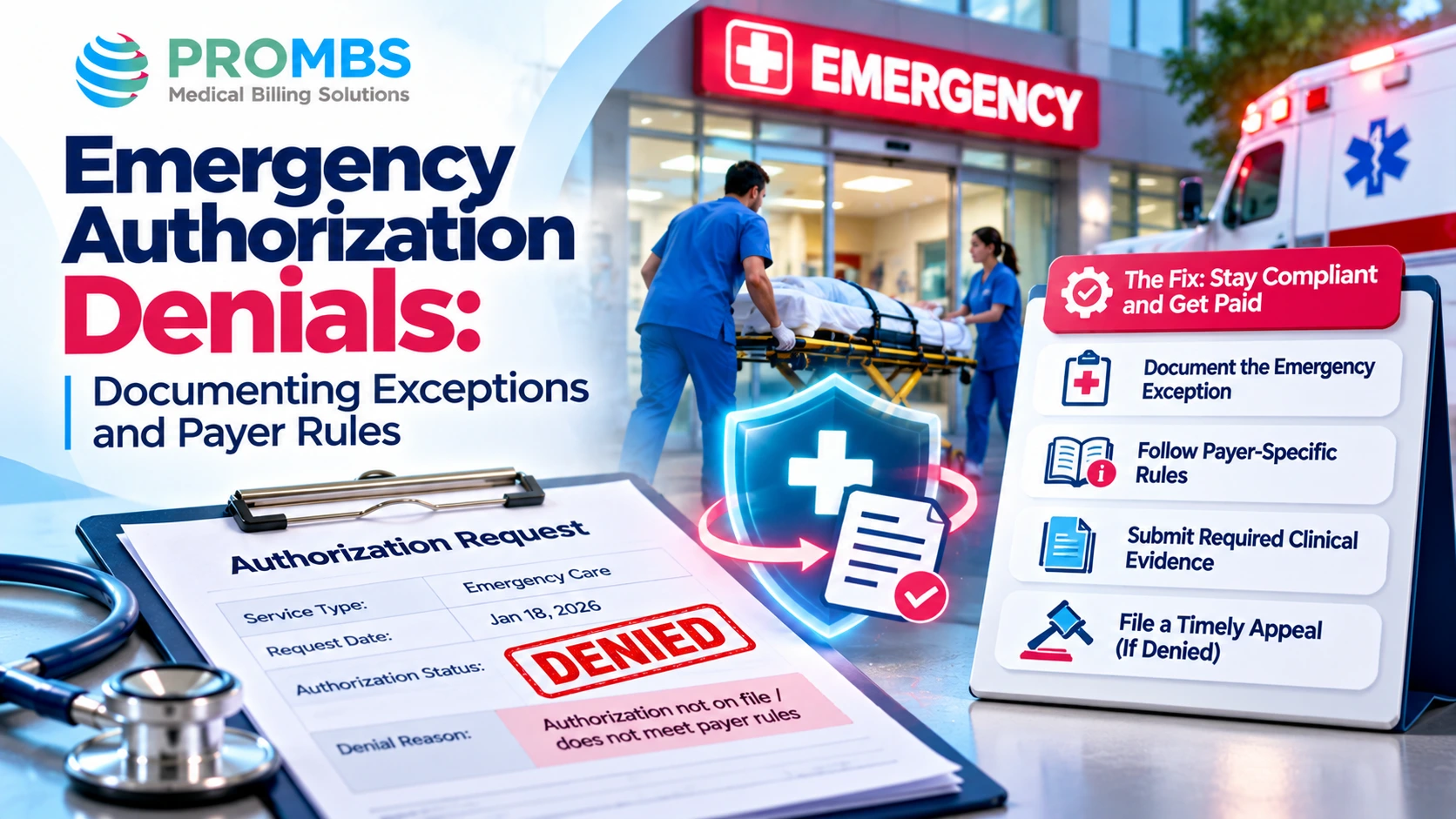
A patient arrives at an emergency department experiencing severe chest pain, shortness of breath, and dizziness. The medical team immediately evaluates the patient, orders diagnostic testing, and provides treatment to rule out a potentially life-threatening condition. There is no practical opportunity to contact the patient’s insurance company and obtain authorization before beginning emergency care.
Several weeks later, the hospital receives a claim denial stating that prior authorization was missing.
The billing team now faces an important question: Was authorization actually required for the services provided, or did the payer apply a requirement that does not belong to qualifying emergency care?
Emergency authorization denials require more than a routine request for retrospective approval. Healthcare providers must determine whether the services qualify for applicable emergency coverage protections, whether the disputed requirement concerns prior authorization or notification, and whether the insurer is challenging the emergency evaluation or a later stage of treatment.
These distinctions affect the documentation needed, the appropriate payer response, and the financial responsibility assigned to the provider or patient.
A missing authorization number does not automatically justify an emergency claim denial. However, the fact that a patient entered through the emergency department does not mean every subsequent service is exempt from all coverage and payment requirements.
This guide explains how emergency authorization rules work, why insurers may deny emergency-related claims, and what billing teams should investigate before correcting a claim or requesting a formal review.
What Are Emergency Authorization Denials?
An emergency authorization denial occurs when an insurer refuses payment for a medical service because the payer determines that a required authorization, precertification, or notification was not obtained.
In medical billing, these denials can arise after emergency department evaluations, emergency procedures, unplanned hospital admissions, and other services associated with urgent medical conditions.
However, the term can describe several different disputes.
A payer might deny emergency department services for missing prior authorization. Another may deny a subsequent inpatient stay because it believes the hospital failed to provide timely admission notification. A third may question whether the inpatient admission met medical necessity requirements, even though it accepts that the initial emergency evaluation was appropriate.
These are not equivalent determinations.
The first may involve a federal or state prohibition against requiring prior authorization for qualifying emergency services. The second may involve an administrative reporting rule and its enforceability. The third may involve the clinical basis for inpatient-level care.
Before responding, the billing team needs to establish what the insurer actually denied and which requirement it claims was violated.
Why Emergency Billing Requires a Different Approach
Routine planned procedures often allow healthcare practices to verify benefits, confirm network participation, and obtain required approvals before providing treatment.
Emergency medical care is different because the patient’s condition may require immediate evaluation and stabilization.
A patient presenting with symptoms of a possible stroke, severe breathing difficulty, major injury, or another potentially serious condition cannot reasonably be expected to wait while administrative approval is obtained.
Federal emergency coverage requirements recognize this distinction for health plans and services within their scope.
The provider must still document the services accurately, submit the claim correctly, and comply with applicable billing rules. But the absence of advance authorization should not automatically be treated as a valid reason to deny qualifying emergency services.
Why Emergency Medical Claims Are Denied for Missing Authorization
Emergency authorization-related denials can result from incorrect payer processing, incomplete clinical documentation, administrative reporting disputes, or confusion between different stages of hospital care.
The Payer Applies a Routine Authorization Rule
A claims system may apply a general authorization edit to a service without adequately accounting for the circumstances of the emergency.
For example, a diagnostic procedure may ordinarily require advance approval when scheduled in an outpatient setting. The same procedure might be performed as part of a qualifying emergency evaluation.
The billing team should determine whether the payer’s authorization requirement applies to the emergency circumstances and whether the service falls within the relevant emergency coverage protections.
A procedure’s usual authorization requirements should not be assumed to apply identically in every setting.
Emergency and Inpatient Services Are Processed Together
A patient may receive emergency evaluation and stabilizing treatment before being admitted to the hospital.
If the insurer denies the hospital claim for an authorization or notification issue, the denial may involve the inpatient stay rather than the initial emergency services.
Billing staff need to identify the services and dates affected by the determination. Without that distinction, an appeal may address the wrong requirement.
The Payer Questions Whether the Condition Was an Emergency
Some disputes arise because the patient’s final diagnosis appears less serious than the symptoms that prompted the emergency visit.
For example, a patient presenting with severe chest pain may ultimately be diagnosed with a condition that does not require inpatient treatment.
That later diagnosis does not automatically establish that the original emergency evaluation was unnecessary.
Applicable emergency coverage requirements may use the prudent layperson standard, which examines the symptoms and circumstances when the patient sought treatment.
Notification or Clinical Information Was Missing
An insurer may require an emergency admission to be reported through a particular administrative process or request clinical records for a subsequent utilization review.
Whether a notification requirement is applicable and whether failure to comply can justify nonpayment depend on the governing plan, program, contract, and legal protections.
The billing team should not assume every administrative deadline is equivalent to advance authorization.
When Emergency Services Are Exempt From Prior Authorization
Under federal requirements applicable to covered plans and emergency services, insurers generally cannot require prior authorization as a condition of covering qualifying emergency services.
The federal rule at 45 CFR § 149.110 addresses emergency coverage requirements for plans and issuers within its scope.
The regulation includes protections involving prior authorization, network participation, and how emergency services must be covered.
For applicable emergency services, the plan generally cannot require a prior authorization determination before coverage is provided, regardless of whether the emergency provider or facility participates in its network.
This is an important distinction from ordinary elective care, where obtaining advance approval may be part of the applicable payment requirements.
What Qualifies as Emergency Services?
Emergency services generally involve the medical screening examination and additional examination or treatment required to stabilize an emergency medical condition, as defined by the applicable law.
Certain post-stabilization services may also fall within the emergency services definition when the relevant conditions are met.
A patient who arrives with symptoms suggesting a potentially serious medical condition may need testing and evaluation to determine whether an emergency exists.
The subsequent discovery that the condition is less severe does not automatically remove the protections applicable to the initial emergency presentation.
However, not every service furnished during an emergency department visit qualifies for the same treatment under every plan or law.
Billing teams should determine the specific services being disputed and whether they fall within the relevant legal and contractual requirements.
Does the Rule Apply to Every Insurance Plan?
No single federal provision should be assumed to govern every possible insurance arrangement.
Commercial group and individual health plans, Medicare Advantage organizations, and Medicaid managed care plans may be subject to different statutory and regulatory frameworks.
Certain coverage types or services may fall outside a particular rule’s scope.
For that reason, the practice should identify the patient’s actual coverage and the governing program before selecting the regulatory basis for a dispute.
The absence of advance authorization may be legally protected in one situation, while a different requirement applies to a later service or a different coverage program.
Understanding the Prudent Layperson Standard
The prudent layperson standard is central to many emergency coverage disputes.
Rather than judging the original need for emergency care solely by the final diagnosis, the standard considers whether a person with average knowledge of health and medicine could reasonably expect that delaying immediate medical attention might place health in serious jeopardy or lead to other serious consequences described in the applicable rule.
This matters because patients generally cannot determine the medical cause of severe symptoms before receiving an evaluation.
A patient with sudden chest pain does not know whether the cause is a heart attack, a respiratory condition, or something less serious. The clinical evaluation is necessary to determine what is happening.
Why the Final Diagnosis May Not Justify a Denial
Consider a patient arriving at an emergency department with severe abdominal pain, repeated vomiting, and signs of dehydration.
The physician evaluates the patient for potentially serious conditions. After diagnostic testing and treatment, the patient improves and is discharged without surgery.
A payer should not automatically conclude that the original presentation was non-emergent simply because the eventual diagnosis was less serious than initially suspected.
The relevant investigation should consider the symptoms, medical history, presenting condition, and circumstances at the time emergency care was sought.
The American College of Emergency Physicians provides professional guidance on emergency coverage disputes and the prudent layperson standard.
Documentation That Supports the Emergency Presentation
Clinical documentation should accurately describe what occurred when the patient presented for care.
Relevant records may include the chief complaint, symptom onset, severity, associated symptoms, vital signs, triage assessment, relevant medical history, and the clinician’s findings.
Documentation should also explain the evaluation performed, the risks being considered, and the medical decisions made.
Timestamps may help establish the sequence of arrival, screening, diagnostic testing, intervention, stabilization, and disposition.
The purpose is to preserve an accurate clinical record. Providers should not alter or exaggerate symptoms to make an encounter appear more urgent after a denial.
A well-documented initial presentation helps reviewers evaluate the medical circumstances under the appropriate standard.
Emergency Screening, Stabilization, and Inpatient Admission
One of the most important billing distinctions is the difference between emergency department treatment and subsequent inpatient care.
A patient may require immediate medical screening and stabilization before the physician determines whether continued hospitalization is necessary.
Although these services may occur during one episode of care, they can raise different coverage and payment questions.
Emergency Department Evaluation and Stabilizing Treatment
The initial emergency evaluation focuses on identifying whether an emergency medical condition exists and addressing the patient’s immediate needs.
For health plans subject to applicable emergency coverage rules, qualifying emergency screening and stabilizing services generally cannot be conditioned on prior authorization.
This protection should not be confused with a guarantee that every billed service, charge, or later treatment decision must be reimbursed as submitted.
The practice still needs accurate coding, appropriate documentation, and a review of the relevant payer’s adjudication.
Emergency Admission and Inpatient-Level Care
After emergency treatment, the physician may determine that the patient requires inpatient admission.
The insurer may separately evaluate whether inpatient-level care meets the applicable medical necessity requirements and whether any relevant administrative procedures were followed.
For example, a payer may accept payment responsibility for the emergency department services but dispute whether the patient’s condition required inpatient admission instead of another level of care.
That is not necessarily the same dispute as missing prior authorization for the original emergency evaluation.
The billing team should identify the exact period of treatment, services, and reimbursement decision being challenged.
What About Post-Stabilization Services?
Post-stabilization services involve care furnished after the patient has received initial emergency treatment.
The applicable coverage rules can be more complicated because some services remain subject to emergency-service protections under defined circumstances, while others may be governed by different provisions.
For Medicare Advantage, 42 CFR § 422.113 addresses emergency and urgently needed services, including post-stabilization care requirements.
For Medicaid managed care, 42 CFR § 438.114 contains relevant emergency and post-stabilization provisions.
The practice should verify when stabilization occurred, what services followed, and which rules establish responsibility for the subsequent care.
It should not assume that all post-stabilization treatment automatically requires advance authorization or that it is always exempt from other applicable payment conditions.
Emergency Admission Notification vs. Prior Authorization
Prior authorization and notification are related administrative processes, but they are not identical.
Prior authorization generally involves a payer reviewing or approving a proposed service before it is performed.
Notification generally involves informing the payer that an event, such as an unplanned hospital admission, has occurred.
An emergency admission may trigger a reporting or utilization review process even when the initial emergency services cannot require advance approval.
However, a payer’s notification policy does not automatically establish that denying payment for late notification is permitted.
The legal enforceability of the requirement must be considered alongside the plan and contract.
Why Notification Deadlines Differ Between Payers
Insurance companies may apply different administrative workflows based on product type, state, and coverage program.
One payer may request notification within a specified number of hours after an unplanned admission. Another may permit a different timeframe or describe emergency admission notification as voluntary for a particular product.
A Medicare Advantage plan may also update its emergent admission review process during the year.
These differences make it risky to rely on a universal rule such as “all emergency admissions must be reported within 24 hours.”
The practice should identify the exact plan, the rule effective on the admission date, and whether applicable federal or state requirements limit an administrative denial.
Late Notification Does Not Automatically Establish Nonpayment
Suppose a hospital provides qualifying emergency treatment and admits the patient for continued care.
The insurer later denies part of the claim because the hospital did not submit an admission notification within the timeframe stated in its provider manual.
Before accepting the denial, the billing team should determine which services the payer denied, whether the notification requirement applied, and whether the relevant law and contract permit payment to be withheld for that reason.
The team should also document when the hospital obtained the patient’s insurance information, when notification was attempted, and any circumstances that affected the process.
These details may be important when requesting review or establishing that the payer applied its rule incorrectly.
Understanding CARC 197 and Related Emergency Claim Denial Codes
A claim adjustment reason code explains how the payer classified a reduction or denial. It does not independently establish that the insurer’s interpretation of the applicable requirements was correct.
Emergency authorization disputes can involve several adjustment reasons.
| CARC | General meaning | Investigation priority |
|---|---|---|
| 197 | Precertification, authorization, or notification absent | Determine whether the requirement actually applied to the disputed services |
| 198 | Precertification or authorization exceeded | Check the approved services, dates, limits, and applicable exception rules |
| 50 | Services not considered medically necessary under the payer’s determination | Review the medical necessity issue and applicable clinical criteria |
| 16 | Claim or service lacks necessary information or contains a submission error | Identify the missing or inaccurate information using the accompanying remark |
| 96 | Noncovered charges | Verify the coverage basis and associated remark information |
These codes should be interpreted using the official X12 Claim Adjustment Reason Codes, the adjustment group, any remark codes, and the payer’s full explanation.
Why CARC 197 Requires Special Attention
CARC 197 may appear when the payer believes that authorization, precertification, or notification was absent.
In an emergency claim, the billing team must first establish what kind of requirement the payer is referring to.
If the denied service qualifies for a prohibition on prior authorization, the absence of advance approval may not be a valid basis for denying coverage.
If the dispute involves a later inpatient admission, the relevant question may instead concern notification, continued-care requirements, or another administrative process.
Staff should avoid automatically requesting retroactive authorization before determining which issue is actually responsible for the denial.
PROMBS’s denial management services can support practices investigating emergency authorization denials by connecting payer follow-up with the relevant claim documentation and billing requirements.
First Steps After Receiving an Emergency Authorization Denial
When the denial arrives, begin by identifying the patient, payer, coverage product, service dates, denied charges, and adjustment codes.
Retrieve the claim and complete remittance to establish whether the payer denied the emergency department evaluation, a procedure performed during stabilization, an inpatient admission, or later treatment.
Next, determine which coverage requirements applied on the dates of service.
For qualifying emergency services, review the applicable emergency coverage protections. For disputed inpatient or post-stabilization services, identify the governing utilization management, notification, and payment rules.
Then compare the payer’s explanation with the clinical record and administrative timeline. Determine whether the documentation establishes the emergency presentation, relevant treatment, stabilization, and subsequent admission decisions.
If the denial appears to result from missing or incorrect claim information, identify the payer-approved correction process.
If the original claim was accurate but the payer applied an inappropriate authorization rule, a documented reprocessing request or formal appeal may be appropriate.
If the dispute concerns inpatient medical necessity, the evidence should address the clinical basis for that level of care rather than merely stating that the patient entered through the emergency department.
Finally, review patient financial responsibility before transferring any disputed balance. Federal or state protections, provider agreements, and the applicable coverage arrangement may restrict billing patients for emergency services, particularly in qualifying out-of-network situations.
The billing team should not assume that a denied charge automatically becomes a collectible patient balance.
For ongoing emergency authorization workflows, PROMBS’s verification of benefits and prior authorization services can also support administrative coordination where applicable, including information gathering and follow-up on payer requirements.
A useful investigation ends with a documented reason for the denial, the rule or evidence supporting the next action, and a clear plan for resolving the claim.
Building an Evidence Packet for Emergency Authorization Denials
When an insurer denies emergency-related services for missing authorization, the billing team needs evidence that explains both the medical circumstances and the administrative requirements that applied. A statement that the patient was treated in an emergency department is not always enough. The practice must identify the exact services denied, determine whether they qualify for applicable emergency coverage protections, and establish why the payer’s decision may be incorrect.
An effective evidence packet connects the clinical record, insurance policy, claim history, and relevant regulatory requirements. It should allow a payer reviewer to understand what happened before treatment, why immediate care was necessary, and which requirements could reasonably have applied.
The investigation should begin with the complete explanation of benefits (EOB) or electronic remittance advice (ERA). Identify the denied service lines, dates, adjustment codes, remark codes, and any explanation supplied by the payer. Then determine whether the disputed amount involves emergency evaluation, stabilizing treatment, admission, or subsequent hospital services.
This distinction determines which documentation is relevant and which argument the billing team should present.
Document the Patient’s Initial Emergency Presentation
For services protected by the prudent layperson standard, the circumstances at presentation are particularly important.
The clinical record should accurately identify the patient’s chief complaint, reported symptoms, relevant medical history, initial vital signs, triage findings, and the medical concerns prompting immediate evaluation.
For example, documentation of sudden chest pain, difficulty breathing, and associated symptoms may help explain why a patient reasonably sought emergency evaluation, even if the final diagnosis is not a cardiac emergency.
Where appropriate, the record should also explain the clinical reasoning behind diagnostic tests, interventions, and the decision to monitor, admit, transfer, or discharge the patient.
These records should reflect the care actually provided. Staff should not modify or exaggerate the patient’s condition after a denial to create the appearance of a qualifying emergency.
Preserve the Administrative Timeline
Emergency claim disputes may also require evidence showing when the hospital obtained insurance information and when it attempted to communicate with the payer.
Relevant records can include the patient’s arrival time, admission decision, insurance verification, notification attempts, payer contact references, and relevant authorization or utilization review responses.
If the hospital could not obtain accurate insurance information because the patient was unconscious or otherwise unable to provide it, document that circumstance using the information available in the original record.
An administrative timeline can help distinguish a genuine failure to follow an applicable process from a situation in which the payer applied a requirement that was not enforceable or could not reasonably have been completed.
The practice should include only the documentation necessary for the particular dispute and transmit protected health information through approved channels.
Claim Example 1: Emergency Department Care Denied for Missing Prior Authorization
Consider a hypothetical patient who arrives at an emergency department with severe chest pain radiating into the left arm. The patient reports sudden symptoms, weakness, and shortness of breath.
The medical team conducts an immediate evaluation, orders diagnostic testing, and provides treatment while investigating a potentially serious cardiac condition.
The patient is eventually stabilized and discharged.
Several weeks later, the health insurer denies part of the emergency claim under CARC 197 because the relevant procedure did not have prior authorization.
The hospital must determine whether the denied service was part of qualifying emergency care and whether the plan is subject to an applicable prohibition against requiring advance authorization.
Investigating the Denial
The billing team should first verify the exact procedure, service date, and setting associated with the denial.
Next, review the initial symptoms and clinical findings to establish why the evaluation was performed. The record should support the medical circumstances without assuming that the patient’s final diagnosis determines whether the original presentation was an emergency.
For covered emergency services under applicable federal protections, the insurer generally cannot require prior authorization as a condition of coverage.
If the denied service falls within those protections, the hospital may have a basis to challenge the authorization edit rather than request an approval that was not required in the first place.
The request should identify the specific claim, describe the relevant emergency presentation, cite the applicable coverage provision, and ask the payer to reconsider the denial.
Appropriate Resolution
If the insurer applied an authorization requirement inconsistent with the governing emergency coverage rule, a reprocessing request or formal appeal may be appropriate under the payer’s procedures.
However, the practice should not assume that the entire claim is payable simply because the service occurred during an emergency encounter. The insurer may have separate, reviewable questions involving accurate coding, benefit administration, or other applicable payment requirements.
The billing team should identify and address the actual disputed determination while preserving correctly adjudicated services.
Claim Example 2: Emergency Inpatient Admission Denied for Late Notification
A patient arrives at the emergency department late on Friday evening with severe respiratory symptoms.
Following immediate evaluation and treatment, the physician determines that the patient requires hospitalization.
The patient is admitted during the night, and the hospital submits admission information to the insurer on Monday.
The payer subsequently denies payment for the inpatient stay, stating that notification was not received within the timeframe described in its administrative policy.
This case requires a different investigation from a denial involving missing prior authorization for emergency screening and stabilization.
Confirm What the Notification Requirement Actually Says
The billing team should identify the exact insurance product and the administrative requirements effective on the admission date.
Some insurers request notification after unplanned admissions within specified timeframes. Others use different procedures depending on the type of coverage, the nature of the admission, or applicable state requirements.
The hospital should verify whether the policy calls for notification, utilization review, authorization, or some combination of these activities.
It should also determine whether applicable federal or state protections restrict the payer from denying payment solely because of administrative notice requirements.
A provider manual deadline should not be treated as conclusive proof that nonpayment is legally permitted.
Examine the Clinical and Administrative Evidence
The hospital should establish when the decision to admit was made, when coverage information became available, and whether staff attempted to contact the payer.
The record should show the patient’s condition, medical necessity for continued hospitalization, and any circumstances that affected notification.
For example, if an insurer’s notification system was unavailable or the hospital initially received incorrect coverage information, contemporaneous records may support a request for administrative review.
These facts do not automatically excuse every missed deadline. They are relevant evidence to evaluate against the applicable plan and legal requirements.
Selecting the Appropriate Response
If the insurer applied the wrong notification policy, miscalculated the deadline, or denied payment contrary to applicable protections, a supported reconsideration or appeal may be warranted.
If the notification requirement was applicable and legally enforceable, the team should investigate whether the payer permits an exception or other review.
The hospital should also separate the inpatient payment question from the initial emergency services. A dispute about inpatient notification does not necessarily establish that the emergency department evaluation was improperly provided.
Claim Example 3: The Final Diagnosis Appears Non-Emergent
A patient visits the emergency department because of sudden, severe abdominal pain accompanied by vomiting and dizziness.
The treating physician evaluates the patient for potentially serious conditions and orders appropriate diagnostic testing.
After examination and treatment, the patient improves and is discharged with a diagnosis that does not appear immediately life-threatening.
The insurer denies the emergency claim, explaining that the final diagnosis does not demonstrate an emergency.
Apply the Prudent Layperson Standard
For coverage governed by the prudent layperson standard, the investigation should consider the symptoms and circumstances that prompted the patient to seek emergency care.
A patient cannot necessarily determine in advance whether severe abdominal pain represents a life-threatening condition. The purpose of the emergency evaluation may be to establish whether a serious medical problem exists.
The final diagnosis alone should therefore not be used as the sole basis for determining whether the emergency presentation qualified.
The billing team should review the initial triage information, symptom severity, associated findings, and physician documentation.
It should explain why an individual with average medical knowledge could reasonably have believed that delaying care might lead to serious consequences under the applicable standard.
Build an Evidence-Based Appeal
A persuasive appeal should connect the presenting symptoms with the appropriate emergency coverage requirements.
The request may summarize the patient’s condition on arrival, the medical concerns being evaluated, and the documentation establishing the need for prompt assessment.
It should not rely on unsupported statements such as “the patient felt it was an emergency” without explaining the recorded circumstances.
Likewise, the practice should not assume every emergency department visit qualifies for the same coverage protection regardless of symptoms or plan type.
The applicable standard must be considered alongside the factual record.
If the denial was based improperly on the final diagnosis instead of the emergency presentation, the practice may have grounds to request review.
Claim Example 4: Post-Stabilization Services and Continued Hospital Care
A patient receives emergency treatment following a serious injury.
The medical team performs an emergency evaluation and stabilizing interventions. After the patient’s condition improves, the physician determines that additional hospital monitoring and treatment are necessary.
The insurer pays the initial emergency services but denies a later portion of the hospital stay because authorization was not obtained.
The key question is whether the disputed services remained within applicable emergency or post-stabilization protections or were subject to other permissible requirements.
Identify the Point of Stabilization and Subsequent Care
The billing team should review the clinical record to establish the sequence of emergency treatment, stabilization, and continued care.
However, a hospital’s general statement that a patient was “stable” does not independently resolve every legal or coverage question.
The applicable rules may define stabilization and post-stabilization services in specific ways. Relevant circumstances can include whether the patient could safely be transferred, whether the treating clinician considered transfer appropriate, and whether the plan assumed responsibility under an applicable process.
For Medicare Advantage, 42 CFR § 422.113 establishes requirements involving emergency and post-stabilization care.
The regulation addresses circumstances in which a Medicare Advantage organization may remain financially responsible for qualifying post-stabilization services, including specified situations involving its response to requests for authorization.
These provisions should be evaluated according to their actual requirements rather than simplified into a universal rule that all services after stabilization are automatically covered.
Review the Relevant Coverage Period
The practice should determine which services the payer accepted and which services it disputed.
If the denial concerns treatment after the emergency coverage period ended under applicable rules, the billing team may need to examine other authorization, network, or medical necessity requirements.
If the relevant post-stabilization provisions establish payer responsibility for the disputed care, a documented review may be appropriate.
The evidence should include the clinical timeline, relevant communications with the insurer, and the precise services under dispute.
This approach avoids treating the entire admission as one authorization issue when different periods of treatment may be governed by different requirements.
Claim Example 5: Emergency Behavioral Health Treatment and an Authorization Dispute
A patient presents to an emergency department experiencing an acute behavioral health crisis.
The medical team conducts an emergency assessment to evaluate immediate safety concerns and determine appropriate treatment.
Following the evaluation, clinicians determine that additional psychiatric care is necessary.
The insurer later denies part of the episode, citing missing authorization for behavioral health services.
The billing team must establish whether the denied services involved qualifying emergency evaluation and stabilization or a subsequent level of care subject to different requirements.
Separate the Emergency Assessment From Later Treatment
An emergency behavioral health presentation may qualify for emergency coverage protections when the applicable definition and other requirements are met.
The relevant facts may include the patient’s initial symptoms, documented safety concerns, clinical assessment, and the need for immediate intervention.
The presence of a behavioral health diagnosis does not automatically exclude a patient from emergency protections.
However, subsequent psychiatric admission or continuing treatment may involve additional requirements depending on the coverage program and applicable law.
The hospital should determine which portion of the episode the payer denied and which rules applied to that period.
Document the Medical and Administrative Circumstances
The evidence packet should accurately reflect the initial presentation, clinical findings, and decisions regarding continued care.
When inpatient psychiatric treatment is disputed, the team may need documentation supporting the relevant level of care rather than relying exclusively on the circumstances of the initial emergency visit.
Staff should also verify whether the plan uses a separate behavioral health administrator or claim-processing arrangement.
A claim routed to the wrong organization may require an administrative correction rather than an appeal of emergency coverage protections.
This distinction helps the practice address the actual payment issue without unnecessarily resubmitting accurate claims.
Comparing Commercial, Medicare Advantage, and Medicaid Emergency Coverage Rules
Emergency coverage protections vary in their legal sources and administrative details. Providers should identify the patient’s actual insurance arrangement before relying on a particular regulation.
| Coverage type | Relevant framework | Main investigation priority |
|---|---|---|
| Commercial group or individual coverage subject to federal emergency rules | Applicable Affordable Care Act and No Surprises Act emergency services provisions, including 45 CFR § 149.110 | Determine whether the disputed services qualify and whether prohibited prior authorization or coverage restrictions were applied |
| Medicare Advantage | 42 CFR § 422.113 and relevant Medicare Advantage requirements | Distinguish emergency care, post-stabilization responsibility, and subsequent utilization review |
| Medicaid managed care | 42 CFR § 438.114 and applicable Medicaid requirements | Verify emergency protections, prudent layperson provisions, post-stabilization obligations, and state or contract rules |
Commercial Health Insurance
For applicable commercial coverage, federal emergency services protections generally prohibit requiring prior authorization for qualifying emergency services.
The rules also address certain network and cost-sharing protections.
However, the billing team should not assume every inpatient service or procedure associated with an emergency department encounter is subject to the same requirements.
The investigation must identify which services fall within the applicable emergency definition and whether any subsequent treatment is governed by different provisions.
Medicare Advantage
Medicare Advantage organizations have specific obligations concerning emergency and post-stabilization services.
The relevant rules address circumstances in which emergency care must be covered without advance authorization and establish requirements for payer responsibility during qualifying post-stabilization care.
When an emergency claim is denied, the team should verify whether the insurer applied the correct Medicare Advantage provisions.
A general commercial insurance policy should not be substituted for the governing Medicare Advantage requirements.
Medicaid Managed Care
Medicaid managed care rules also address emergency services and the prudent layperson standard.
Under 42 CFR § 438.114, relevant requirements include protections for qualifying emergency services and rules addressing post-stabilization care.
State Medicaid requirements and the applicable managed care contract may provide additional operational details.
The practice should confirm which requirements applied on the service date and whether the payer correctly interpreted them.
Corrected Claim, Reprocessing Request, or Appeal: Choosing the Right Resolution
Once the clinical and regulatory investigation is complete, the billing team should select the process that corresponds to the actual problem.
A missing claim detail requires a different action from an incorrect authorization edit. A medical necessity dispute needs different evidence from an administrative notification disagreement.
The goal is to resolve the original issue rather than repeatedly sending unchanged claims.
When a Corrected Claim Is Appropriate
A corrected claim may be appropriate when the submitted information was inaccurate or incomplete.
Examples include an incorrect service date, inaccurate provider information, or a valid emergency-related claim detail that was omitted or reported incorrectly.
The correction must reflect the actual service and be supported by documentation.
Staff should use the payer’s approved correction method and retain the original claim reference when required.
A corrected claim should not be used to invent an authorization or modify clinical circumstances that did not occur.
When to Request Reprocessing
Reprocessing may be appropriate when the original claim was accurate but the payer applied an incorrect administrative rule.
For example, if the insurer applied a routine prior authorization edit to qualifying emergency services that cannot be subject to that requirement, a reprocessing request may be justified.
The request should identify the disputed service, the governing emergency provision, and the evidence showing why the edit should not have applied.
Document the payer contact, reference number, and requested action.
When a Formal Appeal Is Necessary
An appeal may be appropriate when the payer upholds an adverse determination involving emergency coverage, medical necessity, or another reviewable issue.
The argument should address the precise reason for the denial.
For a prudent layperson dispute, emphasize the documented presentation and the applicable standard. For a disputed inpatient stay, address the clinical basis for that level of care. For an improper prior authorization requirement, explain why the relevant emergency coverage protection applies.
The practice should verify the applicable appeal deadline, required submission channel, and supporting documentation requirements.
For additional context about retrospective requests that may genuinely be permitted under payer rules, see PROMBS’s guide to retro authorization in medical billing.
A retrospective authorization request should not replace an appropriate challenge to an authorization requirement that was prohibited for the qualifying emergency service.
Documenting the Governing Payer Rule
A strong emergency denial investigation should identify the rule that applies to the actual coverage product and service date.
Do not rely exclusively on a generic provider manual statement when the issue involves federal protections, state requirements, or a plan-specific exception.
The billing team should retain the relevant policy version, effective date, and any payer correspondence clarifying how the requirement applies.
This is especially important when insurer procedures change.
A notification requirement that applied to one product last year may not apply to another product or to a later admission.
The record should identify whether the issue concerns prior authorization, emergency coverage qualification, admission notification, post-stabilization responsibility, or inpatient medical necessity.
These categories should remain distinct in the claim notes and denial reporting.
Final Payment Reconciliation and Patient Financial Responsibility
An emergency denial investigation does not end when the insurer agrees to review the claim.
The billing team should confirm whether the payer issued a revised determination, what services were affected, and whether any additional payment was actually received.
If the insurer reprocesses the claim, compare the original and revised remittances to identify changes in allowed amounts, insurer payments, contractual adjustments, and patient responsibility.
Avoid posting a replacement payment twice or treating a favorable appeal decision as cash already collected.
When the payer upholds a denial, the team should document the final reason and determine the appropriate account disposition under the applicable contract and law.
Emergency Denials Do Not Automatically Become Patient Bills
Patient billing requires particular care when emergency services are involved.
The No Surprises Act includes protections against certain unexpected out-of-network emergency charges for covered patients and services.
These protections can affect cost-sharing and limit what a provider may charge beyond the permitted patient responsibility.
Other program-specific or state requirements may also apply.
A denial for missing authorization does not independently establish that the provider may transfer the entire unpaid charge to the patient.
Before issuing a statement, the practice should verify the actual service, coverage arrangement, final adjudication, provider obligations, and relevant patient protections.
This is especially important when the disputed services were furnished by an out-of-network emergency provider or facility.
Closing an Emergency Authorization Denial With a Supported Outcome
Every investigated claim should end with a documented resolution.
If the payer applied an incorrect authorization requirement, the record should show the applicable rule, the review request, and the final adjudication.
If the issue concerned a valid correction, the team should preserve the original submission, corrected claim, and payer response.
If the dispute involved inpatient medical necessity, the file should contain the relevant clinical evidence and the outcome of the applicable review.
If no additional reimbursement is owed, the account should receive an appropriate financial disposition rather than remaining indefinitely in insurance accounts receivable.
Through its denial management services, PROMBS supports healthcare practices with claim investigations, payer follow-up, and documentation-driven resolution processes.
Its revenue cycle management services can also support broader tracking of outstanding claims and final payment reconciliation.
How to Prevent Emergency Authorization Denials in Medical Billing
Preventing emergency authorization denials requires a different approach from managing authorization for scheduled procedures. Emergency departments cannot always obtain complete insurance information before treatment, and clinical teams may need to evaluate and stabilize patients immediately. The administrative process must account for these circumstances without creating unnecessary barriers to care.
The goal is not to obtain prior authorization for every emergency encounter. Instead, healthcare organizations should understand which services are protected from advance authorization requirements, identify when separate notification or utilization review procedures apply, and maintain accurate documentation throughout the encounter.
A reliable workflow should connect emergency department registration, clinical documentation, case management, utilization review, and medical billing. Each department needs access to the information relevant to its responsibilities, while the organization must preserve a clear record of what happened and when.
This approach helps reduce avoidable administrative disputes and gives billing teams stronger evidence when an insurer incorrectly applies authorization requirements.
Establish Emergency-Specific Billing Procedures
Hospitals and emergency care providers should distinguish emergency encounters from scheduled services within their administrative processes.
A routine authorization checklist may be appropriate for elective imaging or planned treatment, but it should not be applied indiscriminately to qualifying emergency services. Staff need to understand that applicable federal and state requirements can prohibit prior authorization as a condition of emergency coverage.
The organization should maintain clear instructions explaining how to identify emergency encounters, document the initial presentation, and determine whether subsequent services involve separate administrative requirements.
These instructions should also identify when utilization review or payer communication becomes necessary after the initial emergency evaluation.
A workflow that automatically treats every missing authorization number as a billing defect may create unnecessary corrections, retrospective requests, and appeals.
Identify the Correct Requirements for Each Coverage Type
Emergency billing procedures should distinguish commercial insurance, Medicare Advantage, Medicaid managed care, and other applicable coverage arrangements.
The relevant emergency protections may arise from different statutes and regulations. Their administrative procedures can also vary.
For example, applicable commercial emergency coverage protections are addressed in 45 CFR § 149.110, while Medicare Advantage emergency and post-stabilization requirements are addressed in 42 CFR § 422.113.
The practice should document which framework applies to the patient and identify any separate coverage or inpatient review requirements.
A payer’s commercial product rules should not automatically be used for its Medicare Advantage members. Likewise, a particular insurer’s notification deadline should not be treated as a universal emergency admission rule.
Build a Payer-Specific Emergency Admission Workflow
A reliable emergency admission process begins with current payer information and clearly assigned administrative responsibilities.
Hospitals should maintain accessible guidance for the insurers and products they regularly bill. The guidance should identify applicable admission notification procedures, required clinical information, submission channels, and relevant deadlines.
However, the organization must distinguish a payer’s administrative request from a legally enforceable condition of payment.
A notification policy does not automatically override emergency coverage protections. When a requirement appears inconsistent with applicable law, the organization should investigate before accepting a denial as valid.
Maintain an Updated Payer Requirements Reference
A payer-specific reference should identify the insurance product, relevant admission notification instructions, available electronic submission methods, and any procedures for reporting an unplanned admission.
It should also note whether separate rules apply to inpatient admissions, observation services, or post-stabilization treatment.
Record the effective dates of the guidance. This is important because insurers may revise their utilization management procedures during the year.
When a significant policy change occurs, communicate it to the employees responsible for admission reporting and claim follow-up.
The reference should not attempt to replace the full payer contract or legal requirements. It should help staff locate the correct governing information before taking action.
Create an Escalation Process for Unclear Requirements
Emergency encounters may involve patients who cannot provide insurance information, incomplete enrollment records, or admissions occurring outside normal administrative hours.
The organization should have a documented process for handling these circumstances.
For example, if a patient arrives without available insurance information, staff should record when coverage details became known and complete any appropriate follow-up once reliable information is available.
If an insurer’s electronic notification system is unavailable, retain evidence of the attempt and use an authorized alternative when applicable.
The purpose is to preserve an accurate administrative timeline and support compliance with valid requirements without delaying medically necessary emergency evaluation or stabilization.
Coordinate Emergency Department, Utilization Review, and Billing Teams
Many emergency claim disputes are difficult to resolve because clinical and administrative records are maintained separately.
The emergency department documents the patient’s presenting condition and immediate treatment. Utilization review evaluates the subsequent level of care and relevant payer requirements. Billing receives the claim and remittance, sometimes weeks later.
If the information is not connected, a billing specialist may see only a missing authorization denial without understanding the clinical circumstances or which portion of the encounter the insurer actually disputed.
Improve Clinical Documentation Handoffs
Emergency department documentation should accurately capture presenting symptoms, triage findings, relevant medical risks, diagnostic evaluation, treatment, and disposition.
Where a patient is admitted, the record should also support the clinical reasoning behind the admission and subsequent level of care.
Billing staff should be able to identify whether a payer dispute concerns the initial emergency evaluation, stabilizing treatment, post-stabilization services, or inpatient medical necessity.
These distinctions are essential because different legal and payment requirements may apply.
Documentation should be complete and contemporaneous. Retrospective clarification must follow applicable documentation standards and should never be used to invent clinical findings or change the facts of an encounter.
Assign Administrative Responsibilities Clearly
The organization should establish which department verifies coverage, communicates applicable admission information to the payer, maintains utilization review records, and investigates any resulting denial.
For instance, registration may be responsible for obtaining available insurance information, while utilization review handles appropriate inpatient communication and medical necessity documentation.
The billing team should then use those records to determine the correct claim-resolution pathway.
When an insurer disputes a requirement, the account should have a designated owner responsible for identifying the governing rule, collecting evidence, and following the claim through final adjudication.
This reduces duplicated work and prevents repeated appeals that do not address the actual issue.
KPIs for Monitoring Emergency Authorization and Notification Denials
Healthcare organizations should track emergency-related authorization disputes separately from ordinary planned-procedure authorization denials.
A single authorization-denial category can hide whether the payer applied a prohibited requirement, the organization missed a valid administrative step, or an inpatient medical necessity dispute was incorrectly classified as an authorization issue.
Useful reporting should measure the reason for each denial and the accuracy of the final resolution.
| KPI | Suggested calculation | Operational purpose |
|---|---|---|
| Emergency authorization-related initial denial rate | Unique emergency-related claims initially denied for authorization or notification reasons ÷ comparable initially adjudicated emergency-related claims × 100 | Identifies the frequency of these disputes |
| Incorrect authorization application rate | Investigated cases with evidence that the payer applied an inapplicable authorization requirement ÷ completed authorization investigations × 100 | Highlights possible payer processing problems |
| Applicable notification completion rate | Admissions requiring notification with documented completion under the governing requirement ÷ admissions confirmed to require notification × 100 | Evaluates compliance with applicable administrative procedures |
| Documentation completeness rate | Reviewed emergency cases with required clinical and administrative evidence available ÷ emergency cases reviewed × 100 | Measures readiness for review and dispute |
| Supported resolution rate | Closed emergency denial investigations with documented final dispositions ÷ closed cases reviewed × 100 | Shows whether investigations reach defensible outcomes |
| Actual additional insurer collections | Additional insurer payments received and posted after supported reviews, net of relevant reversals | Measures realized reimbursement |
These are suggested operational measures, not universal industry benchmarks.
The organization should exclude duplicate adjudications from initial denial calculations and distinguish pending reviews from completed determinations.
Example: Understanding Emergency Denial Patterns
Consider a hypothetical hospital that investigates 40 emergency-related authorization and notification denials.
The review determines that 14 involved an authorization requirement that did not apply to the qualifying emergency services, eight concerned disputed admission notification procedures, ten involved later inpatient medical necessity determinations, and eight required additional information before a final classification could be made.
These cases should not all be reported as identical authorization failures.
The first group may justify a targeted review of payer edits. The second requires examination of notification rules and administrative records. The third belongs primarily in a medical necessity review process.
If favorable payer decisions eventually produce additional reimbursement, report the actual payments received and posted rather than assuming that every denied charge represents recoverable revenue.
The findings can then guide improvements in payer follow-up, utilization review coordination, and emergency claim documentation.
Conduct a Monthly Emergency Claim Denial Audit
A monthly audit should review a sample of emergency claims denied for authorization, notification, or related medical necessity reasons.
The purpose is to determine whether the payer applied the correct requirements and whether the organization maintained the documentation necessary to support the encounter.
A useful audit should include unresolved claims, recently appealed claims, and accounts closed through adjustments or patient balance transfers.
Closing an account does not independently establish that the denial or financial disposition was correct.
Verify the Governing Coverage Rule
For each selected claim, identify the insurance product, service date, denied services, and exact payer explanation.
Determine whether the disputed care involved qualifying emergency services, later inpatient treatment, or post-stabilization care.
Review the applicable federal or state provisions and the payer’s rules effective when the services were provided.
If the denial is based on missing prior authorization, confirm whether advance approval was legally permissible for that service.
If the issue concerns notification or medical necessity, evaluate those requirements separately rather than treating them as interchangeable.
Compare the Claim With the Clinical Timeline
The audit should reconstruct the sequence of presentation, screening, treatment, stabilization, admission, and subsequent care where relevant.
Verify that the medical records support the services billed and that administrative documentation accurately identifies when payer information became available.
For disputed admission notices, review the actual submission history, payer acknowledgment, and applicable deadline.
When the payer relies on the final diagnosis to question emergency care, determine whether the applicable prudent layperson standard was appropriately considered.
The audit should identify the specific reason for any discrepancy and whether a correction, review, or other action remains available.
Turn Audit Results Into Process Improvements
If several claims show the same type of incorrect payer edit, the organization may need a targeted discussion with the payer or a review of similar affected claims.
If repeated cases involve unclear admission notification ownership, the hospital may need stronger handoff procedures.
If inpatient medical necessity disputes recur, the appropriate response may involve clinical documentation and utilization review improvements rather than additional emergency authorization requests.
Every significant finding should have an assigned owner and a follow-up process.
The next review should determine whether similar errors decreased after the corrective action.
Patient Billing and Emergency Coverage Protections
Patient financial responsibility requires particular attention when emergency claims are disputed.
Applicable federal requirements, including the No Surprises Act, establish protections against certain unexpected out-of-network emergency bills.
For covered emergency services within the law’s scope, patient cost-sharing and provider billing obligations are subject to specific restrictions.
A payer’s refusal to reimburse a claim does not automatically permit the provider to transfer the entire unpaid amount to the patient.
The practice should determine which protections apply to the coverage arrangement, provider, facility, and services involved.
Separate Payer Disputes From Patient Responsibility
A hospital may be challenging an authorization denial while the patient’s responsibility remains governed by separate legal and contractual requirements.
For example, a disputed out-of-network emergency service may be subject to federal balance-billing protections even while the insurer and provider disagree about payment.
The account should not automatically be converted to self-pay simply because the payer initially denied the claim.
Staff should review the final adjudication, applicable cost-sharing provisions, provider agreements, and patient billing protections before issuing a statement.
If the account remains under a supported payer review, its financial status should accurately reflect that unresolved dispute.
Communicate Clearly With Patients
Patients may not understand why an emergency claim was denied when the care was provided without advance approval.
The billing team should explain the status in clear terms without suggesting that the patient was responsible for obtaining authorization before receiving qualifying emergency services.
If the insurer is reviewing the claim, describe the administrative process and any information the patient may need to provide.
Do not guarantee a favorable outcome before the payer issues its determination.
Clear communication can reduce unnecessary patient confusion while the provider works toward an accurate financial resolution.
How PROMBS Supports Emergency Authorization Denial Management
Emergency authorization disputes require coordination between billing records, payer rules, clinical evidence, and administrative follow-up.
An insurer may deny a claim for an authorization requirement that does not apply, while another case may involve a legitimate but disputed inpatient medical necessity determination.
Treating both cases as ordinary missing-authorization denials can lead to unnecessary retrospective requests, repeated submissions, and unresolved accounts.
Pro Medical Billing Solutions (PROMBS) provides services that can support healthcare organizations in investigating denied claims, improving billing accuracy, and maintaining consistent revenue cycle follow-up.
The objective is to identify supportable reimbursement opportunities and appropriate claim resolutions, not to guarantee that every denied emergency service will be paid.
Denial Investigation and Payer Follow-Up
PROMBS’s denial management services support the investigation of claim denials and communication with payers.
For emergency-related disputes, this may involve reviewing adjustment codes, identifying the disputed authorization or notification requirement, and coordinating the administrative information needed for an appropriate payer review.
A claim should not automatically be sent through a retrospective authorization process when applicable emergency protections may prohibit the requirement.
The investigation should establish the correct basis for the payer’s decision before selecting the next action.
Verification and Authorization Coordination
PROMBS’s verification of benefits and prior authorization services support administrative review of coverage and authorization requirements.
For hospital workflows, the relevant objective is understanding which procedures apply to planned or subsequent services while respecting the protections governing qualifying emergency care.
This can help practices maintain clearer distinctions between emergency evaluation, admission notification, and later services that may require separate review.
Medical Billing and Revenue Cycle Support
Through its medical billing services and revenue cycle management services, PROMBS supports claim processing, payer follow-up, and payment reconciliation.
These activities matter after an emergency denial is investigated.
If a payer reprocesses a claim, the billing team needs to verify the revised adjudication and any additional reimbursement. If the denial is upheld, the organization needs a supported final disposition.
Clear reporting also helps distinguish incorrect emergency authorization edits from admission notification and medical necessity problems.
Medical Billing Audits and Repeated Denial Patterns
PROMBS’s medical billing and coding audit services can help organizations review billing accuracy and recurring administrative problems.
A focused emergency claim review can examine adjustment patterns, payer follow-up records, claim documentation, and opportunities to improve coordination between administrative departments.
Identifying repeated causes can help healthcare organizations reduce unnecessary disputes and improve the consistency of their reimbursement processes.
Frequently Asked Questions About Emergency Authorization Denials
1. Can an insurance company deny emergency services because prior authorization was not obtained?
For qualifying emergency services under applicable federal protections, health plans generally cannot require prior authorization as a condition of coverage. However, the practice must identify the specific services, coverage arrangement, and governing rules. Later inpatient or other services may involve separate requirements that need individual review.
2. Is prior authorization required before emergency room treatment?
Qualifying emergency evaluation and stabilizing services generally cannot be conditioned on prior authorization under the relevant emergency coverage frameworks. This does not mean every service performed during a hospital encounter is exempt from all payment rules. The scope of the emergency services and the applicable coverage requirements must be established.
3. What does CARC 197 mean on an emergency claim?
CARC 197 indicates that required precertification, authorization, or notification was absent. The code explains the payer’s reported adjustment reason but does not prove the requirement was applicable or enforceable. The billing team should verify whether the disputed services were protected emergency care or involved another valid administrative process.
4. Can an emergency claim be denied because the final diagnosis was not serious?
A final diagnosis alone should not determine whether care qualified under an applicable prudent layperson standard. The investigation should consider the symptoms and circumstances when the patient sought treatment. A reasonable concern about serious harm may justify immediate evaluation even when the eventual diagnosis is less severe than initially suspected.
5. What happens when emergency admission notification is late?
The answer depends on the plan, the actual requirement, and applicable law. Some payers have admission notification procedures, but failure to meet an administrative deadline does not automatically establish that nonpayment is legally permitted. The hospital should verify the governing rule, review its administrative timeline, and determine whether correction or review is appropriate.
6. Can a hospital request retrospective authorization for emergency services?
Some payers have retrospective authorization processes for specified circumstances, but requesting retroactive approval is not necessarily the correct response to a denial involving protected emergency care. If the payer could not lawfully require prior authorization for the disputed service, the appropriate action may be to challenge the requirement. Any retrospective request should follow the actual payer rules.
7. Are post-stabilization services automatically covered without authorization?
Not in every circumstance. Applicable commercial, Medicare Advantage, and Medicaid managed care rules can establish specific protections and payer obligations for qualifying post-stabilization services. The relevant circumstances include the patient’s condition, the services involved, and the governing regulatory framework. The practice should verify those requirements rather than assume all subsequent hospital care receives identical treatment.
8. What documentation supports an emergency authorization appeal?
Useful evidence may include the initial presenting symptoms, triage information, medical evaluation, relevant treatment records, stabilization and admission details, payer communications, and the actual policy or regulatory provision supporting the dispute. The submission should address the specific denial reason and include only necessary clinical information.
9. Can the hospital bill the patient after an emergency authorization denial?
Not automatically. Patient responsibility depends on the applicable coverage arrangement, final adjudication, provider agreements, and federal or state billing protections. The No Surprises Act may restrict certain out-of-network emergency charges. The hospital should verify the permitted patient balance before transferring a disputed insurer amount.
Request a Free PROMBS Medical Billing Audit
Emergency authorization denials can create serious billing complications when healthcare providers are required to respond to payer rules that may not apply to qualifying emergency services.
The right approach begins by identifying the actual denial, determining the governing emergency coverage requirements, reviewing the clinical and administrative evidence, and selecting a supported resolution process.
Healthcare organizations can also reduce recurring disputes by maintaining clear emergency admission workflows, accurate documentation, and consistent payer follow-up.
If your organization is experiencing repeated emergency authorization denials, disputed admission notifications, or unresolved emergency claim payments, PROMBS can help evaluate the billing processes contributing to these issues.