

Introduction
According to the American Academy of Sleep Medicine (AASM), public health and safety are threatened by the increasing prevalence of obstructive sleep apnea (OSA), which now afflicts at least 25 million adults in the U.S. Despite its significant clinical and economic burden, OSA remains one of the most underdiagnosed chronic conditions, often overlooked or misclassified in clinical documentation and claims.
Accurate use of the ICD 10 code for obstructive sleep apnea (G47.33) is essential not only for securing coverage for sleep studies and CPAP therapy but also for ensuring clean claims and payer compliance. Misusing codes for related symptoms like snoring, fatigue, or insomnia can lead to denials, underpayment, or audit exposure.
What You’ll Learn
- How to accurately use ICD 10 code for obstructive sleep apnea (G47.33)
- How OSA differs from other ICD-10 sleep codes (snoring, central apnea, insomnia)
- Clinical documentation requirements to support medical necessity
- Coding examples with common EHR scenarios
- A table comparing similar sleep disorder codes
- Tips to avoid claim denials for sleep apnea cases
What Is Obstructive Sleep Apnea?
Obstructive Sleep Apnea (OSA) is a chronic breathing disorder characterized by partial or complete obstruction of the upper airway during sleep, causing intermittent pauses in breathing. These pauses reduce oxygen saturation and disrupt normal sleep cycles, often resulting in daytime fatigue, poor concentration, and increased cardiovascular risk.
Key clinical features of OSA include:
- Loud, habitual snoring
- Gasping or choking during sleep
- Excessive daytime sleepiness
- Morning headaches
- Observed apneas during sleep (often by a partner)
- Poor sleep quality despite adequate time in bed
ICD 10 Code for Obstructive Sleep Apnea
The official ICD 10 code for obstructive sleep apnea is:
G47.33 – Obstructive Sleep Apnea (Adult) (Pediatric)
This code is assigned when the diagnosis of OSA has been clinically confirmed, often through sleep study results, and documented by a provider.
Common Mistakes When Using the ICD 10 Code for Obstructive Sleep Apnea
Incorrect usage of G47.33 can lead to billing errors, claim denials, and compliance issues. Below are the most frequent mistakes seen in clinical settings:
| Mistake | Explanation | Corrective Action |
|---|---|---|
| Using symptom codes like snoring (R06.83) instead of OSA | Snoring alone is not a diagnosis | Use G47.33 only when OSA is confirmed |
| Coding without documentation of sleep study | Most payers require objective testing | Ensure sleep study results are documented in the chart |
| Confusing central apnea with obstructive apnea | Central sleep apnea is coded separately | Central = G47.31, Obstructive = G47.33 |
| Missing comorbidities or secondary codes | OSA often coexists with obesity, hypertension, etc. | Include codes like E66.9 (Obesity), I10 (HTN) if applicable |
Related ICD-10 Codes for Sleep Disorders
Here’s a comparison table to help differentiate OSA from similar conditions that may appear in clinical documentation:
| Condition | ICD-10 Code | Description |
|---|---|---|
| Obstructive Sleep Apnea | G47.33 | Confirmed OSA, adult or pediatric |
| Central Sleep Apnea | G47.31 | Apnea due to brainstem or neuromuscular issue |
| Sleep-related hypoventilation | G47.34 | Shallow breathing during sleep |
| Insomnia, unspecified | G47.00 | Sleep initiation or maintenance issues |
| Snoring | R06.83 | Symptom, not a diagnosis |
| Sleep-related bruxism | G47.63 | Teeth grinding during sleep |
💡 Pro Tip: Never use R06.83 (Snoring) as the primary code if sleep apnea has been diagnosed. Always prioritize G47.33 when the patient has a confirmed OSA diagnosis.
Documentation Tips to Support ICD 10 Code for Obstructive Sleep Apnea
To justify medical necessity for G47.33, the provider’s note should include:
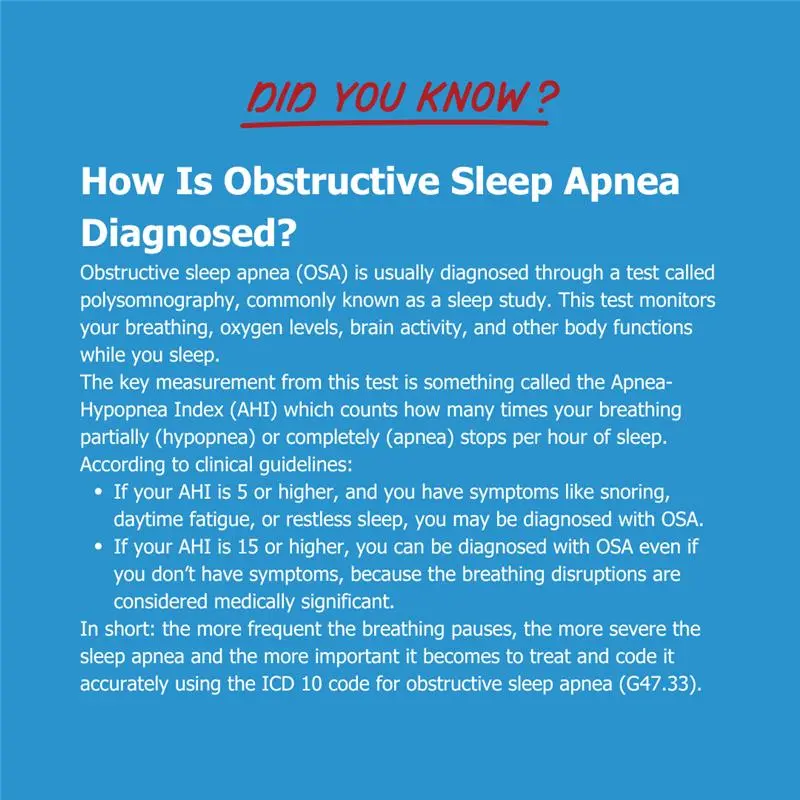
- Date and results of the polysomnography (AHI or RDI values)
- Clinical symptoms (e.g., excessive daytime sleepiness, snoring, nocturnal choking)
- Severity classification (mild, moderate, severe)
- Impact on daily function or comorbidities (e.g., fatigue affecting work, hypertension)
- Treatment plan (e.g., CPAP, BiPAP, referral to sleep specialist)
Example of Compliant Documentation:
“Patient reports excessive daytime fatigue, loud snoring, and observed apneic episodes during sleep. Home sleep study completed 06/10/2025 indicates AHI of 22, consistent with moderate OSA. Will initiate CPAP therapy and refer to DME provider for equipment setup.”
ICD 10 Code for Obstructive Sleep Apnea in Common Coding Scenarios
| Scenario | ICD-10 Codes | Details |
|---|---|---|
| OSA without other conditions | G47.33 | Confirmed OSA with symptoms but no comorbidities |
| OSA with obesity | G47.33 + E66.9 | Patient has BMI ≥ 30 with documented OSA |
| OSA with hypertension | G47.33 + I10 | OSA contributing to blood pressure control issues |
| OSA with fatigue | G47.33 + R53.83 | Daytime fatigue documented but secondary to OSA |
| OSA under treatment | G47.33 + Z99.89 | Add Z99.89 if patient is dependent on CPAP/BiPAP |
Best Practices for Sleep Disorder Coding
- Avoid assigning symptom-only codes (like snoring or fatigue) when a diagnosis of OSA has been confirmed.
- Use G47.33 as the primary code only when documentation supports confirmed OSA.
- Include treatment-related codes (e.g., Z99.89 for CPAP dependency) when equipment or long-term therapy is part of the patient’s care plan.
- Update coding annually, especially as OSA documentation requirements may change with payer policies
How Pro-MBS Supports Sleep Disorder Coding
The Pro-MBS coding team partners with sleep medicine specialists, otolaryngology (ENT) practices, and primary care providers to ensure precise and compliant assignment of the ICD-10 code for obstructive sleep apnea (G47.33) and related sleep disorder codes. Our certified coders review clinical documentation including sleep study reports, AHI results, and provider assessments to validate coding accuracy and support medical necessity per payer and CMS guidelines.
We proactively identify documentation gaps, coding inconsistencies, and high-risk billing patterns commonly associated with OSA and symptom-based codes like snoring or fatigue. By aligning diagnosis coding with test interpretation, severity levels, and treatment plans (e.g., CPAP/BiPAP usage), we help reduce claim denials, optimize reimbursements, and maintain audit-ready compliance across all sleep disorder claims.