

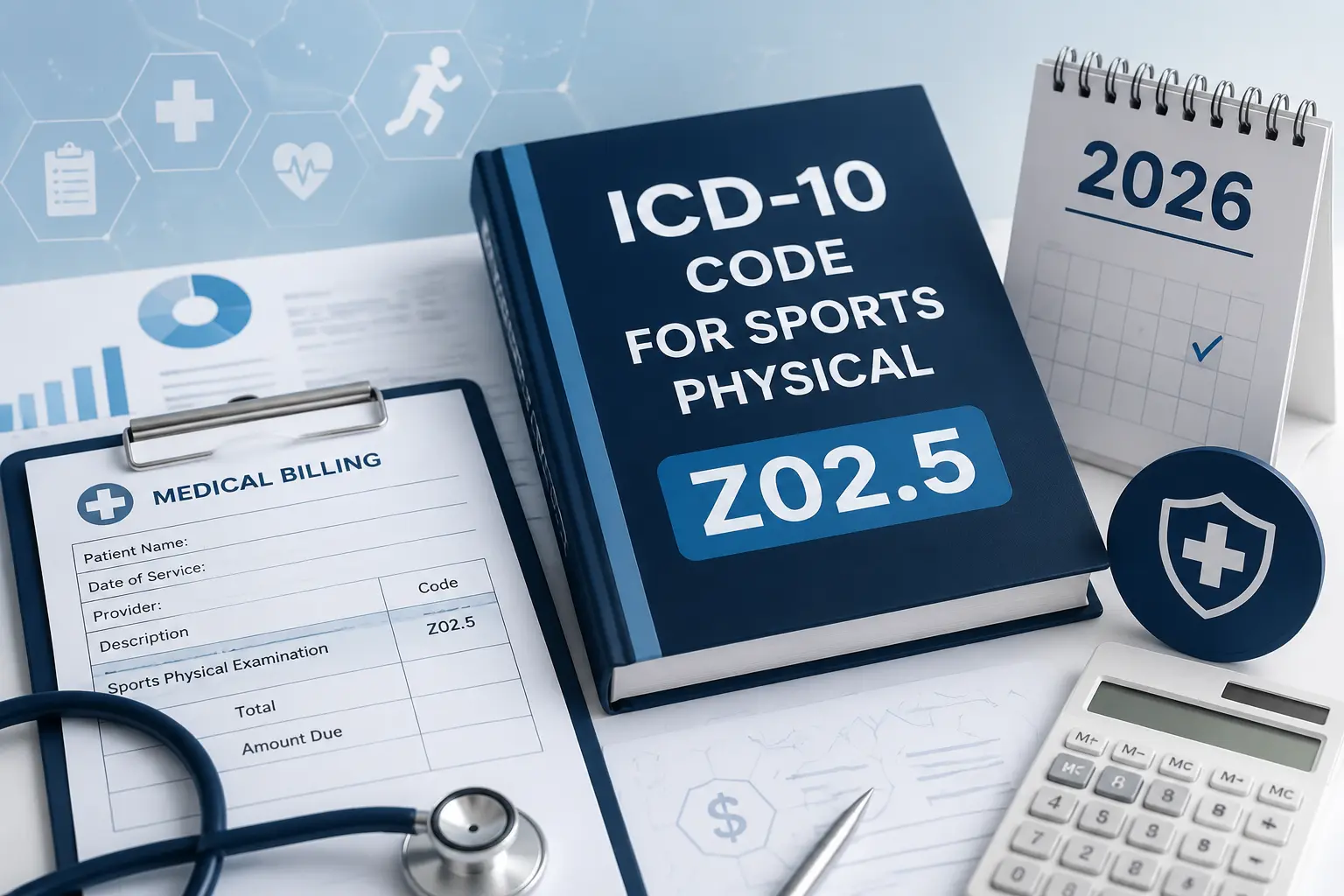
What Is the ICD-10 Code for a Sports Physical?
Quick answer: The ICD-10 code for a sports physical is Z02.5, “Encounter for examination for participation in sport.” It belongs in the primary diagnosis position whenever the sole reason for the visit is sports clearance, and it pairs with preventive medicine E/M codes 99381–99385 (new patients) or 99391–99395 (established patients).
That single-line answer sounds simple, but it is also where most sports physical claims start going wrong. Billers grab the general wellness code out of habit, forget to sequence a finding correctly, or send the claim out without the right CPT pairing. Each of those mistakes gets flagged differently by a payer, and each one adds days or weeks to reimbursement. If you bill for a primary care, pediatric, family medicine, or urgent care practice that sees athletes every fall and spring, getting this one code right on the first pass is worth more than most people give it credit for.
This guide walks through exactly when Z02.5 applies, how it compares to the code it most often gets confused with, how to sequence it against clinical findings, and where practices lose money without realizing it.
Z02.5 at a Glance
| Detail | Information |
|---|---|
| ICD-10 Code | Z02.5 |
| Full Description | Encounter for examination for participation in sport |
| Category | Z02 — Encounter for administrative examination |
| Chapter | Factors influencing health status and contact with health services |
| POA Reporting | Exempt (not applicable to inpatient admissions) |
| Principal Diagnosis Status | Not accepted as a principal inpatient diagnosis; used for outpatient administrative encounters |
| Accepted By | Medicare, Medicaid, and most commercial payers |
| Typical Position on Claim | Primary, unless a clinical finding is documented |
What Is a Sports Physical, Clinically Speaking?
A sports physical, formally called a preparticipation physical evaluation (PPE), is a focused medical assessment used to determine whether an athlete is fit to take part in organized sports. It is not the same encounter as a routine annual physical. A general wellness exam looks broadly at a patient’s overall health. A PPE looks specifically at whether this person’s body can safely handle the physical demands of a particular sport.
Most preparticipation evaluations are built around three goals:
- Identifying risk. The provider checks for musculoskeletal weaknesses, cardiac concerns, or other conditions that could turn into an injury under athletic stress.
- Confirming readiness. This covers cardiovascular endurance, joint stability, and general physical conditioning relative to the sport in question.
- Meeting eligibility requirements. Schools, athletic associations, and youth leagues almost always require documented medical clearance before a student or athlete can practice or compete.
Because the entire purpose of the visit is administrative clearance rather than diagnosis or treatment, the coding has to reflect that from the very first line on the claim. That is exactly what Z02.5 is built to do.
When to Use Z02.5 as the Primary Diagnosis
Z02.5 belongs in the primary position only when the visit exists purely for sports clearance, with no active complaint driving the encounter. The table below covers the scenarios that come up most often in a busy practice.
| Scenario | Use Z02.5 as Primary? | Why |
|---|---|---|
| School or high school athletics pre-participation exam | Yes | The sole purpose is clearance |
| Recreational or club league clearance visit | Yes | The sole purpose is clearance |
| College or adult athletic program physical | Yes | Z02.5 applies at any age |
| Patient reports knee pain and also wants clearance | No | The clinical complaint drives the visit |
| Patient has asthma and requests a sports clearance letter | No | The existing condition takes primary position |
| Annual wellness visit with no sports-related purpose | No | Different encounter type; see Z00.00 comparison below |
| Well-child exam only, no athletic clearance requested | No | Z02.5 does not apply |
The age of the patient, the sport, and the payer do not change this rule. If the reason for the visit is exclusively clearance, Z02.5 goes first. If something clinical surfaces or already exists, that condition takes the lead.
Z02.5 vs. Z00.00: The Two-Character Mistake That Triggers Denials
This is the single most common error in sports physical billing, and it comes down to a mix-up between two Z codes that look similar on paper but mean completely different things to a payer’s adjudication system.
| Attribute | Z02.5 | Z00.00 |
|---|---|---|
| Full Description | Encounter for examination for participation in sport | Encounter for general adult medical examination without abnormal findings |
| Encounter Type | Administrative clearance | Routine preventive exam |
| Correct Use | Sports physicals, pre-participation exams | Annual physical, general wellness visit |
| Effect if Used Incorrectly | Denial or audit flag if applied to a routine wellness visit | Denial, incorrect reimbursement, or audit flag if applied to a sports physical |
The two codes are not interchangeable, and payer systems treat them as entirely different service categories. If your practice regularly bills the routine physical exam ICD-10 code Z00.00 for annual wellness visits, it’s worth training front desk and clinical staff to flag any visit where “sports clearance” or “PPE” appears on the intake form, so it gets coded with Z02.5 instead. That single habit prevents a large share of avoidable denials during fall and spring physical season.
Billing Z02.5 With the Right CPT Code
Z02.5 on its own does not tell a payer anything about the level or type of service performed. It has to be paired with the correct preventive medicine Evaluation and Management (E/M) CPT code based on the patient’s age and status.
| Patient Status | CPT Code Range | Notes |
|---|---|---|
| New patient | 99381–99385 | Select based on age bracket |
| Established patient | 99391–99395 | Select based on age bracket |
When a sports physical happens alongside a general preventive visit on the same day, a few rules keep the claim clean:
- Bill the preventive E/M code that matches the patient’s age and new-or-established status, similar to the logic used for a routine preventive visit under CPT 99396.
- Assign Z02.5 as a secondary diagnosis if the preventive visit has its own separate reason.
- Append modifier 25 to the E/M code when billing both a well-child or wellness visit and a sports clearance on the same day, so the payer recognizes them as two distinct, separately identifiable services. Getting this modifier right matters enough that it’s worth reviewing the full modifier 25 in medical billing guide before submitting same-day claims.
How to Sequence Z02.5 When a Finding Is Discovered
Not every preparticipation exam comes back clean. When a provider identifies a clinical finding during the visit, the coding order flips completely, and getting this sequencing right is what separates a clean claim from a denial.
| Finding | Primary Diagnosis | Secondary Diagnosis |
|---|---|---|
| No findings, clearance only | Z02.5 | None needed |
| Elevated blood pressure identified | Condition-specific code (e.g., R03.0) | Z02.5 |
| Cardiac murmur detected, unspecified | Condition-specific code (e.g., R01.1) | Z02.5 |
| Exercise-induced bronchospasm noted | Condition-specific code (e.g., J45.990) | Z02.5 |
| Scoliosis identified | Condition-specific code (e.g., M41.9) | Z02.5 |
| Existing condition being monitored during clearance | Condition-specific code | Z02.5 |
The rule to remember is simple: whatever clinically drove the visit or was discovered during it goes first. Z02.5 moves to secondary to preserve the administrative context of the encounter without erasing the clinical finding from the record. If a finding also relates to a sports injury already under care, it’s worth checking whether the visit overlaps with an existing diagnosis, such as an athlete presenting with a prior injury like the one covered in the ICD-10 code for left knee pain guide, since that changes how the encounter should be coded and billed.
Common Coding Mistakes That Delay Payment
1. Defaulting to Z00.00 Out of Habit
This is by far the most frequent error. Front desk staff and coders who handle a high volume of wellness visits sometimes code a sports physical the same way, without realizing the payer processes the two encounter types under different medical necessity rules. The fix is procedural, not just educational: flag any encounter tagged “sports physical” or “PPE” at intake so it never gets coded on autopilot.
2. Leaving Abnormal Findings Off the Claim
When a provider notes something like elevated blood pressure, a heart murmur, or asthma symptoms during the exam, that finding needs its own code, sequenced ahead of Z02.5. Skipping it creates a mismatch between the clinical documentation and what was actually billed, which is exactly the kind of gap payers flag during audits.
3. Forgetting the CPT Pairing
Z02.5 by itself does not describe a billable service. Every claim needs the matching preventive E/M code (99381–99385 for new patients, 99391–99395 for established patients). A missing or mismatched CPT code is one of the fastest ways to trigger an automatic denial before a human reviewer ever sees the claim.
4. Missing Modifier 25 on Same-Day Visits
If a wellness exam and a sports clearance happen at the same appointment, the claim needs modifier 25 on the E/M code to show the payer these are two distinct, medically necessary services rather than duplicate billing.
5. Incomplete Documentation for Dual-Purpose Visits
Clear documentation practices matter just as much as code selection. Providers and coders working from a consistent framework, similar to the structure covered in general E/M documentation guidelines, tend to avoid the vague or incomplete notes that lead to secondary-code disputes later.
External Cause and Supplemental Coding for Injury-Related Visits
When a sports participation encounter overlaps with an evaluation for an actual sports-related injury, external cause and supplemental ICD-10 codes strengthen the claim by giving the payer context on how, where, and under what circumstances the injury happened. These are not required for every Z02.5 encounter, but they are worth adding whenever an injury is part of the visit, since they improve claim specificity and support audit readiness.
| Code Type | Examples | Purpose |
|---|---|---|
| Activity Codes (Y93 series) | Y93.61 – Activity, American football Y93.67 – Activity, basketball |
Identifies the specific sport involved; often required for coverage in school, collegiate, or organized athletic programs |
| Place of Occurrence Codes (Y92 series) | Y92.310 – Basketball court Y92.320 – Baseball field |
Documents the setting of the event; relevant for liability and coverage determinations |
| Mechanism of Injury Codes (W21 series) | W21.01XA – Struck by football, initial encounter | Provides precise documentation for injury surveillance and payer review |
Using these codes in injury-related pre-participation visits increases claim specificity, reduces the likelihood of a payer sending a follow-up request for more detail, and creates a stronger clinical and legal record of the encounter.
Payer-Specific Notes Worth Knowing
- Some state Medicaid programs and managed care plans require the routine child health examination code to sit as the primary diagnosis when a sports physical is combined with a well-child visit, with Z02.5 listed as secondary. Always confirm the sequencing rule for the specific plan before submitting.
- Coverage for a standalone sports physical is not universal. Some payers exclude it entirely as a non-covered administrative service, which means verifying benefits before the visit saves the practice an avoidable denial and saves the patient a surprise bill.
- When insurance does not cover the visit, collecting a self-pay agreement at scheduling, with the fee clearly stated, keeps the encounter simple and avoids sending a claim that was never going to be reimbursed in the first place.
A Repeatable Workflow for Clean Sports Physical Claims
- Confirm the purpose of the visit: pure clearance, or is a clinical issue also involved?
- Check whether the patient is new or established.
- Confirm the age bracket to select the correct CPT code range.
- Check whether the annual preventive benefit has already been used this year.
- Select the preventive E/M CPT code that matches age and status.
- Assign Z02.5 as primary if there are no findings, or as secondary if a condition is coded first.
- Append modifier 25 if a well-child or wellness exam is billed on the same day.
- Verify payer-specific sequencing rules, particularly for Medicaid plans.
- Submit with documentation that fully supports every code on the claim.
Practices that turn this into a standard checklist, rather than relying on individual coder memory, tend to see far fewer denials tied to sports physicals, and they get paid faster because the claim rarely needs a second look from the payer.
Free Coding Review
Sports physical claims getting denied more than they should?
PROMBS reviews Z02.5 sequencing, CPT pairing, and modifier usage as part of every coding audit, so clean claims go out the first time.
How PROMBS Approaches Z02.5 Coding
Our coding team applies the same sequencing logic outlined above to every sports physical claim that crosses our desk, with a workflow built around four checkpoints:
- Accurate ICD-10 and CPT alignment — correct pairing of Z02.5 with the appropriate preventive E/M code every time.
- Code optimization — making sure the diagnosis and procedure codes reflect the actual scope and findings of the encounter, not a shortcut.
- Documentation audits — reviewing encounter notes against payer rules and ICD-10 guidelines before the claim goes out, not after a denial comes back.
- Claim scrubbing — catching sequencing errors, missing modifiers, and code conflicts before submission.
This is the same standard we apply across our broader medical coding services, and it’s what keeps sports season from becoming a denial season for the practices we work with.
Frequently Asked Questions
What is the ICD-10 code for a sports physical?
Z02.5, “Encounter for examination for participation in sport,” is the correct diagnosis code for any visit where the sole purpose is sports clearance. It is accepted by Medicare, Medicaid, and most commercial payers when paired with the correct preventive medicine CPT code.
Is there a different code for school sports physicals versus adult or recreational league physicals?
No. Z02.5 applies across the board, whether the setting is a high school team, a college program, or an adult recreational league. The sport and the setting do not change which code applies.
What happens if Z00.00 is used instead of Z02.5?
Using Z00.00 for a sports physical misclassifies the encounter as a routine wellness exam in the payer’s system. This typically leads to a denial, an incorrect reimbursement, or an audit flag, since the payer’s coverage rules for the two encounter types are different.
Can Z02.5 be used as a secondary diagnosis?
Yes. When a provider identifies a clinical finding during the exam, such as elevated blood pressure or a heart murmur, that finding is coded first and Z02.5 follows as secondary to preserve the administrative reason for the visit.
Does Z02.5 apply to adults, or only to school-age athletes?
Z02.5 applies to any age group. Whether the patient is 14 or 45, Z02.5 is the correct primary code whenever the reason for the visit is sports participation clearance.
What CPT code should be billed alongside Z02.5?
Preventive medicine E/M codes 99381–99385 for new patients or 99391–99395 for established patients, selected according to the patient’s age bracket.
Do external cause codes need to be billed with every Z02.5 claim?
No. External cause and supplemental codes from the Y93, Y92, and W21 series are only relevant when the visit involves an actual sports-related injury. For a standard clearance exam with no injury, they are not needed.
Free Practice Audit
Denials from sports physical season eating into your revenue?
Let PROMBS handle the coding, sequencing, and payer-specific rules so your team can focus on patients.
Schedule a Free Practice Audit →
PB
PROMBS Coding Team
Medical billing and coding specialists helping U.S. healthcare practices code accurately, reduce denials, and get paid faster.