

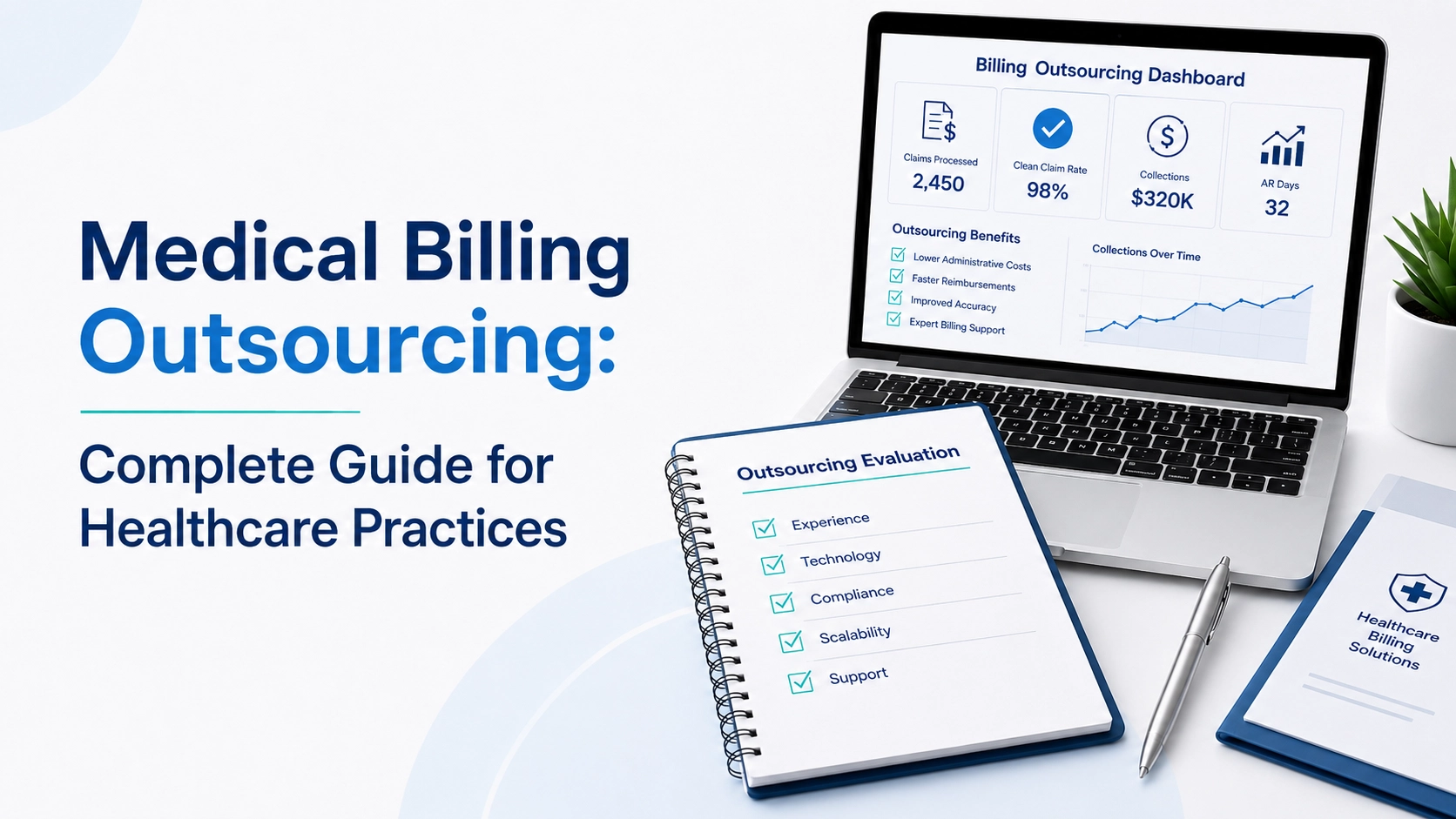
Running a healthcare practice involves much more than providing quality patient care.
Behind every successful practice is a complex financial process that includes:
- Managing insurance requirements
- Submitting accurate claims
- Following up on unpaid balances
- Handling denials
- Keeping up with changing payer rules
For many healthcare organizations, managing all of these responsibilities internally can become overwhelming.
This is where medical billing outsourcing becomes valuable.
Medical billing outsourcing allows healthcare practices to partner with an external billing team that manages important revenue cycle tasks, helping providers reduce administrative workload and improve financial performance.
Instead of spending hours managing claims, coding issues, and payer follow-ups, practices can rely on specialized professionals who understand healthcare billing workflows.
A well-managed outsourcing partnership can help practices:
- Improve claim accuracy
- Reduce billing errors
- Manage denied claims more effectively
- Improve collections
- Gain better revenue visibility
- Allow staff to focus more on patient care
However, outsourcing medical billing is not simply about handing over claims to another company.
Choosing the wrong partner can create new challenges, including:
- Poor communication
- Lack of reporting
- Limited specialty knowledge
- Data security concerns
- Reduced visibility into revenue performance
The goal is not just outsourcing billing tasks.
The goal is finding a reliable revenue cycle partner that improves the entire financial process.
This guide explains what medical billing outsourcing is, what services are included, why practices choose it, potential challenges, costs, and how to select the right partner.
What Is Medical Billing Outsourcing?
Medical billing outsourcing is the process of hiring an external company to manage some or all billing-related activities for a healthcare practice.
Instead of maintaining a complete internal billing department, practices work with specialized professionals who handle revenue cycle tasks on their behalf.
These services may include:
- Insurance verification
- Medical coding
- Charge entry
- Claim submission
- Payment posting
- Denial management
- Accounts receivable follow-up
- Patient billing support
- Revenue reporting
The purpose of outsourcing is to help healthcare organizations create a more efficient billing workflow while reducing the administrative burden on internal teams.
Medical Billing Outsourcing Is More Than Claim Submission
One common misunderstanding is that outsourcing medical billing simply means sending claims to another company.
In reality, effective outsourcing involves managing the entire billing workflow.
A strong outsourcing partner helps practices address challenges before they become payment problems.
For example:
A claim denial may appear to be a billing issue.
But the actual cause could be:
- Incorrect insurance verification
- Missing authorization
- Documentation gaps
- Incorrect coding
- Poor claim review
A good outsourcing partner does not only fix denied claims.
They analyze why problems happen and improve the processes behind them.
What Services Are Included in Medical Billing Outsourcing?
The exact services included depend on the practice and billing partner.
Some practices outsource only specific tasks, while others outsource their complete revenue cycle.
1. Insurance Verification and Eligibility Checking
The billing process starts before the claim exists.
Insurance verification helps confirm:
- Active coverage
- Benefits
- Deductible information
- Patient responsibility
- Authorization requirements
Accurate eligibility verification helps prevent avoidable claim problems.
For example:
A practice may provide a service believing it is covered, only to discover later that the patient’s plan had limitations.
Early verification reduces these situations.
2. Medical Coding Support
Coding plays a major role in reimbursement.
Medical coders translate provider documentation into standardized codes used by insurance companies.
This includes:
- CPT codes
- ICD-10 codes
- HCPCS codes
- Modifiers
Accurate coding helps ensure claims correctly represent the services provided.
Coding mistakes can lead to:
- Claim denials
- Underpayments
- Delayed reimbursement
3. Charge Entry
Charge entry ensures all billable services are captured correctly.
This involves reviewing:
- Services provided
- Procedure codes
- Diagnosis codes
- Patient information
- Provider details
Missing charges can directly impact practice revenue.
4. Claim Submission and Management
A billing outsourcing partner helps prepare and submit claims accurately.
This includes:
- Claim review
- Claim scrubbing
- Electronic submission
- Payer communication
- Claim status monitoring
The goal is improving clean claim rates and reducing unnecessary delays.
5. Payment Posting
Payment posting involves recording:
- Insurance payments
- Patient payments
- Adjustments
- Remaining balances
Accurate payment posting helps practices understand their actual financial performance.
6. Denial Management
Denial management is one of the most important parts of outsourced billing.
A strong process includes:
- Reviewing denial reasons
- Identifying patterns
- Correcting errors
- Managing appeals
- Preventing repeat issues
A good outsourcing partner focuses on denial prevention, not only denial recovery.
7. Accounts Receivable Management
Outstanding claims can significantly affect cash flow.
AR management includes:
- Reviewing aging claims
- Following up with payers
- Prioritizing unpaid balances
- Recovering delayed revenue
Effective AR management helps practices collect revenue that may otherwise remain unpaid.
Medical Billing Outsourcing Workflow
| Step | Purpose |
|---|---|
| Patient Information Review | Ensures accurate demographic and insurance information. |
| Eligibility Verification | Confirms coverage, benefits, and payer requirements. |
| Documentation Review | Ensures services support accurate billing. |
| Medical Coding | Converts healthcare services into standardized codes. |
| Claim Submission | Sends accurate claims to insurance companies. |
| Payment Posting | Records payments and adjustments. |
| Denial Management | Identifies and resolves claim issues. |
| AR Follow-Up | Manages unpaid claims and improves collections. |
Why Healthcare Practices Consider Medical Billing Outsourcing
Healthcare practices usually consider outsourcing when billing becomes difficult to manage internally.
Common reasons include:
- Increasing claim denials
- Staffing challenges
- Growing administrative workload
- Lack of billing expertise
- Difficulty tracking revenue performance
Outsourcing allows practices to access specialized billing professionals without building a large internal team.
Many outsourcing guides emphasize that practices typically outsource tasks such as coding, claim submission, payment posting, denial management, and AR follow-up to improve efficiency and reduce administrative pressure.
Signs Your Practice Should Consider Medical Billing Outsourcing
Medical billing outsourcing is not automatically the right choice for every healthcare organization.
Some practices have strong internal billing teams and processes that work well.
However, outsourcing becomes worth considering when billing challenges begin affecting revenue, staff workload, or practice growth.
Here are some common signs that a practice may benefit from outsourcing.
1. Your Denials Are Increasing
Rising denial rates are one of the clearest signs that a revenue cycle needs attention.
Frequent denials may indicate problems with:
- Coding accuracy
- Documentation
- Eligibility verification
- Authorization workflows
- Claim review processes
A practice may continue submitting claims, but if the underlying issues are not fixed, revenue will continue to leak.
A specialized outsourcing partner can analyze denial patterns and help identify where problems are occurring.
2. Your Staff Is Spending Too Much Time on Billing Tasks
Many healthcare practices have administrative teams handling multiple responsibilities:
- Patient communication
- Scheduling
- Insurance questions
- Prior authorizations
- Billing follow-up
As billing becomes more complex, staff may spend less time on patient-facing activities.
Outsourcing allows internal teams to focus on practice operations while experienced billing professionals handle revenue cycle tasks.
3. Your Accounts Receivable Is Growing
Growing accounts receivable is often a sign that payments are getting delayed.
Common causes include:
- Unworked claims
- Slow payer follow-up
- Denial accumulation
- Inefficient collection workflows
A strong outsourcing partner can help practices:
- Review aging claims
- Prioritize unpaid balances
- Follow up with payers
- Recover delayed revenue
4. You Are Struggling to Hire or Retain Billing Staff
Finding experienced medical billing professionals can be challenging.
A practice may struggle with:
- Staff turnover
- Training costs
- Losing billing knowledge when employees leave
- Keeping up with coding updates
Outsourcing reduces dependence on a single employee and provides access to a broader team of billing specialists.
5. Your Practice Is Growing
Growth creates new billing challenges.
A growing practice may experience:
- More claims
- More providers
- Additional specialties
- More insurance relationships
- Increased administrative complexity
An outsourced billing partner can provide scalable support without requiring the practice to continuously hire additional staff.
Benefits of Medical Billing Outsourcing
The main reason practices outsource billing is not simply cost reduction.
The bigger goal is improving the overall revenue cycle.
A quality outsourcing partner can provide several advantages.
1. Access to Specialized Billing Expertise
Medical billing requires ongoing knowledge of:
- Coding changes
- Insurance requirements
- Payer policies
- Documentation standards
- Denial prevention strategies
Maintaining this expertise internally can be difficult, especially for smaller practices.
Outsourcing provides access to professionals who focus specifically on revenue cycle management.
2. Improved Collection Performance
One of the biggest benefits of outsourcing is creating more consistent payment workflows.
A specialized billing team can help improve:
- Claim accuracy
- Follow-up processes
- Denial resolution
- AR management
The goal is reducing the amount of revenue that gets delayed or lost.
3. Reduced Administrative Overhead
Managing billing internally requires investment in:
- Employee salaries
- Training
- Software
- Compliance updates
- Management time
Outsourcing allows practices to convert many of these fixed responsibilities into a structured service model.
4. Better Denial Management
Denial prevention requires more than appealing rejected claims.
A strong outsourcing partner focuses on:
- Identifying denial patterns
- Understanding payer behavior
- Improving coding workflows
- Reviewing documentation issues
This helps reduce repeated problems.
5. Better Reporting and Revenue Visibility
Many practices struggle because they know their collections but do not fully understand their revenue cycle performance.
Outsourced billing partners often provide reporting related to:
- Claims
- Payments
- Denials
- AR aging
- Collection trends
Better visibility helps practice owners make informed decisions.
How Much Does Medical Billing Outsourcing Cost?
Cost is one of the biggest questions practices ask before outsourcing.
The answer depends on:
- Practice size
- Specialty
- Claim volume
- Services included
- Complexity of billing workflows
Common pricing models include:
1. Percentage-Based Pricing
This is one of the most common models.
The billing company charges a percentage of collections.
For example:
A company may charge based on the revenue it helps collect.
Advantages:
- Cost scales with practice revenue
- Lower upfront investment
- Aligns billing company incentives with collections
2. Flat Monthly Pricing
Some companies charge a fixed monthly fee.
This may work well for practices that prefer predictable expenses.
Factors affecting pricing include:
- Number of providers
- Claim volume
- Services required
3. Per-Claim Pricing
Some billing companies charge based on the number of claims processed.
This model may work for practices with predictable claim volume.\
What Affects Medical Billing Outsourcing Costs?
Several factors influence pricing.
Practice Specialty
Different specialties have different levels of complexity.
For example:
- Behavioral health billing
- Cardiology billing
- Orthopedic billing
- Radiology billing
may require different levels of expertise.
Services Included
A basic billing package may include:
- Claim submission
- Payment posting
A full-service solution may include:
- Coding
- Eligibility verification
- Denial management
- AR follow-up
- Reporting
Claim Volume
A larger practice with thousands of monthly claims may require more resources than a smaller practice.
Common Concerns About Medical Billing Outsourcing
Although outsourcing provides many benefits, practices often have understandable concerns.
A good decision requires understanding both the advantages and potential challenges.
Concern 1: “Will I Lose Control Over My Revenue?”
This is one of the biggest concerns practices have.
Some providers worry that outsourcing means losing visibility into billing operations.
The solution is choosing a partner that provides:
- Transparent reporting
- Regular updates
- Clear communication
- Performance reviews
Outsourcing should improve visibility, not reduce it. Some practices also keep a virtual billing coordinator in-house to review reports and stay close to day-to-day billing activity.
Concern 2: “Will Patient Data Be Secure?”
Healthcare data security is critical.
Before choosing a billing partner, practices should ask about:
- HIPAA compliance
- Data protection processes
- Security policies
- Access controls
A trustworthy partner should clearly explain how patient information is protected.
Concern 3: “Will Communication Become Difficult?”
Communication is one of the most important parts of a successful outsourcing relationship.
Before signing an agreement, understand:
- Who your main contact is
- How issues are handled
- How often reports are provided
- How performance is reviewed
A billing company should feel like an extension of your team.
Concern 4: “Will Switching Billing Companies Disrupt Operations?”
Transition concerns are common.
A professional outsourcing partner should have a clear onboarding process covering:
- Data transfer
- Existing AR handling
- System integration
- Workflow setup
- Communication planning
A structured transition minimizes disruption.
Medical Billing Outsourcing Decision Checklist
| Question | Why It Matters |
|---|---|
| Are claim denials increasing? | High denial rates may indicate workflow problems that require specialized support. |
| Is billing taking too much staff time? | Outsourcing can reduce administrative workload. |
| Is AR increasing? | External support can improve claim follow-up and collections. |
| Do you lack revenue visibility? | Reporting helps practices understand financial performance. |
| Are you growing quickly? | Outsourcing provides scalable billing support. |
How to Choose the Right Medical Billing Outsourcing Partner
Choosing a medical billing outsourcing company requires more than comparing prices.
A billing partner becomes responsible for an important part of your practice operations, including:
- Claims
- Payments
- Denials
- Accounts receivable
- Revenue reporting
Before making a decision, healthcare practices should evaluate several important areas.
1. Look for Healthcare Experience and Specialty Knowledge
Not all medical billing is the same.
Different specialties have different:
- Coding requirements
- Documentation standards
- Payer challenges
- Common denial reasons
For example:
A cardiology practice may deal with different billing challenges than a behavioral health practice or orthopedic clinic.
A good outsourcing partner should understand your specialty and the problems your practice commonly faces.
What to Ask:
- Do you have experience with my specialty?
- How many similar practices do you currently support?
- What billing challenges do you commonly see in this specialty?
What a Good Answer Looks Like:
A strong company should provide specific examples:
“We work with similar practices and understand common denial patterns, payer requirements, and coding challenges.”
A generic answer like:
“We handle all types of medical billing.”
may not provide enough confidence.
2. Understand Exactly What Services Are Included
Every outsourcing company offers different levels of support.
Some companies only manage:
- Claim submission
- Payment posting
Others provide complete revenue cycle support.
Before signing an agreement, confirm whether services include:
- Eligibility verification
- Medical coding
- Claim submission
- Denial management
- AR follow-up
- Patient billing
- Reporting
Many vendor selection guides recommend confirming the full scope of services instead of assuming everything is included.
3. Evaluate Their Denial Management Process
Denial management is one of the biggest differences between average and excellent billing companies.
A company that only resubmits denied claims is not solving the underlying problem.
A strong partner should analyze:
- Why claims are denied
- Which payers create problems
- Which services are affected
- How workflows can improve
Ask:
“How do you prevent recurring denials?”
A Strong Answer Includes:
- Denial tracking
- Root cause analysis
- Appeal management
- Payer trend monitoring
- Process improvement
The goal should be:
Fewer denials tomorrow, not just more appeals today.
4. Review Their Reporting and Transparency
One of the biggest concerns practices have with outsourcing is losing visibility.
A good outsourcing partner should make your financial performance easier to understand.
You should have access to reports showing:
- Collections
- Claim status
- Denial trends
- AR aging
- Payment performance
Ask:
“What reports will we receive every month?”
A Strong Answer Includes:
- Sample reports
- Performance dashboards
- Regular review meetings
- Explanation of key metrics
A billing company should not only send numbers.
They should help you understand what those numbers mean.
5. Understand Their Technology and Workflow
Modern medical billing depends heavily on technology.
Your outsourcing partner should be able to work efficiently with:
- EHR systems
- Practice management software
- Clearinghouses
- Reporting platforms
Poor integration can create:
- Duplicate work
- Data errors
- Communication issues
Ask:
- What systems do you support?
- How is information transferred?
- How do you protect patient data?
6. Review Pricing Carefully
Cost matters, but the cheapest option is not always the best option.
A low-cost billing company may provide limited services or weak support.
Common pricing models include:
Percentage-Based Pricing
The company charges a percentage based on collections.
Advantages:
- Aligns incentives
- Lower upfront cost
Flat Monthly Pricing
The practice pays a fixed monthly amount.
Advantages:
- Predictable expenses
- Easier budgeting
Per-Claim Pricing
The company charges based on claim volume.
Advantages:
- Works well for certain practice types
Before signing, understand:
- What is included
- Additional fees
- Setup costs
- Reporting costs
- Contract terms
Transparency is more important than simply choosing the lowest price.
7. Check Communication and Support Structure
A successful outsourcing relationship depends on communication.
You should know:
- Who manages your account
- How quickly questions are answered
- How problems are escalated
- How often performance is reviewed
A billing company should feel like an extension of your team.
8. Understand the Transition Process
Switching billing companies can feel risky.
A professional outsourcing partner should have a clear onboarding process.
Ask about:
- Data transfer
- Existing AR handling
- System setup
- Timeline
- Training
A smooth transition protects your revenue during the change.
Medical Billing Outsourcing Partner Evaluation Checklist
| Evaluation Area | What to Look For |
|---|---|
| Specialty Experience | Experience with your specialty, payer requirements, and common billing challenges. |
| Services Included | Clear explanation of billing, coding, denial management, and AR support. |
| Reporting | Transparent reports showing claims, payments, denials, and performance. |
| Technology | Ability to integrate with your systems and maintain secure workflows. |
| Communication | Dedicated support and clear escalation processes. |
| Pricing | Transparent fees without unexpected charges. |
How Pro Medical Billing Solutions Supports Healthcare Practices
Medical billing outsourcing works best when the partner focuses on improving the entire revenue cycle, not just processing claims.
Pro Medical Billing Solutions helps healthcare practices manage:
- Medical billing workflows
- Coding support
- Insurance verification
- Claim submission
- Denial management
- Accounts receivable follow-up
- Revenue cycle reporting
- Credentialing support
Our approach focuses on identifying where revenue is delayed and improving the processes responsible for those challenges.
A strong outsourcing partner should help practices:
- Reduce administrative burden
- Improve claim accuracy
- Understand financial performance
- Create more predictable collections
Learn more about our Medical Billing Services and how PROMBS supports healthcare organizations with complete revenue cycle solutions.
Frequently Asked Questions
What is medical billing outsourcing?
Medical billing outsourcing is when a healthcare practice hires an external company to manage billing and revenue cycle tasks such as coding, claim submission, payment posting, denial management, and AR follow-up.
Is medical billing outsourcing worth it?
Outsourcing can be valuable for practices that want access to billing expertise, reduce administrative workload, improve collections, and strengthen revenue cycle processes.
The value depends on choosing the right partner and having clear performance expectations.
How much does medical billing outsourcing cost?
Costs vary based on:
- Practice size
- Specialty
- Claim volume
- Services included
- Billing complexity
Common pricing models include percentage-based, flat-fee, and per-claim structures.
What services are included in outsourced medical billing?
Services may include:
- Insurance verification
- Coding
- Claims processing
- Payment posting
- Denial management
- AR follow-up
- Reporting
The exact scope depends on the agreement.
How do I choose a medical billing outsourcing company?
Look for:
- Specialty experience
- Transparent reporting
- Strong denial management
- Clear pricing
- Reliable communication
- Proven revenue cycle expertise
The right partner should help improve your financial performance, not simply process claims.
Final Thoughts: Is Medical Billing Outsourcing Right for Your Practice?
Medical billing outsourcing can provide healthcare practices with access to specialized expertise, better workflows, and improved revenue cycle visibility.
However, success depends on choosing the right partner.
The best outsourcing relationship is not built around simply sending claims to another company.
It is built around:
- Better processes
- Clear communication
- Transparent reporting
- Continuous improvement
Before making a decision, evaluate your practice needs, ask the right questions, and choose a partner that understands your goals.
A strong medical billing outsourcing partner can help your practice reduce administrative pressure, improve reimbursement performance, and allow your team to focus more on patient care.
Ready to understand how outsourcing can improve your billing process? Contact Pro Medical Billing Solutions and discover opportunities to strengthen your revenue cycle.