


Picture a busy Monday in an ophthalmology practice. The schedule is full. One patient needs glaucoma testing, another is preparing for cataract surgery, and several retina patients are due for injections. Clinically, the day goes well.
Six weeks later, the financial picture looks very different. One injection was authorized for the wrong date. A diagnostic test was billed without a signed interpretation. A routine benefit was sent to the medical payer. The cataract claim paid, but not at the expected contracted rate.
None of those problems began in the billing department. That is the point of Ophthalmology RCM.
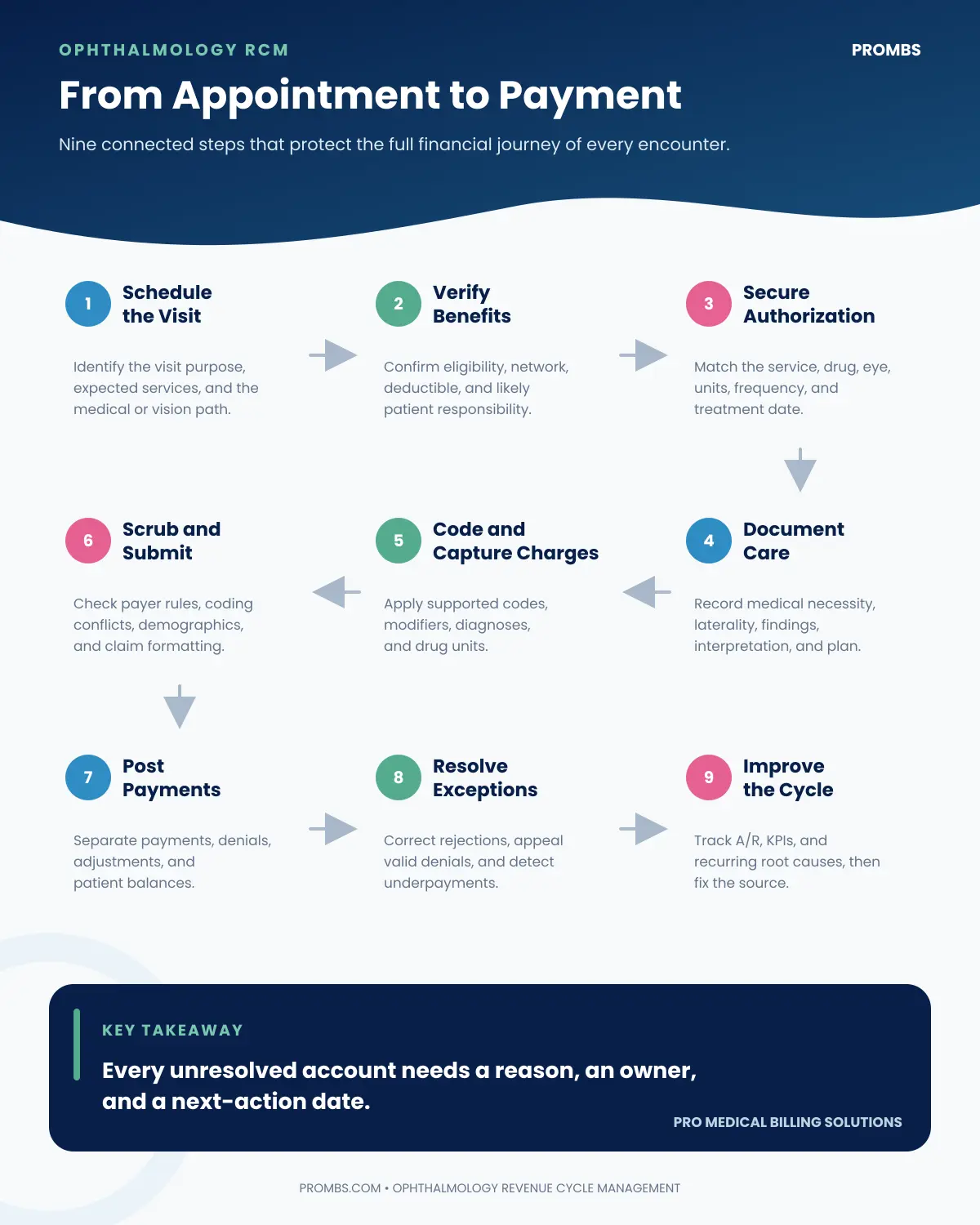
Ophthalmology revenue cycle management connects every financial step surrounding a patient encounter, beginning with scheduling and ending only when the correct payer and patient balances have been resolved. It covers benefits, authorizations, documentation, charge capture, coding, claims, payment posting, denials, accounts receivable, and reporting.
When those parts work as one system, cash flow becomes more predictable. When they operate as separate desks, small mistakes travel a surprisingly long way before anyone notices them.
What Ophthalmology RCM Actually Means
Ophthalmology revenue cycle management is often treated as a longer name for medical billing. It is broader than that.
For Example:
Billing is, “Was the claim prepared and submitted correctly?”
RCM is a larger set of questions like:
- Was the right insurance identified before the visit?
- Was authorization secured for the exact service delivered?
- Did the clinical record support what was billed?
- Did the payer process the claim under the correct policy?
- Was the payment consistent with the contract?
- If the account remains open, who owns the next action?
That last question catches many practices off guard. An account may show “pending,” “in review,” or “appealed,” but none of those labels tells leadership whether someone is actively responsible for it.
A well-run eye care revenue cycle gives every unfinished account a reason, an owner, and a next-action date. Without those three things, A/R can look organized while quietly getting older.
Why Ophthalmology Revenue Is So Easy to Disrupt
Eye care combines routine services, medical treatment, surgery, diagnostics, expensive drugs, and patient-paid options. Each follows a slightly different financial path. A generic billing workflow rarely handles all of them well.
The medical-versus-vision split starts before check-in
A patient may say, “I’m here for an eye exam,” but that description does not tell the team which benefit should be used.
Is the visit routine? Is the patient reporting a medical symptom? Is the physician monitoring diabetic retinopathy, glaucoma, or macular degeneration? Will refraction be performed alongside medically necessary care?
The answer affects the payer, patient responsibility, documentation, and claim.
Original Medicare does not cover routine eye examinations for eyeglasses or contact lenses, although some Medicare Advantage plans offer additional vision benefits. The individual plan still has to be checked. Medicare’s routine eye exam guidance is a useful starting point, not a replacement for plan-specific verification.
This is why the first scheduling conversation matters. If staff wait until checkout to decide whether a visit belongs to medical or vision benefits, the practice is already trying to repair the workflow from the wrong end.
The patient insurance verification guide offers a more detailed checklist for confirming coverage and patient responsibility before care is delivered.
A small mismatch can put a large balance at risk
In a low-value claim, a demographic mistake is frustrating. In retina or surgical ophthalmology, a small mismatch may place a high-cost service at risk.
Consider an anti-VEGF treatment. The authorization, medication administered, dosage, billed units, product information, laterality, inventory record, and claim all need to agree.
If the authorization covers one product and the physician uses another, having an authorization number does not solve the problem.
The same principle applies to cataract and glaucoma procedures. The record has to support the procedure performed, relevant modifiers, and any separately reported services. Co-management arrangements and patient-paid upgrades add more handoffs, which means more places for information to drift.
Clinical documentation becomes financial evidence
Payers never see the quality of the conversation in the exam room. They see codes and, when requested, the record supporting them.
Laterality, an order for testing, findings, interpretation, medical necessity, treatment response, and the assessment and plan are not clerical details. They are the evidence behind the claim.
One common scenario is a diagnostic test that was clearly useful to the physician but poorly connected to the plan in the note. The billing team may have the correct test code and diagnosis family, yet the record does not explain why the test was necessary that day.
The denial arrives later, but the weakness began in documentation.
Find Out Where the Revenue Cycle First Breaks
A denial report only shows the problems that reached a payer. A focused review can also uncover eligibility mistakes, unsigned encounters, authorization mismatches, underpayments, and balances adjusted too early.
Follow the Money Through an Ophthalmology Practice
The cleanest way to understand RCM is to follow one encounter from the appointment request to the final balance.
Before the patient arrives
Scheduling sets the financial path. Staff should know why the patient is coming, which services are expected, whether a referral is required, and whether the appointment should trigger authorization work.
Eligibility verification then confirms more than active coverage. Depending on the service, the practice may need to check:
- Network participation
- Deductibles
- Copays and coinsurance
- Referral rules
- Authorization requirements
- Frequency limitations
- Separate vision benefits
For recurring treatment, verification cannot be a one-time event. Plans change. Authorizations expire. Approved units run out.
A patient who was clear at the start of a treatment series may not remain clear throughout it.
This is also the right time to discuss likely patient responsibility. The estimate should be useful but honest. It is based on available benefit information, not a promise that the payer will adjudicate the claim exactly as expected.
During the encounter
The clinician’s job is patient care, not writing notes for a payer. Still, the clinical record must tell a complete story.
For an office visit, the note should support the service selected. For testing, the record should connect the order, result, interpretation, and treatment plan. For a procedure, it should identify what was done and why.
Templates can help, but cloned language can make a record less credible when the diagnosis, eye, findings, or plan has changed.
Good documentation prompts are quiet guardrails. They remind the provider about missing clinical elements without turning the note into a wall of generic text.
After the note is signed
Charge capture should happen quickly enough that missing details can still be clarified.
A chart left open for several days does more than delay one claim. When that behavior repeats across providers, it creates artificial swings in charges and cash flow.
The coding team then decides how the documented service should be reported. Specialty-specific ophthalmology coding may involve:
- Eye visit codes or E/M codes
- Diagnosis specificity
- Laterality
- Diagnostic testing
- Same-day services
- Global periods
- Bilateral procedures
- Drug units
The correct decision is not always the one with the higher allowed amount. It is the one supported by the record and accepted under the applicable payer rules.
PROMBS’s guide to ophthalmology medical billing goes deeper into eye codes, E/M services, modifiers, global periods, and common documentation risks.
Before submission, a claim scrubber should catch routine formatting and coding conflicts. Specialty edits still need human oversight. A generic rule can flag that a modifier is missing, but it cannot decide whether the documentation supports adding it.
When the remittance comes back
Payment posting is not data entry at the end of the cycle. It is where the practice learns what the payer actually did.
The posting team should distinguish:
- Contractual adjustments
- Denials
- Patient responsibility
- Secondary balances
- True write-offs
Zero-dollar lines need particular attention. If automation posts a denial as an adjustment, the account may disappear from follow-up even though money is still collectible.
Expected reimbursement also matters. A paid claim is not necessarily a correctly paid claim. Without a reliable contracted-rate comparison, underpayments can close unnoticed.
Imagine a payer consistently allowing slightly less than the contracted amount for one diagnostic service. Each variance looks too small to chase on its own. Across hundreds of claims, it becomes material.
Total collections may still look healthy, which is why this problem often survives for months.
When the claim does not pay
A clearinghouse rejection and a payer denial are not the same event.
A rejection usually means the claim failed before adjudication because of missing, invalid, or incorrectly formatted information.
A denial means the payer received and adjudicated the claim but did not pay it as submitted. The follow-up, deadlines, and corrective action may be different.
Strong ophthalmology denial management begins by identifying what actually happened.
Was the issue eligibility, authorization, coding, medical necessity, a duplicate, a frequency edit, timely filing, or payer processing? Was the claim corrected, reopened, or formally appealed? Did the team attach the right clinical evidence?
Repeatedly resubmitting the same claim is not persistence. Sometimes it only creates duplicate denials while the appeal deadline keeps moving closer.
Accounts receivable work should therefore be organized by more than age. Dollar value, filing or appeal deadline, payer behavior, denial cause, and recovery likelihood all matter.
The accounts receivable management guide explains how to prioritize balances without abandoning older, recoverable revenue.
Ophthalmology Coding Needs Judgment, Not a Bigger Cheat Sheet
Code lists have a short shelf life. The reasoning behind good coding lasts longer.
Eye visit code or E/M code?
The choice should be based on the documented encounter, payer requirements, and the code set’s rules. It should not be made solely by comparing reimbursement.
If the practice always defaults to one family, it may leave supported revenue unreported in some cases and create compliance risk in others.
Periodic chart review can show whether providers document similar encounters consistently and whether coding decisions follow that documentation.
Modifiers should explain a real circumstance
A modifier is not a tool for forcing a bundled service through the claims system.
It communicates a fact about the encounter, such as a distinct service, laterality, or care provided during a global period. The documentation must support that fact.
CMS updates its National Correct Coding Initiative policy manual annually. That alone is a good reason to check the current CMS NCCI Policy Manual and payer guidance instead of relying on an old office reference sheet.
Diagnostic testing needs a clinical connection
The presence of a test result in the record does not automatically establish medical necessity.
The order, reason for testing, interpretation, and effect on the care plan should be clear.
This is especially relevant when several tests occur on the same day. The claim may be technically complete while the record fails to explain why each service was reasonable and necessary.
Drug billing should reconcile with inventory
For practices administering high-cost medications, the revenue cycle and inventory process should meet regularly.
Compare what was:
- Purchased
- Administered
- Documented
- Authorized
- Billed
- Paid
- Wasted
- Still held in inventory
If those records are reviewed only when a denial appears, losses may already have accumulated.
What Denials Are Really Telling You
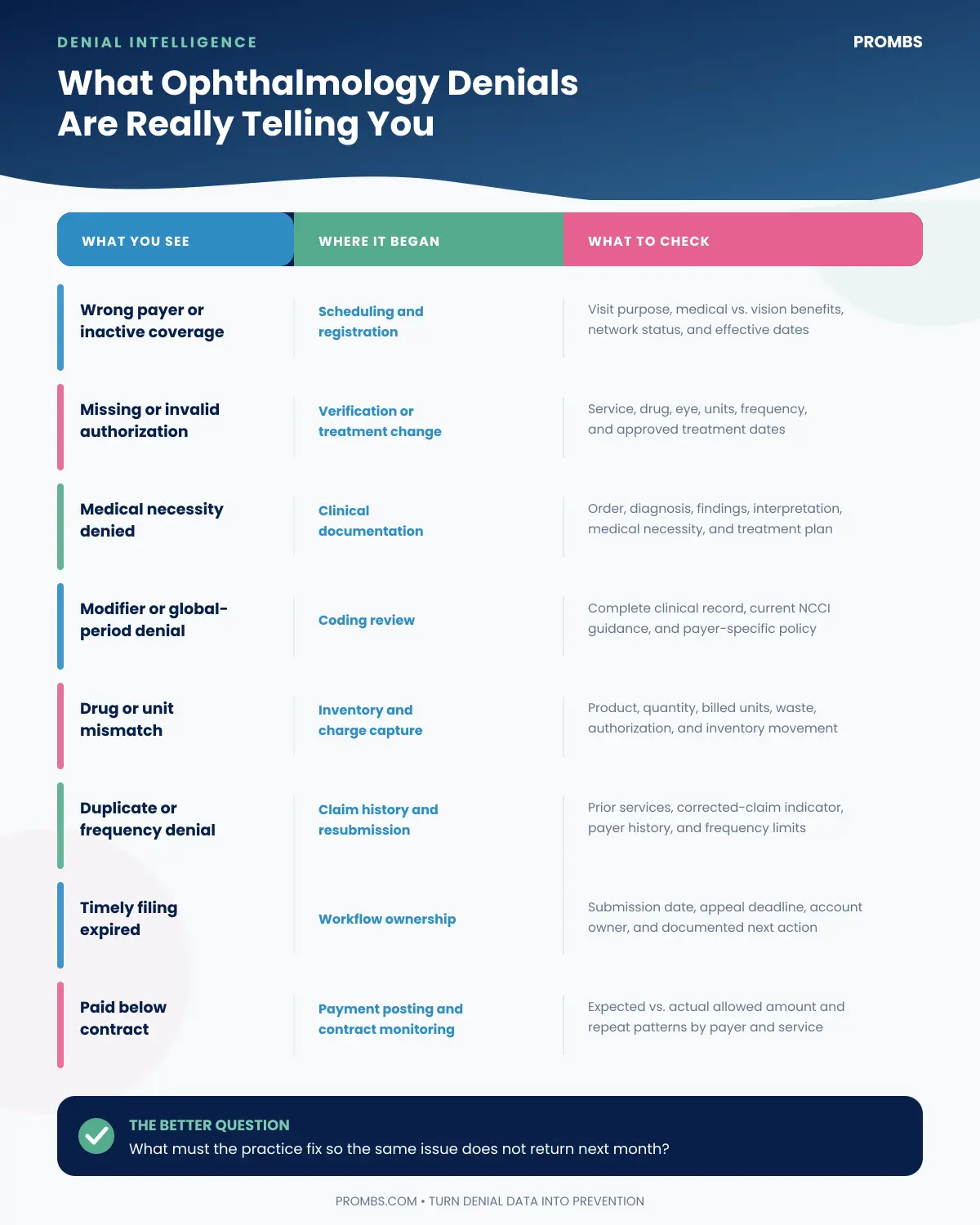
Denials are often treated as a billing-team score. That is too narrow. They are feedback about the entire practice.
An eligibility denial may point back to registration. An authorization denial may expose a scheduling or clinical substitution problem. A medical-necessity denial may begin with the documentation template. A timely-filing denial may reflect an unsigned chart rather than slow claim submission.
The most useful denial report answers five questions:
- What did the payer report?
- What was the actual operational cause?
- Which department could have prevented it?
- How much money is affected?
- What change will stop the same issue next month?
That fourth question matters. Counting denials without measuring their financial value can distort priorities.
Twenty low-dollar eligibility denials and two unpaid drug claims should not automatically receive the same attention.
There is another trap: a falling denial rate can look positive when staff are simply writing balances off faster. Review denial trends alongside adjustments, recovered dollars, appeal outcomes, and net collection performance.
The Numbers Worth Reviewing Every Month
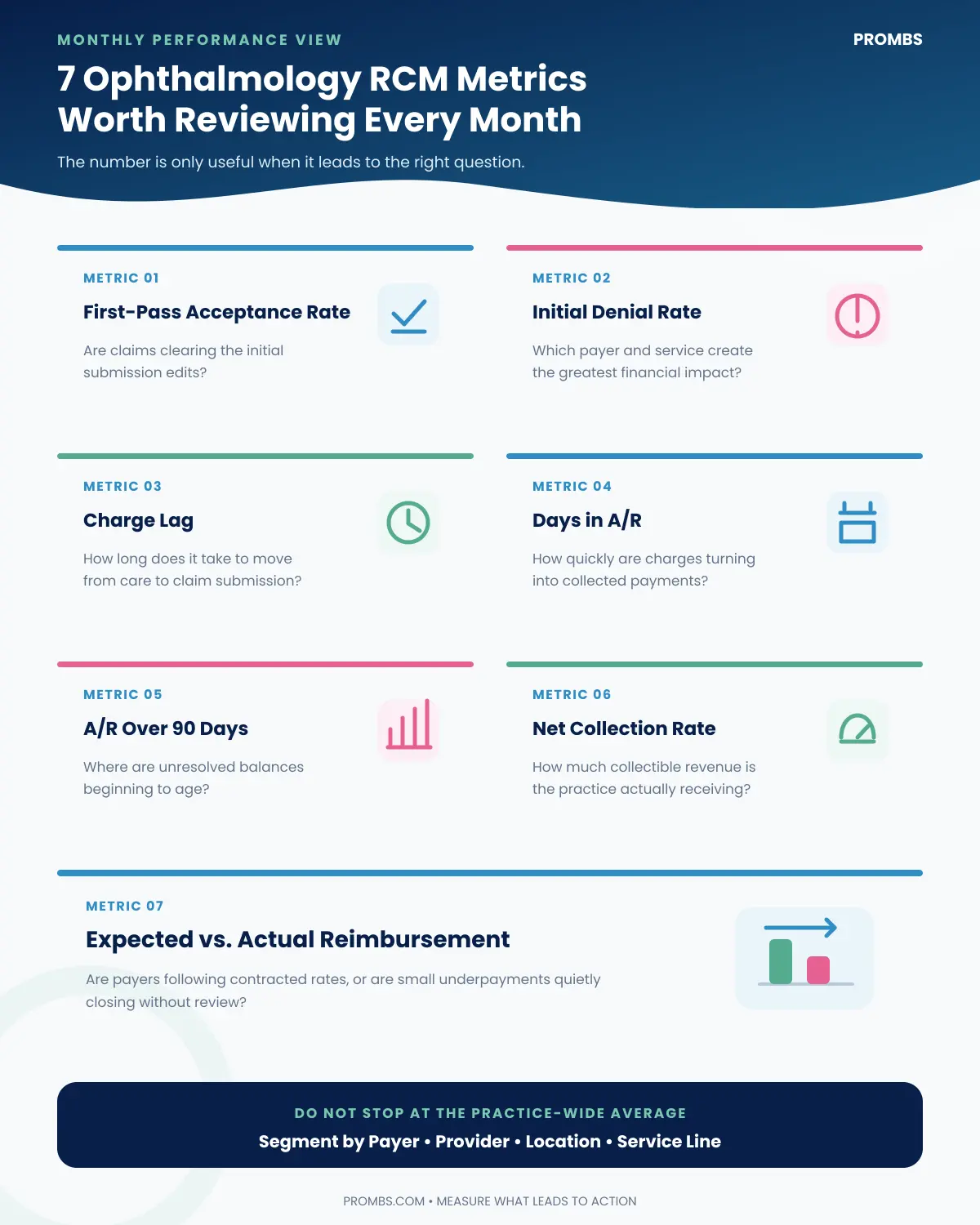
A dashboard should help someone make a decision.
The best revenue cycle KPIs expose a problem someone can investigate. If leadership receives 40 measures and acts on none of them, the report is decorated.
| Metric | What it reveals | Useful follow-up question |
|---|---|---|
| First-pass acceptance rate | Whether claims clear initial submission edits | Which rejection reasons are increasing? |
| Initial denial rate | How often adjudicated claims are denied first | Which payer and service create the most financial impact? |
| Charge lag | Time between service and charge submission | Are unsigned notes concentrated around one provider or location? |
| Days in A/R and A/R over 90 days | Collection speed and aging risk | Is the delay concentrated in surgery, drugs, one payer, or patient balances? |
| Net collection rate | How much collectible revenue is actually collected | Are write-offs or underpayments lowering the result? |
| Appeal overturn rate | Whether appeals are effective | Which denial categories have enough value and evidence to pursue? |
| Expected-versus-actual reimbursement | Contract performance | Is a payer repeatedly underpaying the same service? |
Targets should be interpreted carefully. A comprehensive eye clinic, a retina group, and a cataract-focused surgical practice do not carry identical claim values, authorization exposure, or payer mixes.
Track the practice against a stable baseline first. Then segment the data.
A reasonable overall denial rate can hide a serious problem with one payer or one procedure family.
For additional definitions and formulas, see the revenue cycle KPI guide.
What a Useful RCM Meeting Sounds Like
A productive monthly review is short and specific. It does not begin with, “Collections are up, so we’re doing fine.”
It sounds more like this:
- Our injection authorization denials increased. Which payer changed, and did our workflow miss the change?
- One provider’s charge lag is longer than the others. Is the issue documentation, system access, or schedule design?
- Why did A/R over 90 days fall? Was money collected, appealed, transferred, or written off?
- Which underpayments were confirmed against contract terms?
- What single process change will we test before the next meeting?
That conversation connects financial results to operational behavior. It also avoids blaming the billing team for problems created elsewhere.
A 30-Day Reset for an Underperforming Revenue Cycle
Do not start by changing everything. Start by finding the point where the most money or time is being lost.
During the first week, pull several months of:
- Charges
- Payments
- Rejections
- Denials
- Adjustments
- Aging balances
Separate professional, facility, drug, and patient-pay revenue when relevant. Confirm that totals reconcile to the practice management system.
The medical billing audit checklist can help organize the review without turning it into an endless data project.
Next, choose one front-end failure and one back-end failure. For example:
- Front end: expired injection authorizations.
- Back end: zero-dollar remittances posted as contractual adjustments.
Assign an owner, define the corrected workflow, and test it on a limited group of claims. A small controlled change is easier to evaluate than a practice-wide overhaul.
During weeks three and four, review whether the new process changed the relevant measure.
Did authorization denials fall? Were hidden balances returned to A/R? Did staff follow the new steps without delaying patient care?
If the answer is no, find out why before adding another policy. A written procedure that nobody can follow during a busy clinic session is not a working control.
In-House RCM or an Outside Partner?
Some ophthalmology practices have excellent in-house teams. They understand the physicians, communicate quickly with clinical staff, and know local payer behavior.
Outsourcing is not automatically better.
Outside support becomes worth considering when:
- Specialized staff are difficult to retain.
- Daily follow-up stops during absences.
- Old A/R keeps growing.
- Reporting cannot be trusted.
- Authorization work is falling behind.
- Leadership spends too much time managing billing queues.
When comparing ophthalmology billing services, ask what is actually included. “Full-service RCM” can mean very different things from one company to another.
Questions worth asking include:
- Who handles benefits, referrals, and prior authorization?
- Does the coding team have ophthalmology and subspecialty experience?
- How are drug claims, global periods, and co-management handled?
- Can the practice see claim-level notes and adjustment activity?
- How are underpayments identified?
- Who owns old A/R during the transition?
- What quality checks occur before claims are submitted?
- How are privacy, security, and system access managed?
Price matters, but a lower percentage does not help if important work is excluded or balances are adjusted instead of pursued.
Evaluate scope, transparency, continuity, and results together.
Practices considering outside support can review PROMBS’s ophthalmology medical billing services and use the questions above during any vendor conversation.
Get a Clearer View of Your Ophthalmology Revenue Cycle
Pro Medical Billing Solutions can review eligibility, authorization, coding, denials, payment posting, underpayments, and aging A/R around your existing workflow.
Final Thoughts
The strongest ophthalmology practices do not treat RCM as a cleanup function. They use it as an operating system connecting the front desk, clinical team, coding, billing, and leadership.
When a claim fails, they recover what can be recovered. Then they trace the failure back to its source. That second step is where long-term improvement happens.
Start with one costly handoff. Make ownership clear. Measure what changes. Then move to the next one.
Over time, that discipline produces something every busy ophthalmology practice needs: fewer surprises and a more dependable path from patient care to payment.
Frequently Asked Questions
What is the difference between ophthalmology billing and Ophthalmology RCM?
Ophthalmology billing mainly covers charge entry, coding, claim submission, payment posting, and follow-up.
Ophthalmology RCM includes those functions but also addresses scheduling, insurance verification, authorization, clinical documentation, patient responsibility, underpayments, reporting, and process improvement.
Billing manages claims. RCM manages the full financial journey of the encounter.
Why do ophthalmology practices have medical and vision billing problems?
The same patient may have separate medical and vision benefits, and the correct payer depends on the reason for the visit and services performed.
Problems occur when staff route the claim based only on the appointment label or insurance card rather than the clinical purpose, plan rules, and documentation.
Clear scheduling questions and benefit verification reduce that confusion, but the final claim still has to match what happened during the encounter.
Which ophthalmology RCM metrics matter most?
Start with first-pass acceptance, initial denial rate, charge lag, days in A/R, A/R over 90 days, net collection rate, appeal outcomes, and expected-versus-actual reimbursement.
Practices with high-cost drugs should also reconcile authorization, inventory, billed units, and payment.
The number alone is rarely enough. Review it by payer, provider, location, and service line to find the operational cause.
Can an ophthalmology practice eliminate every denial?
No. Payer errors, coverage limits, changing policies, and unusual cases will still produce denials.
A strong RCM process should reduce preventable denials, recognize payer mistakes quickly, protect appeal deadlines, and stop the same internal error from repeating.
The realistic goal is not zero denials. It is fewer avoidable denials and faster, more disciplined resolution of the ones that remain.