

A primary care physician refers a patient to a neurologist for symptoms that require specialized evaluation. The referral is medically appropriate, and the specialist’s office schedules an appointment. The patient assumes the visit will be covered because their physician recommended the specialist and both offices accepted their insurance information.
Several weeks after the consultation, the specialist receives a claim denial. The insurance company explains that the physician is not part of the patient’s specific provider network and that the required out-of-network approval was never obtained.
The referring practice believed it had completed the necessary referral. The specialist believed the patient’s insurance information was sufficient. The patient now faces an unexpected bill, and both practices must determine whether the claim can be corrected, reviewed, or appealed.
This situation illustrates a common problem in specialist referral workflows. A physician’s clinical recommendation does not automatically establish insurance authorization, network eligibility, or reimbursement at in-network rates.
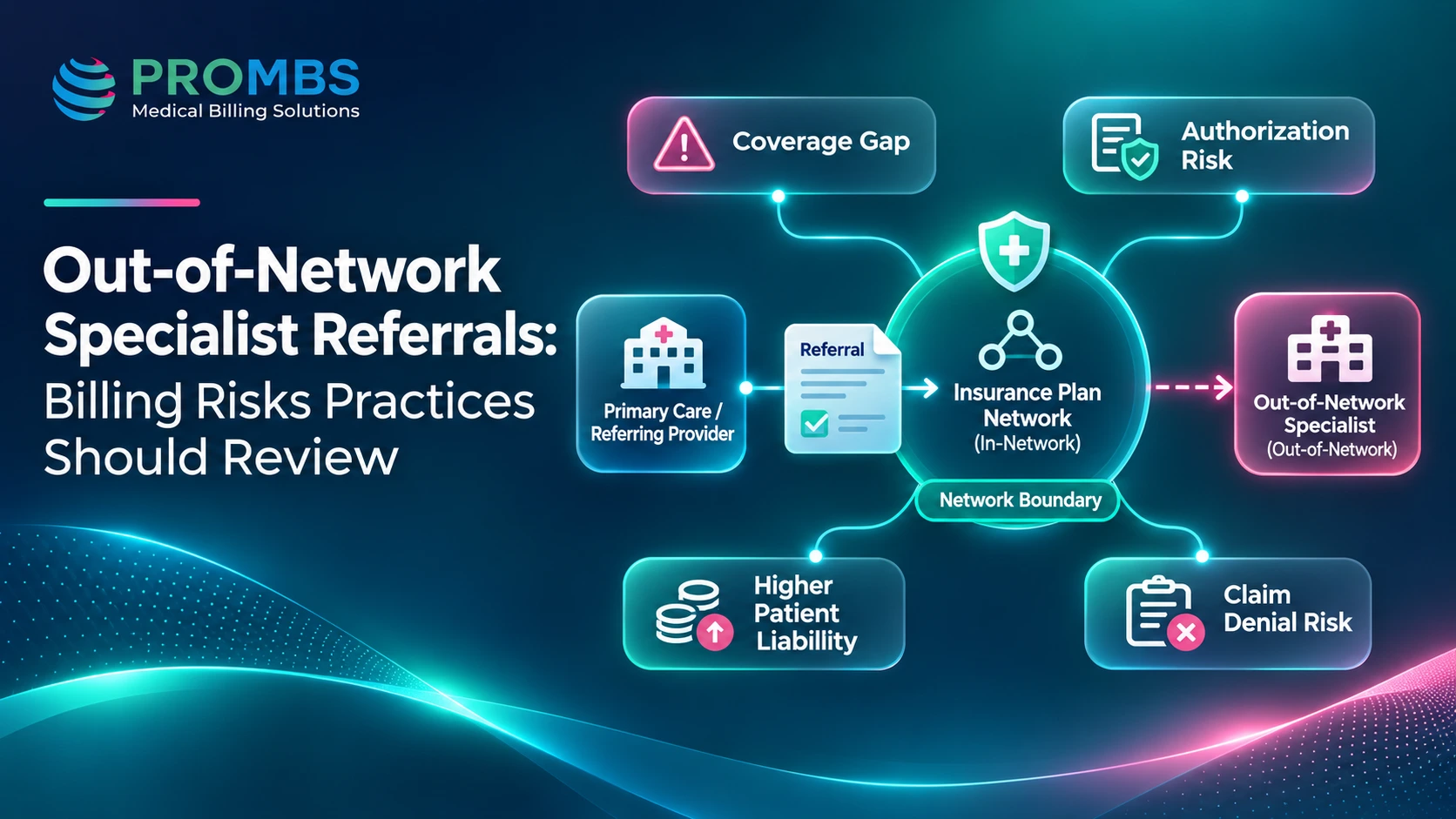
Out-of-network referrals can involve separate requirements for the clinical referral, the specialist’s network participation, prior authorization, and any network gap exception. Missing just one applicable step can result in denied claims, reduced reimbursement, administrative follow-up, or patient financial responsibility that was not clearly understood before treatment.
Healthcare practices need a process that connects referral decisions with the patient’s actual insurance benefits and the requirements governing the specialist’s services.
This guide explains the key billing risks, how referral and authorization requirements differ, when an out-of-network specialist may qualify for an exception, and what practices should verify before scheduling care.
What Is Out of Network Referral Billing?
Out of network referral billing involves submitting and processing claims for specialist services furnished by a provider who does not participate in the patient’s applicable insurance network.
A patient may be referred to an out-of-network specialist because the referring physician believes that provider has the appropriate clinical expertise, the patient’s preferred specialist is unavailable within the network, or the plan lacks a participating specialist capable of providing the required service.
However, the clinical reason for a referral and the insurer’s payment requirements are separate matters.
A physician can recommend a particular specialist without the insurance company agreeing to reimburse that specialist at an in-network rate. Some health plans may cover out-of-network services under separate benefits, while others may require advance approval or provide limited out-of-network coverage for routine, non-emergency care.
The billing team must understand which arrangement applies before assuming the claim will be payable.
Why a Specialist Referral Does Not Guarantee Insurance Payment
Consider a patient with a commercial HMO plan who receives a referral from their primary care physician to an orthopedic specialist.
The primary care physician may have documented why the consultation is medically necessary. However, if the specialist does not participate in the patient’s network, the plan may require a separate authorization or network exception before the consultation.
The referring physician’s recommendation alone may not satisfy those requirements.
Even when an insurer approves a referral, the approval may apply only to certain services, dates, or providers. Additional diagnostic procedures, follow-up appointments, or treatment may require separate verification.
That is why the referral process should address more than whether the patient has a valid insurance card and a signed referral order.
Why Out-of-Network Specialist Referrals Create Billing Risks
A specialist referral can create billing problems before the patient receives care. These problems often arise when the referring office, specialist, and insurance company rely on different assumptions about the patient’s coverage.
The referring practice may believe that recommending the specialist completes its responsibility. The specialist may assume that a referral from an in-network physician establishes coverage. The patient may reasonably believe that the referral means the specialist is approved by their insurer.
When those assumptions are not verified, the billing team may discover the problem only after the payer processes the claim.
Network Participation May Differ Across Insurance Products
A specialist can participate with a major insurance carrier without participating in every network offered by that company.
For example, a cardiologist may accept a carrier’s PPO product but remain outside its narrower HMO network. A referring physician who checks only the carrier’s name may incorrectly assume the specialist is in-network.
Provider network status can also differ by location, billing organization, and plan product.
A physician may participate at one practice location while another location or facility operates under a different arrangement. The rendering physician and the facility may have different contractual relationships with the insurer.
The practice should therefore verify the exact network associated with the patient’s policy and the provider who will perform the service.
Missing Approvals Can Lead to Claim Denials
Some plans require a formal referral, service authorization, or network gap exception before the patient receives out-of-network specialist care.
If the required approval is missing, the insurer may deny the service or process it under different benefits.
The precise outcome depends on the plan and applicable law. Not every missing administrative requirement results in a valid denial, and not every out-of-network claim requires the same authorization process.
The billing team should confirm the requirement that actually applies rather than relying on a general assumption that all specialist referrals follow identical rules.
Patients May Face Unexpected Financial Responsibility
Out-of-network reimbursement may be based on a different allowed amount from the specialist’s billed charge.
Depending on the plan, provider arrangements, and applicable protections, the patient may face higher deductibles, coinsurance, or lawful balance billing.
A clinical referral does not automatically eliminate those risks.
The practice should identify the relevant financial arrangements and communicate known coverage limitations before non-emergency care whenever possible. An estimate should not be presented as a guarantee of final insurance payment.
Clinical Referral vs. Prior Authorization vs. Network Gap Exception
One of the most important distinctions in specialist billing is understanding that a clinical referral, prior authorization, and network gap exception serve different purposes.
These processes may be related, but one approval does not necessarily replace another.
| Requirement | Primary purpose | Important billing limitation |
|---|---|---|
| Clinical referral | Documents a clinician’s recommendation for specialist evaluation or treatment | Does not automatically establish insurance coverage |
| Plan referral requirement | Satisfies a plan’s applicable administrative referral process | May not authorize care outside the network |
| Prior authorization | Obtains the payer’s required advance review for a particular service | Does not necessarily approve use of a nonparticipating provider |
| Network gap exception | Requests access to qualifying out-of-network care when the plan’s network cannot meet the patient’s needs | Approval may be restricted to specified providers, services, dates, or other terms |
A Clinical Referral Establishes the Reason for Specialist Care
A physician may refer a patient because the condition requires evaluation or treatment beyond the services available in the referring practice.
The referral can describe the patient’s clinical concerns, relevant findings, and the specialty expertise being requested.
This supports coordination of medical care, but it does not independently establish that the selected physician participates in the patient’s insurance network.
The referral team must still determine whether the plan requires an insurer-recognized referral or another approval before treatment.
Prior Authorization Addresses Specific Payer Requirements
Prior authorization generally involves an insurer reviewing a planned service against its applicable requirements before that service is performed.
Some procedures may require authorization regardless of whether the specialist is in-network. Other services may have different rules depending on the plan, setting, and provider.
An approved authorization may confirm that specified services satisfied an advance review requirement. It should not automatically be interpreted as a guarantee of reimbursement or approval of out-of-network status.
The practice needs to examine the exact authorization terms.
Network Gap Exceptions Address Access to Nonparticipating Providers
A network gap exception may be available when the patient’s plan does not have a suitable participating provider who can furnish the medically necessary service.
The purpose is to address a potential gap in access to appropriate covered care.
For example, a patient may need a specialist with expertise in a rare neurological disorder, and the available in-network providers may not offer that particular treatment.
The referring physician may support an exception request by explaining the required clinical expertise and why available network options are unsuitable.
Approval depends on the applicable plan, evidence, and governing requirements.
Importantly, service authorization and network gap approval are not automatically interchangeable. Highmark’s published guidance specifically distinguishes these processes.
The billing team should confirm both when applicable.
For practices managing out of network referral billing, PROMBS’s verification of benefits and prior authorization services can support the administrative process of reviewing coverage information, referral requirements, and payer approvals.
How HMO, PPO, EPO, and Other Plan Rules Differ
Health plans use different network structures and referral requirements. Understanding the patient’s specific product is necessary before deciding how a specialist’s services should be billed.
HMO Plans
Health Maintenance Organization plans commonly emphasize participating provider networks and may require a primary care physician to coordinate certain specialist services.
Depending on the product, a formal referral may be required, and routine out-of-network services may have limited or no coverage without an applicable exception.
However, HMO requirements vary by carrier, state, product, and coverage program.
A practice should verify whether the specialist is in the patient’s actual network and whether the plan requires a referral, authorization, or network gap exception.
PPO Plans
Preferred Provider Organization plans commonly provide some level of out-of-network benefits, although those benefits may involve higher patient cost-sharing or different reimbursement methods.
A PPO patient may be able to visit an out-of-network specialist without a traditional PCP referral, but that does not eliminate other authorization or coverage requirements.
The billing team should verify the relevant out-of-network benefit and determine whether the proposed service requires additional approval.
A specialist’s willingness to accept the patient’s insurance card does not establish the patient’s final financial responsibility.
EPO Plans
Exclusive Provider Organization plans generally restrict routine covered services to their participating network, subject to applicable exceptions and emergency coverage protections.
An out-of-network specialist consultation may therefore create a significant billing risk when no approved exception applies.
The practice should check the plan’s specific rules rather than assuming that out-of-network coverage available under one product also exists under another product offered by the same carrier.
Medicare and Medicaid Arrangements
Traditional Medicare generally allows beneficiaries to see participating Medicare-enrolled specialists without the same PCP referral structure used by many HMOs, although service coverage and other Medicare requirements still apply.
Medicare Advantage plans may have different network and referral requirements, depending on the plan type and governing Medicare rules.
Medicaid managed care arrangements also vary by state and insurer.
For example, North Carolina Medicaid has clarified that its general PCP specialty referral requirement was removed, while authorization may still be needed for certain out-of-network specialist services.
The billing team should identify the patient’s actual coverage arrangement before applying a referral workflow.
Verify Specialist Network Participation Before Scheduling
Network verification should be completed before the appointment whenever practical, particularly when the referral is for planned, non-emergency care.
The process should begin with the patient’s current insurance details and the exact plan product.
Staff should then verify the specialist’s participation using appropriate payer resources and confirm that the participation applies to the intended provider and location.
Check the Rendering Provider and Service Location
A specialist group may contain several physicians with different network arrangements.
The appointment may also be scheduled at an office, outpatient hospital department, or another facility with separate insurance participation.
Confirm which physician or qualified professional will provide the service and whether the location is covered under the relevant network arrangement.
Where applicable, verify the billing and rendering identifiers used for the claim.
A statement that a practice “accepts the insurance company” is not sufficient evidence of in-network participation with the patient’s specific product.
Verify the Actual Services Being Requested
A referral for an initial specialist consultation does not necessarily cover every service the specialist may recommend.
The appointment could result in diagnostic imaging, laboratory testing, injections, surgery, or additional visits.
Some of these services may have separate authorization, network, or coverage requirements.
The referral coordinator should establish what is known about the planned services and identify any additional requirements that must be checked when the treatment plan develops.
Record the Verification Results
Document the date of verification, coverage product, provider and location details, source of information, and any payer reference number.
If the network status cannot be confirmed, record it as unresolved rather than assuming the specialist participates.
Keep the information available to the referring and receiving practices so that unresolved questions are not lost during scheduling.
This documentation can also help when a payer later processes the claim under a different network classification.
When an Out-of-Network Specialist May Be Medically Necessary
There are situations where a patient needs specialized care that is not reasonably available through the health plan’s participating provider network.
The patient may have a rare condition requiring a particular expertise, or the network may lack a clinician capable of providing a specific medically necessary procedure.
In other cases, the listed providers may not offer the required service or may be unable to provide clinically appropriate access within the necessary timeframe.
Whether these circumstances qualify for an exception depends on the governing plan and applicable network adequacy requirements.
Document Why Available In-Network Options Are Unsuitable
A strong request should explain the clinical service the patient needs and the limitations of available network options.
For example, a primary care physician may identify a specialist with experience managing a complex neurological disorder.
If the insurer identifies other network neurologists, the requesting practice may need to explain why those physicians do not provide the necessary expertise or treatment.
The documentation should be specific.
A general statement that the recommended physician is “the best specialist” may not establish that the plan’s network cannot meet the patient’s needs.
The strongest evidence relates to the required medical service, relevant clinical expertise, available providers, and any applicable access or timing requirements.
Network Adequacy and State-Specific Protections
Certain state laws provide procedures for requesting or challenging access to out-of-network specialists when suitable care is unavailable within the plan’s network.
New York, for example, has an out-of-network referral appeal process that can involve a physician’s explanation of why available network providers lack the necessary expertise.
These rules are not identical across states.
A practice should verify the patient’s coverage, the governing state or program requirements, and the insurer’s applicable exception process before preparing a request.
The New York Department of Financial Services provides guidance concerning out-of-network referral disputes under its applicable regulatory framework.
Network Gap Exceptions and Required Documentation
A network gap exception request should establish the clinical need for a nonparticipating specialist and identify the specific services for which approval is sought.
The request should be prepared before the planned appointment when the governing process requires advance review.
The insurer may request information about the patient’s condition, relevant medical history, treatment needs, preferred specialist, and available in-network alternatives.
The referring practice may also need to explain why the requested provider offers a service or expertise not available through an appropriate network option.
Approval Must Be Reviewed for Its Exact Scope
Once the payer issues a decision, staff should verify which provider, facility, services, and dates are covered by the approval.
A network gap exception may be limited to a particular consultation or treatment.
It should not automatically be assumed to include later imaging, follow-up visits, surgery, or other providers involved in the patient’s care.
For example, an insurer might approve consultation with an out-of-network oncology specialist. That does not necessarily authorize a separate imaging facility or surgical provider.
If additional services become necessary, the team should review whether they fall within the existing approval or require further action.
In-Network Benefit Levels Do Not Automatically Resolve Every Billing Question
Some approved network exceptions may allow qualifying out-of-network services to be processed at in-network benefit levels.
However, the practice still needs to verify the applicable reimbursement and financial arrangements.
An approval may not establish the exact amount the insurer will pay, and it may not independently prevent every potential balance-billing issue.
The outcome may depend on a single-case agreement, applicable contract, state law, federal protections, and the terms of the exception.
Healthcare practices should distinguish approval to receive a service from the separate question of how the service will be reimbursed and what the patient may lawfully owe.
Why Approved Specialist Referrals Can Still Result in Denied Claims
Even when the practice obtains approval, the subsequent claim may not match the information the insurer authorized.
For example, the payer may approve an initial specialist consultation, but the claim may include additional procedures that were not part of the approval.
The specialist might provide care at a different location, or the claim might identify a rendering provider not included in the authorization.
A claim can also be processed under the wrong network classification if the insurer’s records do not correctly reflect an approved exception.
These situations require careful comparison between the actual claim and the payer’s approval.
Verify the Authorization and Claim Details
Before billing, confirm that the claim accurately identifies the patient, provider, service dates, procedures, and applicable approval information.
If the insurer approved a network exception, retain the decision and review its restrictions.
The billing team should know whether the payer expects a particular authorization reference, special claim instructions, or another administrative step.
If a discrepancy appears, determine whether it involves inaccurate submitted information or an incorrect payer determination.
The appropriate resolution may involve a supported claim correction, administrative reprocessing request, or formal appeal, depending on the payer’s procedures.
Do Not Assume the Referral Protects Every Patient Balance
A valid clinical referral does not automatically prevent out-of-network cost-sharing or balance billing.
The federal No Surprises Act provides protections in specified circumstances, including certain emergency services and qualifying non-emergency services involving out-of-network providers at participating facilities.
However, a routine scheduled consultation at an independent out-of-network specialist’s office does not automatically qualify for those federal protections.
Other state or plan-specific rules may apply.
The practice should verify the patient’s applicable coverage and financial protections before assuming that an unpaid insurer balance can be transferred to the patient.
For broader guidance on these reimbursement issues, PROMBS’s out-of-network medical billing guide discusses related claim and payment considerations.
What Practices Should Do Before Scheduling an Out-of-Network Specialist
A reliable referral process should begin with the patient’s exact coverage product, not simply the insurance carrier’s name.
The referring team should confirm whether the recommended specialist participates in that network and whether the planned consultation requires a formal referral, prior authorization, or network gap exception.
If the specialist is out-of-network, determine whether the plan provides relevant out-of-network benefits or has an exception process.
Where a network gap request is appropriate, gather the clinical evidence and information about available participating specialists before submitting the request through the payer’s approved channel.
Once a decision is received, verify its scope and share the relevant information with the receiving specialist’s office.
The specialist should independently confirm the details needed for its own billing and should not assume the referring practice completed every payer requirement.
The patient should also receive a clear explanation of confirmed benefits, known coverage limitations, and any unresolved financial questions.
No one should promise in-network reimbursement based solely on the existence of a physician referral.
If the payer’s network information or authorization response is unclear, document the issue and identify the person responsible for follow-up before treatment whenever practical.
A complete referral record should establish what was requested, which insurer rules were checked, what approval was obtained, and which services the approval covers.
Building an Evidence Packet for Out-of-Network Specialist Referral Denials
When an insurance company denies a claim involving an out-of-network specialist, the billing team should first establish why the service was submitted outside the patient’s network and which coverage requirements applied. A physician’s referral may explain the clinical reason for specialist care, but the insurer may require separate documentation establishing network eligibility, authorization, or an approved exception.
An effective investigation connects the patient’s insurance information, the referring physician’s clinical recommendation, the specialist’s participation status, and the services actually provided. The goal is to distinguish a valid coverage restriction from an incorrect payer determination or an administrative error that can be resolved.
The evidence packet should begin with the original claim and the complete explanation of benefits (EOB) or electronic remittance advice (ERA). Identify the denied services, adjustment codes, dates of service, rendering provider, and payer’s stated reason for nonpayment.
Next, retrieve the referral documentation, relevant verification records, authorization decisions, and any network gap approval. Compare these documents with the claim to determine whether the insurer processed the services according to the applicable requirements.
Verify the Exact Insurance Product and Specialist Network
The patient’s insurance carrier name alone is not enough to establish network participation.
A specialist may participate with one product from an insurance company while remaining outside another product offered by the same carrier. Network participation can also depend on the provider’s billing organization, service location, and applicable agreement.
The billing team should verify the patient’s plan effective on the treatment date and confirm whether the rendering specialist participated in that specific network.
If the insurer’s records conflict with the practice’s verification, preserve the original inquiry, available payer reference numbers, and any effective-dated network documentation.
Gather the Referral and Authorization Records
A claim investigation may require several separate documents.
| Documentation | What it helps establish |
|---|---|
| Referring physician’s order or consultation request | Clinical reason for specialist evaluation |
| Insurance eligibility and benefit verification | Coverage and product information applicable to the service |
| Network participation confirmation | Whether the specialist was participating under the specific plan |
| Referral or prior authorization decision | Whether applicable administrative requirements were satisfied |
| Network gap exception approval or denial | Whether out-of-network access was permitted and under what conditions |
| Specialist’s clinical records | What services were actually performed |
| Original claim and payer remittance | How the services were submitted and adjudicated |
The documents should be reviewed together rather than assuming that one approval satisfies every requirement.
If the insurer approved a consultation but not additional procedures, the billing team must identify that limitation before deciding whether the later claim was processed correctly.
Claim Example 1: An HMO Specialist Visit Without Required Network Approval
Consider a hypothetical patient enrolled in a commercial HMO plan who experiences persistent neurological symptoms. Their primary care physician recommends evaluation by a neurologist who practices outside the patient’s network.
The patient schedules the appointment, believing that the physician’s referral establishes insurance approval.
The neurologist provides the consultation and submits a $450 claim. The insurer subsequently denies the service because the specialist was not participating in the relevant network and the required out-of-network approval was not obtained.
The specialist’s billing team must determine whether the plan actually required an advance network exception and whether an applicable exception or other protection could affect the determination.
Investigate the Referral and Plan Requirements
The first step is to verify that the patient was enrolled in the identified HMO product on the consultation date.
Next, confirm the specialist’s network status and the insurer’s rules for obtaining care from nonparticipating physicians.
Review the referring physician’s documentation to establish whether the patient was directed to the specialist for a specific medical reason.
Then determine whether the payer received an out-of-network exception request, whether one was approved, or whether another applicable process was available.
A clinical referral does not automatically replace a required plan approval.
If the policy clearly required advance approval and no applicable exception or protection exists, the denial may be valid. However, the team should verify the actual rules before treating the $450 charge as an unrecoverable insurer balance or a collectible patient charge.
Appropriate Resolution
If the referring practice submitted an approval request that the insurer incorrectly overlooked, the billing team should obtain the submission evidence and request an appropriate review.
If the insurer’s records are accurate and approval was never obtained, determine whether the plan permits a retrospective exception or another review under the circumstances.
A retrospective request is not universally available, and the insurer is not automatically required to grant one.
The final patient responsibility also requires a separate review of provider agreements and applicable billing protections.
Claim Example 2: Approved Network Gap Exception but Claim Paid Out of Network
A patient with a complex neurological condition requires consultation with a specialist whose expertise is unavailable among the health plan’s participating providers.
The referring physician submits clinical documentation supporting an out-of-network network gap exception.
The insurer approves the request for one consultation with the named specialist, indicating that the qualifying service will receive in-network benefit treatment.
The specialist bills $600 for the consultation. However, the insurer processes the claim under the patient’s ordinary out-of-network benefit and applies a higher cost-sharing amount than the approved exception appears to permit.
The practice should not immediately conclude that the insurer owes the difference between the $600 charge and its payment.
Instead, the investigation should focus on whether the insurer processed the service according to the documented approval and any applicable reimbursement arrangements.
Compare the Approval With the Claim
Review the approved specialist, provider identifiers, location, service description, dates, and any authorization or exception reference.
Then compare those details with the submitted claim.
If the approval covers the exact consultation but the payer applied ordinary out-of-network benefits, the billing team may have grounds to request reprocessing.
For example, suppose the claim’s applicable allowance is $350 under the verified payment arrangement. If the approved in-network benefit treatment requires a $35 copayment but the payer instead applies a $140 out-of-network patient responsibility amount, the practice should investigate the apparent discrepancy.
The $105 difference in patient responsibility is not automatically additional provider reimbursement. The actual correction depends on the applicable allowed amount, insurer payment calculation, approval terms, and provider agreement.
Verify the Final Reimbursement Arrangement
Some network gap approvals address benefit treatment without independently establishing the exact provider payment rate or all balance-billing obligations.
The practice should confirm whether a single-case agreement or other arrangement applies and whether the specialist agreed to particular payment and patient billing terms.
If the insurer processed the claim contrary to the applicable approval, submit a supported reprocessing request.
The request should include the network gap decision and identify the specific inconsistency between the approved treatment and the adjudicated claim.
If the insurer corrects the claim, reconcile the revised payment and patient responsibility rather than assuming the original charge is fully payable.
Claim Example 3: Specialist Consultation Approved but Additional Testing Is Not Covered
A primary care physician refers a patient to an out-of-network cardiologist after the health plan approves a network gap exception for an initial consultation.
The cardiologist evaluates the patient and recommends additional cardiac testing.
The specialist’s office assumes that the original referral approval extends to all services related to the patient’s condition.
The testing is performed at an outpatient facility. The insurer pays the consultation but denies the diagnostic testing because the approval did not include that procedure or facility.
This situation illustrates why a valid referral can still produce a partial claim denial.
Review the Scope of the Original Approval
The billing team should confirm whether the network gap exception was limited to the consultation, a defined number of visits, or a particular set of services.
It should also verify whether the diagnostic facility and rendering professionals were separately covered by the approval.
An authorization that identifies one physician or service does not necessarily establish coverage for another provider, procedure, or location.
The team should examine whether the additional testing required separate service authorization, network approval, or both.
If the original approval included the services but the insurer applied an incorrect edit, a documented reprocessing request may be appropriate.
If the additional testing was outside the approval’s scope, determine whether another applicable exception or review process exists.
Prevent the Same Problem During Follow-Up Care
Specialist referrals frequently lead to new treatment recommendations.
The receiving practice should establish a process for checking additional services before scheduling them when advance review is applicable.
This includes verifying whether an authorization covers follow-up visits, diagnostic procedures, injections, surgery, or care provided by another specialist.
The clinical team may determine that additional care is appropriate, but the billing team must separately establish which coverage and administrative requirements apply.
A documented approval for one encounter should not become an unsupported assumption that every related service will receive the same reimbursement treatment.
Claim Example 4: A Participating Specialist Is Incorrectly Classified as Out of Network
Not every specialist referral denial occurs because the provider is genuinely nonparticipating.
A physician may participate in the patient’s network, but the insurer could process the claim using outdated provider records or incorrect billing identifiers.
Consider a specialist who joined a network effective January 1.
A patient receives a consultation on February 10, but the insurer processes the claim as out-of-network because its adjudication system still identifies the provider as nonparticipating.
The practice receives a reduced payment or denial even though the applicable participation agreement was effective on the service date.
Establish the Historical Network Status
The billing team should confirm the actual effective date of participation and the exact plan product covered by the agreement.
Then compare the claim’s rendering and billing provider information, service location, and tax identification details with the payer’s records.
If the claim contains inaccurate identifiers, the practice may need a payer-approved correction.
If the claim is accurate but the insurer’s participation file is outdated, the appropriate response may involve a provider-record correction and reprocessing of the original claim.
A new original claim should not be submitted automatically merely because the insurer processed the first one incorrectly.
Document the Payer’s Correction
Retain the contract or network confirmation, service date, claim details, and payer reference number.
Ask the payer to identify whether it can reprocess the existing claim after updating the participation record.
When a corrected remittance is issued, verify the applicable allowance, insurer payment, contractual adjustment, and patient responsibility.
If the payer originally assigned excessive out-of-network cost-sharing, the revised patient balance should reflect the correct adjudication.
Claim Example 5: No Suitable In-Network Specialist Is Available
A patient has a rare medical condition requiring specialized surgical expertise.
The health plan identifies several in-network physicians within the same broad specialty. However, the referring physician believes those providers do not offer the particular treatment the patient requires.
The insurer denies the request to see an out-of-network specialist because its directory lists participating providers with the relevant specialty designation.
The central issue is whether those listed specialists can actually provide the medically necessary care.
Document the Network Access Problem
The referring physician should explain the specific expertise or procedure required and why the available network options are unsuitable.
Supporting information may include the patient’s diagnosis, previous treatment, clinical complexity, and the requested specialist’s relevant capabilities.
Where appropriate, the practice may document efforts to locate an in-network provider who offers the service.
For example, a network directory might list general neurosurgeons, while the patient requires expertise in a highly specialized procedure not provided by those physicians.
A simple preference for a particular doctor may be insufficient to establish the need for an exception.
The request should identify the actual gap in access to appropriate care.
Review Applicable Network Adequacy and Appeal Rules
Some state laws provide specific protections when a health plan cannot offer suitable specialist care within its network.
New York, for example, has an out-of-network referral appeal process that can consider a physician’s explanation of why available participating providers lack the necessary expertise.
These procedures are state-specific and should not be treated as universal requirements across the United States.
The billing team should verify the governing state and plan rules, determine whether a network adequacy request or appeal is available, and assemble the necessary evidence.
The resolution should address the insurer’s actual reason for denying the specialist request, not merely repeat that the referring physician recommends the out-of-network provider.
Understanding Referral, Authorization, and Network Denial Codes
Out-of-network specialist claims may receive different adjustment codes depending on the reason the payer declined or reduced payment.
The code should be interpreted with the complete remittance, adjustment group, any remark information, and applicable payer policy.
| CARC | General meaning | Initial investigation |
|---|---|---|
| 197 | Precertification, authorization, or notification absent | Determine which approval was required and whether it was obtained |
| 198 | Precertification or authorization exceeded | Compare the approved services, dates, visits, and limits with the claim |
| 109 | Claim or service not covered by this payer or contractor | Verify the correct payer, benefit administrator, or claim destination |
| 96 | Noncovered charges | Investigate the applicable coverage provision and accompanying remark |
| 204 | Service, equipment, or drug not covered under the current benefit plan | Confirm the actual benefit and plan product |
The official X12 Claim Adjustment Reason Codes provide standardized descriptions.
A network-related denial may also involve other reason codes or payer-specific explanations. These codes are not an exhaustive list of possible network determinations.
The Denial Code Does Not Establish Whether the Payer Was Correct
For example, CARC 197 may indicate that a required authorization was absent.
However, the billing team must still determine whether the authorization requirement applied to that service, whether the payer overlooked an approval, or whether an applicable exception changes the analysis.
Similarly, a noncovered-service adjustment does not establish that the patient can automatically be billed for the full charge.
The team should investigate the underlying coverage and contractual provisions before deciding how to resolve the account.
Corrected Claim, Reprocessing Request, or Appeal: Choosing the Right Action
After identifying the denial’s cause, the billing team should select the response that matches the evidence.
A corrected claim may be appropriate when the practice submitted inaccurate information.
A reprocessing request may be appropriate when the insurer processed an accurate claim using incorrect network or authorization records.
An appeal may be appropriate when the payer’s adverse determination conflicts with applicable coverage provisions, network adequacy rules, or supported clinical evidence.
When a Corrected Claim Is Appropriate
Examples include an incorrect rendering provider identifier, wrong service location, inaccurate authorization reference, or another claim detail that was submitted incorrectly.
The correction must reflect the actual care and be supported by the record.
Use the payer’s approved correction process and retain the original claim reference where required.
Do not change the rendering provider or service location merely to obtain in-network processing when those details do not accurately describe the service.
When Reprocessing May Resolve the Problem
Reprocessing may be appropriate when the claim was accurate but the insurer failed to recognize an approved network exception or applied an outdated participation record.
The request should identify the original claim, the correct network or approval information, and the payer’s processing discrepancy.
Document the reference number and verify whether the insurer requires an administrative update before reprocessing.
When an Appeal Is Necessary
A formal appeal may be appropriate when the insurer disputes the patient’s eligibility for an out-of-network exception or maintains a denial despite evidence supporting coverage.
The appeal should address the actual reason for the decision.
For a network adequacy dispute, explain why suitable in-network care was unavailable under the applicable standard.
For an authorization dispute, identify the approval or governing requirement and show why the denial is inconsistent with it.
The practice should verify review deadlines and applicable procedures rather than assuming every plan follows the same appeals process.
PROMBS’s denial management services can support investigation and payer follow-up for specialist referral denials requiring documented resolution.
Out-of-Network Patient Responsibility and No Surprises Act Limitations
Patient billing requires particular care when specialist services are furnished outside the network.
An out-of-network insurer payment may be based on a different allowed amount from the provider’s submitted charge.
Depending on applicable agreements and law, the remaining difference may involve patient cost-sharing, a permissible balance bill, an adjustment the provider must accept, or an unresolved payer responsibility.
A physician referral does not independently establish which of these outcomes applies.
The No Surprises Act Does Not Protect Every Specialist Office Visit
Federal surprise-billing protections apply in specified circumstances, including qualifying emergency services and certain non-emergency services furnished by out-of-network providers in connection with visits to participating facilities.
However, a routine scheduled consultation at an independent out-of-network specialist’s office does not automatically fall within those protections.
Other applicable state or program requirements may provide additional safeguards.
The practice should verify the relevant protections rather than assuming that every out-of-network referral is protected against balance billing.
Network Exceptions and Single-Case Agreements
A network gap exception may permit a patient to receive certain out-of-network services at in-network benefit levels.
A separate single-case agreement may establish reimbursement and patient billing terms between the payer and provider.
These arrangements should be reviewed according to their actual language.
An approved referral does not automatically eliminate all potential balance billing unless the governing agreement or applicable law establishes that result.
Before transferring a disputed amount to the patient, the billing team should confirm the final adjudication and all relevant financial restrictions.
Final Claim and Payment Reconciliation
A specialist referral claim is not resolved simply because the payer agrees to review its decision.
The billing team should obtain the final EOB or ERA and compare it with the original adjudication.
Verify the applicable allowed amount, actual insurer payment, contractual adjustments, patient cost-sharing, and any amounts affected by an approved network exception.
If the payer issues a replacement remittance, reconcile reversals and additional payments rather than posting the entire revised payment as new revenue.
A favorable appeal decision should not be reported as recovered reimbursement until any resulting additional insurer payment is received and posted.
If the insurer upholds a valid denial, the practice should determine the supported account disposition under applicable contractual and legal requirements.
For practices managing complicated specialist claims, PROMBS’s medical billing services and revenue cycle management services support claim processing, insurance follow-up, and payment reconciliation.
How to Prevent Out-of-Network Specialist Referral Billing Errors
Preventing out-of-network specialist referral problems begins before the patient arrives for an appointment. When healthcare practices verify network participation, confirm applicable payer requirements, and communicate clearly with the receiving specialist, they can reduce the risk of avoidable claim denials and unexpected patient charges.
The challenge is that specialist referrals involve several decisions that may be handled by different departments. The referring physician determines the clinical need for specialist care. The referral coordinator identifies an appropriate provider. Insurance verification staff review coverage and network participation. The specialist’s billing team must then confirm that the services furnished satisfy the applicable payment requirements.
When these responsibilities are not connected, important details can be missed.
A patient may receive a valid clinical referral but no required insurer approval. A network gap exception may be approved for one specialist but not another. A consultation may be covered while additional procedures fall outside the original authorization.
These problems are not always visible until the insurer adjudicates the claim.
The most effective prevention strategy is to establish a consistent process that identifies coverage restrictions before planned services occur, preserves the relevant payer decisions, and ensures that the information reaches everyone responsible for the claim.
Verify Coverage Before the Specialist Appointment
Insurance verification should establish more than whether the patient’s policy is active.
The practice should confirm the specific insurance product, relevant specialist benefits, network participation, and whether the planned services require a referral, authorization, or network gap exception.
A specialist may participate with an insurance carrier but not with the patient’s exact HMO, PPO, EPO, Medicare Advantage, or Medicaid managed care network.
Verification should therefore identify the applicable plan rather than relying solely on the name printed on the insurance card.
For planned non-emergency care, unresolved network or approval questions should be escalated before treatment whenever practical.
Separate Clinical Decisions From Insurance Requirements
The referring physician’s recommendation establishes the medical reason for specialist evaluation. It does not necessarily complete the administrative process required by the insurer.
The practice should identify whether the plan requires a formal PCP referral, a service-specific authorization, an out-of-network approval, or a combination of these.
If the specialist is outside the network, staff should determine whether the patient has applicable out-of-network benefits or may qualify for a network gap exception.
A medical referral should not be treated as evidence that the insurer has approved every aspect of the planned care.
Create a Referral-to-Billing Handoff Workflow
An effective referral workflow connects the referring practice, specialist office, insurance verification team, and billing department.
Each team should have access to the information necessary for its responsibilities without assuming another department completed every requirement.
For example, the referring practice may obtain a network gap exception for an initial consultation. The specialist should still verify that the approval names the correct provider and covers the planned service.
The billing team should then confirm that the claim reflects the information supported by the approval.
A structured handoff reduces the risk of mismatched provider details, expired authorization periods, and claims submitted under unsupported network assumptions.
Use a Consistent Referral Checklist
The referral record should include enough information to establish the patient’s coverage, the requested specialist, and any required payer approvals.
| Verification item | What the practice should confirm |
|---|---|
| Patient coverage | Active policy and exact insurance product |
| Specialist network status | Participation under the patient’s specific plan |
| Referring physician documentation | Clinical reason for the consultation |
| Plan referral requirements | Whether a formal insurer-recognized referral is required |
| Prior authorization | Whether the planned services need advance approval |
| Network gap exception | Whether an exception is necessary and approved |
| Approval scope | Authorized provider, location, services, visits, and dates |
| Patient financial responsibility | Applicable cost-sharing, agreements, and billing protections |
This checklist should be adapted to the actual payer and service rather than used as a substitute for the governing plan requirements.
Confirm the Receiving Specialist Has the Correct Information
The referring practice should provide the specialist with the relevant referral documentation and available payer approval information through an appropriate secure channel.
The specialist’s office should verify the information before the appointment.
For instance, an approval might identify a particular physician, but the appointment is scheduled with another physician in the same group. The receiving practice should confirm whether the authorization covers that provider rather than assume that everyone in the group is included.
Similarly, an approved consultation at one location may not automatically apply to a different facility.
The referral handoff should make these distinctions visible before the claim is submitted.
Establish Responsibility for Unresolved Approvals
Every unresolved referral or authorization issue should have an assigned owner.
If the payer has not issued a network gap decision, the practice should identify who will follow up and communicate the result to the patient and specialist.
If a referral is incomplete, staff should know who can obtain the necessary information.
If the patient’s plan changes before the appointment, the verification process may need to be repeated.
Clear responsibility prevents administrative problems from remaining unnoticed until the insurer denies payment.
Maintain Payer-Specific Network and Authorization Requirements
Different insurers may use different referral procedures, network exception standards, and authorization workflows.
Even within one insurance company, requirements can differ across commercial, Medicare Advantage, and Medicaid managed care products.
A practice should maintain an accessible reference containing the requirements most relevant to its specialist referral activity.
This reference should identify which processes apply to particular products and where staff can verify current instructions.
Monitor Changes in Network Participation
Provider participation status can change when contracts begin, end, or are amended.
A specialist who was in-network during a previous referral may no longer participate in the same network.
Likewise, a newly contracted physician may be incorrectly identified as out-of-network if payer records have not been updated.
Practices should verify participation for the relevant service date and retain evidence when the result is important to a claim.
If the payer’s directory conflicts with the provider’s participation records, staff should seek clarification rather than select the most favorable interpretation without confirmation.
Review Network Gap Exception Requirements
An insurer may allow access to a nonparticipating specialist when suitable in-network care is unavailable under the applicable rules.
The approval process may require clinical documentation explaining why the patient needs the requested expertise or treatment.
The referring practice should maintain a process for collecting that information when an exception is appropriate.
Documentation may involve the patient’s clinical needs, relevant treatment history, available specialists, and the limitations of identified network options.
A network gap request should demonstrate the actual access-to-care issue. It should not rely solely on the patient’s preference or an unsupported statement that the recommended specialist is better.
Track Approval Expiration and Service Limits
Some approvals are limited by dates, number of visits, provider, location, or specific services.
A patient may receive several follow-up appointments after an initial consultation. If the authorization covers only the first visit, later claims may encounter avoidable processing problems.
The specialist’s office should review the original approval before scheduling services outside its known scope.
If additional treatment is recommended, staff should determine whether a new authorization, extension, or other network approval is required.
This prevents a valid initial referral from creating a false sense of coverage for the entire course of treatment.
Prevent Inappropriate Patient Billing
Patient financial responsibility is one of the most sensitive aspects of out-of-network specialist care.
A specialist may submit a claim that receives reduced reimbursement or no insurance payment. However, the amount the provider may charge the patient depends on the coverage arrangement, provider agreements, and applicable law.
The absence of insurance payment does not independently establish that the entire charge is collectible from the patient.
Before transferring an outstanding balance, the billing team should understand why the payer denied or reduced the claim.
Distinguish Cost-Sharing From Balance Billing
Deductibles, copayments, and coinsurance represent different forms of patient cost-sharing.
Balance billing generally refers to a provider charging the patient the difference between the provider’s billed amount and the amount recognized or paid under the applicable arrangement, beyond any required cost-sharing.
Whether that additional amount may lawfully be billed depends on the circumstances.
For example, a network gap approval may establish in-network benefit treatment, while a separate agreement or applicable law determines whether the specialist must accept a specified payment arrangement.
The practice should not assume that approval of in-network benefits automatically eliminates every balance-billing question.
Understand No Surprises Act Limitations
The federal No Surprises Act provides protections for certain emergency services and qualifying non-emergency services furnished by out-of-network providers in connection with visits to participating facilities.
However, a routine scheduled consultation at an independent out-of-network specialist’s office does not automatically receive those protections.
State laws and other coverage-specific requirements may provide additional safeguards.
The billing team should evaluate the actual service setting, coverage product, provider relationship, and applicable protections before determining patient responsibility.
For more information, practices can review the CMS guidance on medical billing rights and protections.
Communicate Financial Information Before Treatment
For planned services, patients should receive clear information about verified network status, relevant coverage restrictions, and known financial obligations.
If a network gap request is pending, explain that the insurer has not yet issued the necessary decision.
If the patient’s out-of-network benefits involve higher cost-sharing, describe those benefits accurately without presenting an estimate as guaranteed reimbursement.
The practice should also communicate when an approval is limited to an initial consultation and does not necessarily include additional treatment.
Clear financial conversations can reduce misunderstandings while helping patients make informed care decisions.
KPIs for Monitoring Out-of-Network Referral Billing Performance
A reliable referral management process should be supported by measurable performance indicators.
Traditional denial reports may identify claims denied for missing authorization, but they do not always reveal whether the underlying problem involved network verification, referral documentation, an expired approval, or inaccurate payer processing.
Tracking these causes separately can help management identify where improvements are needed.
| KPI | Suggested calculation | What it measures |
|---|---|---|
| Pre-service network verification rate | Planned specialist referrals with documented network verification ÷ planned specialist referrals reviewed × 100 | Consistency of network checks |
| Applicable approval completion rate | Referrals with required approvals documented before service ÷ referrals confirmed to require advance approval × 100 | Compliance with applicable referral and authorization processes |
| Referral-related initial denial rate | Unique specialist claims initially denied for referral, network, or authorization reasons ÷ comparable initially adjudicated specialist claims × 100 | Frequency of referral-related claim problems |
| Network gap exception approval rate | Approved exception requests ÷ completed exception decisions × 100 | Outcome of submitted requests |
| Approval-scope discrepancy rate | Reviewed claims with provider, service, date, or location differences from the approval ÷ reviewed claims requiring approval × 100 | Errors between authorization and billing |
| Actual additional insurer collections | Additional payer payments received and posted after supported disputes, net of related reversals | Realized reimbursement from corrected determinations |
These are recommended operational indicators rather than universal industry benchmarks.
Practices should establish consistent reporting definitions and avoid counting repeated adjudications of the same claim as separate initial denials.
Example: Reviewing Specialist Referral Denial Patterns
Consider a hypothetical medical group that investigates 50 specialist referral-related denials during a reporting period.
The review identifies 15 claims with missing applicable approvals, 12 with incorrect payer network classifications, 10 with services outside the scope of an existing approval, eight with disputed network gap determinations, and five requiring additional investigation.
These cases do not represent the same operational problem.
The missing approvals may indicate a weakness in referral verification. Incorrect network classifications may require payer record corrections. Approval-scope errors may point to incomplete communication between the referring practice and specialist.
Disputed network gap decisions may require stronger documentation of specialist availability and clinical necessity.
The organization should classify the outcomes before reporting financial recovery.
A successful appeal is not the same as collected reimbursement. Additional insurer collections should be measured when the resulting payments are received and accurately posted.
Conduct a Monthly Specialist Referral and Network Adequacy Audit
A monthly audit can help practices identify referral errors before they become recurring revenue cycle problems.
The review should include a sample of completed referrals, claims denied for network-related reasons, and encounters processed under approved network exceptions.
It should also examine selected accounts that were closed with contractual adjustments or transferred to patient responsibility.
The objective is to determine whether the services were billed and adjudicated according to the applicable coverage and approval requirements.
Review Referral Accuracy
For each selected encounter, confirm that the referral documentation accurately identifies the clinical service requested and the specialist who provided care.
Verify the patient’s actual plan on the service date.
Then determine whether the relevant referral, authorization, or network exception requirements were satisfied.
If the specialist was out-of-network, review whether the practice obtained the necessary approval or accurately documented the coverage arrangement that applied.
Any unresolved discrepancy should be assigned for follow-up.
Audit Network Gap Approvals
For claims with approved network exceptions, compare the approval terms against the services billed.
Confirm the named provider, location, authorized services, dates, and any visit limitations.
Then verify whether the payer processed the claim according to the approved arrangement.
A claim paid under ordinary out-of-network benefits may need further review when an applicable approval required different treatment.
However, the auditor should not assume that an approved exception establishes a particular reimbursement amount without examining the actual payment terms.
Review Patient Balances and Adjustments
The audit should also evaluate whether patient responsibility was calculated correctly.
A denied insurer claim may leave an outstanding amount, but the practice must determine whether that balance is legally and contractually collectible from the patient.
Review applicable provider agreements, single-case arrangements, cost-sharing requirements, and federal or state protections.
If a payer subsequently corrects a claim, the patient’s account should be updated to reflect the revised adjudication.
A zero-balance account should not automatically be considered accurate if the original write-off or patient transfer lacked support.
Use Findings to Improve the Referral Process
Repeated audit findings should lead to specific corrective actions.
For example, recurring incorrect network classifications may require more reliable provider participation verification.
Frequent missing approvals may indicate that referral coordinators need clearer access to payer-specific instructions.
Repeated denials involving additional procedures may suggest that the specialist’s office is not reviewing authorization scope when treatment plans change.
The next audit should determine whether these improvements reduced similar problems.
How PROMBS Supports Out-of-Network Specialist Referral Billing
Specialist referral billing problems often arise because network verification, authorization coordination, claim submission, and payment follow-up are handled separately.
A claim may be denied because the patient was referred to a nonparticipating specialist without an applicable approval. Another claim may have been approved correctly but processed under the wrong benefit level.
These situations require different investigations and resolutions.
Pro Medical Billing Solutions (PROMBS) provides billing, verification, authorization, and denial management services that can support healthcare practices in maintaining more accurate referral-related revenue cycle processes.
The objective is to identify preventable administrative problems, investigate supportable reimbursement disputes, and improve financial accuracy.
Insurance Verification and Authorization Coordination
PROMBS’s verification of benefits and prior authorization services support administrative processes involving insurance benefits and applicable approval requirements.
For specialist referrals, these activities are particularly important when the patient’s plan has restrictions involving network participation, referral authorization, or planned procedures.
Consistent verification can help practices identify requirements that need attention before care is provided.
The practice should still confirm any network gap exception through the applicable payer process and review the exact approval terms.
Medical Billing and Claim Accuracy
PROMBS’s medical billing services support the claim submission and payment processing workflow.
When a specialist consultation involves an out-of-network provider, accurate billing information is essential.
The claim should identify the correct rendering provider, billing entity, service location, procedures, and relevant authorization information.
These details help distinguish an actual coverage dispute from a problem caused by incorrect claim data.
Denial Management and Payer Follow-Up
PROMBS’s denial management services support investigation and payer follow-up for denied claims.
In specialist referral cases, the investigation may involve an incorrectly applied network classification, an unrecognized approval, a valid coverage limitation, or a disputed network gap decision.
The appropriate response depends on the available documentation and governing requirements.
Some claims may require supported corrections, while others may justify reprocessing requests or formal appeals.
Revenue Cycle Management and Billing Audits
PROMBS’s revenue cycle management services support coordination across claim processing, insurance follow-up, and payment reconciliation.
Its medical billing and coding audit services can help practices evaluate billing accuracy and recurring claim problems.
A focused review of specialist referral claims can identify whether repeated denials originate from verification errors, authorization procedures, payer processing, or inaccurate financial adjustments.
Understanding the cause allows practices to address the workflow rather than repeatedly correcting similar claims.
Frequently Asked Questions About Out-of-Network Specialist Referrals
1. Does a doctor’s referral guarantee insurance coverage for an out-of-network specialist?
No. A clinical referral documents the physician’s recommendation for specialist care. It does not automatically establish that the specialist is in-network or that the insurer has approved out-of-network services. The practice should verify the patient’s plan benefits and applicable referral or authorization requirements.
2. What is a network gap exception?
A network gap exception is a process that may allow a patient to obtain covered services from a nonparticipating provider when appropriate care is unavailable through the applicable network, subject to the governing rules. Approval may be limited to specified providers, services, or dates.
3. Can an HMO patient see an out-of-network specialist?
It depends on the HMO product and the circumstances. Many HMOs restrict routine non-emergency care to participating providers, but certain plans or applicable laws provide exception processes. The practice should verify the patient’s coverage and obtain required approvals before planned services whenever applicable.
4. Is prior authorization the same as a specialist referral?
No. A clinical referral establishes the medical reason for seeing a specialist, while prior authorization addresses a payer’s advance review requirements for specified services. A network gap exception is another distinct process that may authorize access to an out-of-network provider.
5. What happens if the insurer approves the specialist but denies the claim?
The billing team should compare the approval with the submitted claim. Check the rendering provider, location, service dates, procedures, and approval scope. If the original claim was correct but the payer failed to recognize the approval, reprocessing or another applicable review may be appropriate.
6. Does a network gap exception cover every follow-up appointment?
Not necessarily. An exception may apply only to a specific consultation, number of visits, provider, treatment, or period. Additional services may require separate review. The practice should examine the approval before scheduling care beyond its documented scope.
7. Can a patient be balance billed after an out-of-network specialist referral?
Possibly, depending on the service, provider arrangement, insurance terms, and applicable law. A physician referral does not automatically prohibit balance billing. Federal or state protections and single-case agreements may restrict the amount collectible. Patient responsibility should be verified before billing.
8. Does the No Surprises Act protect every out-of-network specialist visit?
No. The federal law applies to specified situations, including qualifying emergency services and certain non-emergency services involving out-of-network providers at participating facilities. A routine appointment at an independent out-of-network specialist’s office is not automatically covered by those protections.
9. How should a practice appeal a denied network gap exception?
The appeal should address the insurer’s stated reason for denying the request. When the issue involves network adequacy, relevant evidence may include the patient’s medical needs, specialist expertise required, and why available in-network providers are unsuitable. Follow the applicable plan and state review procedures.
10. How can practices reduce out-of-network specialist referral denials?
Practices can reduce avoidable problems by verifying the exact insurance product, confirming specialist network participation, identifying applicable approval requirements, documenting network gap requests, reviewing approval limitations, and communicating accurate information between referring and receiving offices.
Request a Free PROMBS Medical Billing Audit
Out-of-network specialist referrals can create complicated billing problems when healthcare practices rely on clinical referrals without confirming the associated insurance requirements.
A patient may receive appropriate specialist care while the insurer applies an unexpected network restriction, denies a procedure outside the approval scope, or processes a valid network exception incorrectly.
The most effective approach begins with accurate insurance verification, clear referral documentation, and a reliable process for coordinating required approvals. Practices also need consistent claim review and payment reconciliation to identify errors after adjudication.
If your healthcare practice is experiencing referral-related claim denials, network verification problems, or unresolved out-of-network reimbursements, PROMBS can help evaluate the billing processes contributing to these issues.