Introduction:
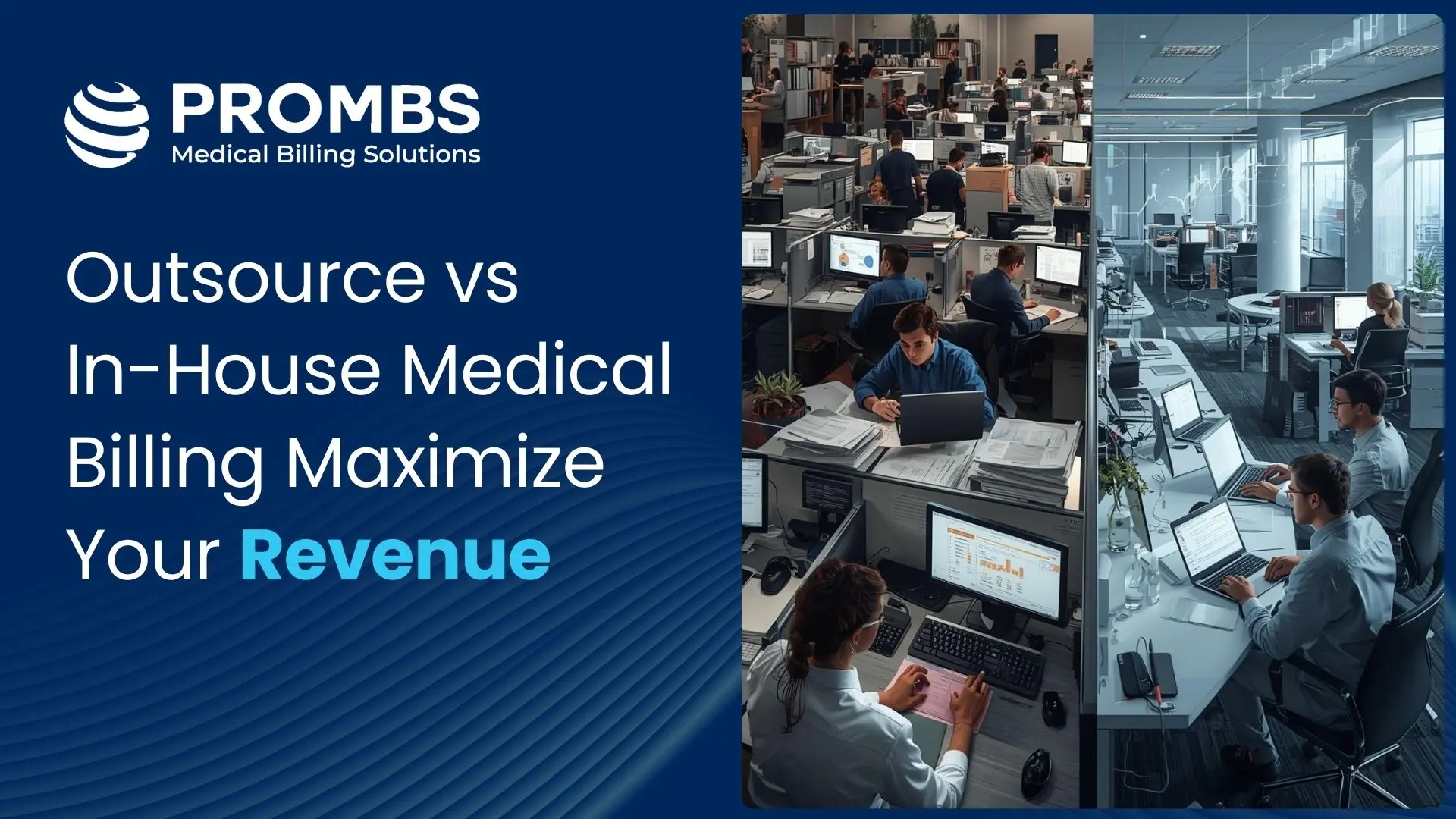
In the high-stakes world of modern medicine, medical billing isn't just an administrative task; it is the engine of your financial survival. When deciding between outsource vs in-house medical billing, you are choosing how to protect your revenue from coding oversights and documentation gaps that risk permanent denials.
Most private practices manage this roadmap through two distinct models:
- In-House Medical Billing
- Outsourced Medical Billing
Both models offer specific advantages and hard operational limits. To choose correctly, you must look past the surface costs and evaluate how each impacts your revenue, compliance risk, and the ultimate patient experience.
What Is In-House Medical Billing?
In-house medical billing is a localized revenue model where every stage of the billing cycle, from charge entry and coding verification to denial management, is performed by employees on your direct payroll.
Using your internal EHR/PM system, your staff handles the "heavy lifting" of payer communication and A/R follow-up.
- The Edge: This model offers tactical transparency. You have immediate, face-to-face oversight of billing workflows.
The Hidden Investment: "Control" comes at a premium. You are responsible for the constant overhead of staffing, specialized training, software licensing, and the high stakes of regulatory compliance management.
What is Outsourced Medical Billing?
Outsourcing is shifting from “Owning the staff” to “hiring the experts.” You partner with a revenue cycle management (RCM) firm that acts as an extension of your practice. They don’t just submit claims. They fight for your every dollar using scrubbing tools that most private practices simply cannot afford.
- The Financial Shift: You stop paying for "hours worked" and start paying for results. Most firms take a percentage of what they actually collect. If you don't get paid, they don't get paid.
- The Technology Edge: You get access to advanced AI-driven analytics and denial-prediction software without the massive upfront licensing fees.
The Comparison
| Operational Factor | In-House Billing | Outsourced Billing |
|---|---|---|
| Control | Full internal oversight of every click. | Shared oversight via transparent dashboards. |
| Staffing Costs | Salaries, benefits, and "The Turnover Tax." | Performance-based fee (you pay for results). |
| Technology | You buy, maintain, and update the software. | Partner provides enterprise-grade AI software systems. |
| Denial Management | Limited by the hours in your staff's day. | Handled by dedicated experts |
| Scalability | Growth requires hiring and more desk space. | Effortless; the partner absorbs the volume. |
| Expertise | Dependent on the individual biller’s memory. | High-level specialty coding professionals. |
Advantages of In-House Medical Billing
When your billing team is ten feet away, the results become much easier to achieve. In-house billing isn't just about "doing it yourself"; it's about the power of immediate, face-to-face clinical-financial alignment.
If you prefer to have your hands on the steering wheel, in-house billing offers a level of tactical agility that an external firm cannot match.
The Hallway Advantage
If a claim has a problem, you don’t wait for an email. You walk down the hall and talk to your biller. Having the provider, the medical records, and the biller in the same square footage creates a real-time feedback loop that kills errors before they're even filed.
Total Workforce Fluidity
Your billing staff is your employees’ first. On a slow billing day, they can pivot to front-desk support or patient coordination. You have the flexibility to deploy your team where they are needed the most.
The Patient Experience
There is a massive trust factor when a patient can discuss a bill with the same office that treated them. You maintain 100% control over the "patient experience," ensuring no one is ever treated like just another "claim number."
Absolute Data Security
You don't have to worry about how an outside company handles your data. Since everything stays on your local servers or within your specific EHR, you know exactly who is looking at your records and how they are being protected.
Tactical Oversight
You don't need a monthly report to tell you how your practice is doing. You can look at your "Accounts Receivable" at any minute. If you see a problem starting, you can pivot your team immediately to fix it.
Disadvantages of In-House Medical Billing
1. The Staffing Trap
In a small office, your billing is only as strong as the person sitting at the desk.
- The Turnover Tax: If your biller leaves, your cash flow stops. You then face the "hiring headache", spending weeks finding, interviewing, and training someone new while your unpaid claims pile up.
Overburdened Staff: Often, in-house billers are asked to help with phones or check-ins. When a biller is distracted, they make "human errors", simple typos or wrong codes that lead to instant denials.
2. The Expertise Gap
98.9% clean claim rates aren't an accident; they are an audit result. To hit that number, a biller needs to be an expert in the "rules of the game," which change almost every week.
- Limited Knowledge: One person simply cannot know as much as a dedicated firm that handles thousands of claims.
Poor Coding Habits: Without constant high-level training, staff often use "safe" codes that get paid but aren't accurate, or they repeat old mistakes that eventually trigger a painful audit.
3. The Hidden Overhead Drain
Keeping it in-house is a "fixed cost" graveyard. You pay for:
- Salaries & Benefits: Even in months when your volume is low.
- Office Space & Equipment: Computers, desks, and square footage that could be used for more exam rooms.
The Tech Ceiling: Most practices can't afford the $100k+ AI "scrubbing" tools that big firms use. This means you are stuck with slower, manual processes that delay your money.
4. Taking the "Doctor" out of the Physician
The most expensive con is lost time. Every hour you spend talking to your staff about a "denial report" or a "software glitch" is an hour you aren't spending with a patient. It shifts your focus from healthcare to "paperwork management," leading to burnout for both you and your team.
Advantages of Outsourced Medical Billing
When deciding between outsource vs in-house medical billing, you are choosing between being a "billing manager" or being a physician. Outsourcing allows you to maximize your revenue while you focus on your patients.
1. Turning "Fixed Costs" into Profit
Keeping your billing internal is often a "fixed cost" graveyard. You pay salaries, benefits, and software fees even if your patient volume is low.
- Pay for Performance: The outsource vs in-house medical billing debate often comes down to risk. Most firms charge a percentage of what they actually collect. If you don’t get paid, they don't get paid.
Cut the Overhead: You suddenly stop paying for office desks, billing software licenses, and the cost of hiring and training new staff every time someone quits.
2. Access to "The Specialist Tier."
Insurance companies change their "rules of the game" almost every week. An outsourced firm lives in these weeds, so you don’t have to.
- Fewer Errors: You get a room full of certified coders who handle thousands of claims. They spot patterns and errors that a single in-house biller would likely miss.
Liability Shift: When the firm handles your coding, they take on the responsibility for its accuracy. This lowers your personal liability for billing mistakes.
3. Enterprise Tech Without the Price Tag
In 2026, manual billing will be too slow to survive.
- AI Claim Scrubbing: In the world of outsource vs in-house medical billing, technology is the tie-breaker. Partners use high-end AI tools that "clean" your claims before they ever reach the insurance company.
Predictive Analytics: They use data from thousands of other doctors to warn you about new payer trends or denial patterns before they hit your bank account.
4. Scalability: Growth Without the Growing Pains
If your practice doubles in size tomorrow, an in-house model would require you to interview, hire, and buy more equipment.
Instant Expansion: An outsourced partner scales with you instantly. Whether you see 50 patients or 500, the system handles the volume without you needing to post a single "Help Wanted" ad.
5. Reclaiming the "Doctor" in Physician
The most valuable factor in choosing between outsourcing and in-house medical billing is time.
- Patient Focus: Your clinical staff stops chasing paper and starts focusing on the people in the waiting room.
Administrative Freedom: You no longer have to spend your evenings reviewing denial reports or managing billing staff conflicts. You get your life back.
Disadvantages of Outsourced Medical Billing
While shifting the workload away sounds like a dream, the outsource vs in-house medical billing debate has a "dark side." When you move your money out of your office, you are trusting a third party with your most sensitive data and your patient relationships.
1. The Loss of Control
When you keep billing in-house, you can see exactly what your staff is doing. With an outside firm, you lose that "over-the-shoulder" oversight.
- Invisible Workflows: You might not know if they are actually fighting difficult denials or just "skimming the cream" by focusing on easy claims to get their commission.
Reduced Flexibility: If you want to change how you handle certain billing tasks, you can't just tell your staff. You have to navigate the firm’s rigid policies and schedules.
2. The "Disconnected" Patient Experience
Your billing team is often the last point of contact for a patient. If that team doesn't share your office’s values, it reflects poorly on you.
- Cold Communication: A third-party representative might be rude or unhelpful when a patient calls with a question. Since they don't know the patient like your staff does, it can lead to frustration and a loss of trust.
Brand Confusion: Patients often get confused or suspicious when they receive a bill from a company name they don't recognize.
3. Data Privacy and Security Risks
In the outsource vs in-house medical billing comparison, security is a major factor. Every time you send data to an outside vendor, you increase the risk of a breach.
- HIPAA Compliance: You are legally responsible for your patients' data. If your billing partner has a security leak or isn't strictly following HIPAA laws, your practice faces fines and a damaged reputation.
Offshore Obstacles: Some firms use teams in different time zones. This can lead to massive communication delays and gaps in understanding how your specific local laws work.
4. The Hidden Fees
Outsourcing is often sold as a way to save money, but the costs can fluctuate wildly.
- Percentage-Based Costs: As your practice grows and you make more money, you pay the billing firm more. For a very successful practice, this fee can eventually be much higher than a staff member’s salary.
The Fine Print: Many contracts have fees for things like extra reports, sending patient statements, or even setting up new providers. If you don't read the contract carefully, your "cost savings" can disappear.
How Healthcare Practices Should Evaluate Their Billing Model
Choosing between outsourcing and in-house medical billing is a choice between owning the process or owning the results. Keeping it in-house gives you "The Hallway Advantage," where you can fix errors face-to-face and keep a personal touch with patients. However, you also own the "Hiring Headache," the software costs, and the risk of your cash flow stopping if a key staff member quits.
Outsourcing turns your billing into a performance-based engine where you only pay when you actually get paid. This frees you from managing staff and gives you access to high-end AI tools without the massive upfront price tag. The trade-off is a loss of direct oversight and a "Success Tax" that grows as your practice becomes more profitable.
The right decision depends on your "Revenue Vital Signs." If your current team hits a 95% clean claim rate and you enjoy the control, keep it in-house. But if you are growing fast and feel buried by administrative bloat, it is time to move to a specialized partner who can scale with you.
Why Healthcare Practices Choose ProMBS As A Medical Billing Partner
ProMBS turns the complex outsource vs in-house medical billing debate into a simple solution for your practice. We replace your administrative bloat with a high-speed revenue engine designed to capture every dollar you've earned.
Our Core Services
We handle the "paperwork" so you can handle the patients, providing a specialized team that manages your financial health from start to finish.
- Full Revenue Cycle Management (RCM): We manage the entire life of a claim, ensuring a steady flow of cash into your practice without the typical delays.
- Precise Medical Billing & Coding: Our certified experts use advanced "scrubbing" tools to catch errors before they reach the insurance company, preventing costly denials.
- Aggressive Denial Management: We don't just "receive" denials; we fight them. Our dedicated "experts" resolve complex rejections immediately to reclaim lost revenue.
Most practices are trapped by "The Turnover Tax", the endless cycle of hiring and training in-house staff. ProMBS breaks that cycle by giving you instant access to enterprise-grade technology and expert coders without the salary overhead. We turn your billing from a fixed expense into a performance-based asset that scales as you grow.
Frequently Asked Questions
Is keeping billing in-house actually cheaper for small practices?
Outsourcing is usually the more affordable path because it kills the "Turnover Tax." When you keep it in-house, you pay fixed salaries and benefits even in slow months. By choosing to outsource vs in-house medical billing, you switch to a model where you only pay a percentage of what you collect, giving you access to high-end AI tools you couldn't afford otherwise.
How does outsourcing change the way my patients feel?
A good partner acts like a professional extension of your front desk. While you lose that "hallway" chat, your patients gain a team of experts who can answer complex insurance questions instantly. This removes the "money talk" from your office, letting your clinical staff focus entirely on making the patient feel comfortable and cared for.
What are the real risks of moving to an outside partner?
The big fears in the outsource vs in-house medical billing debate are security and losing control. You are trusting a third party with your data, which means you must vet their HIPAA protocols carefully. You can solve the "control" issue by picking a partner that gives you a real-time digital dashboard so you can see your money moving 24/7.
Can a partner really get me paid faster than my own staff?
Usually, yes. Your internal staff is often busy answering phones or checking in patients, leading to "distraction errors." Professional firms employ coders who do nothing but study insurance rule changes. They use enterprise-grade "scrubbing" software to clean your claims before they go out, which slashes your denial rates and speeds up your cash flow.
When is the right time to make the switch?
You should move to an outside partner the moment you feel "administrative bloat" holding you back. If your denial rates are over 5% or if you are spending your evenings managing staff instead of seeing patients, you’ve hit the ceiling. When the headache of the outsource vs in-house medical billing struggle starts affecting your clinical care, it's time to outsource.
